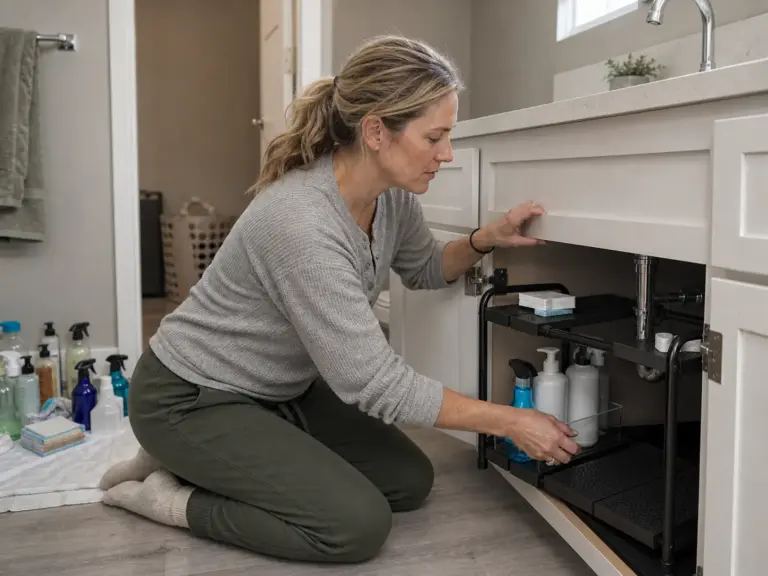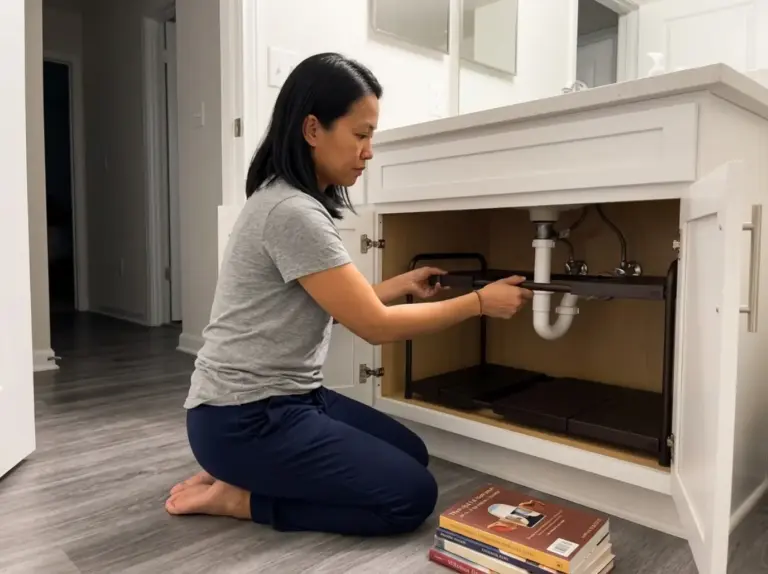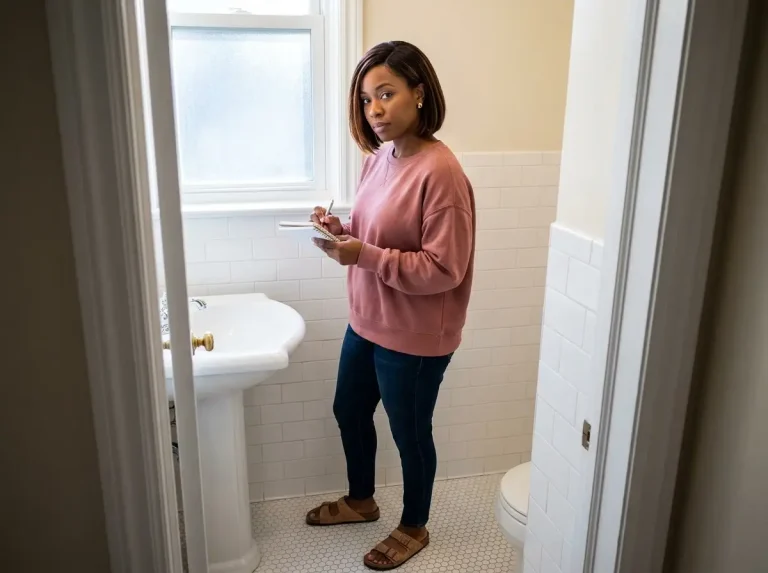
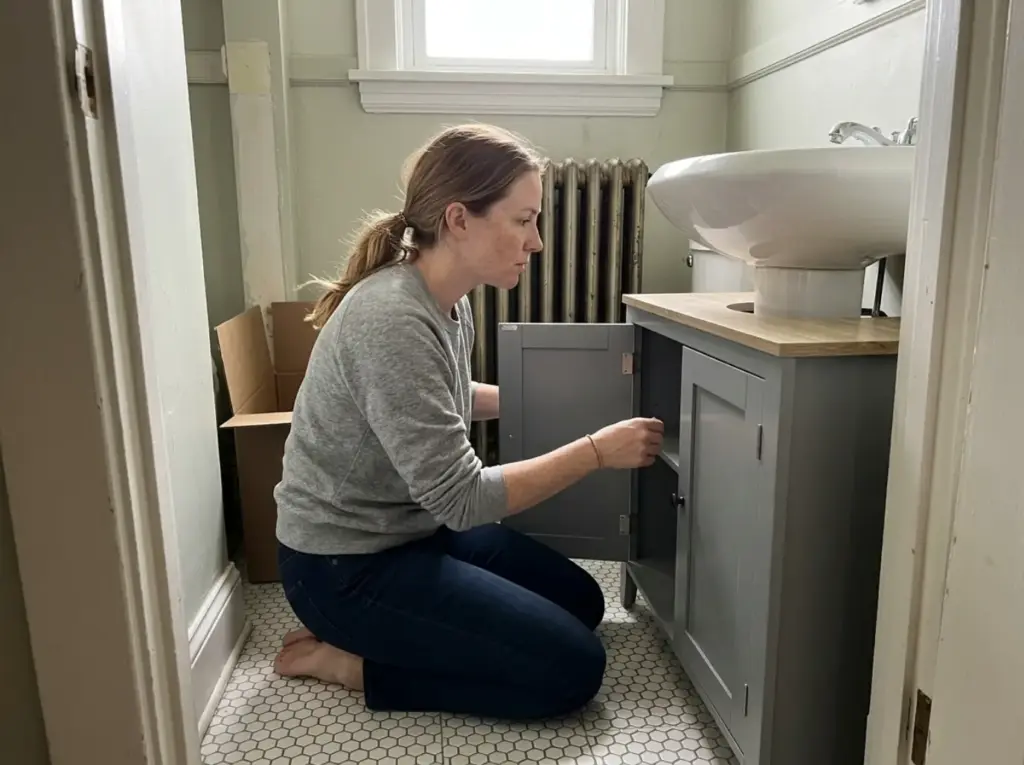
You didn’t pick the pedestal sink. It came with the apartment, and it looked fine right up until the backup toilet paper, the cleaning spray and the shampoo had nowhere to live but the floor next to the pipe.
Here’s the part nobody says out loud: pedestal sinks are disproportionately common in older buildings and rentals precisely because their compact footprint clears tight door swings a boxy vanity can’t. Under sink storage with a pedestal sink is a structural problem, not a decorating mistake you made. A no cabinet bathroom is what the building handed you.
What follows is a decision framework, not a product list. Every bathroom vanity alternative below works the same whether you’re solving apartment bathroom storage, tiny bathroom storage in a studio, or a historic home bathroom with original fixtures. Measure the floor around your pedestal first and the solution picks itself.
Quick Answer
Five solution types, sorted by how much usable floor space you actually have:
- Wrap-around cabinet with a U-shaped cutout: most floor space, hides the most
- Freestanding narrow or expandable unit beside the sink: you have a gap, not open floor
- No-drill medicine cabinet plus wall shelves: zero usable floor space
- Over-the-toilet organizer: supplemental, when the toilet sits close
- Sink skirt — cheapest full-coverage fix, half-baths only
Why a Pedestal Sink Leaves You With Nowhere to Put Anything
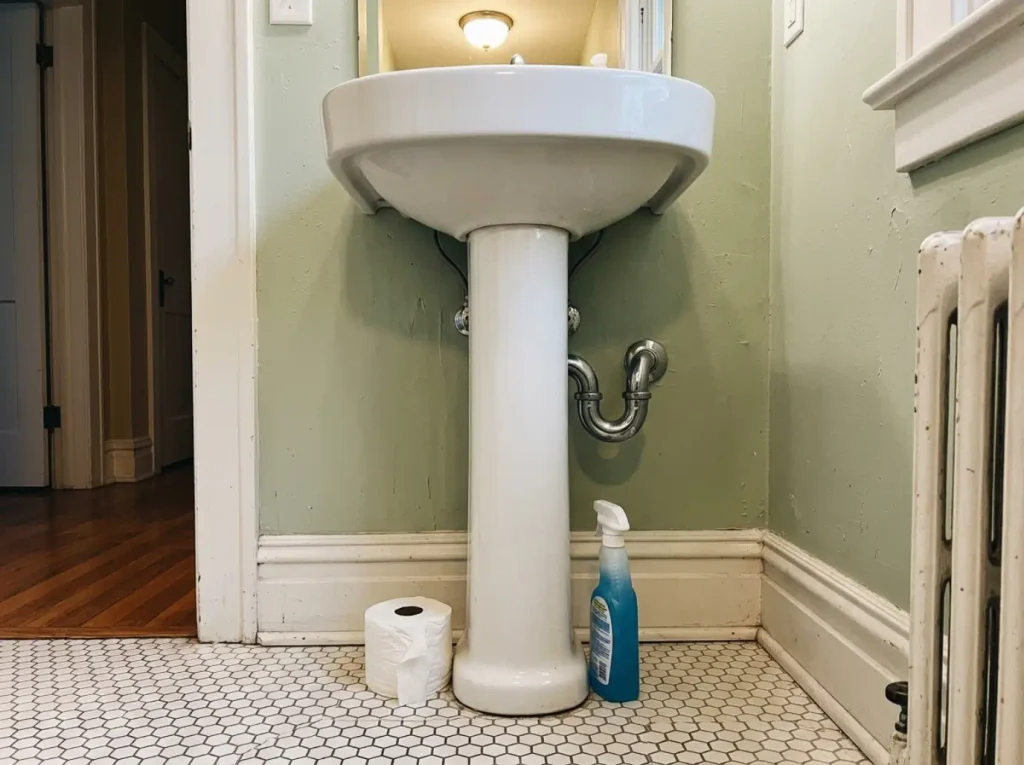
The usual framing is that you traded practical for pretty. That’s wrong twice over. Most people never chose the sink, and the real constraint of a no vanity cabinet setup isn’t the missing box anyway. It’s the porcelain column and drain pipe sitting exactly where furniture wants to go.
If you do have a vanity and landed here by accident, the full under-sink system for a bathroom that does have a vanity is the article you want. Everything below assumes there’s nothing under your sink but air and pipe.
The problem isn’t missing storage, it’s interrupted floor space
There is floor under your pedestal sink, usually a decent amount of it. The issue is that it’s interrupted by the column and the trap rather than absent, and almost no furniture is manufactured for interrupted space.
A bin that would slide under a vanity hits the pedestal base footprint and stops halfway. A narrow cart clears the base and bumps the P-trap. Every failed attempt lands the same way: a perfectly good storage unit sitting at an angle, door refusing to close.
Size compounds it. Standard pedestal sinks run 22 to 24 inches wide, per This Old House’s buying guide, with compact models as narrow as 19½ inches. That spread makes “fits most pedestal sinks” close to meaningless on a listing.
The three measurements that decide everything
Take a tape measure into the bathroom before you open a single product page. You need three numbers, and they take about ten minutes to get.
- Gap width on each side of the pedestal. Wall to column, on both sides. They’re rarely equal, and the narrower one is the one that matters.
- Trap protrusion. How far the P-trap sticks out from the wall at its deepest point. Measure to the front face of the pipe, not the wall behind it.
- Remaining floor depth. How much depth is left in front of the sink once you subtract the standing space you need.
That last one has a real number attached. The NKBA’s bathroom planning guidelines call for at least 30 inches of clear floor space in front of any sink, plus roughly 4 inches from the edge of a pedestal lavatory to the nearest wall.
So the honest test of any floor unit isn’t whether it clears the pedestal. It’s how much floor clearance is left in front of it. A cabinet that fits perfectly and turns your bathroom into a place where you shuffle sideways is not a fit.
What “clears the trap” actually means in inches
P-trap clearance is the detail competitors skip, and the one that costs people a return shipment. Drain lines sit 18 to 24 inches above the finished floor and supply lines run 20 to 22 inches. That band is where the plumbing lives. A wrap-around cabinet doesn’t just need a notch at the bottom for the column, it needs its back panel to accommodate that plumbing band, and the two are different problems.
Most people measure the pedestal base, feel confident and order. Then the back panel meets the trap at 21 inches and everything stops. Write down the trap protrusion number. It decides the next section.
Take a photo of the tape measure in place for each of the three measurements, not just the number. When you’re comparing listings a week later, the photo tells you where you measured from. The number in your notes app never does.
If all three measurements come back tiny, that’s information, not failure. In small bathroom storage the sink zone genuinely gives you nothing sometimes, and the nearest reclaimable vertical space is over the toilet.
The SONGMICS 3-Tier Bamboo Over-the-Toilet Storage straddles a standard tank at 66.9 inches tall, and its adjustable middle shelf is what lets it work over tanks of different heights. It’s supplemental, not a replacement, and it only helps if the toilet sits near the sink. But it borrows space you’re currently not using at all.
Wrap-Around Cabinets That Fit Around the Pedestal Base
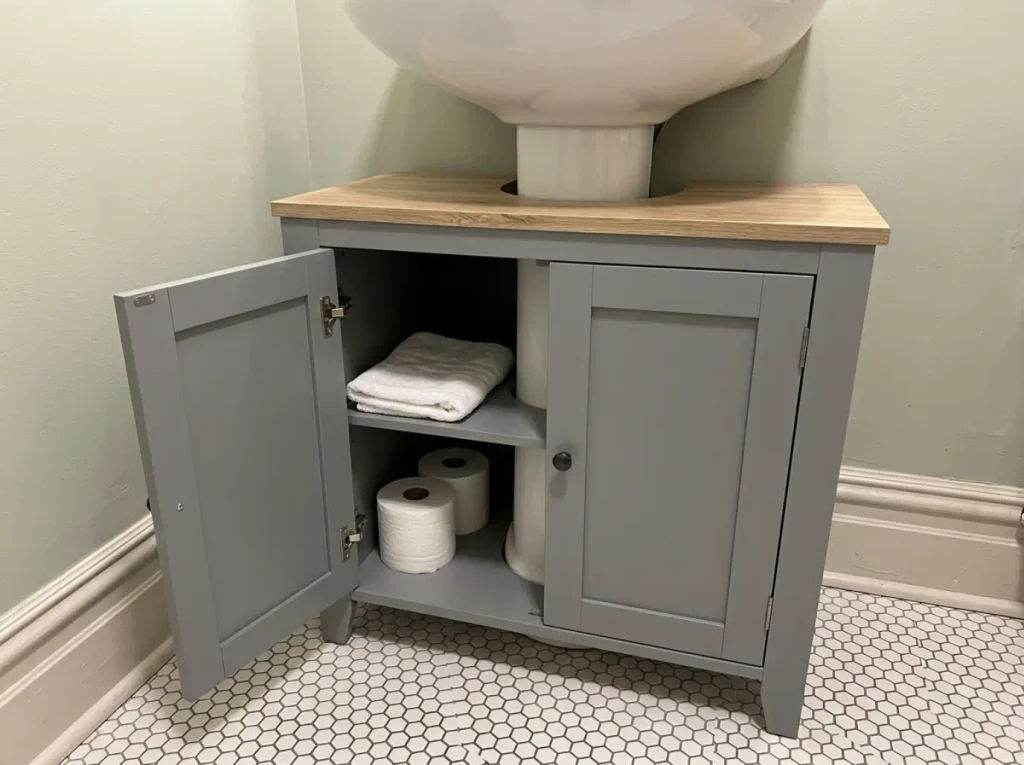
This is the solution everyone wants, because it’s the one that makes the sink look like it always had storage. It’s also the one that gets returned most, and the reason is boring. Nobody measures the trap.
How a U-shaped cabinet actually mounts
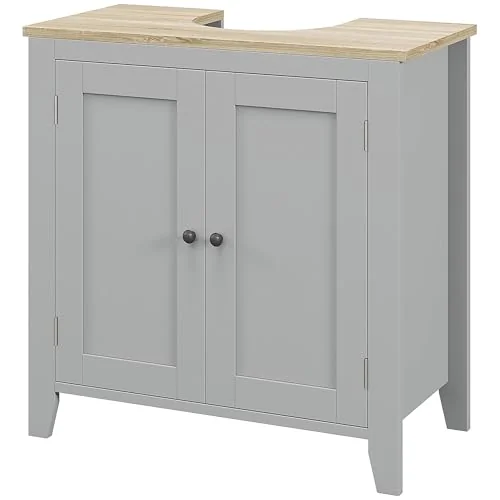
A wrap-around cabinet, called U-shaped in most listings and sometimes a fitted pedestal cabinet, is a floor unit built with a cutout so it sits around the pedestal column instead of beside it. Two doors, usually an interior shelf, and a notch carved out of the back and bottom for the porcelain and the pipe. Retailers file it under sink base cabinet alongside vanity boxes, which is why searching that phrase buries you in units built for a plumbing setup you don’t have.
The mounting surprises people. These typically attach to the porcelain lip with industrial-strength adhesive hook-and-loop strips, not screws into the wall, so they’re genuinely renter-safe. Stability then depends entirely on strip quality and a clean, dry lip. Wipe the porcelain with alcohol and let it dry fully first, or the strips let go in a month.
Be clear on one thing: you’re attaching the cabinet to the sink for positioning, not hanging weight from it. This Old House notes that a pedestal sink relies on wall-mounted blocking for support, not just the pedestal itself, so the fixture carries its own basin and not much else. The cabinet’s weight belongs on the floor.
The cutout measurement that decides whether it fits
U-shaped cabinets are commonly manufactured with a single precise cutout, often around 20cm by 8cm, sized for what somebody decided a “standard” pedestal is. Yours was not consulted. If the base or the trap protrudes past that cutout, the cabinet won’t sit flush, and once it sits proud the doors won’t close square.
The return-box story is the most repeated complaint across wrap-around cabinet listings: ordered online, arrived, cutout doesn’t clear the trap, repacked within the hour. That’s a measuring problem, not a brand problem. Compare your trap protrusion number against the listed cutout depth before anything goes in a cart. If the listing doesn’t state a cutout dimension, that absence is itself the answer.
When a wrap-around is the wrong shape entirely
Before you commit, one free move. Compare the gap beside your pedestal against the open space under the basin. If the side gap is wider, a wrap-around is the wrong shape for your bathroom and a narrow unit beside the sink will cost less, fit better and never involve a cutout. Don’t force the look.
What wrap-arounds do that nothing else here does is give you closed storage at floor level: doors, at exactly the height where dust and hair collect. That’s why this tier stays at the top despite the measuring risk. For how wraparound units compare to the rest of the under-sink organizer field, the broader roundup puts them next to the bins and pull-outs built for cabinets.
Freestanding Storage That Fits Beside the Sink
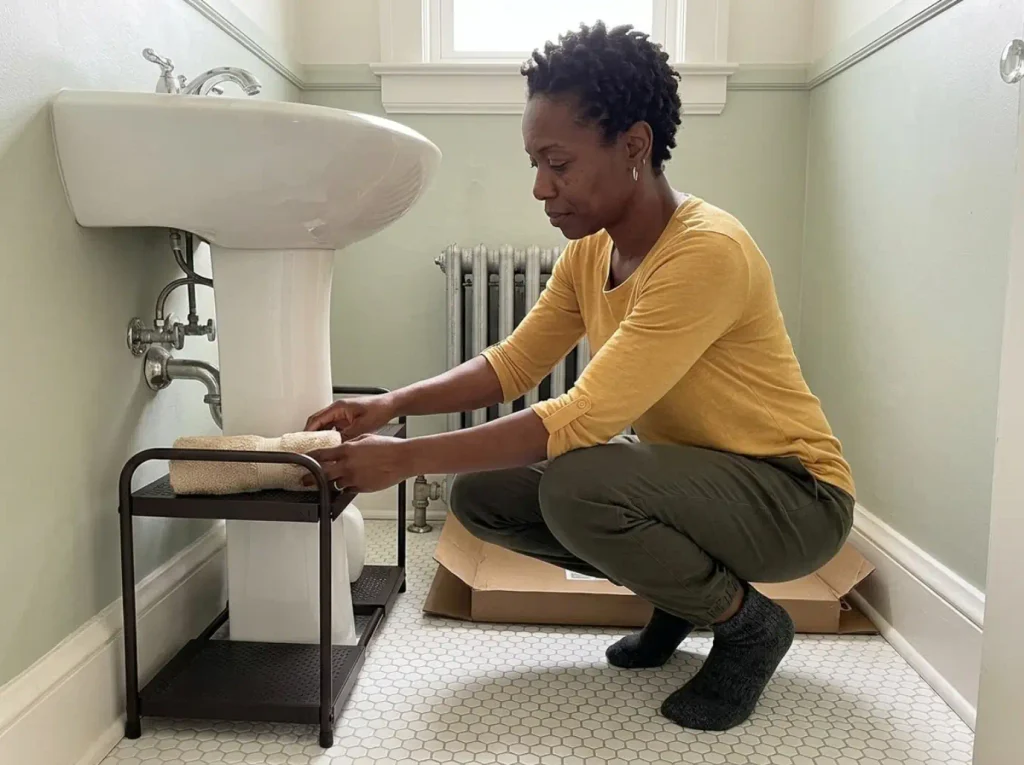
The gap beside a pedestal sink is usually narrow and awkward, so people leave it empty and stack things on the toilet tank instead. It’s the easiest win in the room.
Why the gap beside the sink is easier than the space under it
This tier is forgiving in a way the last one isn’t. A freestanding cabinet or rack standing beside the sink has to clear exactly one dimension: width. No cutout, no trap protrusion, no adhesive on porcelain.
If it’s narrower than your gap, it fits. That’s the whole test.
Expandable units for gaps that aren’t a standard size
The gap between a pedestal and the wall is almost never a size furniture is manufactured in. It’s 11 inches, or 14, or some number sitting between two product sizes and matching neither. Expandable-width organizers exist for exactly this.
The SimpleHouseware Under Sink 2-Tier Heavy Duty Expandable Organizer adjusts its width to bridge an odd gap without needing any pedestal-specific shaping. It’s a wire rack, open on all sides, so anything you want kept dust-free goes on it in closed storage bins.
I used to send people straight to a narrow cabinet for this spot. What changed my mind is how consistently the odd-gap complaint shows up: someone buys a 12-inch cabinet for a 14-inch gap and resents those two dead inches every time they walk past. Expandable solves the measurement problem instead of hoping it goes away.
In a small bathroom, height beats width every time. A narrow unit that goes up buys more storage than a wide one that stays low, and it keeps that 30 inches of front clearance intact. Look at what’s above your knee before you look at what’s beside your foot.
Worth naming even though it isn’t a pick here: IKEA’s bamboo shelf lines for sinks, RÅGRUND and BJÖRKÅN, get called out across multiple sources as purpose-built for sitting around a pedestal base. They aren’t on Amazon, so they aren’t a recommendation in this article.
What actually belongs on a low open shelf
Two-tier shelving puts the lower tier at floor level, where dust and hair settle. Plan for it rather than discovering it.
Backup toilet paper in a closed bin belongs there. Extra towels, or lidded storage baskets, belong there. Anything with an opening you’ll later put against your face does not.
The renter angle here is simple: this is removable storage in the truest sense, nothing touches a wall, so nothing can cost you a deposit. If this is one zone of a bigger problem, the wider system for a bathroom with no cabinets anywhere covers the whole room.
Wall Storage When the Floor Is Already Spoken For
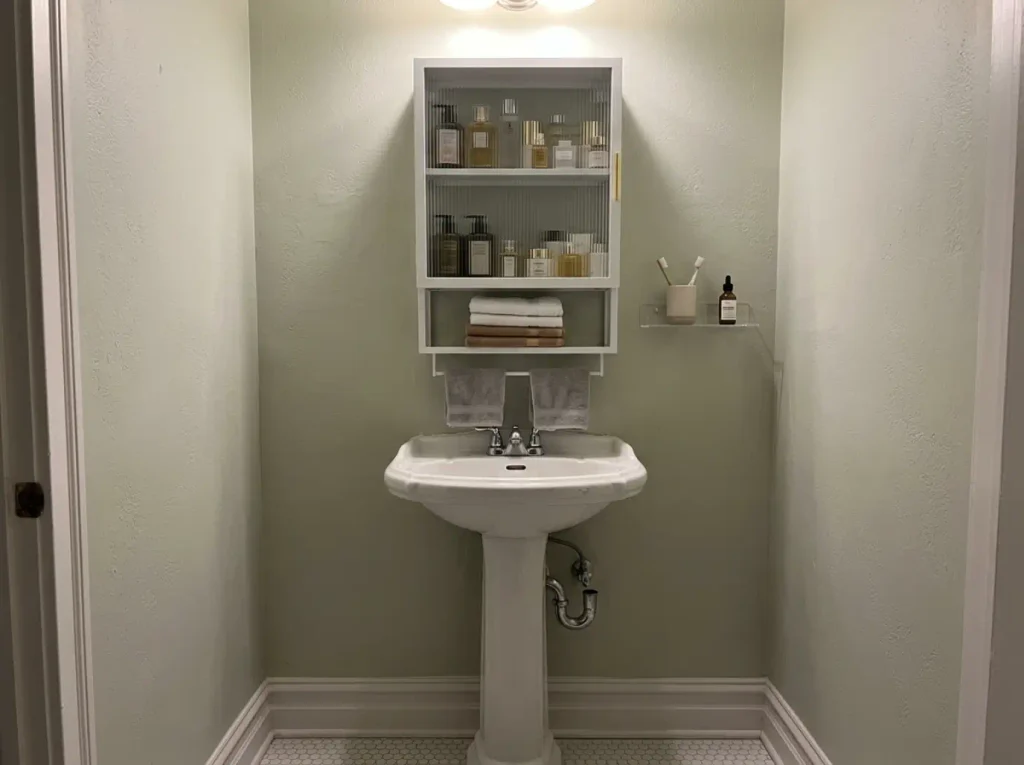
In a lot of older bathrooms the honest answer is that the floor is finished. There isn’t a solution down there. That sounds like bad news and mostly isn’t.
When the floor is finished and you stop looking down
Run the numbers from the first section once more. If 30 inches of front clearance plus the door swing consumes the room, a floor unit makes the bathroom worse even while it adds storage. You gain shelf space and lose the ability to dry off without bumping into something. People make that trade constantly, then quietly move the cabinet to the hallway six weeks later.
Look up instead. The vertical wall space above a pedestal sink is usually empty, because these sinks rarely ship with a mirror cabinet the way a vanity setup does. Nobody is competing with you for wall-mounted storage there.
There’s a constraint here almost nobody mentions, and it applies even if you own the place and can drill freely. A pedestal sink relies on wall-mounted blocking screwed between the studs to carry the basin. So the stud bay directly behind or beside your sink may already be occupied, and you can’t assume open stud access where you’d most want it. Check with a stud finder before planning anything heavy.
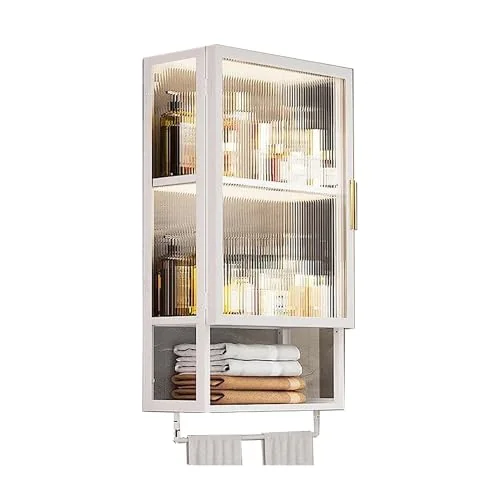
No-drill cabinets and what they can actually hold
Which is why no-drill storage deserves better than treatment as the renter consolation prize. These mount without touching a stud, and on this particular wall renter-friendly storage is an advantage as much as a compromise.
But “no drill” does not mean “no weight limit.” Adhesive mounting is rated for lighter loads than stud-anchored hardware, and overloading is the most common way these fail within a few months. The failure isn’t gradual either. An adhesive mount holds and holds and then doesn’t, usually at an hour when everyone is asleep. Read the stated per-shelf limit, load to about two-thirds of it, and leave the margin alone.
Open shelves for the two or three things you reach for daily
Closed storage for anything you don’t want to dust weekly. Open shelves for the two or three items you reach for every day, and nothing else. The moment an open shelf holds five things it stops being storage and starts being visual noise.
Load discipline is the whole game up here. Glass bottles, full backup shampoo, anything with real mass belongs in the floor tier or behind a cabinet door.
An adhesive shelf holding a toothbrush cup and a face cream is fine indefinitely. The same shelf holding three full bottles is a countdown. With that established, the 2-Pack No-Drill Acrylic Wall Shelves suit this job: clear acrylic disappears against a painted wall, which matters when every solid object in a small room reads as bulk, and the no-drill mount keeps the deposit intact. Light daily items only.
For a wider comparison of which no-drill floating shelves actually hold up in a bathroom, the shelving roundup goes deeper on materials and mounting.
Renter-Friendly Picks and What Breaks After Three Months
Every pedestal sink article ends at the after photo. The interesting part starts later: the skirt whose adhesive relaxes in a humid room, the open floor storage that turns into a dust collector because there’s no door, the shelf that gave up because somebody put the shampoo on it.
The budget ladder, stated plainly. Cheapest full coverage is the sink skirt, and the middle rung is the expandable organizer and the acrylic shelves.
At the top, the splurge cabinet is the wrap-around or the no-drill medicine cabinet, depending on which way your measurements went. A budget-friendly cabinet lower down the ladder isn’t wrong, though. They answer different questions.
The cheapest fix that actually works, and where it doesn’t
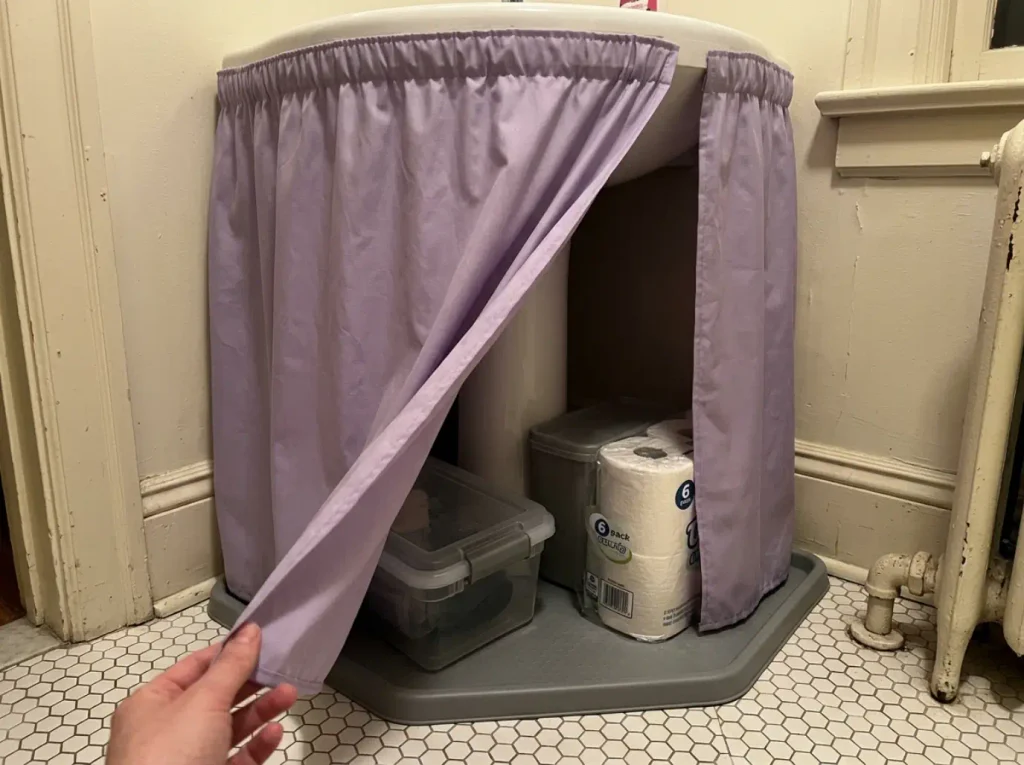
A sink skirt is a fabric panel that attaches around the basin and hides everything stored on the floor beneath it. No rigid furniture, no cutout, no measuring the trap.
The limitation comes first, because it decides whether you should buy one at all.
Skirts suit low-humidity spaces: half-baths, powder rooms, guest baths with no shower. In a full bath with weak ventilation, mold-prone fabric hanging at floor level is a problem waiting for a warm week, which is why humidity-safe materials like acrylic, coated metal and sealed plastic carry the rest of this article. Even in the right room the adhesive backing tends to relax over the first few months, which reviewers handle by reinforcing the strip with hot glue or super glue. Plan on re-securing it once and it becomes routine maintenance instead of a disappointment.
If your bathroom passes both tests, the Sink Skirt Bathroom, Self-Stick Adhesive Waterproof Fabric covers 55 by 32 inches, enough to wrap a standard pedestal with fabric to spare for trimming. It hides bins, not clutter. What goes behind a skirt should still be in containers.
And dust is the cost of the open tier. Anything on the floor under a pedestal sink without a door gets dusted by the room, faster in a bathroom than anywhere else because of hair. That’s the real closed storage vs open storage trade, and dust accumulation open shelving invites is the half nobody photographs. It reads as visual clutter long before it reads as dirt.
The fix isn’t more shelving. It’s hidden storage: closed bins inside the open space, which turns exposed mess into concealed clutter you never look at.
Protecting the floor under an open pedestal
Under a vanity, the cabinet base absorbs condensation and slow drips. Under a pedestal, nothing does. The pipe sweats, a fitting weeps a little, and the water lands on your flooring or on whatever bin you parked there. Nobody notices until there’s a mark in the tile grout or a soft spot in the vinyl.
A tray solves it cheaply. The TRZZ Waterproof Under Sink Mat runs 34 by 22 inches, and the raised edge is the part that matters: a flat mat spreads a drip around, a raised edge holds it until you notice.
Put a folded paper towel on the mat under the trap for a week. If it comes up damp and you never spilled anything, you have a slow drip, not condensation. That’s a plumbing call, and catching it at the paper-towel stage is a great deal cheaper than catching it at the flooring stage.
The free moves to make before you buy anything
Two moves cost nothing and both get skipped. A basket or tray on the back of the toilet tank absorbs the daily items currently living on the sink rim. Hooks on the back of the bathroom door take robes, towels and the bag you keep meaning to put away, and a tension rod across the space under the basin hangs spray bottles clear of the floor for pocket change. Between them they often clear enough that the storage problem shrinks to something one product solves instead of three.
Do those first. Then look at the rest of the renter-safe bathroom storage playbook if you’re working around a deposit, and check which over-toilet shelves hold up if the toilet zone is where your space actually is.
Behind every no-drill recommendation here sits the same hardware question. The Command Bath Large Water-Resistant Adhesive Strips come 16 to a pack and are built for the humidity cycle a bathroom puts adhesive through, which standard indoor strips are not. Buy the water-resistant version. In a room that goes from steamy to dry twice a day, the regular ones are a false economy.
Bringing It Together
Measure three things before you open a single product page: the gap on each side of the pedestal, how far the trap sticks out from the wall, and what floor depth survives after 30 inches of front clearance. The measurement picks the solution, not the other way around.
Then match the tier to the number. Open floor under the basin means a wrap-around cabinet. A usable gap beside it means a freestanding or expandable unit. Nothing left means you go vertical, which is a real answer and not a failure.
And whichever tier you land in, closed beats open at floor level in a bathroom every time.
In three months, press the adhesive strips back down, look under anything fabric for mildew, and empty the floor tier once to see what’s collecting there.
Take the tape measure into the bathroom before you open a single product page. Ten minutes of measuring is what separates the cabinet that fits from the one you repack.
Frequently Asked Questions
01What can you put under a pedestal sink for storage?
A wrap-around cabinet with a U-shaped cutout is the only furniture built to sit around the pedestal column itself. If the floor space is narrow or already spoken for, a freestanding unit beside the sink, a sink skirt hiding closed bins, or wall storage above it all work. The measurement decides which.
02Can you put a cabinet around a pedestal sink?
Yes, and they are sold specifically for it, but the cutout has to clear both the pedestal base and the P-trap, which is where most of them fail. Measure how far the trap protrudes from the wall before ordering, because a cutout sized for a standard pedestal will not sit flush against an unusually deep one.
03How do you hide storage around a pedestal sink without buying a cabinet?
A self-adhesive sink skirt is the cheapest full-coverage option, hiding everything stored on the floor without any rigid furniture. Keep it to a half-bath or a bathroom with a working exhaust fan. Fabric near the floor in a humid full bath is a mildew risk, and the adhesive tends to relax within the first few months either way.
04Can renters add storage to a pedestal sink bathroom without drilling?
Every tier in this article has a no-drill path. Wrap-around cabinets attach to the porcelain sink lip with adhesive hook-and-loop strips rather than the wall, freestanding units touch nothing at all, and no-drill wall cabinets and acrylic shelves mount with adhesive strips. Just respect the lower weight limits that come with them.
05Why do pedestal sink storage cabinets get returned so often?
Two reasons, both fixable with a tape measure. The cutout does not clear the pedestal base or the trap, so the doors will not close. Or the cabinet was sized for a standard 22 to 24-inch sink and the buyer has a compact model closer to 19½ inches. Measure your own sink before ordering, not the one in the listing photo.
Disclaimer: ClutterlessNest is a participant in the Amazon Services LLC Associates Program. As an Amazon Associate we earn from qualifying purchases. This article may contain affiliate links — if you buy through them, we may earn a small commission at no extra cost to you. We only recommend products we have tested or genuinely believe in.