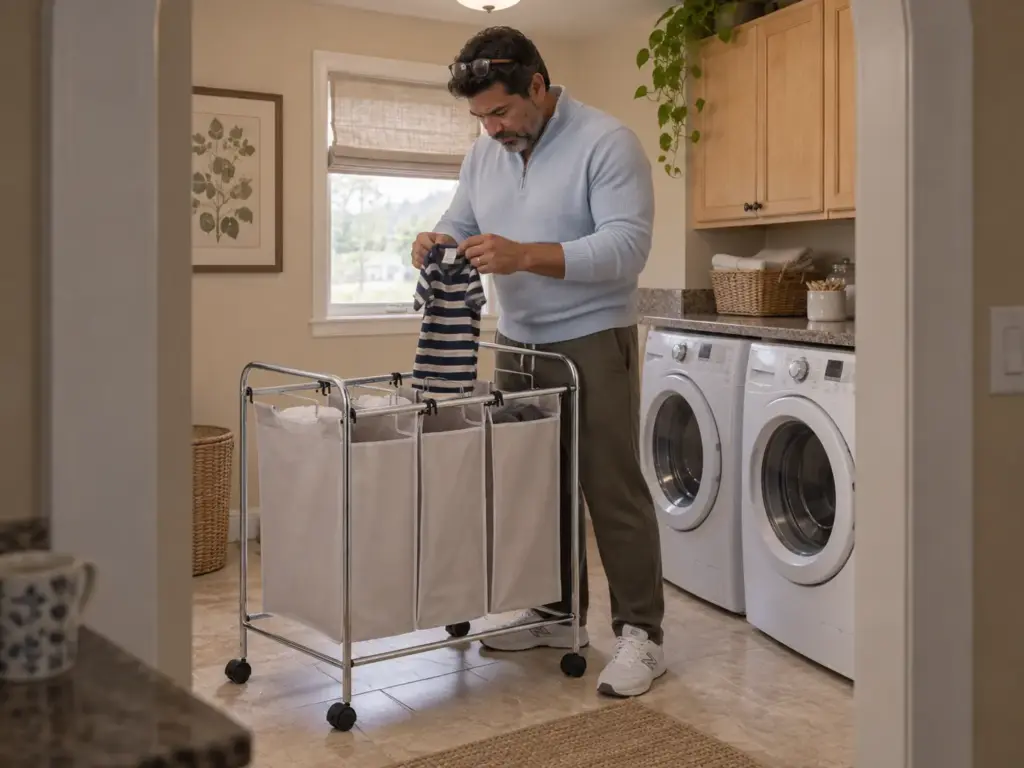
You bought the sorter, it worked for about two weeks, and now there is a chair in the bedroom wearing every shirt that wasn’t quite dirty enough to go in it. The fix is almost never a nicer sorter. The laundry sorting system ideas that last share three traits, and the pattern shows up again and again in organizing threads: the sort happens at drop-off, each bag holds roughly one real wash load, and the in-between clothes have somewhere to go that isn’t furniture. Below are the physical setups worth copying, each with a no-drill version next to the drilled one, plus the actual sizing numbers for the bags.
Quick Answer
The sorting systems that keep working are matched to the space they live in:
- Freestanding 3-bag frame: the no-drill default for most laundry rooms
- Tension-rod or existing-hook bag rail: the wall-mounted look without holes
- Rolling multi-bag cart: shared homes and building laundry rooms
- Corner, gap or in-cabinet sorters: tight laundry closets
- A separate hook for worn-once clothes: the piece that keeps any system from reverting
Why Most Laundry Sorting System Ideas Stop Working
Your sorter didn’t fail because you lack discipline. It failed because it asks for a sorting decision at the worst possible moment: late at night, one sock in hand, too tired to care whether the gray tee counts as a light or a dark. Any laundry sorting system that depends on good decisions at that hour drifts back to the floor. The ones that survive make each decision so small it costs nothing.

The One-Basket System Sorts Nothing
A single laundry basket doesn’t sort anything. It postpones the sort to wash day, and on wash day the pile is mixed and knee-high, so you either spend twenty minutes pulling it apart on the floor or give up on trying to sort laundry at all and wash everything together. So the basket slowly becomes a pile with a rim.
A shared-bedroom couple in r/organization described the arc exactly. Their clothes worn once or twice went into one basket on the floor, and the laundry basket system wasn’t working: it was “hard to sort through and ends up overflowing a bit.” The fix is moving the sort to drop-off, one item at a time, when choosing the left bag over the right bag takes half a second.
The “Worn Once” Pile Has No Home
The most repeated failure in laundry threads isn’t about dirty clothes. It’s the jeans you wore once: not dirty enough to wash, not clean enough to fold back into the drawer. One r/organization poster described a room “slowly becoming draped in clothing items,” and that’s precisely where those jeans end up.
Most sorting systems offer two states, dirty and clean, for what is really a three-state problem. The third state has no container, so it claims the nearest flat surface: the chair, the end of the bed, the top of the dresser. And once three worn-once sweaters sit on the chair, the fourth lands there too, because the chair is now the system. The fix comes later in this article, and it costs one hook.
What a System Needs to Survive a Month
The usual reflex after a failed basket is a bigger basket, or a prettier sorter with more compartments. A bigger basket just moves the same wash-day pile a week later, and extra compartments add decisions at the exact moment you have the least patience for them.
What matters is three conditions, and a system missing any one of them slides back to a floor pile within a month. First, sorting happens at drop-off, never on wash day, so there’s no big mixed pile to face. Second, each bag holds roughly one wash load, which turns “the bag is full” into “wash it” with no calendar and no judgment call. Third, the in-between clothes have a fixed spot, and that spot isn’t the chair.
Every idea below is some physical version of those three rules. Pick the one that fits your room.
Size the Bags Before You Pick a Sorting System
Most people choose a sorter from the photo, and the size bites them one of two ways. Bags that are too small fill by Wednesday and spill over, so you run half-loads just to keep up. Bags that are too big let clothes sit for two weeks, and by then the damp gym towel at the bottom smells like a basement. Size backward from your washer instead, and the bag tells you when to do laundry.
Match Each Bag to One Wash Load
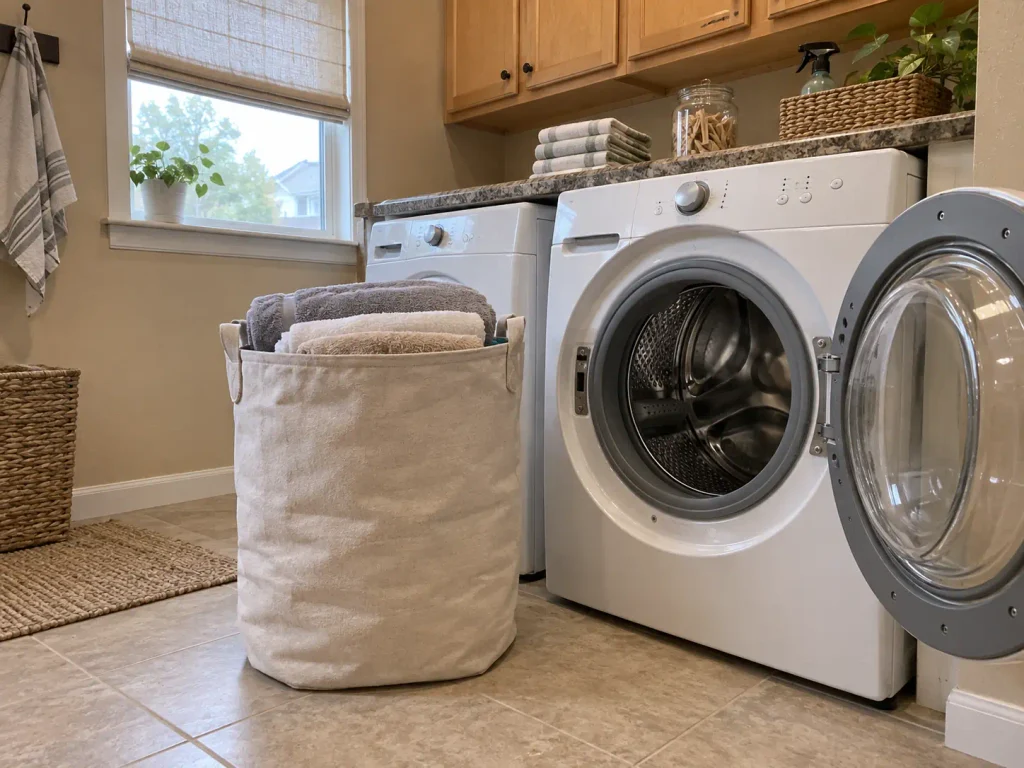
Start with the drum. Top-load washers run roughly 3.1 to 4 cubic feet, and front-loaders roughly 4.2 to 5 cubic feet. A typical 3-bag frame sorter gives you bags of roughly 8.6 to 10 gallons each, about 1.2 to 1.3 cubic feet (one cubic foot is about 7.5 gallons).
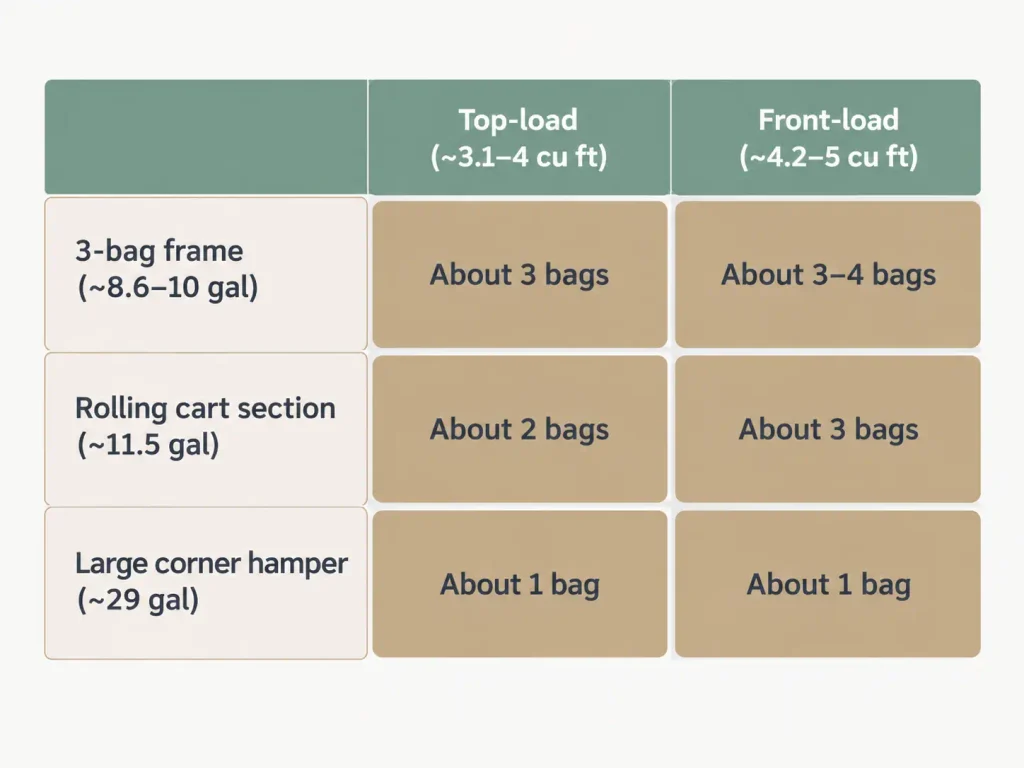
On paper that looks like a mismatch, but a hamper bag gets packed tight while a drum is loaded loosely so clothes can tumble. In practice, a full frame-sorter bag is roughly one small load. In a large front-loader, two full bags of compatible streams (darks and jeans, say) make roughly one normal load. None of this is precise, since towels compress differently than T-shirts, but it’s close enough to plan with.
The rule to keep is short: full bag, wash it. If one bag never fills within a week, that stream doesn’t need its own bag. Merge it with its nearest neighbor.
Hook Spacing and Rail Length
If you’re building a hanging version, the spacing math matters more than the hardware. One widely shared DIY build used a 44-inch rail with six hooks at 8-inch spacing, two hooks per bag, mounted 36 inches off the floor. Those numbers fit that one room, but they turn into a rule you can reuse anywhere.
Rail length is roughly the number of bags times the bag width, plus a couple of inches at each end so the outer bags don’t scrape the wall. Hooks go at the bag’s own grommet or loop spacing, not at a round number that looks tidy. Mount height is whatever lets the bottom of the bag clear the floor by a few inches when it’s full.
“When it’s full” is doing all the work in that sentence. A canvas bag stretches as it loads, and a bag packed with towels hangs noticeably lower than the empty one you held against the wall to mark the spot. You find out on the first heavy week, when the towel bag is resting on the floor.
Fill one bag with bath towels, hang it from a door hook, and measure from its lowest point to the top of the hook. Add a few inches of floor clearance to that number and you have your rail height. An empty bag will lie to you by several inches.
How Many Bags, Not How Many Categories
The conventional advice is to sort by the care labels: whites and colors split further into lights and darks, plus delicates, towels, maybe a separate bag for work clothes. In practice, most households need three bags, and cutting categories is what makes a system stick. Every extra bag is one more decision at drop-off and one more half-empty sorting stream on wash day. One parent in r/organization only got a system working after cutting nine sorting categories down to six (that setup comes up again in the rolling-cart section).
Which three depends on who lives with you, and working out how many laundry streams your household actually needs deserves its own walk-through. For hardware, you only need the number: three bags means a 3-bag frame, a three-section cart, or a rail with six hooks.
The Wall-Mounted Multi-Bag Sorter, With and Without Drilling
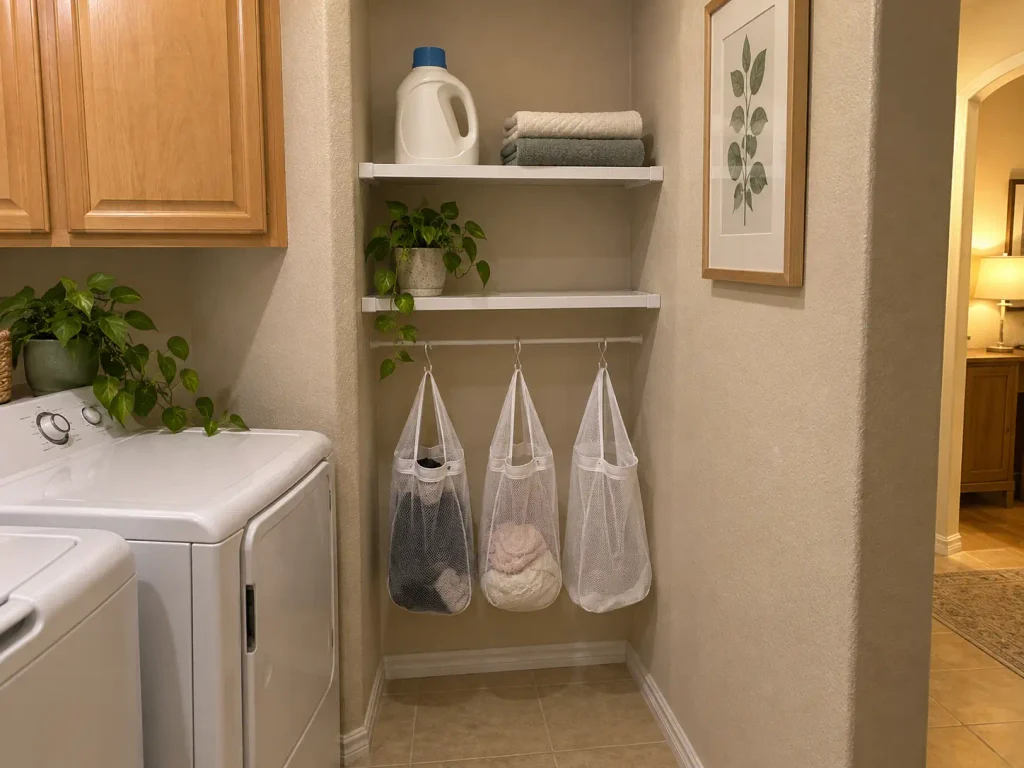
The hook rail with a row of canvas laundry bags is the wall-mounted sorter everyone saves, and almost every version of it asks you to drill into studs. If you rent, or you just don’t want holes behind the washer, you can still get the same result. Here it is four ways, cheapest first.
The Zero-Cost Version With Hooks You Already Own
Start with what’s already on your walls and doors. An over-door hook rack, a coat rack, a towel bar beside the machines: any of them can carry bags. You don’t need a sorter to sort, just three bags and something to hang them from, and old reusable totes or dollar store bins work fine for the main streams.
The cheapest working rig in r/organization was a pack of mesh bags and a dollar-store cup hanger, pocket change for the pair. The poster labeled a tag for each bag ahead of time, and the whole point of the thread was no more lost socks. It worked because each small item went straight into its own bag the moment it came off.
A set like the BAGAIL Mesh Laundry Wash Bags (Set of 5) is the literal zero-tool component: hang each one from a hook you own, and the mesh bag is the sorting bag and the wash bag at once. The limit is size: they hold delicates, socks and baby clothes, not a week of towels. Use them for the small streams and let the totes carry the loads.
The Tension-Rod Rail for Renters
If your machines sit in an alcove between two walls, a tension rod turns the drilled rail into no-drill laundry storage. It spans the gap with pressure alone, S-hooks carry the bags, and when you move out, it comes with you.
The Home in Bold Tension Rod Shelving expands to fit the alcove and locks in with tension, giving you a no-drill second rail or a shelf for detergent above the bags. It needs two solid, parallel walls to press against, so an open-sided laundry corner won’t hold it.
Be honest with yourself about the load, too: a tension setup is made for light, even weight. Hang bags you empty often, not three bags of wet towels, and follow the manufacturer’s instructions for fit. For the rest of the closet, the same logic applies to organizing a laundry closet without drilling.
S-hooks on a smooth rod drift together every time you yank a bag off, until all three bags are bunched at one end. Wrap a hair tie around the rod on each side of every hook. They stay put, and the bags keep their spacing.
The Freestanding Frame (No Wall at All)
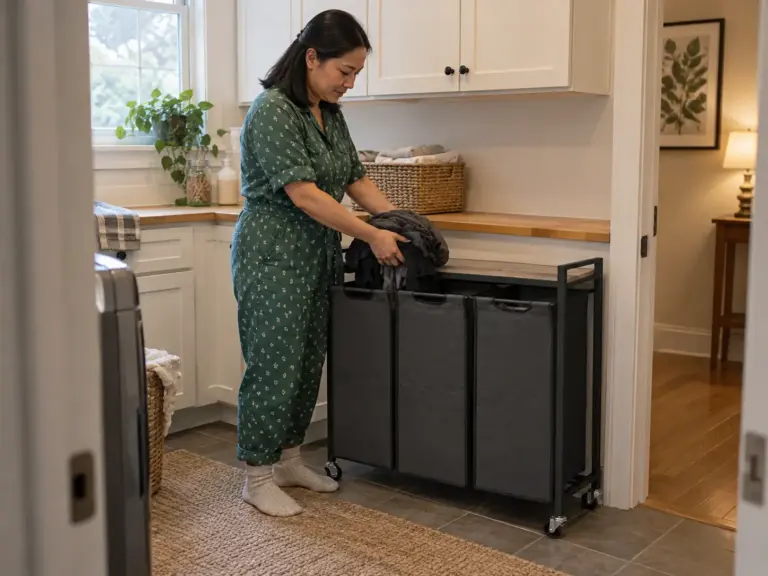
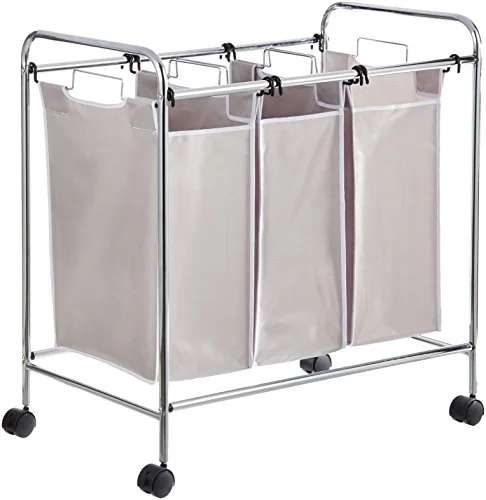
No wall, no rod, no hooks: just a metal frame with three removable bags. For most laundry rooms this is the right default. Well, for most laundry rooms with a few square feet of floor to give up, because nothing touches the wall and the only measurement is floor space.
The feature that matters is removable bags. A fixed-bag sorter makes you scoop armfuls out and carry them to the machine, dropping a sock in the hallway on every trip. A bag that lifts off goes to the washer whole and comes back empty. The trade-off is footprint, roughly a small side table’s worth of floor.
The Amazon Basics 3-Bag Laundry Sorter is the plain, budget-friendly version, with bags right in the one-bag, one-load range.
The Drilled Hook Rail (If You Own the Wall)
If you own the place, a board rail screwed into studs is the sturdiest version of all of this, and it’s the one that will still hold three packed bags years from now. Into studs, not into drywall alone. A stud finder and the hardware maker’s instructions handle the rest.
Adhesive hooks and Command strips are where this idea usually goes wrong, so here are the numbers. Command’s standard Large Hook is rated for 5 pounds and its Heavy Duty hook for 15.
A canvas bag packed with bath towels can blow past the first number and creep up on the second, and it gets yanked every time someone pulls a shirt out. Adhesive hooks are fine for a mesh bag of socks. They aren’t a rail.
Studs for the bags. Adhesive for the socks.
Corner, Gap and Cabinet Sorters for Tight Laundry Closets
Good laundry closet organization starts from four spaces nobody uses: the corner, the gap beside the machines, the cabinet under the counter, and the machine itself. Each takes a different kind of sorter (shelves and clearances live in small laundry room storage; this is only about where the sort goes).
The Corner Sorter
A rectangular bin pushed into a corner leaves a wasted triangle of floor behind it. A triangular hamper fills that triangle. The Triangular Mesh Laundry Hamper with Wheels holds roughly 29 gallons (110 L), about three frame-sorter bags’ worth in one footprint. That’s the appeal and the limit: one big compartment suits a single high-volume stream, usually towels or the kids’ clothes, not three.
The Gap Between the Machines
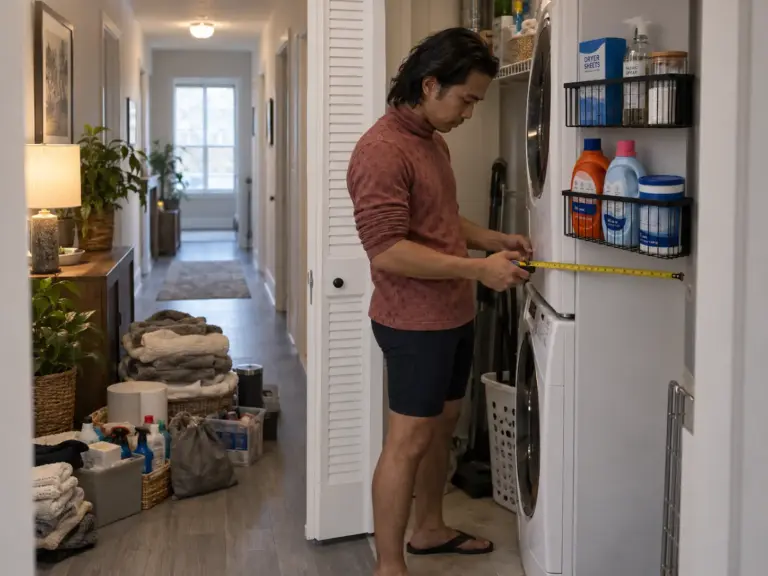
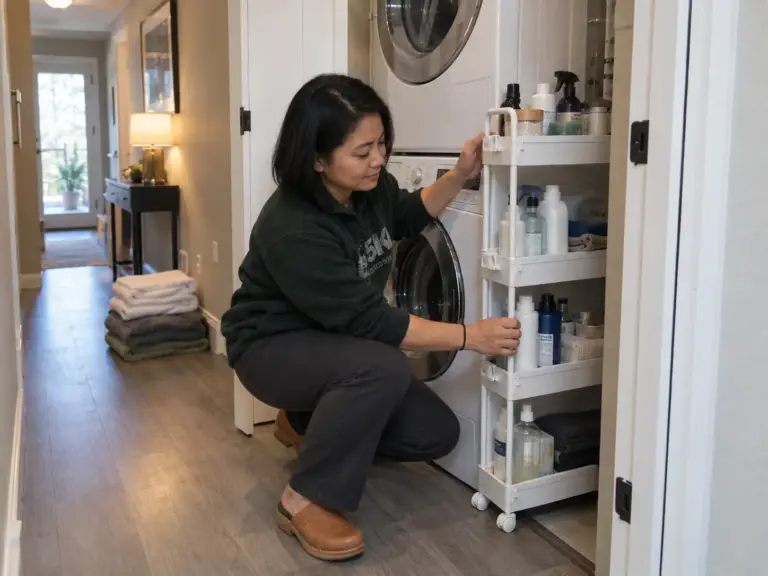
NAPO’s Greater Philadelphia chapter suggests a narrow rolling cart between the washer and dryer for small items. A sorter is a harder ask. One r/organization poster with about 8 inches beside the machines in a stacked washer dryer closet wanted “a few hampers for different types of dirties, probably at an angle of some sort,” and never found anything that fit.
The honest answer: under about 8 inches, the gap takes a slim single-stream bin or a pull-out cart, not a multi-bag sorter. At that point width is the whole question, and these slim hampers sized for narrow gaps are measured for it.
The Sorter Hidden in a Cabinet
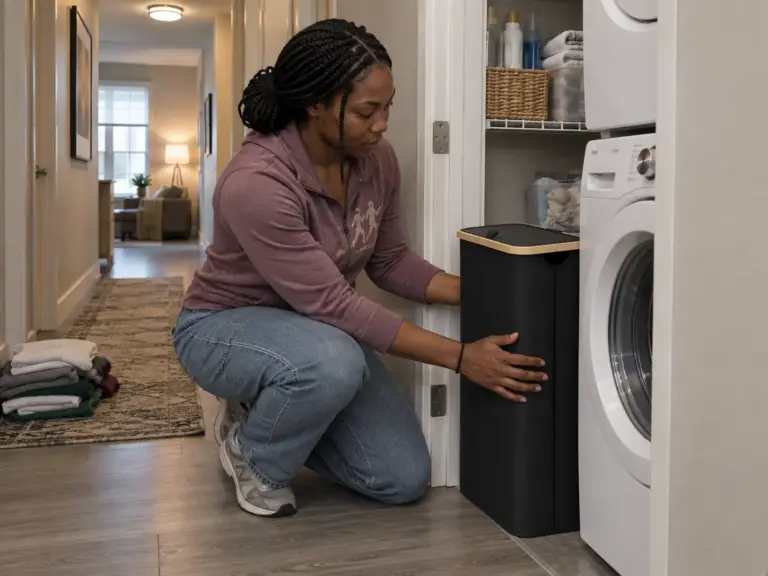
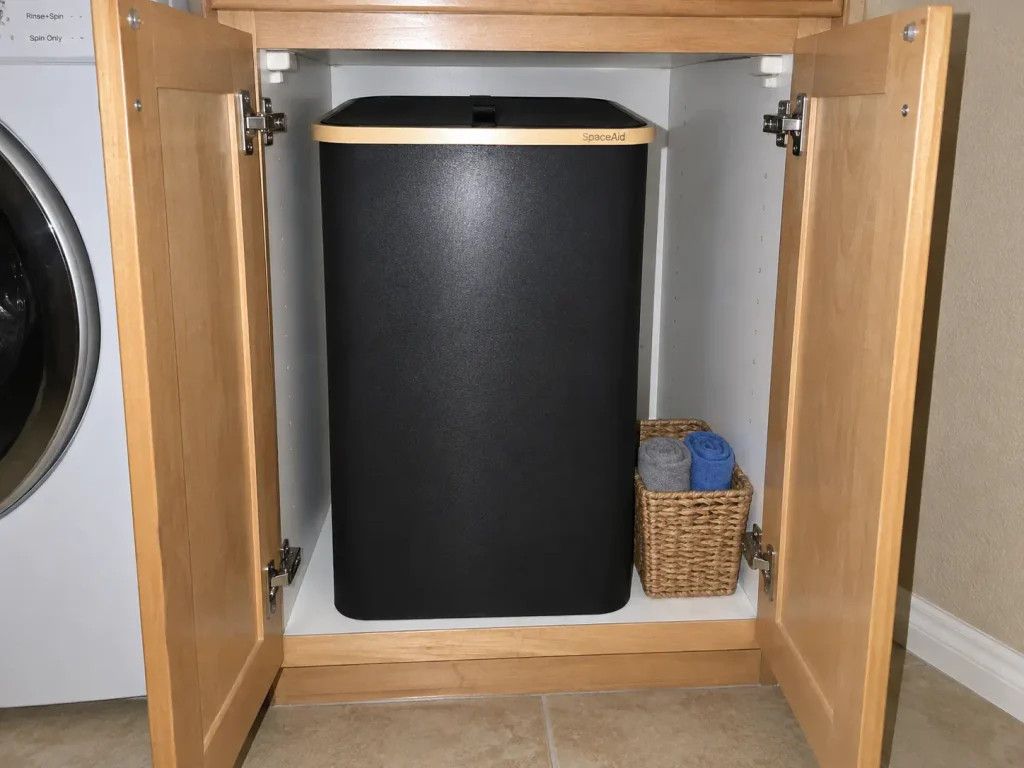
A cabinet-hidden hamper gets recommended as the tidy fix, and it works as long as that stream gets washed often. Shut a week of gym clothes behind a lid and a door and you’ll smell it on opening. So hide the stream nobody wants to look at but somebody washes every few days, like kitchen towels or cleaning rags.
The SpaceAid Slim Laundry Hamper with Lid measures 16 by 8.75 inches and stands 28 inches tall with 65 liters inside, slim enough for a base cabinet beside the machines, and it’s one stream only. Measure the cabinet opening, not the cabinet box: hinges and the face frame eat width. A tall freestanding cabinet-style hamper has a dresser’s top-heavy profile, and dressers now fall under the CPSC’s mandatory tip-over standard for dressers and other clothing storage units. The rule doesn’t cover hampers, but the physics is the same: anchor it or keep it low around kids who climb.
On the Machine Itself
On a washer or dryer with a steel casing, a magnetic shelf mounts to the side with no wall contact at all, the most renter-proof “wall-mounted” idea there is. It won’t hold a sorting bag. It holds what the sort needs nearby: the stain spray, the lint bin, the mesh bag for socks.
The AMZFAWO 2-Pack Magnetic Laundry Organizer Shelf comes as a pair, for steel casings only and nothing heavy. For the top of the machine, over washer and dryer storage has its own clearance math.
Test the exact spot with a fridge magnet, near the top and bottom edge of where the shelf would sit. Many machines have plastic trim panels, so a magnet that grabs mid-panel can slide off at the edge. If the fridge magnet won’t hold there, the shelf won’t either.
Rolling Sorters for Shared Homes and Building Laundry Rooms
A fixed sorter assumes one person, one room and one machine. Real households break that on day one: the teenager’s hoodies, the toddler’s tiny socks, the shared laundry room two floors down. A sorter on wheels is the only kind that goes where the machines are.
Why Wheels Matter More Than Bags
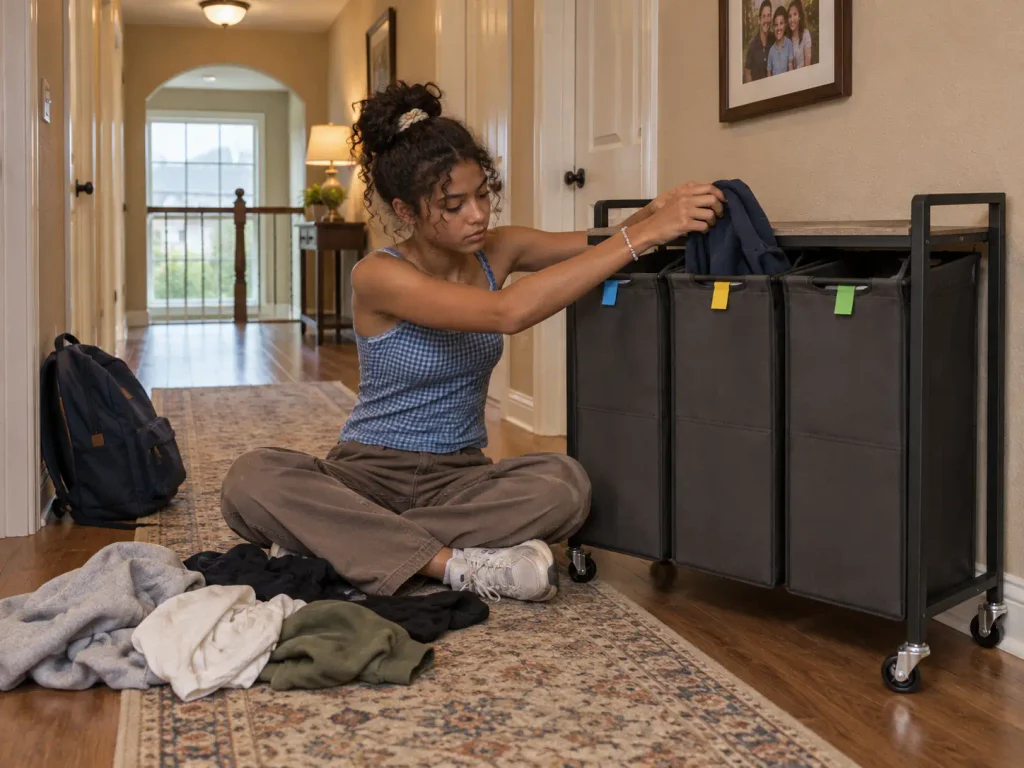
Carrying is where sorting quietly falls apart in a multi-person household. Without wheels, somebody scoops the sorted clothes into their arms, walks them down the hall, and leaves a trail of socks that ends up in nobody’s bag. With a rolling laundry cart, the sorted load reaches the machine intact, and whoever does laundry that day doesn’t need to know who sorted what.
It also turns sorting into a zone instead of a basket by the door. NAPO’s Greater Philadelphia chapter is blunt about why professional organizers recommend dedicating a specific zone for sorting: “Dedicate space for sorting dirty clothes; use bins or rolling carts to separate and contain whites, colors, delicates, and heavily soiled items.” A cart is a zone that moves. It parks near the bedrooms all week, where clothes actually come off, and rolls to the machine on wash day.
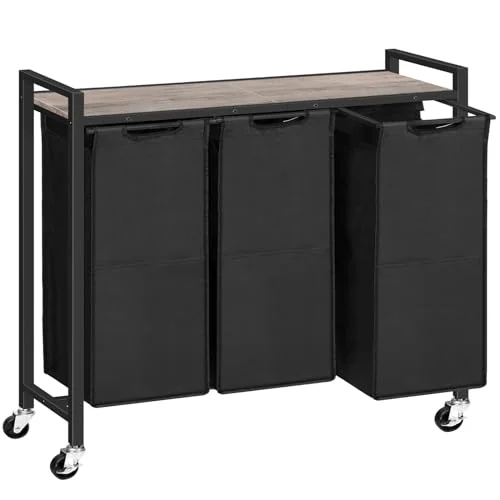
The HOOBRO Laundry Sorter 3 Section splits its capacity into three 11.5-gallon sections, each a little bigger than a frame-sorter bag and still in one-load territory. The limit is the floor path. On hard floors it rolls; over carpet it’s a push, and a thick rug at a doorway will stop it cold.
Color-Coded Bags a Toddler Can Use
The parent from the sizing section is the clearest example of a rolling system that stuck. In r/organization, they described ending up with a 3-bag laundry cart with a wood top, then cut their sorting categories from nine down to six in a later edit, because nine never worked. Each basket got a color-coded label, and the daughter, about to turn two, was learning which basket each item goes in.
Color is the part worth copying, and it beats labeling bins with words (no label maker needed). It works for anyone who can’t or won’t read a label: a toddler, a teenager at midnight, a houseguest. Use one color per bag, and repeat that color on the shelf or hook above it so the right bag is obvious from across the room. Then put the kid’s bag low enough to reach without help, because a toddler who has to ask for a lift will drop the shirt on the floor instead.
The Building Laundry Room Version
For apartment laundry, where the machines are in the basement or down the hall, the sort happens in the apartment and the laundry room only washes. Keep the sorter at home and roll or carry the pre-sorted bags down, so you’re never separating darks on top of a dryer somebody else is waiting for (and nobody wants to sort their underwear in front of a neighbor). Removable bags turn almost any sorter into a carrier: lift the dark bag off the frame, take it down, dump it, bring it back.
The rest of the no-drill setup is covered in laundry room organization for apartments. And for gear that holds up in a warm, damp room, see these laundry room organizers that survive the heat and humidity.
Keep the Sorting System Working Past Month One
The system you set up on Saturday gets judged on the second Thursday, when everyone is tired. Keeping it alive isn’t a chore chart or a whole new laundry routine. It’s one hook and two small rules.
Give “Worn Once” Clothes Their Own Hook
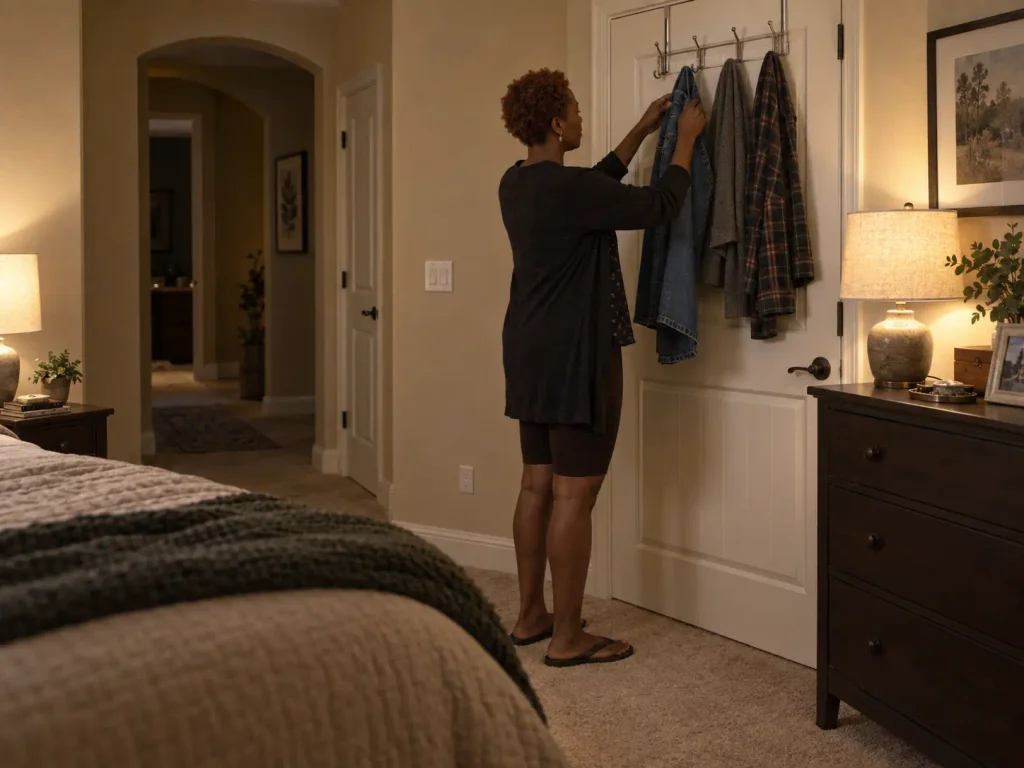
Here’s the fix for the chair. Put an over-door hook or a short hook rail in the bedroom, one hook per person, for the jeans and sweaters worn once. That’s the third state the sorter never had, and it’s the one change that empties the chair. The rule that keeps it honest: if something has hung on the hook for a week, it’s either dirty (into the bag) or clean (back in the closet).
Give each person exactly one hook, not a shared rack with five. One hook holds one or two items, so it forces the dirty-or-clean call every few days. A shared rack just becomes the chair again, only vertical.
Wash the Stream When the Bag Is Full, Not on a Schedule
The standard advice is to pick a laundry day and stick to it. A laundry schedule is great if you already run one. But schedules break the first week someone travels or gets sick, and then every bag overflows past the day you skipped.
A full bag is a trigger that survives a bad week: when a bag is full, that stream gets washed, whatever day it happens to be. And because each bag holds roughly one load, “full” and “worth running the machine” arrive at the same time.
The Three-Month Check
At three months, look at three things. Which bag never fills? Merge it.
Which one always overflows? Split it, or wash that stream twice a week.
And is anyone still using the colors, or has the whole house slid back to whatever bag is closest? If the colors died, the bags are usually in the wrong order or at the wrong height for the people using them. Adjust the system to the household, not the household to the system.
One Rail, One Hook, One Month
Every idea above comes down to three moves. Sort at drop-off, not on wash day.
Size each bag to roughly one load, so a full bag tells you when to wash. And give the in-between clothes a hook, because that pile is the one that brings the chair back. Three months in, merge the bag that never fills and split the one that always overflows.
Start with one bag rail and one hook. Live with it for a month. Then add the next bag.
Frequently Asked Questions
01What is the best way to sort clothes for laundry?
Sort each item the moment you take it off, into three bags such as lights, darks and towels, instead of sorting one big mixed pile on wash day. Most households never need more than three, and fewer decisions at drop-off is what keeps a laundry sorting system running.
02How can I make a DIY laundry sorter?
Hang three mesh or canvas bags from hooks you already own, an over-door hook rack, or a tension rod across an alcove, with no drilling and very little spending. Size each bag to roughly one wash load, so a full bag means it is time to wash.
03What is the best way to organize laundry?
Give every state of a garment its own place: a sorting bag for dirty clothes, a hook for clothes worn once, and the closet for clean ones. The pile always forms wherever one of those three places is missing.
04What are good laundry sorting system ideas for a small space?
In a tight laundry closet, use the dead spaces: a triangular hamper in the corner, a slim bin in the gap between machines, and a lidded hamper inside a base cabinet. A magnetic shelf on the machine holds the small items.
05What are the best ways to organize my laundry room?
Start with the sorting zone, because that is where the floor pile begins, then add supply storage on shelves above or beside the machines. The folding surface comes last, once dirty clothes have a fixed home.
Disclaimer: ClutterlessNest is a participant in the Amazon Services LLC Associates Program. As an Amazon Associate we earn from qualifying purchases. This article may contain affiliate links — if you buy through them, we may earn a small commission at no extra cost to you. We only recommend products we have tested or genuinely believe in.