
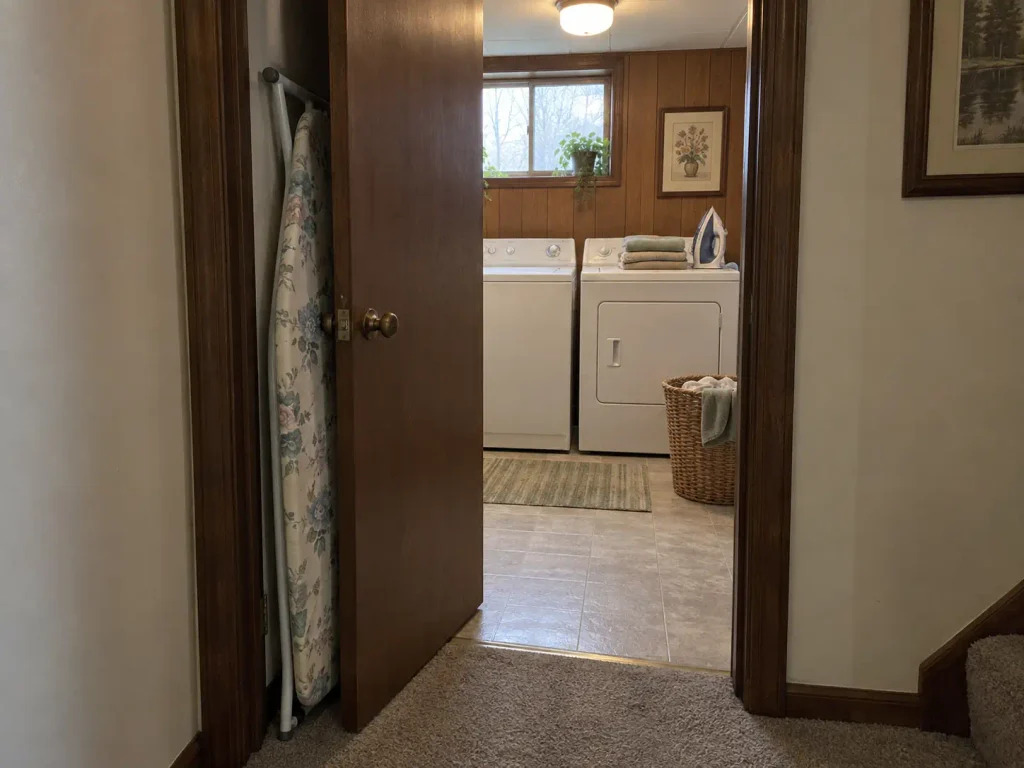
The ironing board is leaned behind the laundry-room door again, or wedged against the wall between the dryer and the hallway. You don’t put it away, because putting it away means dragging 54 inches and about 11 pounds of metal out of a packed closet next time. So you squeeze past it. Every day.
That’s what makes ironing station organization harder than it looks: the board is the one piece of laundry gear that’s too long for a shelf, too heavy for most adhesive hooks and too awkward to live on the floor, which is why every “just hang it” tip falls apart in a rental. Below: what to measure, the no-drill spots (free ones before bought ones), the two upgrades worth paying for, and a place for the hot iron itself.
Quick Answer
An ironing station that works in a small space, without drilling, comes down to five moves:
- Measure the board first: a standard full-size board is about 15 by 54 inches and weighs roughly 9 to 15 pounds, so it needs a floor-to-wall spot, not a shelf.
- Try the free no-drill spots: upright behind hanging clothes in a closet, flat under a bed with open space beneath it, or on an over-the-door hanger rated for the board’s weight.
- Put tension shelving in the gap beside the machines for the iron, spray bottle and cover, not for the board itself.
- Skip adhesive hooks for the board: a 7.5-pound utility hook can’t hold a full-size one, but it handles pressed shirts on hangers or a tabletop board you’ve weighed.
- Give the iron its own heat-safe spot, like a silicone rest pad, and let it cool fully before it goes back in storage.
Why Ironing Station Organization Fails When the Board Just Leans in a Corner
Everyone has done the lean. You finish the last shirt, fold the legs and prop the board against the nearest wall for now. It feels temporary, which is exactly why it becomes permanent.
The Board That Never Gets Put Away
A thread on r/UnfuckYourHabitat about ironing drew some brutally honest replies. One commenter said they’d “never put it away and instead squeeze by it repeatedly for the next 2 years.” Another admitted they’d find a way to “lean it against the wall and squeeze by anyways.”
Nobody there is lazy. They’re doing the math correctly.
Putting the ironing board away means opening a packed closet, shifting the vacuum and wrestling a 4.5-foot frame into a slot that was barely big enough last time. Leaving it out costs one sideways step. So it stays out.
That’s the whole game of ironing board organization: a spot only works if putting the board back is easier than stepping around it. Buried behind the holiday bins counts as out of sight, and it’s also why the board comes out once and never goes back.
Watch a leaned board for a month and it migrates: behind the door, then beside the dryer, then into the hallway, because no spot was ever its spot. Of everything in the rest of the laundry system, it’s the one piece of gear that never got an assigned home.
54 Inches and About 11 Pounds Don’t Fit “Small Appliance” Storage
Standard size guides put a full-size ironing board at about 15 inches wide and 54 inches long, with legs that adjust the working height from roughly 27 to 39 inches. Weight runs roughly 9 to 15 pounds depending on the frame, about 11 on average.
Most laundry room storage (bins, cubbies, shelf risers, adhesive hooks) is built for things that weigh a couple of pounds and fit inside a cube. The board is a 4.5-foot, 11-pound outlier. Houzz contributor Becky Harris put it plainly: she’s never been good at pulling out “that heavy, awkward ironing board,” and admits she goes out in unpressed clothing more often than not. When setup takes more effort than wearing a wrinkled shirt, the wrinkled shirt wins.
What a Leaning Board Actually Risks
According to the CPSC’s Anchor It! campaign, “Anchoring all furniture with drawers, doors, and shelves to the wall prevents tip-over injuries and deaths.” That campaign is about dressers and bookcases, not ironing boards, but the physics carries over. A tall, narrow object leaning free against a wall is a tip-over risk the moment a door, a hip or a laundry basket nudges its base.
In a hallway, it drops across the walkway. In a house with a toddler or a big dog, it drops onto someone.
The iron that goes with a leaned board usually lives on the dryer top or the floor, cord trailing, sometimes still warm. That’s the other half of the problem, and it gets its own fix in the last section.
Measure the Board, the Gap and the Weight Rating Before You Pick a Spot
Three numbers decide which storage spot can even work in your home: the size of the board, the size of the gap you want to put it in, and the weight rating of whatever will hold it. Most people only check length. Weight is the number that sinks most renter setups.
Full-Size Board vs Tabletop Board
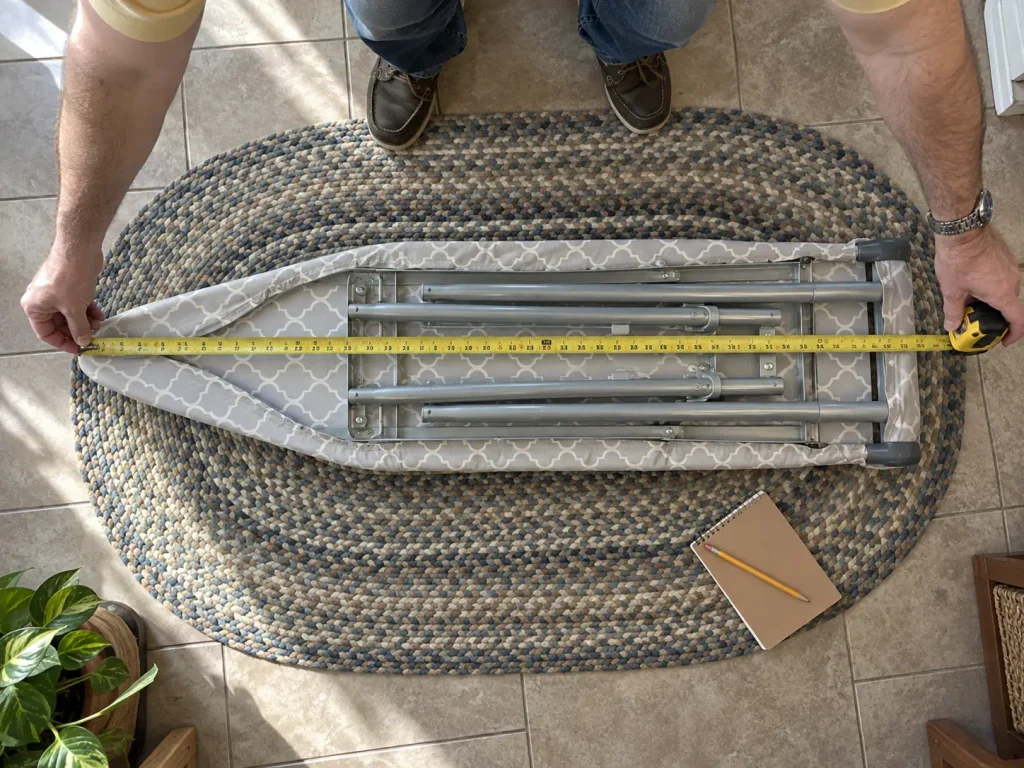
A full-size board runs about 15 by 54 inches and 9 to 15 pounds. A tabletop ironing board is a different object entirely: the compact folding model in the upgrades section below measures 23.6 inches long, 7.1 inches wide and 14.3 inches tall with its legs open, less than half the length of the full-size version.
That size gap maps directly onto what you press.
A tabletop board, the most portable ironing board there is, handles shirts, pillowcases, sleeves, collars and small quilting blocks without complaint. It struggles with anything long: trousers pressed full length, sheets, tablecloths, a dress you’d rather do in one pass. If your ironing is mostly work shirts, the small board is enough, and the whole storage problem shrinks with it. If your pile includes bedding, you need the full 54 inches, plus somewhere to keep them.
Folded Isn’t Flat — Measure the Legs Too
A folded board looks flat in the product photo. In real life, size guides like Homenish note that the frame legs can stick out about 10 inches past the board’s edge, so “folded” still means a bracket of metal hanging off one side. That 10 inches is what decides whether the board slides behind a door or stops halfway.
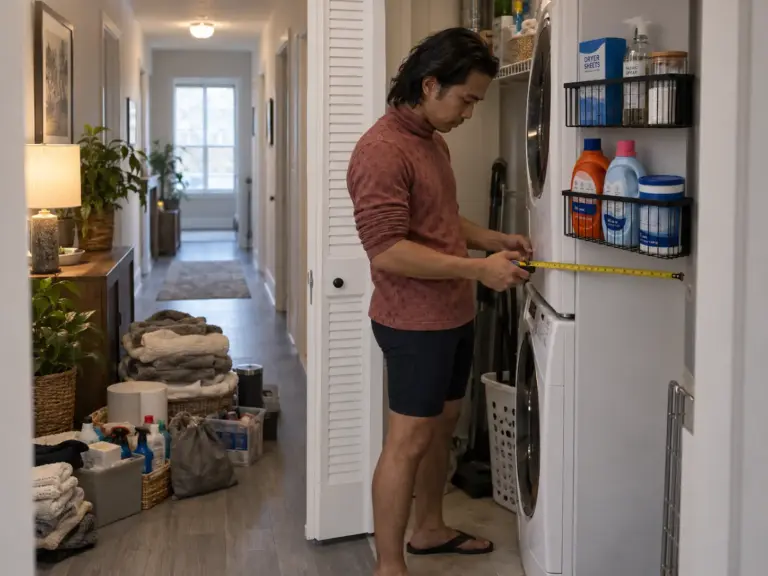
Measure the gap you’re eyeing (beside the washer, behind a door, inside a closet) at its narrowest point. Then measure the folded board at its widest point, legs included. The same logic applies when you’re measuring a tight laundry closet for anything else: the smallest number wins, never the average.
The classic miss is the board that fits the gap beside the dryer until one leg catches the dryer’s side panel. It goes in, but only with a shove and a scrape, every single time. That shove is why so many boards end up leaned just outside the gap they technically fit.
Measure the gap twice: once at floor level and once at knee height. Baseboards, the dryer’s leveling feet and a dryer vent hose can steal space at the bottom that the top of the gap never shows you, and the bottom is where the board’s feet go.
Weight Rating Beats Everything Else for No-Drill
For a no-drill spot, the number that matters most is printed on the package. A standard adhesive utility hook, like Command’s jumbo version, is rated by its maker for 7.5 pounds. A full-size board weighs 9 to 15. It doesn’t clear.
The rule: compare the hook’s or hanger’s listed weight rating against the board’s actual weight, not against how light it looks propped in the corner. If the weight isn’t on a label or a listing, weigh it yourself. Step on a bathroom scale holding the board, step on again without it, and subtract.
The mounting surface matters as much as the rating. An over-the-door ironing board holder on a hollow-core door carries the whole load on the door’s thin top edge, and every time the door swings, that load swings with it. A hanger’s rating tells you what the hanger can carry, not what your door can.
No-Drill Ironing Board Storage Renters Can Actually Use
“Mount it on the wall” is the standard answer to where an ironing board should live. And it’s a good answer, right up until your lease says no holes. For renters, the order is free spots first, then two inexpensive pieces that turn a spot into a station.
The Free Spots — Behind the Clothes, Under the Bed, Behind a Door
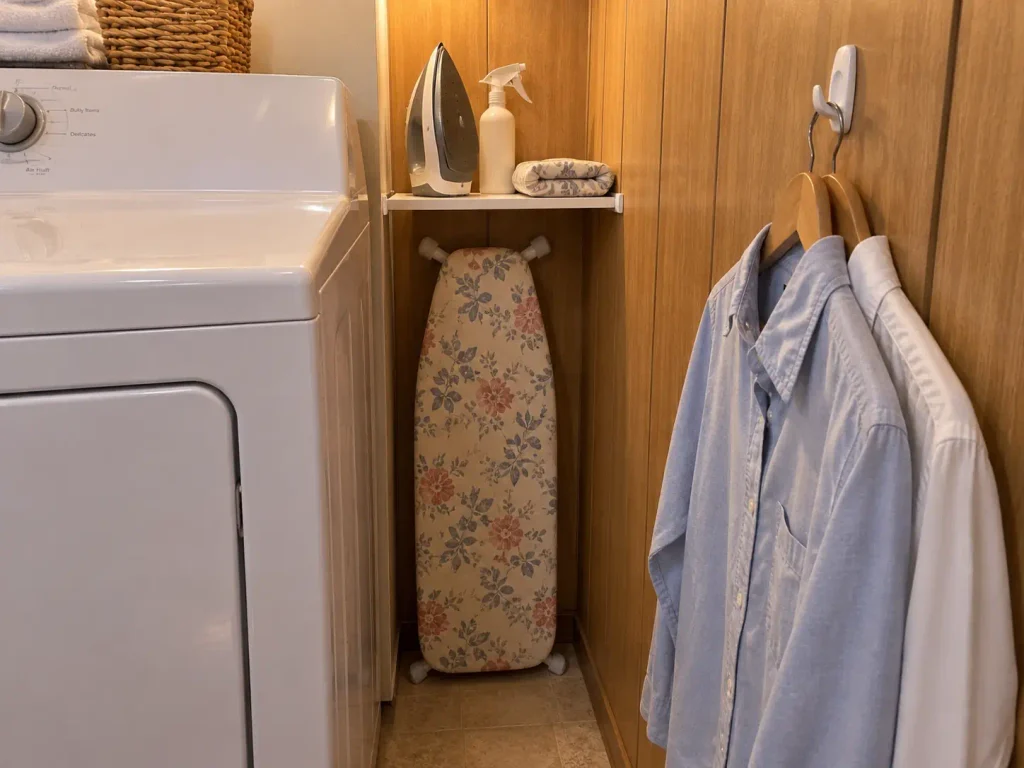
In an r/malelivingspace thread about storing an ironing board in a small apartment, one reply solved it for nothing: they keep theirs “behind my clothes in the closet since it’s not very thick.” Stood upright at the back of a reach-in closet, the board uses depth that shirts on hangers leave empty anyway. The only cost is sliding a few hangers aside when you want it out.
Under-bed ironing board storage works too (or under the couch), a suggestion from the same thread for anyone whose board won’t be visible from a standing angle. The failure case came from the person who started the thread: their bed had storage drawers, so under-bed was ruled out before it started. Check your bed frame, and measure the clearance against the board’s folded thickness with the legs, before you plan around it.
The top-voted reply went a third way: “Back of a door? You can buy door hangers for them; they’ll also hold an iron.” An over-the-door ironing board hanger is the neatest no-drill storage option when the numbers line up, so run the check from the previous section first: the hanger’s rating against your board’s weight, and whether the door is solid or hollow-core. If your laundry is a shared room down the hall and the board has to live inside your unit, the same closet-and-door logic runs through apartment laundry setups.
Try all three before you buy anything. Honestly, the back of a reach-in closet organizer setup swallows a full-size board more often than people expect, and it costs nothing.
Knock on the middle of the door before trusting an over-the-door hanger. A hollow-core door sounds like a drum and flexes slightly under your knuckles; a solid door sounds dull and doesn’t move. If it’s hollow, treat the hanger’s rating as a ceiling, not a target, and keep the board’s weight well under it.
Tension Shelving for Everything Except the Board
The free spots solve where the board lives. They don’t solve the iron, the spray bottle, the starch and the spare cover, which usually end up in three different places. So setting up to iron takes three trips instead of one.
The fix is a shelf in the gap beside the machines or at the back of a laundry closet, held in place by pressure instead of screws. It’s vertical storage in a slot that was otherwise dead space.
The Home in Bold Tension Rod Shelving expands to press between two walls with no drilling, the same method behind organizing a laundry closet without drilling. The cooled iron, the spray bottle, the starch and the folded spare cover go on the shelf, and the board stands on the floor in the gap below or behind it.
One limitation: tension shelving needs two solid, parallel walls to push against, so it won’t work in a gap that’s open on one side, like the end of a counter.
The board and everything that goes with it now share one footprint. It’s the same instinct one renter in that apartment thread described, tucking a broom and “other skinny products” into a narrow gap next to the AC and heater closet. One footprint. One trip.
What an Adhesive Hook Can and Can’t Hold
Say it flatly: an adhesive hook can’t hold a full-size ironing board. The Command 7.5 lb Jumbo Utility Hook with 4 Adhesive Strips is rated for 7.5 pounds, and the board weighs 9 to 15. No amount of careful surface prep changes that math.
But the hook earns a spot next to the board anyway. Its best job is holding pressed shirts. Actually, its best job is holding pressed shirts at the exact spot you finish them, so each one goes from board to hanger to hook without getting crushed in a basket on the way to the closet. It can also carry the spare cover folded in a small bag, or a tabletop board, but only after you’ve confirmed the board’s listed weight sits under 7.5 pounds.
Follow the strip maker’s surface guidance (painted drywall, clean and dry). The weight-rating logic behind no-drill closet setups that protect your deposit holds here unchanged: the rating is the limit, and the wall decides whether you even get that far.
Two Upgrades Worth Paying For: A Tabletop Board or a Wall Mount
Sometimes the storage problem won’t solve. The closet is full, the bed has drawers, the door is hollow and the gap beside the washer is six inches wide. At that point, stop hunting for a spot for the board and change the board. There are two ways to do it, and they sit at opposite ends of the budget: one budget-friendly, one closer to splurge-worthy.
The Budget Fix — A Tabletop Board
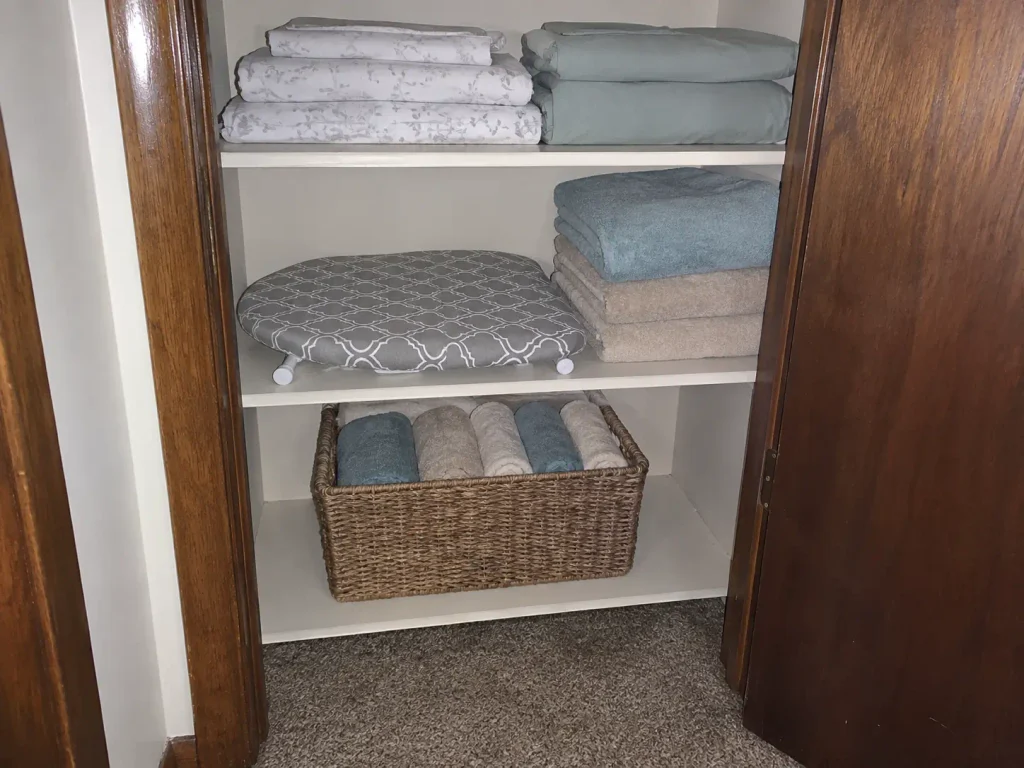
The Amazon Basics Foldable Compact Tabletop Ironing Board measures 23.6 by 7.1 by 14.3 inches with folding legs, which means it can live in places a full-size board never could: a closet shelf, under the bed with room to spare, a deep drawer, the tension shelf from the previous section. When you need it, it comes out onto the dryer top, a kitchen counter or a table covered with a folded towel or a pressing mat. As small space storage goes, it’s hard to beat.
If you plan to hang it, don’t guess at its weight. Check the listed weight against the hook’s 7.5-pound rating, or weigh it the bathroom-scale way.
The limitation is the short surface. Full-length trousers take several repositions, and sheets are a fight you’ll lose.
If you press work shirts twice a week, it’s enough. If you iron bedding, it isn’t. For what it’s worth, it’s also the only board in this article that packs into a moving box without a second thought.
Use the dryer top as your tabletop surface only when the dryer is off. A running dryer shakes the board under the iron and warms the surface from below, and a shaking board is how a hot iron slides off the edge.
The Owner’s Fix — A Fold-Down Wall-Mounted Board
If you own your place, or your landlord signs off on anchors, a wall-mounted ironing board (a fold-down ironing board on a bracket) takes the station off the floor entirely. Install guides agree on the clearances: about 16 inches of open space in front to fold it down and stand at it, and about 24 inches of headroom above the deployed board. Folded flat against the wall, most models sit roughly 3.5 inches deep and need about 18 to 24 inches of clear wall space (some compact models get by with 15).
The headroom number is the one people learn the hard way. Mount the board under a shelf that leaves less than 2 feet above the ironing surface and you’ll hit your head, or the iron’s handle, every session. If you’re also planning shelves over the washer, work out the clearance above the machines before either one goes up, because the shelf and the board are competing for the same 24 inches.
The Xabitat Wall Mounted Ironing Board is 36.2 by 12.2 inches and folds flat, which keeps its footprint small for a drilled board. It needs a wall you’re allowed to drill and solid anchoring into a wall stud per the manufacturer’s instructions, so follow those exactly. The tradeoff: 36.2 inches is well short of a 54-inch board, which makes it a shirt-and-sleeve surface, not a bedding surface.
Pick the wall with the outlet in mind, because cord management starts with where the board goes. Check how far your iron’s cord actually reaches, then mount the board where it gets to an outlet without an extension cord crossing the walkway. A cord stretched across the laundry-room doorway is the leaned-board problem all over again, just lower to the ground.
Which One Fits Your Situation
If you rent and press shirts weekly, a tabletop board plus a tension shelf is the whole station, and both come with you when you move. If you rent but need a full board for trousers and bedding, keep it and use the free spots from the no-drill section; the full board was never the problem, the missing spot was. If you own, have a clear wall near an outlet and can give it 24 inches of headroom, the wall mount is the one worth paying for. The same drill-or-don’t split runs through laundry storage sorted by what you can drill for the rest of the room.
Where the Iron Lives and How the Station Joins Laundry Day
The board gets all the attention. The hot iron is the thing that ends up on the floor, on the dryer top beside clean towels, or balanced on its heel at the narrow end of the board where one bump tips it over.
A Heat-Safe Spot for the Iron
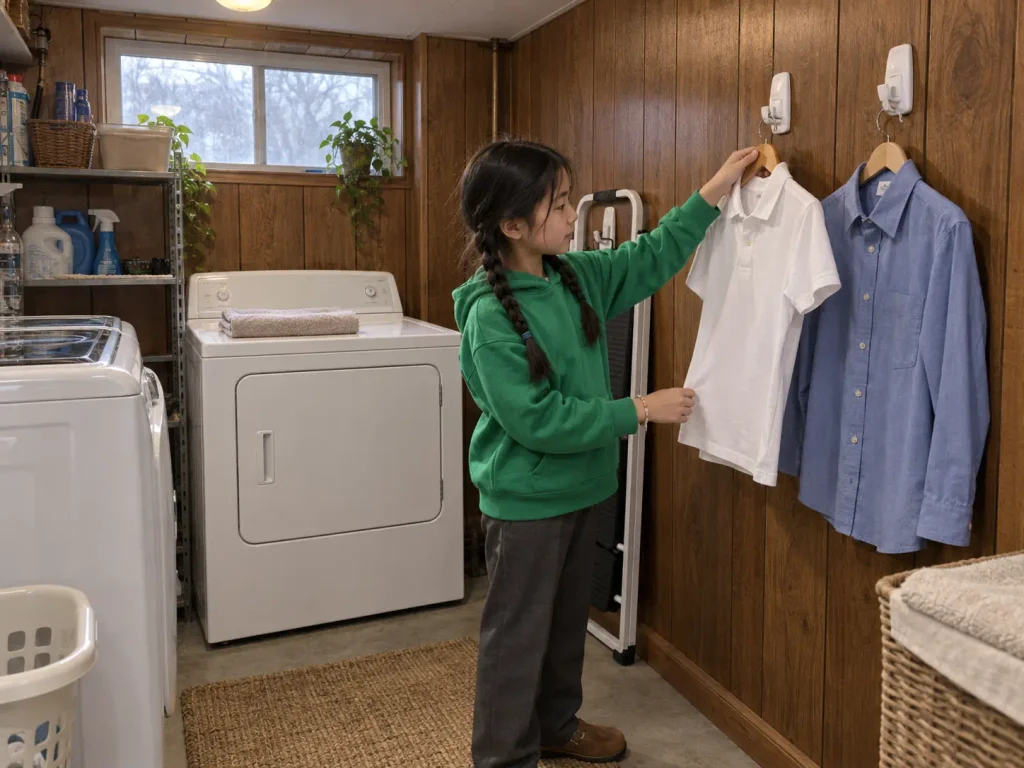
The iron needs a landing spot of its own, and heat safety is most of the reason. The Silicone Iron Rest Pad (2-pack) is heatproof silicone with raised bumps that let air under the soleplate while it cools, and a non-slip base that stays put on a dryer top. Think of it as an iron holder that isn’t bolted to the board, unlike the small iron trivet at the narrow end of many boards. It’s a resting surface, not a guard: it protects whatever sits under the iron and does nothing to keep small hands away from it.
Use the two-pack as two stations: one pad at the board, where the iron rests between shirts, and one on the tension shelf where it’s stored.
My rule: the iron goes back into storage cold, and emptied of water if it’s a steam iron. A warm iron parked next to the folded spare cover is how covers get scorched, and a scorched cover passes that brown mark to the next white shirt.
Make Ironing a Step, Not a Pile
The usual instinct is to iron each shirt the morning you need it. In practice, that’s how a chair fills up with wrinkled shirts, each one waiting for its own morning.
Iron in one batch right after folding, while the shirts are barely damp and the wrinkles are light, then hang them straight on the hook. That makes ironing the last step of a laundry routine that outlasts week two, not a separate chore with its own pile. Pull those shirts out at the sort stage, with a separate bag for iron-before-wearing clothes, and they reach the board in one stack.
The original post in that r/UnfuckYourHabitat thread went the other way: they set the board up in the main hallway so they’re “literally blocked into the office until I put it away.” If you can’t make the board easy to put away yet, make it impossible to ignore. It’s a stopgap, not a storage plan. But it works.
Hang one empty hanger per shirt on the hook before you plug in the iron. Each pressed shirt goes straight onto a waiting hanger, and you never set a warm shirt down on the dryer top where it creases again while you hunt for one.
The Three-Month Check — Cover, Humidity, Spot
Start with the cover. Sewing-community guidance on ironing board covers is consistent: heat-reflective cotton over felt or cotton-batting padding, and no synthetics, which can melt under a hot iron or trap steam moisture. Near a running dryer, a cover that holds moisture is a cover that starts to smell, the same heat-and-humidity problem behind picking organizers that survive the heat.
Then check the spot itself. Is the board still going back in? If the gap also holds the hamper, one of the slim hampers that fit beside the machines leaves the board its slot.
And if it’s leaned just outside the spot again, the spot is too hard to reach. Move the spot. Don’t blame yourself.
Weigh the Board Tonight, Then Choose Its Spot
Measure three things before you buy anything: the board, the gap and the weight rating of whatever will hold it. The numbers rule out half the options on their own.
Use the free no-drill spots first, then add tension shelving for the iron and supplies. Never trust an adhesive hook with a full-size board; it’s rated for 7.5 pounds, and the board weighs more.
If storage still won’t solve it, change the board. A tabletop board shrinks the problem, and a wall mount takes it off the floor, for owners who can drill.
In three months, look at where the board actually is. If it’s leaning outside its spot again, move the spot closer to where you iron.
Tonight, weigh your board and measure the gap beside your machines. Those two numbers pick your spot.
Frequently Asked Questions
01How do you make an ironing station in a small space?
Pick one spot that holds the board, the iron and the supplies together, usually the gap beside the washer or the back of a laundry closet. Stand the board in the gap, put a tension shelf above it for the cooled iron and spray bottle, and add a hook for pressed shirts.
02Where do people store their ironing boards?
Most people store ironing boards upright behind hanging clothes in a closet, under a bed with open space beneath it, on an over-the-door hanger, or in a narrow gap beside the machines. Wall-mounted fold-down boards are the option for people who can drill.
03What is an ironing table called?
It’s called an ironing board, and the small versions that sit on a counter, table or dryer top are sold as tabletop ironing boards. Full-size boards stand on their own folding legs, usually about 54 inches long.
04What is the best ironing board cabinet?
For renters, none: a recessed ironing cabinet means cutting into drywall, so a no-drill spot or tabletop board is the realistic choice. Owners should allow about 16 inches of clearance in front and stay within cord reach of an outlet; afold-down wall-mounted board gets the same result without the cabinetry work.
05Can a Command hook hold an ironing board?
Not a full-size one: a standard ironing board weighs roughly 9 to 15 pounds, and the Command jumbo utility hook is rated for 7.5 pounds. Use the hook for pressed shirts on hangers, or for a tabletop board only after checking its listed weight.
Disclaimer: ClutterlessNest is a participant in the Amazon Services LLC Associates Program. As an Amazon Associate we earn from qualifying purchases. This article may contain affiliate links — if you buy through them, we may earn a small commission at no extra cost to you. We only recommend products we have tested or genuinely believe in.