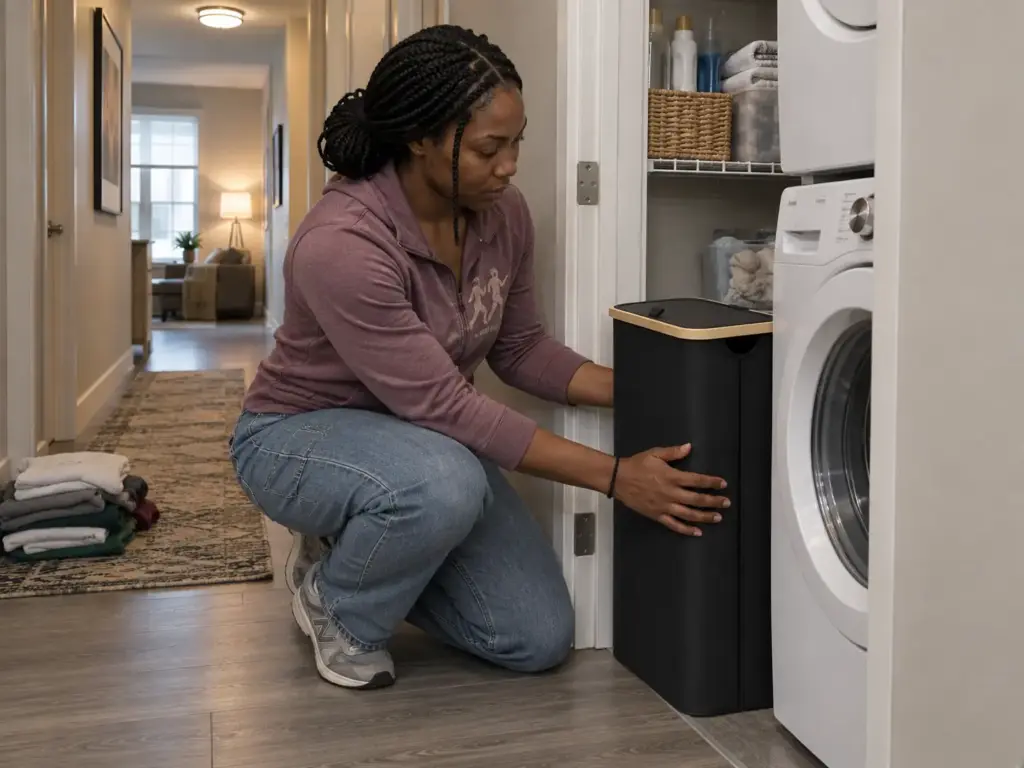
You are standing in the laundry nook with a tape measure, and the gap next to the dryer is narrower than your forearm. Every hamper the stores sell by default is wider than that. The useful way to shop for the best laundry hampers for small spaces is to work from real clearance numbers, what a stacked closet leaves beside the machine and what a side-by-side pair leaves along the wall, rather than trusting the word “slim” on a product page. So: measure first, then the four formats that fit, the no-drill options renters never get offered, sorting without a dedicated room, and why a correctly sized hamper still fails by week six.
Quick Answer
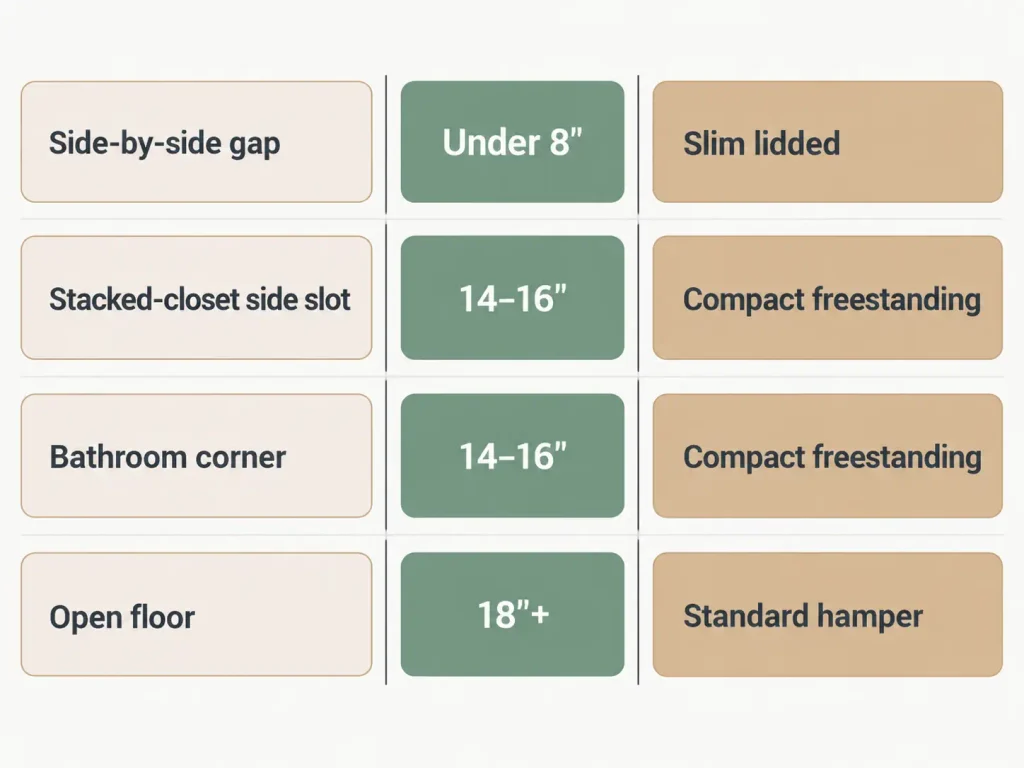
Match the hamper to the usable width of your spot, not to the word on the label:
- Under about 8 inches wide: the only format that clears the strip between a side-by-side washer and dryer
- Around 14 to 16 inches wide: the band for a stacked-closet side slot or a bathroom corner
- Collapsible under 4 inches folded: the only collapsibles that genuinely stow away
- Wall-hung on an adhesive hook: the renter substitute for the drilled wicker hamper every list shows
- Anything 18 inches or wider: needs open floor space, whatever the listing calls it
How to Figure Out What Actually Fits Your Laundry Space
Everybody shops for a hamper by looking at the hamper. The people who end up with one that works looked at the gap first. The failure has a predictable shape: you buy the one labeled compact, it arrives, and the closet door will not close.
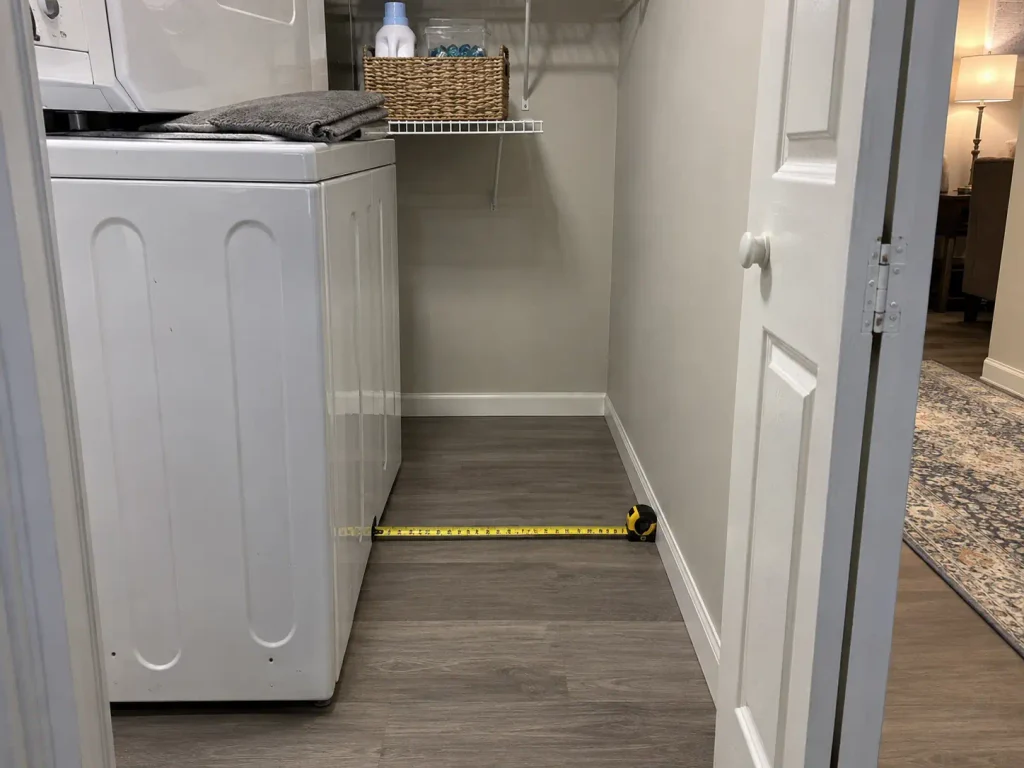
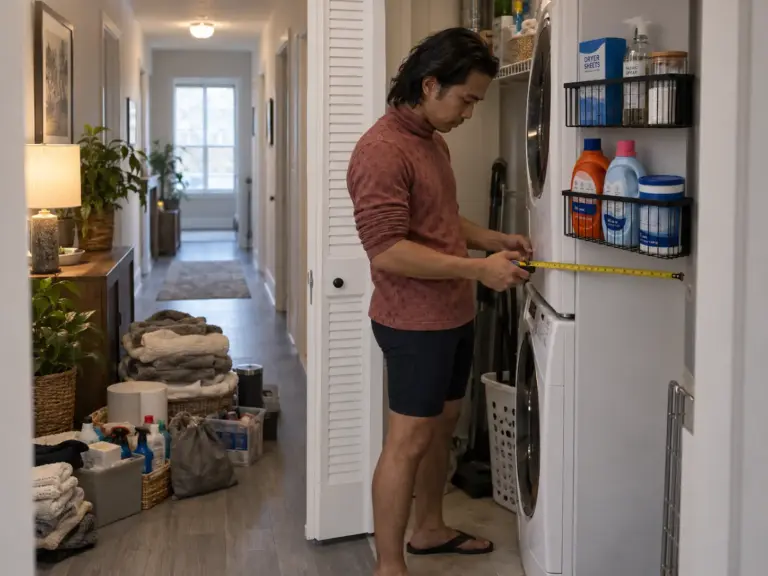
Start with the closet, because the nominal width lies to you. According to Dimensions.com, “The Laundry Closet (1 Unit) layout has a typical width between 36″-42″ (91-107 cm) and depth of 36″ (91 cm).” Those are standard laundry closet dimensions, and the machine eats almost all of them.
What is left beside a stacked unit is a slot, not a floor. The closet depth matters less than that leftover width, and the door clearance eats into it again.
Do the subtraction for your own closet: a 38-inch opening with a 27-inch machine leaves roughly 11 inches before trim, and the door has to swing through part of that. That leftover strip is the dead space you are actually shopping for.
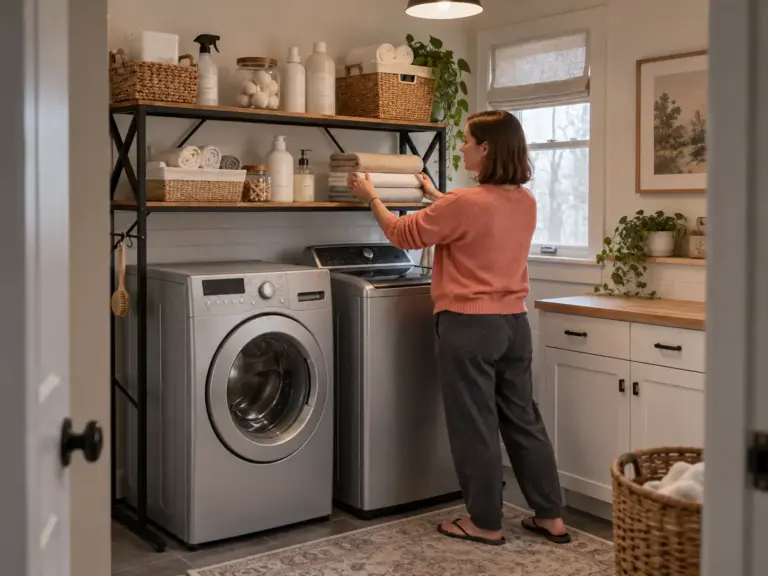
A side-by-side pair is tight in a different way. Those runs typically need about 48 inches of combined width, with at least 6 inches of clearance per side for ventilation and hose routing.
That strip is usually the only floor left, and it is the between washer and dryer slot every product page means when it says slim. Which is why slim and narrow are not the same category even though every listing treats them as synonyms. Slim means under about 8 inches. Narrow means 12 to 15, which is the band a narrow laundry basket actually occupies.
One fits between your machines and the other does not.
Meanwhile the default hamper in every store aisle runs 18 to 24 inches across. That is the size most people buy because it is the size on the shelf, and it fits none of the spots this article is about. It is a hamper for a room with spare floor.
Three measurements do all the work, and they take about ninety seconds:
- Usable gap width. Not the closet width. The width of the floor that is still empty once the machine, the trim and the baseboard are accounted for.
- Door swing clearance. Open the door and watch where it passes. A bifold eats a few inches at the hinge; a standard door sweeps the whole arc.
- Height to the obstruction above. A shelf, a countertop, a hanging rod. Measure to the lowest one, then subtract enough to lift a full load straight up and out.
That third one is the same clearance math that decides what fits over washer and dryer storage, and it is the number people skip most. A hamper that fits the footprint but sits under a shelf you cannot clear gets dragged into the room every wash day, which defeats the point of the spot.
Write your three numbers on a strip of masking tape and stick it to your phone case before you shop. Listings bury width in the middle of a spec block where 16 x 8.75 x 28 reads as one blur, and the number you need is almost never the first one.
Honestly, the measuring is the whole article. Everything below is matching a format to a number you already have.
The Four Hamper Formats That Fit a Small Space
There are not fifty options in closet laundry storage. There are four shapes, and each exists because of a specific spot in a small home. Once you know which spot you have, the shortlist collapses to one or two.
Slim and Lidded, for the Gap Between Machines
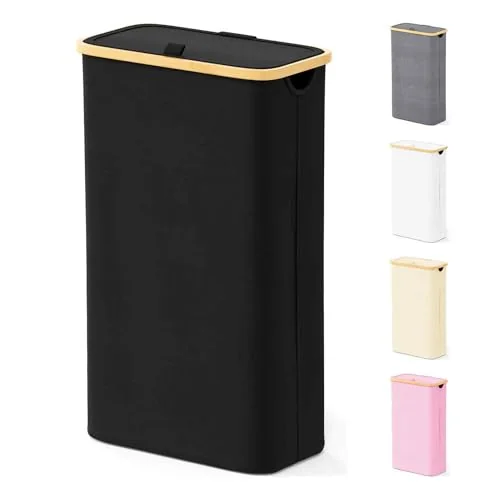
The strip between a side-by-side washer and dryer is the hardest spot in the house to fill: usually 6 to 8 inches of floor bounded by two vibrating appliances. Anything wider either does not go in or blocks the vent clearance, so what works is tall and flat, gaining capacity upward because up is the only direction available. The lid matters here and not for looks: with apartment laundry the hamper sits in your bathroom or hallway where you see it constantly.
Slim and Rolling, When the Laundry Is Not Where the Hamper Is
People buy this format for the wrong reason. A slim rolling cart is not a capacity solution, it is a portability solution, for the setup where the machines are down the hall or two floors away and a fixed hamper means you carry an armload and come back for the rest.
The SOLEJAZZ Slim Rolling Storage Cart runs about 5 inches wide across four tiers and travels to the machine on its casters instead of you ferrying loads to it. That width is what makes the rolling useful, since it can live in a dead strip beside a fridge the rest of the week. The limit is obvious once you see it: four shallow tiers do not hold a family’s weekly wash.
Collapsible Mesh, When the Hamper Itself Has to Disappear
Some homes have no permanent spot for a hamper at all: a studio, a bedroom where the only floor is the walking path, or dorm laundry that has to live under a raised bed between washes. There the hamper has to exist on wash day and vanish the rest of the week.
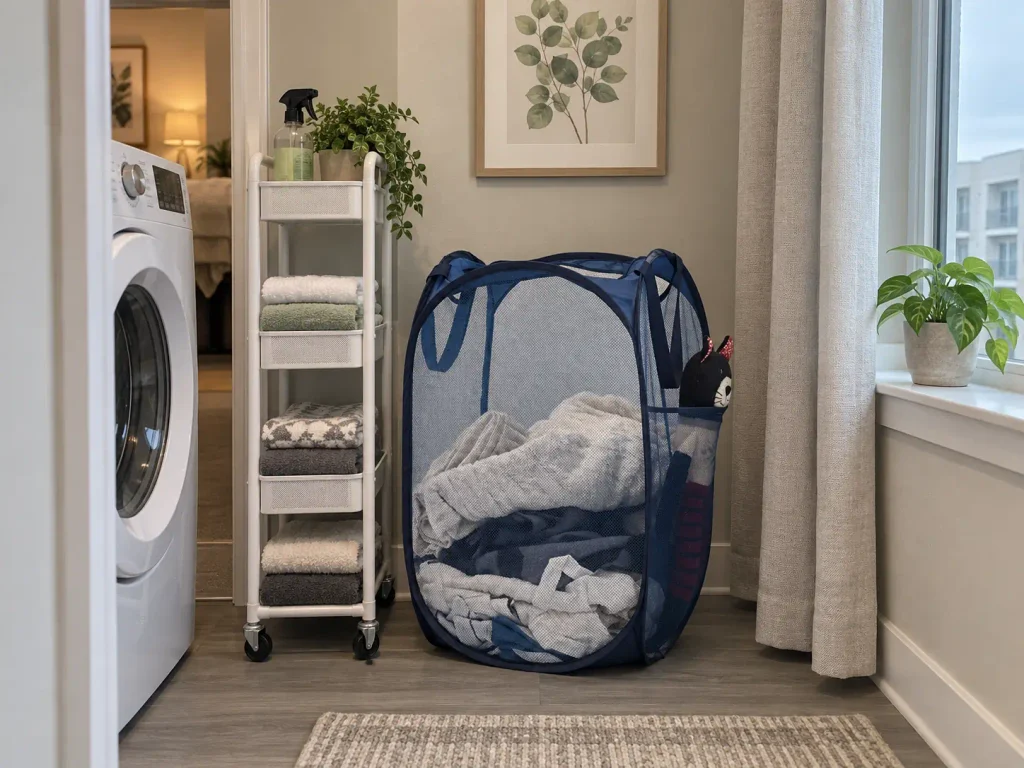
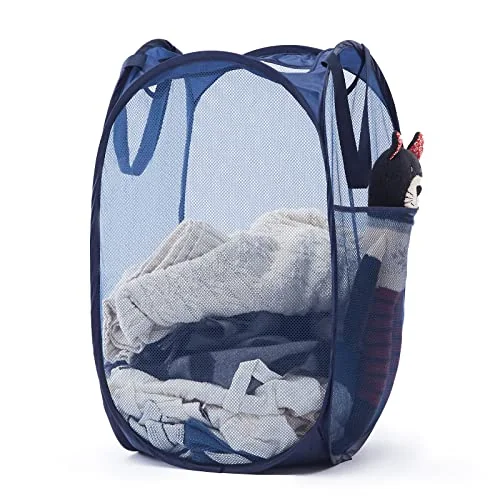
The number that decides whether a collapsible laundry basket is real or decorative is the folded depth. Baskets that genuinely fold flat come down to roughly 1.5 to 3.5 inches. Anything above 4 inches will not slide behind a door or under a shelf, so it will not be stowed, so you bought a rigid hamper with a weak spot in the middle. Check the collapsed dimension, not the word foldable on the box.
A ventilated hamper does a second job solid sides cannot, and a wire mesh basket does it for the same reason. The damp laundry smell that fills reviews of enclosed hampers is trapped moisture held against fabric with nowhere to go, and in a closed closet the air never moves. Odor control in a small laundry space is ventilation, not a scent booster, and left long enough that trapped moisture is where mildew starts.
Compact Freestanding, for a Corner That Is Genuinely a Corner
If your spot is a bathroom corner or the floor of a reach-in closet, you do not need slim. You need the band nobody labels clearly: 14 to 16 inches wide, 20 to 22 tall. It reads as a normal hamper and behaves like one, it just is not the 18 to 24 inch default, and you can reach into it with one hand instead of digging down into a tall narrow one. Worth saying plainly, though: a corner with a door swinging into it is not a corner.
Renter-Friendly Hampers That Need No Drill
Open any small-space hamper list and there is a beautiful wicker basket mounted on a wall. It looks like the answer. Nobody mentions that it is screwed into a stud.
Why the Wall-Mounted Pick on Every List Is Off the Table for Renters
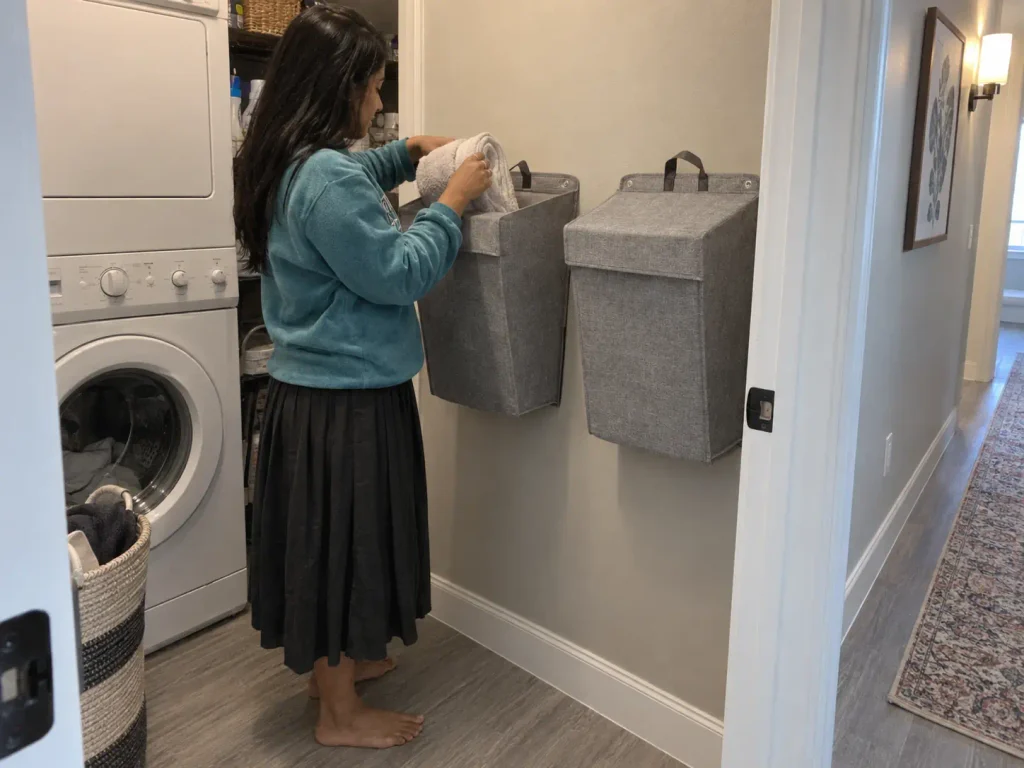
The wall-mounted wicker and bamboo hampers that dominate this category hang on a bracket anchored into framing, because a full load of fabric hangs on a lever arm away from the wall. That is a reasonable engineering choice and an impossible one if your lease says no holes. The whole category quietly excludes renters without ever saying so.
The substitute for a wall-mounted hamper is not a downgrade, it is a different mounting method with a different weight ceiling, and once you know the ceiling it works fine. Off the floor is not decorative in a small room anyway, it is vertical storage doing the same job it does everywhere else. It is the difference between a hamper that eats your only walkway and one that does not.
Adhesive-Hook Wall Baskets, the Direct Swap
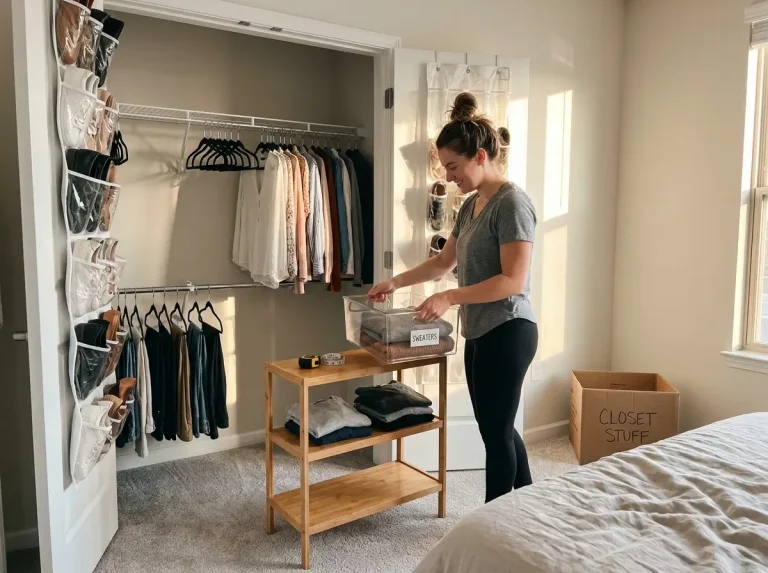
Before spending anything: a tension rod and a hanging bag do most of this job for pocket change, and it is the swap renters in budget threads land on first. Span a closet gap or an alcove, hang the bag, done. A tension mount puts nothing in the wall and comes down in one twist. If that covers your situation, go buy a rod.
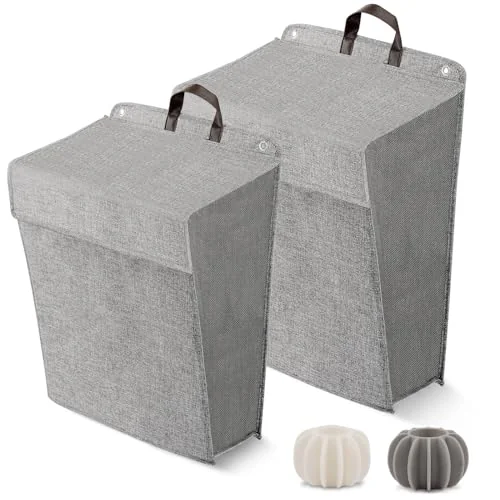
If you want something that looks less like a workaround, an adhesive-hook wall basket gives the same off-the-floor footprint with nothing to patch at move-out. Respect the load ceiling: adhesive mounts, command strips included, are rated by the hook and not by the basket, and the rating assumes a clean flat surface and a full cure before anything hangs on it. Textured wallpaper, fresh paint and a daily-steamed bathroom all cut into it. The same no-drill mounting methods applied to a bedroom closet hit the identical limit, so the rule is the same everywhere: hang the light streams, keep the heavy pile on the floor.
The Tension Rod Workaround (and What It Will and Won’t Hold)
Tension rods rated for closet and laundry use carry up to about 66 pounds with no wall hardware, far more than a hamper’s worth of clothes. The conditions attached to that number are where people get burned. A tension rod holds by friction against two opposing surfaces, so it wants a hard flat wall at both ends, a span well inside its rated range, and a load hanging straight down rather than pulling sideways. Mount it over unsupported drywall, load it near the rating, and it creeps and eventually drops.
So the practical ceiling sits below the spec sheet. Hang bags, not bins. Keep the span short.
Re-tighten it monthly at first, because a rod that has settled is a rod about to let go at 2 a.m. Past that it holds indefinitely and comes down in one twist.
If the hamper is only one piece of the puzzle, the same logic covers organizing the whole closet without drilling, shelf by shelf, with the same hardware.
Wipe both mounting spots with rubbing alcohol and let them dry fully before an adhesive hook goes up, then hang nothing for the full cure window on the package. Most adhesive failures people blame on the hook are really a film of bathroom residue and an impatient first load.
Sorting in a Small Space Without a Mudroom-Sized System
The real problem is rarely “I need a hamper.” It is “I have one hamper, so everything goes in it, so on wash day I dump the whole thing on the floor and sort it there.” One hamper does not save space. It moves the work to the worst possible moment.
Why One Hamper Creates the Work It Was Supposed to Save
Small-space laundry threads circle the same complaint: no room for multiple sorting bins, and no willingness to waste time dumping the entire thing out to re-sort at wash time. The diagnosis matters. The failure is not a shortage of hampers, it is the forced re-sort, landing on the day you have the least patience for it.
That re-sort has a second cost people underestimate: it needs floor. You cannot sort a week of laundry into piles without somewhere to put the piles, and in a studio the only surface available is the bed or the walking path. The hamper that was supposed to save space consumes the entire room once a week.
The conventional wisdom says a small home can only support one hamper. In practice the number of bins matters far less than where the sorting happens, and the home with no floor to spare benefits most from sorting at the source. The wider version of that argument is the full sorting system this hamper plugs into.
Three Sections in One Footprint
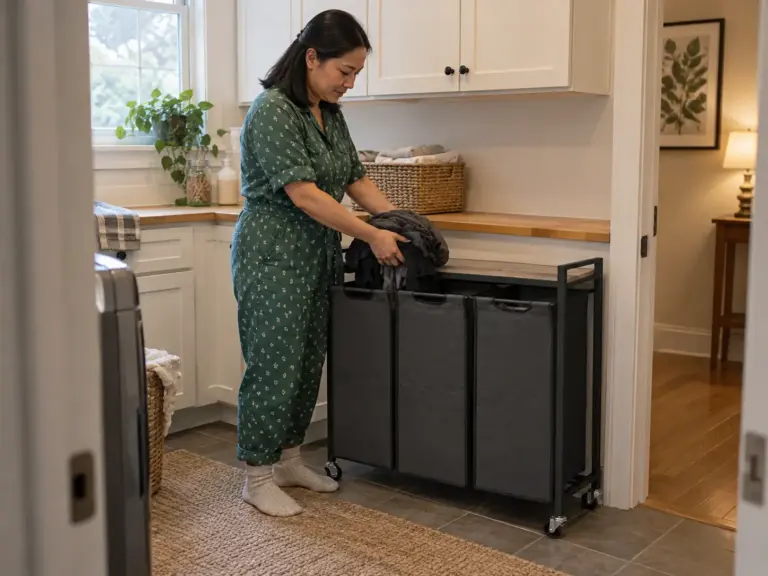
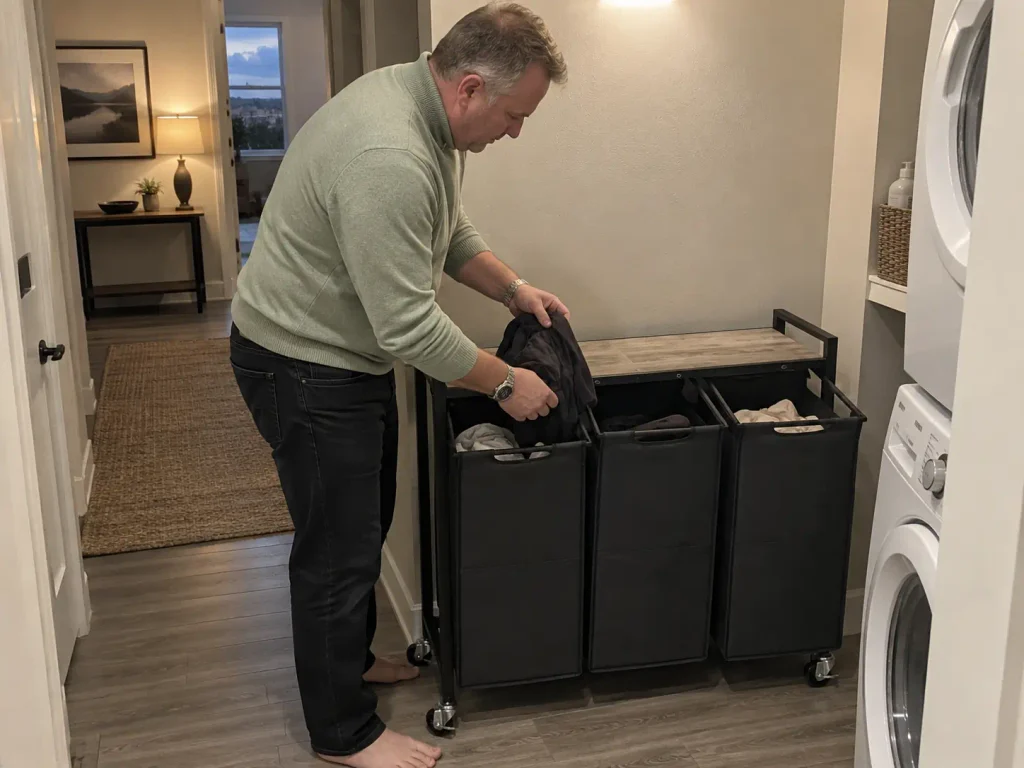
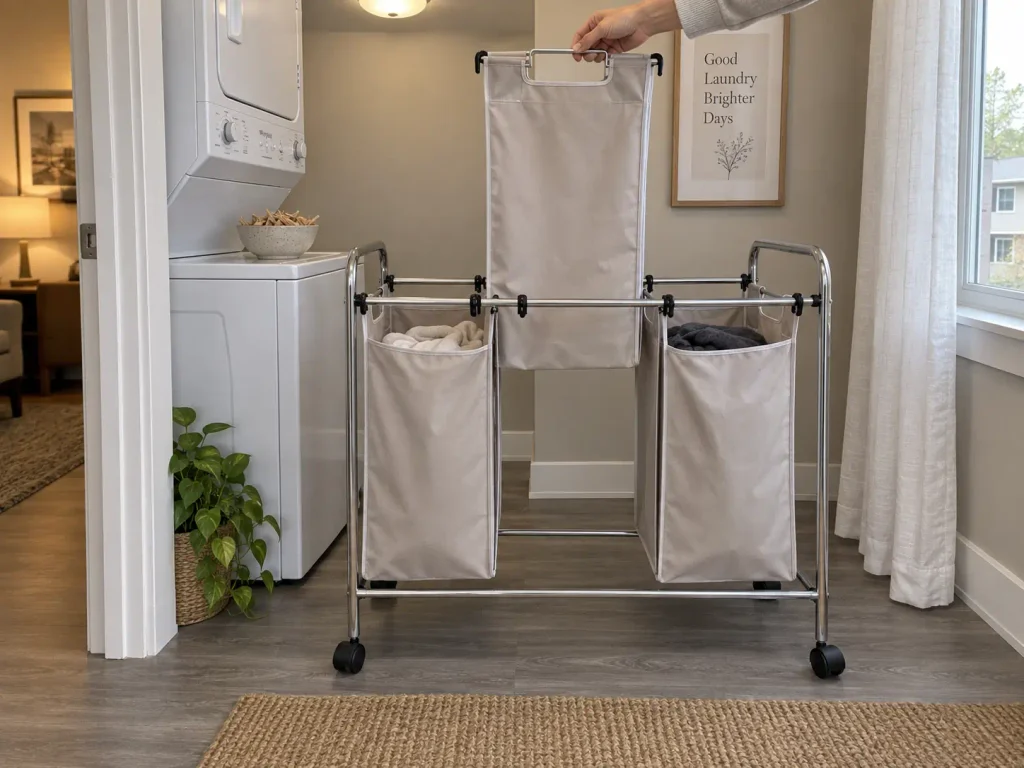
Sorting at the source means the decision happens when the item comes off, not on wash day. Lights left, darks right, end of thinking. This feels impossible only because people picture three round baskets side by side, which is genuinely three baskets’ worth of floor. A vertical multi-compartment hamper is different geometry: it stacks the streams upward on a narrow frame, so the unit takes barely more floor than one standard round hamper while holding three separated loads.
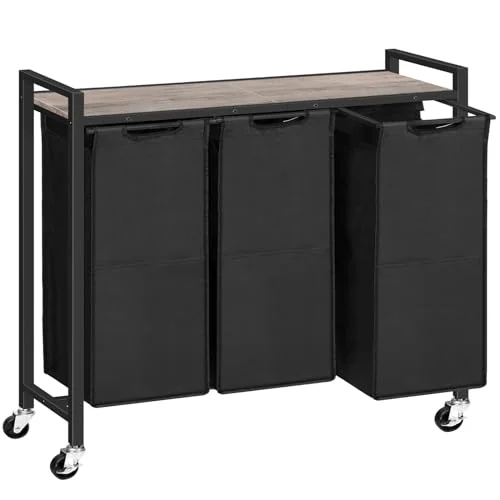
If the wheeled version is more unit than your corner wants, the Amazon Basics 3-Bag Laundry Sorter delivers the feature that removes the wash-day work: the bags lift out. Each stream travels to the machine on its own and goes straight in, so the dump-and-re-sort step never happens. It is a plain metal frame with three hanging bags, meaningfully cheaper than anything on casters, and you give up mobility plus a little rigidity when a pulled-out bag leaves one side unsupported.
The Second Sort That Takes Up No Floor at All
The textbook split is lights darks delicates, three streams, and in a small home it is one too many.
Two streams is usually the honest answer: lights and darks, or wash-now and wash-later. Sort by color only as far as your machine schedule actually earns it. Three works if the sorter goes vertical. Four is a system nobody maintains past the first busy week, and the fourth bin becomes a shelf for something unrelated within a month.
There is one extra stream you can add for free, and it saves the most grief: delicates and smalls. Call it a hand-wash bag if that is what ends up in it.
A set of mesh wash bags on a hook you already own handles bras, socks and anything that migrates into the dryer vent, without adding a square inch of floor. A mesh lingerie bag is the same object under a narrower name. Fill it through the week, drop the whole bag in the machine, and the sorting already happened. If your machines live in a shared laundry room downstairs rather than in your unit, this matters double: the bag travels as its own load and nothing gets re-sorted on a folding table in front of strangers.
Cheapest fix in this entire article.
A shared small space is where a single hamper breaks fastest, because two people’s sorting logic never matches. One person’s delicate is the other’s regular, and after a couple of arguments about a shrunken sweater the system reverts to one pile. Separate bags per person fix that faster than separate hampers, which is the one piece of small apartment storage advice that survives a roommate, and they matter more still in apartments where the machines are not even in your unit.
Put the sorter where you undress, not where the machine is. Sorting only stays effortless while it costs zero extra steps, and a bin in the laundry closet means the bedroom floor becomes the real hamper by Wednesday.
Why Small-Space Hampers Fail After a Month
The hamper fits. You measured. Six weeks later it is propped open, permanently unfolded, or living in the hallway.
None of that is a sizing problem. It is what happens when a format meets daily use in a room with no slack.
The Collapsible That Never Collapses Again
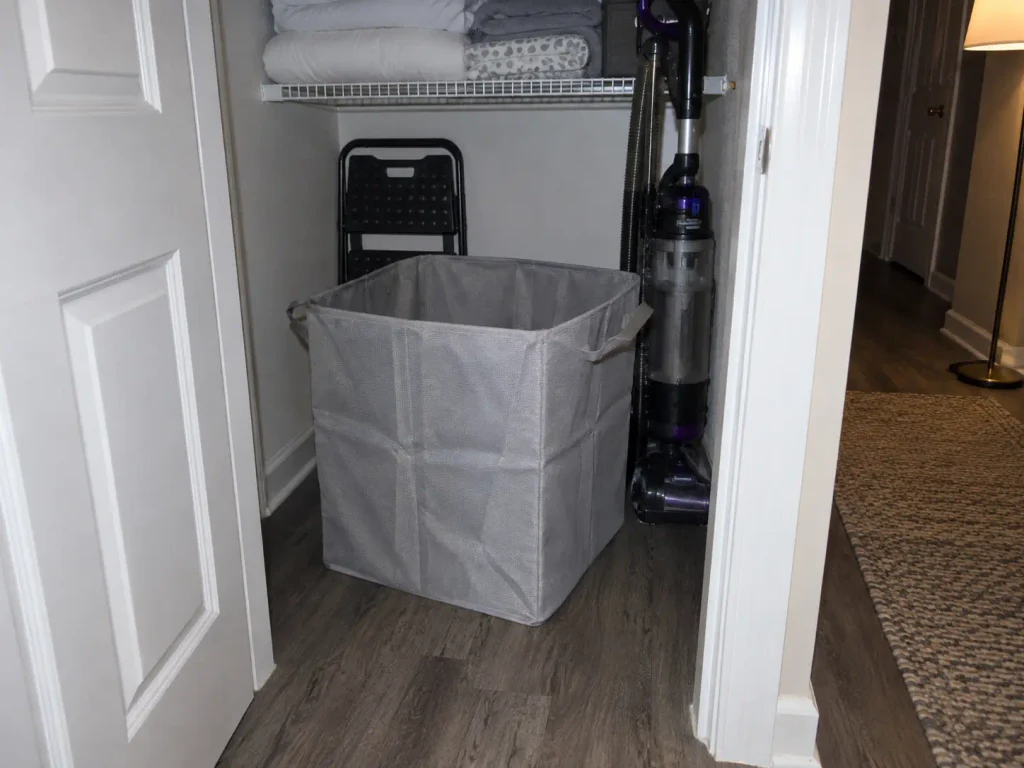
In the product photo it folds flat and slides behind a door. In a real house it goes up once and stays up for two years, because folding it is one extra step at the end of a chore nobody enjoys. Then it is a floor-clutter object that happens to fold, and the mechanism becomes a weakness rather than a feature: reviews of collapsibles repeat the same pattern, sides buckling under even a small pile while people straighten them constantly.
The test is behavioral, not dimensional. Will you fold it? If the honest answer is no, a slim rigid hamper is the better buy at the same footprint, because it is built to stand up full-time. Collapsible is right for genuinely intermittent use, a guest room or a dorm over a break, and wrong for a permanent daily spot.
Trapped Moisture and the Damp Laundry Smell
Damp gym clothes and a wet towel go in on Monday. The hamper is solid-sided, the closet door is shut, no airflow. By Thursday the whole closet smells, and the smell has moved into the fabric rather than the air, which is why airing the room does nothing.
This is what makes the mesh-versus-solid choice matter more in a small space than anywhere else, because a laundry room has volume and usually a vent while an enclosed closet has neither. Two fixes work: use an open-weave hamper so moisture leaves instead of pooling, or keep wet items out entirely by hanging towels and workout clothes on a hook until they dry. The second is free, so try it first. If the closet itself is the problem, the picks in organizers that survive the heat and humidity of a laundry closet are chosen around the same constraint.
Overflow, and Why It Costs More in a Small Room
In a big laundry room an overflowing hamper spills onto floor you were not using anyway, and nobody notices for a week. In a small one it spills into the walkway, and within about three days the overflow pile has become the hamper’s real location. The hamper is now furniture and the laundry lives on the ground beside it.
Overflow is a geometry problem before it is a habits problem. Pick the widest band your space allows rather than the narrowest one that technically fits, because a hamper sized to your average week overflows on your worst week, and the worst week is the one that sets the habit.
A fourth failure is worth flagging because it is the only one with a safety standard attached: tall lidded hampers can tip. The CPSC’s clothing storage unit rule covers a freestanding hamper or any similar unit at least 27 inches tall with 3.2 or more cubic feet of enclosed storage, and qualifying units must ship with an anti-tip device meeting ASTM F3096, per the federal safety standard for clothing storage units. A tall wood hamper in a small room with a toddler or a cat is the case that rule exists for. Check the box for the strap before you flatten it for recycling.
The fix for all four is one piece of discipline: pick the format for the behavior you have, not the behavior you intend to adopt.
Budget Hampers vs. the Splurge, What Is Worth Paying For
Hampers are easy to overspend on, because a splurge hamper looks like furniture and the cheap ones look like laundry. Capacity gallons on the listing will not tell you which one you need either. In a small room you are buying geometry and hardware, and only two of the upgrades change how the thing works.
The Two Upgrades That Change How It Works
Caster wheels are the first, with a condition: they only count if they roll on the floor you have. Hard casters do nothing on a low-pile rug and stick at every tile grout line, and locking wheels matter more than the listing suggests once the unit shares a wall with a spinning machine. Where they work, they turn the unit from something you drag into something you steer, which is the difference between cleaning behind it and never cleaning behind it. The SOLEJAZZ slim rolling cart is the clean example of a rolling laundry cart worth the money, since its 5-inch width is what makes the rolling useful at all.
A wide cart with wheels still has nowhere to go in a narrow room.
A frame that stays square is the second, and it decides whether a sorter is usable in a year. Pull a full bag out of a cheap frame and the whole thing racks sideways, so you hold the frame with one hand while wrestling the bag with the other. A cross-braced frame just stands there.
Everything else is finish. A rattan basket in a humid closet is a maintenance decision dressed up as a style decision, matching sets organize nothing, and a premium hamper liner does the job of the cotton liner already in the box. The same logic sorts the shelving, which is how storage sorted by what you are allowed to drill is organized.
Where the Cheap Version Is the Same Product
Multi-stream sorting is the clearest case of the budget tier doing the real work. The functional win is the removable bag, not the frame material and not the wheels, because the bag is what removes the re-dump step. A plain metal-frame Amazon Basics 3-bag sorter has that exact removable liner bag mechanism for a fraction of the wheeled version, which makes it the budget-friendly hamper in this whole lineup, and if your sorter lives in one corner permanently, the casters you paid for are decoration.
Before any of it: if your problem is one extra stream rather than three, a hook and a mesh bag cost almost nothing and take no floor. Buy the sorter when you genuinely have three streams and somewhere to put them.
Shop the removable liner before the hamper. A liner with handles that comes out in one motion turns any basket into a carry-to-the-machine system, and a fitted liner with no handles turns an expensive hamper into something you scoop out by hand.
Buy Once: Measure the Gap, Then Pick the Format
Three things decide whether this purchase works. Measure the usable gap, the door swing and the height before you look at a single product, then shop the band: under 8 inches straddles between machines, 14 to 16 fits a stacked-closet slot or a corner, 18 and up needs open floor. If you rent, skip the mounted wicker category entirely, since an adhesive-hook basket or a tension rod gets the same off-the-floor footprint with nothing to patch. And if wash day starts with dumping the hamper out, your problem is streams, not capacity.
In three months, look at where the hamper actually is. If it has migrated into the walkway, or the collapsible has not been folded once, the format is wrong for how your household behaves. Swap the format, not the size.
Measure the one gap you have been eyeballing. Write the number down. Shop from that number, not from the word “slim.”
Frequently Asked Questions
01What is the best laundry hamper for a small space?
The one that matches your usable gap, not the one labeled small: under 8 inches wide for the strip between a side-by-side washer and dryer, 14 to 16 inches for a stacked-closet slot or a bathroom corner. A slim lidded hamper covers the most common small-space spot, and a collapsible mesh basket covers the case where the hamper has to disappear between wash days.
02What is the best narrow laundry hamper?
Narrow and slim are two different categories, and the difference decides whether it fits. Narrow hampers typically run 12 to 15 inches wide, which suits a corner but will not clear the ventilation strip beside a washer. Slim hampers run under about 9 inches, and slim rolling carts go down to around 5, so those are the ones that fit between appliances.
03What are some good laundry basket ideas for a small space?
Go up or go off the floor. A three-section vertical sorter takes barely more floor than one round basket, a wall basket on an adhesive hook takes none at all, and mesh wash bags on an existing hook handle a second stream with zero footprint. The one idea to skip in a small home is a second standard round basket.
04Are collapsible laundry hampers worth it in a small space?
Only if it folds under about 4 inches and you will actually fold it. Anything thicker is not stowable behind a door or under a shelf, and reviews are full of collapsibles that get straightened back up constantly instead of put away. If the hamper will stay out anyway, buy a slim rigid one and skip the folding mechanism.
05How do I sort laundry when there is no room for multiple hampers?
Sort at the source with one vertical unit instead of several bins on the floor, since a three-section sorter occupies roughly one standard hamper’s footprint by stacking the streams upward. Removable bags matter more than the number of sections: they let each stream go to the machine on its own, which removes the dump-and-re-sort step on wash day.
Disclaimer: ClutterlessNest is a participant in the Amazon Services LLC Associates Program. As an Amazon Associate we earn from qualifying purchases. This article may contain affiliate links — if you buy through them, we may earn a small commission at no extra cost to you. We only recommend products we have tested or genuinely believe in.