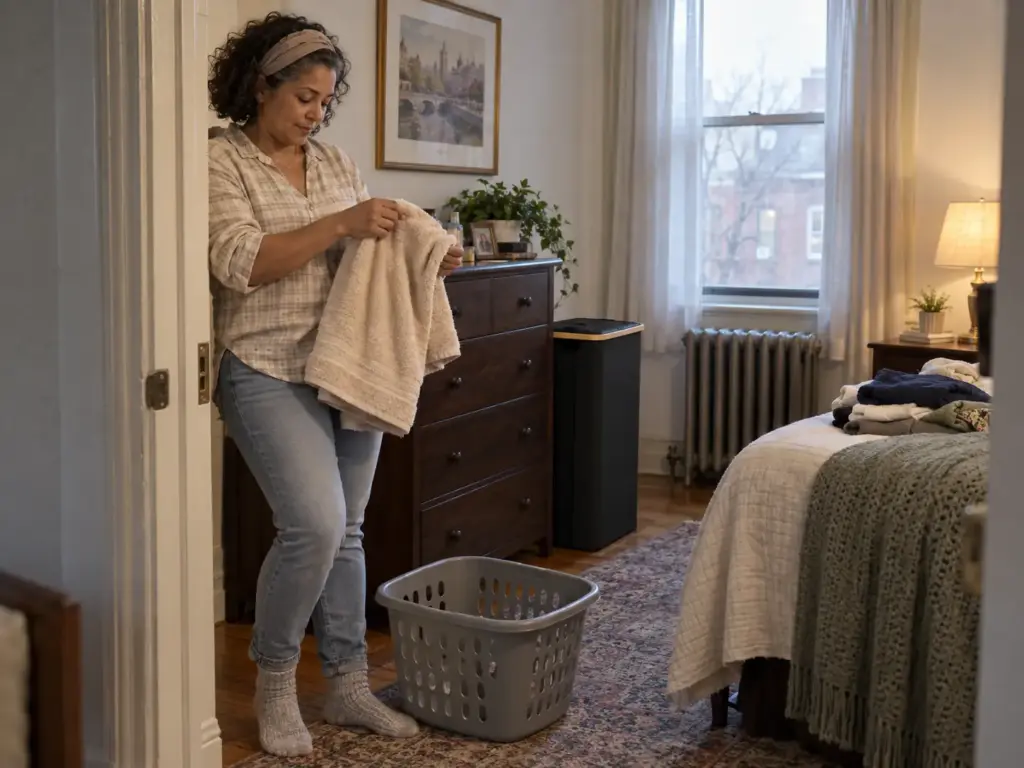
You set it up on a Sunday: one load a day, folded before bed. Nine days later, one skipped load has turned the bedroom chair into a laundry mountain, and you’re back to a frantic Saturday wash-a-thon.
Knowing how to create a laundry routine is the easy part; routines fail at one of three predictable points, and none of them is a character flaw. Habit research puts the average time for a new routine to feel automatic at 66 days, so two weeks in, you weren’t even a quarter of the way there. Below: the single-load loop, the cadence for your household, what changes when the machines are shared, and what to do the week it breaks.
Quick Answer
A laundry routine that lasts starts on a daily cue and ends at put-away:
- Anchor the load to a daily habit you already have, like making coffee.
- Sort at the source: dirty clothes go straight into a divided hamper.
- Start one load at the trigger and set timers for the wash and dry.
- Fold and put away the same day; this is where most routines stall.
- Pick a cadence for your household, then check it again at three months.
Why Your Laundry Routine Collapses by Week Two
Day one goes fine. Day four goes fine. Then a late Thursday means no load, Friday’s clothes land on top, and by Saturday the hamper lid won’t close. The next attempt starts already behind, so the plan becomes “I’ll start fresh Monday,” and Monday never quite arrives.
That’s the collapse pattern people describe again and again. Motivation barely figures in it; three mechanical failures do the damage.

It Had No Trigger, So Nothing Restarted It
A routine tied to “whenever I have time” works right up until the first busy day, and then it has nothing to relaunch it. Habit-formation research makes the point about any new routine, a laundry habit included: one anchored to a fixed daily cue (making coffee, brushing your teeth) survives a disruption, because the cue shows up again tomorrow whether you feel like it or not.
The same research puts the average time for a routine to become automatic at 66 days. Two weeks of effort is about a fifth of the way, not a failure. And the vague version never breaks loudly. There’s no moment where you decide to quit; the laundry just stops coming up in your head, and three weeks later you notice the chair.
Wash Day Secretly Started With a Sorting Chore
The second failure hides well. Organizing guidance from NAPO chapters treats the pre-sort space (bins, a rolling cart, a divided hamper) as infrastructure that exists before wash day, not as part of it. Without it, “doing laundry” quietly begins with dumping a hamper on the floor and separating darks from whites from the towel that’s somehow still damp.
Starting the washer takes a minute. That surprise sort takes far longer, and it’s often the real reason you keep putting the load off. If your categories aren’t settled yet, start with how to sort laundry so the pile stops coming back.
One Skipped Fold Became a Mountain
The skipped step is almost never the wash or the dry. It’s the fold and put-away, the moment you have to fold laundry by hand instead of letting a machine do it. Clean clothes land in a basket, then on a chair, then on a second chair, and forums have a name for the result: the laundry mountain, dug through every morning for a matching sock.
The usual advice pours its energy into getting loads started, which is the wrong end of the loop. Folding is the one step the machine hands back to you, late in the evening when you’re done for the day. The dryer is patient. The chair is not.
Name your two phone timers after the next action, “switch” and “fold,” not “laundry.” A timer called laundry gets swiped away from the couch.
How to Create a Laundry Routine, One Load at a Time
A load takes roughly 1.5 to 2.5 hours from start to dry, but only minutes of that involve your hands, so plan around the elapsed time.

Pick a Trigger You Already Hit Every Day
Tie “start the washer” to something that already happens daily: the coffee maker, walking in from work, the kids’ bedtime. It also has to fit the cycle times: Maytag’s figures put a normal front-load wash cycle at 60 to 80 minutes, a quick or speed wash at 15 to 40, and a typical dryer cycle at about 45. Start a normal cycle at 9 p.m. and the dryer buzzes around 11, so if you’re asleep by 10:30, that’s a morning pile, not a routine.
The Loop: Sort at the Source, Start, Switch, Fold, Put Away
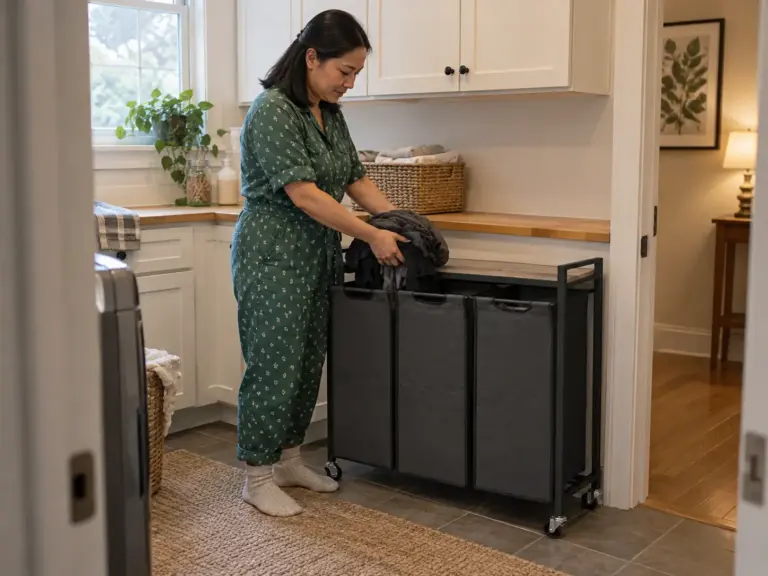
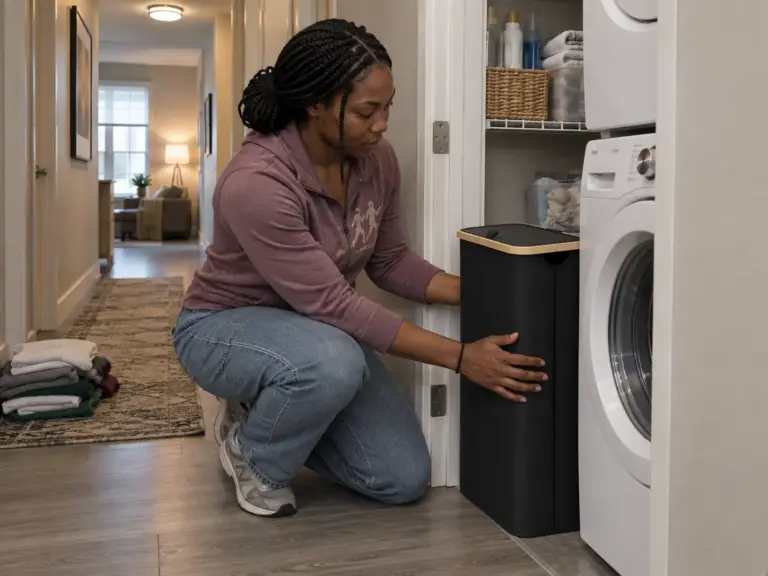
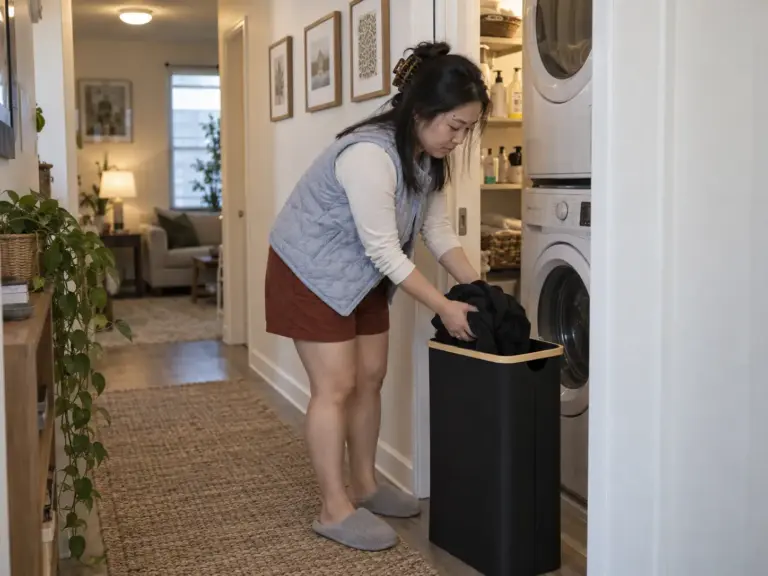
Sorting belongs where clothes come off. The SpaceAid Slim Laundry Hamper with Lid works as that drop point: at 16 x 8.75 x 28 inches, it fits beside a dresser or inside a laundry closet, though it’s a single compartment, so plan on one per stream. Need a different footprint? See these laundry hampers for small spaces.
Then start, switch, and fold and put away in the same session the dryer ends. My rule: the basket goes back empty, or the load doesn’t count. Fold on the bed, not the couch (you can’t sleep under a pile of shirts, so the deadline enforces itself).
Take the Small Decisions Out of Every Load
Every mid-load question (“can this go in?”, “where’s the stain spray?”) is a place the routine stalls; settle the categories once with these laundry sorting system ideas.
Delicates are the classic snag: a lace top waits for a hand-wash session that never happens. A mesh laundry bag fixes that: the BAGAIL Mesh Laundry Wash Bags (Set of 5) let most of those items ride along in the regular load or on a delicate cycle, though a hand-wash-only care label still wins, bag or no bag.
Then laundry supplies storage. Professional organizers at NAPO recommend a simple split: “Keep everyday supplies readily accessible by the machines. Store infrequently used and non-laundry products out of the way.”
Any lidded jar you already own handles that for free. The COAZEX 3 Pack Laundry Powder Container & Dryer Sheet Holder is a budget set with matching lids, worth it only if you decant.
Daily Loads or One Laundry Day? Pick a Cadence by Household Size
One load a day sounds like a lot until you see what normal already is.
What Normal Actually Looks Like
Industry estimates put the average US household at about 7.4 loads a week, roughly 50 pounds of laundry, which is close to a load a day. On Mumsnet, a UK parenting forum, families of four mostly landed between four and eight loads a week, and two things explained most of the spread: drum size and how often bedding and towels went in. So a family running a load a day isn’t over-washing. It’s matching the average and spreading it out.
For a single-person laundry routine, or a couple, skip the number entirely. Run a load when one section of the hamper is full. That rule scales itself (a week of gym clothes fills it faster), and honestly, it’s the only cadence rule a solo household needs.
One Load a Day vs. One Laundry Day — Who Each One Fits
One load a day (plain daily laundry) fits families and anyone home during the same window every day. Loads stay small, so the fold and put-away stay a short job. One fixed laundry day, a weekly laundry schedule built around a single day, fits singles, couples and anyone without in-unit machines. But the fold lands at the end of a long session, so put the fold on the calendar, not just the wash.
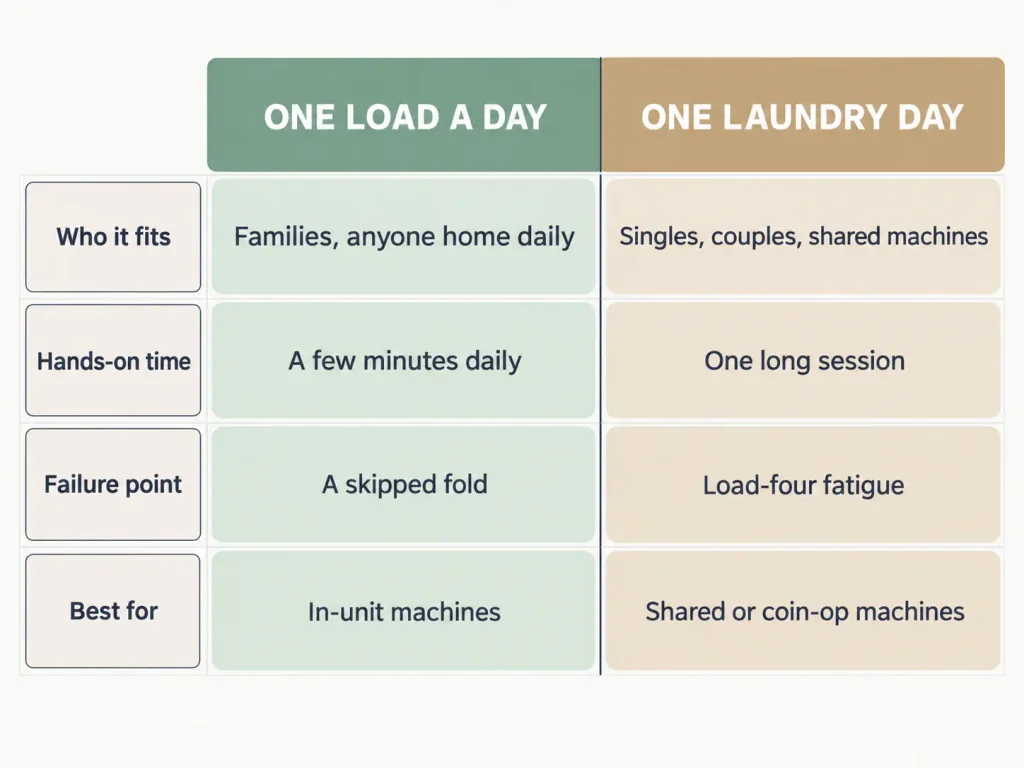
The daily method gets recommended as everyone’s default. And it works, as long as someone is home when the washer ends; rotating shifts or a washer in a shared basement break it within a week. A laundry day fails at load four, not load one, when three loads sit unfolded and you’ve been at it since breakfast. Fold load one while load two dries.
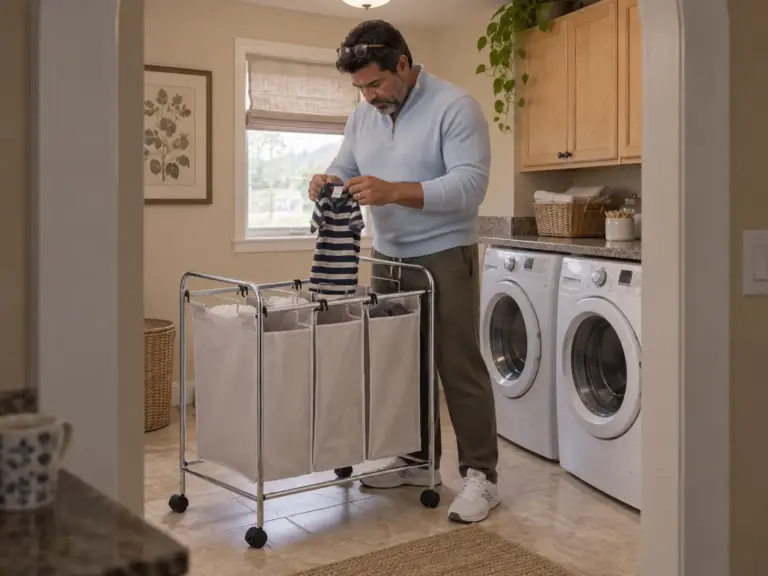
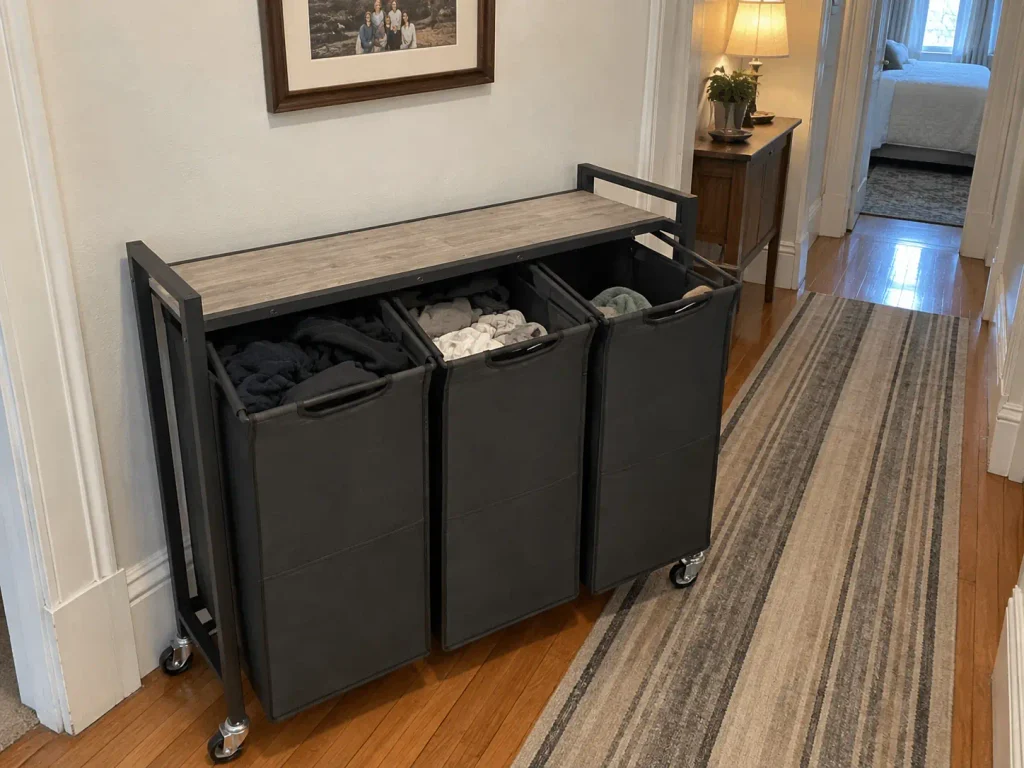
A family laundry routine also can’t hinge on one person. Give everyone a stream to drop into: the HOOBRO Laundry Sorter 3 Section, Laundry Hamper with Wheels splits into three 11.5-gallon bags and rolls to the machine. It needs more floor than a slim hamper, which makes it the family pick; in a studio, the SpaceAid still fits better.
Then assign laundry tasks by step, not by load: one person starts it, one switches it, and whoever owns the clothes puts them away. Kids old enough to carry their own folded stack back can close their own loop. A plain laundry chore chart taped inside a closet door does the reminding, so the person who set the system up isn’t the one nagging about it.
Cut Loads Without Cutting Corners
The free cut: wash bedding and towels every other week instead of weekly. Several families in that Mumsnet discussion do exactly this to drop a load or two. One household of four adults there holds four or five loads a week with five fixed categories (darks, whites, reds and browns, greens and blues, towels and bedding), so nobody decides anything on wash day.
Combining colors helps too. Shout Color Catcher Sheets, 24-count pick up loose dye in the wash water, so lights and mid-tones can share one drum instead of two.
They won’t make brand-new dark denim or a red cotton tee safe with whites; wash those alone the first few times. One respondent in that same discussion called moving from a 6 kg to a 9 kg drum their single biggest cut. Worth knowing if you’re replacing a washer anyway. Not a reason to buy one.
Building a Laundry Routine When You Don’t Control the Machine
Most laundry advice assumes in-unit laundry, with the washer ten steps from your bed. For a lot of renters it’s a coin-op washer several floors down, shared with the whole building.

A Shared Laundry Room Runs on a Timer, Not a Trigger
In a shared laundry room (the communal laundry room in the basement, usually) you can’t start a load and deal with it tomorrow, because someone else needs the machine. Apartment-etiquette guides agree on the rule: be back when the cycle ends. So a renter-friendly laundry routine runs on two phone timers, one for the wash (60 to 80 minutes on normal) and one for the dry (around 45). Miss the return by forty minutes and you’ll find your wet load in a heap on top of the dryer.
The trigger becomes the hour the machines are reliably free, usually early mornings or a weeknight slot most neighbors skip (you’ll spot yours within a few trips). For what it’s worth, the time you lose isn’t the wash. It’s standing there with a full basket waiting for a machine, so pick the slot, not the day. If the room itself is the sticking point, this guide to laundry room organization for apartments covers the etiquette and the restock routine.
The Laundromat Version Is a Batch Day on Purpose
At a laundromat, one load a day doesn’t exist; nobody makes seven trips a week. This is the case where a fixed laundry day is the right answer, not the lazy one. The step that decides whether it works: fold at the laundromat tables before you leave. Carrying unfolded clothes home is how the mountain starts, first in the back seat, then on the chair.
Pre-Sort and Pack a Go-Kit at Home
A shared room gives you nowhere to sort, so sorting happens entirely at home. That’s where the rolling HOOBRO sorter earns its floor space: three bags, three loads, and wheels to the elevator or the front door.
Keep a go-kit by the door with detergent for one trip, a stain stick, and reusable dryer balls, so nothing runs out mid-trip. The Wool Dryer Balls, Smart Sheep 6-Pack XL replace the box of dryer sheets you’d otherwise restock and carry. They add no scent on their own, and they’re a swap for sheets, not a shortcut for your schedule.
Restock the go-kit the minute you get home. With the empty detergent pouch still in your hand, it takes thirty seconds; six days later, it’s the reason you’re in the laundry room with nothing to wash with.
When the Routine Breaks: Recovery and the Three-Month Check-In
It will break: a sick week, a work trip, a new job. The difference between a routine and a resolution is whether there’s a plan for that week.

Clear the One Backlog, Not the Whole System
After a bad week, the pull is to start over with a new schedule and a fresh Monday. Skip it. The recovery point is the single overflowing hamper, not the system: run the laundry backlog, fold it the same day, and resume your normal cadence tomorrow.
A catch-up day is the right call exactly once. The trouble starts when catch-up Saturday quietly becomes the schedule, and you’re back to one frantic day a week with a daily routine on paper that nobody runs.
Count the mountain before you dread it, too. It looks like ten loads. Actually, it often turns out to be two, because clothes heaped on a chair take far more room than the same clothes folded in a drawer. That’s it: one evening, back on track.
Re-Anchor When Your Life Changes
Sometimes the routine didn’t break; the trigger disappeared. A new shift, a baby, a move, and the coffee you tied the load to now happens at 5:40 a.m. in a rush.
Pick a new daily cue. That’s the fix, not more discipline. And expect the clock to restart: a re-anchored routine is a new habit, so the 66-day average applies again, and a few weeks of effort is part of the deal.
The Three-Month Check
Call it the three-month test, the only routine maintenance this system needs.
At three months, ask three things. Is the basket going back empty? Which step keeps getting skipped: the start, the switch, or the fold? Did the load count creep up (towels back to weekly, say)?
Change the step that fails, not the whole routine. A fold that never happens at night might happen in the morning with coffee. A switch that keeps getting missed usually means the trigger window is wrong, not the timer. If the room itself is the problem, work through these small laundry room organization ideas that hold up before touching the schedule, and fold the laundry check into a short monthly reset of the rest of your place.
Put the three-month check on your calendar the day you start, with the three questions typed into the event. When the reminder pops up, it asks the questions for you.
The Load Isn’t Done Until the Basket Is Empty
Tie the load to a trigger you already hit every day, not to a free moment that never shows up. Sort at the source and fold the same day, because the loop only closes at put-away. And match the cadence to your household and your machine access, not to someone else’s Sunday schedule.
In three months, look at one thing: does the basket go back empty? If not, fix that one step.
Pick your trigger tonight. Run one load tomorrow. Fold it before bed.
Frequently Asked Questions
01How can I create a laundry schedule?
Anchor one load to a daily habit, or pick one fixed laundry day if you use shared machines, then sort into a divided hamper as clothes come off. Fold everything the same day, and adjust how often you wash to the size of your household.
02What are the 7 steps of laundry?
The seven steps of laundry are sort, pretreat stains, wash, dry, fold, iron if needed, and put away, repeated as a loop rather than a one-time event. Putting away is the step most people skip, and it’s where most routines quietly fail.
03How many loads of laundry a week is normal?
Industry estimates put the average US household at around seven loads of laundry a week, which works out to roughly one load a day. Families of four on a UK parenting forum reported four to eight, depending on drum size and how often bedding gets washed.
04Is it better to do laundry every day or once a week?
Daily small loads suit families and anyone home at the same time each day, while one fixed laundry day suits singles, couples and anyone using shared machines. The better choice is the one where you actually fold everything the same day.
05What should I do when my laundry piles up?
Clear only the one backlog: wash, dry and fold it the same day, then go back to your normal laundry cadence starting the very next day. Don’t restart the whole system or turn a catch-up day into a new weekly rule.
Disclaimer: ClutterlessNest is a participant in the Amazon Services LLC Associates Program. As an Amazon Associate we earn from qualifying purchases. This article may contain affiliate links — if you buy through them, we may earn a small commission at no extra cost to you. We only recommend products we have tested or genuinely believe in.