























In this article
You dump the drawer out on the counter, sort it, put it back neater, and it looks great. Six weeks later it’s identical. Here’s the part almost every guide gets wrong: the fix is almost never a better divider, because almost nothing in that drawer is actually junk. It’s a tape measure, a spare key, a flashlight, a charger for a phone you still own: working things with nowhere else to live. The junk drawer organization ideas below start from that fact instead of ignoring it, and they cover what to keep, what to measure, what to build for free, what to buy, and how many of these drawers a home should have at all.
Quick Answer
Organize a junk drawer in six steps, in this order:
- Empty it completely so you can see every item.
- Test what’s left and toss anything that fails.
- Sort the rest into named categories, not one pile.
- Measure the drawer’s interior before buying any organizer.
- Give each category a bounded slot, batteries in a closed case.
- Reset it for five minutes once a month.
Why Junk Drawer Organization Ideas Miss the Real Problem
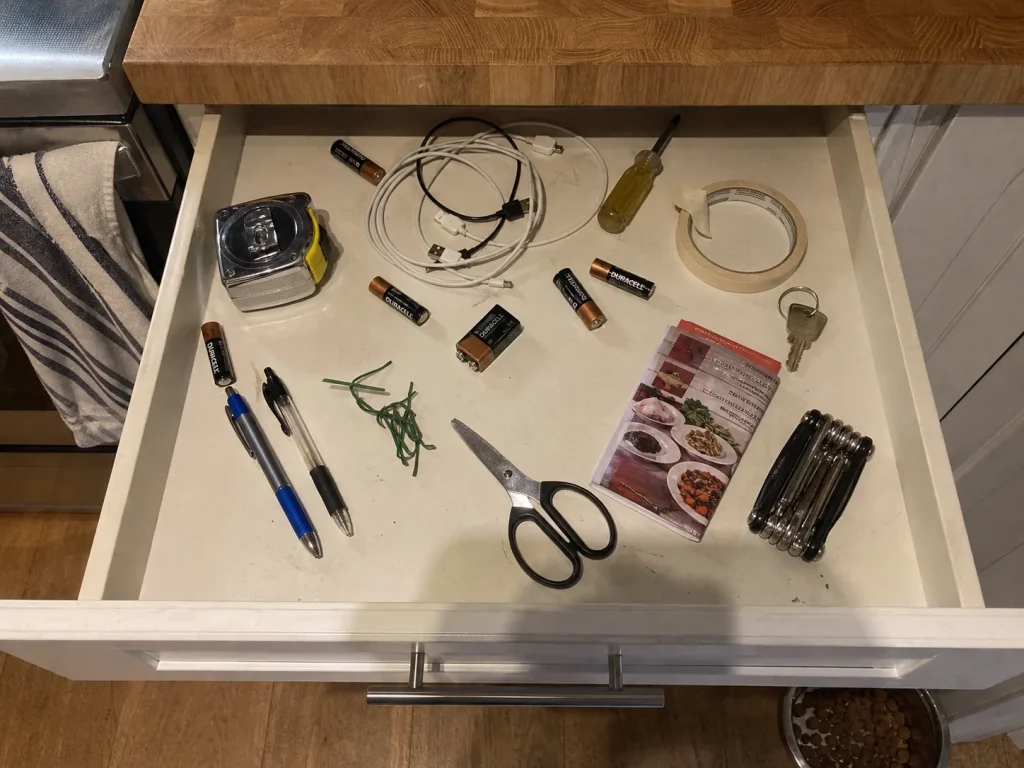
Every guide on this topic opens the same way: throw out what’s broken. Dead pens, snapped rubber bands, a glue stick that dried out during a previous administration. That advice is fine. It’s also about 20% of the problem, and it’s the 20% you’d have solved on your own.
The other 80% is the stuff that works. The extra garlic press. The appliance manual. The spare key to a door you’re no longer certain exists. None of it is broken, none of it is useless, and none of it has a home anywhere else in the house. So it goes in the drawer, because the drawer is the only place in your kitchen that accepts items without asking questions.
That’s the actual mechanism, and it’s why the drawer refills. Call it the catch-all drawer, the black hole drawer, whatever your household calls it: it isn’t a trash problem you can declutter or purge your way out of. It’s a homelessness problem. This is the might need it later trap, and it’s the part no guide names, because the item isn’t what’s broken. The undecided state is. Anything you haven’t made a decision about defaults to this drawer, every single time, and the pile reconstitutes itself in six weeks whether or not you bought a divider.
Which is why dividers alone fail so reliably. A tray full of neat compartments still collapses if the categories inside don’t match how you actually use the drawer, and the most common version of this is subtler than skipping dividers entirely: people buy the tray, use it correctly for two weeks, then start dropping things into whichever compartment is closest. If one of those compartments is unnamed, it becomes the miscellaneous section, and the miscellaneous section eats the drawer inside a month. It always wins. Give it a corner and it takes the whole thing.
The fix starts with a rename. Professional organizer Amanda Titchenal of Well Organized calls hers a utility drawer, and that isn’t a cosmetic change. A utility drawer has a job you can say out loud: batteries, tape, cables, small tools. A junk drawer has a name that grants it permission to be a dumping ground. Everything below is really just the work of giving this one drawer a job, and it plugs into the wider kitchen drawer organization system where every other drawer already has one.
Empty the Drawer and Sort What’s Actually Left

Dump it all on the counter. Not a tidy-around-the-edges pass, not “I’ll just pull out the obvious stuff.” Everything out, drawer bare. You cannot size a system for contents you can’t see, and you can’t see contents that are three layers deep.
Now test as you go, because this is where the easy 20% leaves. Pens get a scribble on a scrap of paper. Batteries get a tester or a device you know works. Tape gets a thumbnail check for whether the adhesive has gone chalky. Lighters get a flick. Anything that fails goes straight to the bin, not back on the counter to be re-considered later.
Then sort what survived into named categories rather than one improved pile. In most kitchens the real set comes out to something like batteries, adhesives and tape, writing tools, cables and chargers, small tools and hardware (a screwdriver, a multi-tool, loose screws and push pins), keys, and measuring. Your set will differ slightly. That’s the point of doing it before you shop.
Here’s the question that does the actual work, and it comes straight from the mechanism above: for each functional item, does this have a home somewhere else? If yes, it leaves the drawer now. Walk it to the cabinet or drawer where it actually belongs while you’re standing there, because “I’ll deal with it later” is how it got in the drawer the first time. If the honest answer is no, it earns a slot. The pile that survives both filters is your category list.
The things that quietly refill this drawer never look like junk. Loose batteries you can’t remember testing, pens at 5% ink, cords for something. Individually they all pass the eye test, so nobody removes them until the drawer is full again. Test them explicitly or they live there forever.
Measure Your Drawer Before You Buy Anything
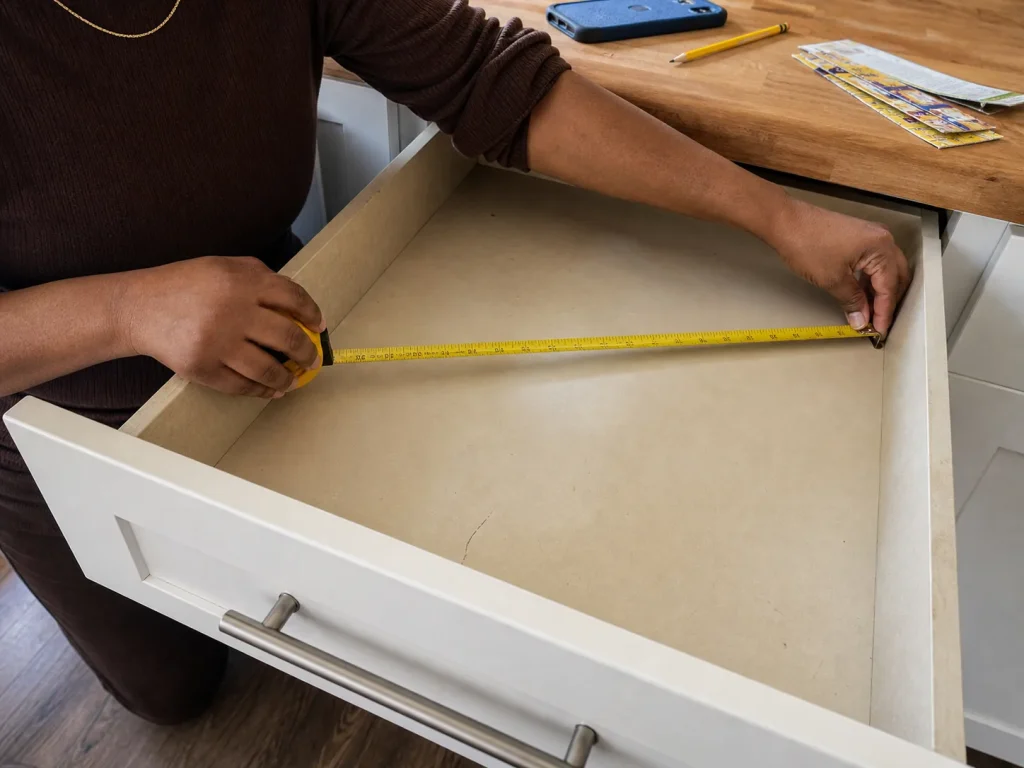
Utensil drawers are boringly consistent, which is why generic dividers mostly work in them. Junk drawers are wherever the cabinet layout left a gap, so they’re the wild card of the kitchen. This is the section where you find out yours is 19 inches wide and every tray you’ve been looking at was photographed in a 24-inch one.
Standard US kitchen drawers run roughly 12 to 36 inches wide, with 18 to 24 inches covering most general-purpose drawers. That range is why buying before measuring goes wrong so often: a divider sized for an 18-inch drawer rattles loose in a 24-inch one, and a 24-inch tray simply will not go into an 18-inch box at any angle.
Measure the interior, not the drawer front. The face panel overhangs the box on most cabinetry, so the number you’d get by measuring the pretty side is bigger than the number that matters. That single gap accounts for a lot of returns. The same measure-first rule applies to dresser drawers and their inserts: different room, identical failure.
Then check the two constraints nobody thinks about. Depth is the first: a typical shallow kitchen drawer gives you about 4 to 6 inches, which quietly disqualifies most of the tall multi-tier organizers that photograph so well. The second is pull-out clearance, which is how far the drawer actually travels and whether the countertop lip clips the back of a tall tray on the way out. A tray that fits the box but can’t clear the opening is still the wrong tray.
All of which leads to one rule: buy for the drawer you have, not the drawer in the photo. And if your numbers land somewhere between standard sizes, which they usually do, that’s your argument for adjustable or modular over fixed.
The iDesign Linus Drawer Organizer (Amazon) is a useful reference point here at roughly 6 by 9 inches and 2.25 inches tall, low enough to clear the shallow-drawer depth that rules out taller trays, and because the pieces interlock you commit to one unit against your measured width instead of guessing at capacity. More on where it goes in a moment.
Start With What You Already Own
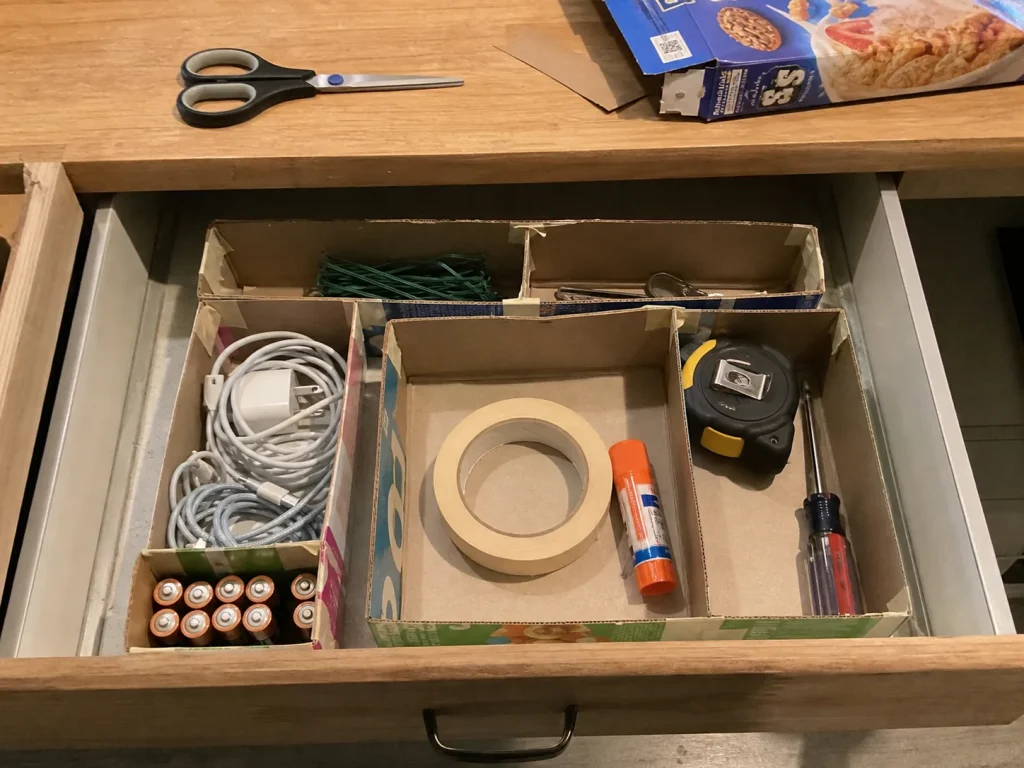
Nobody writes this section, because free systems don’t pay commissions. Even the dollar-store organizing posts are still selling you something. But the junk drawer is the single best place in the house to test your categories before spending anything, for one reason: your categories will change in the first month. Cardboard is a much cheaper way to be wrong than a tray is.
The method is the cut-to-fit box grid. Cereal boxes, granola bar boxes, and tea boxes cut down to your drawer’s interior depth and taped or glued into a grid matched to your actual category count. This isn’t a theoretical suggestion that photographs once and dies. Real households report it genuinely holding, months later, doing the same job the plastic version does.
And that’s the part worth sitting with. The free grid isn’t a poverty version of a real system — it’s a prototype. Live with it for a month. The compartments that get used are the categories worth buying a proper tray for. The ones that stay empty are telling you your list was wrong, and it cost you a cereal box to find out.
Most people do this in the opposite order: buy the tray, discover the layout is wrong, and then live with the wrong layout because they already paid for it. This is the same give-every-item-one-home principle applied to a drawer instead of a whole kitchen.
The repurposing goes further than boxes, and it maps onto real categories rather than generic advice. Pill organizers hold screws and picture hooks in separated cells. Ice cube trays isolate batteries and small hardware. Mason jar lids catch loose change and tiny parts that would otherwise migrate to the corners.
Renters, this drawer is free of charge. Every solution worth using here is freestanding: it drops in, it lifts out, nothing bonds to the drawer box. If a setup asks you to adhere or screw something to the inside of a drawer you don’t own, it’s the wrong setup for a problem that has a zero-damage answer. Skip the contact paper for the same reason: it’s adhesive-backed, and a drawer you don’t own is the last place to find out how it comes off. Non-adhesive liner cut to size stops the grid sliding without bonding to anything.
The honest limit: cardboard warps if anything wet or greasy ends up in the drawer, and it looks like cardboard. That’s the whole trade. It’s a real one, and it’s still worth a month of your time before you spend money.
Build the System One Category at a Time
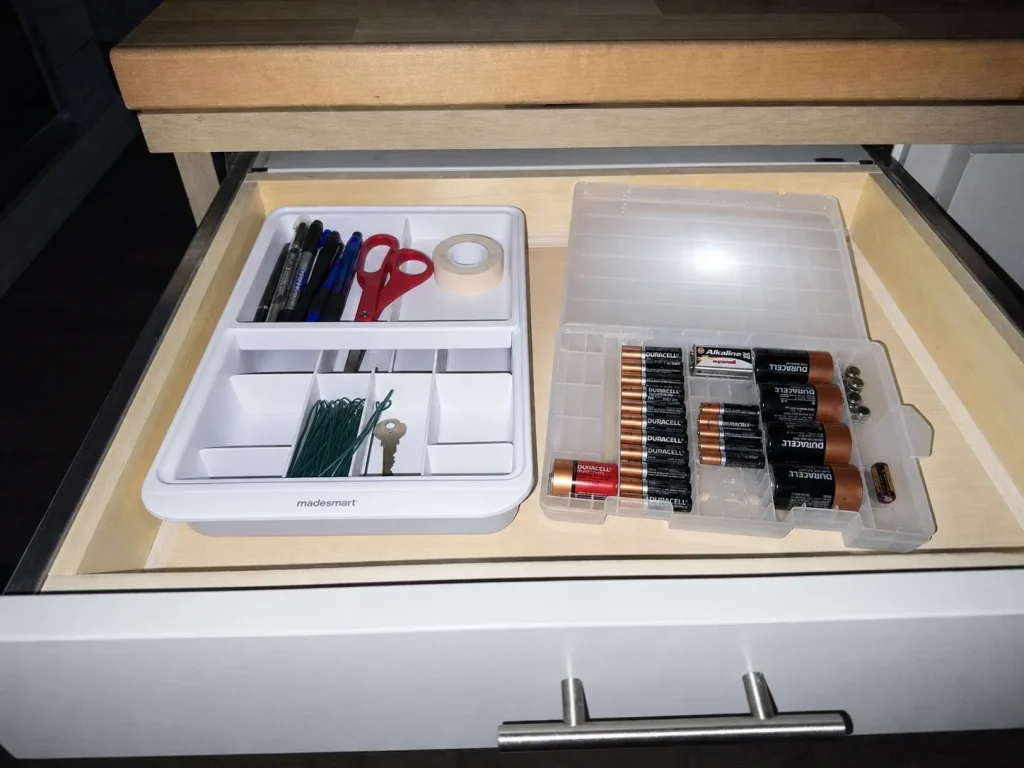
The standard product advice in this niche is one sentence long: get a divider. That’s useless, because the categories in this drawer fail in completely different ways. Batteries fail as a safety problem. Cables fail as a volume problem. Pens fail as a decision-fatigue problem. One tray cannot answer three different questions, and pretending it can is why the tray ends up half-empty and half-chaos.
So match the container to the failure mode, not to the photo. Everything below is freestanding and drops straight in, which carries the renter rule forward without needing a separate section for it.
The Backbone Tray for Everything With a Name
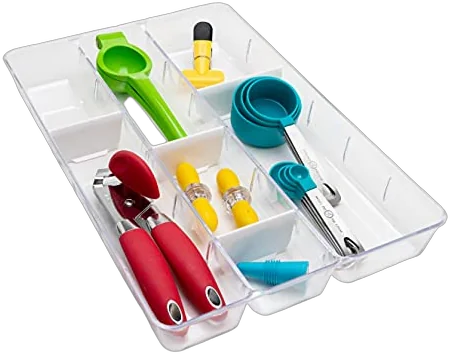
Your bulk categories (tape and adhesives, writing tools, measuring, keys) want one tray with real boundaries. The failure mode here is category drift. Fixed-compartment trays lock you into the manufacturer’s guess at your life, and when your categories shift (they will, in month one) the mismatched compartments quietly become the new miscellaneous section. You solved nothing; you just bought a nicer container for the same problem.
Movable dividers answer that directly, because they reconfigure to the categories that actually survived your prototype month.
Batteries Get a Closed Case, Not a Corner
This is the one category in the drawer with a reason to be bounded that has nothing to do with tidiness. A 9-volt battery carries both of its terminals side by side on the same face, unlike an AA, which keeps them at opposite ends.
That geometry is the whole issue: a loose 9V rolling around against a paper clip, a coin, or another battery has a real path to bridge its own terminals. It’s why fire departments specifically warn against storing 9-volt batteries loose in a drawer near metal objects, and why a state consumer-safety bulletin on the short-circuit risk says the same thing about batteries you think are dead.
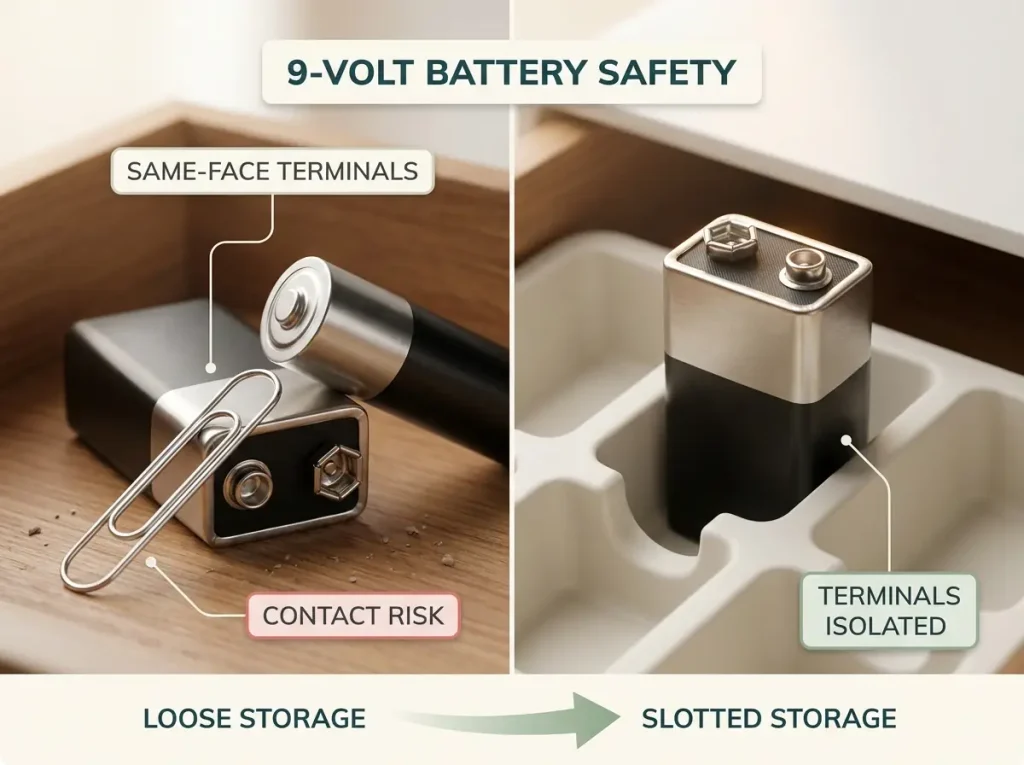
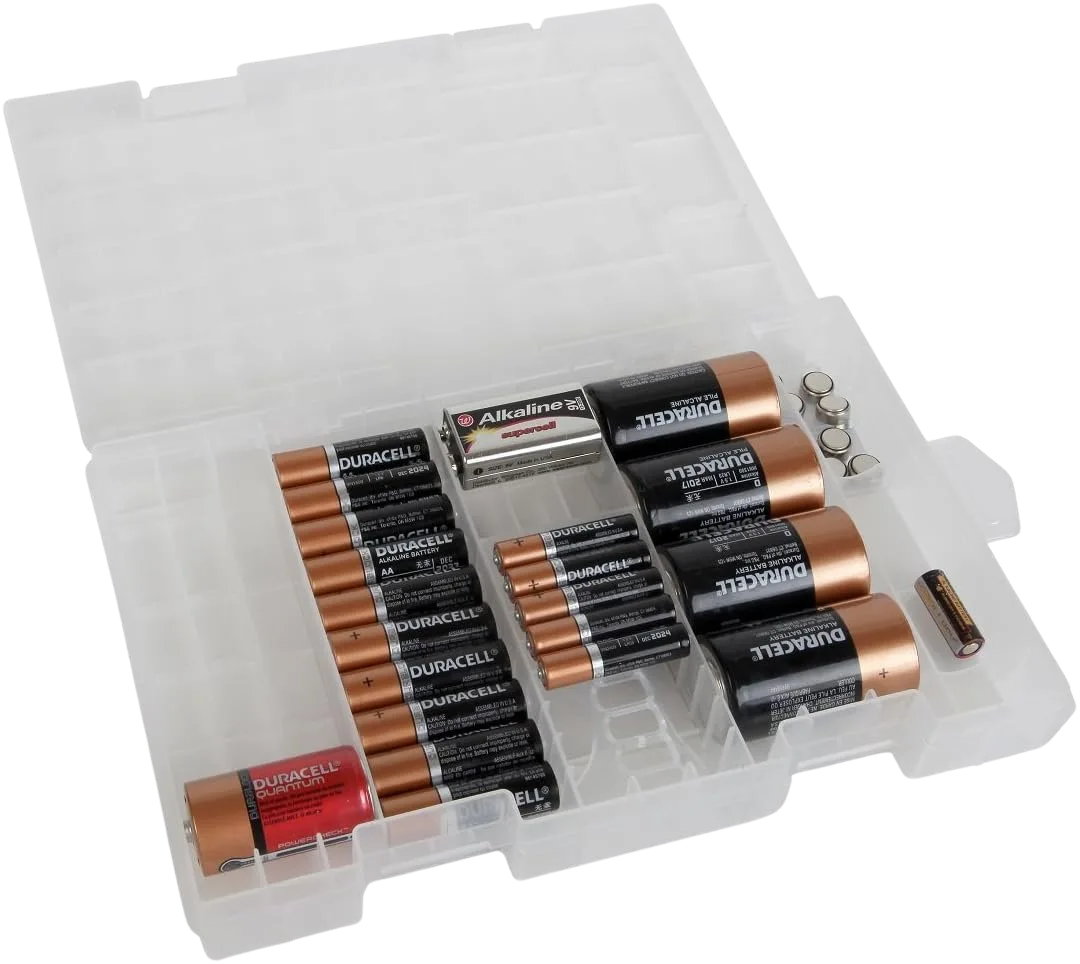
So the batteries stop being loose. That’s non-negotiable, and the free version from the last section (an ice cube tray, jar lids) does the isolation job at zero cost. A dedicated case is the upgrade, not the requirement.
The Everyday Zone That Never Changes
I used to push adjustable dividers on everyone. Then enough people described the same thing in organizing threads: they never moved the dividers once, not in a year. That changed my mind about who needs them. If your everyday zone is pens, tape, scissors, and twist ties, that list has not changed since you moved in and it is not going to. For you, fixed compartments aren’t a limitation. They’re one fewer decision.
The madesmart 13-Compartment Junk Drawer Organizer with Sliding Top Tray (Amazon) is the version of that with a second floor: the top tray slides back to reach the layer underneath, which is the only honest way to get two levels out of a drawer that shallow. The trade is exactly what it looks like. You’re accepting madesmart’s compartment sizes instead of your own, so this is the wrong call if your prototype month showed your categories are still moving.
Cables, Chargers, and the Small-Tool Corner
Cables are the category that breaks fixed layouts, which is why buying a dedicated cable organizer sized to today’s pile is usually wasted money. Their volume never sits still. You buy a new phone and inherit two cords. You throw out a lamp and lose one. Committing to a fixed footprint here on day one is a guess you will lose.
That’s what the iDesign Linus from the measuring section is for. Because the pieces interlock, you start with one unit for the cables and small hardware and add a second only when the volume actually demands it, rather than buying capacity you’re hoping to grow into. It’s the answer for the reader whose measurement landed between standard tray sizes (which, as established, is most readers).
Leave one compartment empty on purpose and don’t name it. Not as a miscellaneous section, as slack. Every system needs somewhere for the thing that arrives on a Tuesday and hasn’t been assigned yet, and a named-but-empty slot is how you keep that item from being crammed into the tape compartment where it starts the drift all over again.
How Many Junk Drawers Your Home Actually Needs
There’s a purist strain of organizing content that treats the junk drawer as a personal failing to be abolished. That’s wrong, and it’s exactly why those systems don’t survive contact with an actual house.
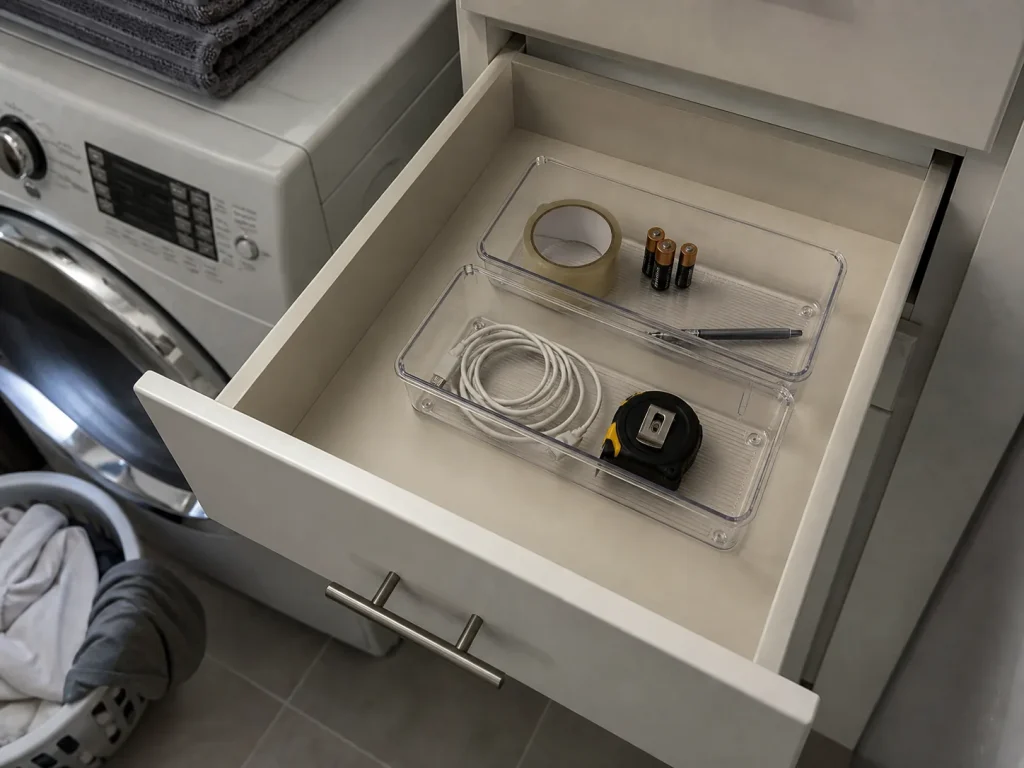
Start with the on-record answer, because there is one and almost nobody quotes it. Titchenal aims for exactly one per house, reframed as a utility drawer, with one stated exception: a large or two-story home can justify one upstairs, often in a laundry room, and one downstairs in the kitchen. One per floor. Not one per room.
The count is doing the real work there. Two utility drawers is a system. Five is a house where nothing has a home and the overflow simply found five hiding places instead of one. The number is the boundary that makes the naming mean anything, because a drawer that can spawn siblings whenever it’s full has no constraint on it at all.
And abolishing it entirely fails for the reason this whole article has been circling: the orphaned-item problem does not evaporate because you refused to allocate a drawer to it. Deny it a drawer and it moves to a counter, then a basket, then a shopping bag in a closet. That’s a worse outcome by every measure, and it comes with a special indignity — at least the drawer closes. Professional organizers put a drawer aside on purpose. It’s the number they argue about, not the existence.
So the proximity test: a second utility drawer is only justified when the distance to the first one is what creates the pile. An upstairs laundry room, two floors from the kitchen, qualifies honestly. The dining room, eight feet away, does not — that’s not a second utility drawer, that’s the first one failing.
Then the test for whether yours has earned its place. Say its job out loud, in one sentence. If you can’t, it isn’t a utility drawer yet. It’s a junk drawer with a nicer label, which is where most professional organizers would tell you the work actually starts.
The Monthly Reset That Keeps It From Refilling
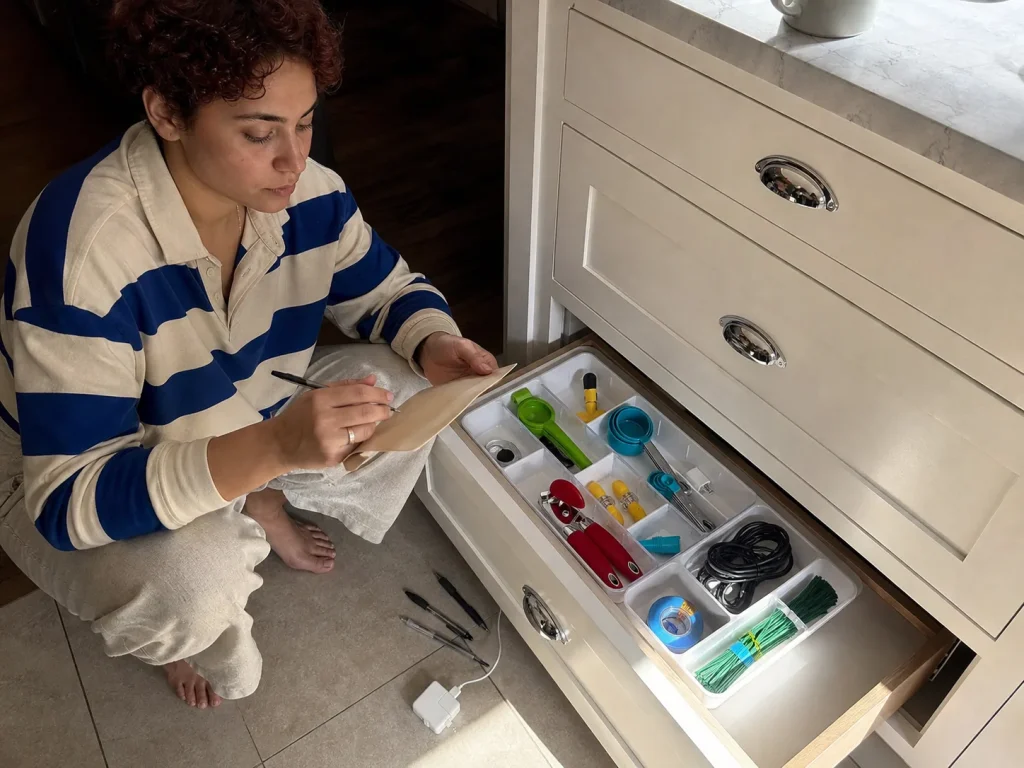
Every maintenance recommendation in this niche fails for the same reason: it’s too big. “Deep clean quarterly” translates to never, because a quarterly task is a project and projects need a free Saturday. The junk drawer is the rare space where the honest number is five minutes — and a task you believe is five minutes is a task you’ll actually start.
The consensus cadence across the sources that bother to name one is about five minutes, roughly monthly. That’s it. Pull the drawer, scribble-test the pens, remove anything that drifted in without a category, put back what belongs.
Watch for one signal specifically, and it’s the same one from the opening: the moment something is in there because you haven’t decided about it yet, the drawer has started reverting. Undecided is the entire disease. If an item is sitting there undecided at reset time, decide it right then or send it somewhere else — the drawer is not a waiting room.
Between resets, the one-in-one-out rule is the guardrail, applied to categories rather than items. The drawer holds its category count, not its item count. A new charger means an old charger leaves the house, not that the cable compartment gets a little fuller.
The reason this holds when the deep-clean doesn’t is that you’re maintaining a bounded, named system rather than re-litigating forty objects from scratch. The reset is a check against a rule you already made. That’s the difference between five minutes and an afternoon, and it’s why it’s still running in month six.
The Bottom Line
Your junk drawer isn’t full of junk. It’s full of working things with no other home, and until each one either gets a home or gets a named slot, no organizer on the market fixes it.
Measure the interior first, prototype the layout in cardboard for a month, then buy a tray sized to the categories that actually survived. Bound the whole thing: one utility drawer per floor, a job you can name in one sentence, five minutes once a month.
The three-month check: open the drawer and look for the section you can’t name. That’s where the miscellaneous category is growing back, and it’s the only part that needs your attention.
Empty the drawer tonight. Sort what’s left into piles on the counter and leave it there overnight. Whatever you haven’t reached for by tomorrow morning is telling you what the drawer is really for.
Frequently Asked Questions
01What should you keep in a junk drawer?
Keep only the categories with no other home in the house: batteries, tape and adhesives, writing tools, cables and chargers, small tools and hardware, keys, and measuring. Anything that has a home elsewhere goes back to it, and anything that fails a quick test leaves the house.
02Which junk drawer organization ideas work in a shallow drawer?
In a typical 4 to 6 inch drawer, low-profile freestanding trays and interlocking modular units fit; tall multi-tier organizers do not clear the opening. Measure interior depth and pull-out clearance before buying, and choose adjustable or modular if your width lands between standard sizes.
03Should every home have a junk drawer?
Yes, one. Professional organizers generally aim for a single utility drawer per home, with a second justified only on a separate floor. Amanda Titchenal of Well Organized names the upstairs-laundry and downstairs-kitchen split as the exception. The count is what has to be bounded, not the drawer itself.
04How do you organize a junk drawer without buying organizers?
Cut cereal, granola bar, and tea boxes down to the drawer’s interior depth and tape them into a grid matched to your categories. Pill organizers hold screws and picture hooks, ice cube trays isolate batteries, and jar lids catch small parts. The free grid doubles as a one-month prototype.
05How often should you clean out a junk drawer?
About five minutes, once a month. Test the pens, pull anything that drifted in without a category, and decide on anything sitting there undecided. The undecided items are what refill the drawer, so a monthly pass catches them before the pile rebuilds.