






















In this article
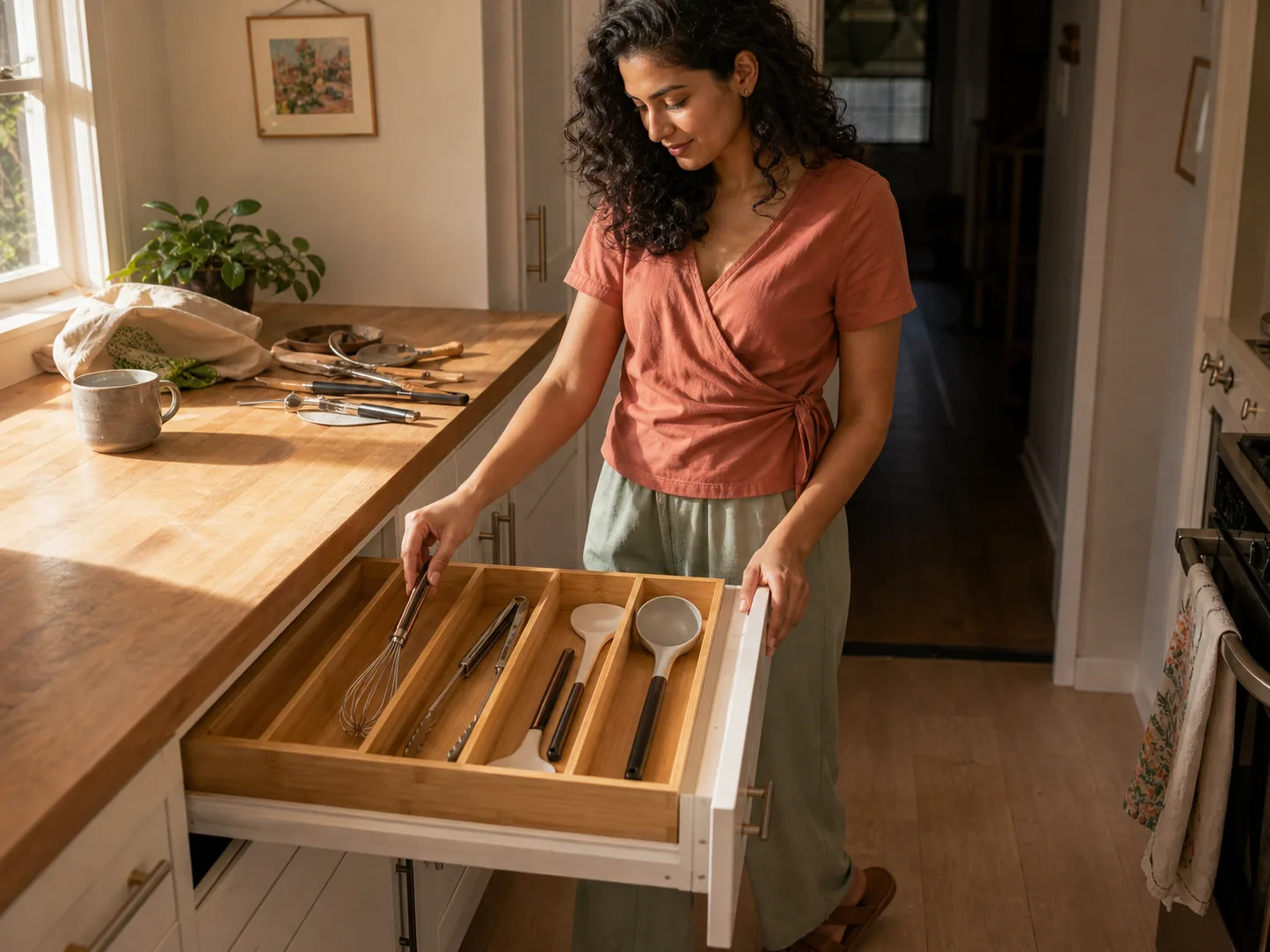
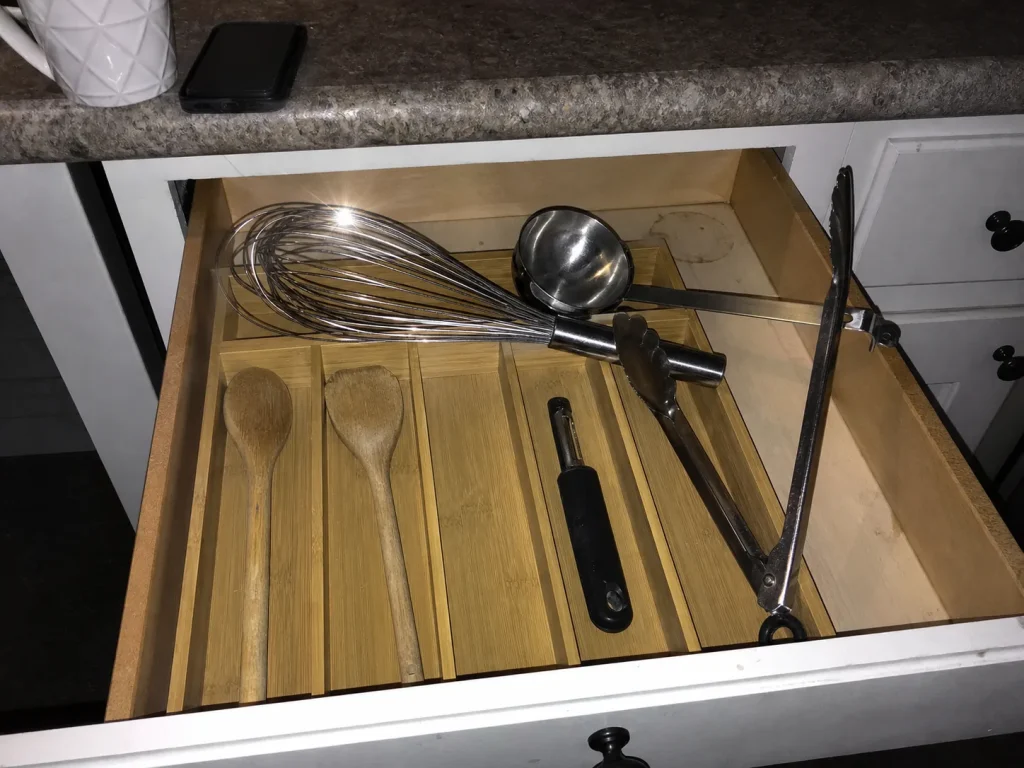
You push the drawer shut and it stops an inch from closed, so you shove it, and somewhere in there a whisk is lying sideways across four compartments like a fallen tree. The fix is almost never a bigger drawer or a tidier you. It’s that the tray you bought was built for forks, and you filled it with tools that have heads. Good utensil drawer organization starts by admitting the shapes don’t match, and everything after that (what to pull out, what to measure, what to buy) follows from it.
Quick Answer
Organize a utensil drawer in five steps, in this order:
- Empty it and keep only tools you actually cook with.
- Move your everyday handful to a crock near the stove.
- Measure the drawer’s interior width, depth, and clearance.
- Buy a tray with slots deep enough for a spatula head.
- Reset monthly and swap one tool out for every new one in.
Why Cooking Utensils Don’t Fit a Standard Drawer Organizer
Nobody warns you that “utensil organizer” means two completely different products. One is built for silverware. The other is built for the things you cook with. They live on the same shelf at the store, they’re both bamboo, and only one of them will ever close your drawer.
The Four Shapes That Break a Flatware Tray
A flatware compartment is engineered around one assumption: the object inside is flat, narrow, and uniform from end to end. A fork is. A spoon is. That’s the entire design brief. Your cooking tools break that assumption four different ways, and each one breaks it differently.
A whisk has a bulbous wire head that’s three times wider than its handle. A ladle has a bowl that needs somewhere to sit. Tongs are spring-loaded, so the hinge end pushes itself open the moment nothing holds it shut. A turner has a wide flat blade that’s fine on width but wrong on length. Four problem shapes, none of them fork-shaped, all of them living in a tray that only knows how to hold forks.
Here’s the diagnosis that saves you an hour: the tool that jams your drawer is basically never the spoons. It’s whichever tool has a head wider than its handle. Once you see that, the whole drawer makes sense.
Slot Depth Is the Real Problem, Not Slot Width
Most people blame the width. They look at the whisk, look at the compartment, and think they need a wider slot. Width is rarely what’s failing. A flatware slot is shallow because a fork lies flat and needs maybe half an inch of relief to disappear below the divider line.
A spatula head or a ladle bowl needs real depth, and in a shallow slot it simply rides up and sits on top of the divider wall instead of down inside the channel. Now the tool is taller than the drawer, and the drawer catches on the cabinet frame above it. That’s the inch you’ve been fighting. Your drawer isn’t overfull. It’s mis-slotted, and those are two different problems with two different fixes.
The Product Catalog Already Knows This
The strongest evidence that this is a real mechanism and not an editorial framing is that manufacturers already sell around it. OXO makes a tray built specifically for long-handled tools as its own product, separate from its flatware organizers. Bellsal markets a bamboo tray explicitly for large cooking utensils and baking tools, with deep slots instead of fork channels.
Amazon’s own catalog draws a product-category line that nearly every article about this drawer collapses into one bucket called “utensils.” If you’ve been shopping the wrong category, that’s not a you problem. Nobody labeled the aisle. This is also where the fix diverges from the rest of the broader kitchen drawer system, where the flatware drawer genuinely is a flatware problem and the standard trays genuinely do work.
Empty the Drawer and Sort by What It Actually Is
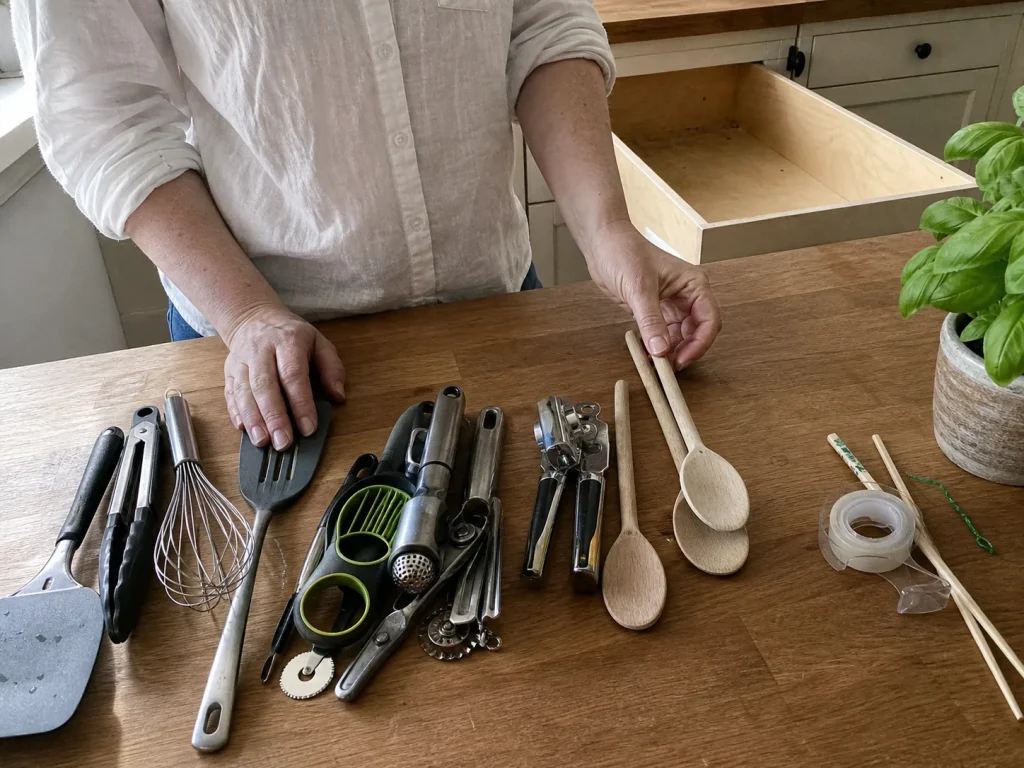
This drawer eats every gadget that ever entered your house. The avocado tool from a registry. Two can openers, because nobody could find the first one. Three wooden spoons that are, if you’re honest, the same wooden spoon. Nobody ever decided to keep any of it. It just never left.
Everything Out, Onto the Counter
Take it all out. Not “tidy it up,” not “sort it in place.” Out, onto the counter, in a pile that will briefly make you feel like a person who owns too many spatulas. You cannot diagnose a shape problem while the shapes are stacked on top of each other, and you cannot measure a drawer with tools in it.
It takes almost no time and it’s the step people skip anyway. It’s also the step that decides whether you need to buy anything at all.
The Four Piles
Don’t sort by category here. Categories are how stores organize, not how you cook. Declutter by honest frequency instead, into four piles:
- Cook with it weekly. The turner, the tongs, the slotted spoon, the whisk you actually use.
- Cook with it rarely. The pastry brush, the meat thermometer, the garlic press, the zester. Real tools, occasional jobs.
- Duplicates. Two of the same thing. Keep the better one.
- Doesn’t belong in this drawer at all. Tape, twist ties, a chopstick from a takeout order, a battery.
That last pile is usually the surprise, and it usually belongs in the pile of things that belong in a different drawer entirely. Don’t organize those here. Just get them out of the shape conversation.
Duplicates are the cheapest win in the kitchen. Keeping two of a tool you reach for once a week costs you a full slot, permanently, in exchange for nothing.
Why This Drawer Fills Faster Than Any Other
Here’s the part nobody writes about: the utensil drawer is the default landing zone for every kitchen gift and impulse gadget your household receives. Every registry, every holiday, every “this’ll change how you cook” purchase lands here, because where else would it go? No other drawer in the house absorbs new objects at that rate.
That’s why this drawer reverts fastest even after a genuinely good reorganization. Gadget clutter here isn’t a discipline failure. It’s an intake problem, and intake problems need an intake rule.
One-in-one-out fails as a whole-house philosophy and works fine as a single-drawer rule. New gadget arrives, an old tool leaves this drawer the same day. Not “later,” not “when I get around to it” — the same day, or the rule is decoration.
Measure the Drawer Before You Shop
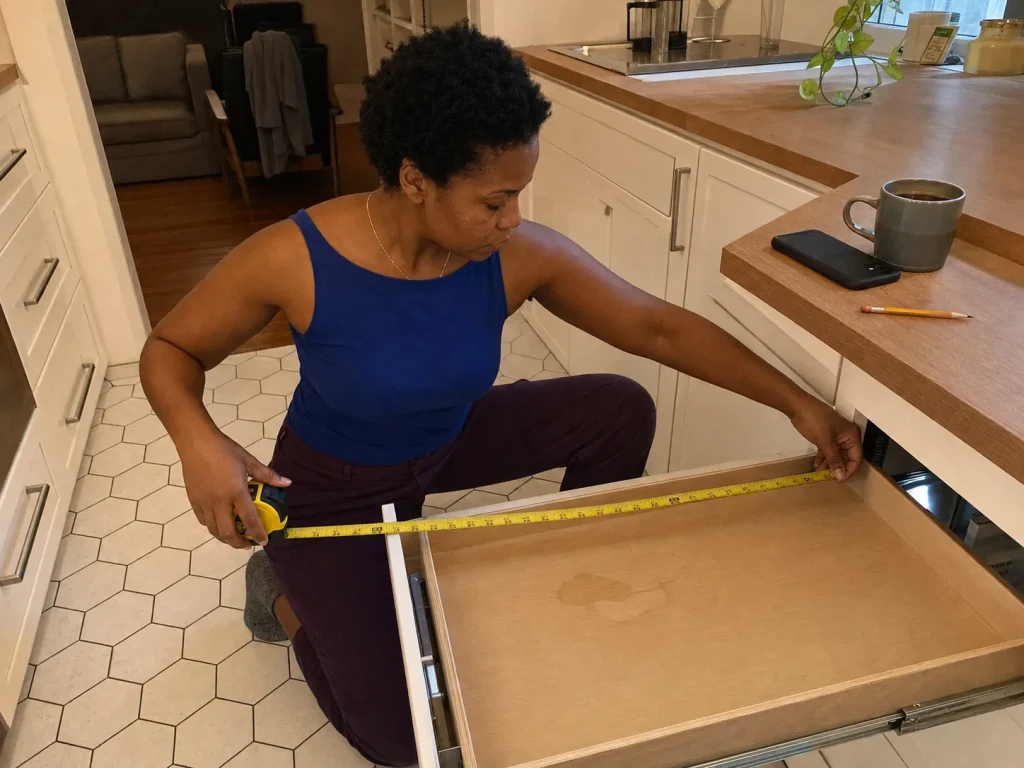
The organizer that “almost fits” is the most expensive one you’ll ever buy, because you won’t return it. You’ll wedge it in at a slight angle and let it annoy you for four years. Ten seconds with a tape measure is the whole prevention.
Measure the Interior, Not the Cabinet Face
A standard base cabinet drawer sits in roughly a 24-inch box, and that number is what people measure and shop against. You don’t get 24 inches. Once the slides and the drawer construction take their cut, you’re working with something closer to 21 inches of usable interior depth. Measure inside the empty drawer, back wall to front wall, and use that number.
Width follows the same logic. Base cabinet drawers commonly run 18 to 24 inches wide, which is exactly why nearly every expandable tray on the market covers a range of about 13 to 22 inches. That’s not a coincidence, it’s the market fitting itself to standard cabinetry. If your drawer is narrower than that range, expandable is the wrong category and you want fixed dividers instead.
The Three Numbers to Write Down
Slot depth is the number nobody hands you, so here it is: the purpose-built cooking-tool trays cluster around 2.5 inches of slot depth. Treat that as your working minimum. Below it, a spatula head or a ladle bowl sits on the divider instead of in the channel, and you’re back to the drawer that won’t close. A flatware tray’s slots are shallower than that, and that single difference is the entire article.
Then measure clearance, which is the one people learn the hard way. The tray’s height plus your tallest tool’s head has to clear the cabinet frame above the drawer, or the drawer catches on its way out and you blame the slides. Write down three numbers on your phone before you shop: interior width, interior depth, height clearance. That’s the homework.
Move Your Everyday Tools Out of the Drawer
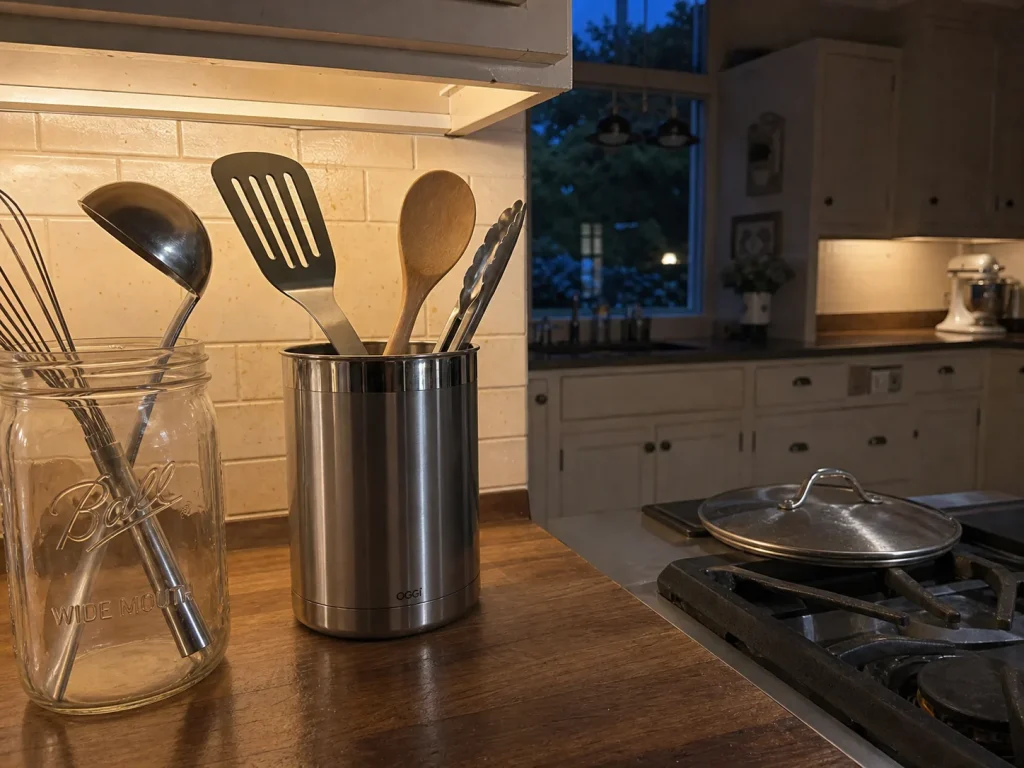
You have maybe five tools you touch every single time you cook, and about twenty you touch a few times a year. Right now they’re competing for the same slots, and the twenty are winning on sheer numbers.
Sort by Frequency First, Task Second
Zone by frequency before you sort by task. The daily five (whatever yours are) go on the counter. Everything else stays in the drawer, where slower access costs you nothing at all, because you’re reaching for the zester twice a year and the extra second doesn’t register. Task grouping is the refinement you apply inside the drawer afterward: baking tools together, prep tools together, so you’re not hunting past the pastry brush for the peeler.
This isn’t a preference. NAPO, the professional organizers’ association, pairs the divider advice with a placement rule: professional organizers pair the divider advice with a placement rule, organizing cooking tools by frequency of use and keeping them near the stove. The zone matters as much as the divider does.
You Probably Already Own a Crock
Before you buy anything: go look. A wide-mouth jar, a sturdy glass vase, an empty coffee can, a small flower pot. Any of them works, and two things decide whether it works well. The opening has to be wide or tapered so the tools fan out and you can grab one with one hand while the other hand is holding a pan. And it has to be heavy enough to stay put when it’s loaded, so test it full, not empty. Light containers tip the moment you grab for a spatula mid-recipe, and you only need that to happen once over a hot burner.
If you’d rather buy than repurpose, Ball Mason Jars Wide Mouth Quart do the job for close to nothing: the wide mouth gives you the fan-out, the glass wipes down, and the base has enough weight to hold long tools standing handle-down. The honest caveat is that glass shows every fingerprint and grease speck, so it looks worse faster than steel does, even when it’s just as clean.
The Honest Problem With Crocks
Crocks get greasy. This is the part the pretty photos leave out. Park one beside the stovetop and it collects a splatter film faster than you’d expect, and then washing the crock becomes its own recurring chore you didn’t sign up for. It’s a well-documented arc in kitchen storage discussions: people love the open, no-digging convenience for a few weeks, then quietly go back to the drawer once the grease shows up.
Two things fix it, and neither is buying a nicer crock. Move it a step away from the burners rather than beside them, and pick a material you can wipe rather than one that’s porous. The Oggi Stainless Steel Utensil Holder 5 Inch is the wipeable answer at a compact diameter that doesn’t claim much counter. It won’t rescue a crock parked directly next to a gas burner, though. Nothing will. Placement does more work than the product here, which is also the argument for being picky about what actually earns its spot on the counter.
Renter note: every part of this move is free and reversible. Nothing mounts, nothing drills, nothing needs a landlord’s permission.
Pick an Organizer Built for the Shapes You Own
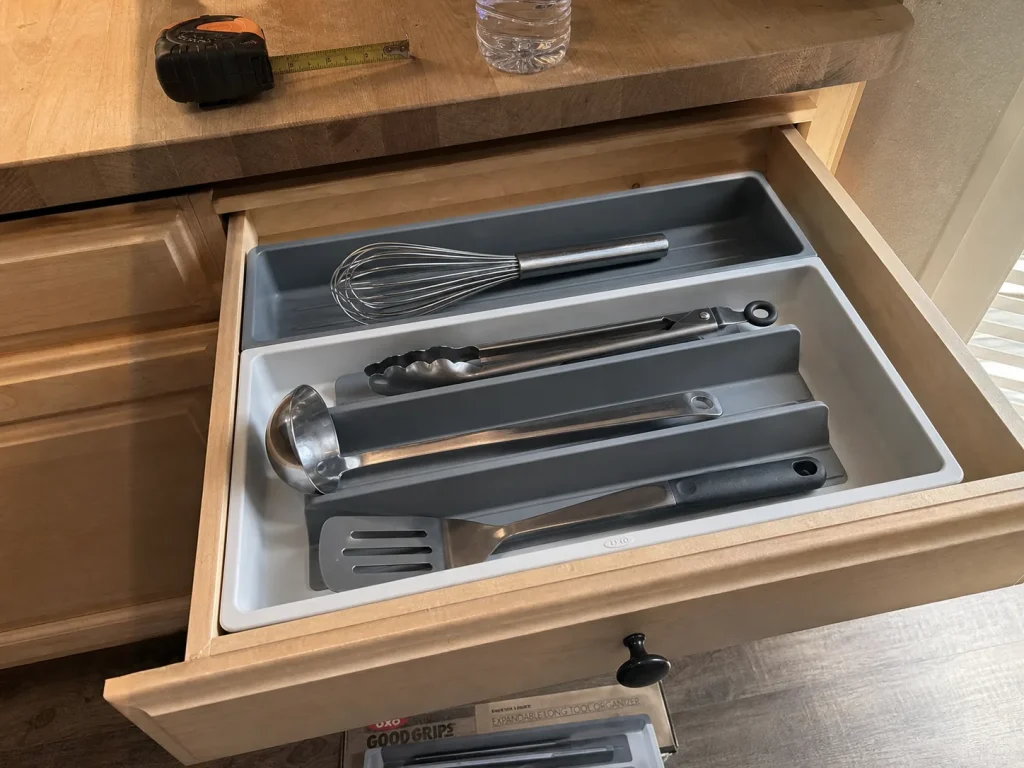
By now the drawer holds only tools you cook with, minus the daily handful that moved to the counter. That’s a much smaller shopping problem than the one you started with. It’s also, finally, a problem an organizer can actually solve.
You Want a Cooking-Tool Tray, Not a Flatware Tray
Same drawer, different product category. You’re looking for deep slots (that 2.5-inch working minimum) and an expandable width in the 13-to-22-inch range that covers a standard drawer. The Bellsal Bamboo Utensil Organizer 5-Slot Expandable is the cleanest version of this: five slots sized for large cooking utensils rather than cutlery, expanding across the standard drawer width. The caveat is baked into the material, and it’s the next subsection.
Buy the tray after the edit, never before. A tray sized to the drawer you have today is worthless once you pull out eight duplicates, and you’ll have paid for slots you no longer need. The edit is free. The tray isn’t.
Long Tools That Will Never Lie Flat
Some tools lose this fight no matter what you buy. A long ladle, a tall whisk, a pasta fork: they ride over every divider in the store because their handles are longer than your drawer is deep. Stop trying to make them lie down.
Store them vertically, handle-down, in the crock from the last section. A whisk that has beaten every tray you’ve owned sits perfectly happily in a jar. This is the cheapest fix in the article and it’s the one people resist longest, because it feels like giving up. It isn’t. It’s matching the storage to the shape, which is the only thing this whole article is about.
Material Decides More Than Looks
The conventional wisdom is that bamboo is the upgrade and plastic is the compromise. In practice, the drawer’s distance from the sink decides it, and that reverses the answer more often than not. Bamboo is fine on the dry side of the kitchen. Put it in the drawer next to the sink and sustained humidity swells it, and it goes musty from the inside. Acrylic has its own failure mode: it cracks at the corner joints, and once a hairline crack starts, grease and water wick straight in and it spreads within weeks.
Plastic wipes clean in seconds and asks nothing of you. No oiling, no dry-wipe habit, no worrying about the wet whisk somebody left in the tray overnight. The Lifewit Utensil Organizer for Kitchen Drawers runs the same deep-groove design in plastic across a similar expandable range, which makes it the correct pick for a drawer near water, not just the budget-friendly one. It looks like what it is, and that’s the trade. Pick by the drawer’s location, not by what photographs well. This is the same buying logic as the same buying logic applied to dresser drawers, where humidity isn’t a factor and bamboo wins on merit.
Renters Are Not Excluded From This Fix
Every tray worth buying for this drawer is freestanding and drop-in. That makes the whole category renter-friendly by default: no-drill, non-adhesive, no cabinet modification, and it comes with you at the end of the lease. There’s no version of this problem where renting is the obstacle, which is not something you can say about most kitchen storage advice.
The OXO Good Grips Expandable Long Tool Organizer is the clearest example: purpose-built for long-handled tools, with non-slip feet so it doesn’t slide to the back of the drawer every time you open it, which is the small ongoing irritation that makes people abandon a tray they otherwise like. Its limitation is that it’s specialized. It solves length. If your actual problem is bulky heads rather than long handles, the deep five-slot trays above are the better buy.
Keep the System When You Share the Kitchen
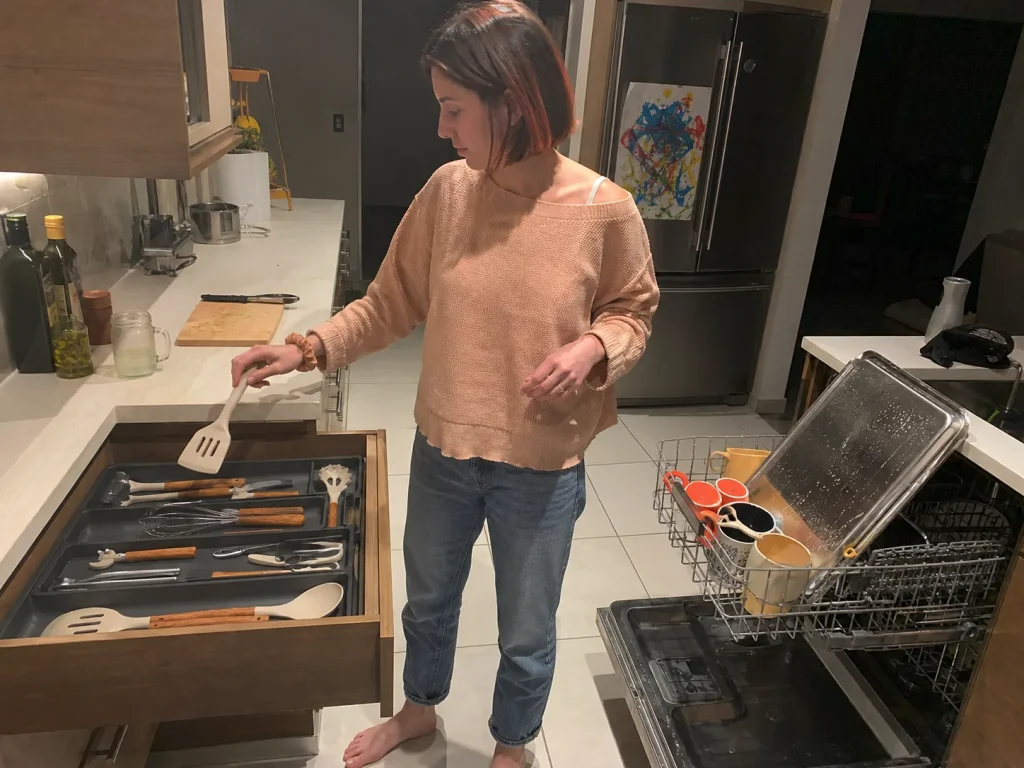
You built this. You know the tongs live in slot two. Nobody else in the house was standing there when you decided that, and the dishwasher gets unloaded by whoever’s closest to it.
Fewer, Wider Zones Survive Other People
Every article about this drawer writes it as if one person owns it. No one does. Unlike a closet, the utensil drawer gets refilled by a partner, a roommate, a teenager, or a guest who’s being helpful. They didn’t design your zones and they will not study them.
More zones sounds better. And it works, right up until someone unloads the dishwasher at speed. A system with three unmistakable zones survives other people. A system with nine precise ones does not, because the person putting things away will guess, guess wrong, and from there it degrades on its own. Make the zones readable at a glance without labels: long tools here, flat tools here, small tools here. If someone has to think about where the peeler goes, the peeler is going in the wrong place.
This is why the expandable trays are quietly better for shared kitchens than the fixed multi-compartment ones, and it has nothing to do with fit. Five wide slots forgive a wrong guess, because the tongs landing in the turner’s slot still looks and works fine. Fifteen narrow compartments punish one, because a tool in the wrong compartment is now blocking the tool that belongs there, and the next person just puts theirs on top. Two weeks of that and you have a pile with dividers under it.
There’s a second failure that only shows up in shared kitchens: the tool that never comes back. Somebody uses the good tongs, they end up in the dishwasher, the dishwasher runs overnight, and by dinner the next day you’ve reached into an empty slot twice and started keeping a backup pair somewhere else. That’s how duplicates get reintroduced into a drawer you just edited, and it’s why the zones matter more than the count. An empty slot that’s obviously the tongs’ slot gets refilled. An anonymous compartment doesn’t.
Labels are the instinct here and they’re mostly wasted on this drawer. They work in a pantry because the contents are hidden inside opaque containers. Your utensil drawer is a tray of visible objects, and nobody reads a label on an open drawer they’re already looking into. Shape and position do the communicating. Make the long slot obviously long.
Leave visible slack in every zone. A slot that’s exactly full reads as “no room” to the next person, and they’ll put the tool somewhere else. Room to spare is what lets a rushed guess land correctly, which is the whole job of a shared system.
The Monthly Reset
I used to recommend a weekly reset for this drawer. After enough “it lasted three weeks” stories in kitchen organizing discussions, I stopped: weekly is a routine almost nobody keeps, and a routine you skip twice is a routine you’ve quit. Monthly is one that survives contact with a real month.
One honest pass, once a month. The strays go back to their zone, and any new gadget that showed up gets the one-in-one-out treatment on the spot. That’s it. The same reversion pattern shows up with pots and pans, so if you’ve watched the same reversion pattern shows up with pots and pans, you already know the rhythm.
Then give it three months before you judge it. If a slot is still empty, that tool is gone and you can shrink the system. If a slot is overflowing, that’s not you failing at maintenance. That’s the drawer telling you the zone is under-sized, and the fix is a wider zone, not more willpower.
The Drawer That Finally Closes
Three things carry this whole project. The tray wasn’t failing because you’re messy, it was failing because it was built for forks and you filled it with whisks, so buy for the shape rather than the label on the box. Cut the drawer’s workload before you organize it: edit the duplicates, move the daily handful to a crock, and only then measure and shop. And match the material to the drawer’s distance from the sink, keeping the zones wide enough that someone who didn’t build the system can still use it.
Three-Month Check: open the drawer in three months and look for two things, the empty slot and the overflowing one. The first tells you what to remove for good, the second tells you which zone you under-sized.
Pull everything out onto the counter tonight. You’ll know inside ten minutes whether you have a shape problem or just too many wooden spoons, and one of those two costs nothing to fix.
Frequently Asked Questions
01Should cooking utensils be stored in a drawer or a countertop crock?
Both, split by frequency. The handful you use every time you cook belongs in a crock a step away from the stove; everything else belongs in the drawer, where slower access costs you nothing. Putting all your tools in a crock is what leads people to abandon crocks once grease builds up.
02What size drawer organizer fits a standard utensil drawer?
Look for an expandable tray covering roughly 13 to 22 inches, which fits the 18-to-24-inch drawers most kitchens have. The number that actually matters is slot depth: aim for about 2.5 inches so a spatula head or ladle bowl sits below the divider line instead of on top of it.
03Is a bamboo utensil organizer a bad idea next to the sink?
Yes, and it’s the most common material mistake in this drawer. Bamboo handles the dry side of the kitchen fine, but sustained humidity beside a sink swells it and it turns musty. Use plastic in the drawer nearest the water and save the bamboo for the one by the stove.
04How do you organize a utensil drawer without buying anything?
Empty it, remove the duplicates and the tools that belong in another drawer, then move your daily handful into a jar or vase you already own. That alone fixes most utensil drawers. The tray is what you buy afterward, if you still need one.
05What do you do with utensils too long for the drawer?
Store them vertically, handle-down, in a wide-mouth container instead of fighting a tray that will never fit them. A long whisk or ladle that rides over every divider sits flat and grabbable in a jar. The container just needs a wide opening and enough weight to stay put when loaded.