






















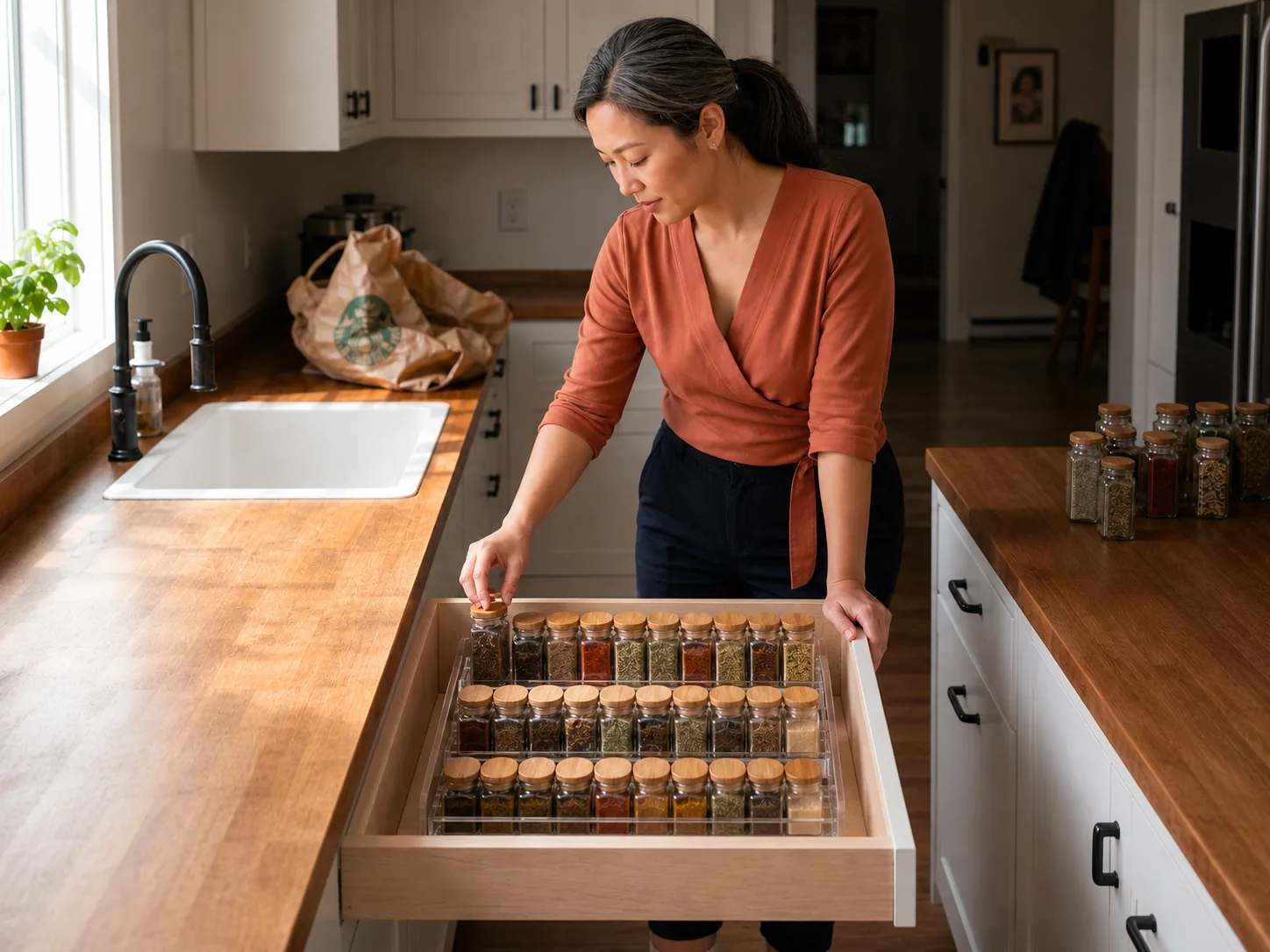
In this article
You open the drawer and every jar has slid into the same diagonal pile at the back. You dig past the oregano, find the paprika behind the second cumin, and stop for a second, because you now own two cumins and you have no memory of buying either one. That is not a space problem. The fix is almost never a bigger drawer, and the number that decides which organizer will actually work in yours is the one measurement nobody takes. Here is why the drawer keeps reverting, what to measure first, and which system matches the drawer you actually have.
Quick Answer
Spice drawer organization works when every label stays readable from where you stand. Five steps get you there.
- Empty the drawer and smell-test every jar before buying anything.
- Measure interior width, interior depth, and vertical clearance.
- Under 4.5 inches of clearance, use a flat liner instead of a riser.
- Around 5 inches or more, use a tiered riser sized to your width.
- Switch to square jars and keep every label facing up.
Why Spice Drawer Organization Reverts in Two Weeks
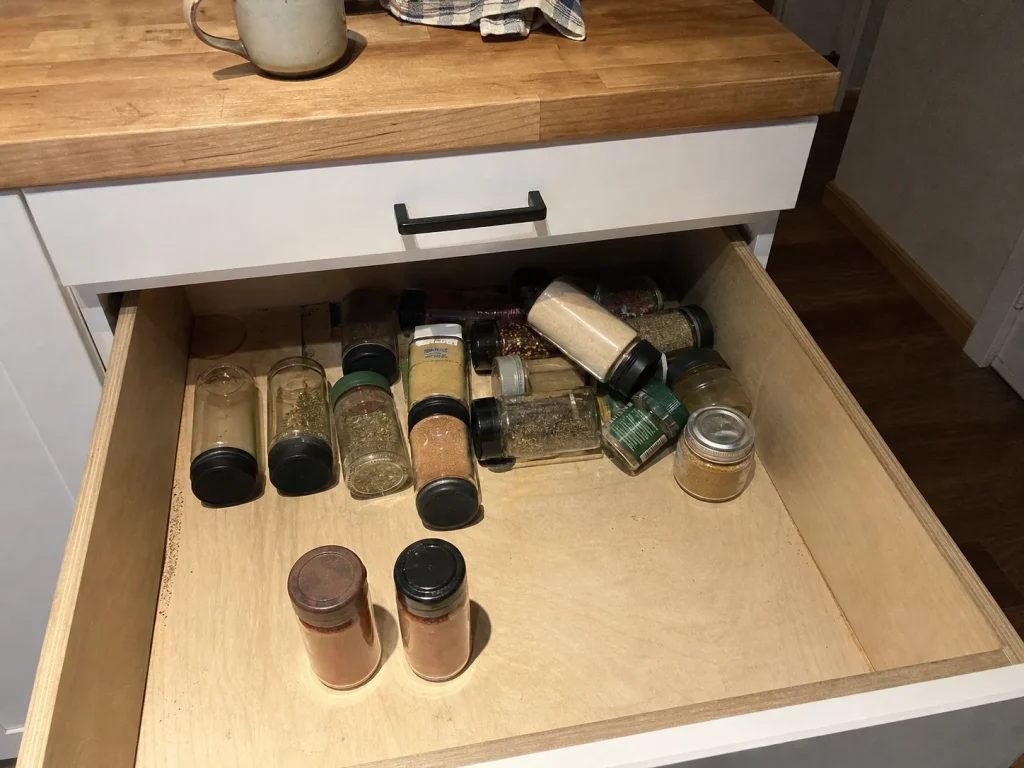
Ask anyone who has reorganized a spice drawer twice: the second attempt looks exactly like the first one did on day three. The jars go back neatly, the drawer closes, and within two weeks everything has slid to the back again. Most people read that as a discipline problem. It isn’t. It’s a design problem with a very specific mechanism, and once you can name it, the whole product decision gets easier.
The pile is the symptom, not the problem
Jars rolling around is the phrase almost everyone uses, and it’s the right description of what you see. It’s the wrong description of what’s wrong. A loose jar in an open drawer has nothing holding its position, so every open and close nudges it a little further back, and the ones that land on their sides point their labels at the drawer wall. Give it a week and the drawer sorts itself into a pile by physics alone.
What actually broke is visibility. A jar you can’t read doesn’t exist, and a jar that doesn’t exist gets replaced. It’s the same mechanism that undoes kitchen drawer organization everywhere else in the kitchen: the tidying fixed the appearance and left the cause running.
Why you own three jars of cumin
Here is the part no one connects. You didn’t buy the second cumin because you’re careless. You bought it standing in a grocery aisle, running a mental inventory of a drawer where most of the labels face sideways. Your brain checked, found nothing, and told you to buy cumin. It was right, given the information available.
That loop has a real cost, and it’s the reason a spice drawer deserves more thought than a utensil drawer. Every buried jar is money you spend twice and flavor you lose while the duplicate sits at the back going quiet. Nobody notices it happening, because each individual purchase is rational.
It also compounds. The duplicate takes a slot, which pushes another jar further back, which makes that jar the next one you can’t see. A drawer doesn’t drift into chaos all at once. It does it one reasonable grocery run at a time. So the fix has to keep labels readable permanently, not just on reset day, and everything below is downstream of that one requirement.
Why the drawer still beats the counter rack
Before you buy anything, settle the location question, because there’s a real reason to keep spices in a drawer beyond looks. Open storage exposes every jar to light, and McCormick’s own storage guidance on how heat and light shorten a spice’s shelf life puts flavor decline at roughly 300% faster than opaque, closed storage. That sunny counter rack under the window is quietly draining every jar sitting on it.
A closed drawer solves light by default. Heat is the other half: the drawer directly beside your range is the worst spot in the kitchen for spices no matter how good the organizer inside it is. If your spices currently live somewhere else entirely, if your spices live on a pantry door instead the same visibility rules apply, just on a vertical surface.
Measure These Three Numbers Before You Buy Anything
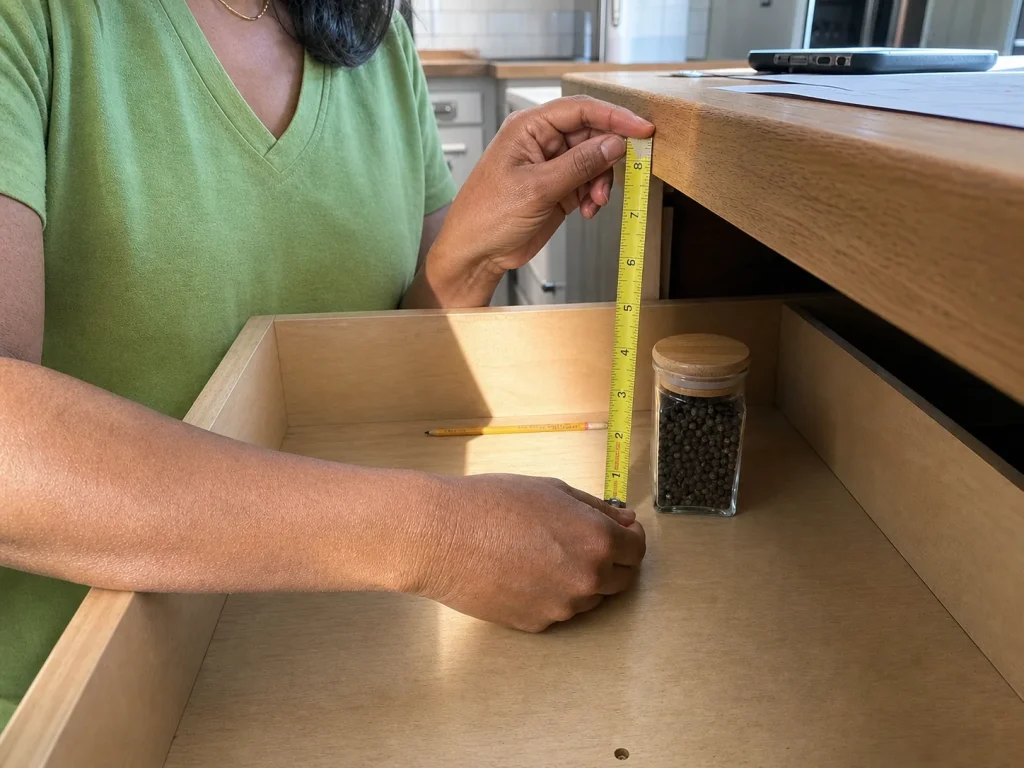
Every article on this topic tells you to measure your drawer. Almost none of them tell you what to do with the number, which is why so many spice organizers get returned. There are three numbers that matter, and the one that sends products back is the one most people never take.
Width and depth are the easy two
Interior width decides whether an expandable tray can reach both of your drawer walls. Because most spice organizers cover a range rather than a single size, width is a “does it stretch far enough” question, not a “does it fit” one. Measure wall to wall inside the drawer, not the drawer front, and write down the number at its narrowest point if your drawer box tapers at all.
Width is also where the gap math bites. An organizer that stops two inches short of the wall doesn’t cost you two inches of storage, it costs you the whole system: jars migrate into that canyon, tip over, and start the rolling problem the tray was supposed to end. A tray that reaches your walls is doing structural work, not cosmetic work.
Interior depth is almost never your problem. According to the National Kitchen & Bath Association’s standard drawer guidelines, a 24-inch base cabinet runs roughly 18 to 21 inches of interior depth, with about 20 to 22 inches usable on a full-extension slide. That’s more room than most people assume, which is why “my drawer is too small” almost always turns out to mean something else.
Check whether your drawer actually extends fully before you trust that number, though. A drawer on a three-quarter-extension slide keeps its back few inches under the counter permanently, so a tray sized to your measured depth will have a section you can never see. It’s the same measure-the-interior-first rule that decides a utensil tray, applied to a smaller, rounder object.
The clearance number that decides everything
Vertical clearance is number three, and it’s the whole ballgame. A standard 4-ounce spice jar stands about 4 inches tall. Add roughly half an inch for the lid and the closing gap, and you need about 4.5 inches of clearance for jars to stand upright. Below that number, no tiered riser on any roundup will let your drawer close, regardless of star rating.
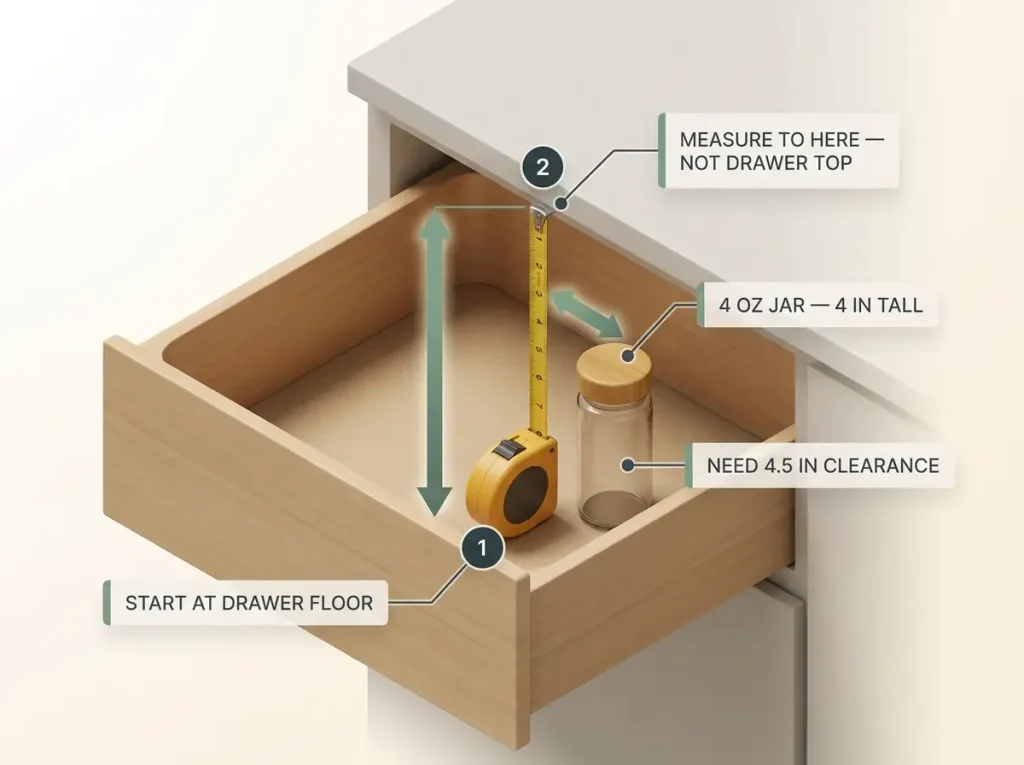
Measure it from the drawer floor to whatever physically stops the drawer from closing: the underside of the counter, a cabinet rail, the drawer above. Not to the top of the drawer box. That distinction is why people measure 6 inches, buy a 5-inch riser, and discover their drawer now closes to within an inch of shut.
Take the three numbers with the drawer pulled all the way out, then write them in your phone notes before you open a single product page. Every organizer listing is designed to make you think in tiers and jar counts. Your drawer only cares about three measurements, and you will not remember them accurately by the time you’re comparing listings.
The 2.5-inch drawer no organizer fixes
Here’s a real one, cited by a reader in competitor content: 8 inches wide, 20 inches deep, 2.5 inches tall. Twenty inches of depth. Plenty of room, on paper. And physically incapable of holding a 4-inch jar standing up.
No product on any “best spice organizer” list solves that drawer, and none of those lists mention it. If your clearance came in under 4.5 inches, skip ahead two sections, because half of the standard advice does not apply to you.
Edit the Drawer Before You Organize It
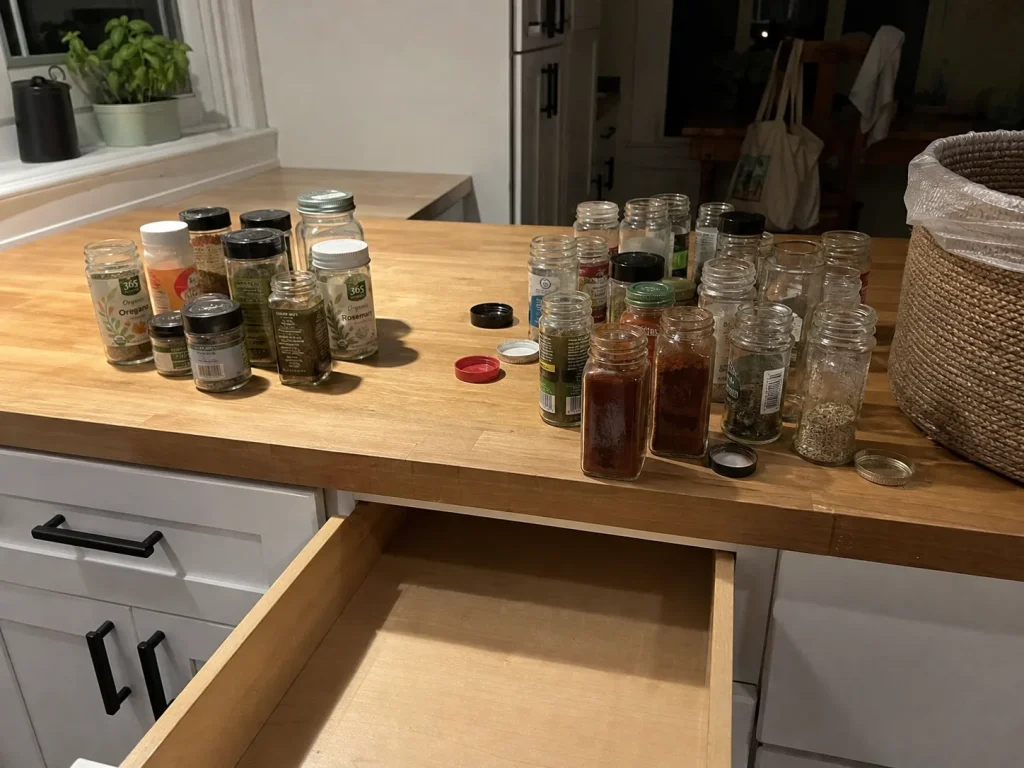
This is the free step and the one everyone wants to skip. Before you size anything, take everything out and declutter spices the way you’d edit any other drawer. The one that “doesn’t fit” usually fits fine once a third of what’s in it leaves, and you’re about to buy an organizer sized for jars you will never open again.
What still smells like anything
Expired spices aren’t a food safety question, they’re a potency question. Spices don’t spoil, they fade. McCormick’s shelf-life ranges put ground spices at 2 to 4 years, whole spices at about 4, and dried leafy herbs at 1 to 3 before they lose real potency. A jar past that window is safe to eat and pointless to cook with.
So the test is your nose, not the date. Open it, smell it. If it smells like the jar instead of the spice, it’s a slot you’re paying for with nothing in it. That jar of dried tarragon you bought for one recipe in 2022 is taking prime real estate from the paprika you reach for weekly.
The duplicates tell you what’s broken
Line up the pairs while you sort. Two cumins, two chili powders, the third jar of cinnamon. That’s not a character flaw, it’s the receipt for the visibility problem from the last section, and it’s the most useful diagnostic you’ll get all afternoon. Count them. That number is roughly how many drawer slots your current system is wasting on information failure.
Cut to the jars you actually cook with
Anything you reach for less than twice a year does not deserve a spot in the drawer. It can live in a cabinet, a bin, or the trash. The drawer is for the jars you actually cook with, and it works best when it holds only those. This is the same discipline as sorting by what belongs somewhere else that makes a junk drawer stop refilling.
Do this before you count jars for a kit. The number you need is the number that survives this step, and it is almost always smaller than the 24-piece or 36-piece set you were about to add to your cart. For a lot of people, this step alone turns a “too small” drawer into a drawer that works. That’s the whole fix, and it costs nothing.
Shallow Drawers Need a Liner, Not a Riser
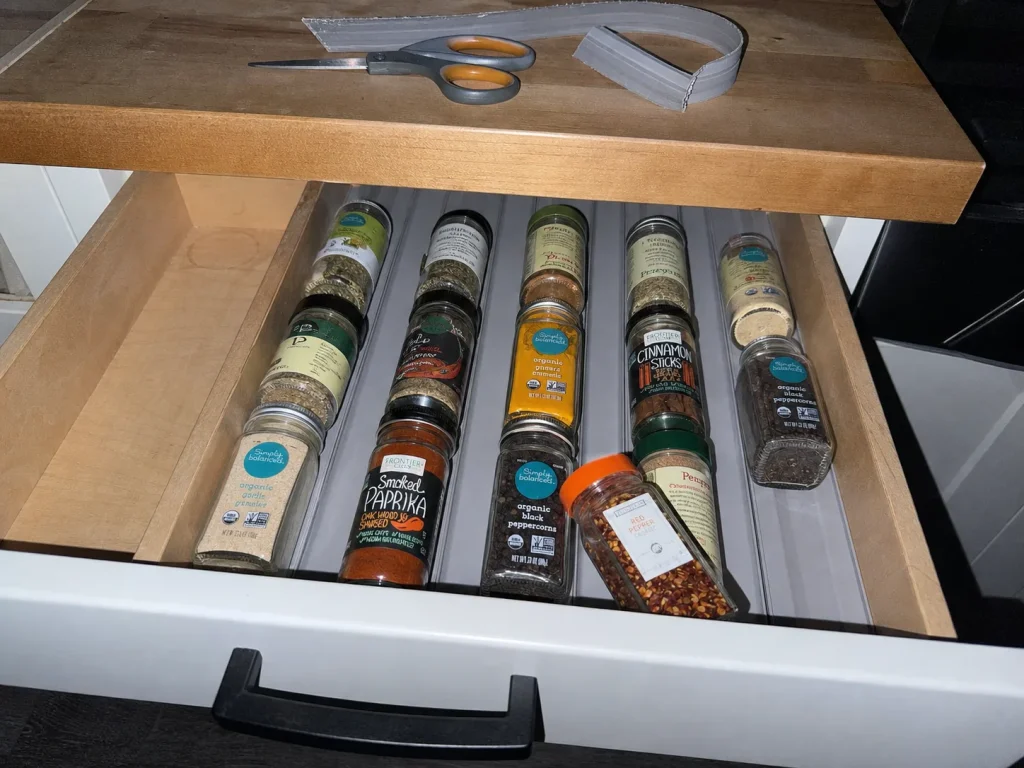
If your clearance came in under about 4.5 inches, every tiered organizer in every roundup is wrong for you, and not one of those articles will say so. Your jars are going to lie down. That’s not a failure, it’s the only configuration physics allows. The job changes from stacking to stopping the roll.
Why your jars are going to lie down
A 4-inch jar in a 2.5-inch drawer lies flat. There’s no product decision to make about that part. Once jars are horizontal, two things go wrong at once: they roll on every open and close, and their labels point at the ceiling or the drawer wall instead of at you.
Solve those two and here’s the part that surprises people: a shallow drawer can work better than a standard one. Everything sits in a single readable layer with nothing hidden behind anything, which is the exact outcome a tiered riser spends four tiers and a lot of drawer trying to fake. The riser exists to defeat depth. You don’t have depth to defeat.
The catch is capacity, and it’s worth naming before you commit. A shallow drawer holds what its floor holds and not one jar more, so if you came out of the edit step with more jars than the floor fits, the answer is a second drawer or a cabinet bin, not a cleverer liner. No product solves a floor-area shortage.
The free fix that works today
Start with friction. A cut-to-fit non-slip drawer liner, no adhesive and no tools, stops jars sliding by grip alone. It’s the cheapest real fix in this entire article, it’s genuinely no-drill and no-adhesive, and if you have a liner roll in the house you can do it in the next ten minutes. Skip contact paper for this job: it’s an adhesive surface with no grip, so your jars will slide across it exactly as well as they slide across bare plywood.
Cheaper still: a folded-flat egg carton makes compartments for small round jars for free. It looks like exactly what it is. But it tells you whether the compartment approach is even what you want before you spend anything, which is worth more than it sounds.
Velcro strips on jar bottoms come up constantly as a cheap alternative, and they genuinely work. They also carry adhesive residue risk on the drawer surface, which makes them an owned-home solution rather than a rental one. If you’re renting, stay with friction and channels. Nothing you do to a spice drawer should require a security-deposit conversation.
The liner that makes labels readable
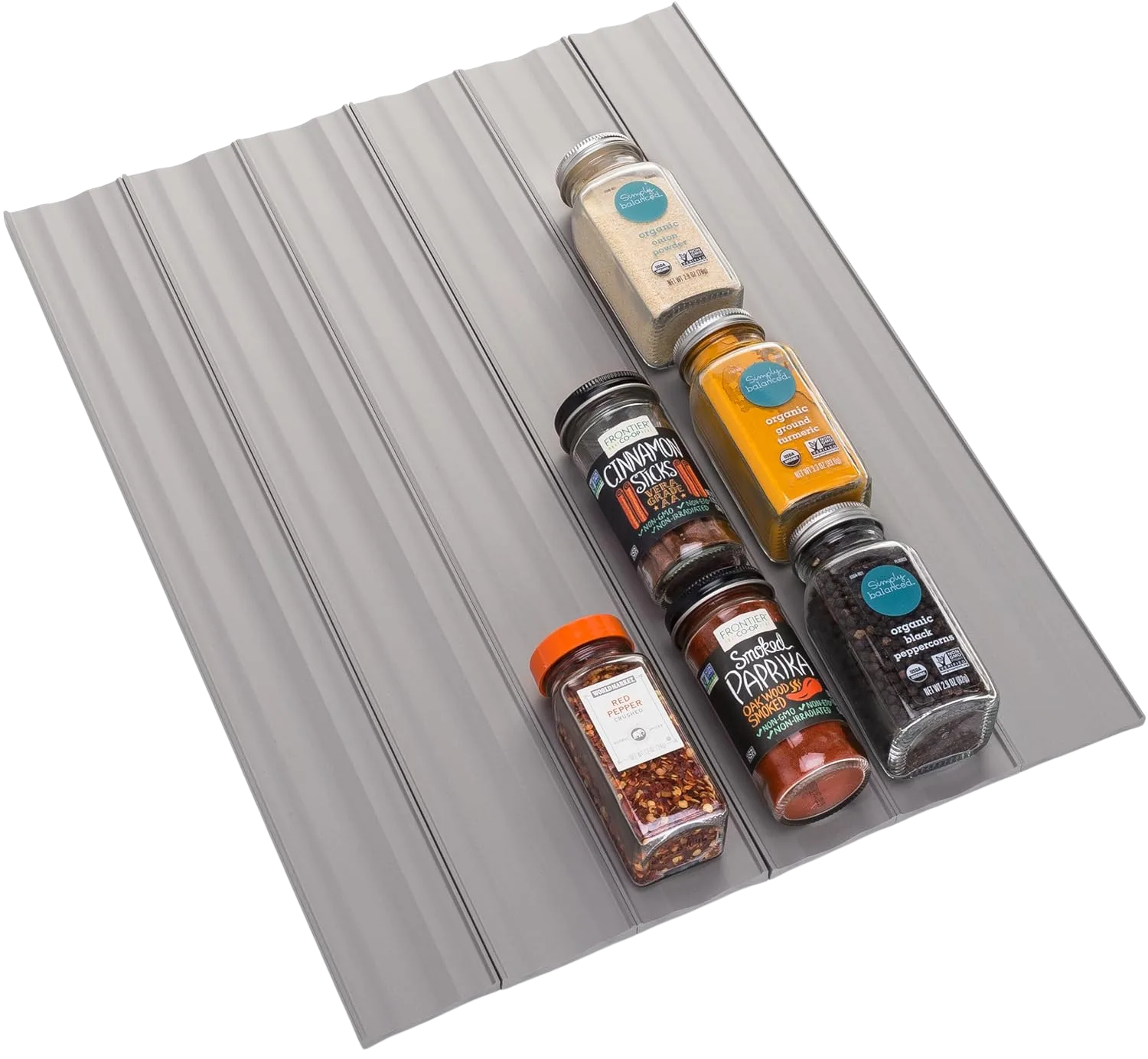
If the free version holds but you want the labels to face you instead of the ceiling, this is where a foam liner earns its place. Molded channels cradle each jar at a slight angle, so the cap end tips toward you and the whole flat drawer becomes readable at a glance. That angle is the entire trick.
The YouCopia SpiceLiner is the version worth knowing about here, and it’s the only product in this article that solves a sub-4.5-inch drawer. It trims to fit with kitchen scissors and needs no installation, adhesive, or mounting, which makes it renter-safe by design rather than by workaround. The tradeoff is honest: a foam liner holds fewer jars per square inch than a riser would, because you’re using the drawer’s floor instead of its height. In a shallow drawer that was never on the table anyway.
Standard Drawers Take a Tiered Riser
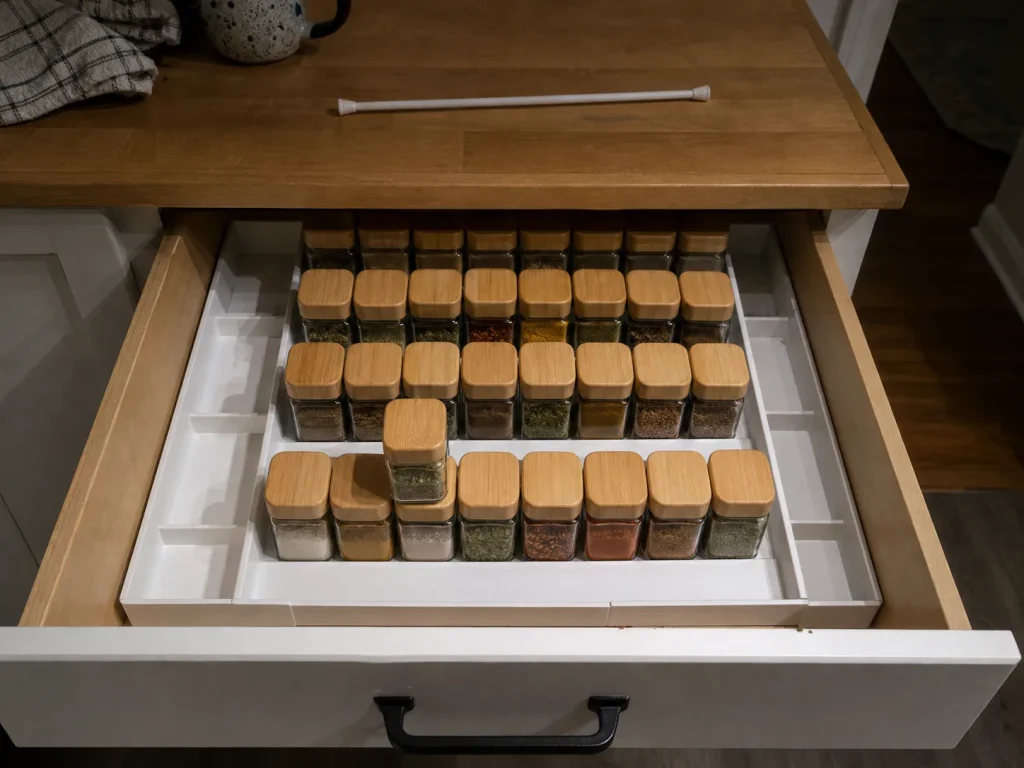
This is the drawer most people have, roughly 5 inches of clearance or more, and it’s the easy case. Once you have your width, the product decision is nearly automatic.
The riser buys you sightlines, not space
A tiered riser doesn’t create storage. It creates sightlines. Flat rows mean the back two rows are invisible from where you stand, which drops you straight back into the duplicate loop from the first section. Steps raise each row above the one in front of it, so you read the whole drawer standing up without touching a jar.
Professional organizers at NEAT Method recommend measuring width, depth, and height before choosing between an expandable, modular, or stacking system. The system type is downstream of the tape measure, always.
Expandable when your drawer isn’t standard
The conventional wisdom is to buy the tray that matches your drawer. In practice, almost no rental drawer matches anything, so an expandable tray is the safer default.
The Dial Industries Expandable Spice Organizer Tray is the standard version: stepped tiers that expand to meet your drawer walls, sized for normal clearance. If your drawer runs wide or genuinely odd, the MIUKAA Clear Acrylic Spice Drawer Organizer covers 13 to 26 inches and comes as organizer only, no jars, which makes it the budget-friendlier pick if you already own jars you like. Its tiers run about 1.7 inches tall each, so check that against your clearance number first. Worth reading before you order: how the expandable trays hold their size once they’re loaded, because spring tension and snap-in expansion behave very differently under a full load of glass.
The no-buy version with tension rods
There’s a renter method that keeps showing up in reader tips: tension rods wedged across the drawer as dividers, spaced to jar width, jars lined up between them. Fully removable, costs pocket change.
It’s fussier than a tray and it gives you no tiered sightline. But it holds jars in fixed lanes, which handles the rolling half of the problem for almost nothing.
Arrange by how you cook, not by the alphabet
Whichever drawer you have, you still have to decide which jar goes where, and most people default to alphabetical organization because it feels orderly. It is orderly. It’s also what makes you walk the whole drawer to build one spice rub, because your cumin, paprika, and coriander sit rows apart by accident of spelling.
Two arrangements beat it for actual cooking. Frequency of use puts your daily handful in the front row and everything else behind them. Cuisine-based sorting groups the jars that get pulled together anyway: the taco set in one lane, the curry set in another, and splitting sweet and savory spices into separate rows so nobody hunts for cinnamon at 8am.
I used to think alphabetical was the safe default for shared kitchens, since anyone can find a letter. In practice, the drawers that keep working are the ones sorted by how the household actually cooks, because nobody has to remember a rule to put a jar back near its neighbors. Pick one and commit.
Deep Drawers Fit a Full Jar System
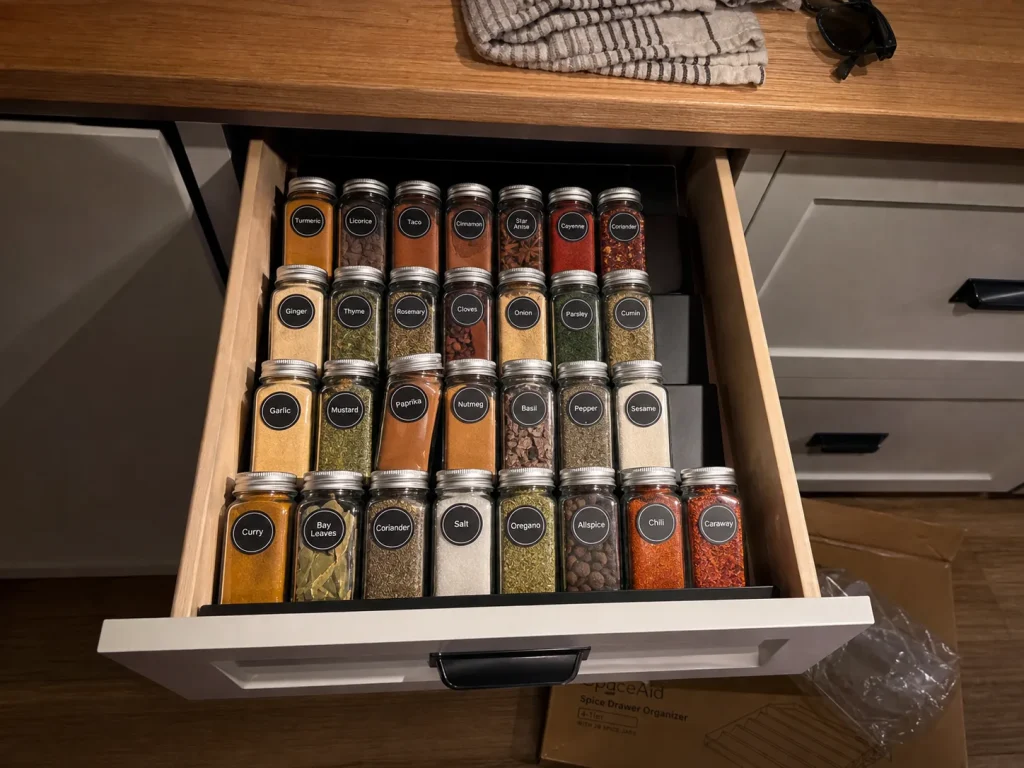
If you have the deep drawer, roughly 17 inches of clear interior or more, you have the one case where buying the entire system in a single order is defensible. Not because it organizes better. Because piecing it together across three deliveries costs more of your Saturday than it saves you.
What extra depth actually buys
More depth means more rows of tiers front to back, and more rows means every jar in the drawer is a single reach with nothing sitting behind anything. A vertical spice jar organizer with four tiers is the ceiling of what stacked spice storage can do in a drawer, and it’s only available to drawers deep enough to run those four tiers without crowding the front row against the drawer face.
The one-order option and what it costs you
Piece it together first, if you can. A riser plus a separate jar set is usually the budget-friendlier path, it lets you keep jars you already like, and it doesn’t force you into a jar count someone else picked. That’s the honest default recommendation for most deep drawers.
The exception is starting from zero. If you’re replacing everything anyway, the SpaceAid Spice Drawer Organizer with 28 Spice Jars closes organizer, jars, and labels in one purchase. The tradeoff is that you’re buying 28 jars whether you need 28 jars or not, and if you did the edit step honestly, you probably don’t. Go count what survived before you commit to a number this large.
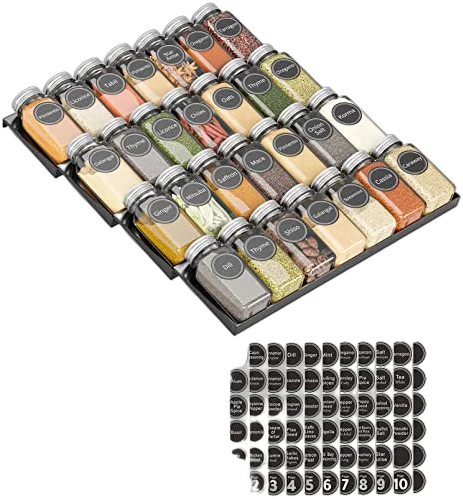
Check the kit’s footprint against your number
Every all-in-one kit is built to a fixed footprint, and a 17.5-inch tray in an 18-inch drawer clears by half an inch. That’s fine, and it’s also the entire margin. Measure before you order, not after it arrives.
One more thing about deep drawers, and it’s the failure mode specific to them: a deep drawer is the only spice drawer roomy enough to let you keep every dead jar without noticing. Depth is not a reason to skip the edit. It’s the reason the edit matters more.
Pick Jars That Don’t Roll and Don’t Stain

Round jars are why your drawer sounds like a maraca when you shut it. This is the single cheapest structural fix available, and it has nothing to do with which organizer you bought.
Why round jars roll and square jars don’t
Square jars win on two counts at once. They sit flush against each other with no wasted gap, so you fit more jars in the same width. And a flat side physically cannot roll. Round jars leave a curved dead space at every contact point and turn the drawer into a pinball table on every close.
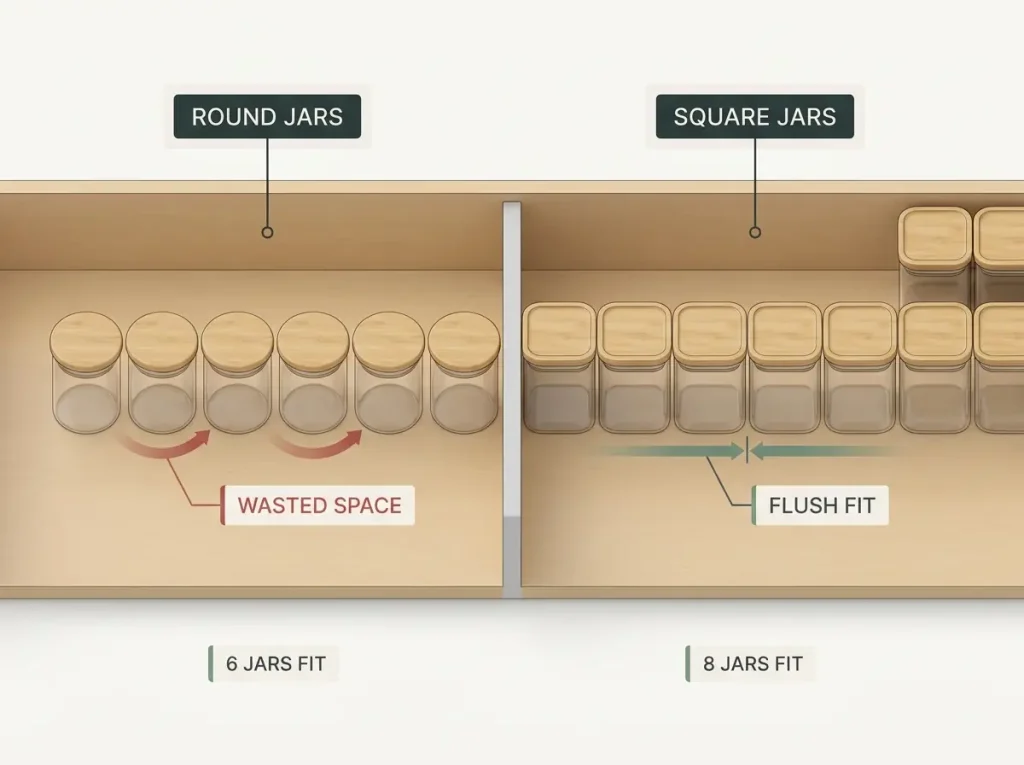
Before you buy anything, though, read the last subsection of this section. Jar replacement is optional more often than the internet suggests.
The AISIPRIN Glass Spice Jars are a reasonable version of the standard square 4-ounce jar: glass, bamboo lids, shaker inserts, labels included. The 4-ounce size is what the whole product category is built around and what the clearance math above assumes. Buy taller jars and you quietly break the riser you just measured for. The bamboo lids are the weak point, as they are on every set: they’re the first thing to warp in a steamy kitchen.
Glass, plastic, and what stains
Glass wins the long game. It doesn’t absorb spice oils and it doesn’t go permanently orange after two years of turmeric and paprika the way plastic does. Plastic wins on weight and on not shattering, which matters if the drawer sits at kid height.
Airtight lids matter less here than the listings imply. In a closed drawer you’ve already solved light, and a lid that seals hard is a lid you fight one-handed while something reduces on the stove. Screw-top over clamp-lock.
I used to think lid material was a matter of taste. After enough warped-bamboo complaints in kitchen threads, I’ve changed my mind: if your kitchen runs humid, plastic or metal lids are the call, and the bamboo look is not worth the replacement cycle. What actually matters more than either is the shaker insert. That’s the part that stops you dumping a tablespoon of cayenne into a pot you can’t un-cayenne.
When you shouldn’t decant at all
Here’s the part the product listings won’t tell you. If your store-bought jars are already square and already the same rough height, you don’t need to decant anything. Buying jars does not organize a drawer. It just gives you nicer-looking versions of the same problem you had before.
Decanting earns its place in exactly two situations: your jars are wildly mismatched in height, or you buy bulk spices in bags with nowhere to put them. That’s it. If it’s the second one, a mini funnel is the only other thing you need, and a collapsible one lives in the drawer instead of the gadget graveyard. The gap between “I own jars” and “I have a system” is where most people stall out, and a matching jar set is not the bridge.
Label It So It Survives the Restock
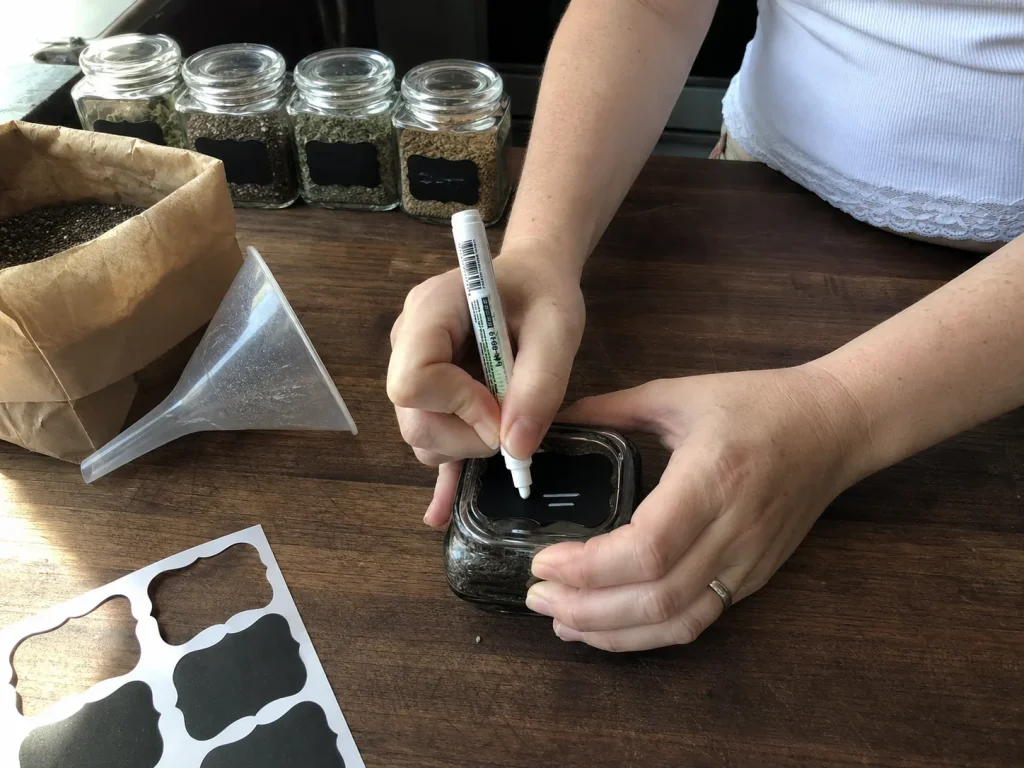
Every spice drawer article in the top results stops one week before this section starts. The system does not break on reset day. It breaks the first time someone refills the wrong jar, or you buy bulk cumin and there’s no way to change what the label says.
Label the surface you actually see
The rule is one sentence: label whichever surface faces you from where you stand. If your jars stand upright in a riser, that’s the lid. If they’re lying flat in a liner, it’s the front face of the jar. A label on the bottom of a jar is decoration, and a label on the back of a jar in row three is worse than no label, because it makes you think the drawer is handled.
Test it before you commit to a system. Stand where you normally stand, open the drawer, and read the back row without moving your feet. If you can’t, you haven’t fixed the visibility problem, you’ve just reorganized it into rows.
Why removable labels fix the duplicate problem
Now the part nobody connects back to the beginning of this article. You relabel every time you restock with something different, and if your labels aren’t removable, you have two options: peel adhesive residue off glass, or leave the wrong label on the jar. Most people pick the second one. And a jar with the wrong label on it is exactly the invisible jar that made you buy the second cumin in the first place. Permanent labels reintroduce the original failure by way of your own label choice.
Free version first: painter’s tape and any pen. It looks like nothing, it costs nothing, and it’s the right first pass while you’re still learning which jars survive. Upgrade after a month if the system holds.
When you do upgrade, removable is the requirement, not a preference. Chalkboard labels with a chalk marker wipe clean and rewrite, so changing what a jar says costs a wet cloth instead of a new sticker. The limitation is legibility: chalk on black is harder to read in a dim drawer than black on white, so if your kitchen light is poor, use white spice jar labels and a paint pen instead.
This is also the one place a label maker loses to the cheaper option. Printed tape looks sharper and it’s permanent by design, which is the wrong property for a jar whose contents change. Save it for the pantry bins that hold the same thing forever.
The refill rule for a shared kitchen
Your partner will refill the paprika jar with smoked paprika and not change the label. Your roommate will top up the chili powder with the cayenne because both bags were open. This is not hypothetical and it’s not a character issue. Shared kitchens fail on refill, not on tidying, and it’s the most-repeated version of the “the system looked great for a week” story in organizing threads.
The rule that works is one sentence, said out loud once: refill the jar it says, or change the label. That’s the whole system. It works because it doesn’t ask anyone to learn a layout, remember a category, or care about organizing. It asks for one action at the moment of the mistake.
The other half of shared kitchen organization is where the backup spice supply lives. Bulk bags and unopened replacements do not belong in the drawer, because the moment they do, the drawer stops being a readable single layer and starts being storage. Put them in a labeled bin in a cabinet. The drawer holds what you cook with; the bin holds what refills it.
Put the chalk marker or the pen in the drawer itself, next to the jars. Not in the junk drawer, not in the office. Relabeling only happens if the tool is within arm’s reach at the exact second someone refills a jar. Every relabeling system that lives in a different room quietly stops existing by month two.
Then run the quarterly pass. Pull the drawer out once every three months, smell the front row, and look for the duplicate that snuck in behind it. It takes four minutes and it’s the whole difference between a drawer that lasts and a drawer you reorganize again next spring.
The Drawer Is Only as Good as Its Worst Label
Three things carry this whole system.
Measure the clearance, not just the width. Under about 4.5 inches, the tiered riser that every roundup recommends physically cannot close your drawer, and knowing that number before you shop saves you a return.
Edit before you buy. The jar count you need is the count that survives the smell test, and it’s smaller than the set you were about to order. Sometimes that step alone is the entire fix.
Square jars and labels that face you are what stop the rolling and the duplicate buying. The organizer is just the frame that holds them in position.
In three months, pull the drawer and smell the front row: if a jar has gone quiet or a duplicate has appeared behind it, a label stopped being readable from where you stand, and that’s the thing to fix, not the layout.
Take a tape measure to the drawer tonight and write down the clearance. That one number tells you which half of this article applies to you.
Frequently Asked Questions
01How do you keep spice jars from rolling around in a drawer?
Switch to square jars, because a flat side physically cannot roll and square jars sit flush against each other with no gap to slide into. If you are keeping round jars, a cut-to-fit non-slip liner stops the sliding by friction alone, with no adhesive and no tools.
02What size spice jars fit in a standard kitchen drawer?
Standard 4-ounce jars stand about 4 inches tall and fit any drawer with roughly 4.5 inches of vertical clearance once you allow for the lid and closing gap. Measure from the drawer floor to whatever stops the drawer from closing, not to the top of the drawer box.
03Should spices be stored in a drawer or a cabinet?
A drawer wins on visibility, which is what actually breaks spice storage, because every jar is a single reach with nothing hidden behind it. Both beat an open counter rack, where light exposure shortens shelf life sharply. The exception is the drawer beside your range, where heat works against you.
04How do you organize a shallow spice drawer?
Accept that the jars will lie flat and solve for the roll instead of the height. A foam liner with molded channels holds each jar at an angle so the cap faces you, and it needs no adhesive or mounting. A cut-to-fit non-slip liner is the free version of the same idea.
05How often should you replace the spices in the drawer?
Ground spices hold up 2 to 4 years, whole spices about 4, and dried leafy herbs 1 to 3 before they lose potency. Nothing spoils, it just goes aroma-dead, so the test is your nose and not the date. Smell the front row once a quarter.