






















In this article
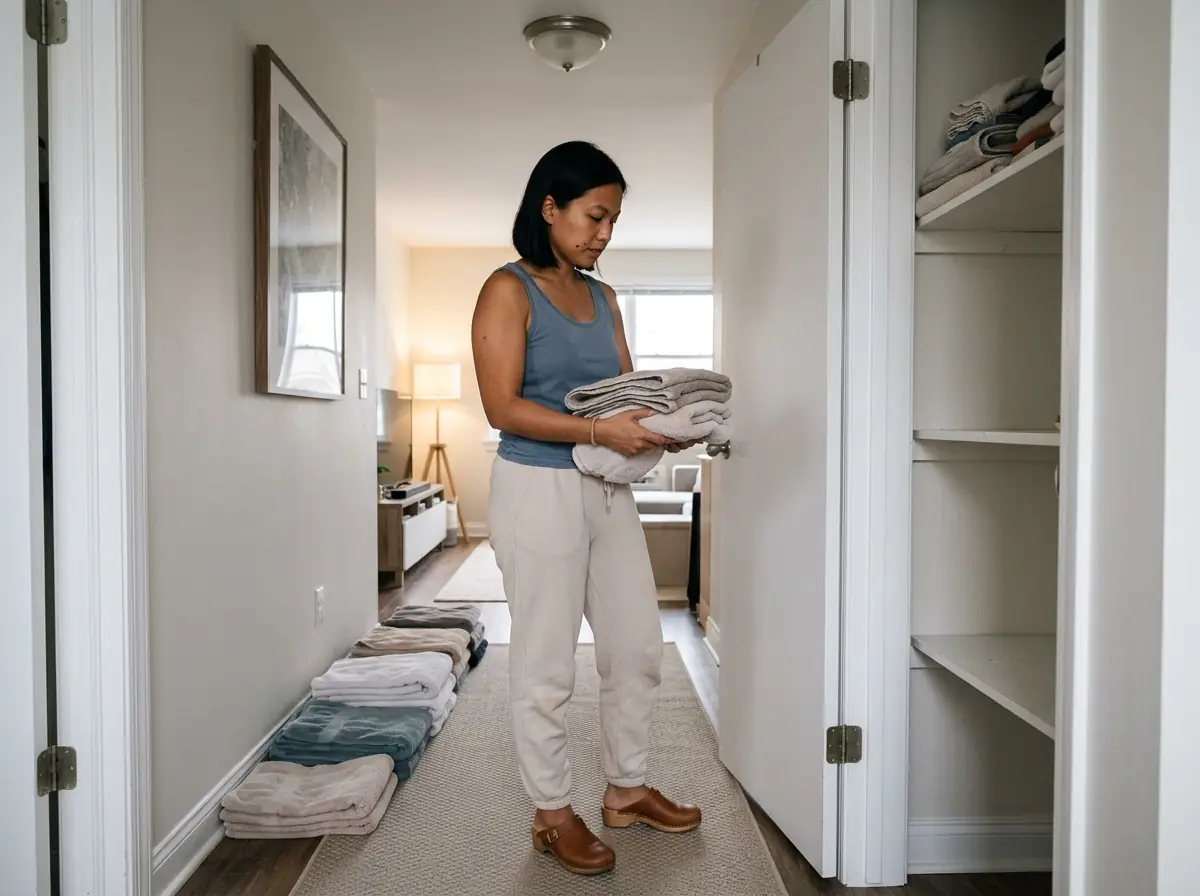
You emptied the whole thing on a Saturday. Refolded every towel, lined the sheet sets up by size, stood back and felt genuinely good about it.
Six weeks later you’re wedging a bath towel into a gap that doesn’t exist, and the shelf looks exactly like it did before. The fix is almost never better folding. Small linen closet organization fails on arithmetic: a shelf holds a fixed cubic footage, and if the quantity going back in hasn’t changed, neither has the outcome. Here’s what your closet can physically hold, what has to leave it, how to hold the rest in place, how to gain room without drilling a single hole, and how to keep it that way when three other people use the same shelf.
Quick Answer
A small linen closet refills because its capacity never changed, only its arrangement. Work in this order:
- Measure your real shelf depth and the spacing between shelves.
- Pull everything that isn’t a linen and give it a named destination.
- Cut down to two sheet sets per bed and one stored towel set per person.
- Divide and contain what’s left so stacks hold their shape.
- Label the zones, then recount every three months.
Why a Small Linen Closet Fills Up Again in Weeks
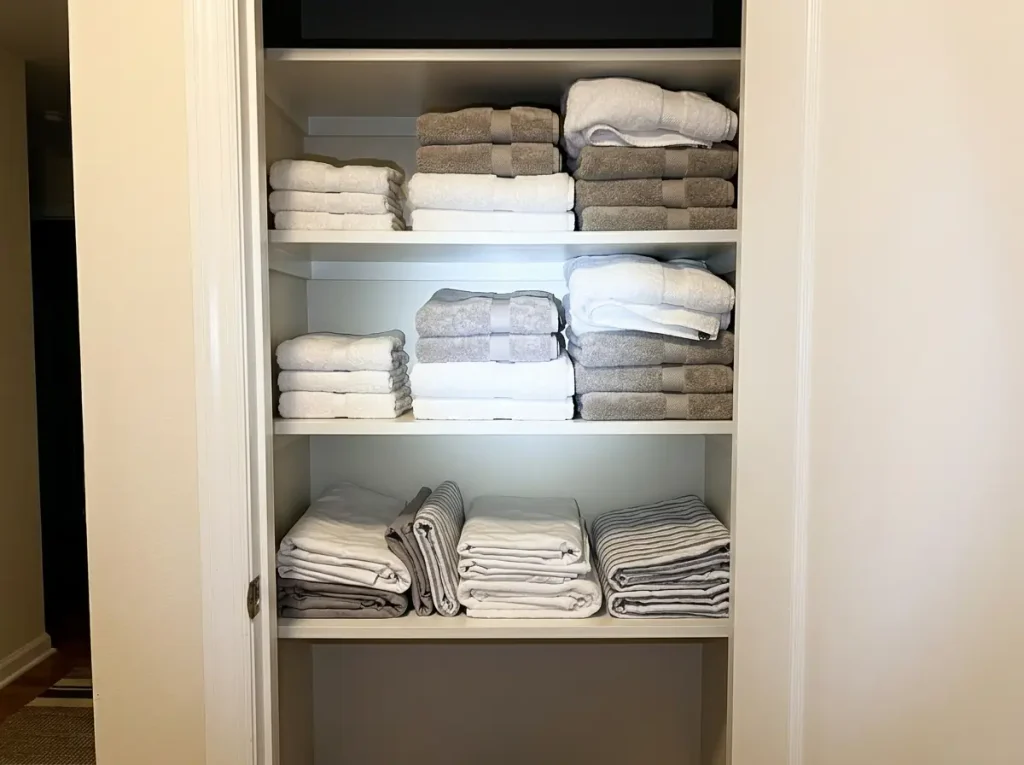
Every article about this closet tells you to fold better or add a bin. Neither changes the number of inches you have.
The reason it reverted by week six is that the same volume of stuff went back into the same volume of space. That’s not a technique failure. That’s arithmetic.
Your closet is probably a normal size
Your linen closet is almost certainly average. According to the standard closet dimensions contractors build to, a typical one runs about 24 inches deep, 36 to 48 inches wide, and 60 to 80 inches tall. When you call yours “small,” you’re usually describing how it feels when it’s full, not an unusual build.
That changes what you’re solving. If the closet were genuinely undersized, the answer would be construction. It isn’t, so the answer is quantity, and quantity is the one variable you control without a contractor or a landlord’s permission.
The two ceilings — shelf depth and shelf spacing
The first ceiling is depth, and it’s smaller than the closet is. House Digest puts usable shelf depth at 12 to 16 inches even in a 24-inch closet, because the door frame narrows the opening and your arm only reaches comfortably so far. Stack past roughly 12 inches and the front of the pile tips the moment you disturb it.
The back four inches aren’t storage. They’re where things go to be forgotten.
The second ceiling is shelf spacing, and nobody measures it. The bands run 10 to 12 inches for sheets, 12 to 16 for towels, 18 to 20 below the first shelf, and 16 to 18 up top. What makes those worth trusting is that a NAPO-certified organizer’s 10-14 inch shelf-spacing rule lands independently in the same band, which is rare in a field where most advice is one blogger repeating another.
Here’s the part that stings: most builder-grade closets have even, unadjusted spacing nobody chose. Four shelves, identical gaps, installed before anyone knew what would go on them. So you get 14 inches of clearance above sheets that need 10, wasting four inches per level, while the towel shelf is starved. The capacity was capped before you touched a single towel.
Measure the vertical gap first, then subtract two inches before you decide what goes on that shelf. Those two inches are what lets you lift a stack out instead of dragging it, and dragging is how the stack next to it collapses.
What overstuffing actually costs you
You reach for one bath towel from the middle of a stack, three more come with it, and now two are on the floor. That avalanche isn’t clumsiness. It’s a stack taller than the spacing it lives in, packed tightly enough that friction binds the whole pile together.
The cost of overstuffing goes past the mess. Crammed towels don’t fully dry between washes, and organizer publications tie that directly to the sour smell readers report in small, humid linen closets. It’s why some closets smell faintly wrong even when everything in them is clean.
Older linens compound it quietly. Sheets past the two-to-five year mark thin and pill, but they almost never get pulled, because nothing forces a comparison against the newer set folded right beside them. If you want the whole build rather than the capacity diagnosis, the full linen closet system covers the setup end to end.
What Stays and What Leaves — the Two-Bucket Decision

Look at what’s actually in there. Gift bags. A roll of wrapping paper.
Beach towels you use four times a year. Maybe a screwdriver.
Most of what’s crowding a linen closet was never a linen, which is why the usual advice to declutter linens under-solves the problem: you can purge every towel you own and still be out of room. Organizers call this drifted in, items that arrived by default rather than by decision. So the sort isn’t one bucket. It’s two, and the second is where the inches come from.
Bucket one — what leaves the house
House Digest publishes a removal list that works as a ready-made first pass. Outdated sheet sets.
Expired cleaning products. Excess stained towels. Damaged gift bags and boxes.
Surplus blankets past about two per person plus guest spares. Broken seasonal decor. Mismatched tablecloths.
Expired medication. Worn cleaning cloths.
Damaged seasonal clothing. Pest-damaged linens. Sheets and pillowcases older than two to five years.
Count how many of those twelve are linens. Four, maybe five. The rest is household drift that took over a closet built for bedding.
Before the stained towels go out, cut them into cleaning rags. Free, and you never buy microfiber cloths again. Expired medication shouldn’t go in a household bin at all, so check your pharmacy’s take-back program.
Bucket two — what leaves the closet but stays in the house
This is where you relocate items rather than bin them, and it’s the bucket that frees real space. Homes & Gardens frames it cleanly: these are things fine to keep, just not here. The beach towels belong with the beach gear. The gift wrap belongs in a bedroom closet with the tape and the tags.
Here’s the rule that makes it stick: every relocated item needs a named destination before it leaves the shelf. Not “somewhere else.” Not “the garage, probably.” A specific spot you can point to. An item without a destination doesn’t get relocated, it gets carried around the house for two days and put back.
Cleaning supplies are the usual test case. The free version is a tote or bucket you already own, parked under a sink.
If you want a cleaning supply caddy built for it, the Cleaning Caddy Organizer with Handle measures 15 by 8 by 10.5 inches and fits under most standard vanities, with a handle for a one-grab move between rooms. At that footprint it eats a real portion of the cabinet, so measure around your drain pipe first. The same logic is the same sort applied to a whole room when you run it beyond the hallway.
How many towels and sheets should actually be in there
Now the number to test your shelf against: about two sheet sets per bed (one on, one in the closet) and roughly three towel sets per person, which means one set stored at a time, because one is in use and one is in the wash.
Do the arithmetic.
Household of four: four towel sets on the shelf at any moment. Two beds: two stored sheet sets. Stack sheets by bed size, not by color, or you’ll unfold three to find one. If your shelf holds eleven bath towels and six sheet sets, you’ve found the overflow, and it isn’t a shelf-size problem.
One adjustment to the standard advice: count the guest reserve separately rather than folding it into the per-person number, or you’ll quietly justify an extra set each and end up back where you started.
Do the relocate bucket before the discard bucket. Pulling out the non-linens first shows you how much room you actually have, and people who see that space are far less likely to talk themselves into keeping six spare pillowcases.
Containing What Earned Its Spot
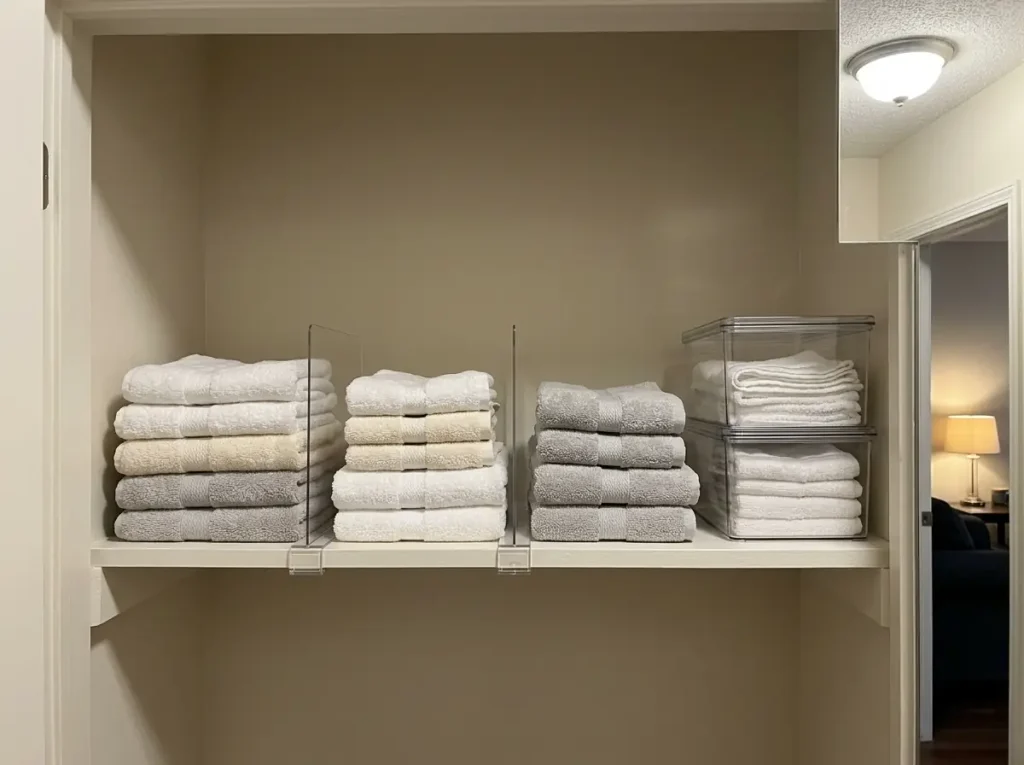
You’ve cut the quantity and the shelf finally has air on it. Give it two laundry cycles and the stacks lean into each other until the shelf is one sliding heap again. Reducing without containing buys you about a fortnight. This is the shortest step and the one people skip, because an empty-ish shelf looks solved.
Stop the lateral collapse
Stacks fall sideways, not forward, which is why depth fixes don’t help here. Without vertical dividers, nothing holds the left edge of one pile away from the right edge of the next, so the first time someone pulls from the middle, both stacks merge.
Try a bookend you already own first.
Park a heavy one between two stacks for a week; if it holds the line, you’ve solved it for free and you know how many dividers you’d need. If the bookend holds, you’ve skipped the purchase entirely. For the budget-friendly purpose-built version, the HBlife Acrylic Shelf Dividers (6-Pack) clip onto shelves roughly 9/16 to 1 inch thick and hold a stack upright inside the spacing you already have, a no-drill, renter-friendly fix. The limitation is in the spec: they clip to a shelf edge, so a floating shelf with a thick or bullnosed front won’t take them, which is why matching the divider to your shelf type is worth two minutes before buying.
Keep the sightline — you buy what you can’t see
The reason you own six spare bottles of the same shampoo, and most of your spare toiletries in duplicate, is that they lived behind a folded blanket. Anything you can’t see from the doorway effectively doesn’t exist, so you replace it, and the replacement joins the pile that hid the original.
Clear stacking bins fix it for small loose items that can’t hold a stack on their own. The Vtopmart 6 Pack Clear Stackable Bins with Lids run about 11 by 8 by 6 inches, fitting a 12 to 16 inch shelf without hanging over the front edge and blocking the door. One caveat: the lids that make them stackable also make them annoying, because a lidded bin on a shelf you reach into daily gets left open within a week. Lids on the seasonal top shelf, none on the working shelf.
A free move belongs here too. The bed in a bag fold: fold a sheet set into a rectangle and tuck it inside one of its own pillowcases, so pillowcase-bundled sheets store as one unit instead of three strays on three shelves. It survives being handled by someone who isn’t you, which makes it a fold that survives other people in the literal sense.
Label the zone, not the item
An unlabeled shelf reverts to catch-all, because a shelf with no declared purpose is an invitation and every household has someone who accepts it. Categorize linens by zone and label the zone: a shelf that says TOWELS resists drift in a way that a shelf which just happens to contain towels does not.
Masking tape and a marker do this for free, today, and tape tells you whether your zones are right before you commit to them. Once they’ve survived a month, the small splurge is worth it: the Brother P-Touch PTD220 Label Maker makes them permanent and legible from four feet away by someone in a hurry. Its downside is the tape cartridges, which you will run out of mid-project.
And label the zone, not the item. “Towels” holds up when the towels change. “Blue guest towels” is a label you’ll peel off in eight months.
Renter-Safe Ways to Add Space Without Adding a Shelf
You’ve reduced, you’ve contained, and you still need more room. Almost every guide’s answer here is to add a shelf, paint the interior, or install DIY shelf covers. If you rent, those are off the table before you finish reading them. Everything below comes back out with you and needs no permission.
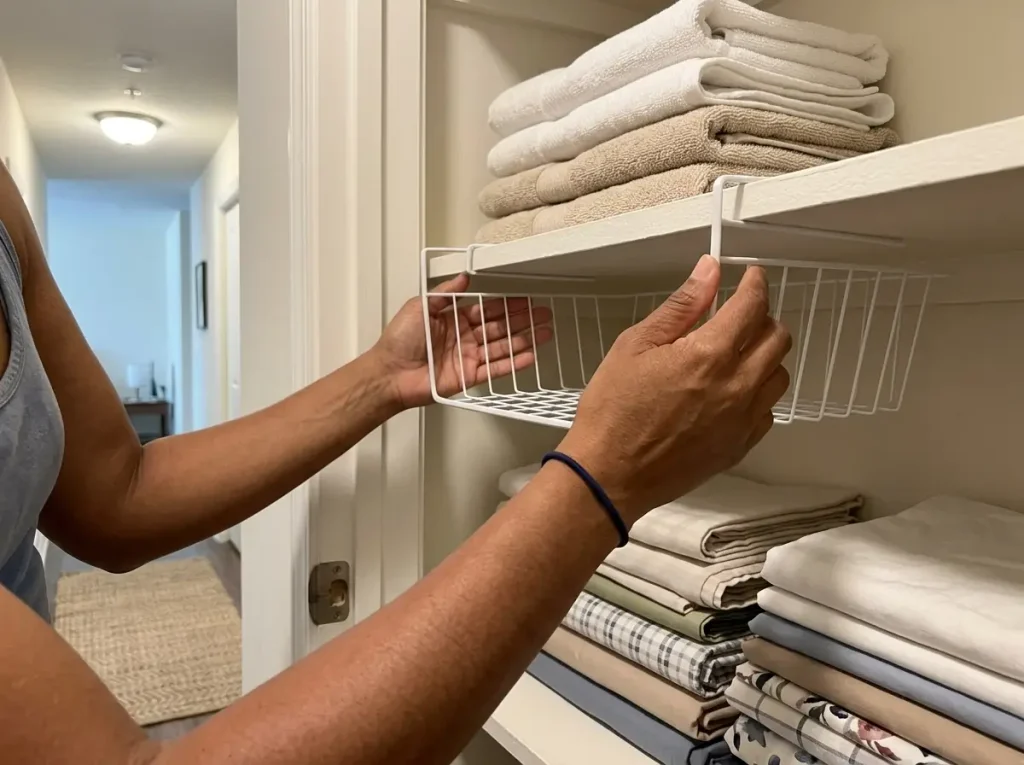
Claim the dead air under a shelf
Look at the gap between the top of your folded stack and the underside of the shelf above. In a builder-grade closet that gap runs the full width and depth of every level, and it adds up fast. Across four shelves it’s the largest pocket of unused space you have, invisible because it reads as negative space rather than clutter.
A slide-under basket claims it without adding a shelf. The HEMOTON Under Shelf Basket is roughly 16 by 10 by 4.5 inches and slides onto an existing shelf from the front, hanging in the gap underneath. Steel wire units in this class commonly carry 33 to 50 pounds per basket, an honest ceiling worth respecting: washcloths and pillowcases yes, extra blankets or a stack of duvets and quilts no. The real constraint is that 4.5-inch profile, so measure your gap first, because a basket that doesn’t clear the stack below just moves the problem downward.
Two rows deep without losing the back row
With deep-closet shelving, 16 inches or more, the back row dies the moment something taller sits in front of it. The fix costs nothing: short container in front, tall one behind. Both stay visible from the doorway and the back row rejoins your working inventory instead of becoming an archive.
Same for loose stacks, short forward, tall back. No purchase required.
Wire shelving without the tipping
If your closet has coated wire shelving you know the failure: small items tip through the gaps, folded stacks develop ridges along the wires, and a stack on an uneven surface leans before it falls. Rigid cardboard cut to size works in a pinch and it’s free, though it warps in a humid hallway closet within a season.
The reversible version is a non-adhesive liner. Unlike the peel-and-stick shelf liners sold for kitchen drawers, the Performore Clear Waterproof Vinyl Wire Shelf Liners (5-Pack) come as 14 by 36 inch sheets you cut to your shelf and lay down with nothing sticky involved, so they lift out on move-out day with no residue. Caveat: non-adhesive means a sheet cut short will shift when you slide a bin across it, so cut to the full shelf width. If your closet is entirely wire, more linen closet organization ideas for wire shelves go deeper than this section does.
One thing here is not renter-neutral. If your overflow answer is a free-standing shelf unit or a rolling cart parked next to the closet, the federal tip-over standard that applies to any shelving or cart over 24 inches wide or 30 inches tall calls for anchoring it to the wall. That’s hardware in the wall, a landlord conversation, and a patch job at move-out.
Most renters do better relocating overflow into bedroom closet storage or under-sink storage you already have, which is itself the renter-safe move for a closet whose square footage cannot change. When you’re ready to buy rather than improvise, organizers sized for a 12-inch shelf carries the depth this article leaves out.
Keeping It That Way When You Share the Closet
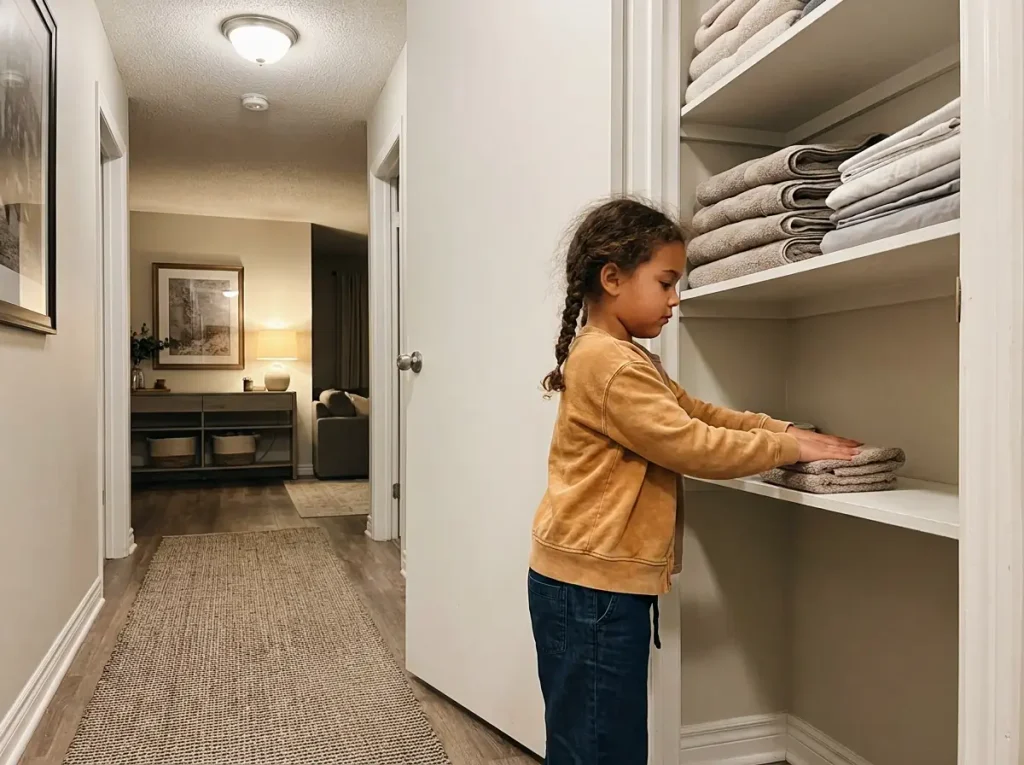
A system that only holds when one person maintains it isn’t a system. In a shared household it’s a chore assigned to whoever cares most, and that person gets tired around week five. Kids pull from the middle of the stack because the middle is at their eye level.
Guests refold nothing. A partner won’t refold a fitted sheet, they’ll put it back as a ball, and no amount of explaining changes that. Build the zones so kids and guests land in the right place without being told. Build for those people, not against them.
Build for the person who doesn’t care about the system
The design rule is the whole section in one line: every category needs a spot obvious enough that someone who doesn’t care still gets it right. If putting a towel away requires thought, it won’t happen twice. They’ll set it on the nearest flat surface, and that surface becomes the new default.
Height assignment does more work than any instruction you’ll give.
Kids’ towels go on a shelf a kid can reach, which removes the reason to dig through the middle of an adult stack. Guest linens go up top, where nobody reaches by accident. Everyday towels sit at eye level, in front, because that’s where a hand goes without deciding. You’re sorting by frequency of use, not by size or color.
Give the guest reserve its own small labeled zone rather than a place in the working stack. Mix them in and you get the classic outcome: the good towels are in the laundry the day someone arrives.
Test a zone by asking the least invested person in your house to put a clean towel away without any hints. If they hesitate for more than a second or two, the label or the height is wrong. Fix the closet, not the person.
The miscellaneous shelf has to go
Every reverted linen closet has one shelf with no assigned category. It starts as breathing room and ends as the household’s overflow drain, undoing the entire relocate bucket within about a month. It’s the junk drawer failure repeating itself on a shelf: give one section no rule and it eats the rest.
It isn’t laziness. A person holding an object with nowhere to put it takes the option that requires no decision, and a shelf with no rule is that option. Remove it and they have to either find the right zone or leave the room.
So assign every shelf, including the awkward top one. A vague assignment beats none: “off-season” is a category, “extra” is not.
The three-month count, not the three-month tidy
I used to think this closet needed a quarterly tidy. That’s wrong, and the failure stories in organizing coverage point the same direction: tidying restores the appearance while the quantity keeps climbing, so the closet looks fixed and refills anyway. What it needs is a count. Call it the three-month test: the only maintenance routine this closet actually requires, and the reason a weekly reset or a monthly reset never fixes it.
Every three months, count the towel and sheet sets against the keep number from earlier.
Four people, four stored towel sets. Two beds, two stored sheet sets.
If the count drifted up, something arrived without anything leaving, and that’s precisely what a tidy hides. It takes about four minutes, less than the tidy you were going to do instead. Same cadence as a quarterly reset you can run in any room, applied to a closet that refills faster because it’s small.
One last thing, and it matters more than any product on this page.
A shared linen closet will never look like the photo on a Tuesday afternoon. Someone will have shoved a hand towel in sideways. The measure that counts is whether the stacks are still in their zones, not whether the edges line up. If you’d rather rebuild from empty than patch what’s there, the full empty-sort-measure process walks the order start to finish.
The Takeaway
Your closet is most likely a normal size. The refill is a quantity problem, and quantity is the only variable you control without tools or a landlord’s approval.
Most of what crowds a linen closet was never a linen. The relocate bucket frees more inches than any bin you can buy, and it costs nothing except naming a destination before an item leaves the shelf.
A system that needs one person to police it is already failing. Assign every zone so the household’s least invested member gets it right on the first try, and retire the miscellaneous shelf before it swallows what you just sorted.
In three months, count the sets against your keep number instead of tidying by eye. A tidy shelf hides the drift. A count finds it.
Start with one shelf, the one at eye level. Empty it, decide what belongs there, and give everything else a named destination before you buy a single container.
Frequently Asked Questions
01What should not be stored in a linen closet?
Expired medication, expired cleaning products, damaged gift bags, broken seasonal decor, mismatched tablecloths and any linen past its useful life. Most linen closet clutter isn’t linens at all. It’s items that drifted in because they had no assigned home elsewhere in the house.
02How many towels and sheets should I keep for each person?
About three towel sets per person, which works out to one set stored in the closet at a time, plus two sheet sets per bed: one on the bed, one on the shelf. Count your household against what’s actually on the shelf. The difference is your overflow.
03How far apart should shelves be in a small linen closet?
Roughly 10 to 12 inches for sheets, 12 to 16 for towels, and 18 to 20 below the first shelf. A NAPO-certified organizer independently recommends a 10 to 14 inch band for everything below the top shelf, which is unusually strong agreement for this niche.
04Where can I store linens if my closet is too small?
Under a bed, on the top shelf of a bedroom closet, or in a labeled bin in the room where those linens are actually used. The rule is that overflow gets a named destination, never a vague somewhere else. An unnamed destination is how items drift back into the linen closet.
05Why does my linen closet get messy again so quickly?
Because the shelf’s capacity never changed, only its arrangement. If the quantity going back in is the same as before, the closet returns to its previous state within a few laundry cycles no matter how carefully everything was folded.