




















In this article
You bought the organizer set, lifted out the first bin, set it on the shelf, and the mirror door wouldn’t close, because the bin is six inches deep and your shelf is three and a half. That mismatch is the whole problem with medicine cabinet organization, and almost nobody warns you before you spend the money. A recessed medicine cabinet runs roughly 3.5 to 5 inches of overall depth, and gives back less once the mirror and framing take their cut. Here’s the order that works: clear it out, get rid of what’s expired, decide what earns a spot at the sink, measure the shelf, then buy to the measurement instead of the photo.
Quick Answer
Organize a medicine cabinet in this order, and skip nothing:
- Empty it completely onto a towel on the counter.
- Pull anything expired and take it to a pharmacy drop box.
- Move backstock and non-daily items to a drier room.
- Measure the shelf depth before you buy a single bin.
- Group what’s left by who uses it, then label the zones.
Start by Emptying It and Getting Rid of What’s Expired
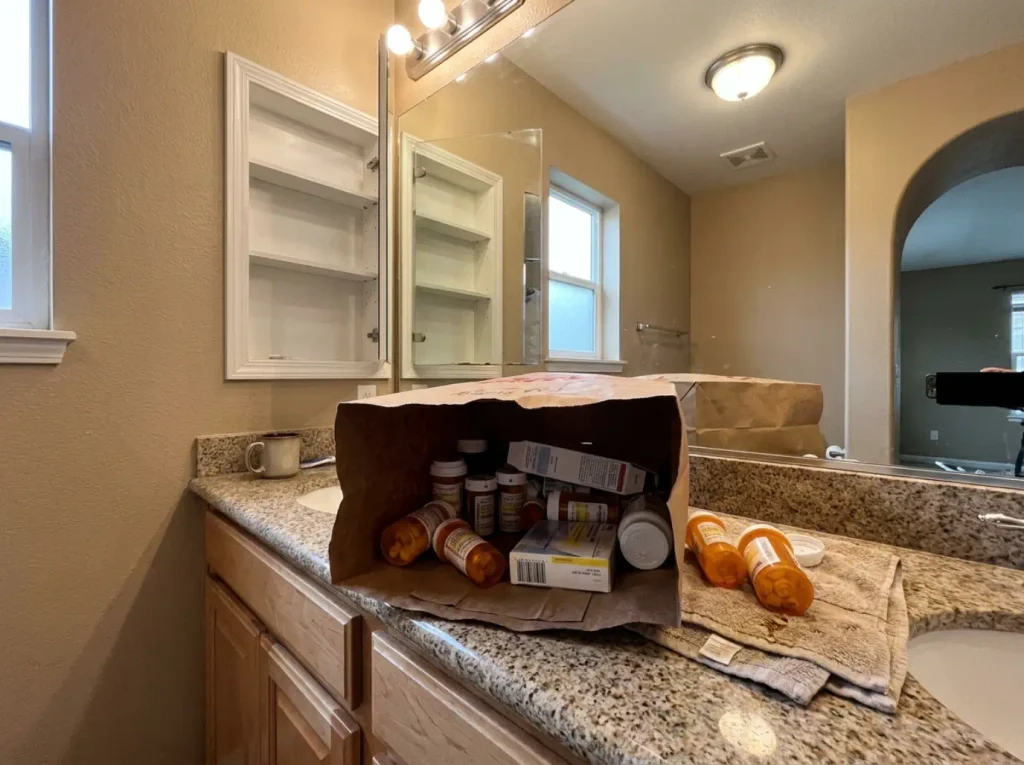
Nobody organizes a medicine cabinet in place. The shelves are too shallow to sort on, so everything comes out onto a towel on the counter first, and the pile is always bigger than you expected.
Three half-used bottles of cough syrup. A prescription from a surgery two years ago. Sunscreen from a vacation you’d have to check a photo album to date.
It gets worse than any other storage spot in the house for one reason: nothing in it ever gets thrown away on purpose. It only accumulates, behind a mirror, where nobody looks directly. People call it the junk drawer of the bathroom, and that’s exactly right.
Do the expiration date check as you go, not in a second pass later. Most prescription medicines carry a shelf life of two to three years under proper storage, and “proper storage” is doing a lot of work in that sentence. Anything past its date goes in a separate pile that does not go back in the cabinet.
Disposal is the step people skip, and when they don’t skip it they usually get it wrong. Follow the FDA’s guidelines on disposing of unused medicine safely: the preferred route is a take-back location or a DEA-authorized collector, and both CVS and Walgreens run kiosks, so it isn’t a special errand.
If there’s no take-back near you and the medication isn’t on the FDA’s flush list, mix it with dirt, cat litter or used coffee grounds, seal it in a bag, then bin it. Never drop loose pills straight into a wastebasket. Pets go through trash. So do toddlers.
Bag the expired pile and put it in your car, not by the front door. Bags left by the door become furniture and sit there for months. In the passenger seat, it gets handled on the next drugstore run without you having to remember anything.
What Actually Belongs in a Medicine Cabinet (and What to Move)
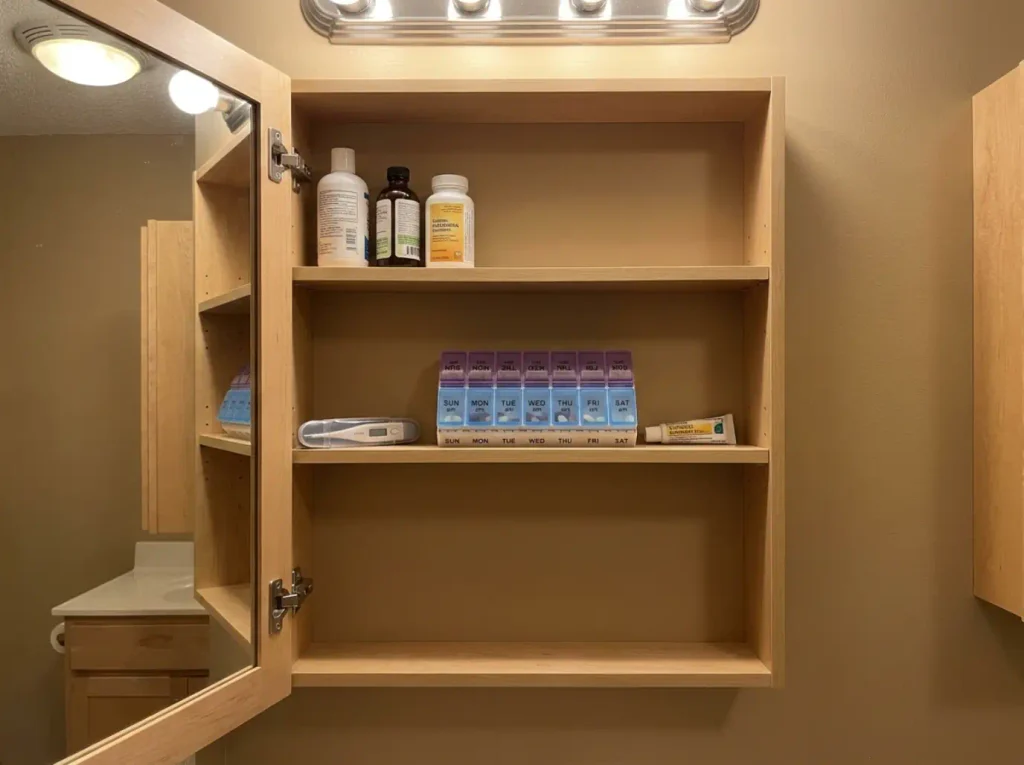
The name is half the problem. It says medicine cabinet, so people store all their medicine in it: the backstock, the vitamins and supplements, the antibiotic cream used once a year. But a bathroom is close to the worst room in the house for medication, and it’s also the smallest storage space in that room.
Ideal storage sits between 59 and 86°F with humidity under 60%, and a bathroom clears neither during a shower. A kitchen near the stove doesn’t clear them either, though, and most advice ends at “move everything to the kitchen,” which is useless if the mirror cabinet is all you have. This is a relocation argument, not an abandon-the-cabinet argument.
What stays is what you reach for at the sink: a thermometer, a basic first aid kit, contact solution, the over-the-counter medications you take daily, the thing you’d want at 2am without turning on every light. What moves is backstock and refills, bulk vitamins, and anything you touch less than monthly. A linen closet or bedroom drawer is measurably better for all of it, and the toiletries relocation has an obvious destination too, since the cabinet under the sink is the right home for most of it.
That split is the highest-leverage change in this article. Mixing “in use” with “spare” in one bin is the failure people describe over and over: the cabinet looks organized on day one, and by week three you’re paging through ten bottles every morning to find the one you take. Nothing about the bins caused that. The category did.
The fix is a container that lies down instead of standing up. The Ezy Dose Weekly 7-Day AM/PM Pill Organizer sits flat and needs no bin depth at all, which is the trick on a three-inch shelf, and it separates a week of in-use doses from every backup bottle.
The caveat is real: filling it is a Sunday-night task, and if nobody wants it, it becomes an empty tray in prime shelf space. It works for people with a routine. It doesn’t create one.
Whatever backstock you do keep, restock it front to back. FIFO restocking, first in first out, means the new box goes behind the open one rather than on top of it, so you finish what’s already started instead of opening a third bottle of the same thing. It’s the one habit that stops a shelf from quietly accumulating duplicates.
Sort What’s Left by Who Reaches for It
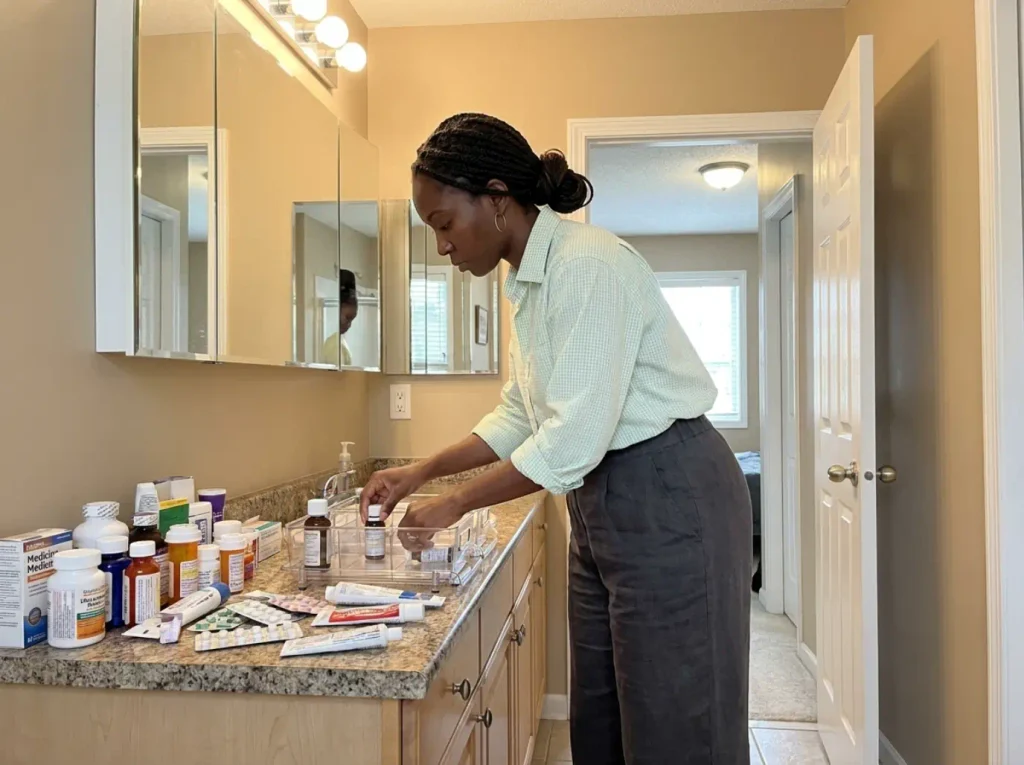
Every guide says group by category and stops there, which is fine for exactly one kind of household. Category alone works in a one-person bathroom and collapses in a shared one, because the categories don’t match how anybody reaches into a cabinet at 7am. In a house of three, “allergy” isn’t a category anyone thinks in at that hour. “Mine” is.
Two schemes work. By ailment groups cold and flu, allergy, pain and fever, first aid, skin, and it’s right for a solo bathroom or a couple sharing supplies. By person takes over the moment two routines stop overlapping. Pick one and commit, because a cabinet running both halfway is running neither.
The reversion story is consistent in organizing threads: a cabinet gets set up beautifully around one person’s needs, then a second household member’s items get shoved in wherever there’s room. Within a month the zones have bled together. It didn’t fail because anybody was careless. It failed because it never had an “everyone’s stuff has a home” rule, so the first unassigned item broke it and every item after followed.
Shelf assignment goes by frequency, not looks: daily items at eye level, seasonal stuff up top, tall bottles on the bottom where the clearance is (the narrow shelves are where the tall cough syrup bottle goes to die). It’s the same measure-first, zone-by-frequency approach that fixes the rest of a small bathroom, applied to a space four inches deep.
Divided compartments do the work of one-bin-per-category without you buying six bins, which matters when the shelf is only wide enough for two or three containers side by side. Before you buy anything: a silverware tray with molded dividers, pulled from a kitchen drawer you barely use, does this for free. If the width fits, you’re done here.
If you want something built for the space, acrylic organizer bins hold up better than clear plastic bins in this room, because the thinner clear plastic ones go brittle and crack at the corners after a couple of years of heat and steam. The HIHEGD 2-Tier Clear Acrylic Bathroom Organizer with Dividers has slide-out drawers and twelve removable dividers, so each person or ailment group gets a compartment inside one unit. The catch is that it’s two tiers, so measure your shelf spacing and not just your depth.
Decant the things that ship in wasteful boxes. Cotton rounds, floss picks and makeup sponges all come in cardboard that’s two-thirds air, and moving them into a slim jar recovers real shelf inches you already paid for. The cardboard was going to fail in the humidity anyway.
Measure the Shelf Before You Buy a Single Bin
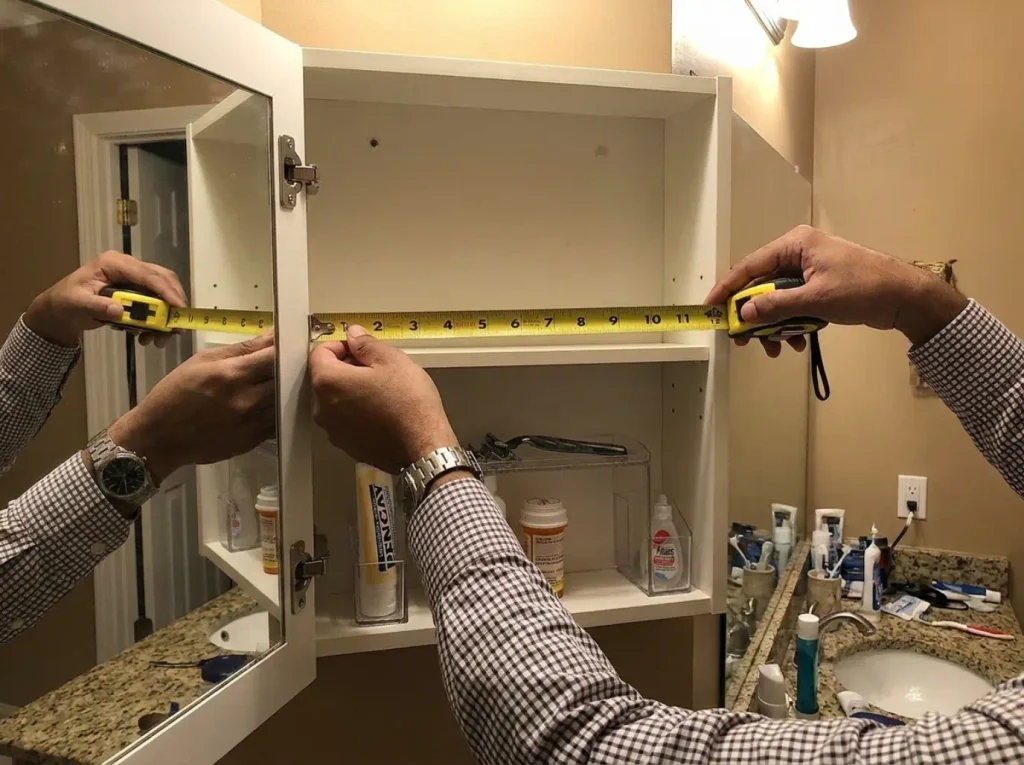
This is the section the article exists for. Nobody warns you about the depth, because the sites recommending those bins recommend the same bins for pantries and vanities, spaces with two to four times the clearance. A medicine cabinet gets treated like a generic bathroom shelf, and it isn’t one.
Start with the spec sheet. Recessed cabinets typically run 3.5 to 5 inches of overall depth, while surface-mounted units project 4 to 8 inches into the room.
Then subtract, because the spec number is not the number you can use. Usable interior depth runs half an inch to a full inch less, once the mirror thickness, wiring and structural frame take their share. A cabinet sold as “4 inches deep” can leave you three to three and a half inches of real shelf. That gap sounds small and isn’t: it’s exactly the range separating a bin that fits from a bin that stops the door.
So measure the shelf, not the cabinet, and buy under your measurement rather than to it. Tape measure from the back wall to the front edge (an actual tape measure, not your thumb and a guess), then take off a little more for the door’s swing and the hinge hardware. Write the number down somewhere you’ll have it while shopping, because you will not remember whether it was 3.25 or 3.75 once you’re comparing listings. It’s the same measure-before-you-buy rule that saves you money everywhere else in a small bathroom.
Here’s why this is a reversion mechanism and not just a shopping annoyance. A bin that barely fits gets pushed back so the door will close. The bottles behind it get shuffled. Within a few weeks the tall items are tipping into the short ones, the short ones have vanished behind them, and nobody sees them again until the next clean-out.
That’s why the same cabinet gets decluttered three times a year by someone who reasonably concludes they’re bad at organizing. They aren’t. The container was wrong the day it arrived.
I used to point people toward the standard multipack of clear bathroom bins here, because they’re cheap and everywhere. After enough versions of the same complaint in organizing threads (bought the set, nothing fits, mirror won’t close) I stopped. For a medicine cabinet, depth is the only spec that matters first.
So before you buy anything, a shallow shoebox lid from a dollar store gives you the same depth for pocket change, and it’s the fastest way to learn whether a corralled group is even right for that shelf. If it earns its space over two weeks, replace it with something that won’t go soft in the humidity. The iDesign 43130 Med+ High-Rise Bathroom Medicine Cabinet Organizer is one of the very few built to a three-inch depth rather than a generic bathroom-organizer depth, so it clears the door line on most recessed cabinets. Measure anyway: a three-inch organizer in a two-and-three-quarter-inch cabinet is still wrong.
And the door is free real estate while shelf depth isn’t. Most medicine cabinet doors are flat metal inside, so magnetic tins and a thin magnetic strip add an entire storage layer without touching shelf depth. Tweezers, nail clippers, bobby pins: none of it competes for shelf space anymore. Cheapest high-value change in this article.
Label It So the System Survives Other People
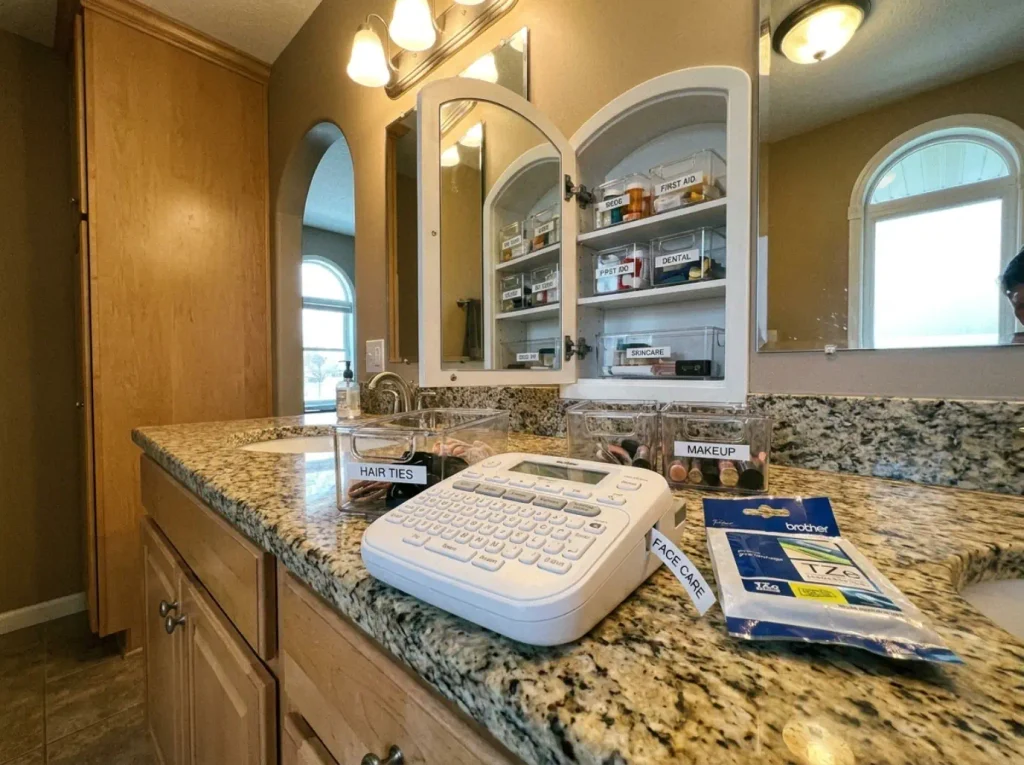
Labels do a different job here than in a pantry. There, a label tells you what’s inside a container you can’t see through. Here the containers are usually clear and the bottles already have their own printing, so the label’s real job is telling everyone else in the house where things go back.
That means labeling the zone, not the item. “Cold and flu.” “First aid.” “Dad’s.”
A label naming a specific product goes wrong the moment that product runs out and gets replaced, and then it lies to everyone using the cabinet. Zone labels survive restocking. Item labels don’t.
Humidity decides the rest. Handwritten masking tape and printed paper labels curl at the edges and let go within a few months, which is the same humidity that ruins everything else in a bathroom: the warped bamboo, the rusted caddy, the peeling adhesive. Laminated tape stays stuck because the printing sits sealed between layers instead of on the surface where steam gets at it.
Start free anyway. Painter’s tape and a permanent marker label your zones just as clearly, and cheap labels make you willing to change your mind. Give it four weeks, watch which zone names you keep hesitating over, then relabel. Committing on day one is how people end up with a beautifully labeled cabinet organized around the wrong categories.
When you do commit, the Brother P-Touch PTD220 Label Maker is the standing pick across this site, the same one used in the pantry, closet and under-sink guides, paired with Brother TZe-231 Laminated Label Tape in half-inch black on white. The tape is the half that matters in this room; the machine just prints it. If you’re only ever labeling one cabinet, painter’s tape is genuinely enough.
One more free addition, and in a shared bathroom it does more than the labels do. Stick a small dry erase board on the inside of the door and it becomes a low-stock list and a “who took the last of this” note in the same place. The person who used the last allergy tablet writes it there instead of intending to mention it later, which is the version that never happens.
Child Safety and the Shared-Bathroom Problem
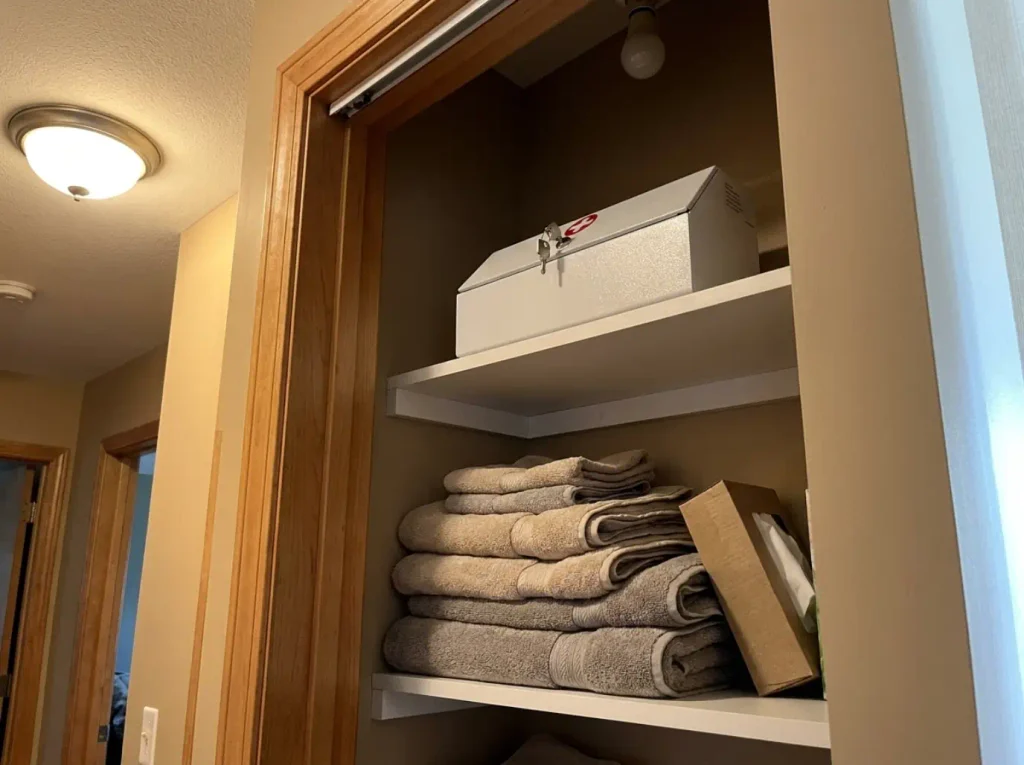
Every organizing guide for this cabinet stops at “put it up high.” That’s the entire safety conversation across most of the search results, which is strange given what’s stored in there. A medicine cabinet is the one storage space where the organizing decision and the safety decision are the same decision.
Start with what child-resistant caps actually do, because most people misread them. They’re a deterrent that buys time, not a guarantee, which is the Consumer Product Safety Commission’s data on child-resistant packaging framing rather than a cautious blogger’s. Packaging that slows a determined three-year-old by a few minutes has done its job. It was never the plan.
The actual safety layer is placement plus a lock: high, out of sight, and locked for anything prescription or high-risk, which is child safety guidance from Seattle Children’s Hospital on secure medicine storage. The out-of-sight half deserves more attention than it gets. A child who never sees a bottle doesn’t go looking for one, and visibility is what turns a high shelf into a climbing project.
Here’s the catch nobody mentions: a three-inch recessed cabinet usually can’t take a lock mechanism at all. There’s no depth for the hardware, the door is a mirror you don’t want to drill, and if you rent, that mirror is somebody else’s property. So the realistic answer is a split. Everyday low-risk items stay in the cabinet, and the few things that genuinely need securing move into a small lockbox mounted nearby or set on a linen closet shelf.
A lockable tackle box or a small toolbox with a key, already in the garage, does this job today for nothing. It isn’t elegant and doesn’t need to be, since the point is that it stays closed and out of sight.
If you’d rather have a medicine box built for it, the POCHAR Wall Mount Locking Medicine Cabinet Box is steel, child-proof, and mounts on a nearby wall rather than inside the rented cabinet. The limitation is obvious: it needs wall space and hardware. If your walls are off-limits too, it sits on a shelf and works the same.
Shared adult households have a different problem, and it isn’t safety. It’s attribution. When two people’s medication looks alike, someone eventually takes the wrong bottle in the dark at 6am. Per-person zones and zone labels fix it, and they cost nothing.
Before a grandparent visits or a houseguest moves into the spare room, do a ten-minute pass on what’s sitting out at eye level. Visiting kids don’t know your house rules and they explore bathrooms, which are the one room where a closed door reads as normal rather than suspicious.
Keeping It Organized in a Humid Bathroom
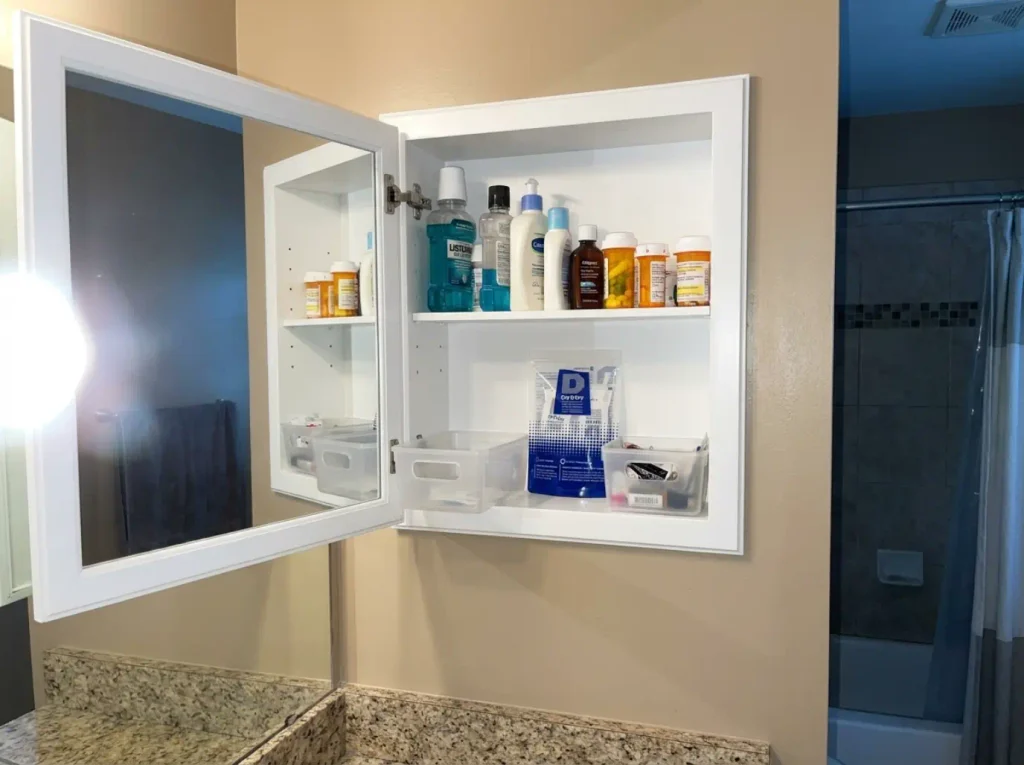
The after-photo is not the finish line. The real test comes six weeks later, when somebody opens the cabinet looking for the thermometer and can’t find it under three bottles that never got put back. And unlike a closet, this space has an active adversary between clean-outs.
Name the mechanism, because it explains what follows. Bathroom humidity spikes toward 85 to 95% during a hot shower, and for moisture-sensitive medications that accelerates chemical breakdown substantially compared with dry storage. The expiration date assumes a cool, dry drawer, not a room that turns into a steam chamber twice a day. That’s why the annual clean-out matters more here than in a linen closet.
The behavioral fixes come first because they’re free and do most of the work. Run the exhaust fan during your shower and leave it running afterward, which is the part people skip. Keep the cabinet door closed while the steam is up, since an open mirror door is a steam trap.
That’s it. Two habits, no purchase.
For a cabinet you genuinely can’t relocate, add a rechargeable indicating silica packet to the shelf. The Dry & Dry Rechargeable Silica Gel Packets change color when saturated and reset in a microwave or low oven, which is why they beat disposable packets: no recurring cost, nothing to reorder. They’re a moisture buffer, not a dehumidifier, so treat them as the last layer after the fan and the closed door. The color change is a signal in itself: if it saturates fast, your ventilation is the real problem.
The maintenance rhythm is smaller than most people expect: a two-minute look every time you refill a prescription, plus one annual medicine cabinet clean-out. Tie that yearly pass to something already on your calendar, like the fall time change. A maintenance task with no trigger doesn’t happen, and this cabinet has no natural trigger, which is why it accumulates for years.
The system that survives three months isn’t the prettiest. It’s the one with the fewest decisions: if putting something back means choosing between two plausible bins, it ends up on the counter instead.
One more thing before you buy anything else for this room: which materials survive a bathroom and which ones don’t is a decision you only want to make once. Cardboard is out, bamboo warps, and plastic and coated metal are boring and last.
If You’re Renting
Every solution here is renter-safe by design, which wasn’t an accident. The bins sit loose on the shelf, the dividers sit inside the bins, the magnetic accessories cling to metal that’s already there, and the lockbox mounts on a wall rather than inside the cabinet. Nothing needs a drill or a permanent adhesive.
That matters because a rented mirror-cabinet interior is exactly the surface a security deposit gets docked over. Adhesive hooks pull the finish off painted walls, and anything mounted through a mirror frame is a repair, not a scuff. Skip both. If the wall is off-limits too, the lockbox sits on a linen closet shelf and does the identical job.
Conclusion
Three things carry the rest. Measure the shelf before you buy anything, because the usable depth is less than the spec and that gap is why the last organizer set didn’t fit. Keep only what you reach for at the sink, and move backstock, bulk vitamins and anything monthly-or-rarer to a drier room. Give every category a home and label the zone rather than the item, which is what lets the system survive other people putting things away.
In three months, open the cabinet and look for the item that keeps ending up on the counter. That’s not a discipline problem and not proof the system failed. It’s a category you didn’t create, and it takes a minute to fix once you notice it.
Start with the expired pile. Bag it, put it in the car, and drop it at the pharmacy kiosk on your next errand. Everything else here gets easier once the cabinet has room in it.
Frequently Asked Questions
01What are the most common medicine cabinet mistakes?
Buying bins before measuring the shelf, and keeping backstock in the same cabinet as daily-use items. The first means the mirror door won’t close; the second means paging through eight bottles every morning to find one. Both are why the same cabinet gets reorganized three times a year.
02What should be in every medicine cabinet?
What you would reach for at the sink: a thermometer, basic first aid supplies, the medication you take daily, and anything you would want at 2am without hunting for it. Everything else keeps better somewhere drier, including backstock and bulk vitamins.
03Where should you store medicine if not the bathroom?
A linen closet, hallway cabinet or bedroom drawer. The ideal storage range is 59 to 86°F with humidity below 60%, and a bathroom clears neither during a shower. A kitchen cabinet near the stove has the same problem, so pick the driest room you have.
04What organizers actually fit a medicine cabinet?
Ones built at 3 inches deep or less, plus anything flat enough to lie down rather than stand up. Most bins sold as bathroom organizers are 5 to 6 inches deep and designed for a vanity or under-sink cabinet, not a recessed mirror cabinet.