





















In this article
Your medicine cabinet doesn’t get messy in a way you can see. It gets messy behind a closed mirrored door, and you only find out when you open it and everything comes forward at once. The community phrase for this is “constantly overflowing,” which is exactly right: nothing looks wrong until the moment it does.
Most medicine cabinet organization ideas you’ll find treat this like a shelf problem, but professional organizers name the same two constraints every time, and depth is the first one. The second is the room itself, because a mirrored cabinet two feet from a shower gets steamed twice a day and almost nobody follows that through to what it means for the products they’re recommending. What follows is a menu, not a project. Take one idea at a time, and if you haven’t cleared the cabinet out yet, start with the full framework before you buy anything.
Quick Answer
The ideas that actually hold in a medicine cabinet, in the order they matter:
- Measure shelf depth before you buy anything at all
- Containerize in slim high-rise organizers, never deep bins
- Divide small items instead of pooling them in one tub
- Add a small-diameter turntable, not a kitchen-sized one
- Use the door and the wall, not just the shelves
- Pick materials that tolerate steam, and label with laminated tape
Start With Depth, Because That’s What Kills Most Cabinet Buys
There’s a specific pile that forms in bathrooms across the country, and it’s made of organizers that came home and went straight back in the box. The listing photo made the thing look small. It sat on the shelf fine. Then the mirrored door hit it on the way closed, and that was the end of that.
This is not a measuring failure on the reader’s part. It’s that every product page tells you a width and every article tells you to declutter, and nobody says the one number that decides everything.
Depth is the binding constraint in a bathroom cabinet. Professional organizers flag it consistently, ahead of width and ahead of height, because a recessed medicine cabinet has only as much room as the stud bay behind it allows. Family Handyman’s organizer roundup, built on input from Shannon Krause of TidyNest, opens on exactly this point. A product that reads “compact” next to a bathroom sink in a photo can still be an inch too deep for your particular shelf, and an inch is the whole margin.
Which brings up the distinction almost no competing article makes: recessed versus surface-mount. A recessed mirror cabinet sits inside the wall cavity, so its shelves are genuinely shallow, often just a few fingers deep. A surface-mount cabinet hangs on the wall face and can be noticeably deeper, and the vanity cabinet under the sink is deeper again. These are three different storage problems that get treated as one, and shelf depth is what separates them.
Before any idea in this article turns into a purchase, work out which of the three you’re standing in front of. A product that’s ideal in one is a returns-pile candidate in the other two, and the dead space you’re trying to reclaim isn’t the same shape in any of them.
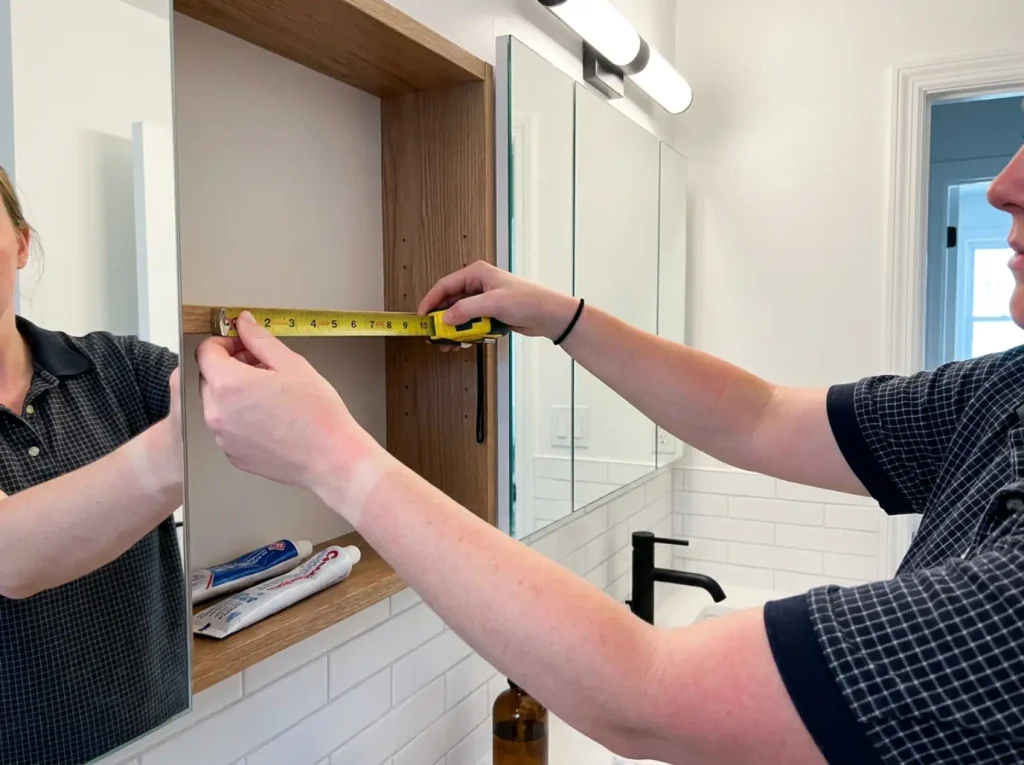
The rule itself is short. Measure the depth from the back wall to the inside face of the closed door, then subtract about a finger’s width.
That clearance isn’t decorative. It’s the space you need to hook a hand around a container and lift it out past the door frame, and without it you’ll be sliding things sideways every morning. It’s the same measure-then-subtract method that decides turntable sizing, reused here because the geometry doesn’t care which room it’s in.
Now the part that surprises people. In most overflowing cabinets, the physical reason the door won’t close isn’t the total volume of stuff. It’s one item.
A full-size mouthwash bottle, or a pump lotion, or the tall shampoo that migrated over from the shower. Pull that single bottle out and the door shuts. This is the detail that reframes the whole problem, because it means the fix might not be a purchase at all.
Measure with the door closed on a ruler, not with a tape against the back wall. Slide a ruler flat onto the shelf, push the door shut against it, and read where the door lands. That number includes the door’s own hardware and the shelf lip, which a back-wall measurement quietly leaves out.
So the free version comes first: decanting. Pouring the oversized mouthwash or lotion into a smaller container you already own frees real depth in a shallow cabinet, and the professional organizer case that Apartment Therapy documented used exactly this move on a studio-apartment cabinet. It removes the tall branded packaging as a side effect, but that’s the bonus. The point is the inch you get back.
When you do want a product, buy the shape that answers the constraint instead of fighting it. A tiered shelf riser is the classic version of that move in a kitchen, and the medicine cabinet equivalent is a tall narrow organizer. The iDesign 43130 Med+ Plastic High-Rise Bathroom Medicine Cabinet Organizer is built tall and narrow specifically for shallow medicine cabinet shelves, which means it uses the vertical room a recessed cabinet has plenty of rather than the depth it doesn’t. The caveat is the flip side of the same design: a high-rise profile needs vertical clearance between shelves, so if your cabinet has fixed shelves set close together, measure that gap too before ordering.
Divide Small Things Instead of Pooling Them
Here’s a sequence that plays out constantly. You organize the cabinet on a Sunday. It looks great. Three months later you’re at the drugstore buying nail clippers, because the ones you own are somewhere in the cabinet you organized and you have looked twice.
The bin didn’t fail. The bin was the wrong size for what you put in it.
Family Handyman’s organizers name the failure in plain terms: small grooming items get “lost in large baskets or bins.” Nail clippers, tweezers, a single lip balm, the tiny scissors. These items have almost no footprint, so in a wide open container they migrate.
And in a shallow cabinet, migration is worse than it sounds, because of the sightline. You’re not looking down into a bin on a medicine cabinet shelf. You’re looking across it, at eye level, through a door opening that crops the back third of the container out of view entirely. Anything that drifts backward stops existing.
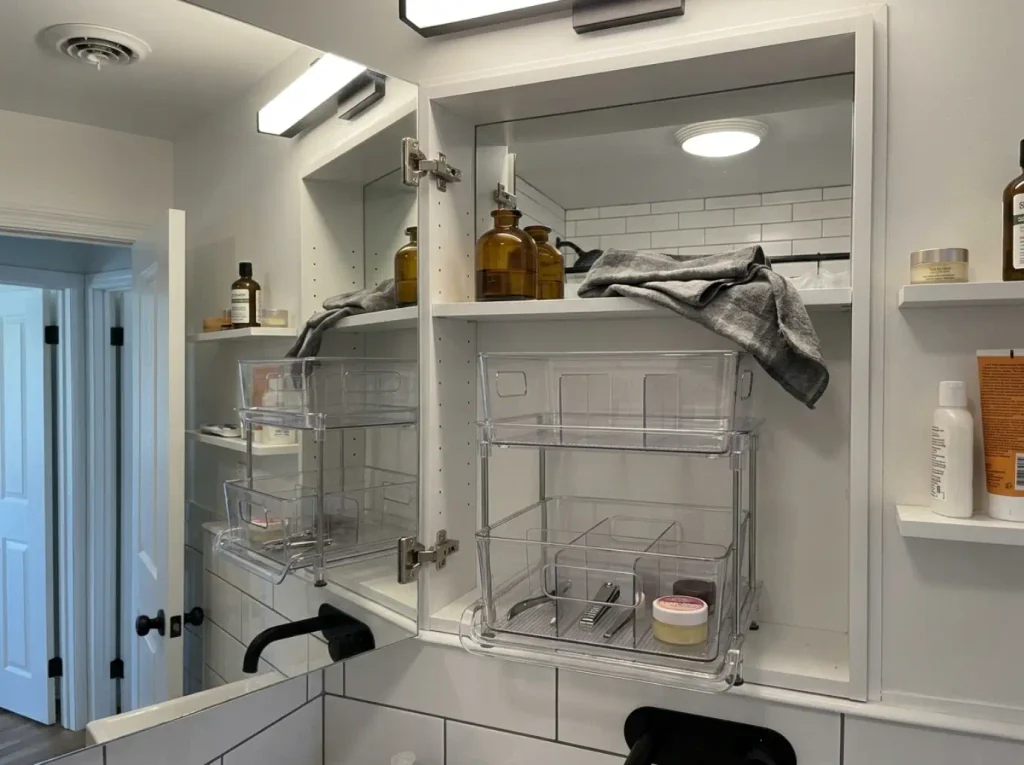
The fix is dividers sized close to the item’s own footprint, the same principle behind drawer dividers in a kitchen. Not one catch-all tub with sections drawn in your head, but physical walls that stop a clipper from traveling. If what you want instead is the strict sequence rather than a gallery you pick from, the strict step-by-step version of this reset walks the whole cabinet start to finish.
Slide-out access matters more here than it does anywhere else in the house. In a pantry you can reach past a container. In a medicine cabinet you can’t get a hand behind anything without pulling the whole unit forward first, because the shelf edge and the door frame are both in the way. That single mechanical fact is why a divided organizer that slides beats a divided organizer that sits.
Give every compartment one rule and never create a spare. The moment a divided organizer has a section with no assigned job, it becomes the miscellaneous section, and the miscellaneous section always wins. If something genuinely has no home, that’s information about whether it belongs in this cabinet at all.
Before buying anything, try the free version. Small containers you already own do this job: a clean jam jar, an empty mint tin, the little box a thermometer came in. Set them inside the shelf, assign one item type to each, and live with it for two weeks. Stackable containers work here too if the vertical gap allows it.
If you find yourself reaching past the improvised version because it slides around, you’ve learned something worth the price of the real thing. If it works, you’re done, and you spent nothing.
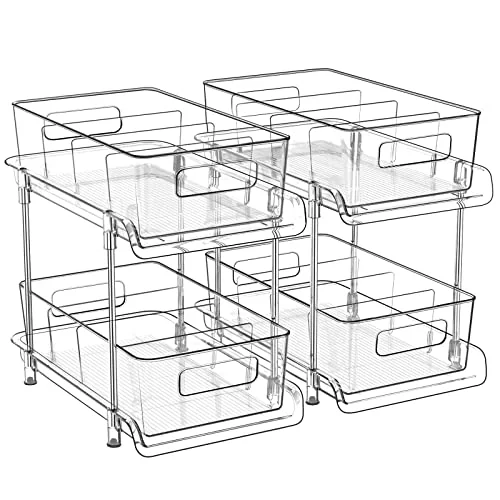
The upgrade, when you want it, is a two-tier unit with dividers you can move.
Put a Turntable In, But Size It for a Cabinet Not a Kitchen
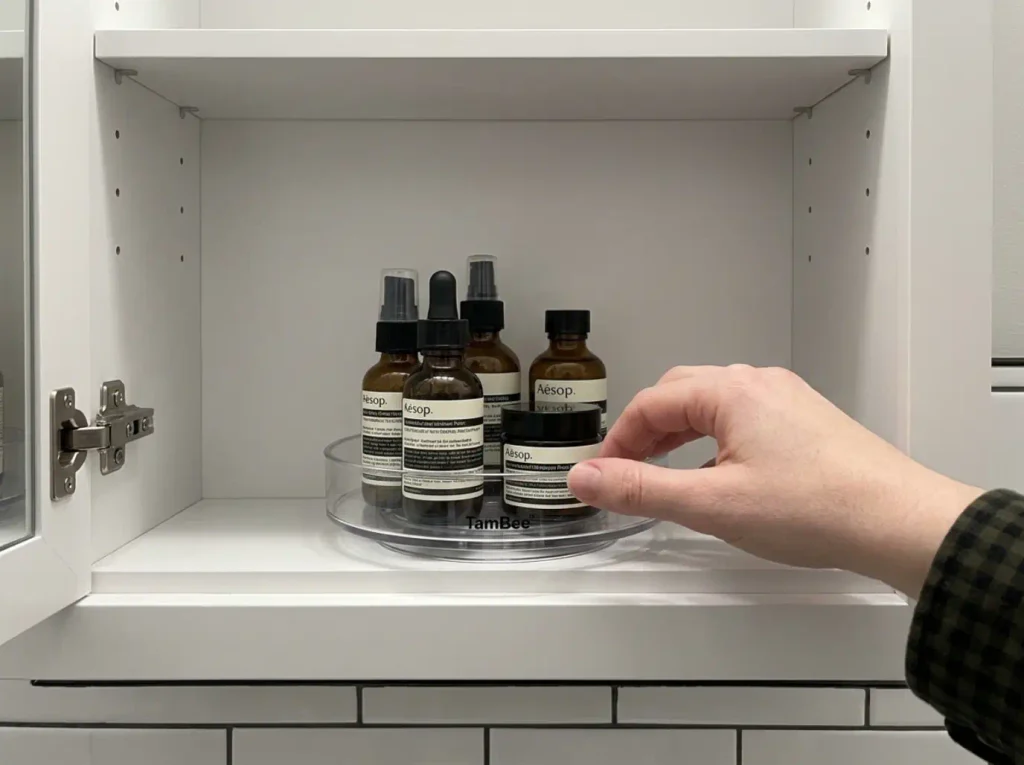
The turntable is the idea every list recommends and almost nobody sizes. A rotating organizer is genuinely good advice for the shelf you touch every day, because rotating beats reaching when six bottles are competing for the same square of shelf. But “add a lazy susan” without a diameter is how a good idea becomes a worse layout than the one you started with.
Start with the feature that decides whether it works at all. Professional organizers recommend turntables with raised walls for daily-use shelves, and the reasoning is mechanical: a flat disc with no lip flings small bottles off the edge every time it’s spun with any speed.
In a bathroom, where half of what’s on the tray is a slim bottle of something with a narrow base, a wall-less turntable becomes a mess generator within a few weeks. The wall is not a styling detail. It’s the whole product.
Then the geometry, which is where the sizing goes wrong. A circle inside a rectangle wastes its corners by definition. In a wide kitchen cabinet those corners are surplus you can afford.
In a narrow recessed mirror cabinet, the corners are most of your shelf, so a 12-inch or 16-inch turntable can leave you with genuinely less usable space than the bare shelf had. You spin things more easily and store fewer of them. That’s a bad trade, and it’s the exact failure the recessed-versus-vanity split from the last section predicts.
Test the diameter with a dinner plate before you order. Set a plate on the shelf, close the door, and see what’s left on either side of it. A standard dinner plate is close to 10 inches, a salad plate close to 7, so you get a physical read on how much shelf a given circle eats without waiting for a delivery.
For a mirrored cabinet, small is the answer. The TamBee 2 Pack 6 inch Lazy Susan Turntable Organizer is sized for exactly this problem, and the two-pack means you can run one on the daily-use shelf and one above without a second order. Acrylic is also the right material here for reasons the materials section gets into, which is the same argument for clear acrylic bins over anything opaque on a shelf you scan at eye level. The limitation is honest: six inches holds a rotating cluster of five or six small bottles, not a shelf’s worth of product, so it’s a solution for the things you reach for every morning rather than for everything you own.
And here’s what the bigger size is actually for. The OXO Good Grips Lazy Susan Turntable, 16-Inch is the wrong purchase for a mirrored cabinet and the right one for the vanity cabinet underneath it, where depth is generous and the wasted corners are corners you weren’t reaching into anyway. Same product category, two different rooms in effect. If that’s where you’re headed next, the deeper vanity cabinet underneath has its own set of picks.
One more thing in the turntable’s favor, and it’s underrated. Of every idea in this article, this is the only one with no mounting question attached at all. It sits on a shelf.
Nothing gets drilled, nothing gets stuck to a mirror, nothing has to come off cleanly at the end of a lease. If you’re renting and half the ideas you read about make you nervous, start here.
Use the Door and the Wall, Not Just the Shelves
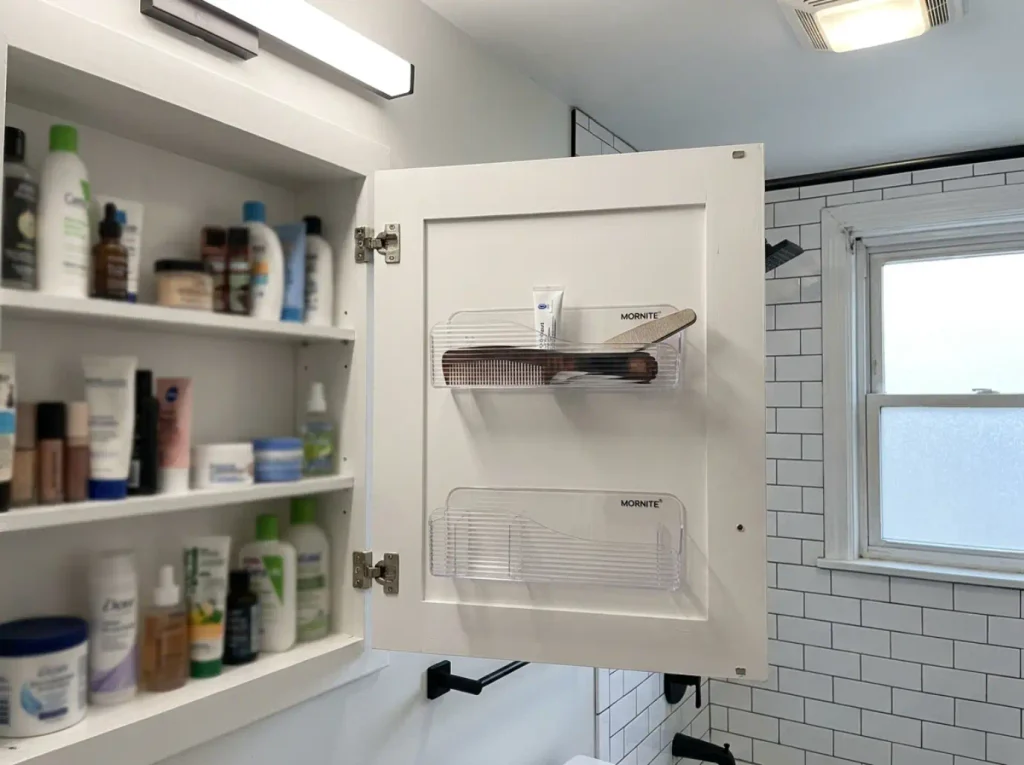
Once the shelves are full, the instinct is to buy a bigger cabinet or accept the overflow. Both are wrong, because the two surfaces with the most unused capacity in the average bathroom are cabinet door storage and wall-mounted storage on the strip beside it, plus whatever corner storage the room has going spare.
Neither is holding anything. And both are shallow-friendly by their nature, which is what makes them useful here specifically: the door has to close, so whatever mounts to it physically cannot be deep enough to cause the problem the first section described. The constraint enforces itself.
Door-mounted trays and narrow wall organizers are the direct play. The MORNITE Bathroom Medicine Cabinet Organizer Set is a set of compact trays built for cabinet-door or wall mounting, and the narrow profile is doing the work: it respects the clearance the closed door leaves. Load it with the flat, light things that waste shelf space by lying down, cotton rounds and emery boards and lip balm, and keep the tall bottles on the shelf where their height isn’t a problem.
Small metal tools deserve their own solution, because they’re the worst offenders in the bin problem and the easiest to fix. Tweezers, nail clippers and small manicure scissors are all magnetic, which means a short magnetic strip takes them out of container space entirely and puts them where you can see all of them at once. The hecef 6 Inch Magnetic Knife Strip, Acacia Wood is sold for knives but marketed for metal items generally, and six inches is the right length for a cabinet door rather than a kitchen wall.
But read the material before you buy, because this is the article’s own rule applied to its own recommendation: that’s unsealed acacia going into a room that gets steamed twice a day, and the next section explains precisely what happens to it. If your bathroom has a working extractor fan and the strip mounts away from the shower, it’s fine with a wipe-down habit. If your bathroom fogs the mirror every morning and stays damp for an hour, buy a coated metal strip instead and don’t argue with the room.
Which raises the question none of the competing articles answer. If you rent, can you do any of this? The magnetic strip mounts with screws, and drilling into a mirrored cabinet door is a bad idea even when you own the place.
This is the gap worth closing, so here it is directly: the no-drill, renter-friendly answer is water-resistant Command strips rated for bathrooms, and a mirrored door is close to an ideal surface for them. It’s smooth, non-porous, cleanable and rigid, which is the exact list of conditions adhesive mounting wants.
The Command Water-Resistant Adhesive Refill Strips, Large (16-pack) are the humid-room-rated version, and a 16-pack covers a door tray, a wall caddy and the two projects you think of afterward. Wipe the mirror with rubbing alcohol first, not glass cleaner, because glass cleaner leaves a film that adhesive hates. For the full treatment, the deposit-safe version of every mounting idea in this article covers the rest of the room too.
I used to treat adhesive mounting as the compromise option, the thing you settle for when drilling isn’t allowed. After enough threads where the drilled magnetic strip cracked a mirrored door panel or pulled out of a hollow cabinet back, I flipped: on a mirror cabinet door, adhesive is the better engineering choice and renting is beside the point.
The honest limit is weight, and it’s a real one. Adhesive mounting has a ceiling, and everything about a bathroom works against it: humidity softens some adhesives, and the door swings, which turns a static load into a repeated jolt.
Load light plastic trays and small tools, never glass bottles or anything you’d mind landing in a sink. And take it down before it takes itself down. If a mounted tray starts to feel like it has any play in it, that’s the warning, and the second warning is the noise it makes at 2 AM.
Whatever you mount on the inside of the door has to pass the swing test: load it, then open and close the door ten times at normal speed. If anything rattles, shifts or works its way toward the edge of its tray, it will eventually make the trip all the way. Fix it now, while the sink below is empty.
The last consideration is behavioral rather than structural. Anything on the door moves every time someone opens the cabinet, so the door is the right home for items that sit flat and stay put, and the wrong home for anything that rolls, stands tall on a narrow base, or has a lid someone leaves loose.
Two neighbors of this idea are worth knowing about even though neither fits inside a mirror cabinet. Under-shelf hooks clip onto a shelf lip and hang small light things below it, and a tension rod does the same job in the vanity cabinet underneath. Both need more depth than a recessed cabinet has, so they belong to the cabinet below rather than this one.
Pick Materials That Can Take the Steam
This is the section nobody writes, and it’s the reason the previous four sections don’t quite add up on their own. Every listicle in this space recommends a bamboo riser in one item and an acrylic bin two items later, as if the room they’re going into were a linen closet. It isn’t. A mirrored cabinet mounted over a sink a few feet from a shower gets a humidity swing every single day, twice on a workday with two people in the house, and materials respond to that whether or not the article mentioned it.
So here’s the verdict, stated flatly. The genuinely moisture resistant options are acrylic, coated metal and laminated surfaces, and they keep tolerating the daily swing. Unsealed bamboo, untreated wood, cardboard and paper labels do not. That’s the whole material rule, and it’s enough to filter most of what you’ll be shown when you search for a medicine cabinet organizer.
Bamboo deserves a real answer rather than a blanket no, because it’s on half the bathroom storage listings you’ll see and it does look better than clear plastic. The nuance: “bamboo” is not one material. Multi-layer laminated construction resists warping meaningfully better than single-ply, and routine maintenance matters more than people expect. Wiping it dry and keeping it out of standing water, plus sealing it, extends its usable life by roughly 30% according to manufacturer guidance from bath-caddy maker KingKonree.
What none of that changes is the underlying behavior. Bamboo still absorbs moisture, and in a consistently damp bathroom it can swell, then warp, then split at a glued seam. The choice on offer is maintenance or replacement. There is no third option where you buy it and forget it.
Labels are the same problem in miniature, and they’re the version most people run into first. Paper labels and plain stick-on labels lift at the corners in a humid cabinet, usually within a couple of months, and once a corner lifts the rest goes quickly.
Laminated tape survives it, because the printed layer is sealed between plastic rather than sitting on the surface waiting for moisture to find the adhesive. Effectively waterproof labels, in a room that tests the claim daily. This is the specific fact that makes labeling a bathroom different from labeling a pantry, and it’s why “use a label maker” is incomplete advice here without naming the tape.
For the device half, the Brother P-Touch PTD220 Label Maker is the standard handheld pick and does everything a cabinet needs, though if you’re only labeling six containers a set of writable vinyl labels and a fine marker gets you there without buying a machine at all. The half that actually answers the humidity problem is the tape: Brother Genuine TZe-231 1/2″ Laminated Tape is the laminated construction described above, and the half-inch width suits a small container front better than the wider rolls do. If you want the mechanism in full, why labels peel in the first place, in more detail than this section has room for unpacks the adhesion side properly.
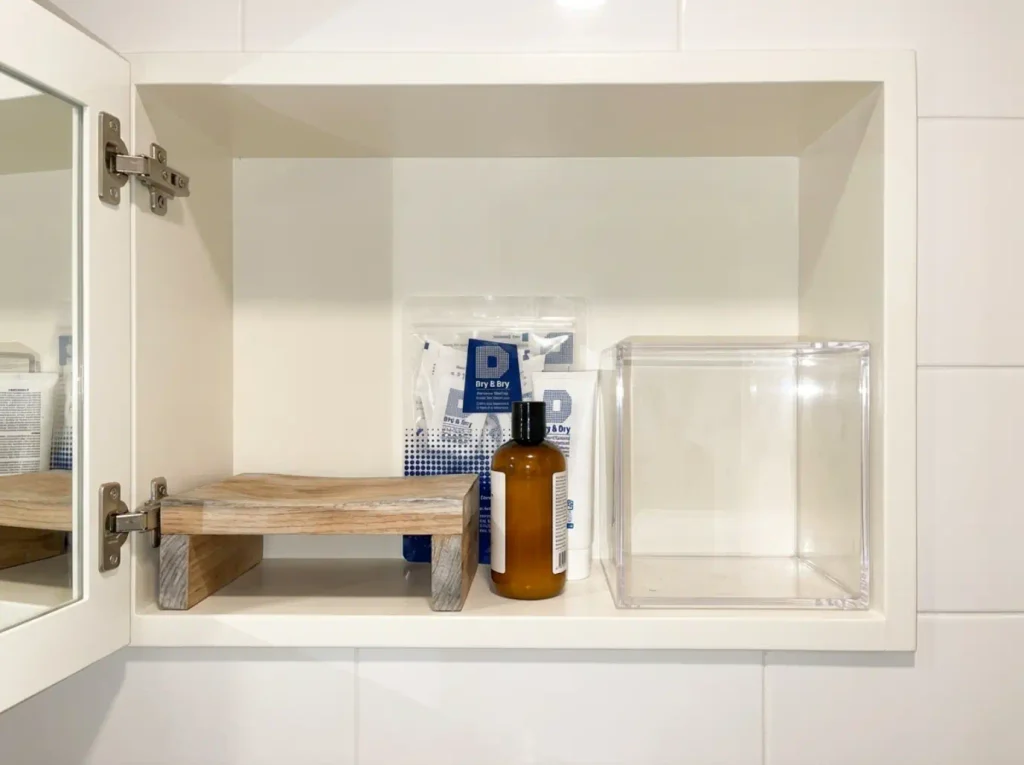
Then there’s the countermeasure that costs the least and gets skipped the most. Rechargeable indicating silica gel packets tucked at the back of a shelf pull moisture out of the cabinet’s air, and the indicating kind change color when they’re saturated so you know when to recharge them rather than guessing.
The [Dry & Dry 5 Gram [50 Packets] Rechargeable Silica Gel Packets](https://amzn.to/4orPYaV) are a multi-pack that will outlast this project by years, and a pack of these costs a small fraction of replacing a warped riser annually. They won’t dehumidify a bathroom, to be clear. They moderate the air inside a closed cabinet, which is the only air the contents of your cabinet ever experience.
The community-attributed read on all of this is worth stating without softening it. In a genuinely damp bathroom, a wood organizer is a consumable. Organizing threads circle back to the same confession about wood bath accessories on a regular basis: it looked right for a season, then a seam opened.
If you love how it looks, buy it knowing that, keep it as far from the shower wall as the room allows, and treat it as something you’ll replace rather than something that failed you. The same logic applied a few feet away, inside the shower, gets even less forgiving.
Keep It Working — the Reset, the Disposal, and the Shared Cabinet

A medicine cabinet doesn’t fail the way a pantry fails. A pantry gets visibly chaotic and you notice. A cabinet gets stale, and nothing looks wrong right up until you pull everything out and find expired medication from two summers ago sitting behind the current bottle of the same thing. Quiet failure is harder to catch than messy failure, which is why this section exists at all.
The cadence is every few months, and the reason to put it on a calendar rather than trusting yourself to notice is that there’s nothing to notice. Family Handyman’s organizers frame it exactly this way: reassess the contents on a schedule, because you’d be surprised how many expired, empty or unwanted products turn up. A recurring reminder is free, takes fifteen minutes to act on, and is the single highest-return maintenance habit for this particular cabinet.
Now the step where every competing article stops short. “Toss the expired stuff” is not a method, and getting the method wrong matters. Per the FDA’s guidance on safely disposing of expired medicine, the first choice is a medicine take-back location or a mail-back envelope, and many pharmacies host one.
If neither is available to you, the household method is specific: mix the medicine with something unappealing like dirt, used cat litter or coffee grounds, seal that mixture in a bag, and put it in the household trash. Do not flush, unless that specific medication appears on the FDA’s flush list, which is short and exists for a reason. That’s a real idea in its own right, not a throwaway line at the end of a decluttering step.
Scratch your name off prescription labels before the bottle goes in the trash, and do it during the reset rather than at the bin. Empty pill bottles carry your name, your prescriber and what you were taking, all printed on a label designed to stay readable. A permanent marker takes two seconds per bottle.
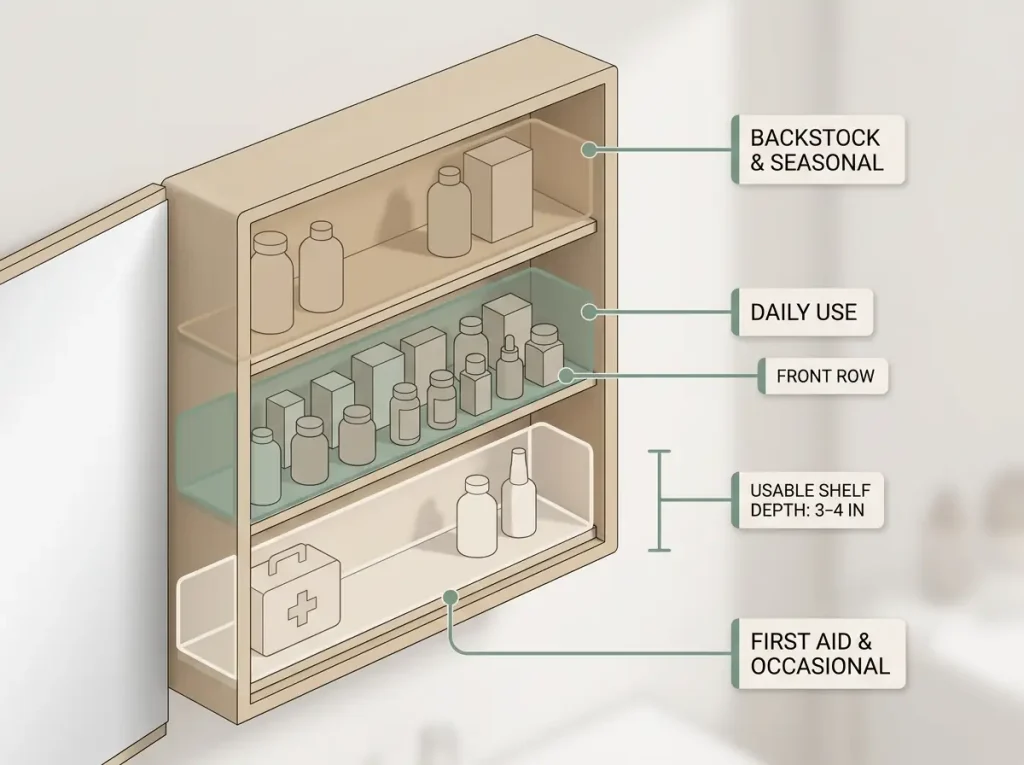
On zoning, there’s a better default than the one that gets repeated. When a professional organizer worked a studio-apartment medicine cabinet for Apartment Therapy, the finished cabinet came out divided into three shelves by how often things get reached for: daily health and hygiene, occasional health items like first aid supplies and the pain relief you only reach for twice a year, then hair and beauty. Not by category. Not by whose name was on the bottle.
Frequency zoning generalizes better than height-based shelf assignment in a shared bathroom because it survives a household member moving in or out, and because it maps to the only question anyone asks at 7 AM, which is where the thing they need right now lives.
Per-person assignment still has one case where it clearly wins, and it’s the case where the stakes are different. Daily medication belongs in an individual container rather than on a shared shelf, because the failure mode isn’t an untidy shelf, it’s a missed dose or a doubled one. The Ezy Dose Weekly (7-Day) AM/PM Pill Organizer handles the standard version of this with morning and evening compartments, so a glance tells you whether today happened.
The caveat is that a weekly organizer means loading it weekly, and a system that depends on a Sunday habit is only as good as the Sunday habit. Pair it with the same calendar reminder that drives the quarterly reset.
Finally, the case for locking something up. The Consumer Product Safety Commission is direct about this: medications and household cleaners should be locked up and kept out of reach where children are in the house, because even small amounts carry real risk. That’s the Consumer Product Safety Commission’s guidance on locking up medications, not this article’s editorial emphasis, which is why a lock box earns a place on an ideas list rather than a child safety warning tacked on the end.
The POCHAR Wall Mount Locking Medicine Cabinet is the steel, keyed version and it’s the splurge-worthy end of this article’s budget spread, which runs from budget-friendly decanting that costs nothing at one end to a locking wall-mounted box at the other. It’s wall-mounted, so check your lease before drilling.
If you’re securing more than the medicine, the same locking logic applied to the cabinet under the sink covers the cleaning products, which the CPSC names in the same breath. And once this cabinet is settled, organizers for the rest of the bathroom pick up where it leaves off.
Conclusion
Depth decides what fits, so measure it and subtract a finger’s width of clearance before any idea here turns into a purchase. Capacity in a medicine cabinet comes from shape rather than volume: divide small, rotate small, and put the flat light things on the door where the shelves aren’t competing for them. And materials are the line between a system that lasts and one you rebuy, because acrylic, coated metal and laminated tape shrug off the steam while unsealed wood and paper labels quietly don’t.
Open the cabinet in three months and look for two specific things: a label that’s started lifting at one corner, and anything you haven’t reached for since the day you organized it. Both are telling you the same thing about what this room does to a system left alone.
Pick the one idea that fixes whatever annoys you every morning. Do that one. The rest of the cabinet can wait.
Frequently Asked Questions
01What is the best way to organize a medicine cabinet?
Group items by how often you reach for them rather than by category: daily health and hygiene on the easiest shelf, occasional items above, hair and beauty wherever is left. Then contain small things in dividers sized close to the items themselves, because one deep bin in a shallow cabinet hides whatever migrates to the back.
02What are the most common medicine cabinet mistakes?
Buying organizers without measuring shelf depth first, and pooling small items into one oversized bin. The depth mistake means the door will not close; the bin mistake means you buy a second nail clipper three months later because the first one sits at the back where you cannot see it.
03What should every medicine cabinet have?
The daily-use items you genuinely reach for, a divided container for small grooming tools, and labeling that survives humidity. What it should not hold is anything heat- or moisture-sensitive, since many medications keep better somewhere dry and stable, which is rarely the room with the shower in it.
04What is the easiest way to organize medications specifically?
A weekly pill organizer for anything taken daily, and one labeled container for everything occasional. If there are children in the house, the Consumer Product Safety Commission treats locked storage as a baseline precaution, and a lockable box handles that without reorganizing the entire cabinet.
05Do bamboo organizers hold up in a bathroom?
Not without upkeep. Bamboo absorbs moisture and can swell, warp or crack in a consistently damp bathroom; multi-layer laminated construction resists it better than single-ply, and wiping it dry regularly extends its life meaningfully. Acrylic and coated metal are the lower-maintenance picks for a cabinet that gets steamed daily.