























In this article
You spent a Saturday afternoon on it. Every towel came out of the dryer, got folded properly, went onto the shelf with the edges lined up, and for about four days that closet looked like something you’d photograph. Then one load of laundry went through, a few people grabbed towels during the week, and now the middle shelf is a shoved in pile with a washcloth hanging out of it.
Here’s the part nobody tells you: the fold was almost certainly fine. What failed was everything around it, starting with stacking height and where people pull from. This guide covers how to fold towels for a linen closet so the stack survives real use: the thirds fold, why stacks collapse, when rolling beats folding, how to size the fold to your own shelf, and what to do with sheet sets.
Quick Answer
Fold bath towels in thirds so the finished bundle matches your shelf depth, then cap the stack height:
- Lay the towel flat, tag side down.
- Fold it lengthwise into thirds, one side over, then the other.
- Fold in half, short end to short end.
- Fold in half again so the bundle sits about as deep as your shelf.
- Shelve it folded-edge out, no more than three towels high.
The Thirds Fold That Fits a Standard Linen Closet Shelf
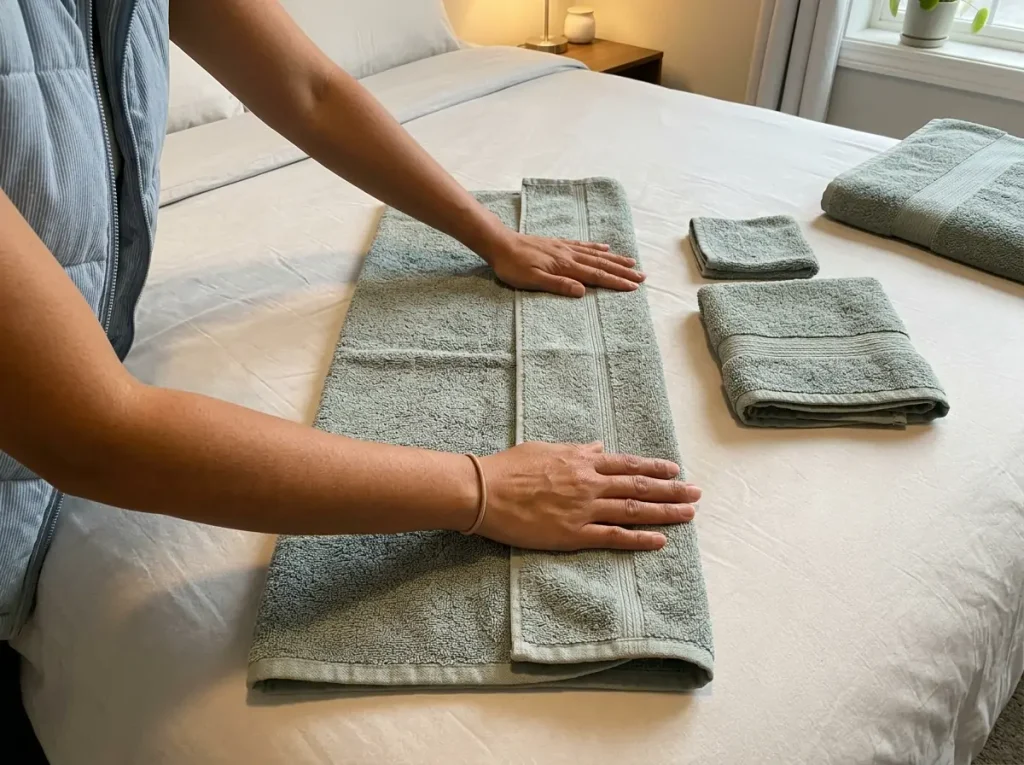
Every tutorial teaches the thirds fold, or tri-fold, as though it were a style choice. It isn’t. A bath towel folded lengthwise in thirds and then halved twice ends up roughly fourteen inches deep, and most linen closets are built between twelve and sixteen inches deep.
That’s the whole reason this fold became the default. It was never about looking like a hotel fold. It was about landing the folded edge at the front lip of the shelf instead of hanging over it or floating in the middle with dead space behind.
Start with the towel flat, tag side down. Fold one long side toward the center, then the other over it, giving you a strip about a third of the original width. Bring one short end to meet the other, then fold in half again.
The tag ends up buried inside, which keeps the front of a stack from being speckled with white labels. Shelve it folded edge out, never the open edges, and every uniform stack in the closet reads the same way from the doorway.
Where this goes wrong is size. A bath sheet is not a big bath towel, it’s a different object, roughly forty by seventy-two inches against a standard towel’s twenty-seven by fifty-four. Fold both the same way and the bath sheet comes out deeper, which is why one stack always bulges past the others.
Give it one extra fold across the width and it matches. Hand towels and washcloths run the logic in reverse: thirds and a single half, not the full four-fold sequence, or you get dense little bricks that are more work to unfold than they’re worth.
If you keep refolding the same towels trying to make one stack look uniform (what organizing communities call towel origami), stop. That’s not a folding problem, it’s a mixed collection problem. Two towel sets from different years in different weights will never stack even, so declutter down to one or two sets per bathroom before you fold anything, and sorting the closet by category first is the step that comes before any of this. If the whole closet needs that treatment, the full linen closet walkthrough is where to start instead.
Fold on a flat surface, not against your chest. The chest fold is faster and it’s why half your towels have that soft, uneven bulge on one side. Two extra seconds on a bed gives you a square bundle that stacks flat, and square bundles are the foundation of a stack that doesn’t slide.
Why Your Folded Stacks Collapse After One Laundry Cycle
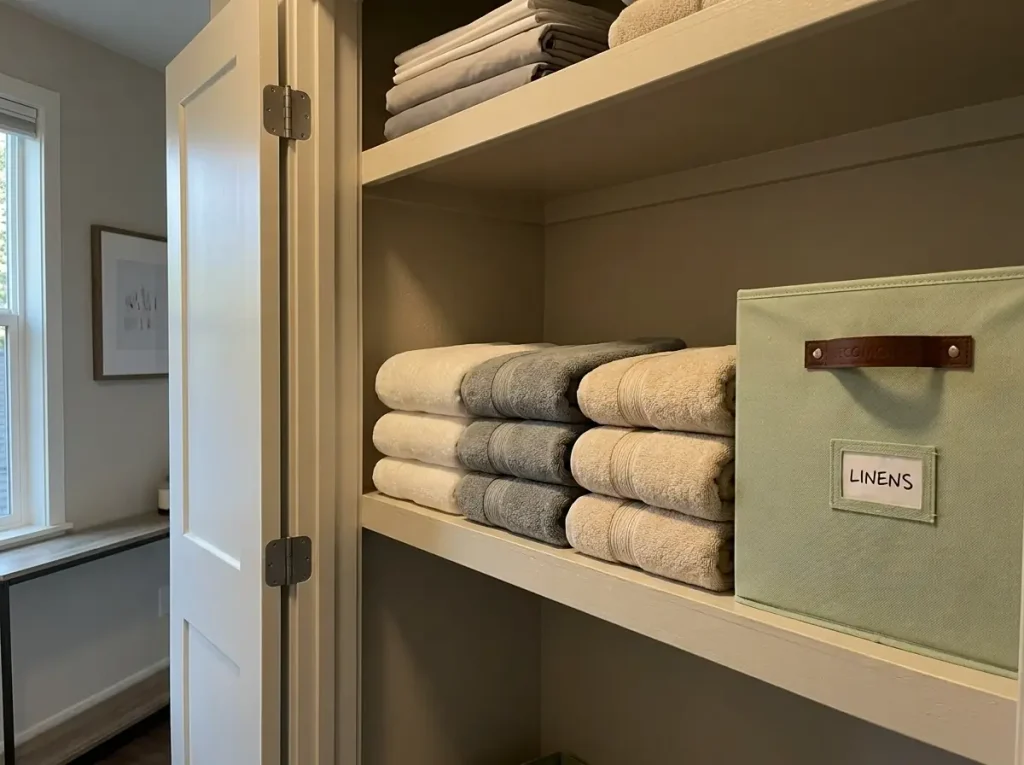
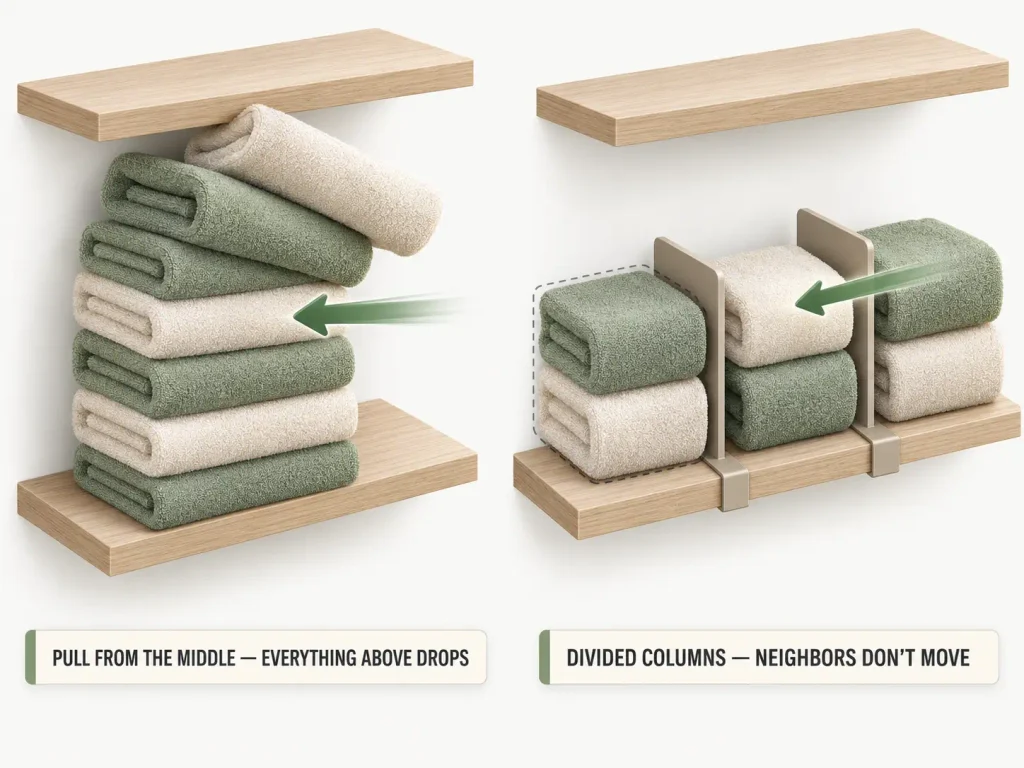
Here’s the mechanism every folding video skips. A flat stack has nowhere for a disturbance to go. When somebody pulls from the middle, and they will, because the towel they want is the soft one and the soft one is third from the top, everything above drops into the gap and the stack loses its square edge.
And the person who pulled doesn’t refold, because nobody refolds. They shove. One pull from stack like that and the shelf is on a downhill slide that ends in the messy closet you’re looking at now.
Put clean towels at the bottom of the stack, not the top. It rotates the linens so the same two towels don’t take every wash cycle, and it forces you to lift the stack as one unit, which is a quick check that the stack is still short enough to lift. If you can’t lift it in one hand, it’s too tall.
The Pull Rule That Keeps a Stack Square
Cap the stack at about three towels. That’s the whole rule. At three, the towel someone wants is always within reach from the top, so nobody ever has a reason to dig into the middle. At six, the middle exists, and the middle is where systems die.
The obvious objection is that three high doesn’t hold enough towels. Correct. The answer isn’t a taller stack, it’s more stacks side by side.
Divide the shelf into columns no wider than a single folded towel and one tall unstable pile becomes three or four short stable ones. Professional organizers keep landing on the same phrasing: a shelf divider works like a bookend, holding each column upright so pulling from one doesn’t move its neighbors.
Bookends Before Bins (the free version first)
Before buying anything, look at what’s already in the house. A magazine file holder turned on its side does the bookend job perfectly, and it’s the substitute budget-organizing threads bring up first every time. A shoebox stood on end does the same. Both cost nothing, and both let you find out whether column dividing solves your problem before spending anything.
If the free version works and you want the permanent one, match the divider to what your shelf is made of: a clip-on that grips a laminate edge won’t hold on coated wire at all. That’s the difference between the divider that actually fits your shelf type and a generic pick that arrives and clips onto nothing.
Dividers don’t solve a second situation, though. If one shelf holds several categories at once (bath towels, beach towels, the guest set, cleaning rags), columns still leave you with piles that grow.
A container caps them physically. The Fabric Storage Bins with Labels come as a collapsible set of six with label windows, and one bin per category means no pile can grow tall enough to have a middle worth pulling from. The tradeoff is real: fabric bins eat a couple of inches of shelf depth in walls and seams, so on a shallow shelf they cost more capacity than they save.
Why “Just Refold It” Never Sticks
Any system whose maintenance instruction is “refold it when it gets messy” is not a system. It’s a chore you’ve scheduled for yourself indefinitely, and you will stop doing it around week three.
The arc that shows up constantly in organizing threads is a closet that was picture-perfect on day one and went, in one person’s words, topsy turvy once a whole household started pulling from it, then stayed that way for years. The fold was fine. The system was built for exactly one careful person, and then more than one person used it. Design for day two hundred, not for day one.
Rolling vs Folding for a Linen Closet
Rolling gets sold as the prettier option and folding as the sensible one. Both framings are wrong. They fail in completely different ways, and which you want depends less on taste than on how many people open that closet.
When Rolling Actually Wins
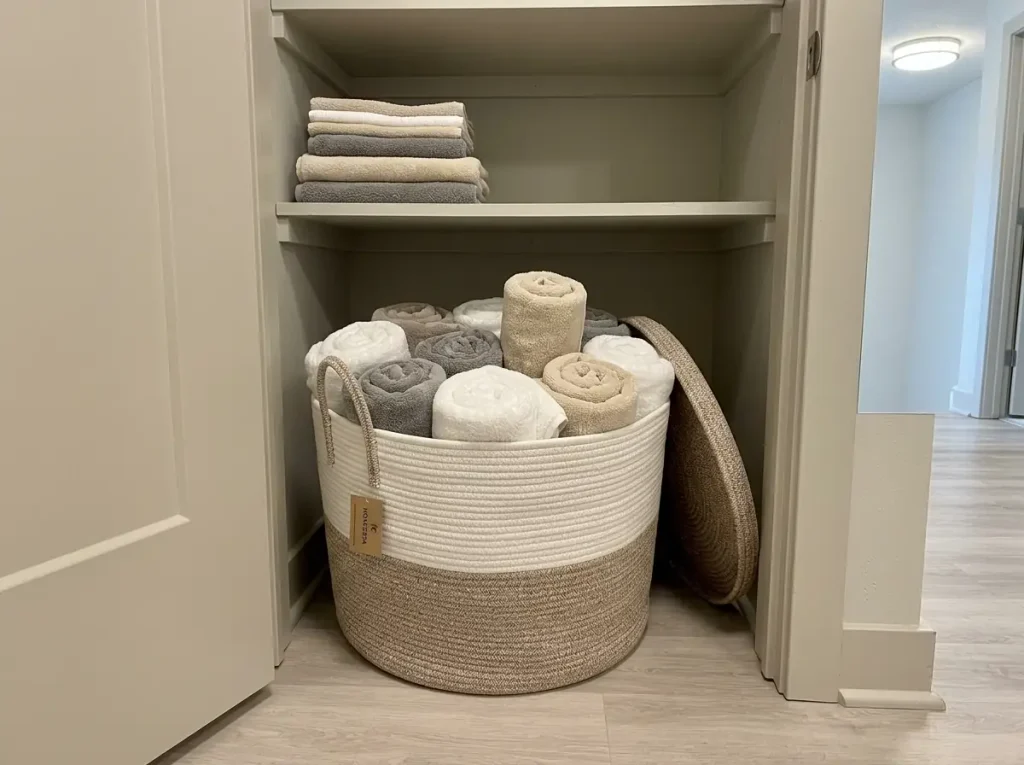
Rolled towels use the depth of the shelf rather than the height, and depth is the dimension most people waste. More importantly, a pyramid of rolls survives being grabbed from: take one out and the rest stay put. Nothing shifts, nothing needs restacking, nothing gets shoved back in. That’s the failure mode from the section above, eliminated by geometry rather than discipline.
Rolling also ends the mixed-size problem outright. Rolls don’t need to match to look deliberate, so towels bought across four different years stop being an eyesore without replacing any of them. Honestly, that alone makes rolling the right call for more households than admit it.
The catch is containment. A spa roll pyramid stacked loose on an open shelf is an avalanche waiting for whoever grabs from the bottom row. Check first whether you already own a deep bin or a spare laundry basket; either holds rolls upright and solves this for free.
If you’d rather it looked intentional, the HONCESTA Extra Large Woven Basket with Lid runs about eighteen by fourteen inches, deep enough that bath towel rolls stand on end and any one lifts out without disturbing its neighbors. The lid is the compromise: it keeps dust off but adds a step, and a container with an extra step is one a household quietly stops using.
When Folding Is Still the Right Call
Folding wins in three conditions that tend to arrive together: a matched set of same-size towels, a shallow shelf, and a household of one or two people who put things back. Under those conditions folding is faster out of the dryer, reads tidier because every edge is identical, and there’s no roll tightness to get right.
Shelf construction shifts the math too. On a solid shelf a folded stack sits flat and stays flat; if your closet came with coated wire shelving, the grid presses lines into the bottom towel and the stack rocks on the wires, a small annoyance that turns into a shoved shelf faster than it should.
Rolling’s own weakness is time. It takes longer per towel, and a roll that wasn’t wound tight enough loosens and unrolls itself a week later. Roll tight or don’t bother.
The Mixed Closet (roll some, fold some)
You don’t have to pick one. The best-working linen closets run both: bath towels rolled because everyone grabs those and mismatched sizes disappear in a pyramid, hand towels and washcloths folded because they’re small, uniform, and easy to keep square.
One more variable if you rent. Many rental closets run narrower than the standard build, closer to twenty or twenty-two inches, and a narrow closet punishes a fold sized for a deeper one: the bundle overhangs the front edge, or you add a fold and it gets uncomfortably thick. Rolling adapts without recalculation, because a roll’s diameter is set by the towel, not the shelf. In a small linen closet that alone is usually the deciding factor.
Roll a towel by folding it in thirds lengthwise first, exactly as if you were going to fold it, then rolling from one short end. Rolling from a full-width towel gives you a floppy cone. Rolling from the thirds-folded strip gives an even cylinder that holds its shape without being wound painfully tight.
Match the Fold to Your Shelf, Not to a Video
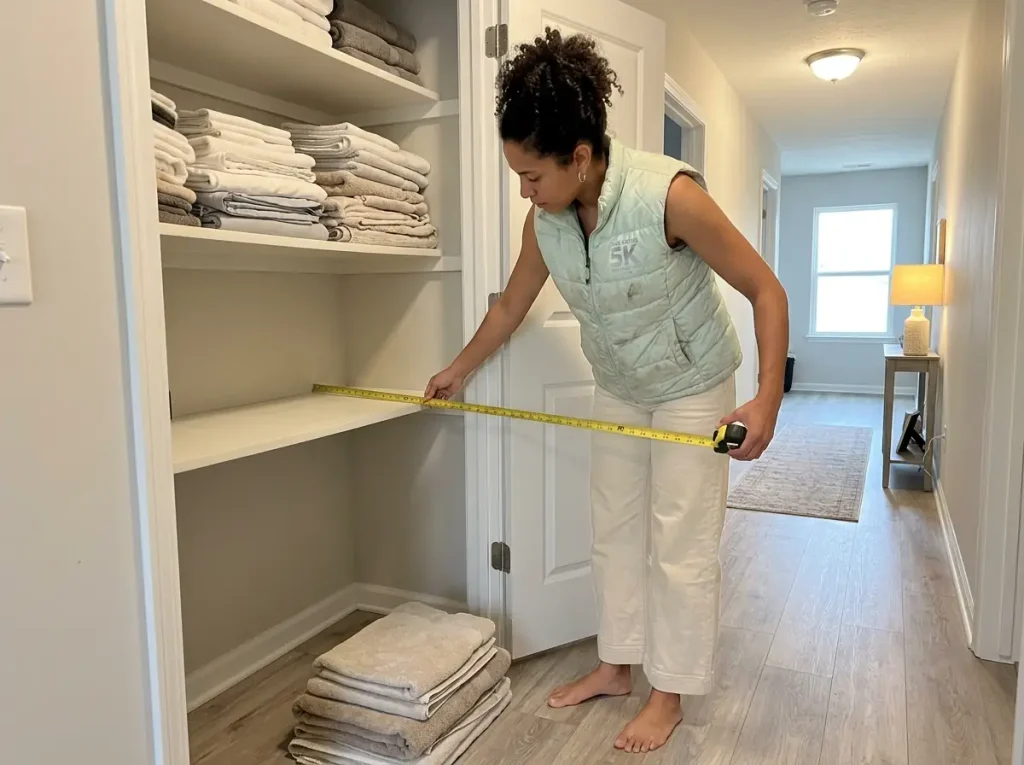
Every folding video you’ve watched was filmed in someone else’s closet. The fold that looks effortless in it is the fold sized to that shelf, and copying the technique without copying the shelf is why yours comes out slightly wrong in a way you can’t name. Take two measurements once and the choice makes itself permanently.
Measure the Depth Once, Fold Forever
Depth is the first number: front edge to back wall. Twelve to sixteen inches is the standard range, and the thirds-folded bath towel exists because it lands right in it. If your shelf comes in at the shallow end, take one fold out of the width (fold in half lengthwise instead of thirds, then halve twice), or roll instead. On the deeper end, the standard fold is already correct.
Clearance Caps Your Stack Height
The second number is the air between one shelf and the one above it, and it overrules the fold entirely. Somewhere around ten to twelve inches of clearance is typical for hand towels and folded linens, twelve to sixteen for bath towels and folded sheets.
That gap sets your maximum stack height no matter how immaculate the fold is. Tight clearance means shorter stacks, more of them side by side, which is the identical fix to the collapse problem from earlier. Two different constraints, one answer.
Leave a couple of inches of air above every finished stack. Filling a shelf to the ceiling means the top towel scrapes the shelf above on the way out, and that friction pulls the next one down with it. A shelf at about three quarters full stays neat far longer than one packed to the edge.
What to Do With a Shelf That’s Too Deep
Past about sixteen inches you get a second row nobody can see, and the back row becomes a graveyard. It’s the same pattern deep-pantry threads describe about expired cans: whatever goes behind the front row stops existing. A deeper shelf doesn’t want a deeper stack, it wants front-to-back organization: a bin you pull out like a drawer, or rolls standing on end so the whole depth is one reachable row.
That’s also the point where the right container stops being optional. If you’re at that stage, organizers sized for a shallow shelf are worth reading before ordering anything, because a bin that overhangs the front edge blocks the door and one that’s too short leaves the same dead zone you started with.
And give the bottom shelf its due. It wants eighteen to twenty inches of clearance and the bulky things: comforters, spare blankets, the sleeping bag. Another immaculate towel stack in the hardest spot to reach is a fight you lose slowly.
If you rent, you don’t get to choose the shelf anyway. The fold is the only variable you control, which is why it’s worth choosing deliberately.
Sheets, Pillowcases, and the Bundle That Ends the Hunt
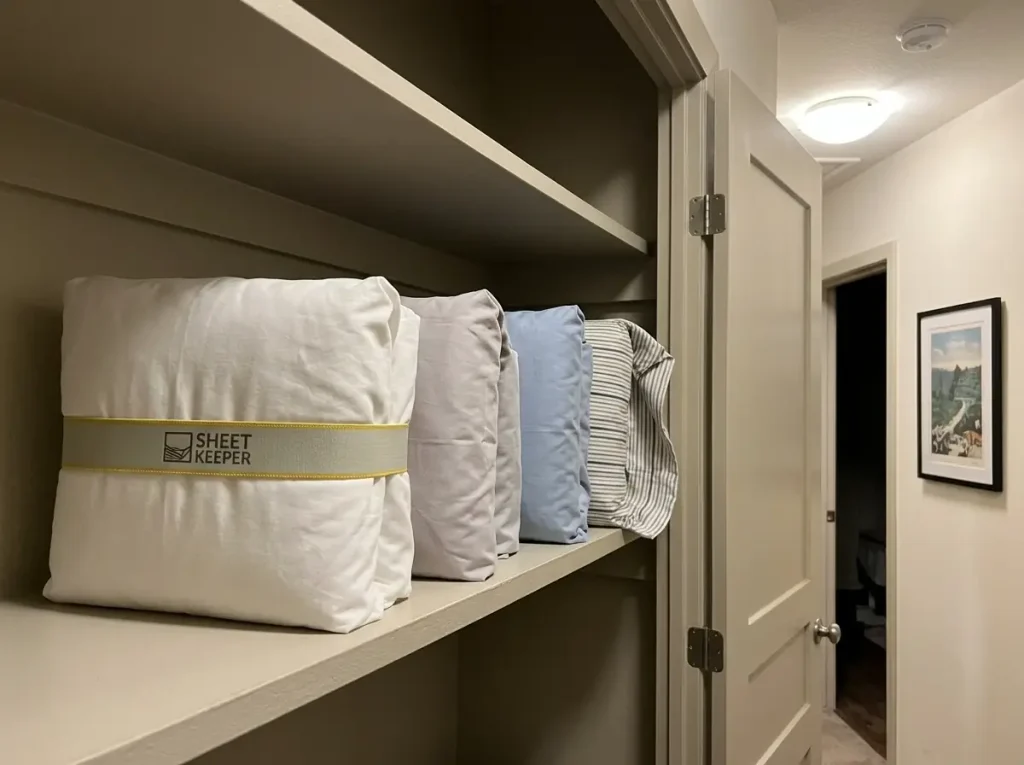
Towels are the easy half of a linen closet. Sheets are where it falls apart: a fitted sheet that refuses to fold flat, its flat sheet two shelves away, pillowcases distributed at random. The fix costs nothing, takes under a minute, and works the first time.
The Pillowcase Bundle, Step by Step
Fold the fitted sheet as flat as it will go. Fold the flat sheet. Fold the spare pillowcases. Stack all three. Take one pillowcase, turn it inside out, slide the stack inside, flip it right side out around the stack, and tuck the open end inward.
One bundle, one complete set. You pull it out and the whole set comes with it. No matching, no digging behind the towels for a flat sheet in the same color.
The method creates one problem it doesn’t solve: a shelf of identical bundles is as hard to search as an unsorted pile. You’ve traded one hunt for another unless you label them. The free version first, because it works: a scrap of fabric tied in a bow, a different color per bed, identifies a set from across the closet at zero cost.
If you’d rather it looked deliberate, the Sheet Keeper Bed Sheet Organizer Bands are elastic bands sized to a sheet set that hold the bundle closed and give you a surface to mark, with no hardware needed. They’re sized per bed, though, so a band bought for a queen set sits slack around a twin.
Bundle with the oldest, most mismatched pillowcases you own, the ones already sitting in the donate pile. They never get seen, they cost nothing, and using an odd one per bed means the bundle is self-labeling before you add a single tag.
Why Breathable Beats Airtight
The reason this beats a sealed bin isn’t only convenience. Freshly laundered linens hold residual moisture even when they feel dry, and an airtight plastic container keeps it against the fibers for months. What comes out is musty, with weakened creases and sometimes discoloration along the folds.
University extension guidance on textile care is blunt about the cause: mildew develops most readily on cotton and linen stored damp in still air, which is exactly what a sealed bin creates. A cotton pillowcase breathes while still keeping dust off. This matters most in the common setup where the linen closet shares a wall with the bathroom and runs humid every time somebody showers, so it’s worth knowing where sealed plastic starts working against you before committing a whole closet to lidded bins.
Off-Season Sets Are a Different Problem
Everything above applies to the sheets you rotate. The guest set that comes out twice a year and the flannel sheets you use four months of twelve are a separate category with a separate goal: they don’t need to breathe daily, they need to stop eating shelf space.
That’s where compression makes sense, and only there. Try the manual version first: press the air out by hand and roll the set tight inside a zip-top bag. Free, and it holds for a few months.
For a whole season, Vacuum Storage Bags with Hand Pump come as a twenty-count set in mixed sizes, and the hand pump matters more than the count because you’re not hauling a vacuum cleaner into a closet every time. The failure mode is seal loss: a leaking bag re-inflates quietly over a few weeks and you find it puffed on the top shelf in November, so pick bags that actually hold their seal over the cheapest multi-pack. Compressed sets crease hard, so plan on a tumble before the guests arrive.
Keeping the Fold Alive When Other People Live There

A fold that only works when you’re the one folding isn’t a system, it’s a hobby. The real test isn’t the day you finish. It’s the first Tuesday somebody else puts the laundry away.
Build for the Least Careful Person in the House
Design for whoever in the household cares least about this, because that person sets the ceiling on how good the closet can stay. If the arrangement needs a perfect fold to remain standing, it won’t.
This is the real argument for rolling in a full house. Nobody can un-square a roll. Put one back badly and it’s still a roll, still cylindrical, still fine. A folded stack put back badly is ruined, and that asymmetry decides multi-person closets.
I used to think folding was simply the correct answer and rolling was for spas and hotel photos. After reading the same collapse story enough times in organizing threads, I don’t think that anymore. Above two regular users, roll.
The vertical KonMari fold gets recommended constantly here, and it’s a good technique in the wrong room. The KonMari method works because a drawer’s walls hold everything upright; an open shelf has no walls, so a row of standing towels leans over. If the wider method is new to you, Marie Kondo’s approach in full is worth reading before you apply one piece of it to a shelf it wasn’t designed for. Keep the standing fold that works in a drawer for drawers and use rolls in a basket for the same effect on a shelf.
Shelves Assigned by Who Uses Them
Group the closet by where things get used, not by what they are. Towels for the hallway bathroom live on the shelf closest to that door. Kids’ towels go on a shelf kids can reach without climbing. Professional organizers repeat this constantly, and it works for an unglamorous reason: people put things back where it’s easy, not where the logic says they belong.
Then accept a shorter stack. Three high that stays square beats six high that collapses on Tuesday. And yes, your partner will eventually put the hand towels in with the bath towels. Build the shelf so it doesn’t matter: if the hand towels have their own bin or divided column, the wrong item is visible and correctable in two seconds instead of triggering a shelf-wide collapse.
Conclusion
The fold that fits your shelf beats the fold in any video. Measure the depth and the clearance once, pick from those two numbers, and you never think about it again.
Stacks collapse because somebody pulled from the middle, not because the fold was wrong. Cap the height at about three, divide the shelf into columns no wider than one towel, and the middle stops existing.
If more than two people pull from that closet, roll. It survives being used by people who aren’t thinking about it, which is the only durability test that counts.
Give it the three month test: open the closet a season later and check exactly one thing, whether the front edges still line up. If they’ve gone ragged, your stacks are too tall or too wide. It’s not the folding.
Start with one shelf. The one you open most. Get that shelf right and leave the rest alone until it earns the effort.
Frequently Asked Questions
01How do you fold towels so they don’t fall over in a linen closet?
Cap each stack at about three towels and split the shelf into stacks no wider than a single towel, so nobody ever pulls from the middle. The fold matters far less than the stack rule. A flat stack collapses because a pull from the middle has nowhere to go, not because the towel was folded wrong.
02Should you roll or fold towels for storage?
Roll if more than a couple of people use that closet or your towels are mismatched sizes; fold if you have a matched set and a shallow shelf. Rolling uses the shelf’s depth instead of its height and survives being grabbed from, which is why it holds up in a family closet where folding drifts back to a pile.
03How do you fold a bath sheet for a linen closet?
Give it one extra fold across the width compared to a standard bath towel, so the finished bundle ends up the same depth as the rest of the shelf. A bath sheet folded exactly like a regular towel overhangs the shelf edge, which is what makes an otherwise tidy stack look wrong.
04What’s the best way to store sheet sets in a linen closet?
Fold the fitted sheet, flat sheet and spare pillowcases, then slide the stack inside one of the pillowcases turned inside out and flip it right side out. You grab one bundle instead of hunting for the matching flat sheet, and the cotton breathes, which sealed plastic doesn’t, so linens stored airtight can turn musty over months.
05How do you keep a linen closet neat after doing laundry?
Put the fresh towels at the bottom of the stack rather than on top, and keep the stack short enough that adding to it doesn’t push past the shelf clearance. Most closets revert within one laundry cycle because clean towels land on a stack that was already at its limit, and then everything gets shoved to make it fit.