























In this article
You spent a Sunday afternoon on it. Pulled everything down, sorted by author, put the pretty ones face-out, stepped back and felt good about it. Now it’s three weeks later and the top row is double-stacked again, there’s a pile on the floor beside it, and you’re not sure when that happened.
The advice you followed wasn’t wrong. It just skipped the two things that decide whether a bookshelf holds: what the shelf can physically carry, and what happens to the next book that comes through your door. This walks through how to organize a bookshelf using real load numbers, real span limits, the safety agency’s own anchoring guidance, and the one maintenance rule that stops the slow slide back to double-stacked.
Quick Answer
Organize a bookshelf in five passes, in this order:
- Empty every shelf completely before you sort anything.
- Sort into three piles: keep, relocate, leave.
- Put the heaviest books on the bottom two shelves.
- Group by how you reach for them, not by color.
- Anchor the case, then set a one-in-one-out rule.
Empty the Whole Thing First, Then Decide What Goes Back
Everyone tries to reorganize a bookshelf in place. Pull out a row, shuffle it, slide it back, move on to the next shelf. It feels efficient and it never works, because the shelf that’s already full is the problem you’re trying to solve. You cannot sort a collection you can’t see all at once.
If you’re still deciding which sorting system suits you, the broader bookshelf organization guide walks through the method options; this piece is the execution layer underneath it, for the shelf you already own.
So take everything off. Every shelf, onto the floor, in loose stacks. Working in place means you’re redistributing the same overflow you started with, which is exactly how the shelf got double-stacked in the first place. The overflow never left the system, it just moved to a different row.
Then three piles, and only three: staying on this shelf, belongs somewhere else in the house, leaving. No fourth pile. A “decide later” pile is not a pile, it’s a permanent floor stack with a friendly name, and it will still be there at Christmas.
The keep pile gets decided by one question: when did you last reach for this, and would you come looking for it here? Not “would I read this again.” That question keeps everything, because the honest answer is always maybe. Retrieval is a question you can actually answer.
Goodreads threads land on the same pattern over and over: readers whose shelves stopped working re-sorted what they already owned by genre or author instead of buying more furniture, and got their shelf back. Re-sort before you re-buy. One reader’s whole fix was carving out “a specific spot for my dnfs” — the books she never finished were a real category taking up space with no assigned home, and giving them a shelf edge costs nothing. A new bookcase costs a lot more than a decision.
While the shelves are bare, wipe them down. Two minutes, and it’s the only moment in the next two years when you’ll have clear access to the back edge.
Photograph the shelf before you empty it. Not for the internet, for you. Once everything is on the floor and you’re two hours in, you’ll have forgotten which arrangement you were trying to move away from, and the photo settles the argument in about four seconds.
Here’s the part nobody warns you about: a good cull creates a new problem. You’ve removed a fifth of the books, and now several shelves are two-thirds full instead of packed tight.
That’s structurally better and visually worse, because a partially-filled shelf is where books slump sideways, lean into each other, and slowly slide into a diagonal heap. Packed shelves hold themselves up by pressure. Half-empty ones don’t.
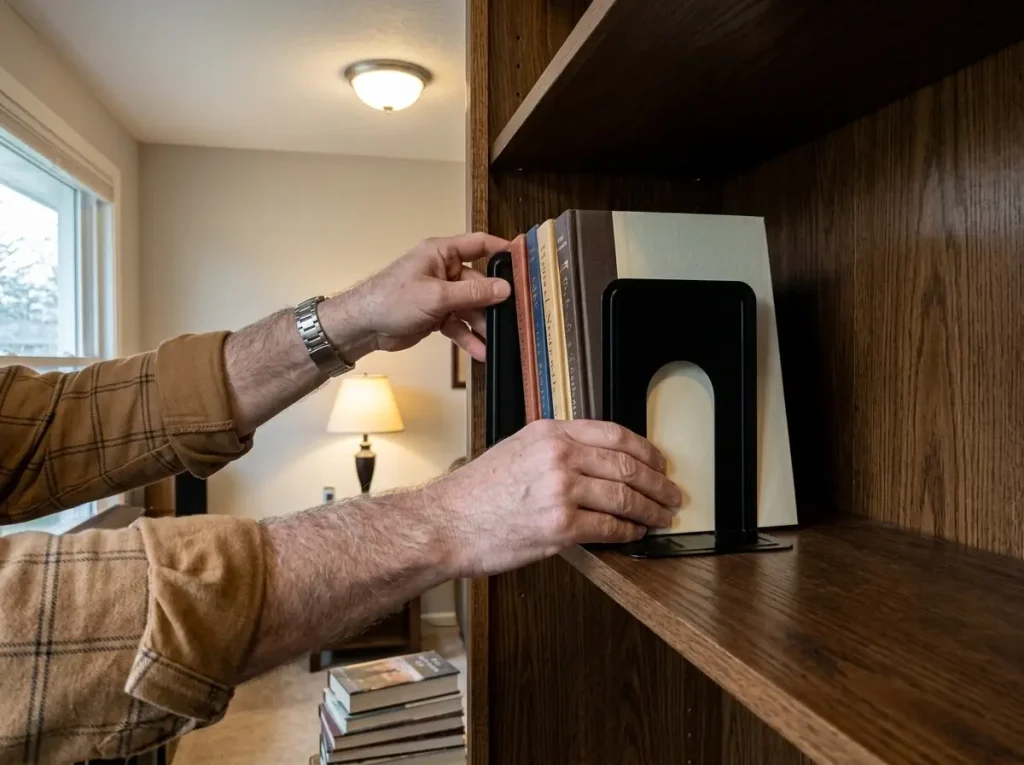
Two unopened cans of soup do the job. So do a couple of bricks wrapped in fabric, which is the fix budget-organizing threads bring up first and which costs nothing. If you’d rather not have pantry goods on display, the MaxGear 8.5″ Heavy Duty Metal Bookends come as two pairs and hold a run of hardcovers upright without the thin sheet-metal bend that makes cheap bookends slide across a shelf under load. The limitation is honest: at 8.5 inches tall they’re sized for standard books, and an oversized art volume will just tip over the top of them.
Get the Weight Right Before You Get the Look Right
Every guide says heavy books on the bottom, then moves straight on to color palettes, as though it were a styling preference. It isn’t. It’s a load calculation, and there are numbers behind it that tell you whether your shelf is already past its limit or has a year of quiet sag ahead of it.
Start with the load figure. The library-shelving guideline sits around 35 pounds per linear foot, and empirical shelf-sag testing that pegs safe library-style loading at roughly 35 pounds per linear foot also weighed real books to see how close ordinary collections get.
Large 9×11 inch hardcovers came in near 32 pounds per linear foot. Shelved magazines hit about 40, over the guideline. Paperbacks were 6. Read that gap again, because it reframes the whole problem.
A 3-foot shelf of big hardcovers is carrying roughly 100 pounds, and the identical 3-foot shelf of paperbacks is carrying under 20. A paperback shelf and a hardcover shelf are not the same object, and weight distribution across the case is the thing you are actually deciding when you choose what goes where.
Material decides the shelf span, not what you paid. Three-quarter-inch pine shouldn’t span more than 24 to 30 inches under book weight. Hardwood plywood manages 32 to 36 inches. Solid maple goes 36 to 42.
So if your shelf is wider than about three feet and made of pine or particleboard, it isn’t damaged and you didn’t overload it through carelessness. Wide shelves bowing is the material doing precisely what it is rated to do. This is also why built-in shelves in older houses often outlast the furniture around them: a shelf that runs into a vertical center stile or a fixed divider halfway along has had its span cut in half, and half the span is a fraction of the sag. Sagging shelves in a freestanding case are almost always a span problem wearing a weight problem’s clothes.
Measure the sag instead of squinting at it. The target is no more than about 0.06 inch of deflection per linear foot, roughly a sixteenth of an inch, though the eye starts catching a dip well before that. Lay a straightedge or a level across the shelf and look at the gap in the middle. Hairline dip, normal. Pencil-width gap, redistribute now. This takes fifteen seconds and it’s the difference between knowing and worrying.
That’s the whole diagnostic.
Heaviest books go on the bottom two shelves, and now the reason is concrete rather than decorative. It’s a load path (the bottom shelf is closest to its supports and the case’s own base) and a tip-over question at once. A tall case with all its mass up high is a lever waiting for a toddler or a curious cat.
Shelf depth is the other number worth checking. Standard runs 10 to 12 inches, and 16-inch shelves exist specifically for oversized art and reference books. On a deeper-than-standard shelf, ordinary paperbacks slide toward the back and look lost, and you end up shoving a second row in behind them because the space is technically there. That extra depth belongs to the oversized volumes, or it belongs to a divider.
If a shelf has already bowed, flip it over before you buy anything. Most adjustable shelves sag in one direction only, and turning the board 180 degrees puts the curve on the other side, where the load will slowly work against it. It won’t fix a badly overloaded span, but on a mild dip it buys you years for free.
Adjustable pins are free capacity most people never touch. Most cases run 7 to 15 inches between shelves, with 8 to 12 the useful range for a mixed hardcover and paperback collection. If your paperback shelf has 14 inches of headroom above a 7-inch book, that’s dead air. Close 2 to 4 unnecessary inches per shelf across a five-shelf case and you’ve bought close to an extra shelf of books inside the same footprint, without spending anything.
The r/organization purchase filter is telling: people shopping for a new case describe wanting “something more sturdy than the Ikea Billy,” which means real buyers are already shopping against sag before they think about price. The span numbers explain why that instinct is right rather than snobbery.
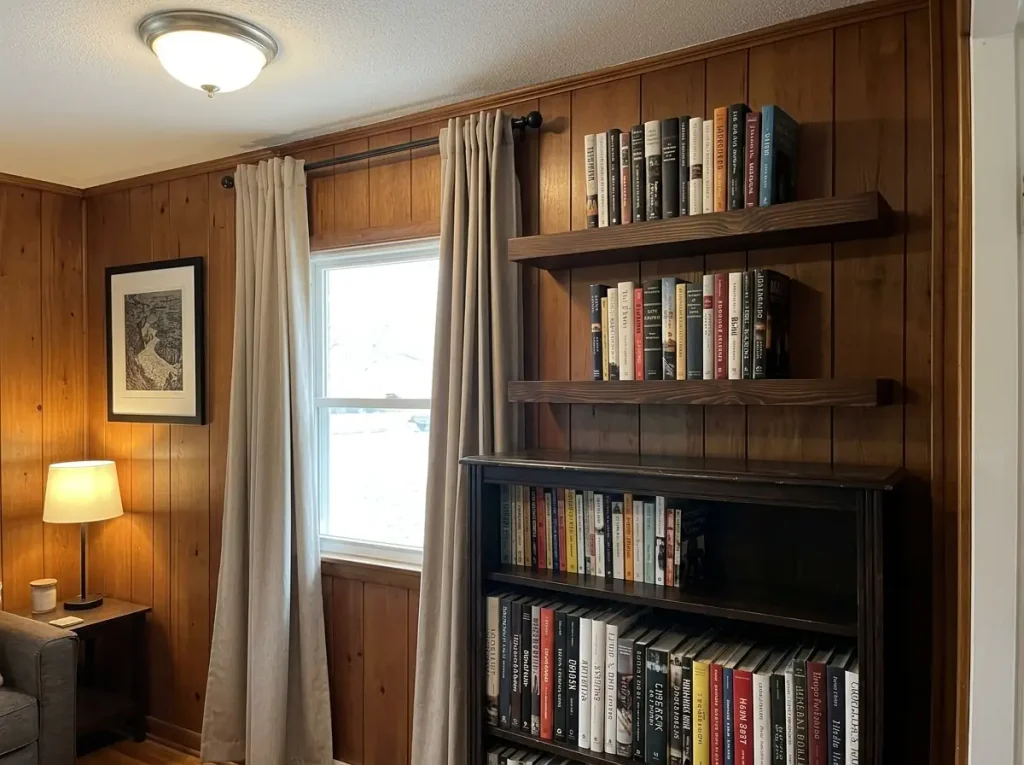
When the case is genuinely at capacity, the answer isn’t cramming it further. A low shelf or side table you already own works as an interim overflow spot, and it costs nothing to test whether the overflow is permanent or just a bad month. If it’s permanent, a pair of wall-mounted shelves takes the spillover without buying a second bookcase.
The Homeforia 24″ Solid Pine Wood Floating Shelves come as a set of two and, being solid pine rather than the MDF most budget cases use, resist sag better under a book load. Two caveats, and they matter. The pine span limit above applies to these too, so keep the run short and don’t treat 24 inches as a starting point for a longer shelf, and floating shelves live or die by the mount, which the guide to floating shelves that actually hold their load goes into properly.
Arrange for How You Actually Reach for Books
Color-coding is the most photographed and least functional bookshelf system there is. It looks incredible in a photo and then you spend four minutes hunting for one specific title, because your brain stored the author and the year you read it, not the jacket color.
The sort has to answer one question: where would I go looking for this? To sort by genre is the default for most collections, and to sort by author is the one that survives if you buy everything a writer publishes. Alphabetical order sits underneath either of those as a tiebreaker rather than a system on its own. All three are valid.
What matters is that the system matches the way you already search, rather than the way the shelf photographs. To sort by size is the exception that proves it: it looks tidy and it tells you nothing about where a book is, so it belongs on a display shelf and nowhere else.
I used to argue the color thing harder than I do now. The debate among actual readers is genuinely split, and both sides make sense: one Goodreads reader calls her rainbow shelf “basically chaotic but it works,” another objects that sorting by color “breaks up series,” which is a real cost if you own trilogies. NAPO-credentialed organizers land in the same place.
Color is a styling layer, not a retrieval system. If you love how it looks, keep it and add a secondary sort inside each color block, or accept that finding a specific title means scanning spines. That’s a trade, not a mistake. Multi-volume sets are where it hurts most, so pull those out and keep them together whatever else you do.
Eye-level shelves are the ones you actually use, so spend them deliberately. Reference books, current reading, anything you touch weekly goes at eye level. Archives, sentimental keeps, and the ones you’re keeping for a future self go high or low — the top shelf is for what you consult twice a year, not for the overflow you have not dealt with. This is the single fastest improvement on most shelves, and it costs nothing but ten minutes.
Books go spine-out, and the exceptions are worth naming because both get overused. Spine-in walls of cream page edges photograph well and make every book anonymous. Facing a cover forward is a display choice that costs the width of two or three other books, so it earns a spot on maybe one shelf, not five.
Mix vertical stacking in upright rows with short horizontal stacks. Everyone frames this as visual rhythm, and it is, but there’s a mechanical reason too: a horizontal stack acts as a hard stop in a long unbroken run of spines, so the row on either side has something to lean against instead of slowly fanning over.
It also gives you a flat surface, which is where the three or four decorative objects belong — framed photos, a small plant, a bowl.
That surface is also where cords and chargers collect if the case sits near a socket, so one small basket for them keeps a shelf from becoming a drop zone. Storage baskets and fabric storage bins on a low shelf do the same job for anything that isn’t a book. A shelf that’s only books reads as storage. A shelf that’s only objects isn’t a bookshelf.
Leave breathing room, and understand what it’s for. A shelf packed edge to edge means every retrieval is a two-handed operation, which means books get shoved back in front of their neighbors instead of into their actual spot. That’s how a second row starts. Not from too many books, from too much friction.
It’s the same one-category rule that keeps small living room storage working: the gap isn’t wasted space, it’s the tolerance that lets the system absorb normal use.
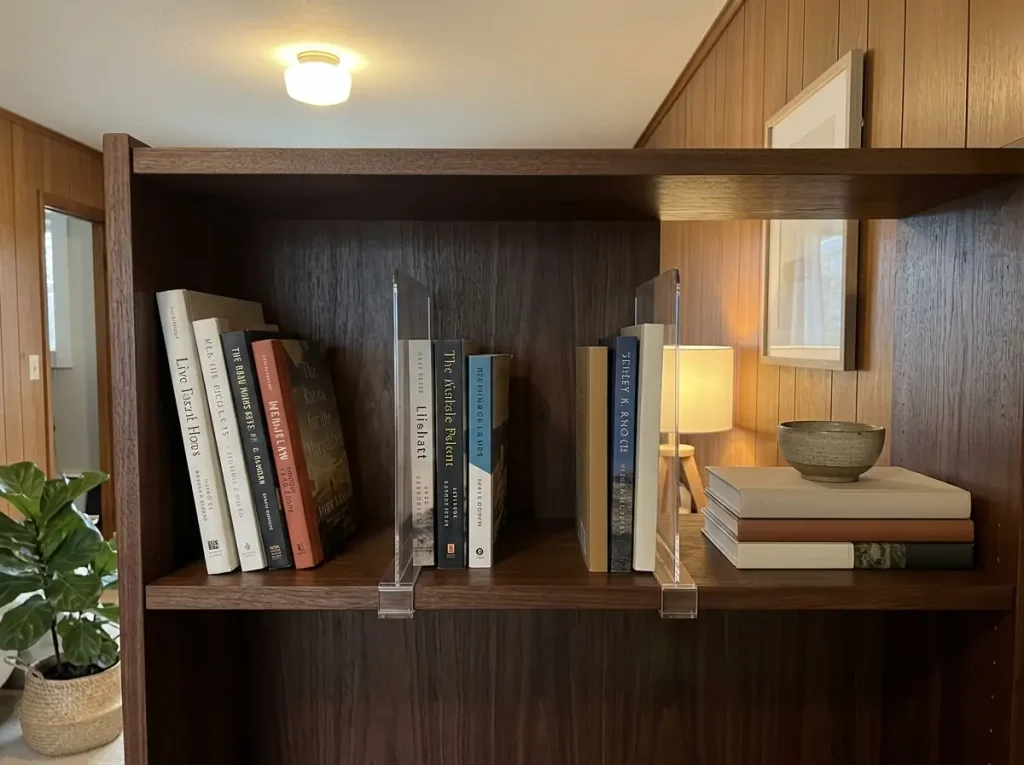
Then the gap closes anyway, because the books on either side lean into it. Deliberate negative space turns back into a slump within a month unless something holds it open. Folded heavy cardboard works, and so does a kitchen shelf riser you already own.
If you want something that disappears visually, the HBlife Acrylic Shelf Dividers come in a six-pack and hold about 15 pounds each, which is enough for a section of hardcovers, not enough for a full run of encyclopedias. Clear acrylic also scratches, so they’ll look their best on shelves you’re not constantly rearranging.
Anchoring a Bookcase When You Cannot Drill

Renters skip this step, and it’s not carelessness. It’s that every guide covering anchoring assumes you own the wall it’s talking about, and almost none of them are renter-friendly past the first paragraph. A fully loaded freestanding bookcase is one of the heaviest objects in a rental living room, and “it’s just books, it won’t tip” is exactly the assumption the safety agency spends its budget trying to break.
Be precise about the legal position, because a lot of articles aren’t. The CPSC’s mandatory tip-over stability standard that took effect in 2023 applies to clothing storage furniture over 27 inches tall. Dressers, chests, armoires. It does not cover bookcases.
But the Consumer Product Safety Commission’s AnchorIt campaign, which recommends securing every bookcase to the wall, has recommended it for a decade regardless. No code forces your hand here. The recommendation stands on its own anyway, and a loaded case is heavier than the dresser the law does cover.
One thing decides whether any anchor holds, before you choose a method: it has to go into the solid wood top frame of the case, never the thin cardboard or hardboard backing. An anchor screwed into the backing will hold beautifully for months and then tear out under exactly the load it was installed to stop. And mount it at least two inches down from the top edge, so the strap has leverage instead of peeling.
Route One: You Can Drill
Into a stud is best, always. A stud finder or a knuckle rap gets you there in a minute, and wall studs sit at 16 or 24 inches on center in most American walls, so once you’ve found one you’ve found the rest.
When there’s no stud where the bookcase needs to stand, the failure mode is a plastic drywall plug. It grips the crumbly gypsum core, which holds fine against a static hanging weight and gives way under the sustained, wobbling pull a tipping case produces. A spring toggle behaves differently: it opens behind the drywall and spreads the load across a wide patch of board rather than the half-inch ring around the hole.
The QUALIHOME Spring Toggle Bolt Anchors are 1/4 by 4 inches, a 15-pack, sized for standard half-inch drywall. Be clear-eyed about what this route is, though: it’s still drilling. A toggle leaves a bigger hole than a plug does, and patching it at move-out is a spackle-and-sand job, not a nail hole you can ignore.
Route Two: No Drilling At All
This is the same no-drill approach that keeps a rental closet deposit intact, applied to furniture instead of hanging storage. Two mechanisms, with honest limits on both.
Heavy-duty adhesive anti-tip straps mount to the case and the wall with VHB-style tape and no hardware at all. They’re rated for lighter pulls, roughly under 20 pounds per strap, so they’re a real solution for a mid-height case and an oversell for a seven-foot loaded unit. The No Drill Anti Tip Furniture Anchors come as six pairs, which means you can double up on a wider case and still have spares for a dresser.
Now the part that decides whether they work at all. The adhesive needs 24 to 72 hours to cure before any load goes on the strap, and reloading the shelf the same afternoon is the single most-cited reason these fail inside the first month.
The tape feels stuck immediately, which is the trap. Install, wait, then load. If you’re doing this on a Saturday, the books go back on Monday.
The second no-drill option costs less and holds more: a tension rod wedged between the top of an open-backed case and the ceiling handles far more tipping force than any adhesive strap. It’s genuinely the better mechanism where it fits. It also fails completely on a vaulted or sloped ceiling, on a case too short to reach, and on any unit with a solid closed top you can’t brace against. Check your ceiling before you buy straps, in that order.
Anchor the case while it is empty or lightly loaded, which is why this step belongs here in the sequence and not at the end of the project. An empty bookcase can be walked away from the wall with one hand. A loaded one has to be unloaded first, and that is how anchoring gets postponed into never.
The Rule That Stops It Reverting in Three Weeks

Every guide puts maintenance in the last paragraph as a nice-to-have. It’s the whole article. A shelf that looks right on Sunday and is double-stacked by month’s end did not fail at the sorting stage. It failed because nothing was ever decided about the next book that came through the door, and books keep coming through the door.
One-in-one-out is the mechanism, and the timing is the entire point. A new book arrives, one leaves the shelf. It happens at the moment of acquisition, not during a seasonal purge, because the seasonal purge is precisely the thing you’re trying to make unnecessary. Purges are what a system does instead of working.
But one-in-one-out alone doesn’t cover the actual failure, and this is where most advice stops short.
The most useful framing I’ve seen came from an r/organization poster arguing that a system needs a “put away space as well as an in process space.” Think about what your shelf currently accounts for. Finished books, shelved, static. It has no slot at all for the two or three you’re reading right now, which is why those live on the nightstand, the arm of the sofa, and the kitchen table.
The pile isn’t a discipline failure. It’s a design gap, and it’s the same gap every “after” photo hides, because nobody photographs a shelf with a half-read paperback lying face-down on it.
Give the in-process books a deliberate spot. One shelf edge, one basket, one clearly assigned six inches. The piles elsewhere stop forming, because they were only ever the overflow from a category with no home.
That’s the general law underneath it, and another poster in the same community said it better than any organizing book: without a home for every single object, “it ends up dumped somewhere.” A bookshelf with one unassigned category will grow a floor stack beneath it within a month. Every time. The category is usually in-process reading, sometimes library books with a due date, sometimes the ones you’re passing on to a friend and haven’t yet.
The honest note on executive function, because organizing advice tends to talk around it: readers in these threads say flatly that a system existing on paper doesn’t mean it survives a Tuesday. One Goodreads reader describes her shelf as “pure chaos…. I blame my adhd, it has a lot of character lol,” which is a more useful data point than any tidy case study. The answer there is fewer decisions per book, not more discipline.
Broader categories, so shelving a book is a one-second choice rather than a three-way judgment call. A visible in-process spot, so nothing needs deciding while you’re mid-chapter. And no “miscellaneous” shelf, ever, because miscellaneous is a decision you’ve deferred, and deferred decisions accumulate faster than books do.
The shared-household version is the case nobody writes about, and it’s most people. One r/organization poster is doing all of this for a spouse rather than herself: “married to an avid reader and there are piles of books around the house.” A system one person builds and the other never agreed to isn’t a system, it’s a preference with extra steps, and it degrades within weeks.
The version that survives a shared home is the one with the fewest rules to remember. One shelf for incoming, one rule about what leaves. Anything more elaborate is asking someone who didn’t design it to hold your taxonomy in their head.
The maintenance routine worth keeping is two items long, and both are short enough to actually happen. The monthly tidy is a five-minute pass: push the leaning rows upright, return the strays that migrated to other rooms, and empty the in-process spot of anything you finished and forgot. Dusting shelves belongs to that same pass rather than to a separate chore — a dry cloth along the top edge of the spines, working one shelf at a time.
The twice-yearly audit is the longer one, and it is where the culling happens if one-in-one-out slipped. Two things to look for while you are in there. UV fading shows up first on the spines of whatever sits in direct sun, so rotate those or move them out of the light; book jackets are what fades fastest, and a jacket that has gone pale on one edge is a good early warning for the whole shelf. If you keep reference or textbook sections, a label maker run along the shelf edge is worth the ten minutes — labeling shelves is overkill for a personal library and genuinely useful for anything you consult rather than read.
Then there’s the three-week check, which takes about ten seconds. Walk past and look for a second row. If books have started stacking behind other books anywhere, the shelf is over capacity, and that’s a decision about the collection, not a failure of the arrangement. No rearrangement fixes a capacity problem.
You’re either removing books, adding shelving, or accepting the second row on purpose, and picking deliberately beats discovering it in three months. Readers doing this inside a studio or one-bedroom will recognize the same limits that apply to organizing a small apartment: the constraint is real, and pretending otherwise just relocates the pile.
Conclusion
Three things carry the rest. Empty the shelf completely before you arrange anything, because you can’t sort a collection you can’t see. Put the weight where the shelf can carry it, then anchor the case, because a bowed shelf and a tipping bookcase are the same physics problem at different speeds. And decide your one-in-one-out rule before the next book arrives, not after the pile returns.
In three months, run a straightedge along your widest shelf and look for a second row anywhere in the case. A visible dip means redistribute the weight now, before it sets. A second row means the collection has outgrown the furniture, and that’s a decision to make on purpose rather than discover.
Start with the shelf at eye level. Empty it, sort it, put it back. If it still holds up in a month, do the next one.
Frequently Asked Questions
01What is the bookshelf rule?
There is no single bookshelf rule, but the one professional organizers repeat is one-in-one-out: every new book means one leaves the shelf. The styling rules people quote, like the two-thirds rule or a 70-30 vertical-to-horizontal mix, govern how a shelf looks. None of them stop it overflowing.
02How should I arrange items on a bookshelf?
Heaviest books on the bottom two shelves, the ones you reach for weekly at eye level, vertical rows broken by short horizontal stacks, and three or four decorative objects rather than a full shelf of them. The arrangement follows the load first and retrieval second. Looks are the third pass, not the first.
03Is it bad to organize books by color?
Not bad, but it is a styling choice rather than a retrieval system. It works if you recognize your books by their covers, and it fails if you look for titles by author or if it splits a series across the shelf. Pair color blocks with a secondary sort inside each block.
04How do I keep books from falling over on a partly empty shelf?
Use bookends, a shelf divider, or lay the last few books flat as a horizontal stack against the standing row. This is the failure that shows up right after a cull, when shelves go from packed to two-thirds full, so handle it in the same session rather than a week later.
05How do I anchor a bookcase if I am renting?
Adhesive anti-tip straps or a tension rod wedged against the ceiling, neither of which needs a hole. The strap mounts to the solid top frame rather than the cardboard backing, and needs 24 to 72 hours to cure before you reload the shelf. The tension rod carries far more tipping force but only works with a standard flat ceiling.