




















In this article
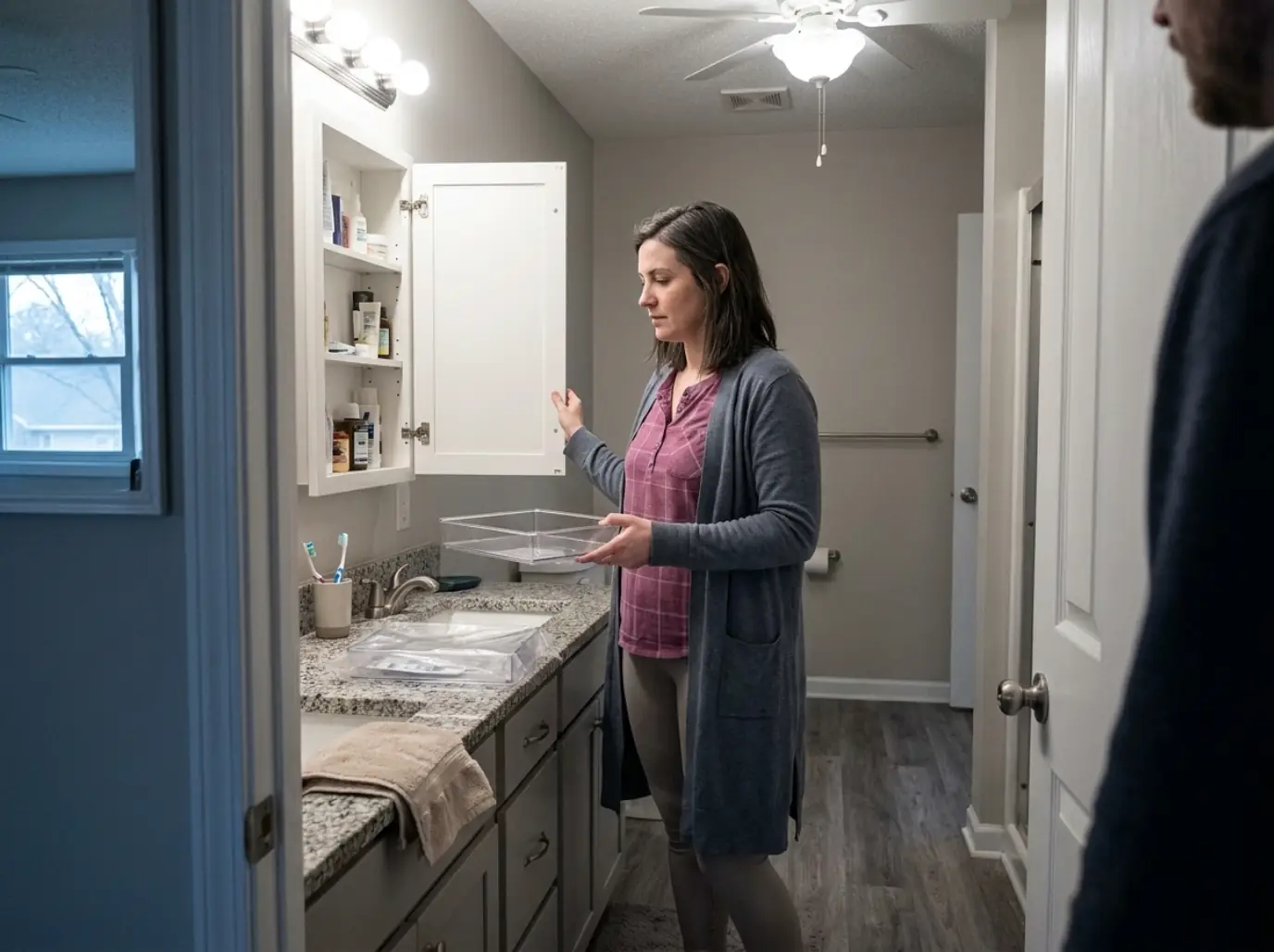
You measured, you ordered, the box came, and now the cabinet door won’t shut. It closes almost all the way, catches on the front corner of the bin, and springs back half an inch.
That happens because the number that decides whether an insert fits is one almost nobody publishes: the usable depth of a bathroom cabinet of this kind is roughly 3 to 4 inches, not the 4 to 5 inches the cabinet itself measures. Most medicine cabinet organizer inserts on the market were designed for a pantry shelf and relabeled. Here’s how to get your real number in about thirty seconds, and then eight inserts sorted by which shelf and which household they actually fit.
Quick Answer
Match the insert to your situation, not to the product photo:
- Shallowest recessed shelf: Eikovia 3-inch acrylic trays
- Plenty of height, no depth: Vtopmart stackable drawers
- Renting and can’t drill: PAVSTINE adhesive organizer
- Round bottles that vanish to the back: TamBee 6-inch turntable
- Young kids in the house: POCHAR locking box
Why Most Medicine Cabinet Organizer Inserts Don’t Fit
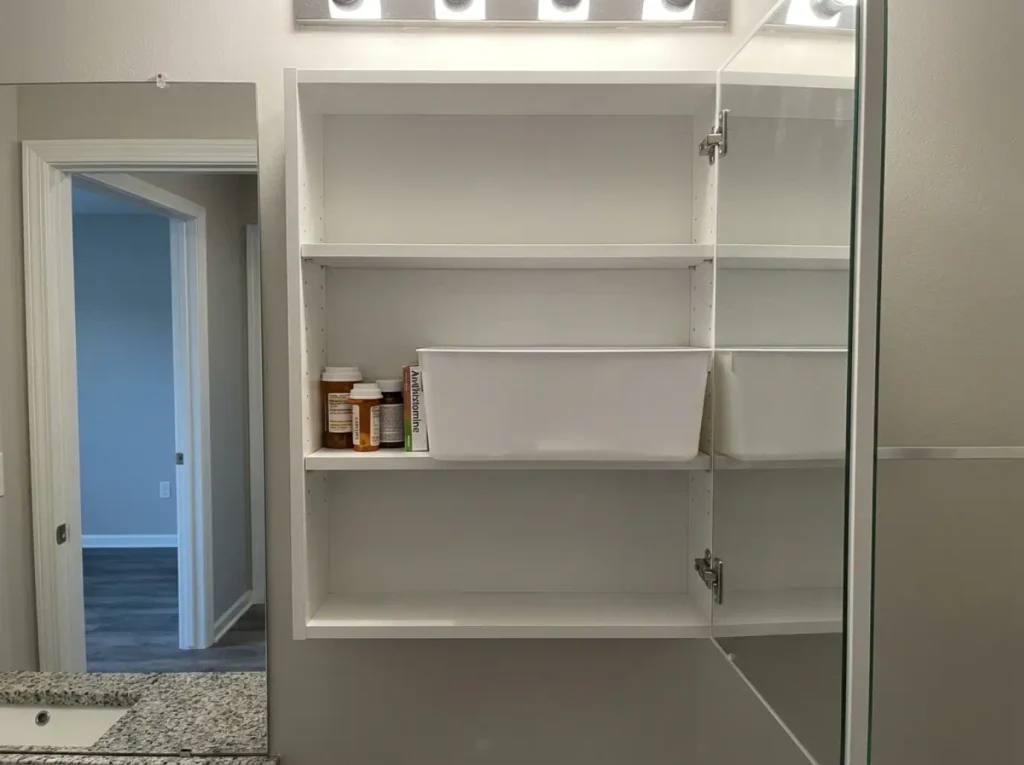
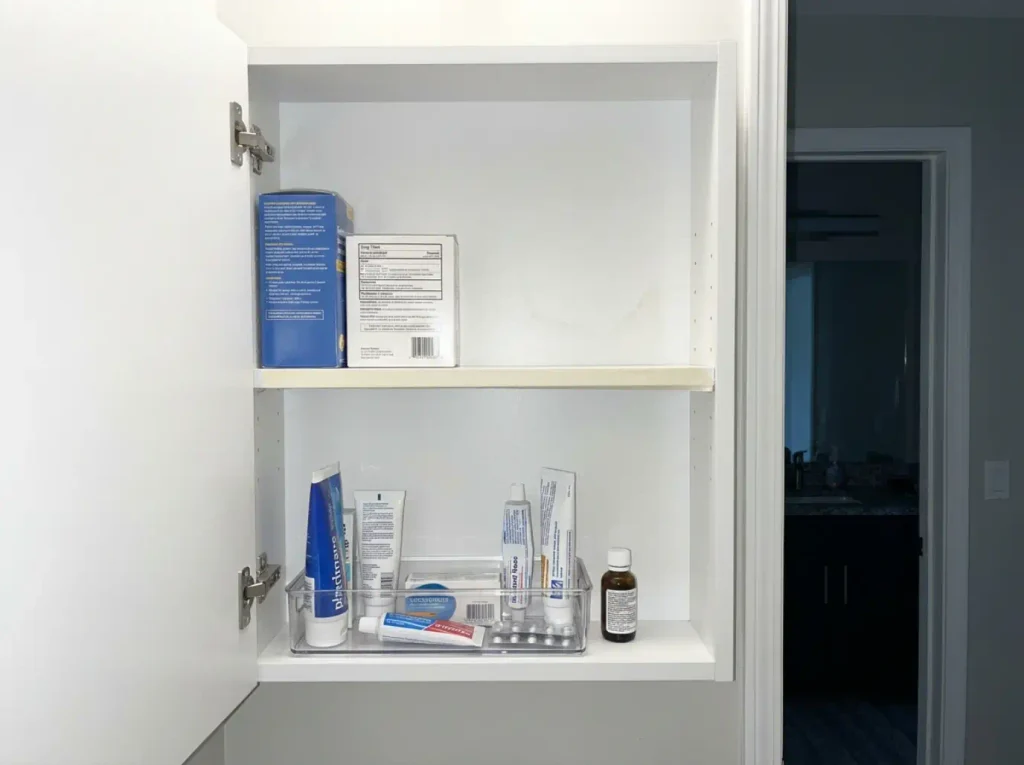
You are not bad at shopping. The product category is mislabeled. A standard mirrored medicine cabinet runs 4 to 5 inches deep overall, and once you subtract the door swing and the hardware clearance, what you actually have to work with is closer to 3 or 4 inches of usable shelf depth.
That subtraction is the entire problem. A kitchen cabinet has room for cans two rows back. A medicine cabinet has roughly the depth of a paperback laid flat.
Which is why a bin rated for a 4-inch shelf can still stop the door closing. The rating describes the cabinet, not the shelf. Sellers measure the box they ship, and the box does not care about your hinge. When a listing says “fits medicine cabinets,” what it usually means is that somebody in marketing looked at a picture of one.
The failure is never dramatic, either, which is why people live with it. Nothing snaps. The door just closes almost, and you nudge it with your hip on the way past, and you keep doing that for six months before you admit the bin is wrong and the money is gone.
There’s a second variable that changes the math completely, and it’s the one people skip. A recessed medicine cabinet, the kind built into the wall cavity so the mirror sits flush, runs about 3.5 to 5 inches deep. Surface-mounted cabinets, the kind that stand proud of the wall like a small box, can reach 8 inches.
If yours sticks out, you have two to four extra inches and a much longer product list. Sellers almost never say which mount type their dimensions were written for. If you want the whole picture behind shelf depth, expired medicine disposal, per-person zones and the rest, the full medicine cabinet organization framework covers the ground this article assumes.
How to Measure Your Cabinet Before You Buy Anything
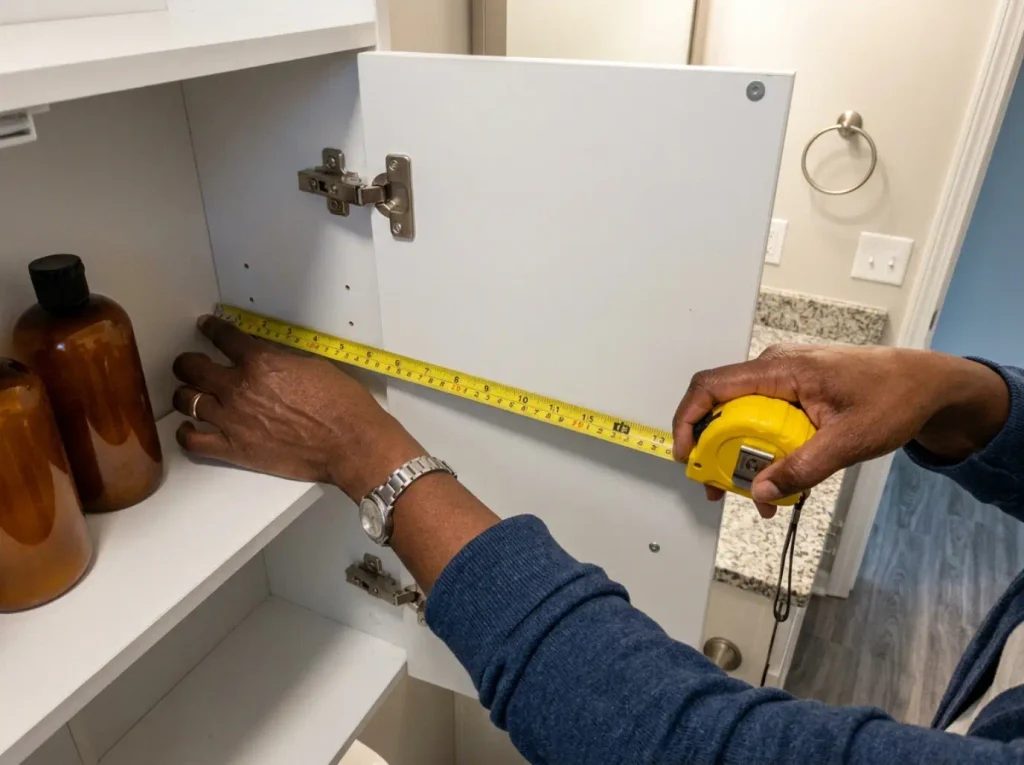
Measuring is step four of the full six-step cabinet reset, and it’s the step people fake. Everyone says measure before buying. Nobody says measure what.
The number that matters is not on the cabinet’s spec sheet and it is not the depth of the box. It’s the clear space between the back wall and the point where the door starts to close.
The Three Numbers That Decide Everything
Usable depth first: put the tape against the back wall and run it forward to where the door swings, not to the front edge of the shelf. The door is what limits you, and on most mirrored cabinets the hinge steals a bit more than you’d guess. Shelf width second, which is the easy one. Vertical gap between shelves third, and that’s the one everybody skips.
That third number is the one worth writing down twice, because vertical clearance is usually far more generous than depth, and it decides whether stacking is available to you. A cabinet that gives you 3 inches of depth will usually hand you several times that in height per shelf. That surplus is storage you already own.
Recessed or Surface-Mounted, Check Before You Shop
Stand to the side of the cabinet and look at it edge-on. Flush with the wall means recessed and shallow. Standing out from the wall means surface-mounted and you probably have room to spare. Five seconds, and it cuts your shopping list in half in the right direction.
Subtract Before You Shop
Take a half inch off your usable depth and shop against that smaller number. I used to say buy to the exact measurement and treat the extra as wasted space (which is how you think about a pantry, where depth is the thing you are short of). In a cabinet this shallow it is backwards.
A bin that fills the shelf exactly is a bin you can’t get your fingers behind, and an insert you have to pry out is an insert that ends up on the counter by week three. The same measure-the-interior rule applies to dresser drawers, which is why drawer dividers fail for identical reasons when people buy to the drawer’s outside dimensions.
Write the three numbers on your phone before you open a single shopping tab. Every listing you scroll past is built to make you forget them.
Measure the shelves individually instead of measuring one and assuming. On plenty of mirrored cabinets the bottom shelf sits slightly deeper than the ones above it, because the door hardware clusters at the top. If you have one item that barely fits anywhere, that bottom shelf is usually where it goes.
The measure-first warning is the single thing organizing threads agree on. One poster who had genuinely nailed her own cabinet still went back and warned commenters in capital letters to measure their inside space first, because the product line she used comes in several sizes and only some of them fit. She wasn’t being dramatic. She was watching people about to repeat the mistake she’d already paid for.
And the honest version of the anti-sell: if your usable depth comes in under 3 inches, nothing on this list fits, and no amount of shopping fixes that. Your answer is a door-mounted or wall-mounted solution that puts the storage outside the shelf entirely.
The Best Medicine Cabinet Organizer Inserts for Shallow Shelves
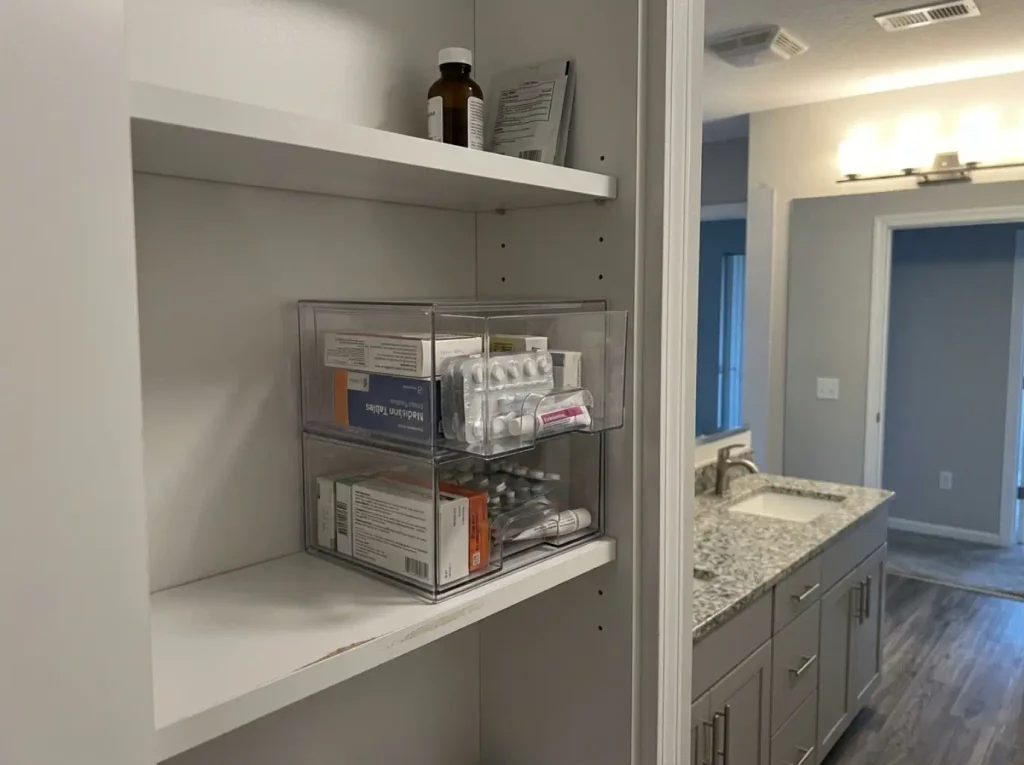
There are two honest ways to beat a shallow shelf. Buy something genuinely shallow, or stop fighting the depth and take the height instead. Most people try a third way, the bin that’s “close enough,” and end up back at the door problem from the first section. Which insert lands on which shelf follows one rule: professional organizers recommend categorizing by how often you reach for something, so the front of the shelf you use daily is prime real estate and everything seasonal moves up and back.
Before you buy anything at all, look at what’s in there now. If your current “organizer” is a repurposed shoebox or a gift box that came inside a delivery, that’s the swap to make first, and it costs nothing to make it. Cardboard and other organic-fiber containers are difficult to clean and prone to mold in a room that gets steamed twice a day. No insert fixes a mold-prone material.
It also helps to know what you’re buying inserts for before you buy them, because categorization is what decides how many trays you need and in what size. Most cabinets sort into five groups and not one more: pain and fever medicine, cold and allergy medicine, vitamins and supplements, a first aid kit worth of bandages and antiseptic, and a catch-all bin for the odds nobody has a home for. Count the groups you actually have before you count trays. Four categories in a cabinet that fits three trays means one group is about to lose, and it’s better to decide which one on purpose than to find out in October.
One note on clear containers while you’re deciding. See-through organizers are not an aesthetic preference in this room, they’re a findability feature, and the whole point of a bin is telling what’s in it without pulling it out.
The Shallowest Option That Actually Exists
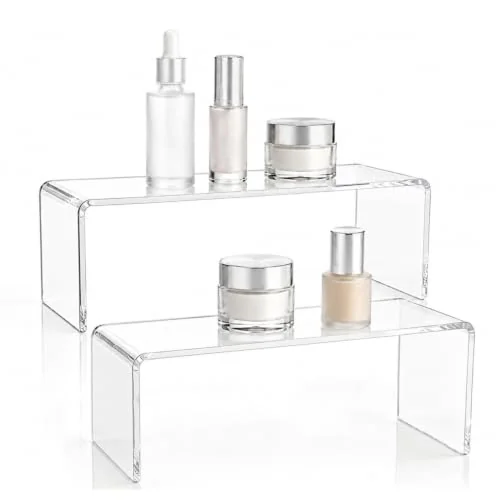
Three inches deep is rare in this category because most manufacturers design one bin for every cabinet in the house, and a 3-inch bin is useless in a kitchen. The Eikovia acrylic trays are the exception: 11.4 inches long, 3 inches wide, 5.1 inches tall, sized for the constraint instead of adapted to it. On a genuinely shallow recessed shelf, they clear the door where a standard organizer bin physically cannot.
Acrylic matters here and it isn’t a decorative choice. Acrylic (PMMA) doesn’t warp, rot, or grow mold at normal bathroom humidity, and its non-porous surface gives mold nothing to grip. If you want the longer version of where that material earns its price and where it doesn’t, we broke down where acrylic bins earn their price and where they don’t against cheaper polypropylene.
Use the Height Instead of the Depth
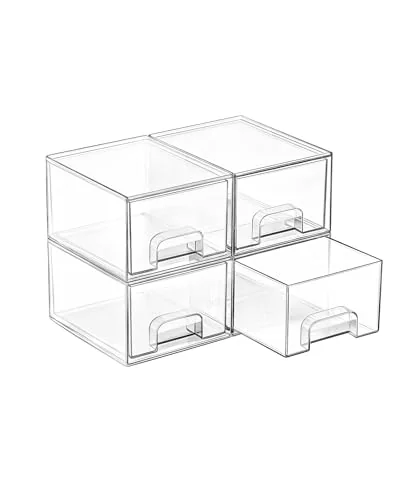
This is the move that changes the math. A Vtopmart stackable drawer measures about 7 inches deep, 6 wide and 4.4 tall, and at 4.4 inches tall two of them stack inside a standard shelf gap. Turned sideways, the 6-inch face runs along the shelf and the depth problem stops being a depth problem. You’ve converted the vertical clearance you measured earlier into the storage the depth refused to give you.
This is also the approach one Reddit poster built her entire cabinet around. She skipped the premium organizer set and bought two 4-packs of the same budget drawers instead, eight drawers total, and reported back that it “worked out just beautifully.” That phrase is worth sitting with, because it’s the real bar: not perfection, just it holds and I can find things.
When Your Shelf Is Taller Than It Is Deep
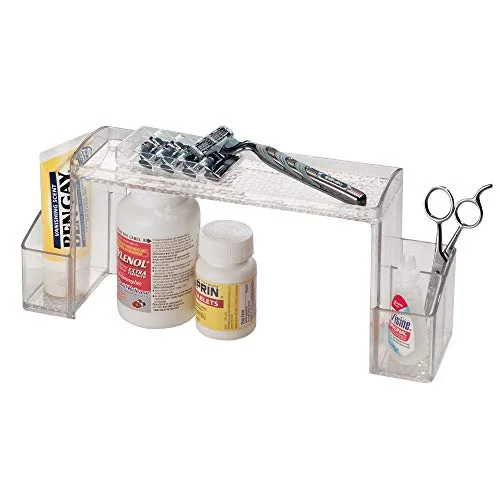
Some cabinets give you one generous shelf gap and nothing else, usually the middle one. The iDesign 43130 Med+ High-Rise is built for exactly that geometry: it adds usable height on a small footprint, so the storage goes up instead of back. It’s also the cheapest way to test whether the vertical approach works in your cabinet before you commit to a full set of anything, which makes it the budget organizer of the group in the useful sense rather than the cheap-and-regret-it sense.
One more thing about clear plastic that has nothing to do with looks. You open this cabinet in the dark, half-awake, reaching for the thing that will let you go back to sleep. A clear tray tells you what’s inside before your eyes adjust. An opaque one makes you turn the light on and wake yourself up properly, which is a small daily tax that opaque bins never advertise.
Inserts for Renters, Shared Bathrooms, and Households With Kids
The right insert for one person in an owned house is the wrong insert for four people sharing a rental. Everything above assumed you can set a tray on a shelf and walk away. These three situations break that assumption, and each one changes the answer.
If You’re Renting and Can’t Drill
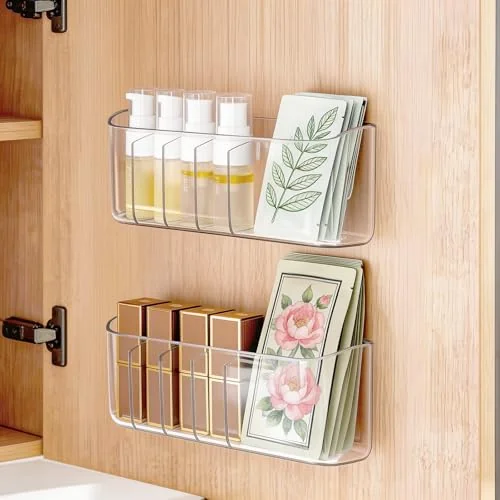
This is the gap in the whole category. Every roundup writes as though everybody can mount whatever they like, and a recessed rental cabinet with a mirrored door is about the least drillable surface in the apartment. Adhesive-mount organizers give you a shelf where a screw isn’t an option, at the cost of one specific patience requirement. That is the whole premise of no-drill organizing: the storage goes where the lease says it can’t, and nothing comes off the wall with it.
Here’s the number nobody reads and everybody needs: the manufacturer’s own instructions build in a 36-hour adhesive cure before the shelf takes any weight. A day and a half of dead time, and the whole point of a no-drill product is that it feels instant. Load it with pill bottles the same afternoon and it comes off the wall, usually at about 2am, usually with everything in it. Stick it up on a Friday night, leave it empty through Sunday morning, and it holds.
I used to recommend tension-fit and freestanding solutions to renters across the board, on the theory that anything adhesive was a security deposit waiting to fail. Enough renters in organizing threads reported the opposite outcome, adhesive holding fine and coming off cleanly with heat, that I changed my mind. The failure stories almost all traced back to the cure time, not the adhesive. If you want the broader version of this filter, the wider no-drill bathroom product list applies it across the room.
If More Than One Person Uses the Cabinet
Round bottles are the specific shared-cabinet failure and they fail in a predictable sequence. Somebody reaches past the front row and pushes a bottle to the back. It rotates on the way, so now the label faces the wall. Two weeks later somebody buys a third bottle of the same thing because as far as the cabinet is concerned, it doesn’t exist.
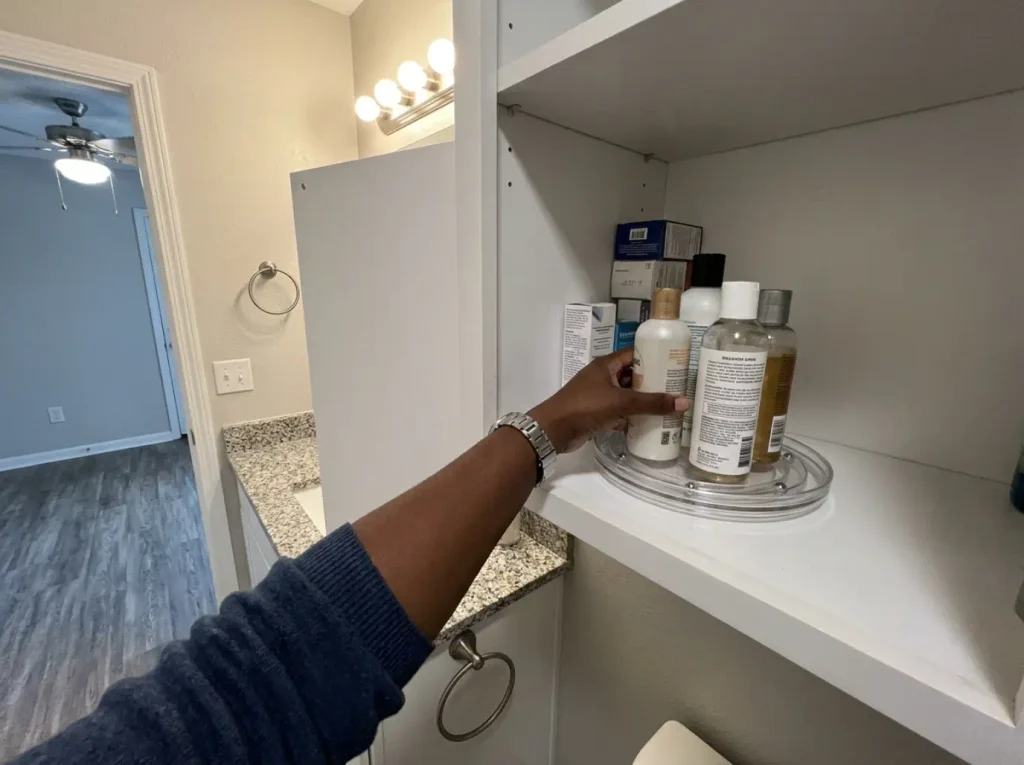
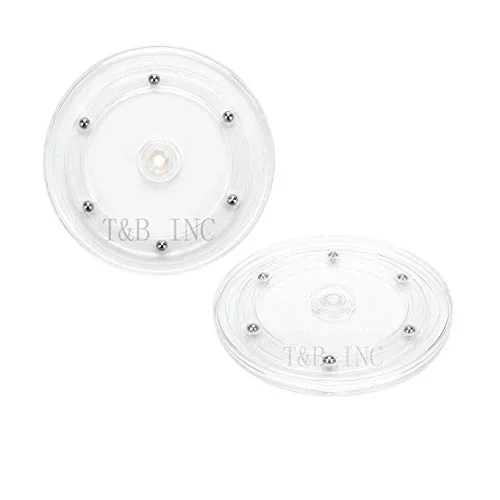
A small turntable fixes the rotation, because you spin the tray instead of reaching past things. Small is the operative word. A 6-inch turntable sits inside a shallow shelf without hanging over the front edge, where a 9- or 16-inch one from the pantry will overhang, catch the door, and put you right back at the first section of this article.
Per-person zoning works better on a turntable too, since each quarter of the tray can belong to someone and the boundary is visible from a step away. Shared bathroom organization lives or dies on that kind of visible boundary, because a rule nobody can see is a rule nobody follows.
If There Are Kids in the House
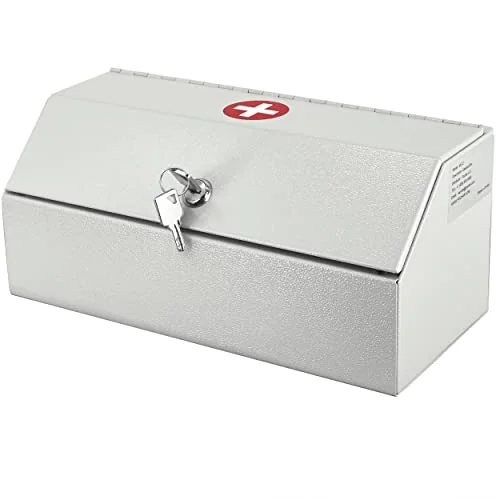
Worth stating accurately, because this gets muddled constantly. The child-resistant caps on the bottles themselves are federally required under the Poison Prevention Packaging Act, which the CPSC has enforced since 1972. Those are federal child-resistant packaging requirements, and they apply to the packaging, not to your cabinet. Nothing you buy for the shelf changes that baseline.
So a locking box is a second layer, not a substitute. It earns its place in two specific situations: young kids in the house, and any bottle whose cap has been swapped for an easier-open one, which happens a lot when somebody in the household has arthritis. If neither applies, the caps are doing their job and a lock box is storage you’re paying extra for.
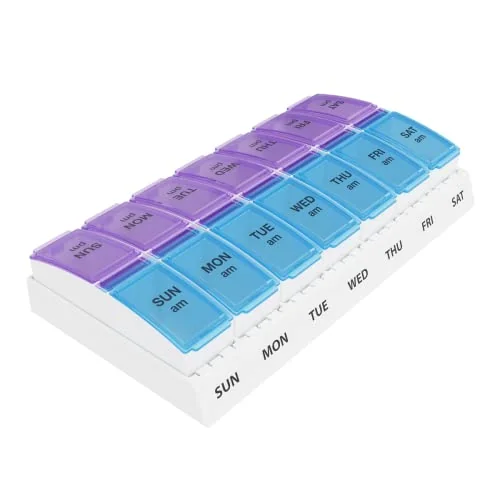
One last piece that solves more shelf-depth problems than any bin. Daily medication is a different problem from storage, and mixing the two is why per-person systems collapse in the second week.
If three people each need a morning and evening dose, you’re opening the same three bottles twice a day, in a hurry, in a small room, and every one of those bottles is competing for the front row. A weekly organizer takes that routine out of the cabinet entirely. Call it decanting if you like, but decanting daily items into one tray on Sunday is the closest thing this room has to a free win.
Check what’s on the other side of the cabinet wall before you decide where things live. A caution that comes up repeatedly in organizing threads is storing medicine near a heat source, and the same logic covers a cabinet backing onto a heat vent, sitting above a radiator, or on a west-facing wall that bakes every afternoon. Temperature swings degrade medication faster than humidity does, and the shelf closest to the warm wall is the one to reserve for cotton balls and spare toothbrushes.
What Makes an Insert Fail After Three Months
An insert that fits perfectly can still be the wrong insert. The two failures that show up months later are reach and labeling, and neither one is visible on the day you install it.
The reach failure is the one with receipts, and it has a name worth remembering: the step stool reach problem. One professional organizer published a case study on her own rebuild. The first system she set up put daily-use items on the second shelf, which meant fetching a step stool for a household member who was 5’10”.
Everything fit. Every measurement checked out. It failed anyway, and she redid the whole thing with stackable bins to bring daily items down to the first shelf. Fit passed, ergonomics failed, and the difference only showed up in daily use.
So the rule is height, not just depth. Daily items go between eye level and chest height. The top shelf is for what you touch twice a year, and the bottom is for backstock and bulk.
And here’s the test that predicts everything: if you can’t put something back one-handed while holding a toothbrush, the system reverts. It always does. That reversion pattern isn’t specific to medicine cabinets either, which is why small bathroom storage drifts back to messy across every zone in the room.
Material is the quiet half of longevity, and it’s the reason the acrylic and plastic picks above beat anything fiber-based. If you want the survey of the organizer types that hold up to bathroom steam, that’s the sibling piece to read before you commit to a material.
Labeling Without Broadcasting Your Medical History
Labeling is what makes an insert work. It’s also the thing nobody warns you about until a guest is standing in your bathroom.
Organizing threads have a running joke about labeling a bin bluntly by symptom, complete with the exact word you’re imagining. It’s funny right up until somebody in the comments raises the actual objection: a visible label on a medicine bin is a piece of your medical history sitting at eye level for anyone who opens that door.
The fix isn’t to skip labels, it’s to build the labeling system around categories instead of symptoms. “Daily,” “cold season,” “first aid,” “kids” tell you what you need at 6am and tell a houseguest nothing at all.
Then label the shelf edge rather than the front of the bin. You read the label when the door is open and the bin is facing you, but a bin’s front face is the one surface hidden behind the door frame when you’re actually reaching in. Shelf-edge labels also survive swapping the bins out, which you will do.
None of this needs a machine. A strip of painter’s tape and a marker survives a bathroom fine, peels off clean, and costs nothing, which makes it the right way to run the system for a month while you find out whether your categories are the correct ones. If they hold and you want the permanent version, the Brother P-Touch PTD220 label maker prints laminated tape that doesn’t curl in steam. Buy it after the categories settle, not before, or you’ll print four labels you have to peel off in October.
Give one bin the job of holding whatever doesn’t have a category yet, and give that bin a hard size limit. Every medicine cabinet accumulates orphans: the sample tube from the dentist, the one weird ointment. Without a home they scatter across every shelf and undo the zoning. With a home, they’re contained, and when the bin overflows you have your signal that it’s time to purge instead of reorganize.
The Bottom Line on Choosing an Insert
Measure the usable depth, back wall to door, before you open a shopping tab. That one number eliminates most of the market for you and turns a confusing category into a short list.
If the depth won’t give you room, take the height instead. Stacking beats squeezing, and every cabinet has more vertical clearance than it has depth.
Match the insert to the household, not just to the shelf. Renting, sharing, and kids each change the correct answer, and no product review that ignores your situation is reviewing the thing you’re actually buying.
In three months, open the cabinet and notice what’s living on the counter instead. Whatever migrated out is what ended up on the wrong shelf, and the fix is to move it down rather than to buy another bin.
Measure one shelf tonight. Write the three numbers on your phone. Buy nothing until you have them.
Frequently Asked Questions
01What are the best organizers for medicine cabinets?
For a shallow shelf, a 3-inch-deep acrylic tray like the Eikovia is the pick; if you have vertical clearance to spare, stackable drawers like the Vtopmart give you more storage per shelf. The right answer changes with mount type, since a surface-mounted cabinet has two to four more inches of depth than a recessed one.
02How deep is a medicine cabinet shelf?
Most medicine cabinets are 4 to 5 inches deep overall, which leaves about 3 to 4 inches of usable shelf depth once the door swing and hardware clearance are subtracted. Recessed cabinets run 3.5 to 5 inches; surface-mounted models can reach 8.
03What to put inside a medicine cabinet?
Daily items go at eye to chest height, seasonal items go on the top shelf, and backstock lives somewhere else entirely. Sorting by how often you reach for something beats sorting by type, because the front of the shelf you open every morning is the most useful space you own.
04Will organizer bins from the kitchen work in a medicine cabinet?
Usually not, because kitchen and pantry bins are built for 10 to 12 inches of depth and a medicine cabinet gives you 3 to 4. Before repurposing one, measure its depth against your back-wall-to-door number, and remember that a bin filling the shelf exactly is one you can’t get your fingers behind.
05Do adhesive medicine cabinet organizers actually hold?
Yes, as long as you respect the cure time. Adhesive-mount organizers typically need 36 hours before they take any weight, and loading them the same day is the single most common reason they let go. For renters, that patience buys a shelf with no holes in the wall.