














In this article
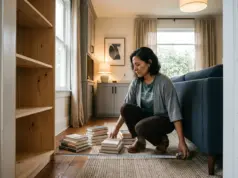
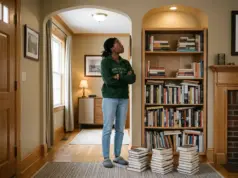
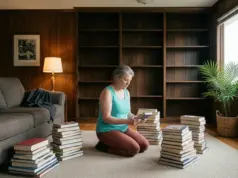
The stack started as a temporary thing. Four books on the floor by the sofa, waiting for a spot to open up on the shelf, and you were going to deal with it that weekend. A month later it is eleven books deep, it has drifted a foot closer to the walking path, and someone catches a toe on it crossing the room in the dark.
The problem is not that you own too many books. It is that almost every piece of advice about how to organize books in a small apartment assumes a bookshelf you either do not have or filled two years ago. So this one skips the shelf: capacity numbers for the furniture already in your rooms, the dead space you walk past daily, and the weight limits nobody mentions before you buy a floating shelf.
Quick Answer
When there is no room for a bookshelf, books go in five places instead of one:
- Inside furniture that is already hollow: ottomans, benches, storage bed frames
- In the dead gaps between and above furniture, using slim rolling storage
- On wall space, but only within the real weight rating of the mount
- Under the bed, flat and lidded, which is the largest unused volume in most apartments
- In the collection itself, by culling on a schedule so fixed capacity stops overflowing
Start With the Furniture You Already Own
You are standing in a room that contains an ottoman, a nightstand, a coffee table and an end table, and you are on your phone shopping for a bookcase. Every one of those pieces already holds books. Nobody ever told you how many.
A book hoarder writing for Book Riot, who reads 100 to 200 books a year in studio and one-bedroom apartments, describes a setup nobody would design on purpose: end tables holding overflow, a nightstand that is “actually just a mini-bookshelf,” cookbooks leaning against glassware on a kitchen cart. Her summary is the reframe that matters. “Everything can be a bookshelf if you just try hard enough.”
Great line, useless plan, because it never says whether the effort pays. So here are the numbers.
What Each Piece Actually Holds
A standard 36-inch shelf holds roughly 40 paperbacks at spacing you can actually get a hand into. Scale that ratio down and a 24-inch coffee-table shelf or a narrow console holds around 25 to 30 paperbacks, which is a real dent in a collection but is not a bookcase.
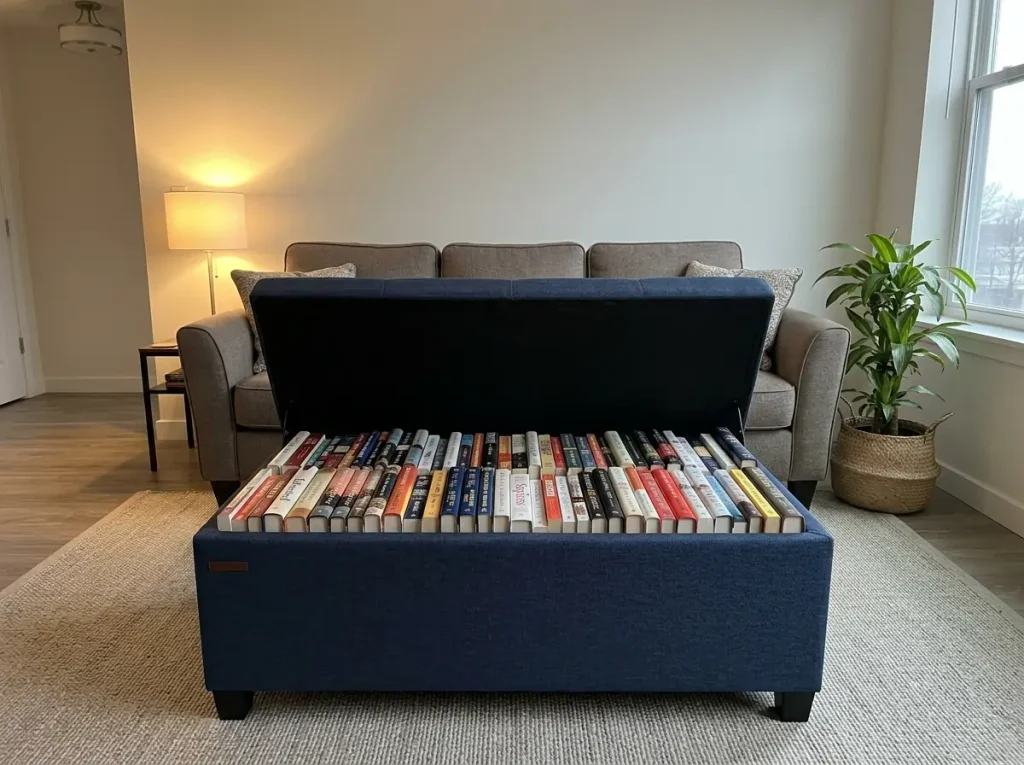
A single open nightstand cubby fits about 8 average novels, and a nightstand that earns its footprint often has two of them. A cube unit holds a shallow row of paperbacks per cube. The interior of a lidded ottoman swallows more than any of them, because it is a volume rather than a surface.
Add those up before you decide you are out of options. Three underused pieces at 25, 8 and 8 is 41 books off the floor, which is usually most of a “temporary” stack plus the row that was double-parked on the shelf.
Shelf depth is the number that surprises people. Most paperbacks need only 7 to 8 inches, so a furniture shelf that looks far too shallow for books almost always is not. That console you dismissed for being too shallow? Measure it.
Count in paperbacks, not in books. Every capacity number here assumes them, and a hardcover or art book eats considerably more of the same shelf. Weight matters as much as space: standard shelving carries about 20 to 30 lbs per linear foot, and 50 thin paperbacks stay well under that while 20 dense art books do not.
The Hollow-Furniture Advantage for Renters
Hollow furniture is the most renter-friendly apartment storage there is, and the safest default for anyone whose lease has opinions about walls. Ottomans, storage benches and bed frames with built-in storage hold books without touching a single vertical surface, so the drilling question never comes up and there is nothing to patch when you move. The category is more common than people realize. Bed frame storage is the one people overlook: the IKEA BRIMNES has a bookcase built into its base, and it is not the only frame that does.
This is where furniture that does two jobs at once stops being a design preference and becomes the actual storage strategy in a small apartment.
The trade-off deserves saying out loud, because most articles skip it. Books inside a closed ottoman are invisible. That is fine for the ones you have already read and bad for the ones you mean to read next, which will sit in there for a year while you buy a second copy of something you already own. Read books go in the hollow furniture; the to-read pile stays visible.
Count Before You Buy
Before anything gets ordered, walk the apartment and count the hollow volumes you already own. Coffee table storage and nightstand storage are the two most commonly wasted, because a closed drawer reads as full whether or not it is. Most apartments have two or three: a lidded ottoman nobody opens, an empty cube unit holding one plant, a laundry cart, the drawer under the bed frame. A fabric collapsible bin tucked under a side table costs nothing and does the same job as a purpose-built piece.
If you genuinely have no hollow furniture and you need seating anyway, that is the one case where buying solves two problems at once. The SONGMICS Storage Ottoman Bench runs 43 inches long and about 15 inches deep, so it works as a bench at the foot of a bed or a coffee-table-height surface in front of a sofa, with the books living inside instead of on display. The limitation is the one above: whatever goes in there, you will forget about. Load it with the read pile and keep the lid clear for a tray.
The Dead Space Nobody Uses
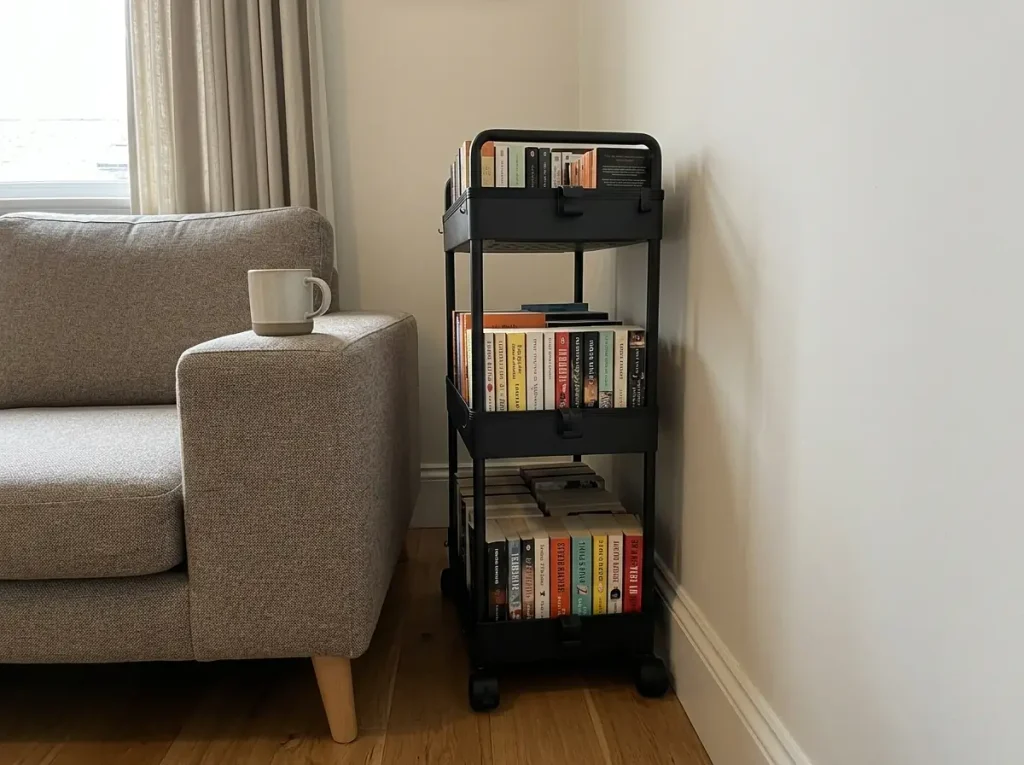
Every apartment has leftover gaps. The 9 inches beside the fridge. The wedge where the sofa arm stops and the wall starts. The strip between a closet door and the corner.
They are too narrow for furniture, so they currently hold a broom and some dust. They are also, almost exactly, the depth of a book.
The Gaps Between Furniture
The Book Riot account describes wedging a rolling cart into “a weird in-between space,” and that phrase is the whole idea. A slim 3-tier cart runs around 9 inches deep, which slides into gaps no fixed shelf could ever use, and the wheels mean you pull it out to reach the back row instead of excavating.
Measure the gap first, with a tape. The difference between an 8-inch gap and a 10-inch gap is the difference between a cart that lives there and a cart that sticks out into the walkway and becomes the new stubbed-toe problem.
If you already own a laundry cart or a bar cart that is not earning its keep, that is your free version and it works identically. If you do not, the Ronlap 3-Tier Slim Rolling Storage Cart measures 8.66 inches deep by about 26 inches tall, which is the dimension that makes it fit beside a fridge. Loaded with hardcovers it gets heavy enough that cheap casters drag on carpet, so it is a hard-floor solution more than a rug one.
Above Eye Level
Vertical storage is where small space living pays off, because a small apartment has far more wall than floor. The run above a doorway, the top of a wardrobe and the strip above kitchen cabinets are all sitting empty. Books do go up there. Send the ones you reach for once a year, and keep them light, because getting a stack of hardcovers down from above a wardrobe one-handed on a step stool is how a book gets a torn spine.
One caveat applies to exactly one of those spots, and it is the one everybody recommends without qualification.
Books are hygroscopic. They pull moisture out of the surrounding air and release it back, and paper swells and warps as it cycles. Above kitchen cabinets sits directly in the path of cooking steam, and any bathroom-adjacent nook swings through the same cycle twice a day.
Day one it looks like free real estate. Six months later the pages have a wave that never flattens out, and that is the whole mechanism behind humidity and book damage. This is why humidity is the quiet threat to any book storage spot, worth reading before you commit a good edition to somewhere that seemed obviously fine.
Practically: paperbacks you would not mourn can live above the cabinets. Anything you care about goes on an interior wall.
Exterior walls run colder than the room in winter, which means condensation forms behind anything pressed flat against them. Leave a two-inch air gap between a book stack and an exterior wall, or move the stack to an interior one.
Under the Bed, Done Properly
Under the bed is the largest single unused volume in most apartments and the one people forget, because it is invisible unless you are on the floor looking for a charging cable. Books go there flat, in something lidded, out of the dust.
Any plastic tote you already own slides under a frame with enough clearance, and organizing threads describe exactly that as the free fix for overflow. The upgrade worth making is transparency.
A clear-lidded box like the IRIS USA Under Bed Storage Box, roughly 32 by 18 inches outside with about 5.75 inches of usable depth, lets you identify what is inside from across the room instead of dragging it out. That sounds minor. It is the whole difference between under-bed storage you use and under-bed storage that becomes a time capsule. Check your frame clearance first, since 6.5 inches of exterior height needs at least 7 to slide.
Once you have more than one bin under there, it is worth taking a few minutes to set the under-bed zone up so it stays organized rather than letting the bins turn into a single undifferentiated layer you have to check three times.
The other thing a cart and a bin have in common: they move. In a rental, where the furniture gets rearranged more often than anyone plans for, that is the only book storage that survives the change without a second decision.
Wall Space and the No-Drill Reality Check
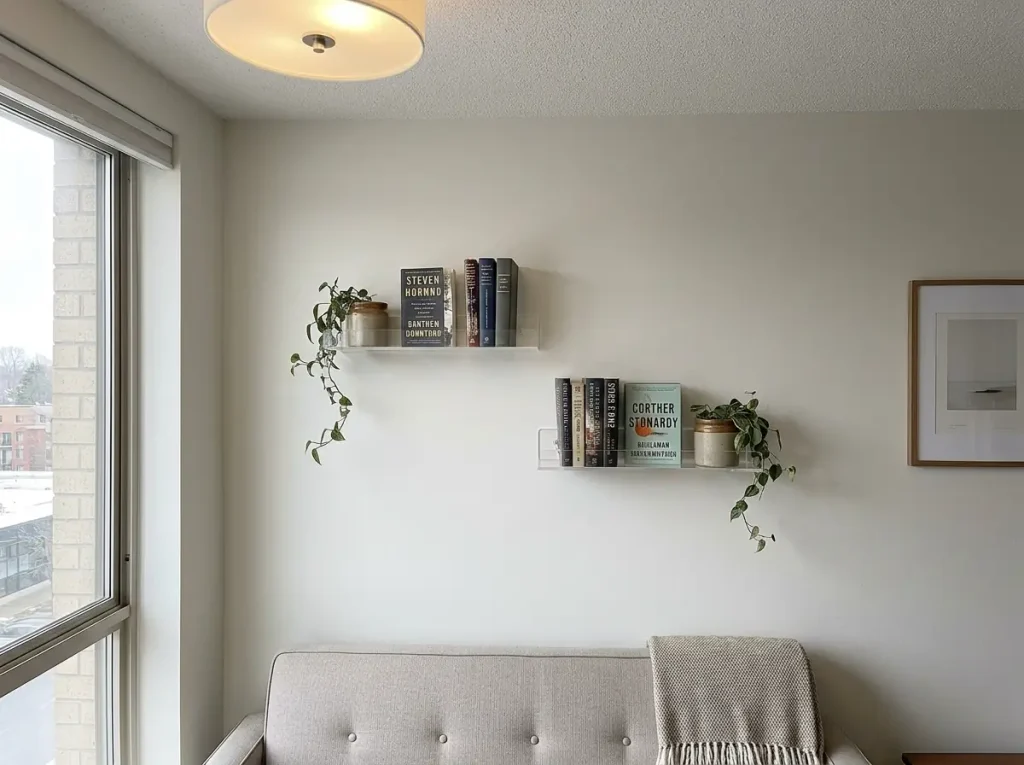
You have already found this advice five times: add floating shelves. It is on every list. What is on none of them is the weight rating, and the weight rating is the entire story.
What an Adhesive Shelf Actually Holds
Adhesive no-drill floating shelves are typically rated for 5 to 10 lbs on drywall, and up to about 15 lbs on tile or glass where the adhesive gets a non-porous surface to grip. A standard hardcover weighs 1 to 5 lbs. A stack of 50 average hardcovers lands somewhere between 50 and 250 lbs.
Do that arithmetic and an adhesive shelf holds three to five paperbacks and a small object. That is the honest number. It is not a book-storage shelf, it is a styling tool that happens to be shaped like a shelf, and the gap between those two things is what sends a row of hardcovers onto the floor at two in the morning with a sound you do not forget.
I used to be softer about this, on the theory that people would read the rating on the box. They do not read the rating on the box, and the failure mode is a damaged book and a gouged wall. So now it gets stated flatly. If you want the mounted-shelf option done right, floating shelves that hold what they claim to hold is the comparison worth reading before ordering anything.
The Renter-Safe Options That Do Hold Books
Two things carry real book weight in a rental. A freestanding unit that does not touch the wall at all, which is the zero-permission option and needs no wall-mounted shelf at all. Or a shelf mounted into studs, which is a hole, but a small patchable one that a tube of spackle handles at move-out. If you go the second route, how much weight a shelf can actually carry covers the load limits, span and anchoring in the detail they deserve, and there is no point repeating it here.
The instinct to go vertical is right. Small apartments have far more wall than floor, and the rest of the vertical space in a small apartment is genuinely where the capacity hides. The correction is about the mounting method, not the strategy.
There is still a real use for an adhesive shelf, because “never use these” is not true either. Put the three books you are currently reading on it at eye level beside the bed or the reading chair, add a small plant, and it does that job well within its rating.
A pair like the 2-Pack No-Drill Acrylic Wall Shelves is nearly invisible on a light wall, which is the whole point of using them for a displayed stack rather than a row. Stay inside the rating and they hold what they say they hold.
How to Stack Books Without Wrecking Them
Stacking gets treated as either the lazy option or the decorative option and never as a technique with rules. It has rules. They are the difference between a stack that works for years and a stack that quietly ruins the books in it.
Widest on the Bottom, and Why
Here is the mechanical version of what goes wrong. A book leaning at an angle puts continuous stress on the spine and the joints where the cover meets it, and over weeks the joint starts to open. A large flat book with others piled on it warps, because the board was never meant to carry a load across its face.
And pulling a book from the bottom of a stack drags the ones above it across the cover, tearing headcaps and spines. None of this is an aesthetic complaint. It is damage on a timeline of weeks.
The technique that prevents it is short. Widest books by cover width on the bottom, narrowest on top, so nothing overhangs and every book is supported edge to edge. Two or three oversized books per stack, maximum. A sheet of felt or plain fabric between them so covers do not rub each other every time the stack shifts.
That is the whole method.
If a stack is the book you are actively reading plus decor, cap it at four. Anything taller and you will pull from the middle instead of the top, which is the exact motion that tears a headcap.
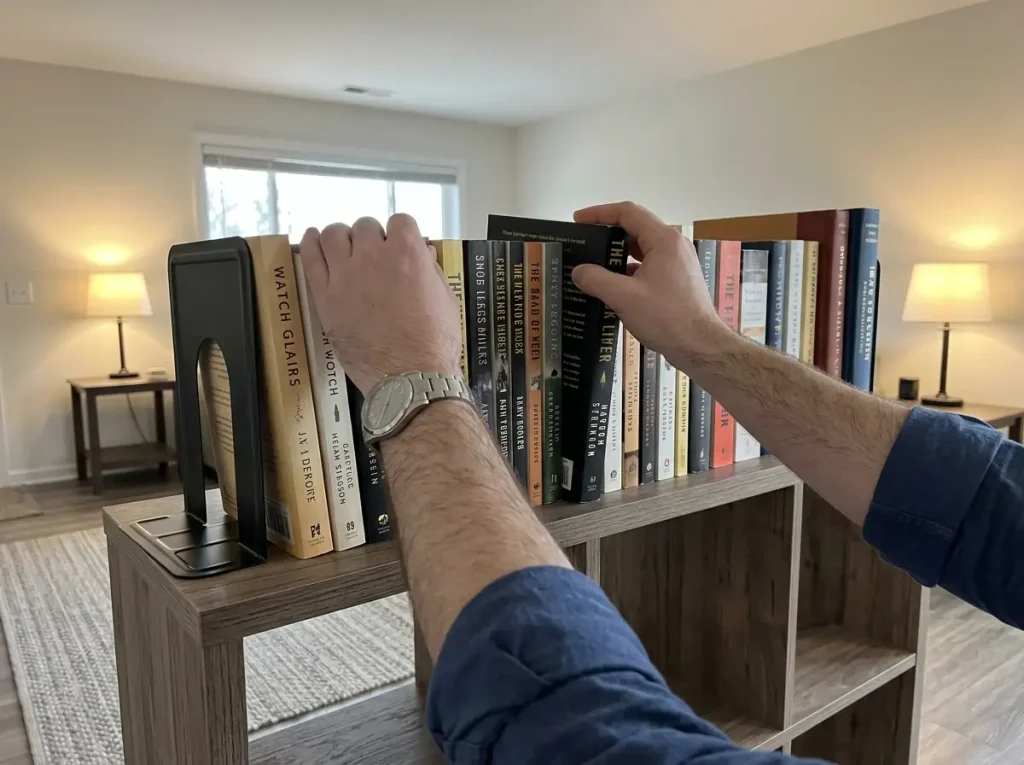
Upright storage sidesteps all of this, which is why it beats stacking for anything you plan to keep, paperback vs hardcover alike. Two heavy objects you already own hold up a row fine: a brick wrapped in fabric, a large candle, a pair of matched ceramic anything.
If you want the version that does not slide, the MaxGear 8.5 in Heavy Duty Metal Book Ends come two pairs to a set and turn the top of a cube unit, a cart shelf or a console into a stable upright zone. They do need a surface with some friction. On glossy laminate a metal base skates under a full row of hardcovers unless you put a felt pad underneath.
The Tetris Pass
Before you buy any storage at all, there is free capacity hiding in the furniture you already filled. Organizing communities describe it as sorting books like a Tetris puzzle, and it is the single highest-return hour in this whole article.
Group similarly-sized hardcovers and graphic novels into their own runs, so you stop losing three inches of headroom above every short book sitting next to a tall one. Double-shelve small paperbacks two rows deep in a single spot, back row raised on something flat so you can read the spines. Stack paperbacks flat on top of boxed sets, which are the worst offenders for dead vertical space above them. Doing this to a shelf that felt completely full routinely frees up a foot of usable run.
It also just looks better, and grouping books so a shelf reads as deliberate goes further into the height and grouping rules if you want the arrangement to do double duty.
One last note for anything you intend to keep long-term. Stable temperature, moderate humidity, away from exterior walls and away from direct water sources. An interior closet shelf beats a kitchen-adjacent one every time, which closes the loop on the above-cabinet warning earlier. If you own anything genuinely worth preserving, the conditions that actually preserve a book collection long-term is the conservation-grade version of that advice.
The Part Nobody Wants to Do
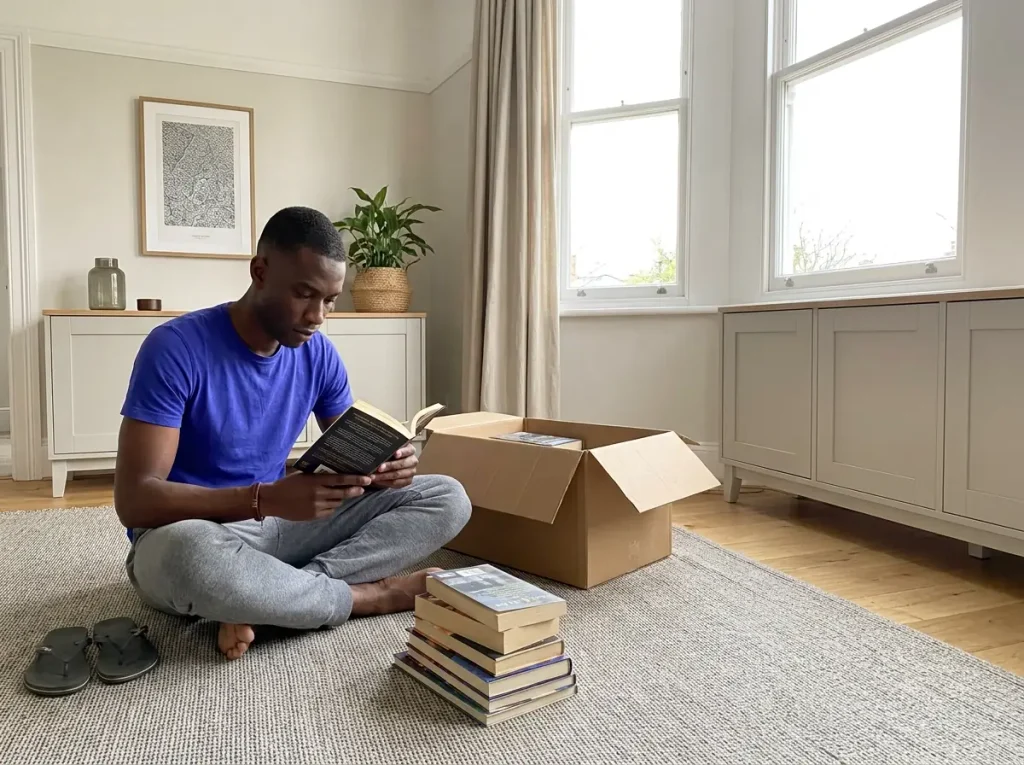
Every solution in this article has a fixed, small ceiling. A full bookshelf wall can absorb a bad month of book buying without anyone noticing. A nightstand cubby holding 8 novels cannot absorb anything. That makes book culling structural here rather than optional, which is the honest thing that no other article about small-apartment book storage will tell you.
The Book Riot writer, who reads 100 to 200 books a year and has genuinely solved the storage side of this, still describes the culling as the part she is worst at: “I only get rid of about 5 books a month, because I’m very weak and bad at giving books away.” That is the person with the system saying the maintenance is the hard part. Believe her.
The One-In-One-Out Rule, Applied to Books
The habit is simple to state and unpleasant to run. A book comes in, a book goes out. Her word for the required posture is “be brutal,” and in practice it means three specific piles.
The to-read book you have not opened in over a year, which you are not going to read, because if you were going to read it you would have read it. The duplicate, including the nicer edition you bought of something you already own.
And the guilt-keep, which is the one that gets everybody: the classic you actively disliked but kept because you finished it.
Her correction on that is worth quoting straight. “I did read them, right? Wrong. Get rid of them.”
There is a free ongoing move that compounds too. Buy paperbacks over hardcovers going forward where the edition does not matter to you. More small paperbacks means more room to keep them, it costs nothing, and it works every month from now on instead of once.
Then apply the three-month test to this system specifically. If there are stacks on the floor again three months from now, the storage did not fail. The furniture is holding exactly what it held in week one.
The inflow failed, and no additional bin fixes an inflow problem. That is the capacity discipline small-space living demands, and a professional organizer’s take on making every square foot work makes the same argument about every category in a small apartment, not just books.
Where they go: book donation to a charity shop, the nearest Little Free Library, a friend who will actually read them. Decluttering books only counts once they leave the apartment. Pick the destination before you start the pile, because a bag of culled books that lives by the door for six weeks is just clutter that moved.
If You Decide You Do Want a Bookshelf
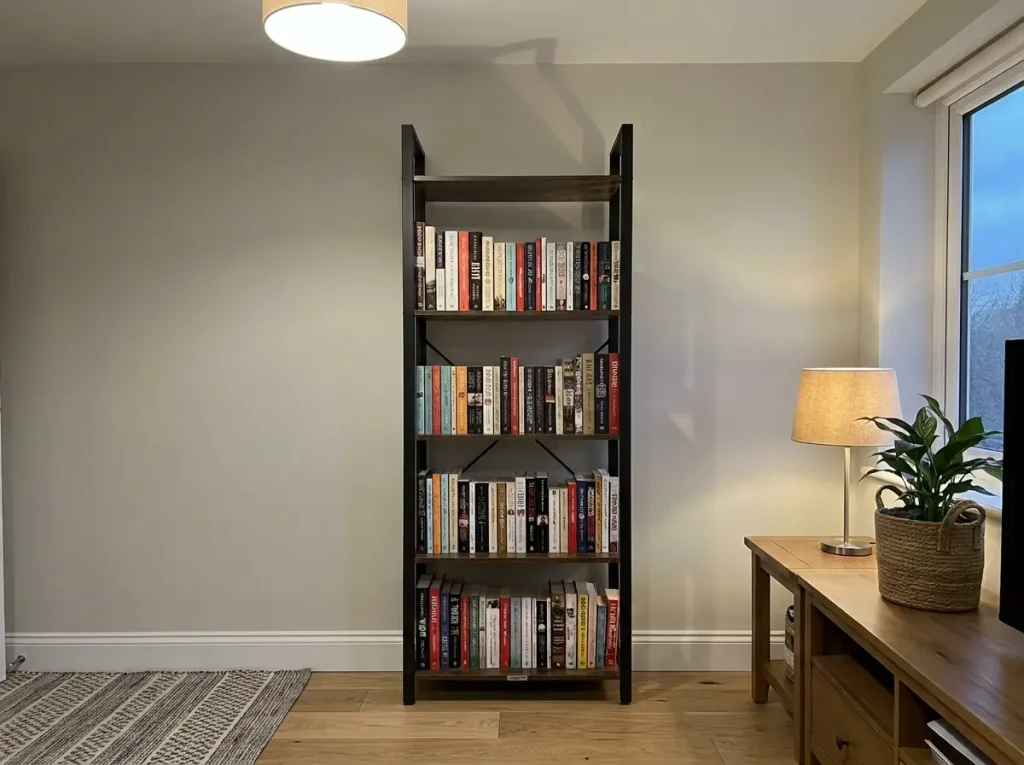
Some readers will do the furniture pass and the dead-space pass and be completely fine. Others will get to the end of both, add up the numbers, and realize they have simply run out of surfaces. That second outcome is not a failure of the method. It is the method telling you something true.
The signal is specific: the counting exercise comes up short. The furniture is spoken for, the gaps are filled, the under-bed bins are in, and there are still stacks. At that point you are not avoiding a bookshelf anymore, you are just delaying one.
What to Look for in a Small Apartment
Depth is what eats a small room, not height. A tall narrow unit around 12 inches deep takes almost no floor away from the walking path and still holds a serious number of books, because paperbacks only need 7 to 8 inches of that depth anyway. Height is nearly free in a rental with 8-foot ceilings. Footprint is the expensive part.
The free version, if you already own it, is a cube storage unit stood vertically against a wall instead of sitting flat as a bench. If you are buying, something like the VASAGLE 5-Tier Bookshelf at 11.8 inches deep and just over 60 inches tall is the shape to look for rather than a specific endorsement over its competitors. It is one example of the narrow-footprint category, and the full comparison of the bookshelves that hold up in small spaces covers the sag causes and format differences properly.
Freestanding beats mounted for renters, for the same reasons from the wall section: no holes, no landlord conversation, and it comes with you to the next place.
Before you load it, check two things that are covered in depth elsewhere rather than guessed at here: what the shelves can carry, and how the unit needs to be secured against tipping. The full framework for a bookshelf that stays organized has both, and a tall narrow unit is exactly the geometry where anti-tip anchoring stops being optional.
Then place it on an interior wall, away from radiators and exterior walls, per the storage conditions above. If the room needs to work harder than one shelf, the rest of the storage a small living room can absorb covers what else fits around it.
Conclusion
Count the furniture you already own before you shop. A coffee-table shelf holds roughly 25 to 30 paperbacks, a nightstand cubby about 8, and most apartments have two or three unused hollow volumes sitting in plain sight.
Adhesive shelves hold 5 to 10 lbs and your hardcovers weigh 1 to 5 lbs each. Use them for a styled stack of three, and put real book weight on something freestanding or stud-mounted.
Stack widest on the bottom with felt between, or skip stacking and go upright with bookends. An unsorted stack damages books in weeks, not eventually.
In three months, look at the floor. If there are stacks again, the storage is not what failed. The inflow is, and that is a culling habit, not another bin.
Start with one piece of furniture. Empty it, count what actually fits, fill it. Then move to the next one.
Frequently Asked Questions
01What is the best way to store books in a small apartment?
Inside furniture you already own: ottomans with hollow bases, nightstand cubbies, coffee-table shelves and under-bed bins, because none of it requires mounting anything to a wall. A coffee-table shelf holds roughly 25 to 30 paperbacks and a nightstand cubby about 8 novels, so counting existing furniture usually houses more of a collection than people expect.
02Should books be stored flat or upright?
Upright is better for anything you want to keep long-term, because a leaning or unsupported book stresses its spine and cover joints. If you do stack flat, put the widest books on the bottom, keep it to two or three oversized books per stack, and slide felt or fabric between them so the covers do not rub.
03Can I use no-drill floating shelves for books?
Only for a small displayed stack. Adhesive no-drill shelves are typically rated for 5 to 10 lbs on drywall, and a single hardcover weighs 1 to 5 lbs, so three or four books and a small object is the honest limit. For real book weight, use a freestanding unit or a shelf mounted into studs.
04How do you store books without a bookshelf?
Use the dead space instead of the wall: a slim rolling cart in the gap beside a fridge or sofa, lidded bins under the bed, the top of a wardrobe, the inside of a storage ottoman. Each spot holds a small fixed number of books, so it works best paired with a habit of culling as new books arrive.
05Is it bad to store books above kitchen cabinets?
For anything you care about, yes. Books absorb and release moisture from the surrounding air, and the humidity swings from cooking steam curl pages and can encourage mold over months. Paperbacks you would not miss are fine up there; keep the rest on an interior wall away from kitchens and bathrooms.