






















In this article
You bring home the tiered spice rack that promised a universal fit, slide it onto the shelf, and the cabinet door stops an inch short of closing. It looked bigger in the store, and now it’s a return. Almost every popular small-kitchen spice fix assumes dimensions your kitchen may not actually have, which is why the fix is almost never a different product. Learning how to organize spices in a small kitchen starts with four measurements, not a shopping cart. This guide gives you the numbers first, then shows you where the free space really is: the inside of a cabinet door, a flat wall section, or one drawer read from above.
Quick Answer
Organize spices in a small kitchen by measuring first and buying last.
- Measure shelf depth, vertical clearance, drawer interior, and magnet grip.
- Cut the collection down to what that space actually holds.
- Move spices to a cabinet door or flat wall panel.
- If you rent, mount with weight-matched adhesive strips instead of screws.
- Use one drawer with a flat liner when shelves are too shallow.
Why Standard Spice Racks Fail in a Small Kitchen
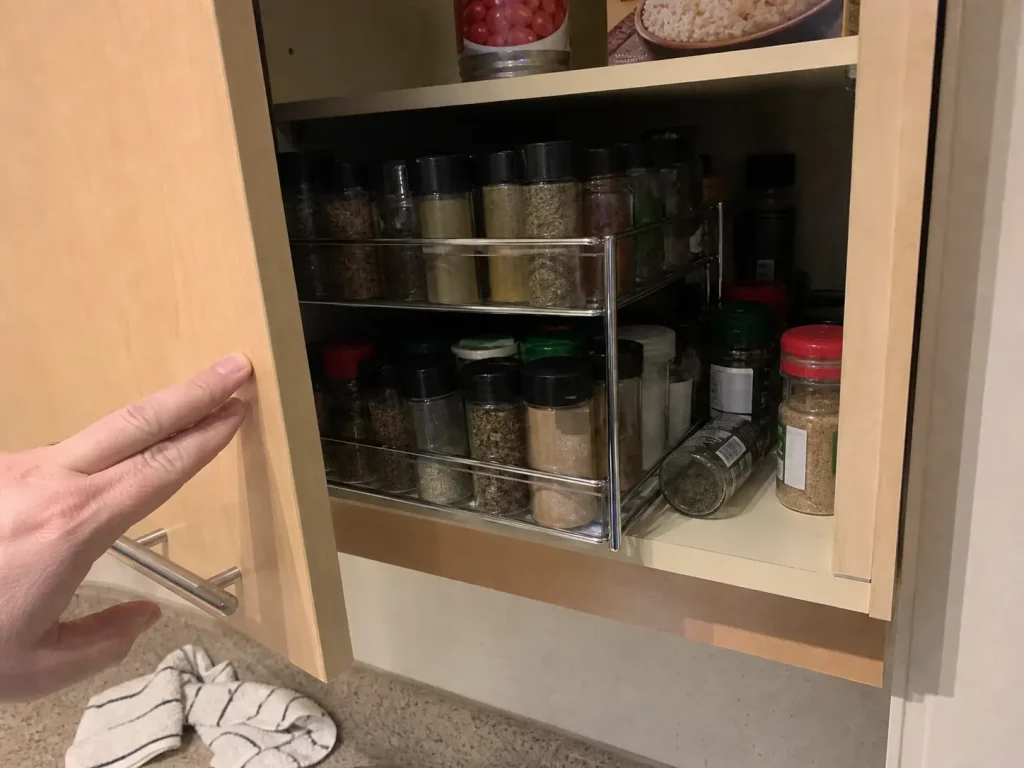
Everyone with a small kitchen has bought the same three things. The tiered riser, the lazy susan, and the tension rod stretched across the cabinet. All three fail for the same unglamorous reason, and it has nothing to do with build quality. The cabinet is shallower and shorter than the product was designed around, and no organizer can invent space that isn’t there.
The shelf is shallower than the rack assumes
A standard upper cabinet runs about 12 inches deep, but the box depth is not what you get to use. Face frames, hinge hardware, and the door itself eat into that, and the shelves in older or budget cabinets sit noticeably shallower than the box depth suggests. A rack built for a 12-inch shelf puts its front row hanging past the edge, the door swings in, and the two meet. And that’s before you’ve put a single jar in it. Here’s the rule worth writing on the tape measure: anything under 10 inches of usable depth means overhang, and 10 inches or more is a clean fit.
Vertical clearance is the number nobody checks
Depth gets all the attention and clearance is what actually sinks the install. A common 3-tier riser stands roughly 4.5 inches tall and needs about 5 inches of vertical clearance before you can lift a jar off the back row without tipping the two in front of it. When shelves are spaced tighter than that, the rack technically fits and the back row becomes permanently unreachable, which is a slower and more frustrating failure than a door that won’t close. You keep the rack, you just stop using half of it.
Why the lazy susan and the tension rod don’t rescue it
Turntables are worse math, not better. A 24-inch lazy susan wants roughly 26 inches of clearance to spin freely, and the standard sizing rule is the smaller cabinet dimension minus 2 to 4 inches. Very few small-kitchen cabinets clear that on either axis, and a corner cabinet in a compact layout almost never does. The tension rod trick is the one every thread recommends and almost nobody reports still working: loaded with full glass jars, the rod slips down the cabinet walls, usually inside the first week. If you’re set on a rack and want to know which formats hold up once they’re loaded, that’s a separate question, and it’s worth reading which rack types actually stay put once they’re loaded before you order anything.
Measure These Four Numbers Before You Buy Anything
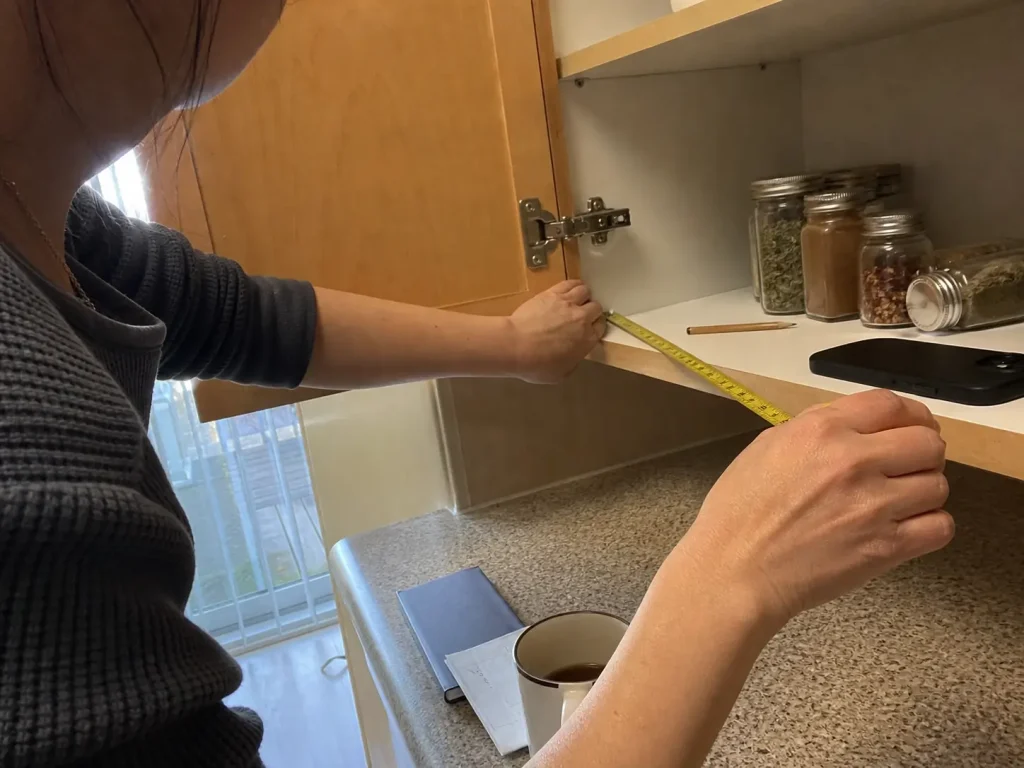
This is the ten-minute step that saves two returns. Tape measure, a scrap of paper, four numbers, and you’re done before you open a single product page. It’s also the step that makes every later decision automatic, because picking the location before you pick the container only works once you know what each location can physically hold.
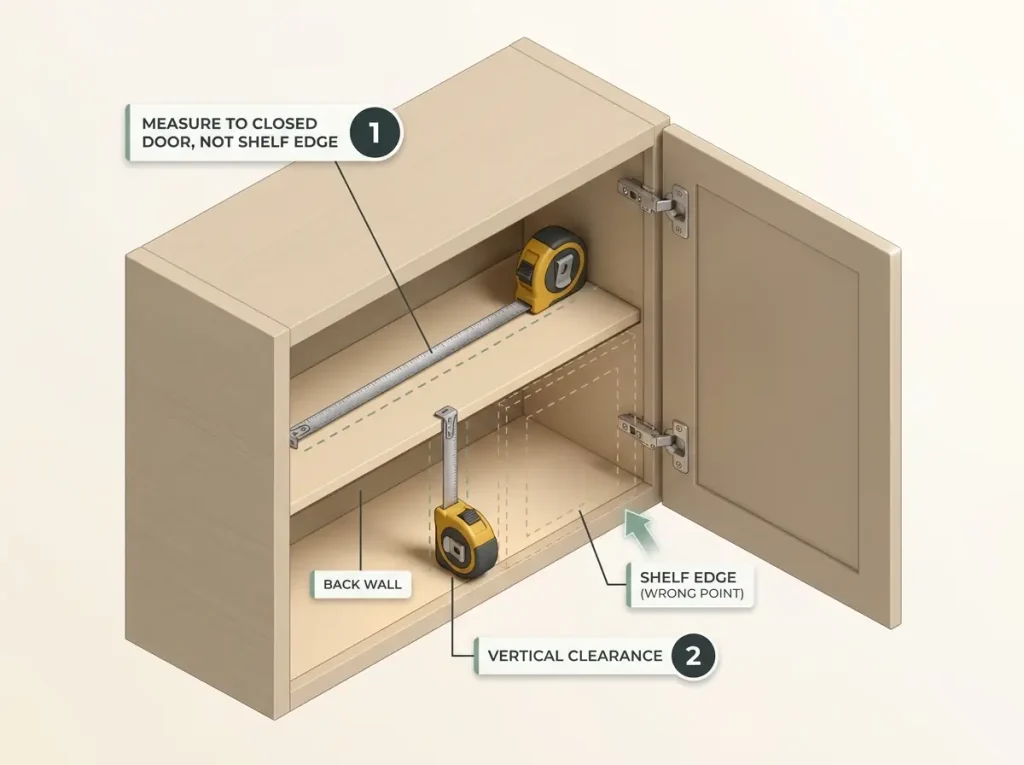
Shelf depth, measured to the door
Measure from the back wall of the cabinet to the inside face of the closed door, not to the front edge of the shelf. Those two numbers are rarely the same, and the difference is exactly where most installs fail. Close the door on a ruler and mark where it lands if that’s easier than eyeballing it.
Vertical clearance between shelves
Measure from the shelf surface to the underside of the shelf above it. Anything under 5 inches rules out every tiered riser on the market, no exceptions and no clever workarounds. Write the number down even if it’s disappointing, because it’s the number that sends you to the door or the drawer instead of another return label.
Drawer interior width and height
Pull the drawer all the way out and measure the inside, not the drawer front. Small-kitchen drawers commonly run 18 to 21 inches of usable interior width, while a lot of drawer inserts are sized for 22 inches and up. The recurring confession in galley-kitchen threads is measuring the one good drawer, expecting 22 inches, and finding 19. Interior height matters just as much, since it decides flat liner versus tiered insert later on.
The fridge-magnet test for any magnetic solution
Take a magnet off the fridge and press it against every surface you’re considering: the fridge side panel, the range hood, the metal strip beside the cabinets. Many modern refrigerators and essentially all stainless-look appliance panels are non-ferrous, and a magnetic tin set will slide right off them. Standard products are sized for standard kitchens, which is why the National Kitchen & Bath Association’s own planning guidelines list base cabinets at 24 inches deep and 34 to 36 inches tall. Your kitchen may not have signed that agreement.
Photograph the tape measure in place for each of the four numbers and keep the shots in one album on your phone. Product listings bury dimensions in the fifth image, and comparing a listing against a photo you took is faster than walking back to the kitchen mid-decision.
Decide What Stays Using Space Math, Not Sentiment
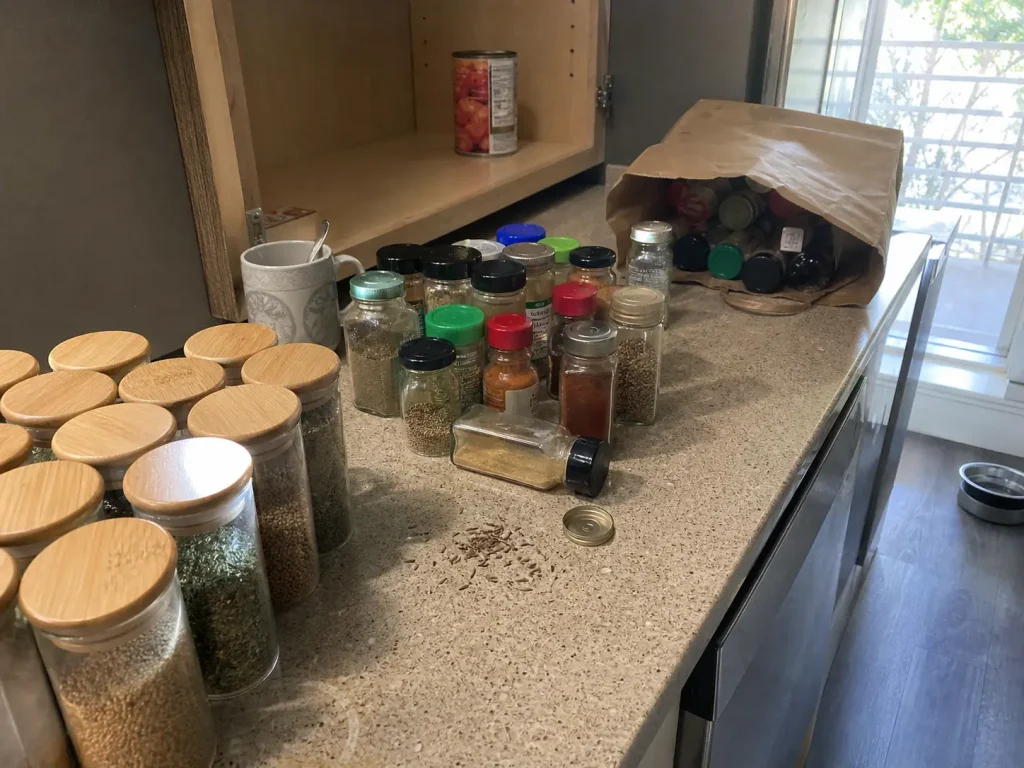
Every guide says declutter first and then moves on without telling you the target. That advice isn’t wrong, it’s just unfinished. In a small kitchen the target isn’t a feeling, it’s a count. The space you just measured holds a specific number of jars, and that number is the limit whether you agree with it or not.
Turn your measurements into a jar count
Take the usable shelf depth and width and divide by the footprint of the jars you own. A shelf with 10 inches of usable depth and 24 inches of width holds two rows of standard jars, and that’s your ceiling. Working backward from a real number changes the question from “what can I part with” to “which twenty jars earn the space,” which is a much easier question to answer at nine at night.
Weekly, occasional, and the jar you bought for one recipe
Sort into three piles. Weekly spices earn the reachable front spot and nothing else does. Occasional goes high or deep, where reaching is a minor annoyance a few times a month. The third pile is the jar you bought for one recipe in 2023, and the honest move is to stop replacing it rather than to store it better. The same capacity-first approach that works in a small pantry applies here without modification.
Age and duplicates decide the close calls
Age is the cheapest tiebreaker you have, and the shelf life printed on the jar is not the number that matters. Ground spices hold their punch about six months and whole spices last one to two years, according to The Kitchn’s guidelines on where spices actually lose potency fastest. The expiration date on the label runs years past that, so flavor gives out long before safety does. Dried herbs fade fastest of all, and anything older is filler occupying prime real estate. Duplicates are the quiet space thief: two half-jars of cumin from two shopping trips are one jar of cumin plus one jar of wasted shelf. In a kitchen with no room to spare, keeping a spice you don’t cook with is an active decision to lose the space, not a neutral one.
The Inside of Your Cabinet Door Is the Only Free Space Left
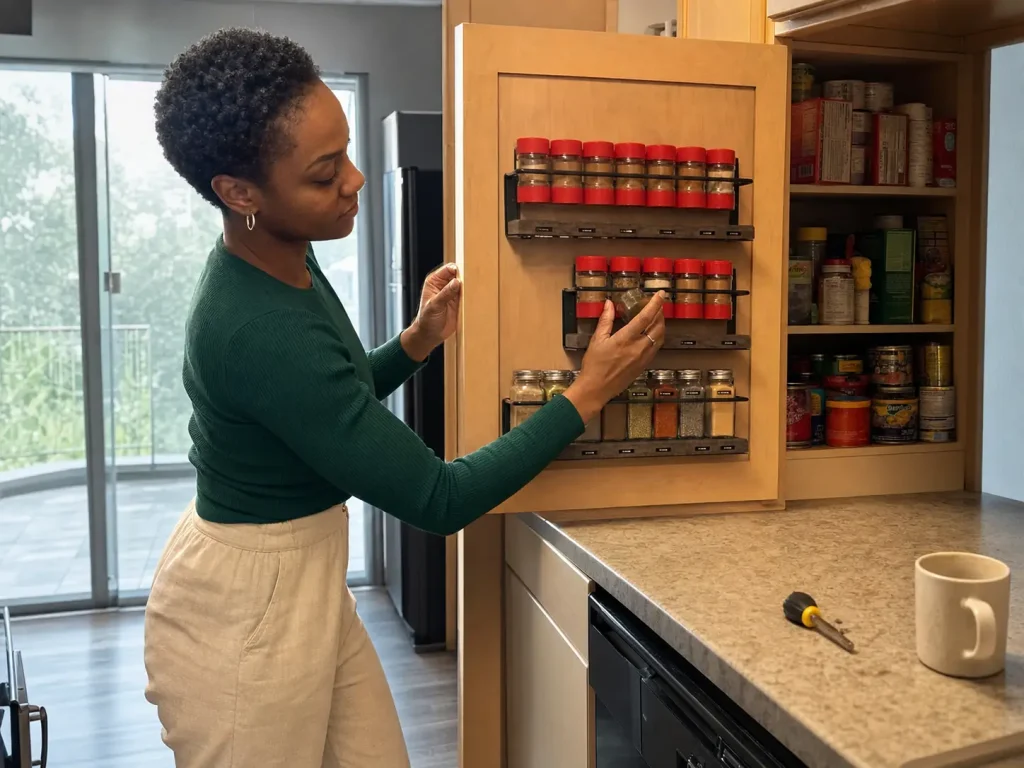
In a genuinely small kitchen, the galley in a studio apartment or a one-wall kitchen in a rental, every horizontal surface is already spoken for. That leaves vertical storage and hidden storage, which in practice means one thing: the dead air behind a cabinet door is the last unclaimed space in the room, and it’s the answer when there’s no counter to give up in the first place.
Why the door face beats the shelf
A door-mounted rack works precisely where a shelf rack fails, because it uses the vertical face instead of the shelf surface. Shallow depth stops mattering. Tight vertical clearance stops mattering. The rack hangs in the gap the door already swings through, which is space you were paying for and not using. Start free: line jars up on the door of a cabinet you already have, or repurpose an over-the-door pantry pocket organizer before you buy anything. Reusing an existing door is the first answer in every small-kitchen thread, well before anyone mentions a product.
The thickness rule that decides if it fits
Whatever you mount must be thinner than the gap between the closed door and the front edge of the shelf. That’s measurement number one, used a second time. Miss it and you’ve recreated the exact failure from the beginning of this article, just on a different surface. If your gap clears, the SpaceAid Spice Rack Organizer for Cabinet Door or Wall Mount mounts to the door face or a flat wall section, and the four-pack ships with a 415-label set so the uniform labeling comes in the same box. The limitation is real: it needs that clearance gap, so measure before it ships rather than after.
The wall panel option, and why not above the stove
A flat wall section beside the cabinets is the second option, and it’s the one people get wrong. Mounting a rack over the stove looks like the obvious move and it’s the worst spot in the kitchen. Heat above 70°F, direct light, and cooking steam degrade spices faster than anything else in the room, so the most convenient reach costs you the flavor you were trying to organize. Move it one cabinet over, or treat that spot as short-term storage for the two jars you burn through anyway.
Mounting Without Drilling When You Rent
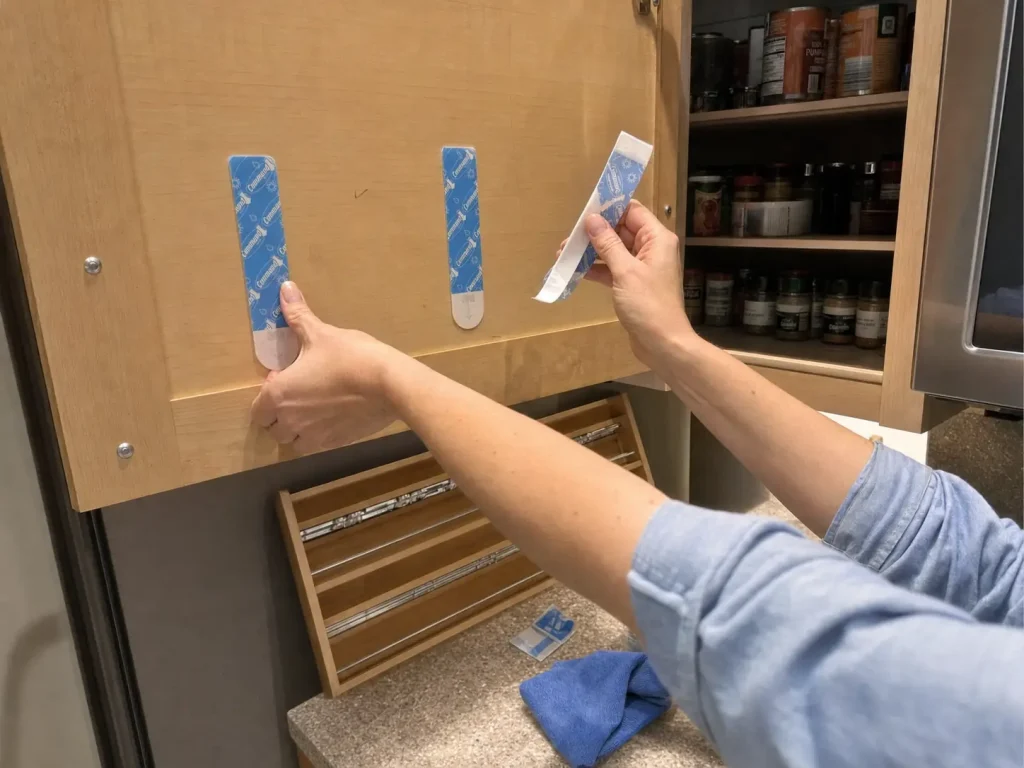
Adhesive strips and magnetic strips are the two things every renter gets told to use, and neither one usually arrives with the caveat that decides whether it works. Both caveats are short, and both are worth knowing before the package does.
Match the weight class to the loaded rack
Adhesive strips are rated by weight class, and a loaded spice rack is heavier than people estimate. Small strips hold around a pound, medium around three, large around sixteen, and utility hooks up to fifteen, per Command’s official weight-limit guide for adhesive strips. Rate against the loaded weight, not the empty product on the box. For a door rack full of glass, the large class is the honest match, and the Command Water-Resistant Adhesive Refill Strips in that size are built for the humidity a kitchen throws at them. They’re refills, though, so they assume you already own or are buying the hooks or hanging hardware they attach to.
Kitchens and bathrooms are the two rooms where adhesive fails early, and the manufacturer’s own guidance is to replace strips there every six to twelve months. Put a repeating reminder on your calendar the day you mount it. Nobody has ever remembered on their own, and the alternative reminder is the sound of the rack landing in the sink.
Test the surface before you buy anything magnetic
Magnetic strips and magnetic tins only hold on a ferrous surface, which is why the fridge-magnet test belongs before the purchase and not after. People discover their fridge or backsplash panel isn’t magnetic once the tins are already on the counter, and that’s the single most repeated purchase regret in renter spice threads. It’s a full return, not a workaround. Once your mounting method is settled, the rest of the no-drill cabinet playbook for renters covers the surrounding cabinets on the same rules.
Making One Drawer Do the Work of a Cabinet
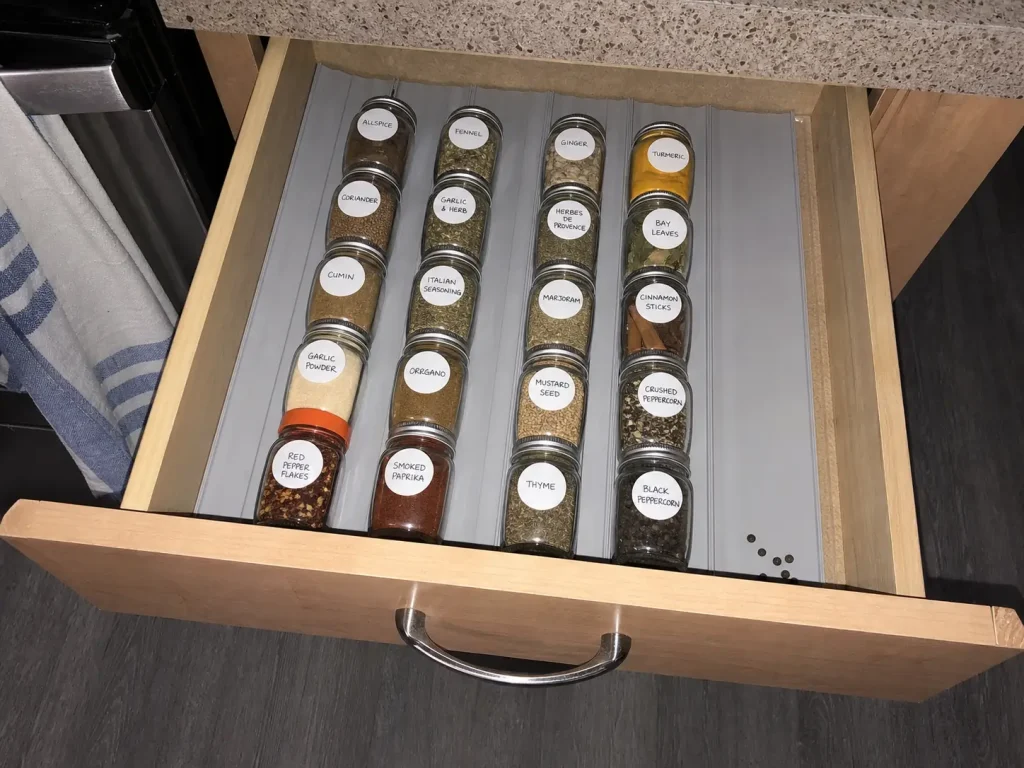
If you have exactly one drawer you’re willing to give up, it can hold more spices more visibly than any cabinet shelf in the kitchen.
Why a drawer reads better than a shelf
Laid flat and read from above, a drawer eliminates the back-row problem completely. Nothing hides behind anything, because there is no behind. You scan instead of digging, which is the actual daily win over a shelf. But it costs you a drawer, and in a kitchen with four of them (three, if one is the junk drawer, and it always is) that’s a real trade rather than a free upgrade.
Flat liner or tiered riser, decided by height
Interior height decides this and nothing else does. A flat liner needs roughly 2 inches of clearance. A tiered riser needs about 4.5 inches. Put a tiered insert in a shallow drawer and the drawer won’t close, which is the cabinet failure again, one room over. For a genuinely shallow apartment drawer, the YouCopia SpiceLiner Spice Rack Drawer Organizer is the low-profile answer, though it holds jars flat and won’t give you the angled visibility of a riser. If your drawer has a little more room and you’d rather spend less, the Dial Industries Expandable Spice Organizer Tray adjusts to your drawer width instead of assuming it, with the tradeoff that an expandable tray shifts around more than a fitted liner.
Label the lids, not the sides
Jars go in lid-up, and the label goes on the lid. Side labels are invisible from above, which defeats the entire reason you moved to a drawer. Do this free version first with tape and a marker on the jars you already own. If it survives a month of actual cooking, then upgrade the insert. When it does stick, the full drawer-by-drawer setup for spices takes it further.
The Rack-and-Jar System That Survives Three Months
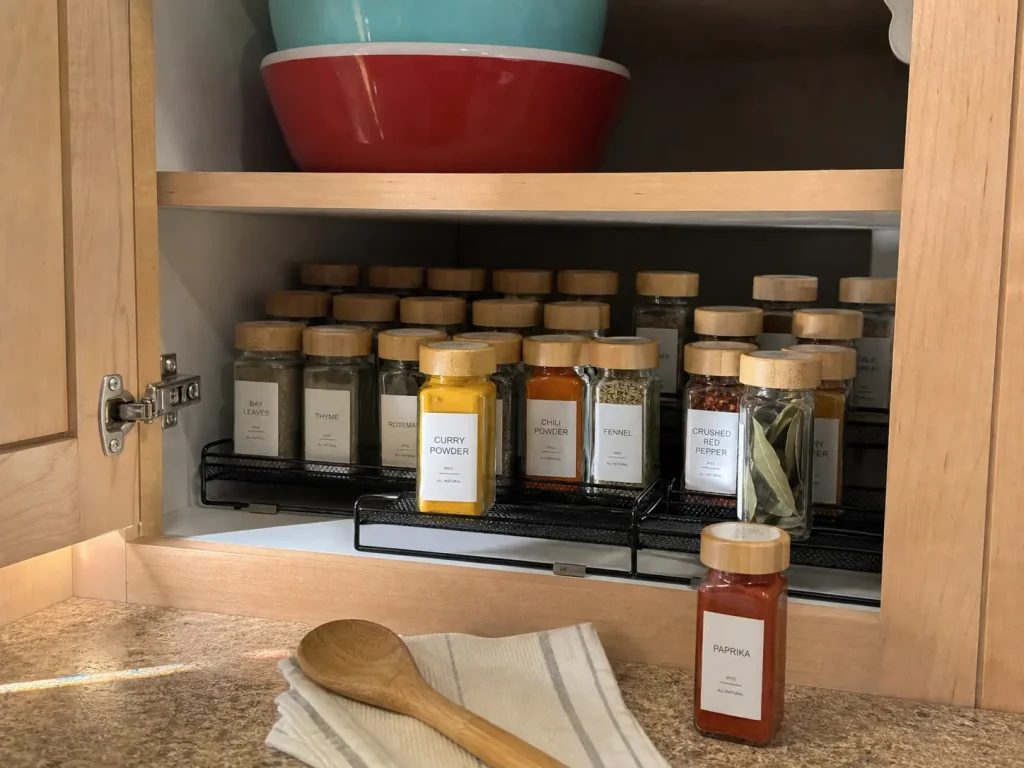
A cabinet rack isn’t the villain. It’s the option with the strictest entry requirements, and if your numbers cleared, take it.
The clearance gate, one more time
5 inches or more of vertical clearance, 10 inches or more of shelf depth. Below either number, go back to the door or the drawer. If you cleared both, the DOTORYDESIGN 3 Tier Wide Expandable Cabinet Spice Rack Organizer expands from 14.5 to 29.1 inches, so it adapts to a non-standard cabinet width rather than assuming one. Its height is the constraint: at roughly 4.5 inches it’s the exact product that fails silently when clearance goes unchecked.
Uniform jars and why 4 ounces fits when 8 doesn’t
Uniform jars aren’t about looks. Same footprint means predictable capacity, and you stop losing shelf space to mismatched supermarket bottles. Start by reusing small jars you already own, because half of any large set ends up storing air. If you do want a matched set, 4-ounce jars fit narrow apartment shelves that standard 8-ounce sets overhang, and the AISIPRIN Glass Spice Jars 24 pcs 4 oz Bamboo Lids are sized for exactly that shelf. Twenty-four is more than most small kitchens need, so expect leftovers.
Place by frequency, not alphabet
Alphabetical order looks organized and it’s the wrong system for a small kitchen. It forces you to reach past the salt for the turmeric every single night. The front row is prime real estate and the weekly group lives there, full stop. Everything else arranges itself behind them.
Turn every jar label to face out the moment you put it back, not later. It takes half a second, and it’s the only maintenance habit that survives contact with a real weeknight. Systems that need a weekly reset don’t last past the second week.
The thirty-second restock habit
The system breaks the day a new supermarket bottle gets set on the shelf “just for now,” because that’s the moment the uniform footprint stops being uniform. Refill from the backup into the same jar instead of adding the new bottle to the rack. Re-check the adhesive mounts on the same schedule as the strips. If you want to take the same logic through the rest of the room, the wider cabinet system these spices are sitting inside runs on identical rules.
Putting It Together
Three things carry the whole system. Measure four numbers before you buy anything: shelf depth to the closed door, vertical clearance, drawer interior, and whether the surface takes a magnet. The free space in a small kitchen is vertical and hidden, which means the inside of a cabinet door, a flat wall section away from the stove, or one drawer read from above. And keep only what the measured space holds, because capacity is the limit, not enthusiasm.
The Three-Month Check: re-check the adhesive mounts and pull anything you haven’t reached for since setup. Strips loosen in a kitchen, and the untouched jars are quietly costing you the space you just won back.
Start with the one cabinet door you open every day. Get that working, live with it for a week, and then decide whether you need anything else at all.
Frequently Asked Questions
01What is the best way to store spices in a small kitchen?
On a vertical surface you aren’t already using: the inside of a cabinet door, or one drawer with the jars standing lid-up. Both sidestep the shelf-depth and clearance limits that stop most cabinet racks from fitting, and both keep every jar visible without digging.
02How do you organize extensive kitchen spices in just one cabinet?
Cut the collection to what the cabinet actually holds, then split it by frequency. Measure the usable shelf depth and vertical clearance, work out how many jars fit, and give the front row to the spices you cook with weekly. The rest go higher, deeper, or out.
03What is the most efficient way to organize spices?
By how often you cook with them, not alphabetically. Alphabetical order looks tidy and makes you reach past the salt every night. Frequency order puts the daily jars at the front and keeps them there.
04What are the 8 spices you need in your kitchen?
There is no universal set, and in a small kitchen the useful question is different: which spices do you actually reach for in a normal week? Whatever that list is, it is the group that earns the reachable spot, and everything else gets stored around it.
05Do magnetic spice tins work on any fridge?
No. They only hold on a ferrous surface, and many modern fridges and stainless-look panels are not magnetic. Test with a fridge magnet before you buy anything magnetic. This is the most common return in small-kitchen spice storage.