























In this article
You open the drawer for the whisk and instead find three vegetable peelers, a fistful of rubber bands, and a takeout menu from a place that closed two years ago. Every drawer organization guide you have ever pinned came from a renovated kitchen with fifteen custom drawers, and not one of them tells you why the setup quits by month three. The fix is almost never a bigger drawer or a prettier bin. It is a system that survives a normal Tuesday night, the way NAPO-certified organizers actually build them: by task, not by aesthetic. Here are nine kitchen drawer organization ideas that hold up long after the “after” photo.
Quick Answer
To organize kitchen drawers so they actually stay organized, work in this order:
- Fix why the last system failed before buying anything
- Empty and declutter the drawer completely first
- Measure the interior depth before you shop
- Build task zones by what you do, not by item type
- Match the organizer to each drawer type
- Bound the junk drawer instead of banning it
- Rank zones by priority in a few-drawer kitchen
- Use what you already own before buying
- Run a 60-second weekly reset to keep it working
Why Your Kitchen Drawers Keep Reverting to Chaos
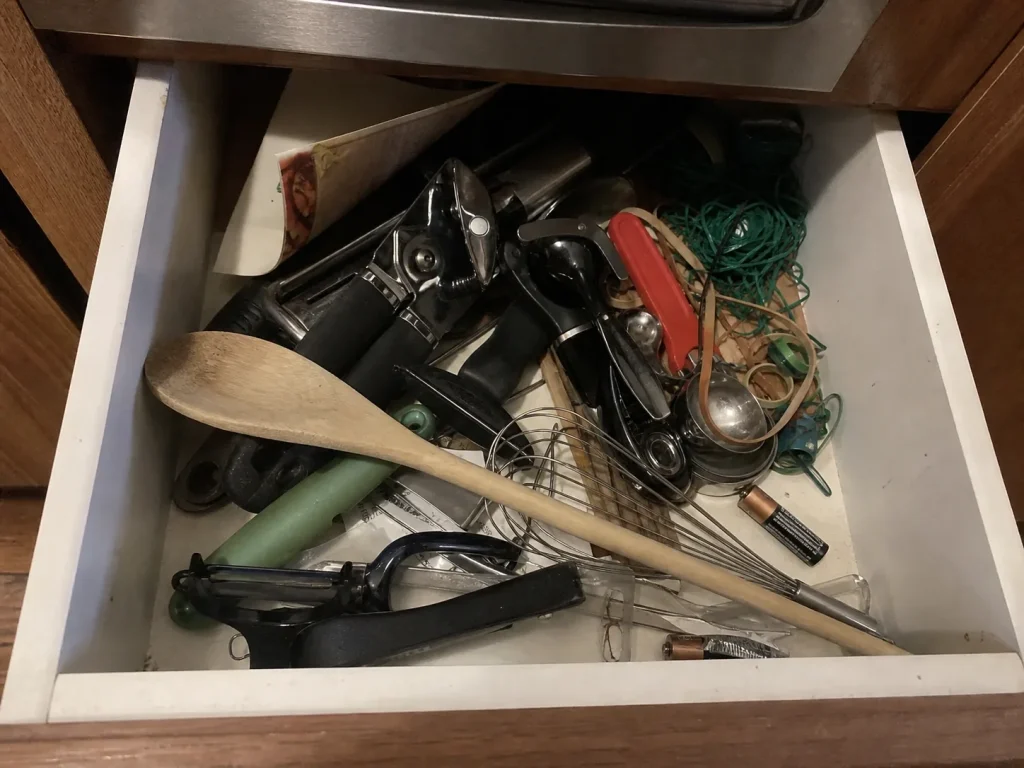
Nobody’s drawer is a mess because they are lazy. It is a mess because the setup had a design flaw baked in from day one, and you cannot fix a flaw you cannot see. Before any organizer earns a spot in your cart, it helps to understand exactly where these systems break down. This is the part every home tour skips, and it is the reason their results never look that way in your kitchen.
The “miscellaneous” slot always wins
The single fastest way to guarantee a drawer reverts is to give it a catch-all slot. The moment one compartment means “everything that doesn’t fit anywhere else,” it stops having a rule, and a section without a rule expands until it swallows the whole drawer. This is the mechanism behind the classic junk drawer, and it is the same reason a beautifully sorted utensil drawer looks feral again within a week. The problem was never the stuff. It was the one open-ended slot you left yourself as an escape hatch.
Nothing has a fixed spot
The second failure is subtler. When the tape “lives wherever there’s room,” it lives everywhere and nowhere, and your brain gives up on putting it back. A system only holds when every item has one home that never changes, so returning it requires zero decisions. And there is a physical version of this too: if putting something away means carrying it across the kitchen to its “proper” spot, it stops getting put away inside a couple of weeks. Proximity beats discipline every time.
Before you reorganize anything, watch where things actually land when you are tired. The spot your keys, mail, or pens drift to on a bad day is where that zone wants to live. Build the system around that instinct instead of fighting it.
One person maintains it alone
Here is the failure that dooms the prettiest kitchens. The person who built the system is the only one who understands it, so they end up policing it alone, and a drawer that depends on one human’s vigilance reverts within the first month. If your partner or your kids were not part of setting the boundaries, they will not honor them. This is the same reason minimalist kitchen setups quietly fall apart by month three: the rules lived in one person’s head, not in the drawer itself. A durable system is one where the fixed spots do the remembering for everybody.
Empty It First (Declutter Before You Buy a Single Organizer)
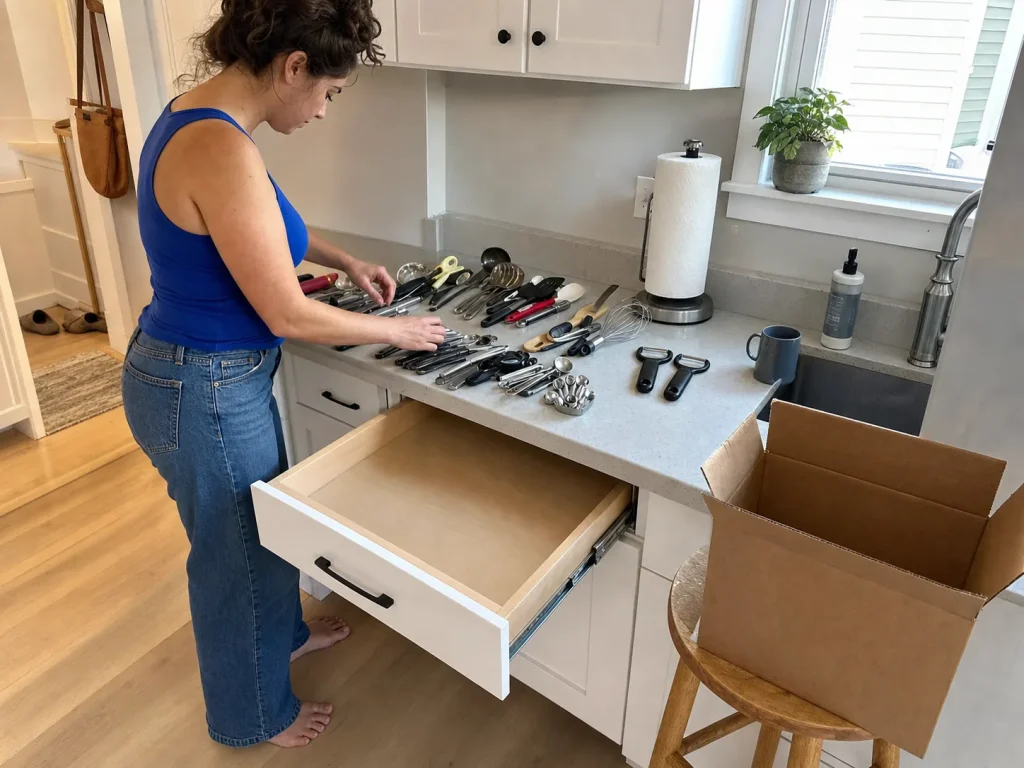
The fastest way to waste money on organizers is to buy them for a drawer full of things you never use. Edit first, and you will need roughly half the dividers you thought. This step is free, it is the one that actually shrinks the problem, and no product belongs in it.
Pull everything out onto the counter
Not a tidy-in-place shuffle. The whole drawer, dumped on the counter, so you can finally see what you own side by side. You cannot spot duplicates when they are stacked three-deep in a dark drawer, and most utensil drawers are hiding two or three of the same tool. Two peelers. A backup can opener. Four wooden spoons when you cook with one (somehow it is always the wooden spoons). Keep the best of each and let the rest go, using the same declutter-by-frequency pass that makes a pantry stick.
Sort by task as you put it back
As things come off the counter, group them by how you actually cook and how often, not by what category a store would file them under. Baking tools together. Everyday utensils together. The avocado slicer and the second garlic press you have not touched since you moved in go in a “do I really need this” pile. This pre-sorts the zones you will build in a minute, so the organizing step becomes almost automatic.
Put the “not sure” pile in a box, tape it shut, and date it. If you have not opened it in a month to grab anything, you have your answer, and you never had to make an emotional decision in the moment.
Measure Your Drawer Depth Before You Buy Anything
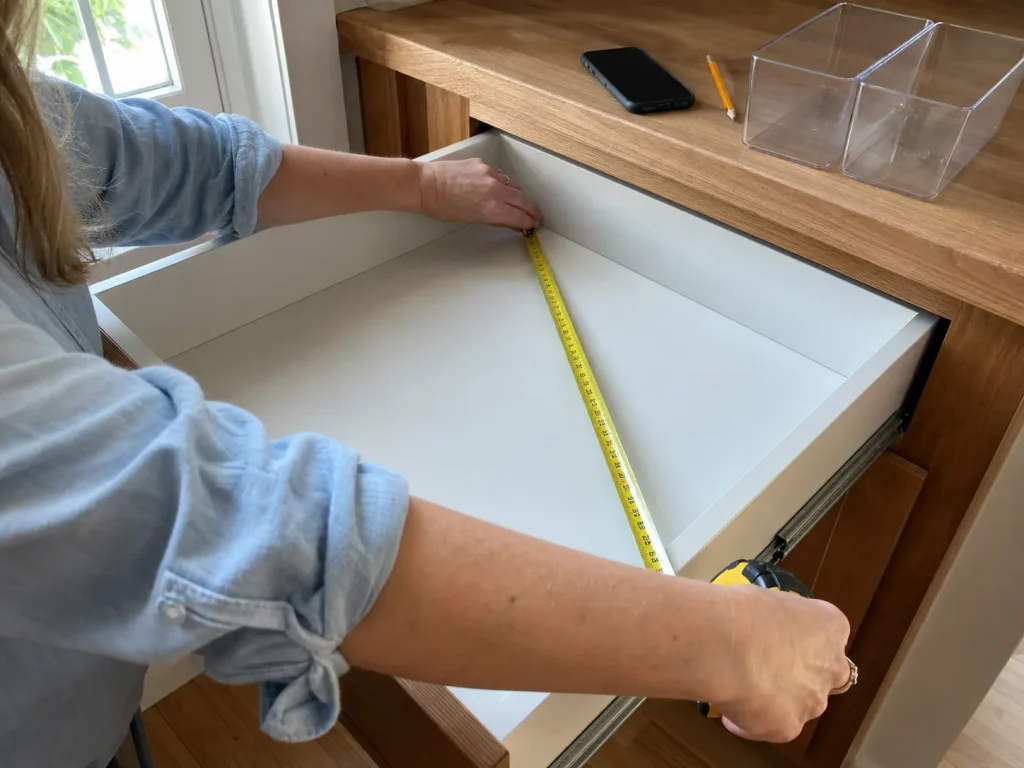
The most common return in this whole category is an organizer that did not fit. It happens because people measure the cabinet face instead of the drawer box, or they ignore depth entirely and grab whatever looked good in the photo. Three numbers, written down before you shop, prevent almost all of it.
Measure the box, not the cabinet face
A standard base cabinet drawer runs about 24 inches deep at the opening, but the usable interior is closer to 21 inches once the back panel and drawer hardware take their share. An insert cut for a full 24 inches jams against the back rail and will not seat flat. Always measure the inside of the drawer box, corner to corner, and note the interior length, width, and depth. If you want the source, this lines up with the National Kitchen & Bath Association’s published drawer-planning guidelines, which set the standard cabinet dimensions most drawers are built to.
Shallow versus deep changes everything you buy
Depth is the number that decides your entire strategy. Shallow drawers run roughly 4 to 6 inches tall and hold silverware, spatulas, and measuring spoons. Deep drawers run 10 to 12 inches and are meant for pots, Dutch ovens, and mixing bowls. Here is where people go wrong: a flat expandable tray sized for a shallow drawer will float and topple in a deep one, leaving six inches of dead, unreachable space beneath it. Once a drawer passes about 6 inches of depth, you need a full-height divider or a tiered insert, not a flat tray.
Width: always buy expandable
The last number is width, and the rule is simple. Buy the expandable style, never a fixed-width tray. A tray that is even one inch too narrow shifts and rattles every single time you open the drawer, and that daily annoyance is what makes people rip the whole system out. An expandable organizer locks wall to wall and stays put. This is the same measure-before-you-buy rule that saves you a return on cabinet organizers, and it costs you nothing but two minutes with a tape measure.
Build Task Zones That Work for Any Drawer Count
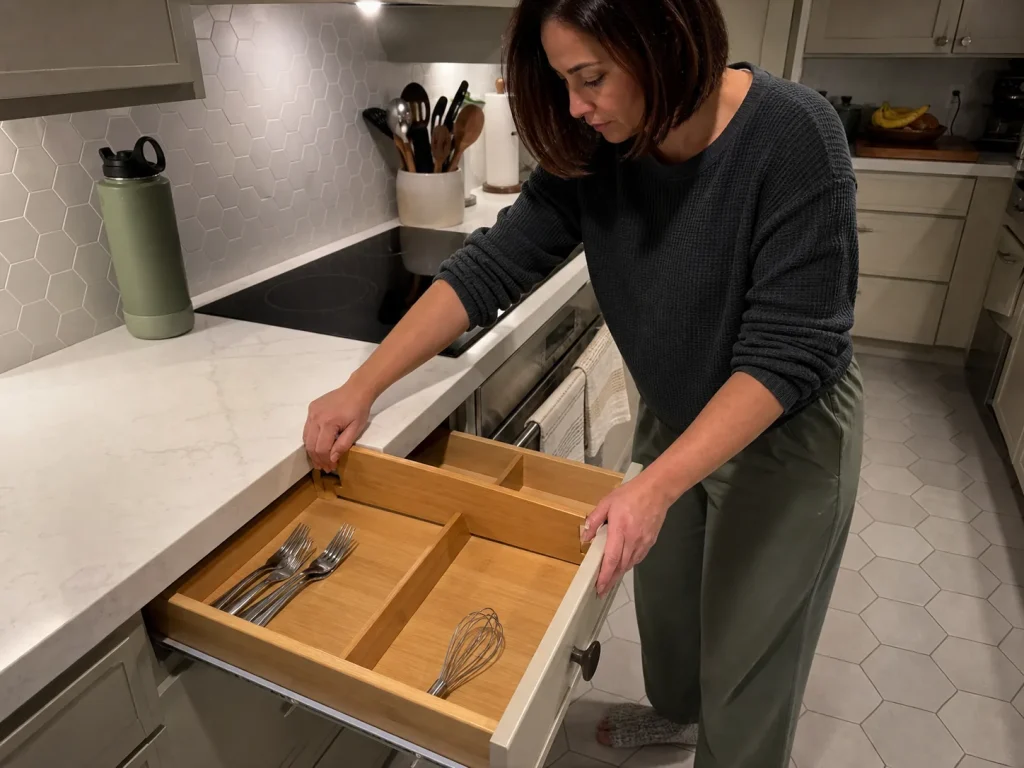
The kitchens you envy are not organized by item type. They are organized by task and by where you are standing when you reach for the thing. That is the entire trick, and it is free to apply whether you have three drawers or thirteen.
Zone by task and proximity
Put flatware near the dishwasher, so unloading is one motion. Cooking tools by the stove. Food wraps and storage bags near the prep counter. Baking tools in one dedicated group. When everything lives a step from where it gets used, you cut the cross-kitchen detour that quietly kills every system. This is the same match-by-frequency zoning that keeps small-kitchen counters clear, applied one drawer down.
Give every zone a hard boundary
A zone without a wall is just a suggestion, and suggestions drift. This is where dividers earn their keep, turning one open drawer into bounded compartments so the forks stop migrating into the spatulas. The SpaceAid Bamboo Drawer Dividers adjust to fit standard drawers wall to wall and are the most flexible single product for carving one undivided drawer into several fixed zones. For narrower apartment drawers or a tighter budget, the Lifewit 8 Pack Drawer Dividers do the same bounding job at slimmer widths, though they are shorter and better suited to lighter items than a drawer full of heavy tools.
I used to tell people to sort utensils into little labeled bins. After enough “it looked great for a week” stories in organizing threads, I switched to full-length dividers that force a boundary instead of relying on you to aim for the right bin. The wall does the work the label was supposed to do.
The system only sticks if the people who share the kitchen helped set the boundaries. Walk your household through the zones once, then let the fixed spots carry the load. If you want to see the reasoning in motion, this professional organizer’s drawer-by-drawer walkthrough shows how a pro assigns each item its zone and why.
Match the Organizer to the Drawer Type
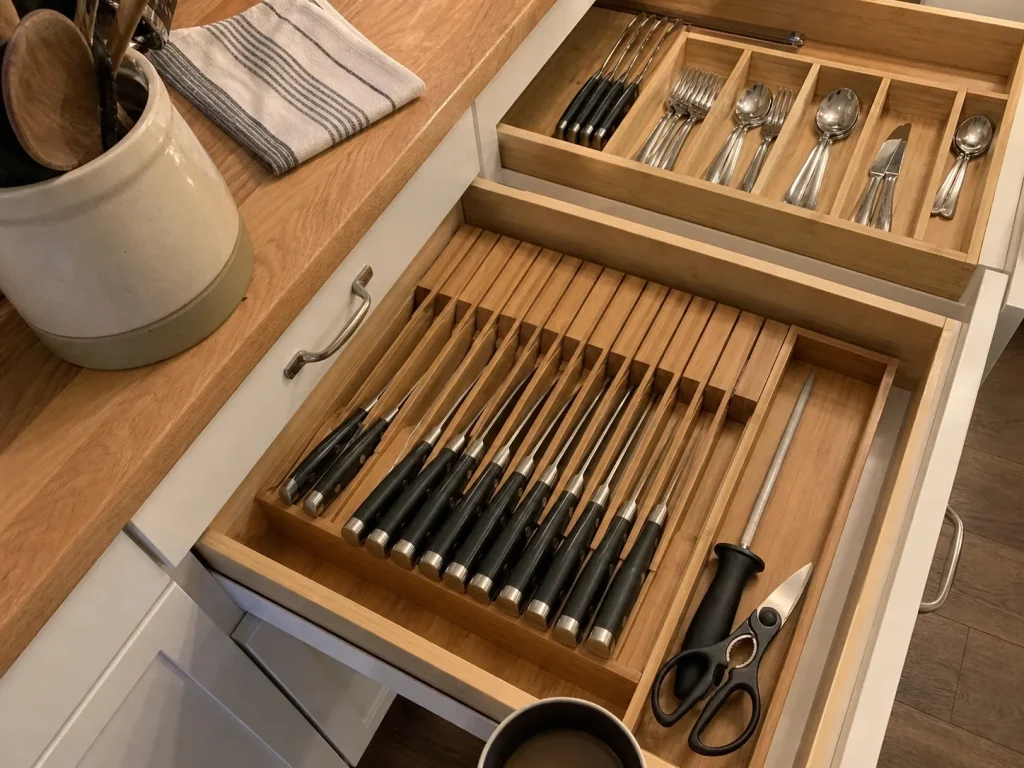
Once your zones are set, each drawer type has a “correct” organizer, and knowing which is which is the difference between a drawer that works and a pile of returns. This is what a NAPO-certified professional organizer means by giving everything a genuine home: the storage fits the item, not the other way around. Material matters as much as size: bamboo and mesh metal suit dry utensil drawers, wipeable plastic or acrylic holds up better near the sink or the prep mess, and a nonslip drawer liner or a silicone mat keeps loose organizers from sliding every time you tug the drawer.
The flatware and utensil drawer
For a shallow everyday drawer, an expandable bamboo organizer is the answer, and the expandable part is the whole point. The Pipishell Bamboo Expandable Silverware Drawer Organizer stretches to lock against your exact drawer width so it never slides when the drawer opens. It is built for the 4 to 6 inch shallow drawer, so keep it out of anything deep, where it will float.
The knife drawer
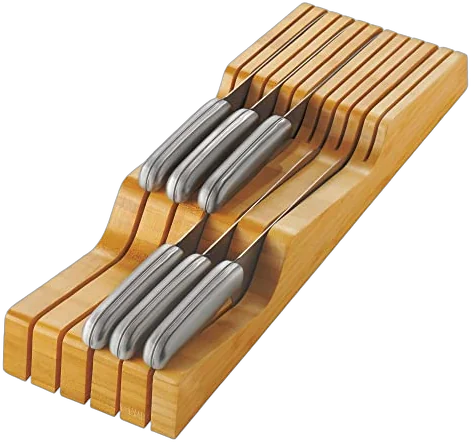
Loose knives sliding around a drawer are both a safety problem and a storage one, and stacking them on the counter defeats the point of organizing. An in-drawer knife block stores them blade-down and out of the way. Before you buy, open the drawer and confirm it clears about 17 inches long and 2 inches tall. Most standard US drawers do, but narrow apartment-style drawers under roughly 16 inches will not fit the larger sixteen-slot versions.
The deep drawer
A deep drawer is where most people lose the most space, because they drop a shallow tray in and call it done, leaving half the drawer as dead air underneath. A full-height divider fixes it. The RAPTUROUS Adjustable Deep Drawer Divider stands 5 inches tall and expands to fit, built specifically for 10-inch-plus drawers where a flat tray would float. It is the same dead-space problem that makes deep cabinets revert, solved with a wall instead of a shelf.
The lid drawer
Loose lids are one of the top reasons a drawer looks chaotic again within a week, because a stacked pile has no fixed spot and every lid migrates. Store them upright, on edge, in a slotted rack instead. The YouCopia StoraLid Pot Lid Organizer adjusts up to 22 inches wide and holds lids vertically so you can see and grab the one you need. It works in a deep drawer or a low cabinet, though it needs enough height to stand the tallest lid on edge, so measure that lid before you commit.
Give the Junk Drawer an Actual System (Not a Ban)
Everyone tells you to get rid of the junk drawer. Nobody actually does. The honest fix is not banning it, because you will always have a catch-all. The fix is bounding it so it stops growing into the drawer of shame.
You are allowed a catch-all, not a black hole
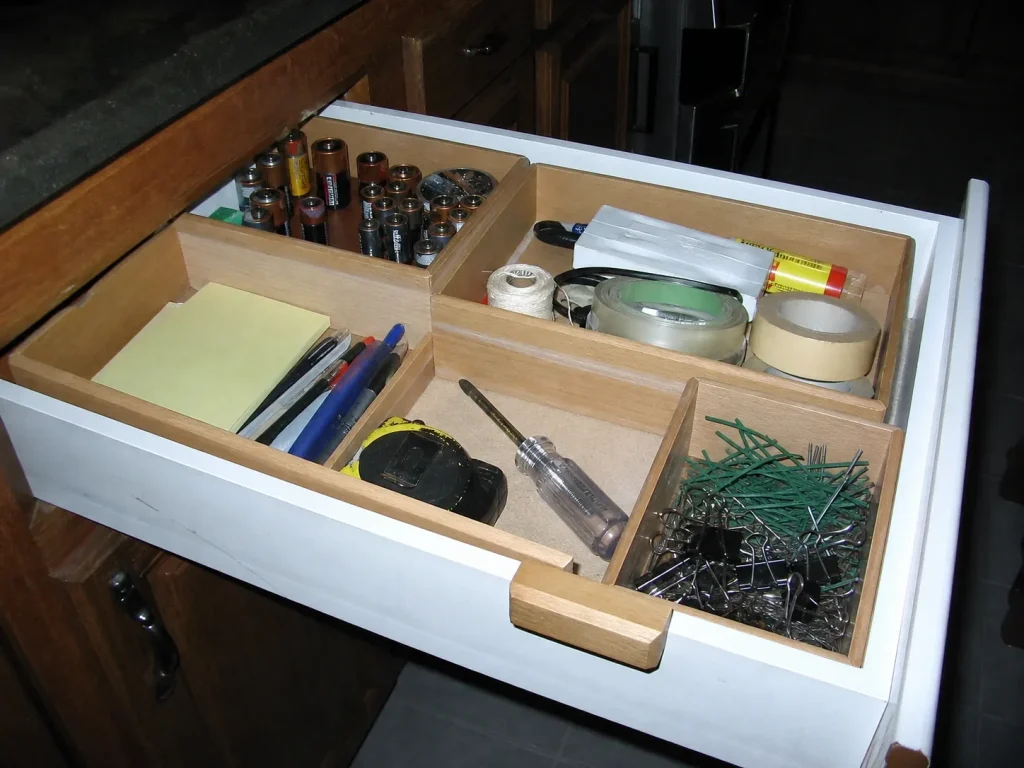
The distinction is everything. A bounded catch-all with fixed compartments is fine. A borderless one is the black hole drawer that eats everything you own. When you sort it out, you will find that the “junk” is not really random. Most junk drawers hold four or five legible categories: batteries, tape and adhesives, pens and a notepad, small tools, and twist-ties or clips. True chaos is rare. It just looks that way because nothing had a wall.
Give every category a rule
Assign each category a fixed compartment and one rule, and then hold the line on the most important rule of all: no compartment is ever labeled “misc.” The instant one section becomes miscellaneous, it reverts, because you have recreated the exact open-ended slot that caused the problem in the first place. Use the same dividers you already put in your other drawers. The junk drawer is not a special case, it is just another zoned drawer that happens to hold odd stuff. It is the same catch-all reversion that turns an under-sink cabinet into a mess of half-used bottles, and the same bounding principle fixes both.
For a category-by-category breakdown, a dedicated junk drawer guide is worth a deeper read, but the bounding principle above is the part that makes any of it last.
Small Kitchens and the 2-to-4-Drawer Reality
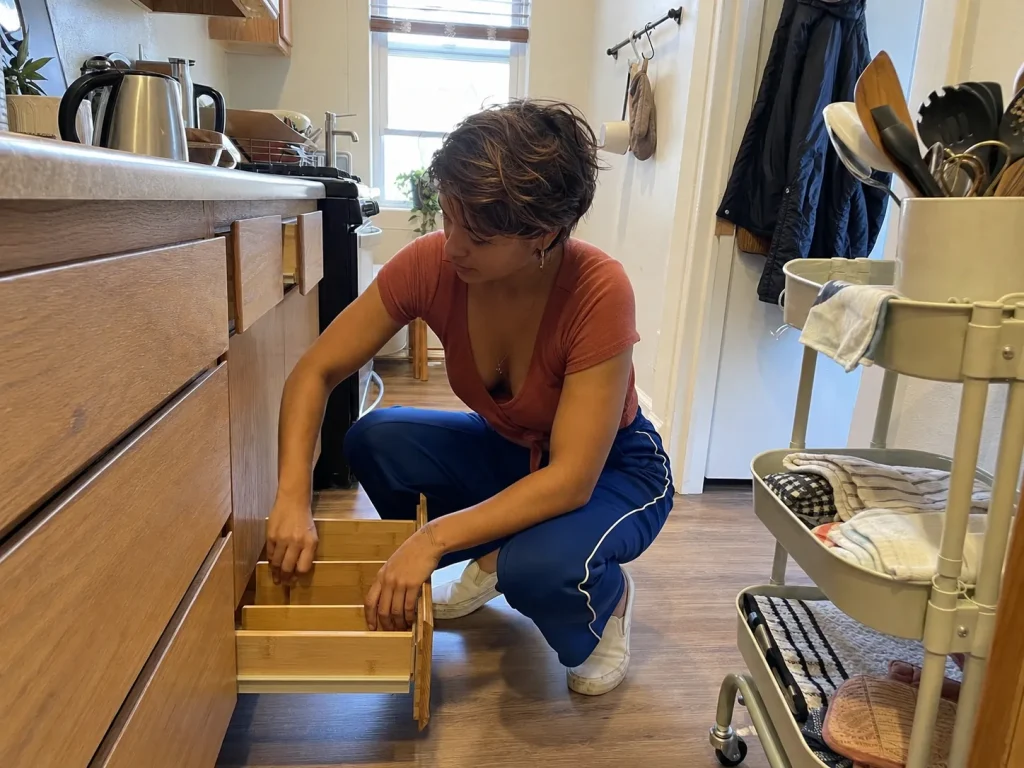
Every drawer article online assumes you have a wall of drawers to fill. If you have three, you are not doing it wrong. Your kitchen was built that way, and the system just needs to be ranked instead of replicated.
Why you are short on drawers
This is not your imagination. The National Kitchen & Bath Association’s own frontage minimums call for at least 120 inches of combined drawer and rollout space in kitchens under 150 square feet, which builder-grade and rental kitchens routinely fail to hit. That is a documented industry baseline, which is exactly why the “give every category its own drawer” advice does not scale down to a real apartment.
Rank your zones by priority
When you cannot have one drawer per category, you rank. Everyday flatware and utensils get the first and best drawer. Knives get the second. A single bounded catch-all gets the third. Anything left over, the cooking tools that do not fit, goes to a counter crock, a tension-rod shelf, or a wall rail, not crammed into a drawer that is already full. You are triaging, not compromising.
Renter-safe by default
Freestanding, non-adhesive expandable dividers are the renter’s best friend because they attach to nothing. No drilling, no adhesive, no trace at move-out, and they are the direct substitute for the built-in pull-out systems every glossy kitchen tour shows off. That is the same no-drill approach that works in rental cabinets. When you genuinely run out of drawer space, a slim rolling cart adds drawer-like zones without a remodel, though if it is tall or top-heavy, follow the Consumer Product Safety Commission’s furniture-anchoring guidance and secure it so it cannot tip. For a full walkthrough of the no-drill approach in a rented kitchen, this renter-friendly drawer organization video covers the angle most text guides skip.
In a three-drawer kitchen, keep one drawer deliberately half-empty for a week. Whatever you keep reaching for and cannot find a home for is telling you what that drawer should hold. Let the friction pick the zone instead of guessing on day one.
Use What You Already Own Before Buying Anything
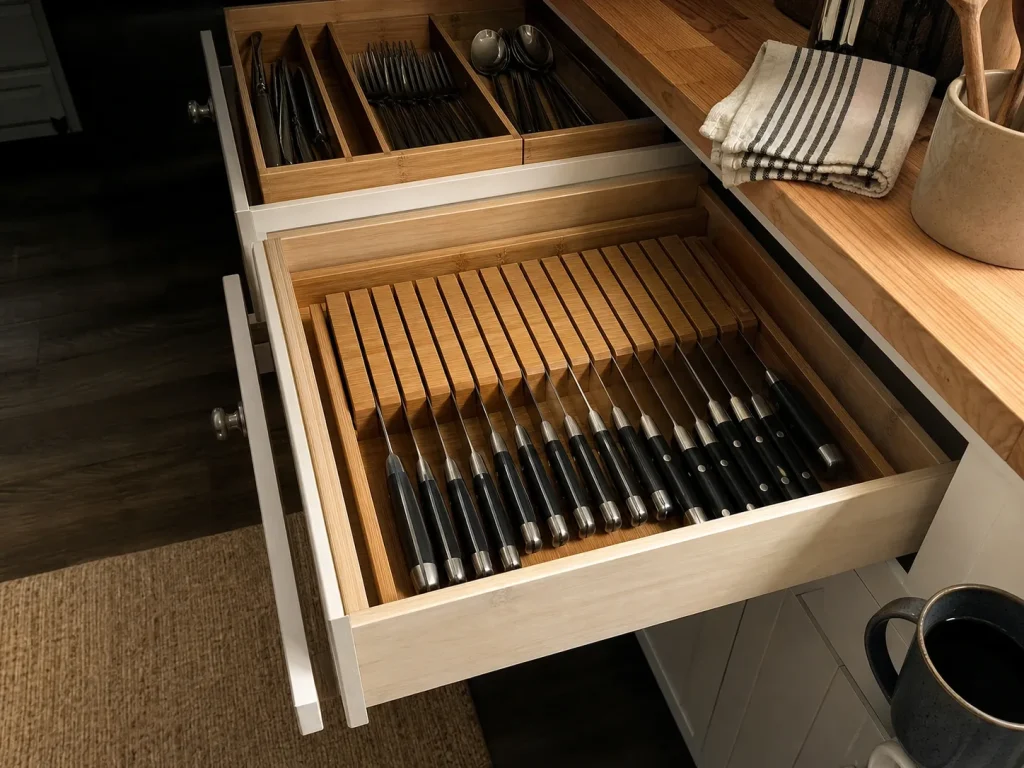
Before you add a single thing to a cart, half your dividers are probably sitting in your recycling bin. The goal is to buy organizers for the drawers that earn them, not for all of them.
Repurpose first
Short wide-mouth glass jars corral rubber bands and clips. A cut-down cereal box makes a free compartment for measuring spoons (it looks rough, and nobody who opens the drawer has ever once commented on it). A small food-storage container you never use for food holds batteries perfectly. These repurposed dividers get dismissed as a stopgap, and they are not: for the junk drawer and low-traffic drawers they usually outlast your intention to buy something “real,” and they are the swap budget threads reach for first. A thrifted or hand-me-down cutlery tray does the same job as a new bamboo insert for the flatware drawer, for nothing.
Where not to cheap out
There is one place the free route backfires. The everyday flatware drawer you open twenty times a day earns a real, expandable divider, because a too-narrow freebie that rattles will annoy you into abandoning the whole system. Buy for the drawer, not the kitchen: containerize the two or three drawers you actually fight with, and leave the rest with their repurposed jars. Honestly, the dollar-store divider does the same job as the boutique one in a drawer you barely open. Spend where the friction is.
The Weekly Reset That Keeps It Working
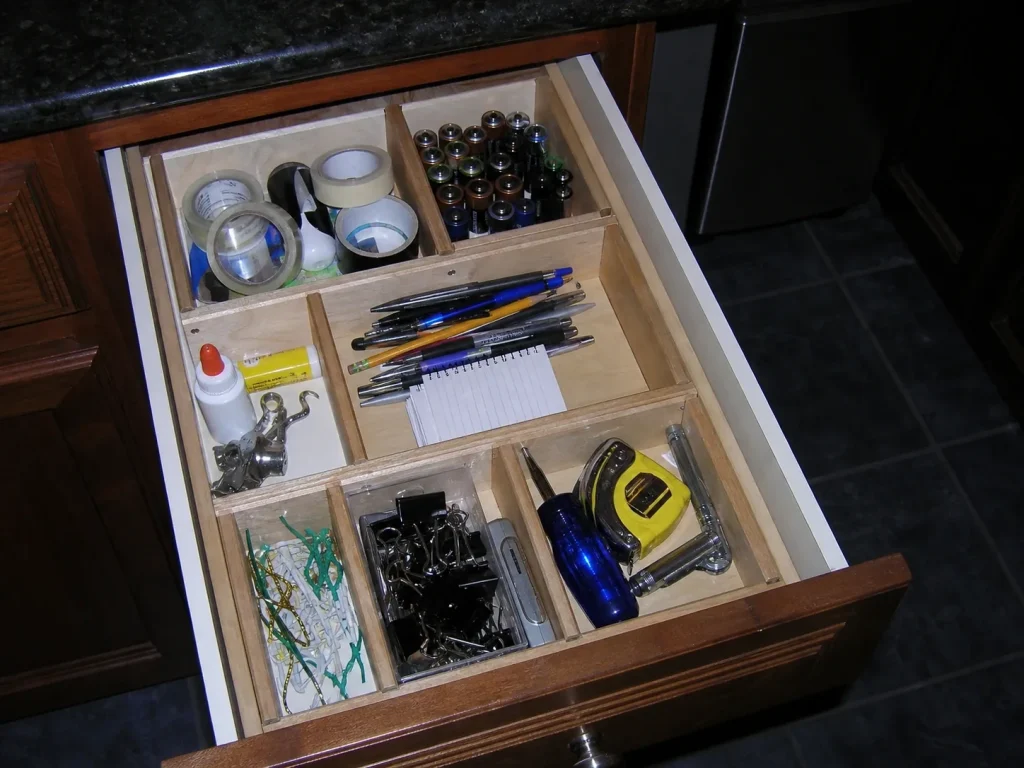
A drawer system does not fail all at once. It fails one misplaced whisk at a time. The reset is how you catch the drift before it compounds into a full teardown.
The 60-second reset
Once a week, one drawer, put back the three or four things that drifted. That is it. The point is frequency, not depth, and a 60-second pass beats a two-hour overhaul you will do exactly once. Because you named the failure up front, you are only ever maintaining a boundary, not reorganizing from scratch.
Keep the household in it
The system holds only if everyone using the drawer knows where the walls are. Show them once, then trust the fixed spots to carry the load. And practice a quiet one-in, one-out rule for gadgets: a new tool means an old one leaves, or the zone you just built overflows again by spring. That is usually the real story behind counter clutter, which is often a sign your drawers are simply over capacity.
The three-month check
Put a reminder on your calendar for the next season change. Open each drawer and notice what you never reached for. The tools you touched daily and the ones you never touched at all tell you which zones to shrink, resize, or reassign. Your kitchen changes across a year, and the system should be allowed to change with it.
Conclusion
The drawers that stay organized are not the ones with the prettiest bins. They are the ones built on three unglamorous rules. Fix why the last system failed before you buy anything, so you bound your categories and give every item a fixed spot within reach. Measure interior depth first and match the organizer to the drawer type, which prevents most of the returns in this category. And rank your zones to your real drawer count, because a three-drawer kitchen prioritizes, it does not replicate a fifteen-drawer showroom.
At the next season change, open each drawer and notice what you never reached for. That is the zone to shrink or hand to something else. Start with the one drawer that annoys you most. Get it right. Then move to the next one.
Frequently Asked Questions
01How do you keep kitchen drawers from getting messy again?
Give every item one fixed spot and run a 60-second weekly reset, putting back only what drifted. Drawers revert when a miscellaneous slot has no rule and slowly eats the whole drawer, so the real fix is bounding categories, not re-tidying.
02What size drawer organizer do I need for my kitchen?
Measure the inside of the drawer box, its interior length, width, and depth, not the cabinet opening. Buy an expandable organizer for shallow 4 to 6 inch drawers and a full-height divider for deep 10-inch-plus drawers, since a flat tray floats once depth passes about six inches.
03How do you organize a kitchen with only a few drawers?
Rank zones by priority instead of giving every category a drawer: flatware first, then knives, then one bounded catch-all. Push overflow cooking tools to a counter crock or wall rail, and use freestanding dividers so nothing has to be installed.
04How do you organize a junk drawer so it stays organized?
Sort it into real categories first, such as batteries, tape, pens, and tools, and give each a fixed compartment with a rule. A junk drawer stays bounded when there is no borderless miscellaneous slot, because that slot is the black hole, not the drawer itself.
05Should I declutter kitchen drawers before buying organizers?
Yes, always empty and edit first. Buying organizers for a drawer full of duplicates and unused gadgets just containerizes the clutter, and decluttering first usually cuts what you need to store, and buy, by half.