




















In this article
You reorganized that drawer two weeks ago. It looked like a store display for about four days, and now it’s a pile again with three shirts you forgot you owned buried somewhere near the bottom. Here’s the flat truth: that isn’t a discipline problem. Organizing threads have a name for what happened, the clothing avalanche, and it’s baked into the way stacked clothes behave the moment you reach for the shirt at the bottom. This guide covers why the stack fails, how to fold clothes to save space with a fold that actually stands up, which fold fits which drawer height, and what still holds three months later when you’re grabbing a t-shirt in the dark at 6:45 am.
Quick Answer
Stop stacking and start filing. Every garment becomes a small rectangle that stands on its own edge:
- Lay the garment flat and smooth out the wrinkles with your palm.
- Fold the sides in to make a rectangle roughly as tall as the drawer is deep.
- Subtract a finger’s width of clearance so you can lift pieces out.
- Fold that rectangle in halves or thirds until it stands on its own.
- Set it on its edge, front to back, and pack the row tight enough to hold itself upright.
Why Your Folded Clothes Turn Back Into a Pile
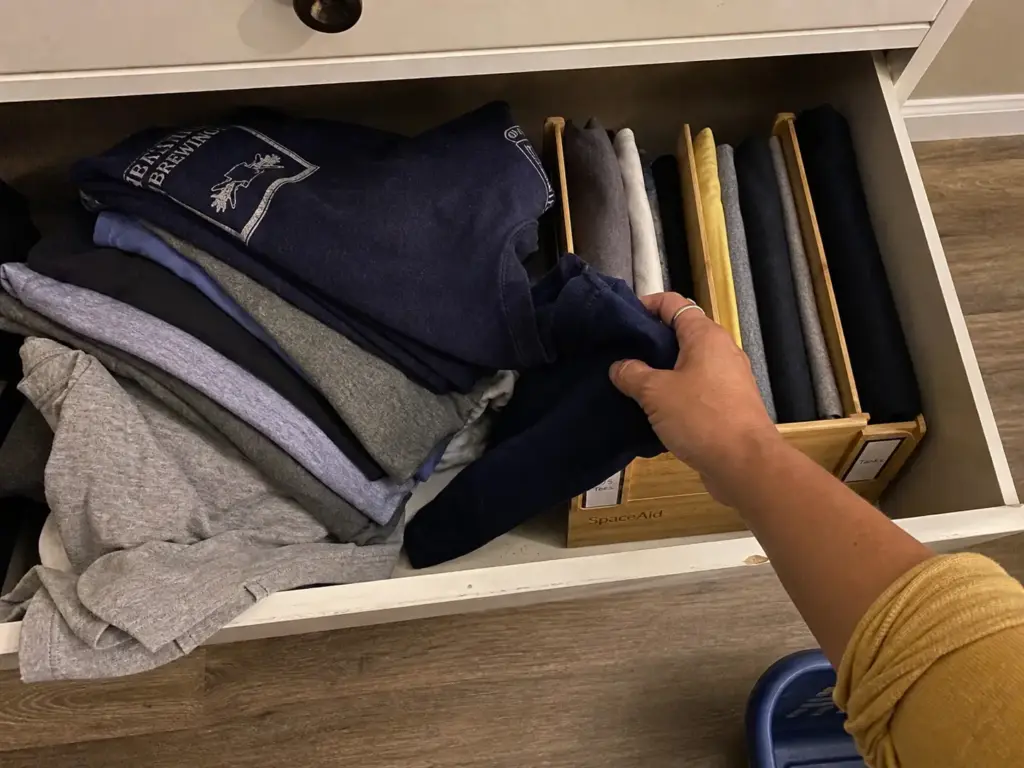
Nobody opens a reverted drawer and thinks “the storage method failed me.” They think they’re messy. But the stack is what’s broken, and it breaks the same way for everyone, which is why this comes before any folding instructions. Folding is one component of the wider dresser system this fold slots into, and the mechanism is what makes the rest of it stick.
The avalanche nobody warns you about
Picture the stack you already have. Five t-shirts, flat, one on top of the other. The one you want is third down, because the two on top are the ones you wore this week. You slide your hand under, pull, and the two above shift and half-fold themselves sideways. Now the stack is a lean, and by Thursday the lean is a pile.
That’s the whole mechanism. Stacking punishes bottom-of-stack access, and bottom-of-stack access is what you do every morning. Nobody restacks a collapsed pile at 6:45 am on a Tuesday, so the drawer keeps a little more chaos than it had the day before. Two weeks of that and you’re blaming yourself for something the geometry did.
And there’s a second cost. A stack only shows you its top garment, so the bottom two-thirds becomes dead inventory you stop seeing and stop wearing.
Why file-folding fixes the access problem
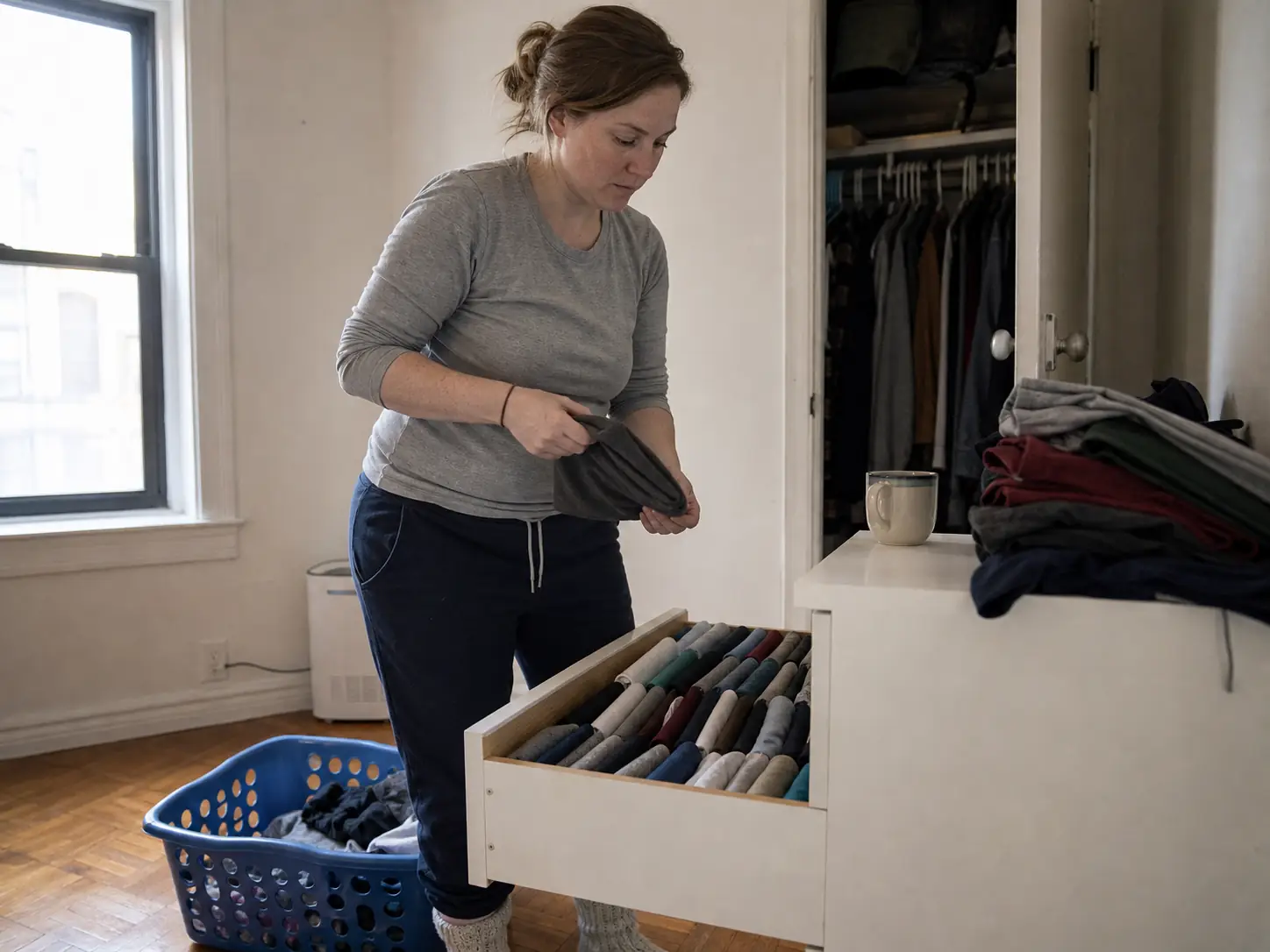
The alternative is mechanical, not motivational. Instead of lying flat, each garment gets folded into a compact rectangle and set on its long edge, like a folder in a filing cabinet. That’s the file fold, and the filing cabinet image is exactly right: you look down into an open drawer and read the spines.
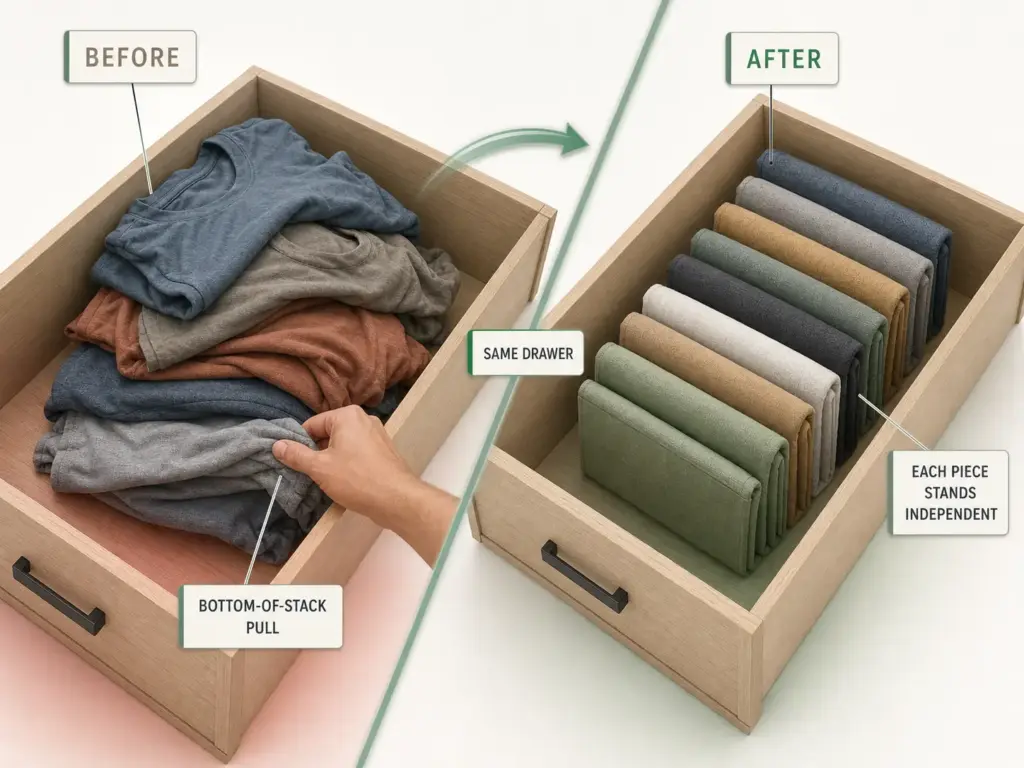
The access problem disappears because nothing sits on top of anything. Pull one piece out and its neighbors stay put. It comes out of Marie Kondo’s system, so if you want the full sequence rather than this one technique, the full KonMari method it comes from covers the rest. You also get the drawer’s real capacity back: standing pieces use the full interior height, front to back, and every one is visible without moving anything.
The second failure — rows that slump sideways
Here’s where the first attempt goes fine and the second goes wrong. You file-fold a drawer, it looks like a magazine photo, and a week later half the row has toppled sideways like dominoes that gave up. Nothing about your fold was wrong. File-folded rows need side pressure to stay vertical, and once you’ve pulled a few pieces out, nothing is pressing them together. A half-empty drawer defeats the fold on its own, with no divider to blame.
Fill the drawer fuller. That’s the free fix, and the one budget-organizing threads land on before anyone suggests buying anything. Most people leave gaps “for growth” and those gaps are precisely what lets the row lean.
Packed snugly, each piece leans on the two beside it and you get the same lateral pressure a divider would give you. If the drawer genuinely doesn’t hold enough clothes to fill it, consolidate two half-drawers into one before you spend a dollar.
If it can’t be filled, or the row keeps collapsing at one end anyway, that’s when a physical wall earns its place. The SpaceAid Bamboo Drawer Dividers with Inserts and Labels adjust across a 17 to 22 inch span, covering most standard dresser widths, and split one wide drawer into shorter rows that can’t build enough momentum to fall. One caveat: bamboo dividers slide when the drawer gets yanked open, so a couple of adhesive bumpers on the bottom corners is usually part of the install whether the box mentions it or not.
Before buying any divider, empty the drawer and push all the clothes to one side. If there’s more than about three inches of open space left over, the drawer is too empty to hold a file-fold and no divider will change that. Move a second garment type in first, then see if you still need the divider.
The Basic File Fold That Works on Almost Everything
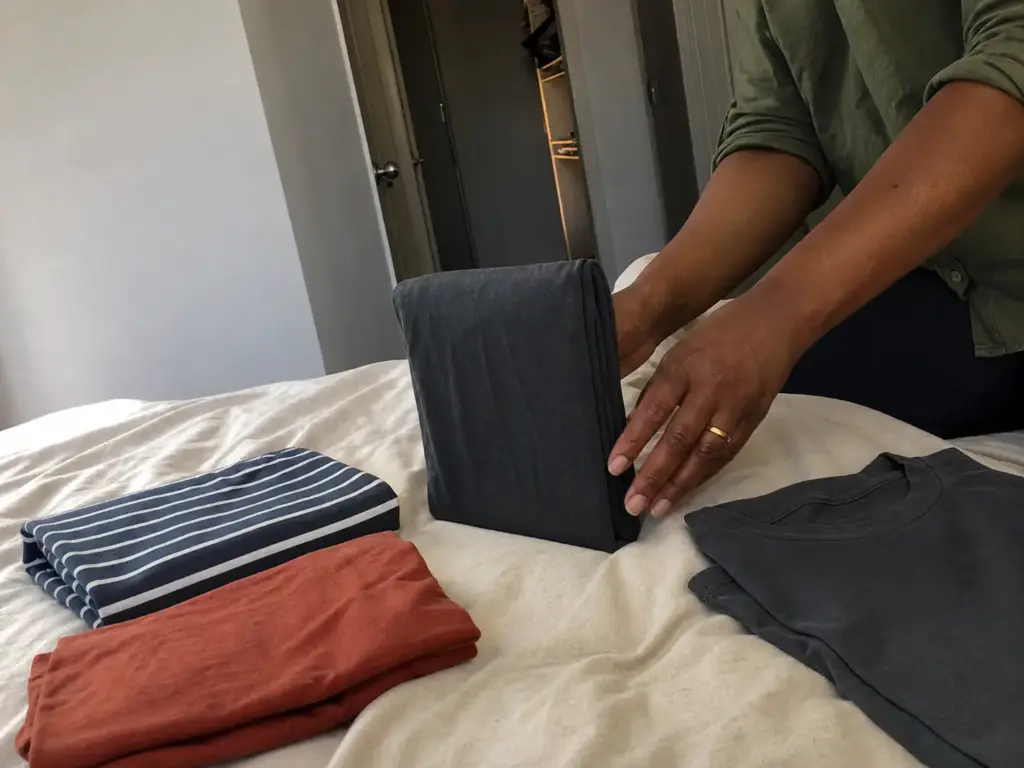
Most folding tutorials show you a shape. Nobody tells you the shape has to be sized to your particular drawer, or that a fold which won’t stand up on a table won’t stand up in a drawer either. That second point is the entire quality check, and it takes ten seconds.
The five-step fold, start to finish
Lay the garment face down and run your palm across it once. Skipping the smoothing step is the most common reason a fold comes out lumpy, because trapped wrinkles turn into bulk that stops the rectangle sitting square.
Fold both sides in toward the center, sleeves included, so you end up with a long vertical rectangle roughly the width of your hand. Then fold it in half from the bottom, and in half again, or into thirds if the fabric is heavy. Where you stop depends on your drawer, but the goal is always a compact brick slightly shorter than the drawer’s interior height.
The stand-up test (do this before you put anything away)
Stand the finished fold on its long edge, the way it’ll sit in the drawer. If it holds, put it away. If it flops, one of two things happened: you folded too few times, so the piece is too tall for its own thickness, or the fabric is too soft to hold a plain three-fold at all.
Run this on the first three garments of a new drawer and you’ll calibrate in under a minute. Skip it and you’ll load forty pieces in, open the drawer that evening, and find the whole row lying down.
Adjustments for shirts, pants, and slippery fabrics
T-shirts and tanks take the standard three-fold unmodified. Button-downs need one change: fold the sleeves back along the placket line rather than across the chest, so the collar doesn’t take a crease through the middle. Jeans and pants fold in half lengthwise first, matching the leg seams, then into thirds. They’re the easiest garment in the drawer, because denim holds a crease without being asked twice.
Looser knits and anything silky are where the plain three-fold falls apart. The last flap works itself loose and the piece slumps into its neighbor. The fix is free and it’s a technique, not a product: the envelope fold. On your last fold, instead of laying the flap flat on top, tuck it into the open pocket the previous fold created. The garment closes on itself and stops coming undone.
Fold every garment in a row to the same height, even when the garments are different sizes. One short fold in a row of tall ones creates a gap, and the gap is where the slump starts. It’s easier to standardize the height than to fix the lean later.
Consistency matters more than precision here. Nobody is grading your corners. Forty slightly imperfect folds at the same height will outperform twenty beautiful ones at mixed heights, every time.
Match the Fold to Your Drawer, Not the Other Way Around
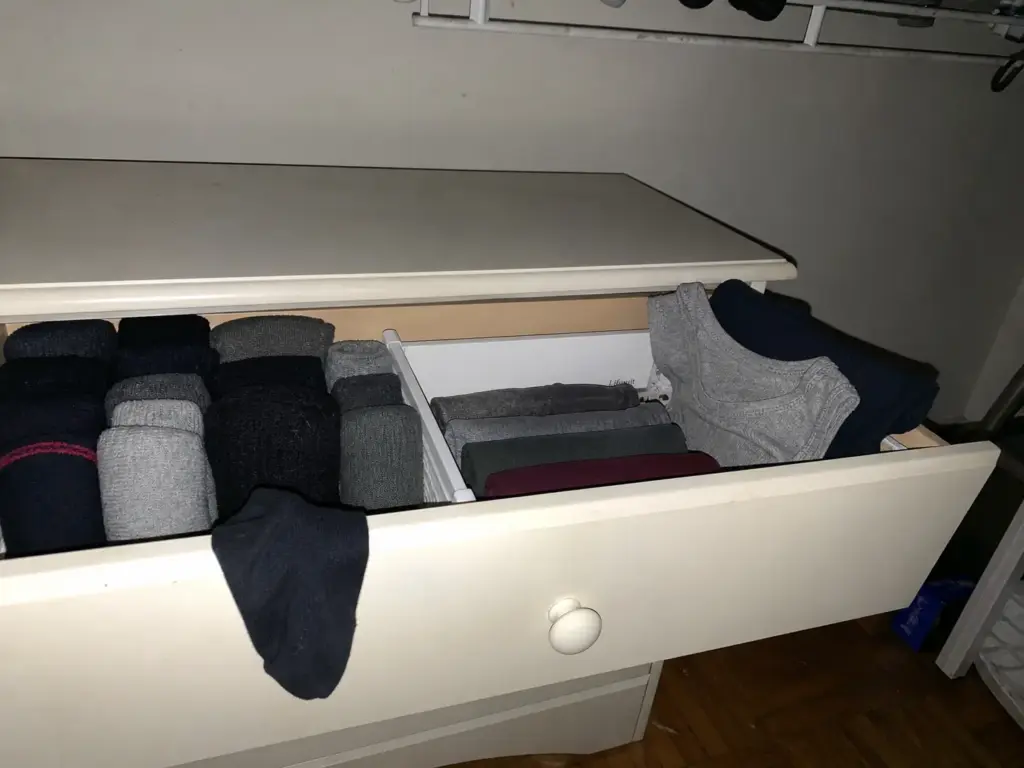
Every folding guide assumes one generic drawer. Your dresser has at least two, and the top is usually half the height of the bottom. Folding the same rectangle for both is exactly why sweaters never fit up top and t-shirts swim around down below. The fix starts with assigning each drawer a job and sizing the fold to that job.
The standard drawer dimensions, plainly: small top drawers run roughly 12 inches wide by 14 deep by 4 high, medium drawers land around 28 by 16 by 6, and large bottom drawers come in near 30 by 18 by 8. Standard front-to-back depth sits between 16 and 18 inches, with the deepest going to about 24.
Which gives you the sizing rule that governs everything else: the finished fold should be one finger’s width shorter than the drawer’s interior height. Fold to the exact height and the pieces sit flush with the top edge, so you drag three neighbors out every time you take one.
The shallow top drawer (and what actually belongs in it)
Four inches of interior height is not a lot. In practice it means socks, underwear, tanks, camisoles, and leggings, folded to about three inches tall. A file-folded sweater is physically never going to fit, and the fact that the drawer looks empty is not an argument.
Free approach first: bundle-fold your socks (fold the pair in half rather than balling them, which also spares the elastic) and stand them in one corner with underwear filling the rest. At a low count, this holds fine on its own.
It stops holding when the drawer has four or five categories migrating into each other. A low-profile divider fixes that, and height is the thing to check. The Lifewit 4 inch High Upgrade Drawer Divider is built at exactly 4 inches tall and adjusts from 11 to 17 inches, the range shallow top drawers actually occupy. Most dividers are 6 inches or taller, sized for main drawers, and in a 4-inch drawer they stick up above the edge and stop it closing. Measure your interior height before you order, because the listing photo won’t tell you.
The standard drawer — where most of your clothes live
Six inches of height and 16 to 18 inches of depth is the workhorse, and where the file fold pays off hardest. Fold to about five inches tall, run the stand-up test, and load front to back in rows. T-shirts, long sleeves, shorts, and most button-downs live here comfortably.
Depth is the variable people underuse. Stacking only ever fills the drawer to the height of the pile you’re willing to dig through, while file-folded rows run the full 16 to 18 inches front to back, so the same box holds noticeably more without gaining an inch.
Measure the interior height with the drawer open and a ruler standing inside it, not the exterior height of the drawer face. Drawer fronts frequently overhang the box by an inch or more, and that inch is the difference between a fold that clears and a drawer that won’t shut.
The deep bottom drawer and the weight question
Eight inches and up is sweater territory: sweatshirts, chunky knits, jeans, anything with bulk. Deeper drawers also allow taller rows, meaning more pieces per square inch of drawer floor, so the bottom drawer is usually the highest-capacity space in the dresser.
Loading the heavy things low isn’t only about balance in the abstract. The CPSC’s 2023 stability standard for clothing storage units requires dressers made after September 1, 2023 to hold 60 pounds on an open drawer without tipping. Top-heavy loading works against the engineering that standard tests for, and with kids in the house that’s worth more than an organizing preference. Heavy goes low. Always.
One thing this approach requires: nothing. It’s no-drill organization in the purest sense, with no mounting and no conversation with a landlord, which makes it the rare renter-friendly organization move that costs nothing and leaves no marks. The technique itself is the storage upgrade.
If the deep drawer still can’t swallow all the sweaters, the answer isn’t compressing it harder, it’s moving off-season pieces out of the dresser. Free version: fold them into a spare pillowcase or tote and slide it under the bed. If you want the volume down, HIBAG 10 Jumbo Vacuum Storage Bags compress a bulky sweater load into something that slides under a low bed frame, with the caveat that long-term compression flattens loft in natural fibers, so wool and cashmere do better loose in a tote.
Which Folds Survive Three Months (and Which Collapse)
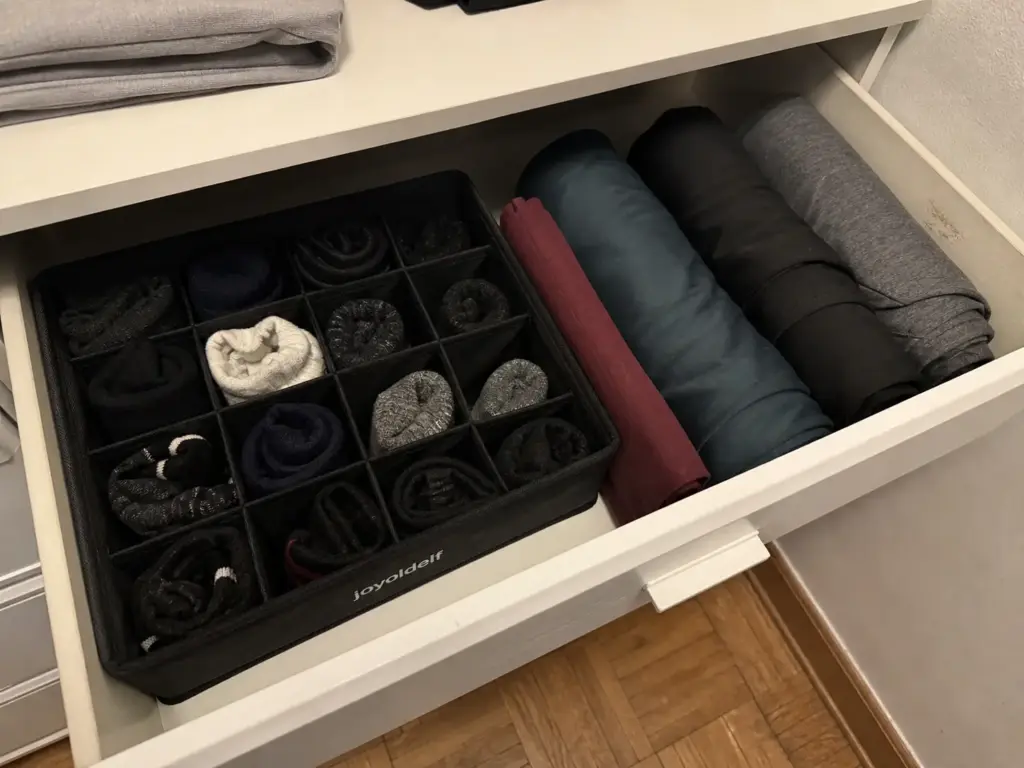
A freshly file-folded drawer looks like a magazine photo on day one. Anyone can get that. The real test is whether it survives someone grabbing a shirt in the dark before work, and some fabrics pass that test and some genuinely do not. Knowing which is the difference between a system and a weekend project you’ll redo in March.
The fabrics that hold a fold
Cotton t-shirts, jeans, chinos, and structured button-downs are the reliable ones. They have enough structure to take a crease and stand without support, and three months of daily grabbing doesn’t change that. If your drawer is mostly these, the file fold holds with almost no upkeep.
Linen belongs here with an asterisk: it holds the fold beautifully and holds the crease line just as beautifully, so anything you want looking sharp is better hung.
The ones that need rolling instead
Activewear is where file-folding quietly fails. Dri-fit, spandex blends, anything slick and stretchy: the fabric slides against itself and the fold works loose within days. Chunky knit sweaters have the opposite problem. They hold the fold fine but stretch at the fold line over time, and a season later there’s a horizontal mark across the front that never quite hangs out.
Roll these instead. Rolling avoids the sharp crease entirely, and stretchy fabric holds a roll far better than a fold because the tension works with the fabric instead of against it.
I used to treat rolling as the lesser option, the thing you do for a suitcase and abandon at home. After enough activewear-slumping complaints piled up in organizing threads, I stopped defending the file fold as universal. It isn’t. Fold what holds a shape, roll what doesn’t. That’s not a choice between two camps, it’s a fabric-by-fabric call you make once per garment type and then stop thinking about.
Rolled and folded pieces should never share a row. A roll is round and a fold is flat, so they don’t press against each other evenly and the row develops a soft spot that collapses first. Give rolls their own section, even if it’s a small one.
Keeping it up without it becoming a chore
Here’s the rule that decides whether any of this lasts: the system survives if putting laundry away takes the same effort as before, or less. If refolding feels like an extra step you have to schedule, the drawer reverts fast.
The move is to fold straight out of the dryer, while you’re already handling every garment anyway. You’re not adding a task, you’re changing the shape you make during one you already do. Putting away becomes dropping finished bricks into a row, faster than restacking a pile ever was.
Socks and underwear are the exception, and where the miscellaneous pile always creeps back in. Bundle-folded pairs loose in a shallow drawer work fine at a low count, but past a couple dozen pairs they migrate, mix, and become one undifferentiated heap by week three.
A fixed-cell tray gives every pair a defined slot, and the joyoldelf Sock Drawer Organizer Divider 2-Pack puts 24 cells across a standard drawer width. The tradeoff is real: cells cap capacity, so at forty pairs a tray forces a decision you might not want to make. If rows keep slumping across the whole dresser rather than just the sock drawer, dividers that actually fit standard dresser drawers is the better starting point.
The rows that survive a season have two things in common: every piece folded to the same height, and a drawer that stays reasonably full. The ones that fail are the half-empty and the mixed-height rows, no matter how good the original fold was.
Conclusion
Your drawer reverts because stacking punishes bottom-of-stack access, not because you lack discipline. Standing clothes on edge changes the mechanism, and once the mechanism changes, daily use stops working against you.
Size the fold to the drawer’s interior height minus a finger of clearance, and match the garment to the drawer: light and small up top, heavy and bulky at the bottom. And fold what holds a shape, roll what doesn’t, because forcing activewear into a file fold is the fastest route to a slumped row.
In three months, open the drawer and look for the gaps. A row that has gone half-empty is a row about to slump, and it’s the earliest signal the system needs either fewer garments or more side pressure.
Start with one drawer. The t-shirt drawer, usually, because it has the most pieces and the most obvious payoff. Get that one holding its shape for a couple of weeks before you touch the rest of the dresser.
Frequently Asked Questions
01How do you fold clothes so they take up less space?
Fold each garment into a rectangle slightly shorter than the drawer’s interior height, then stand it on its edge instead of stacking it flat. Standing clothes vertically uses the drawer’s full height rather than only the top of a pile, and every piece stays visible without disturbing its neighbors.
02Is it better to roll or fold clothes for space?
Fold what holds a shape and roll what doesn’t. Cotton t-shirts, jeans, and structured button-downs stand up well file-folded. Activewear, spandex blends, and slippery fabrics slide out of a fold and slump, so rolling suits them better and avoids the sharp crease line.
03What is the 3-3-3 rule for clothes?
It usually refers to a capsule-wardrobe challenge: three tops, three bottoms, and three pairs of shoes, mixed into a month of outfits. It’s a wardrobe-size rule rather than a folding rule, and it gets confused with a separate decluttering rule of three, where you keep a garment only if you can name three ways you’d wear it.
04How do Japanese fold clothes?
The technique most people mean is the KonMari file fold popularized by Marie Kondo: folding a garment into a compact rectangle and standing it upright so the drawer reads like a filing cabinet. The core idea is that every item should be visible at a glance rather than buried under a stack.
05Why do my file-folded clothes keep falling over?
Almost always because nothing is pressing them together. File-folded rows need side pressure to stay upright, so a half-empty drawer will slump on its own. Fill the drawer fuller, keep every fold in a row the same height, or add a divider to hold the row in place.