






















In this article
You sorted the whole thing on a Sunday. Alphabetical, spines aligned, the tall art books stacked at one end like you meant it.
Six weeks later there’s a second row of paperbacks wedged in front of the first, and three hardcovers lying flat on top of a row because they wouldn’t stand up anywhere. The reason isn’t discipline, and it isn’t that you picked the wrong sorting method. It’s that almost nobody measures the shelf before they sort it, and no sorting method survives a shelf that was already full on day one. This guide covers bookshelf organization the way it actually has to work: what your shelf can physically hold, how to decide what stays, which sorting methods hold up under daily use, and the reset rule that keeps the whole thing from reverting.
Quick Answer
Organize a bookshelf in five steps, in this order:
- Empty the shelf completely, one shelf at a time.
- Measure depth and clear height before deciding anything.
- Cull to what the shelf actually holds, not what you own.
- Sort by how you reach for books, not by how it photographs.
- Leave one shelf at partial capacity as your intake buffer.
Why Your Bookshelf Reverts to Chaos Every Few Weeks
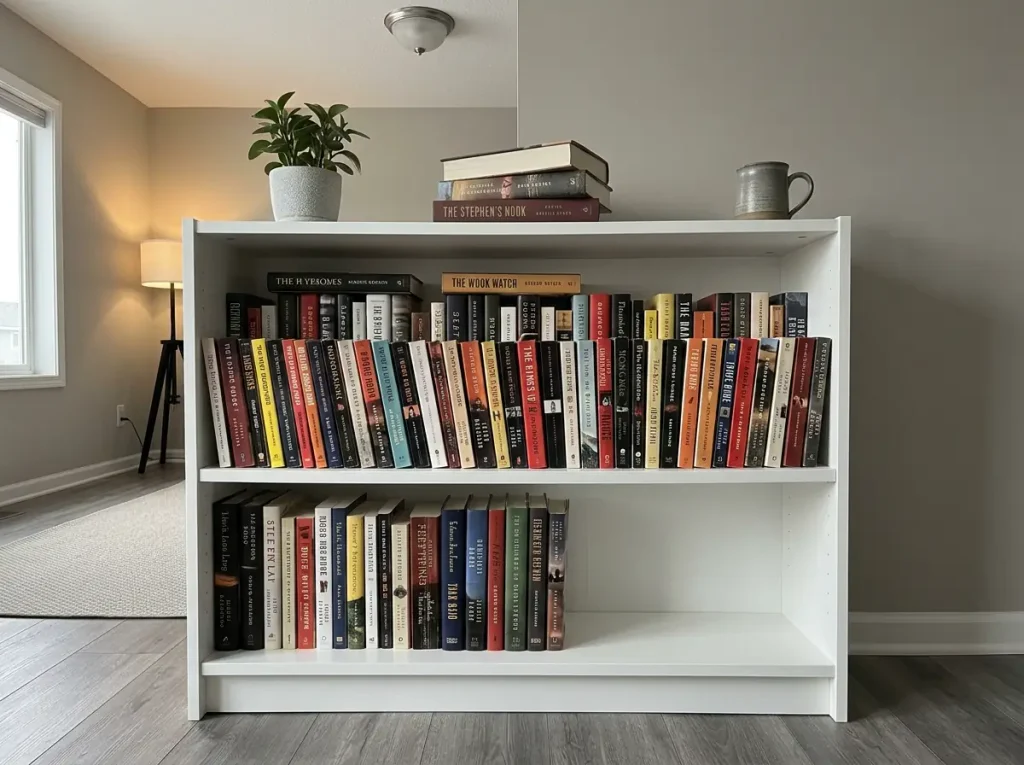
Everyone blames themselves for this. You tell yourself you stopped keeping it up, that you got busy, that you’re just not an organized person. None of that is what happened. What happened is arithmetic: the shelf was at 100% capacity the day you finished, so the very first book you brought home after that had nowhere to go except sideways on top of a row.
That’s the whole mechanism. Formal sorting methods hold beautifully until the shelf runs out of room, and then they give way to what book collectors call “wherever it fits.” One collector who tried strict alphabetical-by-author put it flatly in a community thread: it “didn’t last long.” Another described new acquisitions ending up “haphazardly lying atop other books” once the shelf filled.
Neither of them planned badly. Neither of them was lazy. They just had no rule for what happens when the shelf is full, which means the shelf itself made the rule.
The second symptom is the one people name out loud: the double-stacked shelf, a second row of books wedged in front of or on top of the first because there’s nowhere else.
Double-stacking is worth recognizing for what it is. It isn’t a storage technique, and it isn’t a fix. It’s a diagnosis. A shelf that’s double-stacked is telling you it ran out of room a while ago and you’ve been improvising ever since.
The first book laid flat on top of a row is the exact moment your system ended. Most people don’t consciously notice it for another month, by which time there are six of them and a second row behind the first. If you learn to see that one sideways book, you get a month of warning instead of a weekend of rework.
So the failure is structural, not behavioral.
A shelf organized to full capacity has zero tolerance for a single new book, and books arrive whether or not you planned for them. It’s the same pattern that makes a media console creep back to messy a few weeks after you sort the cables and remotes: nothing was wrong with the sorting, there was just no rule for the next thing that came in. Fix the capacity problem and the sorting method stops mattering nearly as much. Skip it and no method on earth will hold.
Measure Your Shelf Before You Sort a Single Book
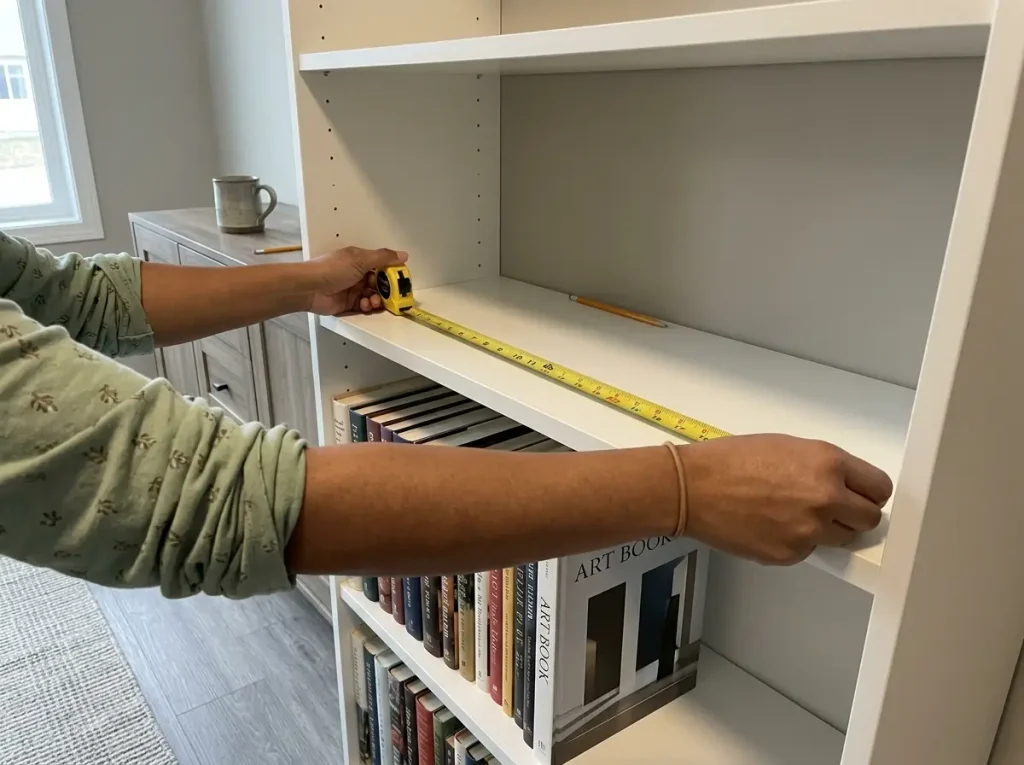
Here’s the step everyone skips, and it’s the one that decides whether any of the rest works. Before you touch a single book, get a tape measure and write down three numbers: shelf depth, the clear height between shelves, and the linear inches of shelf you actually own. Ten minutes. It’s the difference between a system built for your shelf and a system built for a shelf in a photograph.
The reason this matters more than it sounds: shelf capacity is a question about your books, not about your shelving. One collector counted their own shelves and found a range from 45 to 70 books per shelf on shelves of identical dimensions. That’s a 55% swing from book size alone. Any article that hands you a fixed “books per shelf” number is telling you about their collection, not yours.
Depth Is What Decides Whether Hardcovers Hang Off the Front
Standard bookcase depth runs 12 to 13 inches, with some 4-shelf models reaching about 14⅝ inches, according to the standard bookcase sizing charts that most furniture makers build to. Specialty paperback shelving is a different animal entirely, often around 5 inches deep. If you bought a slim shelf because it fit the wall and now your hardcovers stick out past the front edge, that’s why. Nothing is wrong with the books.
Standard bookcase heights step up in predictable increments too: a 2-shelf unit runs about 32 to 36 inches, 3-shelf about 41 to 48, 4-shelf around 54, and 5-shelf between 72 and 77 inches, most of them 30 to 37 inches wide. Read that last one again, because “5-tier bookshelf” sounds compact on a product page and arrives as a piece of furniture over six feet tall. Measure your ceiling clearance and your doorway width before it ships, not while the delivery driver waits.
Clear Height Between Shelves, and the Books That Never Stand Up
Paperbacks need roughly 8 inches of vertical space and 5 inches of depth. Standard hardcovers need about 10½ inches tall by 8 deep. That gap is where most upright-book problems live: a shelf spaced for paperbacks will not take most hardcovers standing, so those hardcovers end up flat, which is exactly the stack that turns into the double-stacked mess from the last section.
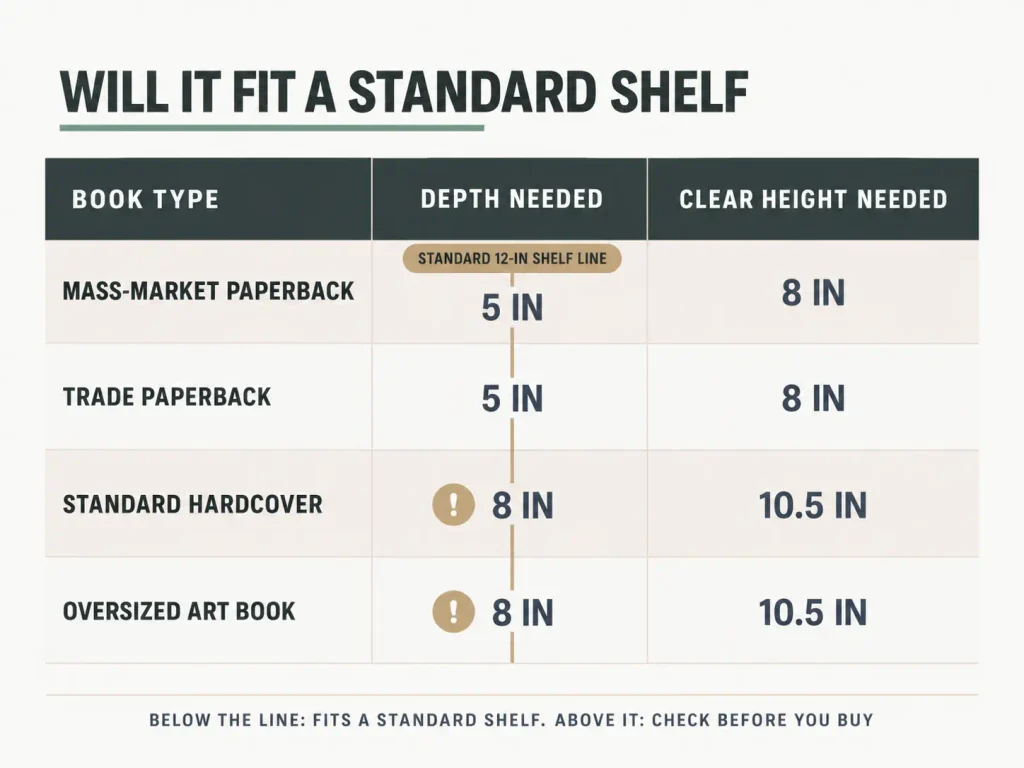
So measure your single tallest hardback (yes, the oversized one you’re already picturing) and check it against the clear height, not against the shelf you hope it fits. If your shelves are adjustable, this is the moment to move one, before books go back on. If they’re fixed, you’ve just learned which shelf your oversized art books live on, and that decision is made for you rather than negotiated every time you put one away.
How Many Books Actually Fit (and Why the Rule of Thumb Lies)
A realistic figure is 5 to 12 books per linear foot, depending on what kind of books you own.
The number that gets repeated everywhere is “10 books per foot,” and in practice it measures closer to 7. Run that out and a single 30-inch shelf holds somewhere between 12 and 30 books. Not a number. A range, and a wide one.
The conventional advice here is to just add another shelf. In practice, knowing your real linear capacity is what stops you from buying a second bookcase you don’t have the wall for, because the honest answer is usually that you’re 15 books over, not a whole unit over. Multiply your shelf count by your shelf width and write the total linear inches on a sticky note. That number is the budget you’re working against for the rest of this article.
Weight Is the Limit Nobody Checks
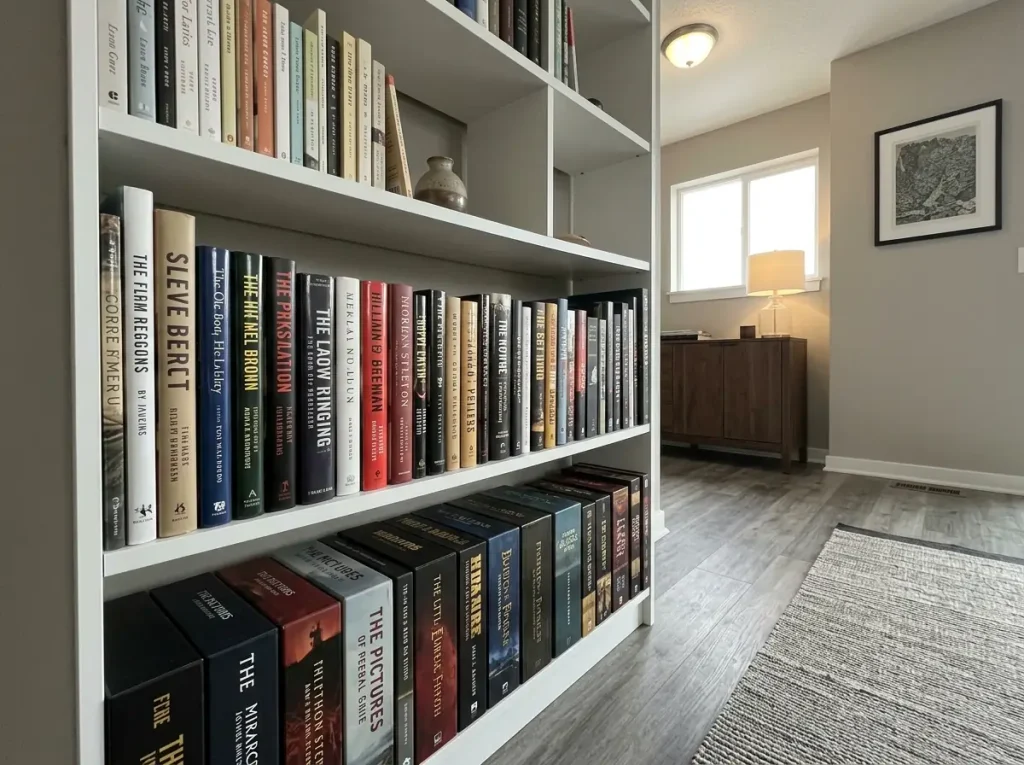
Sight down the front edge of a loaded shelf from one end, the way you’d check a board at a lumberyard. If it dips in the middle, that shelf is past its rating and has been for a while. A bow isn’t a cosmetic complaint. It’s the shelf telling you something, and it will not un-bow on its own once it’s set.
What a Shelf Is Rated to Hold, and What a Full Row of Hardcovers Weighs
The load capacity of general shelving is roughly 20 to 30 pounds per linear foot, and that rating is a weight limit, not a suggestion. Hardcovers average 1 to 2 pounds each. Do that math on a 3-foot shelf and you can hit the rating with as few as 20 to 25 books, which is fewer than most people would guess and considerably fewer than the shelf physically fits. Capacity and rating are two different numbers, and the shelf will happily let you exceed one to satisfy the other.
If yours is already bowing, the fix is to shorten the span or split the load. A center support bracket cuts a 36-inch span into two 18-inch spans and roughly quadruples the stiffness, which is more effective than anything you can do by rearranging books. If the unit can’t take a support, move the heavy rows to a shorter shelf and give the long span the paperbacks. For anything you’re mounting yourself, wall-mounted shelves that actually hold weight are worth reading up on before you commit hardware to drywall.
Why Budget Bookcases Bow First
It’s a material problem. A 3-foot 1″x12″ MDF shelf sags about a quarter inch under 87 pounds, and MDF or particleboard is what most budget bookcases are made of. Solid wood or plywood holds a straighter line across the same span with the same load.
This isn’t an argument for spending more, since a laminated particleboard case is genuinely fine for paperbacks and décor. It’s an argument for knowing which shelf gets the boxed sets.
On a laminate or MDF shelf, flip the board over before you reload it. Most budget shelves are symmetrical and unfinished-side-agnostic, so a shelf that has bowed downward for two years will straighten measurably once the load pushes it the other way. It buys you time and costs nothing but ten minutes.
Heavy Low, Light High
Coffee-table books, boxed sets, textbooks: bottom two shelves. Lighter décor and paperbacks: up top.
This is the reverse of what a lot of people do instinctively, because the big impressive art books feel like they belong at eye level where you can see them. Put them low anyway. CPSC guidance on furniture generally is to store heavier items on lower shelves, and a bookcase is one of the pieces where that matters most, since every pound you put up high moves the center of gravity toward the tipping point. Your shelf stays flatter and your bookcase stays upright.
Built-In vs. Freestanding: Which Problem You Actually Have
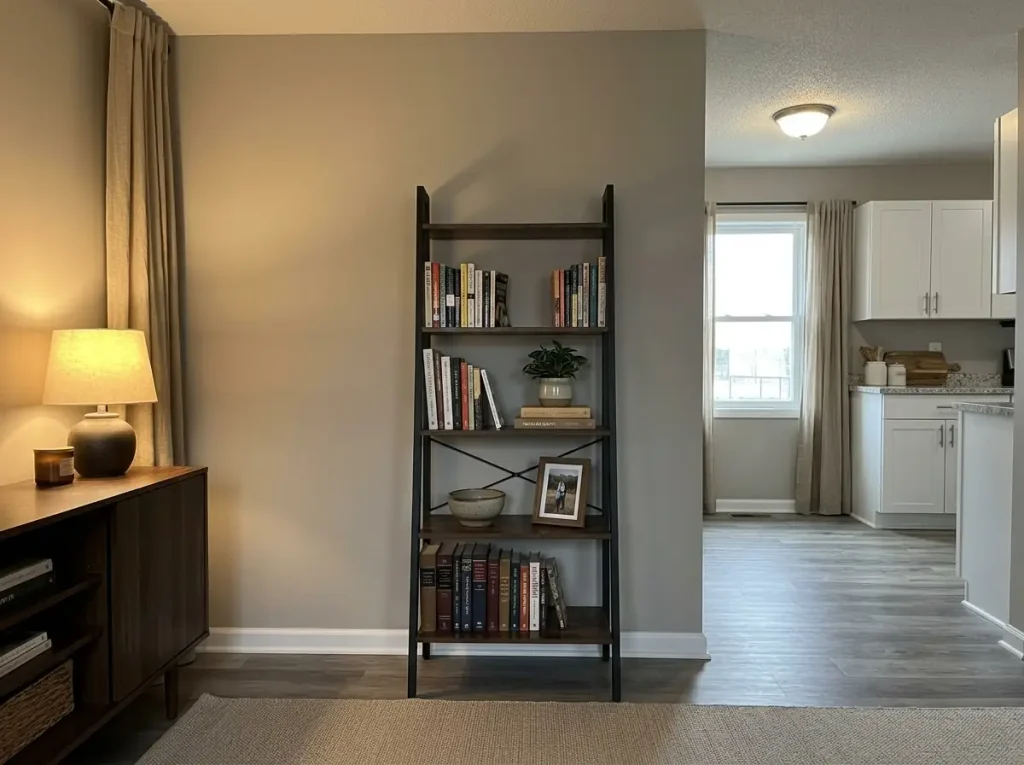
About half the people reading this have a bookcase standing against a wall. The other half have shelving attached to it. Those are genuinely different problems with different failure modes, and most articles on this topic write to neither. Figure out which one you have before you take any more advice, including mine.
What Freestanding Gets You and What It Costs You
Freestanding means the depth and the span are decided for you by the manufacturer. You can’t make a 12-inch shelf into a 14-inch shelf, and you can’t shorten a 36-inch span without adding a support. What you get in exchange is real: it moves, it comes with you when the lease ends, and it needs no permission from anyone. What it costs you is that the entire load sits on a piece of furniture with a footprint maybe 13 inches deep and a height that can pass six feet, which is a shape that wants to tip.
If you already own a bookcase that fits your wall and holds your books, the answer here is to anchor it, not replace it. Genuinely. Skip to the anchoring subsection and keep your money.
But if you’re working with a narrow wall, an awkward alcove, or a room where a full-width bookcase would eat the walkway, the VASAGLE Ladder Shelf, 5-Tier Bookcase is about 22 inches wide across five tiers, so it takes the vertical space a wide unit can’t fit into. The tradeoff of any ladder-style shelf is that the tiers taper: the top shelf is shallower than the bottom, so oversized books have exactly one shelf they can live on.
Wall-Mounted and Built-In: The Load Goes Into the Wall
Move to built-in shelving or a wall-mounted run instead and your constraints invert. Depth and span become whatever you decide, which is the freedom people want. But the load path now runs into the wall, and drywall is not a structural material. This is where anchoring stops being a nice-to-have and becomes the entire question, which is what the renter section at the end of this article is about.
The built-in advantage nobody mentions: you can set your own clear heights. If you measured in the last section and found that your hardcovers need 11 inches and your paperbacks need 8, mounted shelving lets you build exactly that, which recovers three inches of dead air above every paperback row. On a five-shelf wall, that’s most of a sixth shelf you didn’t have.
Anchoring a Freestanding Bookcase
Bookcases get named specifically, alongside dressers and TVs, by the Consumer Product Safety Commission’s Anchor It! campaign, which names bookcases specifically as furniture that needs wall anchoring. A tall unit can tip if a child climbs it or simply pulls on a low, empty shelf, and tip-over injuries have dropped nearly 50% since the campaign launched in 2015. Two brackets and twenty minutes.
One detail from that same guidance that changes what you buy: CPSC warns explicitly against anchors with plastic brackets or zip-tie-style straps, because the plastic goes brittle and breaks over time. The kit that ships in the box with a flat-pack bookcase is very often exactly that kit. Metal L-brackets into a stud are the version that’s still doing its job in five years. And if the bookcase itself is the problem, freestanding shelving units that won’t tip over start from a wider, lower footprint rather than asking hardware to compensate.
Decide What Stays Before You Decide Where It Goes

Nobody wants to hear “get rid of books,” and I’m not going to frame it that way, because it isn’t a moral question. You measured your linear inches two sections ago. You know roughly what the shelf holds. The gap between that number and what you own is the decision you’re actually making, and it’s arithmetic.
Work From the Measurement, Not the Mood
Start with the number. If your shelf holds 30 linear inches per row across five rows, that’s 150 inches of book, and if you’re carrying 190 inches you’re 40 inches over. Forty inches is a stack, not a lifestyle change. That reframing does more work than any decluttering method, because it converts a vague feeling of “too many books” into a specific, finishable task.
The community pattern here is consistent enough to be a rule: when a sorting system collapses into “wherever it fits,” the collapse almost always traces back to skipping this step. The method gets blamed. The method was fine. The shelf was over capacity before the first book went back on it.
The Four Piles That Actually Sort a Collection
Four categories do essentially all the work. Books you reference, meaning you pull them off the shelf to look something up. Books you re-read, which is a smaller list than most people expect. Books you haven’t opened and honestly won’t.
And books you’re keeping because of who gave them to you, which is a real category and deserves to be named instead of quietly hidden inside the other three.
That fourth pile is the one that stalls people. Name it, give it a defined amount of shelf, and it stops contaminating the other decisions. Once “this was my grandmother’s” has its own foot of shelf, you can look at the unopened paperback you bought in an airport in 2019 without any of that weight attached to it.
Cull to about 80% of what the shelf holds, not 100%. The empty fifth is not wasted space and it is not a styling choice. It’s the part of the system that absorbs next month’s books without anything going sideways on top of a row.
Where the Rest Goes
You declutter books the same way you declutter anything else, by destination. Three of them, in descending order of finality: donate books to a library sale or charity shop, sell used books through a local shop or an online marketplace, or put them in a box in a closet with a date written on it.
The dated box is the compromise that lets people actually let go, because it isn’t a decision, it’s a deferral with a deadline. Write the date six months out. If the box is unopened when that date arrives, you already know what it means.
For the overflow that isn’t leaving, living room storage that holds what the shelves can’t covers the closed-storage options in the same room. A lidded ottoman or a closed cabinet base takes a dated box without it becoming visual clutter, and it keeps the box out of the closet you were already fighting with.
Sorting Methods That Hold Up (and the One That Doesn’t)
This is the part of book organization that every article covers and nobody stress-tests. The question isn’t which method looks best when you’re finished. It’s which one you can still put a book back into at 11pm without thinking about it, because that’s the only moment that determines whether the system survives.
By Genre: The One That Matches How You Actually Reach
Genre grouping survives better than anything else, and the reason is retrieval. You go looking for “that cookbook” or “the Roman history one,” not for “that C author.” Your brain stores books by subject, so a shelf organized by subject requires no translation step between wanting a book and finding it.
Alphabetical by author is the method people reach for first because it feels rigorous, and it works genuinely well for a large single-genre collection where you know authors cold. In a mixed collection it collapses, for the reason above: you have to remember the author’s name before you can start looking. I used to recommend alphabetical as the default for anyone with more than a couple hundred books. After enough collector threads describing the same arc, where strict alphabetical “didn’t last long” and gave way to wherever a book fits, I switched to recommending genre first and alphabetical only inside a genre that’s outgrown one shelf.
By Size: Solving the Clear-Height Problem
Book size grouping is purely structural, and it’s the method that directly solves the clear-height problem from earlier. The hardback vs paperback split is where this bites: put a row of 8-inch paperbacks under a shelf spaced for 11-inch hardcovers and you’ve created three inches of dead air across the whole row. Group your tall books together on the shelf with the height to take them, and the short ones on a shelf spaced tight, and you recover that space without moving a single shelf pin.
There’s a side effect of culling that nobody warns you about: a row that isn’t full slides.
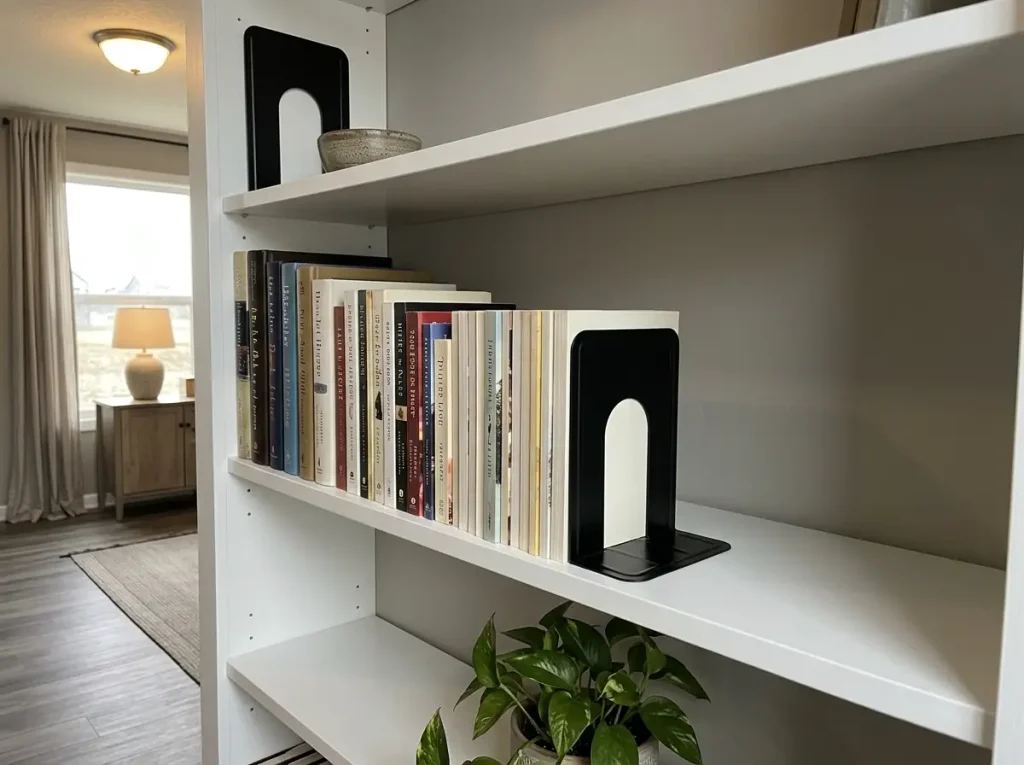
Books lean, then slump, then the whole row lies down at an angle. A heavy hardcover laid flat at the end of the row does the job for free, and honestly that’s what I’d do first. If you’d rather the shelf looked deliberate, the MaxGear 8.5 in Heavy Duty Metal Book Ends come as two pairs of 8.5-inch heavy-gauge steel, tall enough to brace trade paperbacks without disappearing behind them. The limitation is that at 8.5 inches they’re shorter than most hardcovers, so on a hardcover row they hold the base but let the tops lean.
If the real problem is that a full bookcase won’t fit the wall at all, narrow bookshelves that fit where a full bookcase won’t is the piece to read before you rearrange the room around the furniture you have.
Color-Coded, and Why Retrieval Breaks
The rainbow bookshelf looks good, and color-coded books are the most photographed sorting method there is. That isn’t in dispute, and if display is the whole point for a particular shelf, use it.
But it’s the one method that fails on retrieval, because to find a book you have to remember what color its spine is. Nobody remembers that. You end up scanning the entire unit visually every single time, which is exactly what an organizing system is supposed to eliminate.
The honest answer for most people is a hybrid: genre at the shelf level, height within the shelf. Genre gets you to the right shelf in one step, height keeps that shelf from wasting vertical space, and neither requires you to memorize anything. That’s it.
Styling the Shelf Without Losing the System
Every article on bookshelf styling opens with the rule of three and the decorative bowl. Those techniques work. They’re just being applied in the wrong order, because styling a shelf that’s already past capacity is decorating around a problem instead of fixing one. That’s why this section is seventh and not first.
Rule of Three, Negative Space, and Why They’re the Same Rule
Vignette styling is the name interior people give this, and the rule of three underneath it is real, not a myth: odd-numbered groupings of objects read as deliberate, while even-numbered ones read as accidental or symmetrical in a way the eye files as generic. Three objects on a shelf, or a group of three with a taller fourth element well away from it. Fine. Use it.
Negative space is the styling element that costs nothing and does the most, and here’s the part that makes it easy to accept: it’s the same empty fifth you left as your capacity buffer. The styling goal and the systems goal happen to agree completely. A shelf at 80% looks intentional and absorbs next month’s books. You don’t have to choose.
Objects Between the Books
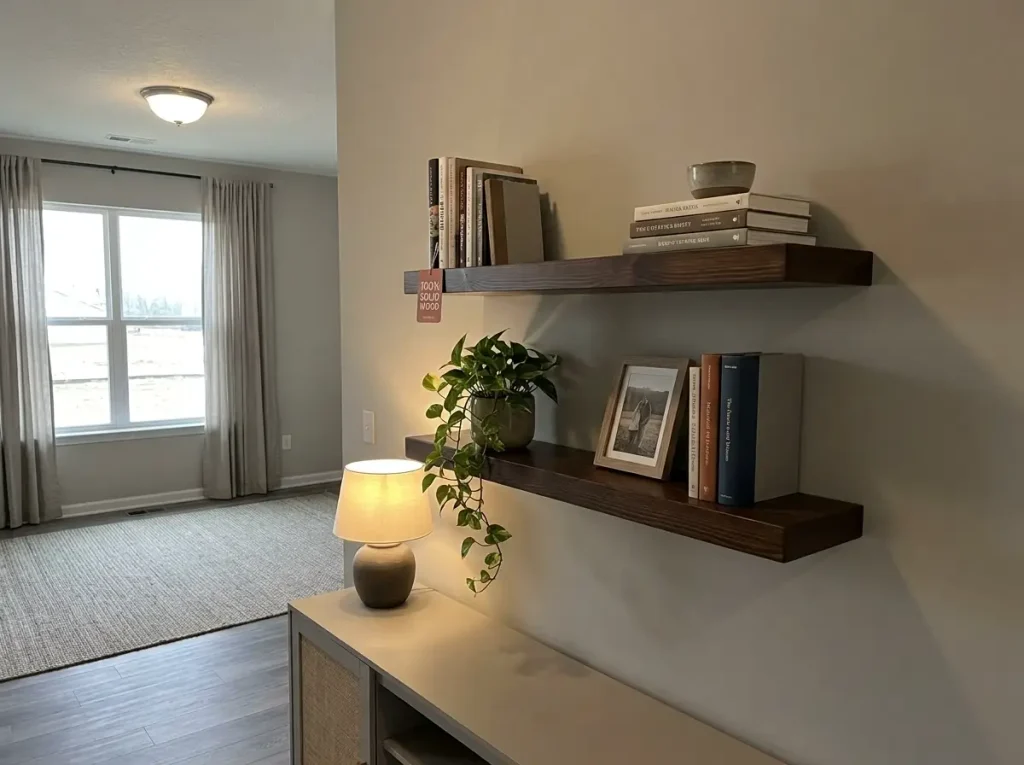
Two or three decorative objects per shelf, not a shelf’s worth. Houseplants do the most work here, and a framed photo or a stoneware bowl covers the rest. Coffee table books count as objects rather than books once you lay them flat, which is a useful reframe when a shelf is tight.
Spine-out styling stays the default for everything you actually read, because it’s the only orientation you can scan. The horizontal-stack trick earns its reputation here: lay three or four books flat, put an object on top, and you’ve broken up a wall of vertical spines while quietly absorbing books a vertical row couldn’t take. It’s the one styling move that adds capacity instead of spending it.
Bookshelves also collect non-book clutter whether you plan for it or not. Remotes, charging cables, the mail that landed there. One basket per unit, not per shelf, handles it. Before buying anything, check what’s already in the house, since a spare tray or a basket you already own does this job identically and the coordinated-basket look is not worth a purchase.
The Built-In Look Without Building Anything
Floating shelves are how renters get the built-in look without construction, and the visual difference between a good set and a cheap one is almost entirely the wood. A laminate shelf reads as a shelf. A solid wood one reads closer to millwork, especially at a deeper profile where you see the front edge.
The budget floating shelves further down this page do the same structural job for less, and if the shelf is going somewhere it won’t be examined closely, that’s the smarter buy. Where the upgrade earns it is at eye level in a room people sit in: the Homeforia 24 in Solid Pine Wood Floating Shelves come as a pair at 24 inches, and solid pine takes stain and wear the way real furniture does rather than chipping at the edge like a laminate wrap.
The tradeoff is weight. A solid 24-inch shelf is heavier empty than a hollow one is loaded, which makes the mounting hardware underneath it the thing that actually matters. For the full range, floating shelves for small spaces that hold up compares the sets by what they’ll actually carry.
Renter-Safe Shelving and the Monthly Reset
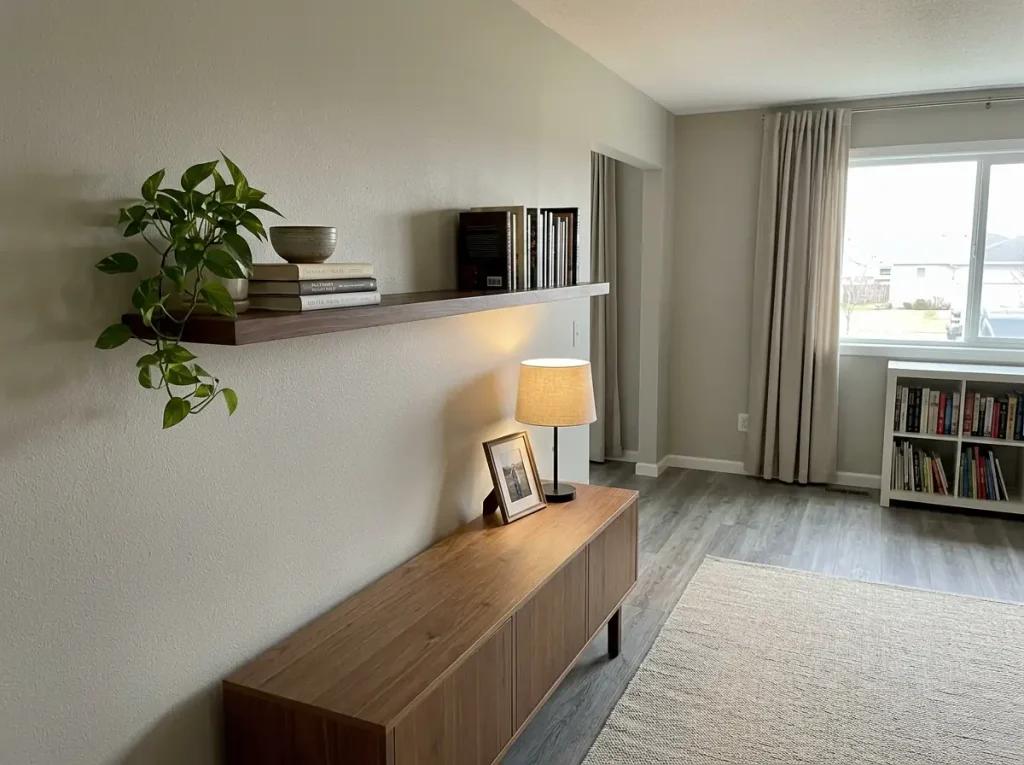
This is the section that decides whether you’re back here in six weeks. Everything above was setup. What follows is the renter-friendly shelving hardware that works without a drill into a stud, and the one rule that answers the failure from the very first section.
What a Drywall Anchor Actually Holds
The plastic anchors that come in the box with a shelf are rated under 20 pounds. At one to two pounds a hardcover, a single shelf of them passes that rating long before the shelf looks full. This is the mismatch behind most “the shelf came out of the wall” stories, and it isn’t the wall’s fault or the shelf’s.
Standard toggle bolts hold roughly 25 to 50 pounds each in shear, and heavy-duty toggles can rate up to 238 pounds in half-inch drywall. That’s a genuinely different category of hardware.
Before you buy any of it, though: if the shelf lands on a stud, you don’t need a toggle at all, and a stud finder costs less than the anchor pack. Find the stud first (a magnet on a string works if you don’t own a stud finder). When there’s no stud where the shelf has to go, the QUALIHOME Spring Toggle Bolt Anchors are a 15-pack of quarter-inch by four-inch spring toggles, metal rather than the plastic-bracket style CPSC warns against, and they come out at move-out leaving a hole you can patch and paint. The catch is that the toggle wing drops inside the wall cavity when you remove the bolt, so the hole is bigger than a screw hole and the patch is a real patch, not a dab of spackle.
No-Drill Shelving That Works in a Rental
A shelf mounted into a stud is always stronger than any alternative. Say that first, because the rest of this section is about what to do when a stud isn’t where you need one. No-stud bracket systems are a real, currently-sold category rather than a workaround people improvise, and they distribute the load across multiple small pins driven at opposing angles instead of relying on one point of grip.
The Hangman No-Stud Floating Shelves run 36 inches in black aluminum with the bracket system built in, which is long enough to span the gap between studs where a conventional shelf would have nothing to grab. At that length the load spreads across the whole bracket rather than concentrating at two points, though a 36-inch shelf is also long enough to look empty at 80% capacity, so plan for an object or two at the ends.
For a smaller run, or a first attempt where you’d rather not commit, the BAYKA Floating Shelves come as a set of three at 15.7 inches and are rated 22 pounds per shelf. That rating is worth sitting with, because 22 pounds is roughly 15 hardcovers or a comfortable row of paperbacks with room for a plant.
It is not a shelf for your art books. Pair the number with the anchor ratings above and you can size the whole wall honestly instead of hoping. For everything in this category, shelving and racks that hold up where you live is the wider guide.
The Five-Minute Monthly Reset
Here’s the rule that answers the first section, and it’s one sentence: one shelf stays at partial capacity, and every new book goes there first.
That’s your new book intake buffer, and it is the entire maintenance system in one shelf. It doesn’t need to be a nice shelf or a visible one. What it needs is to be the same shelf every time, so that new books have a destination that isn’t “on top of whatever row is closest.” It is a softer one-in-one-out rule: nothing has to leave the moment something arrives, but when the buffer fills up that’s your signal to cull, and the signal arrives before anything starts stacking sideways rather than three months after.
The monthly reset itself takes five minutes and is really one question: is anything lying flat on top of a row? If yes, the shelf is past capacity, the buffer already filled up, and you know what to do. If no, you’re done, put the tape measure away. Once the shelf holds, the rest of the small living room is the next thing worth fixing.
Conclusion
Measure the shelf before you sort it. Depth and clear height decide what’s even possible, and every method in this article assumes you know those two numbers. Cull to about 80% of what the shelf holds, because the empty fifth is the system, not wasted space. And sort by how you reach for books, not by how the shelf photographs, since retrieval is the only test a sorting method has to pass at 11pm on a Tuesday.
In three months, look for one thing: a book lying flat on top of a row. That’s the shelf telling you the buffer is full and it’s time to cull again, before the second row starts.
Start with one shelf. Empty it, measure it, and put back only what fits standing up. If that shelf still looks right in a month, do the next one. And when the bookshelf is holding, the TV wall on the other side of the room is usually the next thing quietly falling apart.
Frequently Asked Questions
01What is the bookshelf rule?
There is no single official rule, but the one most people mean is the rule of three: group objects in odd numbers so a shelf reads as deliberate rather than accidental. The more useful rule is to leave about a fifth of each shelf empty so the system can absorb new books.
02How can I arrange my books neatly on my bookshelf?
Group by genre at the shelf level, then by height within each shelf. Genre matches how you actually reach for a book, and grouping by height stops you wasting the vertical space above a row of short paperbacks.
03How to organize books with no shelf?
Floating shelves are the no-furniture answer, and no-stud bracket systems let renters mount them without drilling into a stud. For a small collection, stacking horizontally on a side table or inside a closed cabinet keeps books off the floor without adding furniture to the room.
04How should books be placed on a bookshelf?
Spine-out and upright for anything you actually read, with heavier books on the lower shelves. That is both easier to retrieve and safer, since a top-heavy bookcase is more likely to tip. Lay a few books flat only where you want a platform for an object or need to absorb a couple of extras.
05How many books fit on a shelf?
Between 5 and 12 per linear foot, so a 30-inch shelf holds roughly 12 to 30 books. The spread is that wide because it depends entirely on your books. One collector counted 45 on one shelf and 70 on another of identical size.