





















In this article
You divided the closet down the middle. You made a deal. By the second week, one of you has a jacket on the wrong side and the laundry pile on the floor is a demilitarized zone nobody wants to sort through. This happens in almost every shared closet — not because the people sharing it are inconsiderate, but because “we’ll split it in half” is a boundary, not a system.
After working through a lot of shared closet reorganizations, the pattern is clear: the space problem is almost always smaller than the habit problem. And the habit problem is almost always smaller than the maintenance problem. Fix all three and a shared closet can actually work — for both people, past the first month.
Here’s how to do it from the math up.
Quick Answer: Organizing a shared closet that stays organized for both people takes five steps.
- Measure the actual usable rod space each person gets before dividing anything
- Declutter both wardrobes independently before claiming sides
- Divide based on wardrobe type and actual volume, not just 50/50 floor space
- Install a no-drill double rod to multiply the hanging capacity per side
- Set a shared monthly reset to catch drift before it becomes a conflict
How Much Space Two People Actually Have (Do This Math First)
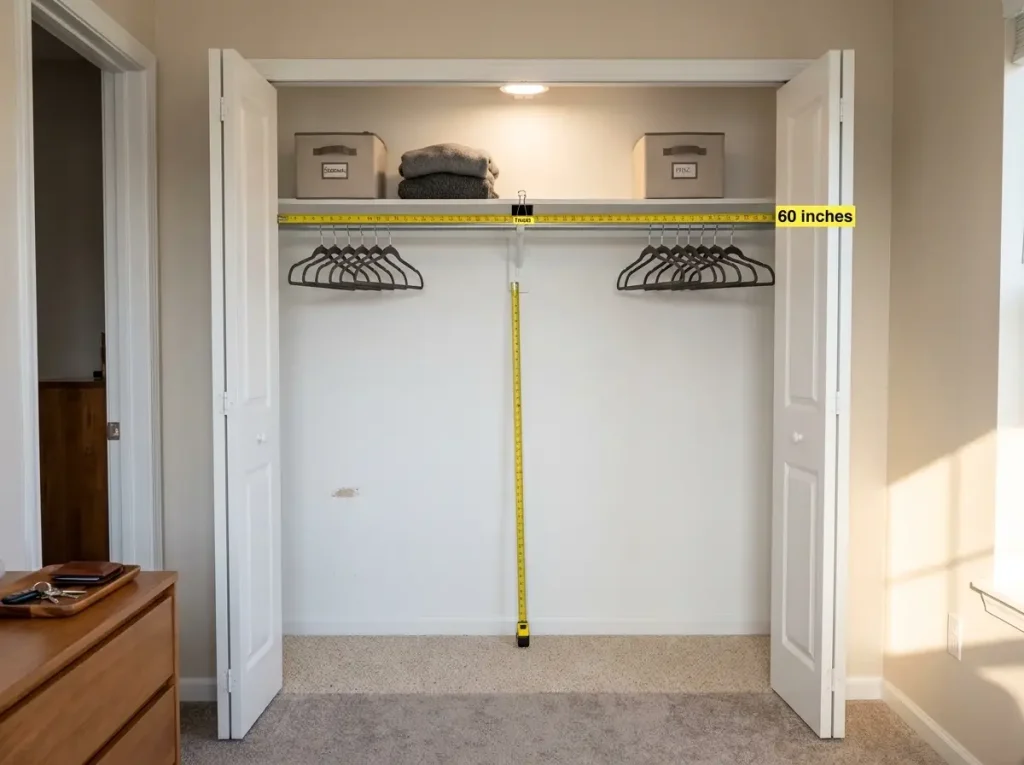
Most shared closet advice starts with “divide in half.” Before you do that, find out what half actually means.
What Standard Reach-In Closets Actually Give Two People
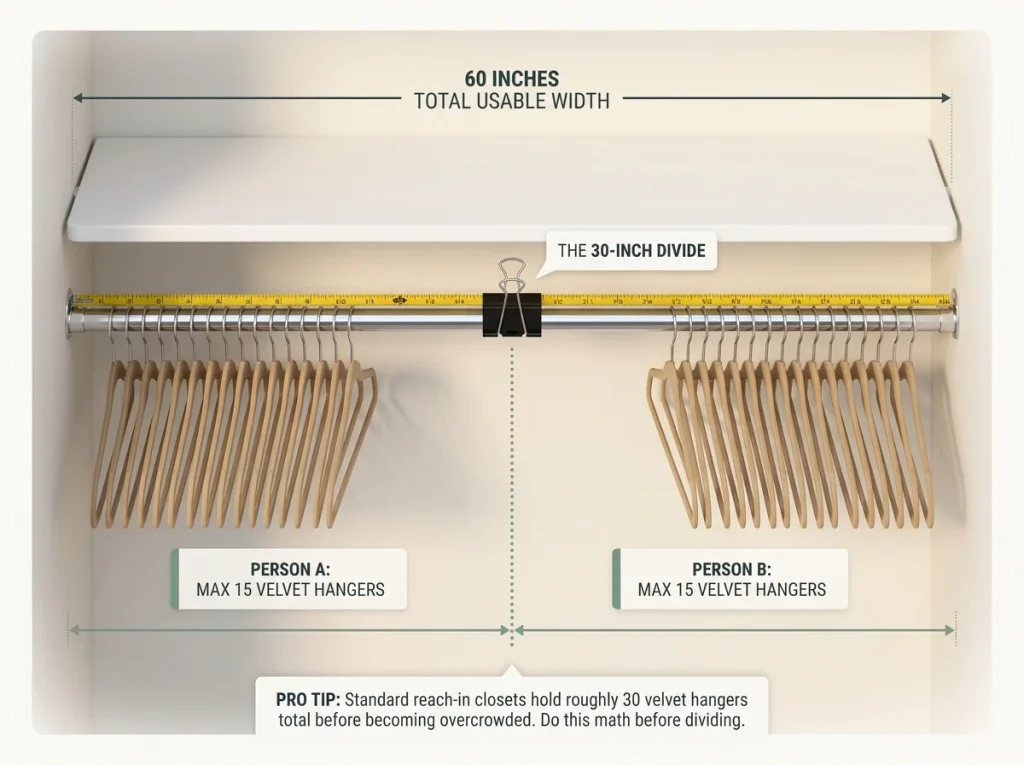
A standard bedroom reach-in closet is typically 60 inches wide and 24 inches deep. Half of that rod — 30 inches — is what one person gets for hanging clothes. At 1.2 inches of rod space per standard plastic hanger, that’s roughly 25 items maximum per side. At 0.2 inches per velvet hanger, you can fit around 40 to 45.
Most people hang significantly more than 40 items in their half of a shared closet. This is why the division fails — not because one partner is inconsiderate, but because the math doesn’t support two average wardrobes in one standard closet without modifications.
If your closet is 48 inches wide, each person gets 24 inches — around 16 to 20 velvet hangers per person. If you’ve ever wondered why your shared closet feels impossible to organize, this is the number you need to start with.
The Velvet Hanger Calculation That Changes Everything
Switching from plastic to velvet hangers is not a style upgrade — it is a capacity upgrade. Plastic hangers are typically 0.5 inches thick. Velvet hangers are 0.2 inches. In a 30-inch section, that difference translates to 10 to 12 additional items per person before reaching the same crowding point.
If you are sharing a reach-in closet and still using plastic hangers on either side, both of you are losing usable capacity. Switching to matching Zober Premium Velvet Hangers across both sides also eliminates the visual noise that makes a shared closet feel chaotic even when it is technically organized — mismatched hangers of different colors and thicknesses create visual disorder that reads as mess even when nothing is actually out of place.
For a detailed breakdown of which velvet hanger type holds which garments best, 5 Slim Hangers Tested — One Freed 11 Inches of Rod covers the five most common slim hanger options with real durability and failure data.
Pro tip: Before buying 100 velvet hangers, buy one pack of 10 and hang them on your side for a week. Check whether shirts slip off and whether your heaviest items stay in place. Velvet works for most garments but is not ideal for silk or very lightweight fabrics — those need a rubberized or notched option.
When One Closet Is Genuinely Too Small for Two Wardrobes
If you measure your closet and realize that each person’s half gives fewer than 20 velvet hangers of rod space, you are not in a sharing problem — you are in a capacity problem. No organizational system fixes a 36-inch closet for two people with two full wardrobes.
What it can do is tell you early where the overflow needs to go, before you try to fit everything in and fail. The honest answer for very small shared closets is overflow by design: one person claims the reach-in, and the other gets a wardrobe, a garment rack, or a second closet elsewhere in the apartment. More on this in the next section.
Declutter Both Wardrobes Before You Divide Anything
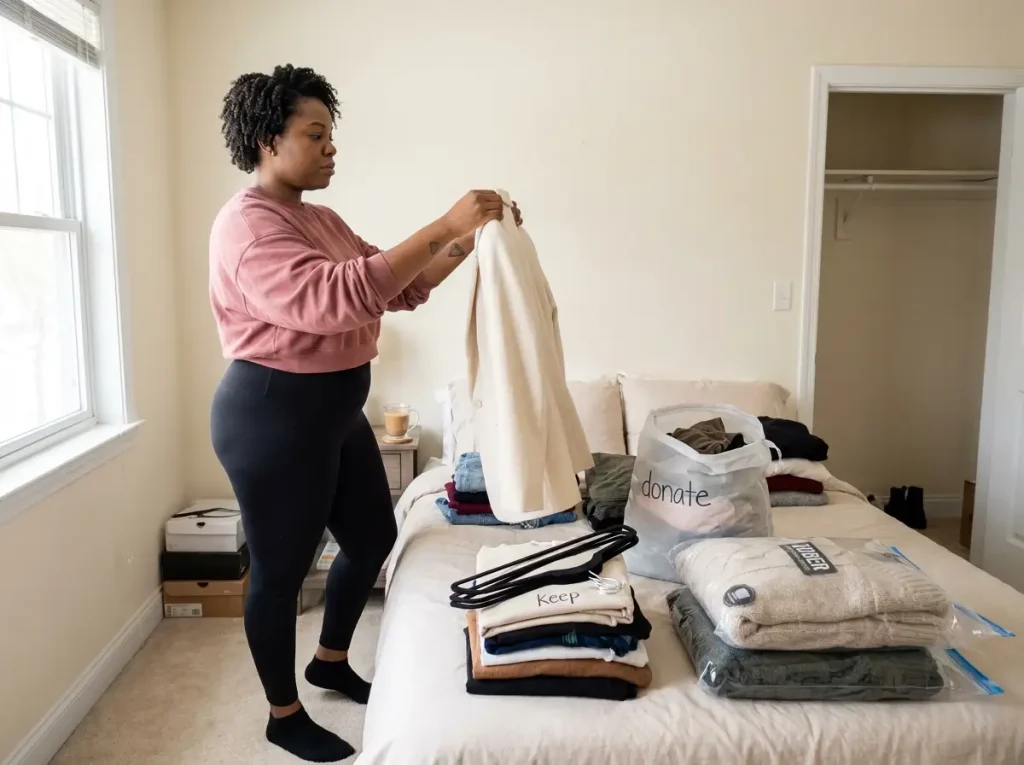
The sequence matters. Most couples divide the closet first and then try to fit their existing wardrobes into whatever space they claimed. That is backward. The division should be based on what you are actually keeping — not what you currently own.
The 30-Minute Paired Wardrobe Edit
Each person removes every item from the closet and goes through it independently. Not together — separately. When you edit your own clothes with your partner watching, the process gets tangled in relationship dynamics. Do yours while they do theirs, in different rooms if possible.
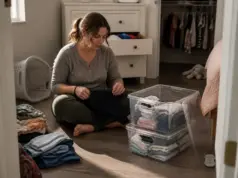
The framework: if you have not worn it in a full calendar year, it leaves. No negotiating. One pile for donation, one pile for seasonal storage, one pile for keeping. The keep pile goes back in. This step should take about 30 minutes per person if you keep moving and do not stop to try things on.
This step alone typically frees 20 to 30 percent of rod space. More importantly, it sets a baseline for what the division needs to accommodate. You might discover that one person’s wardrobe is twice the other’s — which changes the conversation about whether a straight 50/50 split is right.
For a more complete wardrobe edit process, Too Many Clothes? How to Organize a Closet That Stays Neat walks through the three-pile method with the backward hanger test for items you are uncertain about keeping.
Seasonal Items Leave the Shared Closet (Here’s Where They Go)
In a single-person closet, seasonal overflow is annoying. In a shared closet, it is a structural problem. If both partners leave winter coats in the closet through spring and summer, they are occupying rod space with items nobody is reaching for — at the expense of in-season clothes that need the access.
The rule: if it is not getting worn in the next 90 days, it does not live in the shared closet. Heavy sweaters, coats, and bulky cold-weather items go into vacuum storage bags and move under the bed, into another closet, or onto a high shelf in a compressed flat form.
The ZOBER Vacuum Storage Bags Variety Pack compresses bulky items to a fraction of their folded volume — a jumbo bag handles a full winter comforter or four thick sweaters, and the compressed result slides flat under most platform beds. This is not about hiding stuff; it is about not letting off-season items block in-season access. For timing and fabric-specific storage details, Why Your Seasonal Closet Rotation Fails Every Time covers which materials can handle vacuum compression and which cannot.
Pro tip: Label each vacuum bag with the owner’s name and what is inside before compressing. When both people’s winter items are in identical bags under the bed, “whose bag is this” becomes a real question at the start of sweater season.
Building In Secondary Storage From the Start
Once both wardrobes are edited down to what is actively being worn, you will know whether everything fits. Often it does not — and that is fine, as long as you plan for it now rather than discover it after the closet falls apart again in three weeks.
Secondary storage options that do not require extra rooms: a six-drawer dresser in the bedroom absorbs folded items from both sides. An over-door organizer on the bedroom door (separate from the closet door) handles accessories. One person’s shoes moving to a rack in the entry or bedroom corner creates meaningful floor space in the closet for both.
How to Divide the Shared Closet Space
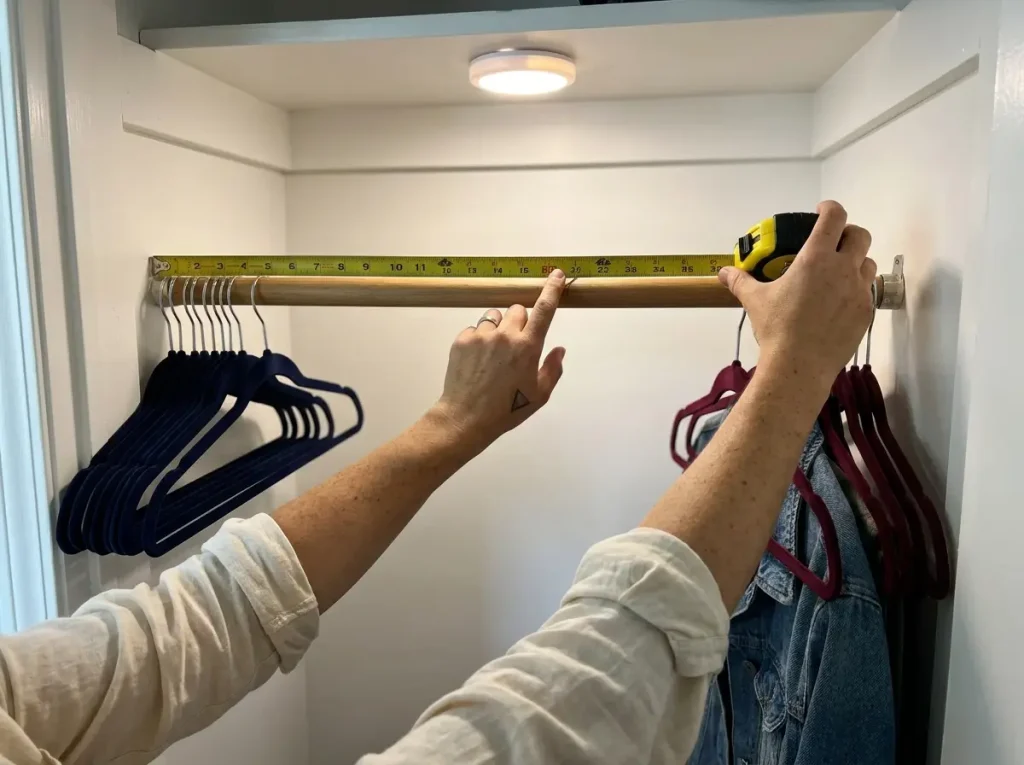
With both wardrobes edited and seasonal items cleared out, you now have an accurate picture of what the closet needs to hold. Divide based on that.
The 50/50 Default and When to Break It
Splitting the rod at the midpoint is the right starting position — each person claims one side, with the center as the dividing line. This only needs adjusting in two situations: one person’s wardrobe is substantially larger after editing, or one person’s clothing is consistently longer than the other’s (formal wear, maxi dresses, floor-length coats) and needs a specific rod section without a lower bar interfering.
If wardrobes are unequal in size, the partner with more clothing edits more aggressively first. If after editing there is still a meaningful imbalance, the solution is designated overflow storage outside the shared closet — not negotiating for more inches at the other person’s expense. That distinction matters for the long-term health of the shared arrangement.
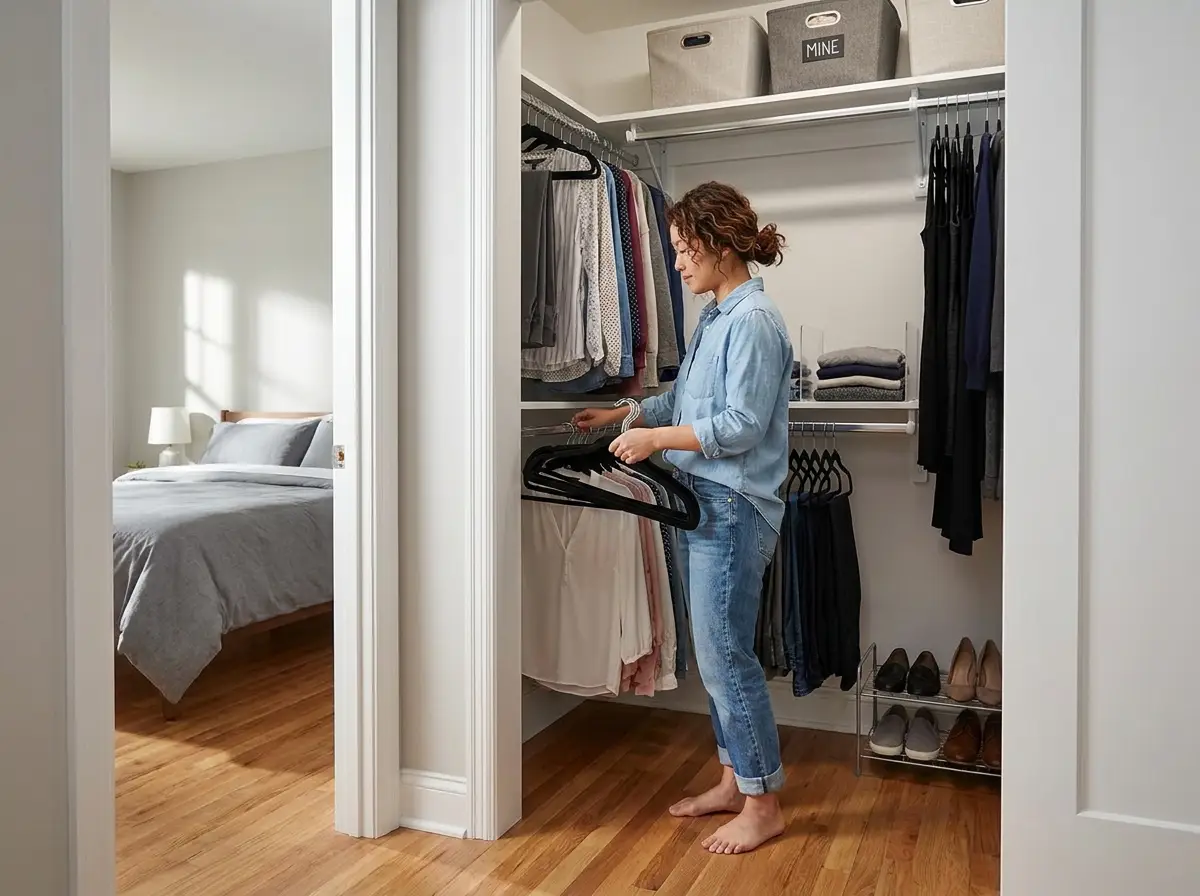
The rod is easy to divide with a binder clip or a strip of tape, but the shelf above is where the boundary tends to collapse fastest — one person’s stack of sweaters leans into the other’s, and within a week the separation is gone. HBlife Acrylic Shelf Dividers clip onto the shelf edge and stand upright between sections, giving each person a physical wall for their folded items without any drilling. At six per pack, one pack handles a full shared shelf — two dividers per person plus two for the center boundary. Check that your shelf is 0.75 inches thick or thinner; that is the standard range these clip onto.
Dominant Hand Placement (Most Couples Skip This)
If one partner is right-handed and the other is left-handed, the left-hander takes the left side.
Reaching to the back of a closet rod requires extending the dominant arm. When a right-hander takes the left side, they reach awkwardly inward across the rod to access items at the back of their section. A left-hander on the left side can reach naturally all the way to the back wall. This sounds minor until you are doing it twice a day for two years, at 6:30 in the morning when you are half awake.
If both partners share the same dominant hand, side choice does not matter functionally — pick based on who gets up first. The person with the tighter morning schedule benefits from the side closest to the door.
Zones vs. Strict Sides — Which Works Better
Two main approaches to division exist: strict sides (left belongs entirely to one person, right to the other, no overlap) and zone-based sharing (the belt rack is shared, the top shelf is split, the floor is functional for both).
Strict sides work better for couples who have significantly different organizational habits. If one partner is meticulous and the other is not, a clear visual boundary at least contains the disorganization to its own half. Zone-based sharing works better when both people have similar habits and want to squeeze every inch of efficiency out of a small space — shared shoe racks and accessory hooks use space better than duplicate setups on each side.
For most couples in standard rental apartments, strict sides with one shared zone (the closet door) is the most practical setup. It removes the negotiation over shared real estate while still capturing the efficiency of pooled door storage.
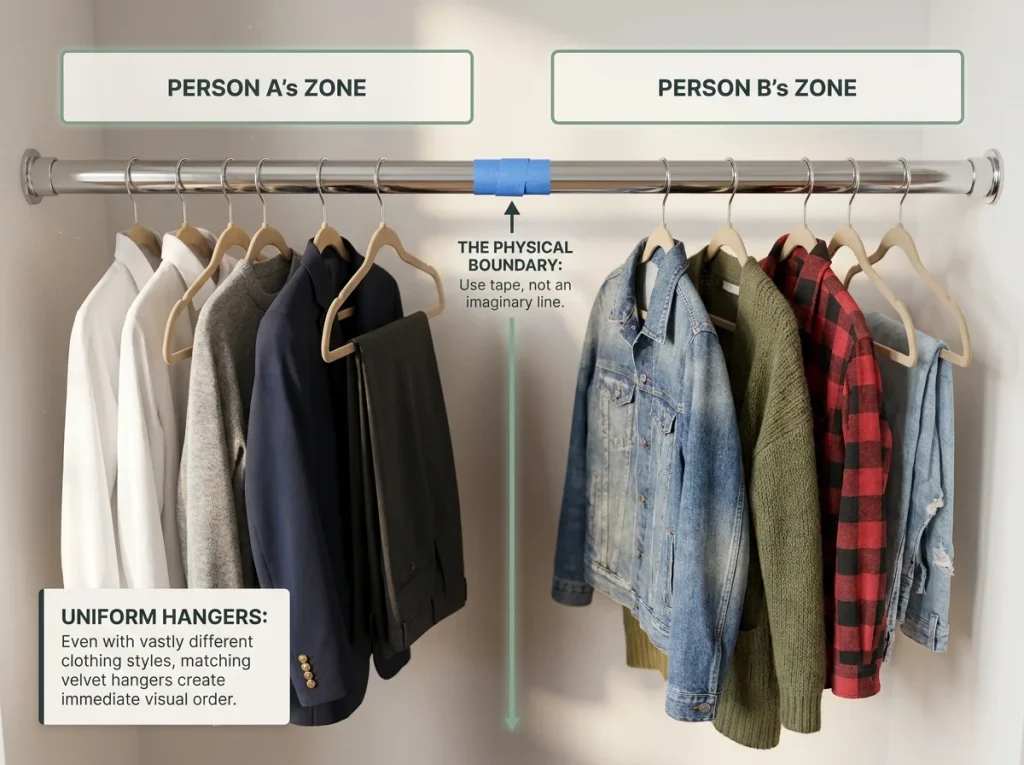
Pro tip: A strip of painter’s tape at the center of the rod is more effective than an imaginary line. A small visible marker makes the boundary clear during the first month when habits are still forming — once both sides are established and automatic, you can pull the tape.
How to Double Your Hanging Space Without Drilling
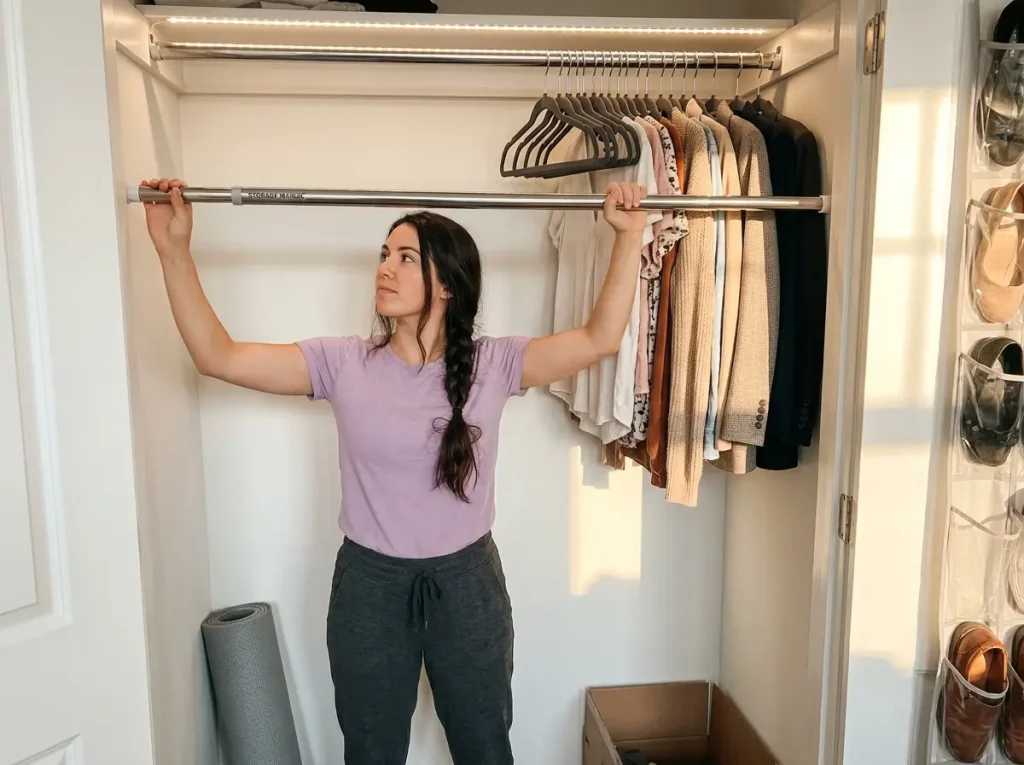
The single largest capacity improvement in a shared closet does not require a new closet system, a contractor, or any wall modifications. It requires a second rod.
The Adjustable Double Rod Setup
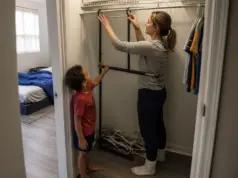
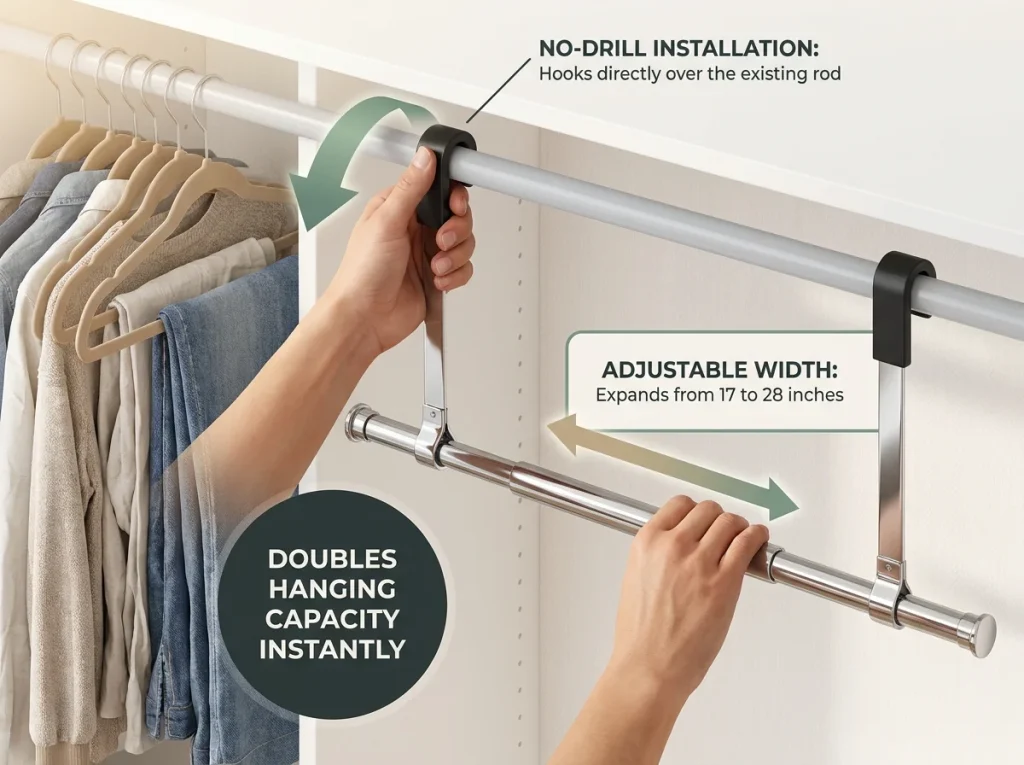
A hanging double closet rod hooks over the existing rod and drops a second bar at approximately 40 to 42 inches from the floor. This creates two hanging zones: the upper area for longer items like dresses, coats, and full-length pants on hangers, and the lower area for shorter items — shirts, blazers, folded pants, jackets.
The STORAGE MANIAC Adjustable Double Rod hooks directly onto the existing rod with no tools and adjusts from 17 to 28 inches wide, which covers most half-sections of a standard reach-in closet. The 110-pound capacity handles a full side’s worth of clothing without bending or slipping off the rod. It installs in under five minutes and comes out just as fast — important for renters who need solutions that move with them when the lease ends.
A placement note: the hanging double rod works under the section where you store shorter items. Do not install it under the section that holds dresses or long coats — that is the hanging space it is replacing. For a more complete renter-friendly system that extends beyond just the rod, No-Drill Closet Organization That Won’t Cost Your Deposit covers Command strip weight ratings, freestanding floor storage, and the full no-modification toolkit for apartment closets.
The Uniform Hanger Switch
Both people switch to the same type of hanger. Not matching colors — the same type. Velvet, same thickness, same width. When hangers are uniform, the closet reads as cohesive at a glance even if the clothing behind them varies. When hangers are mismatched — plastic, wire, bulky wood all mixed together — the closet signals disorder regardless of how organized the clothes actually are.
The Zober Premium Velvet Hangers 50-Pack at 0.2 inches thick fit 40 to 45 items in a 30-inch half-section and grip most garments without slipping. For heavier items — structured suit jackets, winter coats — keep two or three wider wooden hangers on each side. Everything else switches to velvet. One pack per person covers a typical shared closet side.
The Door as Extra Storage Real Estate
The inside of a closet door is universally wasted in shared closets. Each person has one door’s worth of over-door real estate — usually enough for 12 to 24 pockets of shoe, accessory, or small item storage that completely removes those categories from the shared shelf competition.
The SimpleHouseware Over-the-Door Shoe Organizer with 24 Pockets hangs over the door with included hooks and no drilling. Each person claims 12 pockets per door as personal overflow: sandals, flats, folded scarves, belts, sunglasses cases. This moves accessories off the shared shelves entirely, which eliminates one of the most common shared-closet friction points — accessories from both people competing for the same shelf inches.
One measurement before you buy: check the gap between the back of your closet door and the nearest shelf edge when the door is closed. You need at least 2 inches of clearance or the organizer will hit the shelf and prevent the door from closing.
Why Shared Closets Fall Apart (and the Reset That Fixes It)
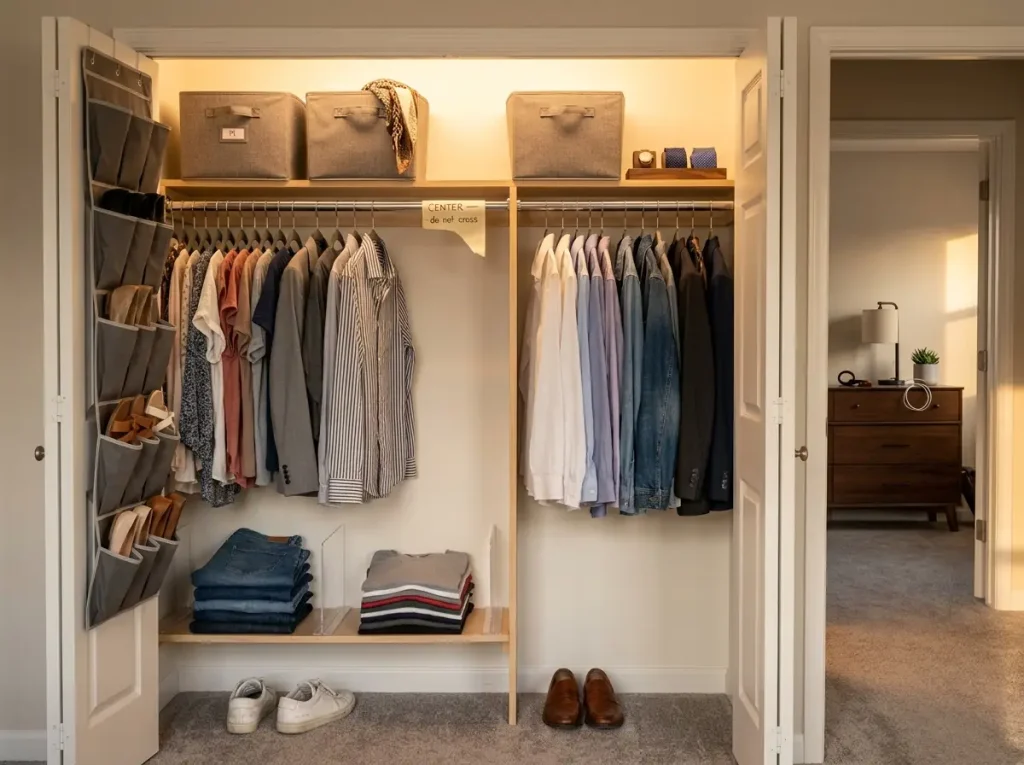
Every couple who has tried to share a closet has experienced some version of this: it works for three weeks, then one side starts migrating. By month two, the imaginary center line has moved two inches in one direction. By month three, it is an argument.
The Exact Pattern That Causes Reversion
The system does not fail because someone is disrespectful. It fails because shared systems require shared maintenance, and most couples set up the closet once and assume it will run itself.
Here is the actual failure sequence: Person A puts clothes away carefully for two weeks. Person B rushes on a Tuesday morning and drops a jacket on Person A’s side “just for now.” It stays there for a week because neither person wants to make the jacket a conversation. Then another item lands on the wrong side. By the time it is noticeable, Person A resents the drift but does not want to seem controlling, and Person B is not aware it has happened incrementally because no single moment felt significant.
This is not a character problem. It is a maintenance gap. The National Association of Productivity and Organizing Professionals identifies maintenance cadence — not the initial setup — as the primary factor in whether any shared organizational system holds past the first month. The closet needs a reset mechanism: a scheduled moment where both people return the system to baseline before drift becomes territory.
The Laundry Day Scheduling Rule
One friction point that almost no shared closet guide addresses: two people trying to put clothes away on the same day. In a standard reach-in closet, there is physically not enough floor space for two people to stand in front of it simultaneously while sorting hangers. The result is one person waiting, clothes piling on the bed, and the put-away step getting skipped entirely.
The fix: designate different laundry days. One person does laundry on Sunday, the other on Wednesday. Each person gets uninterrupted access to their side for put-away. This sounds like a minor scheduling adjustment, but it consistently reduces the “clothes on the chair” problem — which is almost always a closet access problem in disguise, not a laziness problem.
The 10-Minute Monthly Shared Reset
Once a month, both people stand in front of the closet together for 10 minutes. The only agenda: return everything to its designated side, remove anything that has drifted, and check whether the system still reflects how you are actually using the space.
This is the same reset cadence covered in Closet Organization That Still Works in Three Months, but in the shared context the “together” part is non-negotiable. One person doing the reset alone breeds resentment. Both people doing it together turns maintenance into a shared responsibility rather than a chore that defaults to whoever cares more.
If the system has drifted significantly during the monthly reset — if one side is consistently overflowing after every cycle — that is a signal to revisit the original division, not to police the boundary more strictly. The closet arrangement should reflect how both people actually live right now, not an idealized version from the first setup day.
Before You Forget
A shared closet that works for two people runs on three things: accurate space expectations (do the rod math before you divide), a system both people helped design, and a maintenance cadence that does not depend on anyone’s willpower.
Three-month check: in 90 days, do one walkthrough together. Check whether the original division still makes sense given what each person is actually wearing. Wardrobes shift. New jobs add workwear. Seasonal swaps change what needs rod space. Adjust the split before it becomes a chronic problem, not after.
Start with the hanger switch this week. Both sides to matching velvet. That single change will make the shared closet feel meaningfully more workable before anything else has changed — and it costs less than dinner out.
Q1 How do you fairly split a shared closet?
Fair does not always mean exactly 50/50 — it means each person gets the space their actual wardrobe requires, after both have decluttered to what they genuinely wear. Measure the rod in inches, edit both wardrobes first, then divide based on what is staying in the closet, not what you started with. Equal editing effort matters as much as equal space.
Q2 What’s the best way to organize a small closet for two people?
The most effective single change in a small shared closet is a no-drill hanging double rod, which creates a second tier of hanging space at around 40 inches from the floor without touching the walls. Pair that with a uniform velvet hanger switch on both sides and the usable hanging capacity nearly doubles in the same physical footprint.
Q3 How do couples share one small closet without fighting?
The fights are almost always about drift, not the initial setup. A monthly 10-minute reset where both people return items to their side prevents small encroachments from becoming ongoing resentment. Scheduling separate laundry days also removes a daily friction point most couples do not realize is driving conflict — two people cannot efficiently use a reach-in closet at the same time.
Q4 How do you organize a shared closet when one person has more clothes?
The partner with more clothes edits more aggressively first — they do not automatically claim more space. If after a real edit there is still a meaningful imbalance, the solution is designated overflow outside the shared closet (a dresser, a second closet, a wardrobe in another room) rather than negotiating inches at the other person’s expense.