






















In this article
The expandable divider you bought last spring doesn’t span the drawer anymore. It has drifted back toward the width it came in at, and the forks have started sliding underneath it again. That isn’t a defective product, and buying a nicer version of the same mechanism won’t fix it. Most roundups of the best kitchen drawer organizers sort by star rating; this one sorts by the part that actually breaks. Six picks, one measuring method, and the honest reason the cheap ones creep.
Here’s the short version of every pick below, and how each one holds its length.
| Organizer | Best For | Material | How It Holds Its Size |
|---|---|---|---|
| madesmart Expandable Utensil Tray | Best overall, shallow utensil drawers | BPA-free plastic | Snap-in piece, no spring |
| Lifewit 8-Pack Drawer Dividers | Best budget, zoning several drawers at once | Plastic | Spring tension |
| SpaceAid Bamboo Drawer Dividers | Best bamboo, wood instead of plastic | Solid bamboo | Sliding track, keep it dry |
| RAPTUROUS Deep Drawer Divider | Best for deep drawers, pot lids upright | Plastic | Spring tension |
| Bambusi In-Drawer Knife Block | Best for knives, fixed slots | Solid bamboo | Fixed size, nothing to loosen |
| Dial Industries Spice Organizer Tray | Best for spice drawers, top-down labels | Plastic | Sliding tray sections |
Why Kitchen Drawer Organizers Stop Holding Their Size
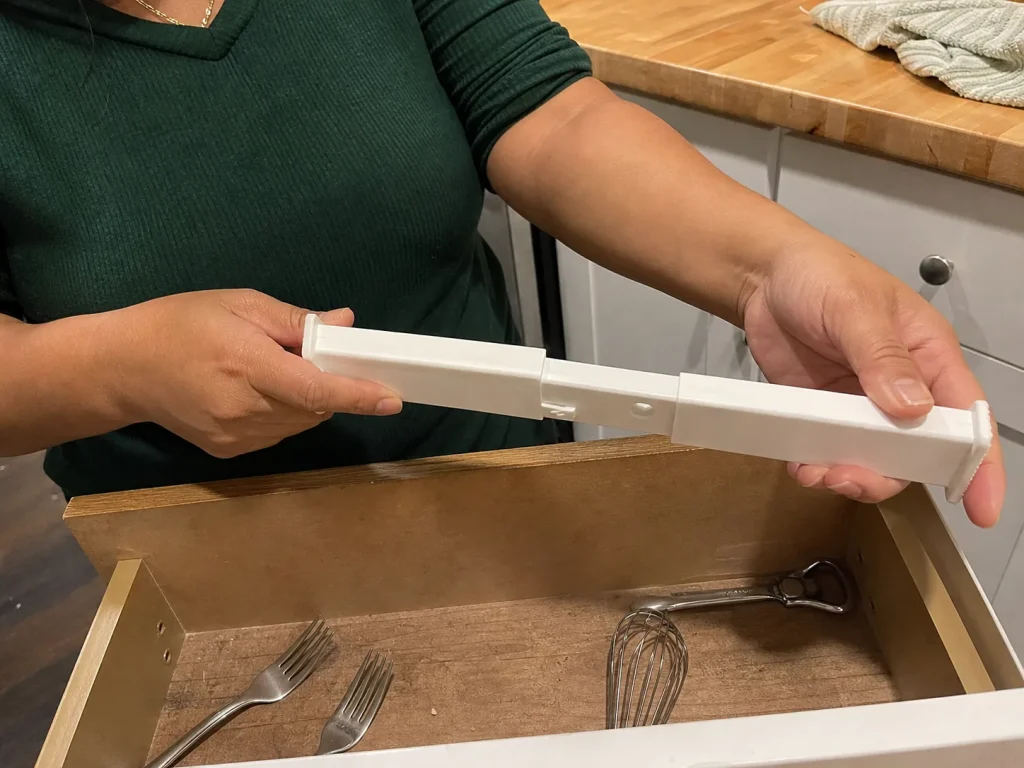
Nobody tells you the divider isn’t broken. It did exactly what it was built to do, right up until the day it stopped, and the reason is a piece of plastic roughly the size of a grain of rice. Once you know what that piece does, this entire product category sorts itself into two piles, and picking becomes much less of a coin flip.
Organizing threads have a name for the symptom before they have an explanation for it. People describe spring-loaded dividers that creep back to original size, or say the thing ka-jolted on them one day and never held again. Both phrases describe the same failure, and it isn’t gradual wear on the panel. It’s one small part letting go.
What Actually Breaks Inside a Spring Divider
A spring-loaded expandable divider holds its length with an internal tension spring and a small locking nib that catches at your chosen width. Push the divider past its rated range, or force it into a drawer that’s a hair too tight, and that nib snaps. After it goes, the two halves slide past each other freely and the divider can’t hold any set length at all. Nothing about that is a manufacturing defect. It’s a part with a finite life reaching the end of it early.
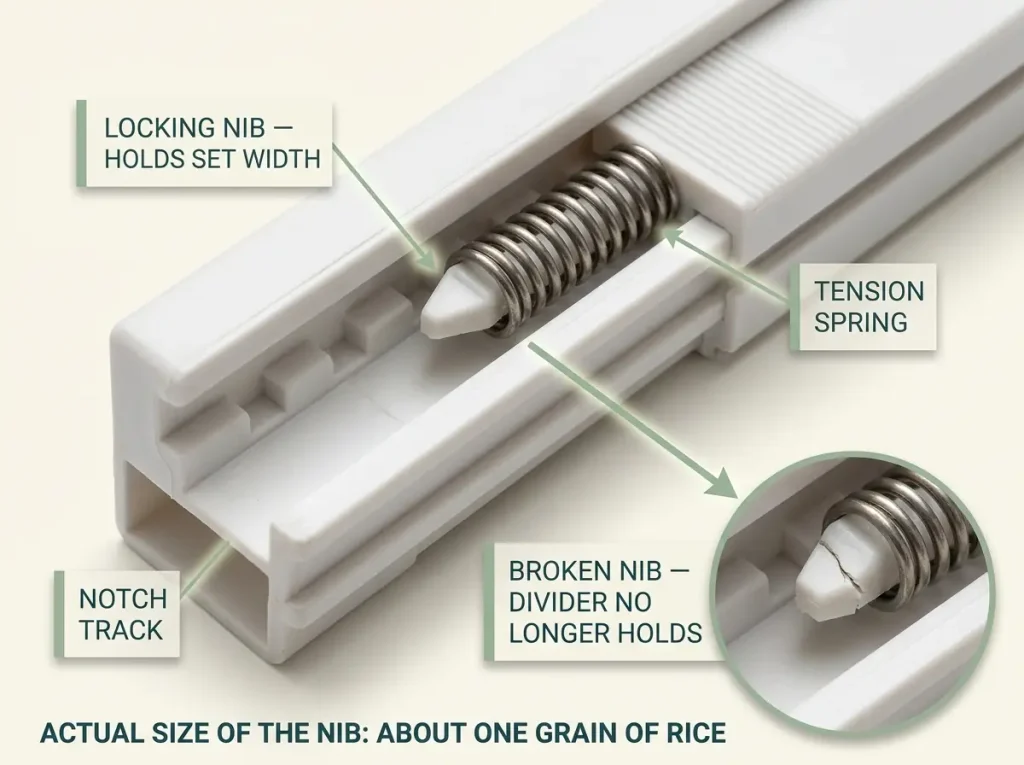
The failure is also silent. You don’t notice the day the nib gives; you notice three weeks later, the fourth time a fork wedges itself under the tray edge and you can’t figure out why the drawer got worse.
Sagging Plastic and the Drawer That Starts to Stick
The second failure has nothing to do with springs. A plastic tray that doesn’t match the drawer’s real interior depth, or one loaded past what it’s rated to carry, sags in the middle over months of ordinary use. That sag is what starts catching the drawer track. So if a drawer begins sticking a few months after you added an organizer, check the tray before you blame the slides. The slides are usually fine.
Why Bamboo Fails at the Track, Not the Panel
Bamboo gets bought on the assumption that solid wood outlasts plastic, and structurally that’s fair. But the panel was never the fragile part. The failure point on an adjustable bamboo divider is the sliding track where the two sections meet, and what kills that track is moisture. Hand-wash it, dry it immediately, and keep it out of the dishwasher.
All of which produces one simple sorting rule: organizers that expand by snapping in a physical extension piece have nothing to fatigue, while organizers that expand by spring tension have one part with a countdown on it. Neither is wrong. You just need to know which one is sitting in your drawer. If you want the whole-drawer method rather than a product, the drawer system that survives real life covers the zoning and reset side of this.
How to Measure Your Drawer Before You Buy Anything
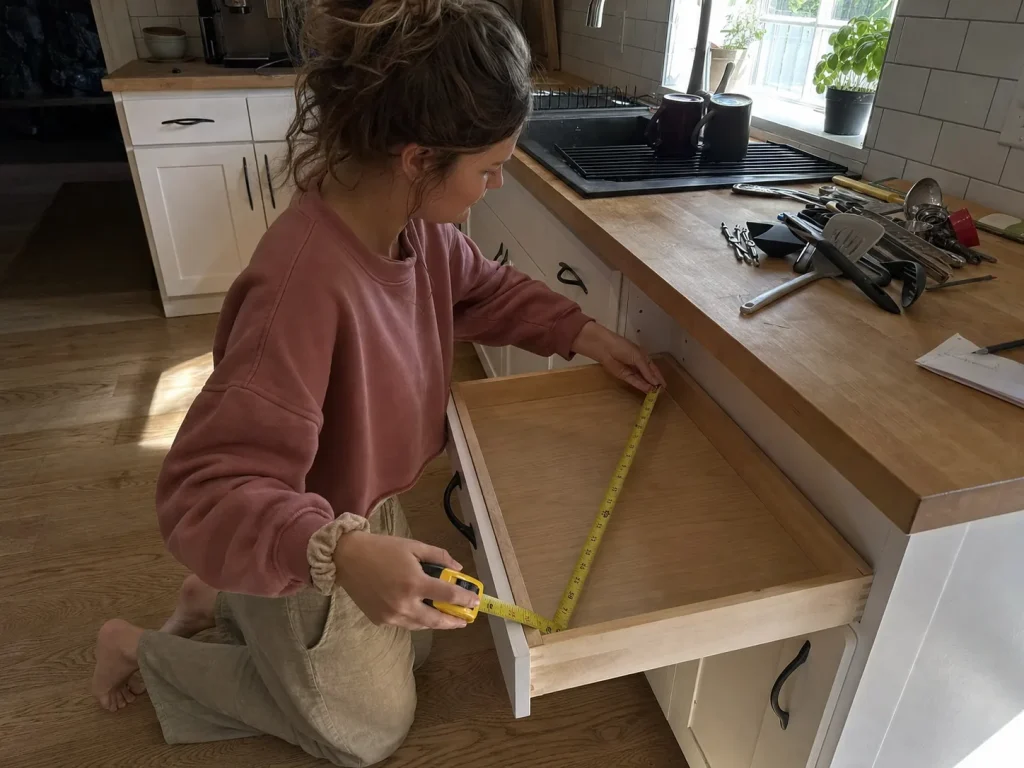
The “13 to 19 inch expandable” number printed on the box describes the organizer. It says nothing about your kitchen. Almost every returned organizer in this category starts with somebody measuring the wrong thing, or measuring nothing at all and trusting the word “expandable” to cover it.
Width, Depth, Height, in That Order
Measure the inside of the drawer box, not the cabinet face (yes, with an actual tape measure — eyeballing a drawer is how you end up with a return label). According to NKBA’s kitchen planning guidelines, standard base cabinets run 24 inches deep, but once you account for the drawer-box hardware and the face frame, usable interior depth lands closer to 18 to 21 inches. Those are two different numbers, and the organizer only cares about the second one.
Drawer widths track cabinet door widths, so yours is probably 12, 15, 18, 24, or 30 inches. That matters more than it sounds: a divider built to adjust from 17 to 22 inches was designed for an 18 to 24 inch cabinet and will not compress down into a narrow 12 inch drawer. Forcing it is precisely how you snap the nib on day one.
Height is the third number and the one everyone forgets. Shallow utensil and silverware drawers run about 3 to 4 inches at the front panel; deep pot drawers run 8 to 10. Drop a 2 inch tray into a 9 inch drawer and you’ve organized the bottom fifth of it.
The Number on the Box Describes the Organizer, Not Your Drawer
Here’s the trap in the middle of that. An expansion range is a range of the product’s own sizes, not a promise about fit. A tray that expands to 20.88 inches wide in a 22 inch drawer leaves a gap at the side, and things migrate into gaps. Read the range as “this is what I can become,” not “this will fill whatever you own.”
Where to Leave Clearance
Measure, then leave room for two things the tape doesn’t show you: the divider’s own hardware, and your fingers. A tray packed edge-to-edge with a whisk in it is a tray you’ll fight every morning. That same measure-first discipline is the same measure-the-opening-first rule that decides whether a pull-out fits in the cabinets below.
Put the three numbers in your phone’s notes app the moment you measure, labeled by drawer. Width, depth, height. You will be standing in a store or scrolling a product page three days later with no tape measure and no memory of which drawer was which, and this is the entire difference between buying once and buying twice.
Best Overall: madesmart Expandable Utensil Tray
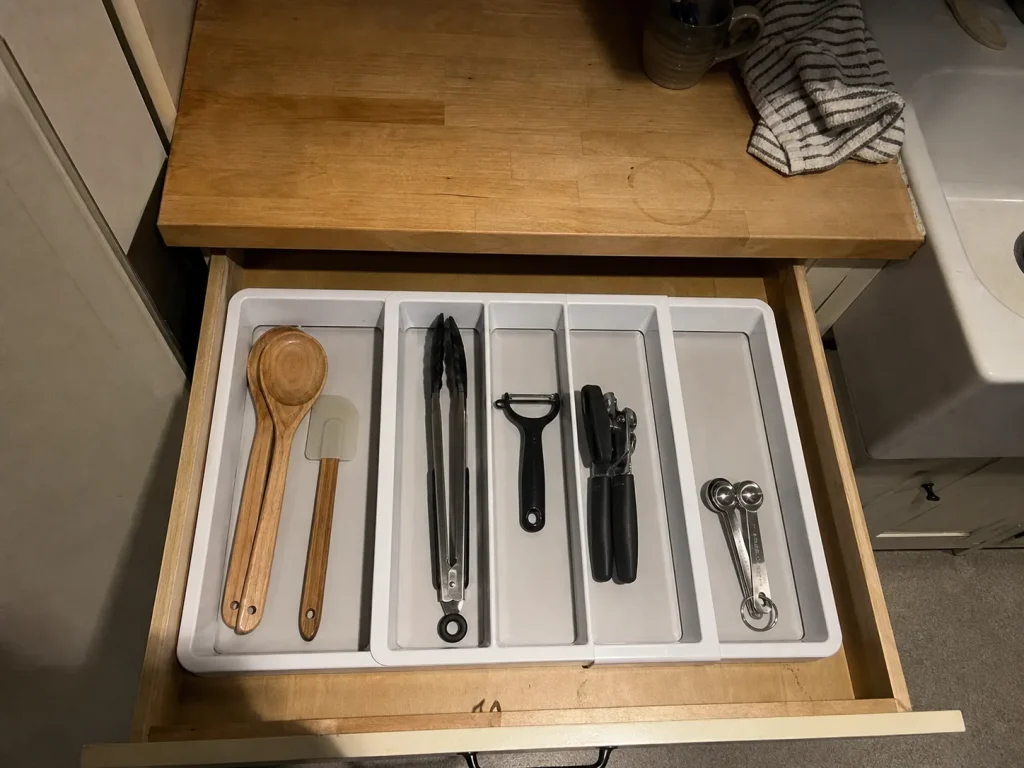
Shop this category for ten minutes and you’ll see the same object sold as a silverware organizer, a flatware organizer, and a cutlery tray. Three names, one product. The only thing separating them is which drawer you happen to put it in, and clearing that up early saves you comparing things that were never different.
This is the pick for someone with one annoying drawer who has no interest in becoming an expert in divider hardware. It wins on the most boring possible reason: there’s no spring inside it.
Why Snap-In Expansion Outlasts a Spring
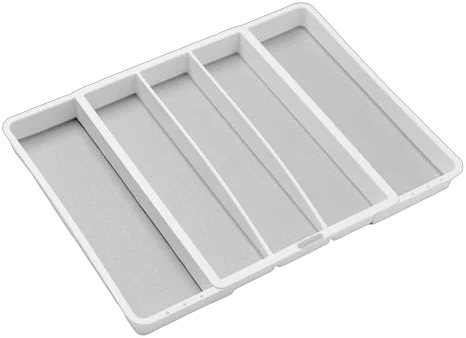
It starts as a 3-compartment tray at 12.5 by 15 inches and expands to 20.88 inches wide by snapping in a physical extension piece. No tension, no nib, nothing under load waiting to let go. Set against the failure from the first section, that’s the whole argument. It also has a soft-grip non-slip base, which stops mattering in a quiet household and starts mattering a lot in a busy one.
Before you buy it: if your drawer holds four utensils and a can opener, you don’t need this. A 16-pack of clear plastic beverage cups from a dollar store works as makeshift dividers and costs about as much as a coffee. Buy the tray when the drawer has enough in it that finding things takes real time.
The Drawer Widths Where It Doesn’t Fit
At 2.2 inches tall it’s built for a shallow drawer, the utensil and silverware kind, and it does not compress below its collapsed footprint to meet a narrow one. It also isn’t the answer for anything with a long handle, since whisks and ladles need deeper slots than forks do and this tray’s compartments are sized for a general mix. In a deep pot drawer it wastes most of the vertical space, which is what the RAPTUROUS pick further down exists to fix.
Best Budget: Lifewit 8-Pack Drawer Dividers
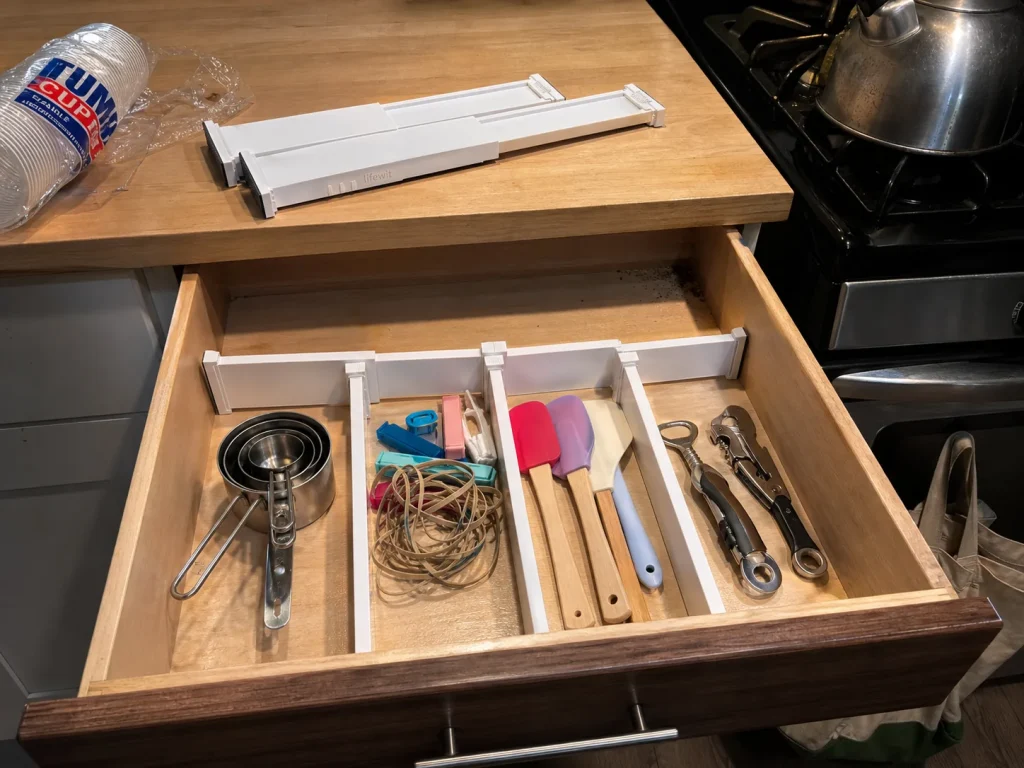
Most budget picks get written as a consolation prize. This one deserves better framing, because the gap between a cheap divider and an expensive one is smaller than the price gap suggests.
What You’re Actually Giving Up
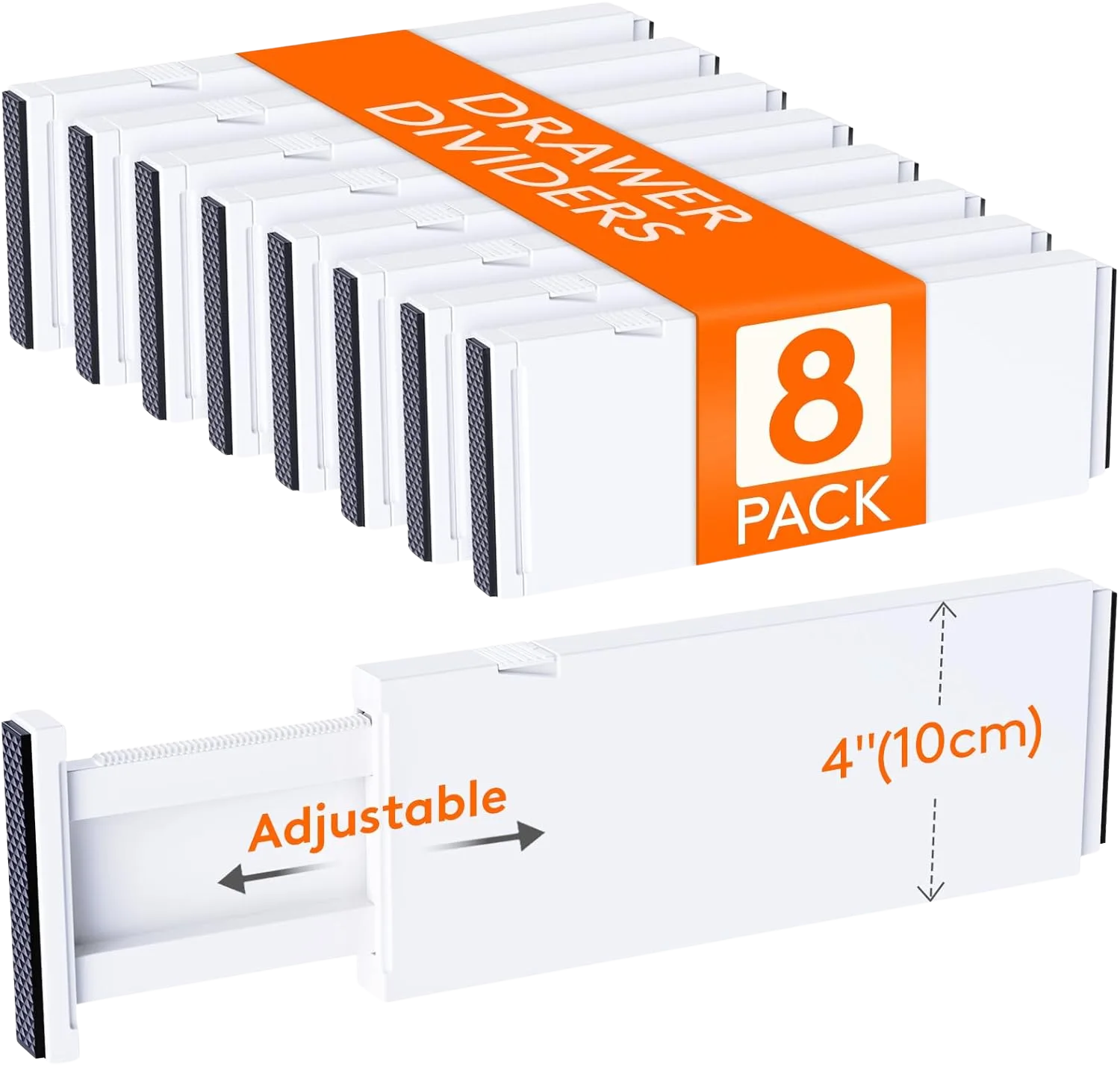
Eight adjustable pieces, 4 inches tall, adjusting from 11 to 17 inches. The count is the real value here: one pack zones several drawers, not one. And 4 inches is a genuinely different job from a 2 inch tray, useful in the mid-depth drawer where a shallow tray disappears.
What you give up is the mechanism. These are spring-tensioned, so everything from the first section applies. Respect the 11 to 17 inch range, set them once, and don’t muscle them into a 10 inch drawer.
I used to steer people toward the priciest divider set on the theory that more money bought a better way of holding a length. Enough side-by-side comparison threads landed on the same verdict that I stopped: past a low floor, you’re paying for material and finish, not for engineering. A premium bamboo divider and a budget plastic one frequently hold their width by the identical spring mechanism. That’s worth knowing before you decide the expensive one will last longer, because on that specific axis, it often won’t.
The Free Version to Try First
Before any of this, run the free tier. A pack of clear plastic beverage cups from a dollar store makes perfectly serviceable silverware dividers. If the zones you improvise survive a month of real cooking, you’ve learned your layout is right and you can buy dividers with confidence. If half the cups end up holding nothing, you just saved yourself the purchase. The same logic scales to the same divider logic applied to dresser drawers if the dresser is next on your list.
Best Bamboo: SpaceAid Bamboo Drawer Dividers
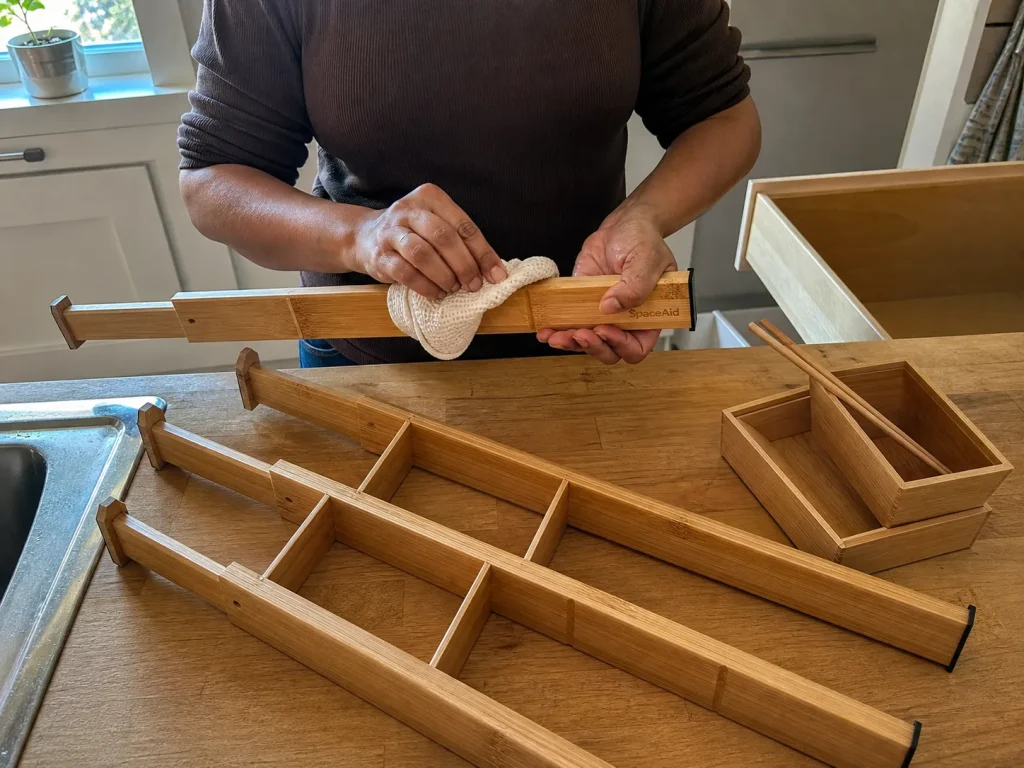
Bamboo is the eco-friendly organizer most people reach for, and it’s also where “nicer material lasts longer” quietly stops being true, for a reason nobody warns you about at checkout.
Solid Bamboo Versus Veneer
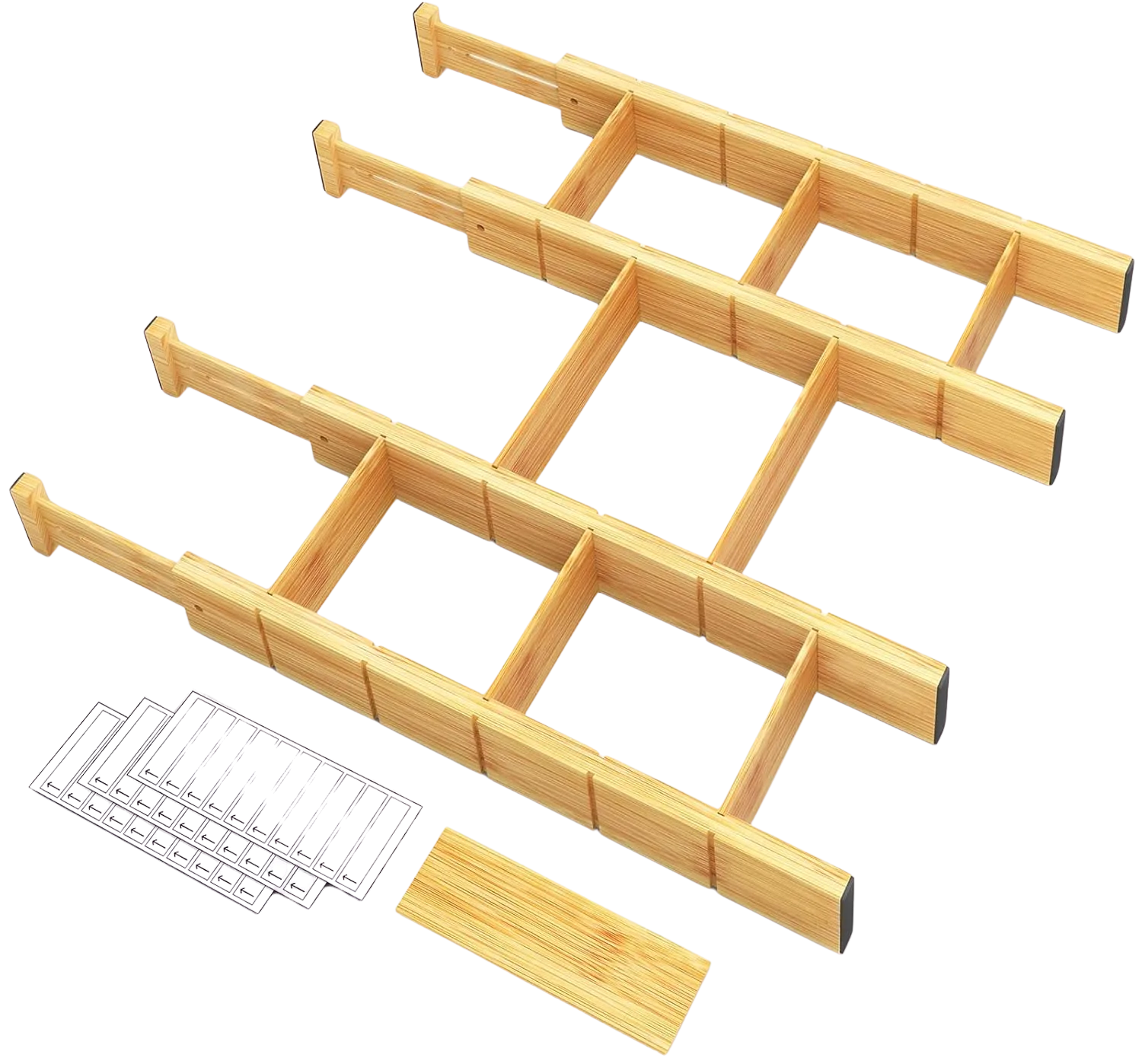
These are solid bamboo, not veneer, and the distinction earns its place. Veneer delaminates at cut edges, and a divider’s edges are exactly where a sliding section rubs. Solid stock doesn’t have that seam to fail at. It’s also worth reading the listing as a system rather than a part: this ships as a 4-piece kit with small insert bins and labels, adjusting from 17 to 22 inches per divider. Compare that against a single plastic tray and the sticker price starts making more sense. Why wood dividers keep showing up in minimalist kitchens is mostly this: they read as furniture rather than as storage.
That 17 to 22 inch range is built for an 18 to 24 inch cabinet. In a narrow drawer it simply doesn’t apply, and no amount of wanting it to will change that.
The Track Is the Part That Fails
Here is the rule that decides whether this outlives your lease: hand-wash it and dry it immediately. Moisture at the adjustable track is the failure mode, and a dishwasher cycle is the fastest possible route there. If your drawer sits next to a dishwasher vent, or your household’s genuine answer to “how do we clean this” is “it goes in the machine,” take the Lifewit plastic and spend the difference on something you’ll actually enjoy.
When you wash a bamboo divider, dry the sliding track first and the flat panels second. The panel dries on its own in twenty minutes on a counter; water sitting in the track doesn’t, because there’s no airflow in there. That groove is the only part with a real failure mode, and it’s the part everyone towels off last.
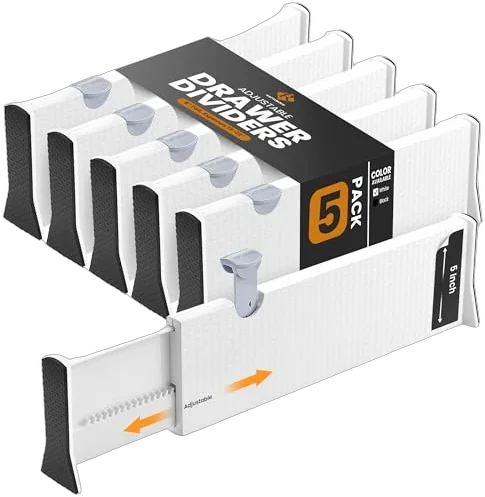
Best for Deep Drawers: RAPTUROUS Adjustable Deep Drawer Divider
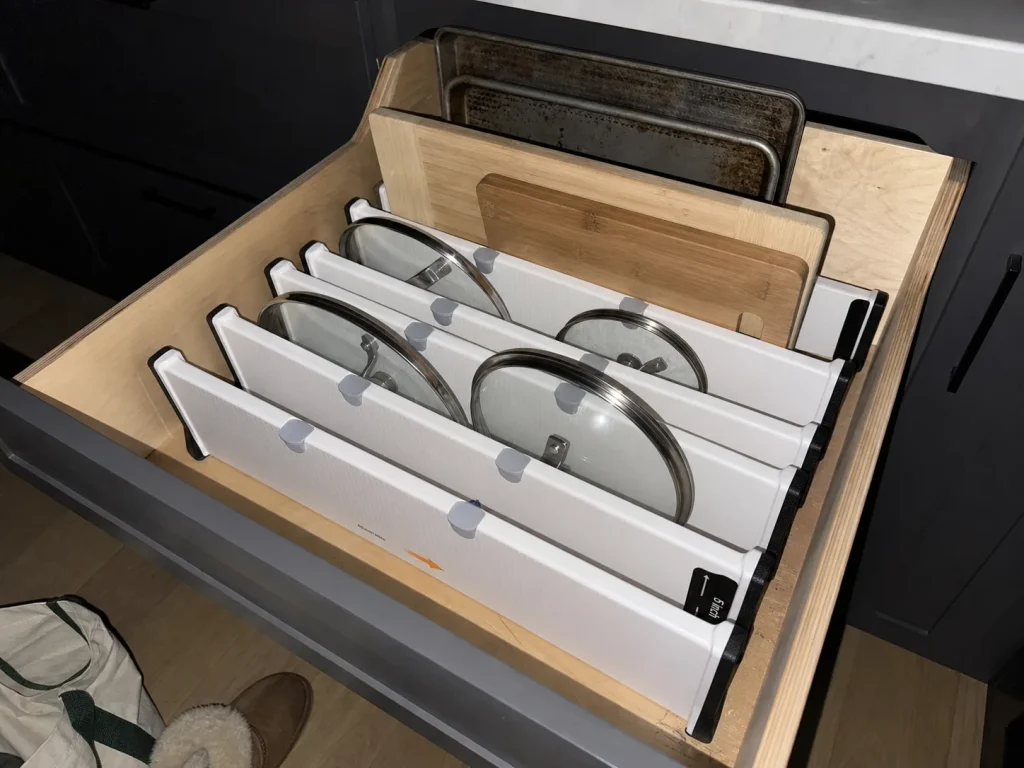
Deep drawers fail differently from shallow ones. Nothing snaps and nothing sags. The space just quietly stacks itself into a pile you have to dismantle every time you want the lid at the bottom.
Why Height Is the Spec People Skip
This divider stands 5 inches tall and adjusts from 13 to 22 inches, and the height is the entire reason it exists. A standard 2 to 3 inch utensil tray physically cannot hold a pot lid or a cutting board upright; the item just tips flat and you’re back to stacking. Height is also the spec shoppers skip most often, and then return the product over.
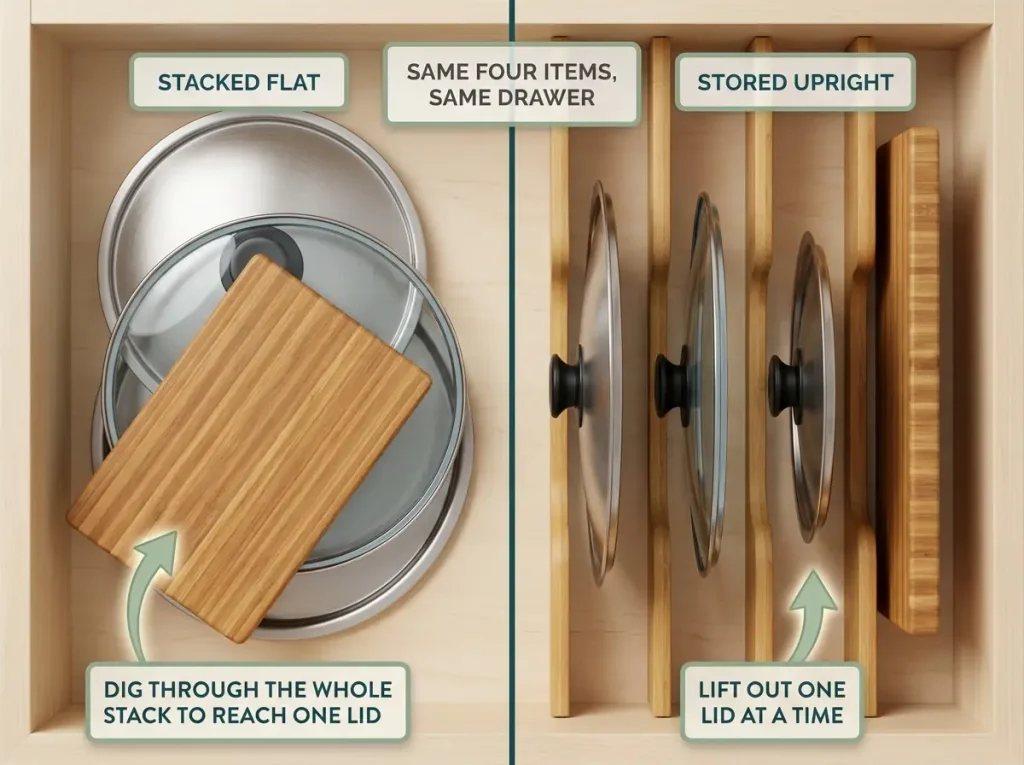
Vertical is the whole point. Lids and boards standing on edge means you take one out without unstacking four, which is also why why your pots and pans system falls apart in a month is usually a lid problem wearing a pot costume. One caution on loading: the CPSC’s furniture stability standard, built around loaded-drawer testing simulates up to 60 pounds of pull force on open drawers. That standard governs freestanding clothing storage units and not your anchored kitchen cabinetry, so it isn’t a rule about your kitchen. The transferable lesson still holds: a deep drawer loaded with cast iron and sheet pans is not a step stool and not something to haul yourself up on.
The Dollar-Store Test to Run First
Before you spend anything on a dedicated deep-drawer divider, lay a wire dish-drying rack from a dollar store on its side inside the drawer. It creates ready-made vertical slots for lids and boards for a few dollars, and more importantly it tells you within a week whether vertical storage matches how you actually cook. Some people reach for the same two lids daily and never touch the rest. Those people don’t need this product.
Best for Knife Storage: Bambusi In-Drawer Knife Block
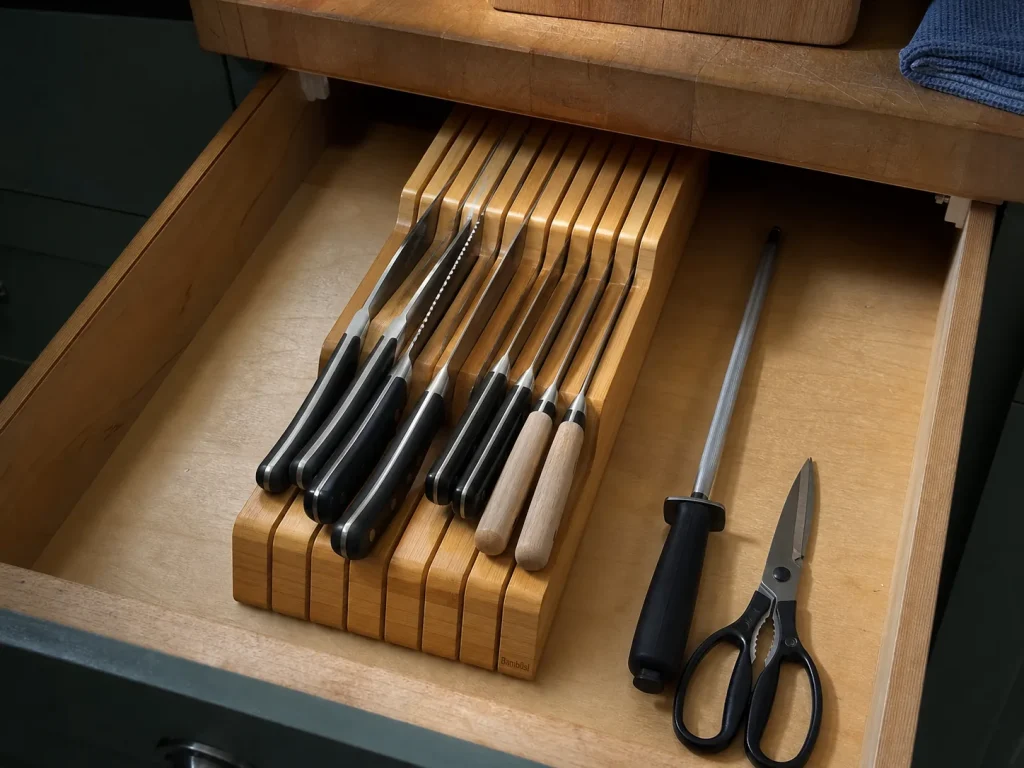
Loose knives in the utensil tray is where almost everyone starts, and it fails on two counts at once. The blades dull against everything else in the compartment, and reaching blind into that tray is the part of cooking nobody enjoys.
Why Loose Knives in a Utensil Tray Is the Real Problem
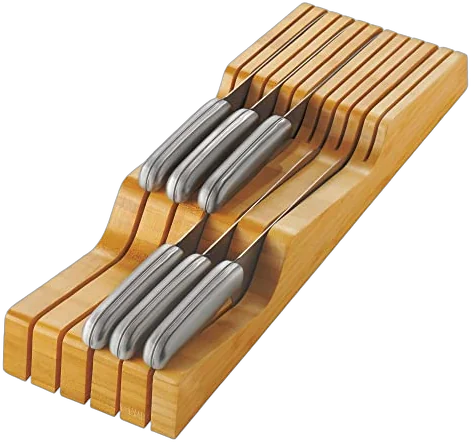
Blades rattling against metal utensils in a shared compartment take the edge off a decent knife long before your cutting board ever does. The tray isn’t at fault; it was designed to hold spatulas. Putting a chef’s knife in it is asking a product to solve a problem it was never shaped for. A bamboo in-drawer knife block at 17 by 5.3 by 2 inches holds blades in fixed slots with the edges protected, and it keeps them well out of reach of a curious toddler in a way a countertop block never manages.
Slot Count Versus the Set You Actually Own
In-drawer knife blocks get recommended everywhere, and they earn it, unless your drawer is shorter than 17 inches or shallower than the block is tall. Then it’s just an expensive board that won’t let the drawer close. Check both numbers against your measurements from earlier, because this one does not expand and has no interest in negotiating.
Sixteen slots covers most 8 to 12 piece sets with room to grow. Count the knives you own before you buy, not the ones the set advertised. And if you own three knives total, a blade guard on each plus a corner of the madesmart tray does this job for a fraction of the effort. This pick is for the drawer that already has a real set living in it.
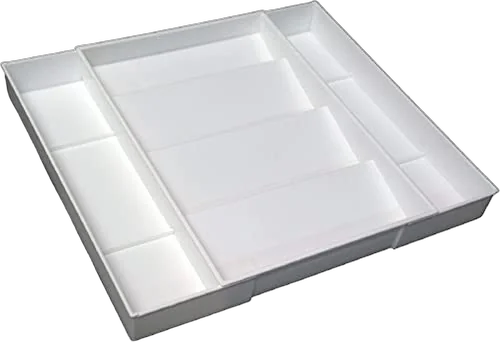
Best for Spice Drawers: Dial Industries Expandable Spice Organizer Tray

A spice drawer is not a small utensil drawer. You interact with it from a completely different angle: straight down, hunting one jar among thirty, usually with something already going on the stove.
Why the Tiers Have to Angle
That viewing angle is the whole design problem. Lying flat in rows, a jar’s label faces the ceiling and the back two rows are effectively invisible, so you end up lifting jars out to read them and putting them back in the wrong order. Angled tiers turn each label toward you as you look down. That’s the only thing this product does, and it’s the only thing that needed doing.
Expandable matters here too, because a spice drawer is usually both shallower and narrower than a utensil drawer, and a fixed tray will either float in a gap or refuse to go in.
Measure the Drawer Height, Not Just the Width
In-drawer spice tiers stack two to four high. If a two-tier stack doesn’t clear the drawer’s top edge, the drawer won’t close, and you’ll discover this after you’ve filled every slot. Height first, width second. If your drawer fails that check, the cabinet is where spices go when the drawer runs out and there’s no shame in it.
The free version, as always, goes first: an egg carton sitting in the drawer holds jars at an angle for nothing at all. It looks like exactly what it is. But it tells you inside a week whether the angled-tier approach suits how you cook, before you commit to a tray.
Before you buy any spice tray, stand your tallest jar upright in the drawer and close it. Not your average jar. The tall one, the vanilla or the oversized cinnamon somebody gave you. If that jar clears on a tier, everything else will. If it doesn’t, you’ve just learned it lives in a cabinet and the drawer holds the other twenty-nine.
Every Pick Here Is Renter-Safe (and the One Thing That Isn’t)
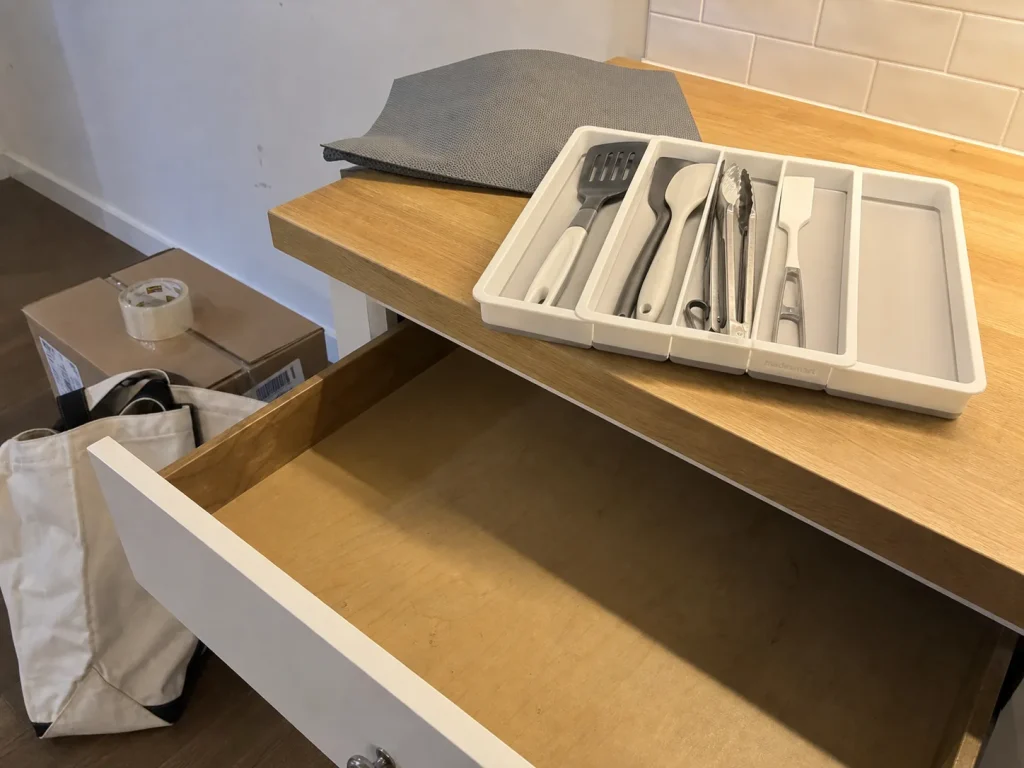
Renters get trained to check every organizing product for whether it drills, sticks, or leaves a mark. For this whole category the answer is no, and it’s worth saying plainly instead of burying it in one product’s bullet list. All six picks above are zero-installation by definition. Nothing screws in, nothing adheres, nothing touches the drawer box at all. The tray sits in the drawer the way a plate sits on a shelf. On move-out day you lift it out and the drawer is exactly as you found it.
So the security deposit question for kitchen drawer organizers is genuinely settled before it starts. Which is why the real risk deserves more attention than it gets: it isn’t the organizer, it’s the thing you buy at the same time. The adhesive non-slip liner you add underneath to stop the tray sliding. The Command strips holding a spice rack to the cabinet door, added while you’re at it. Those touch the finish. The tray never does.
If you do use a Command-brand product alongside one of these, remove it by pulling the tab straight down as the manufacturer instructs, not by peeling it sideways. Sideways is how the drawer liner or the cabinet finish comes off with it, and it’s the single most common way a renter turns a removable product into a repair. The same logic runs through the no-drill rules that apply to the cabinets above the drawer, where the stakes are higher because the surfaces are visible.
And if you want the non-slip effect without any of that exposure: cut a plain rubber shelf liner to the drawer floor and set the organizer on top of it. No adhesive, no residue, same result. The tray was never the thing to worry about. The thing to worry about is the “while I’m at it” purchase.
What Happens When Four People Use the Same Drawer
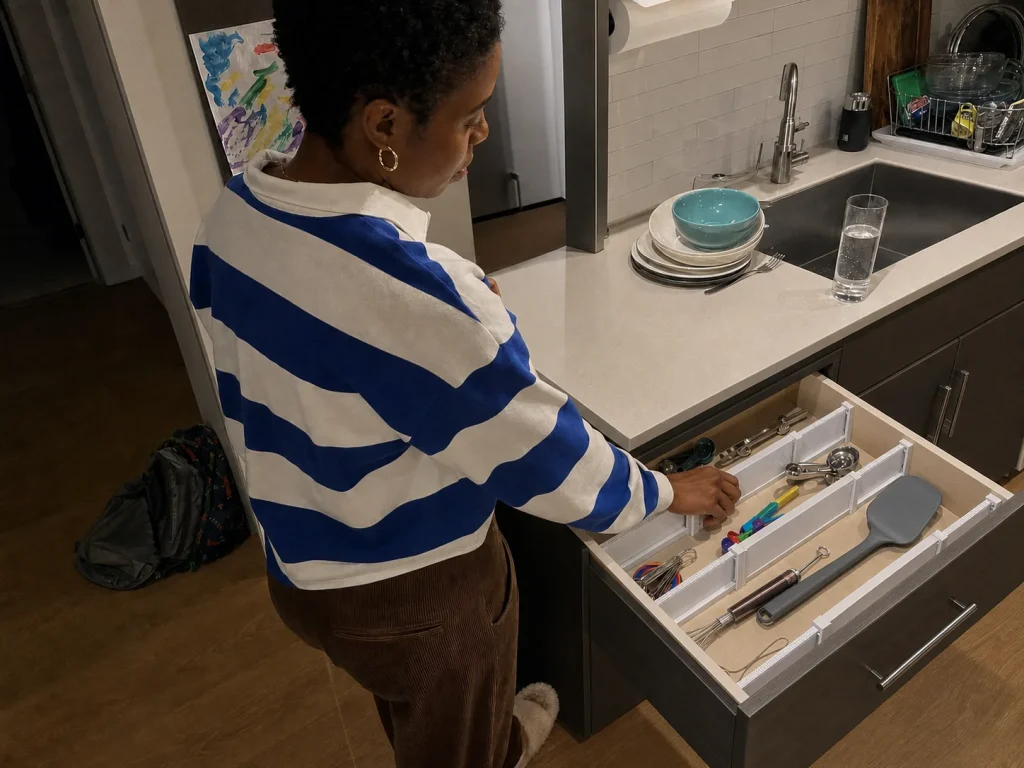
Every organizer review implicitly assumes one careful adult who reads instructions. A drawer in a family kitchen gets yanked open with a wet hand, slammed shut with a hip, and reloaded by somebody who has never once wondered where the bag clips go. That’s the environment the system actually has to survive, and a multi-user household changes the math in ways no product listing accounts for.
Slamming Is What Actually Ages a Spring Divider
Every slam is a small shove against a spring-tensioned divider’s set length. The nib from the first section doesn’t fail from one event; it fails from a few hundred, which is why the identical divider lasts years in a quiet kitchen and a season in a loud one. If your drawer gets used twenty times a day, weight the snap-in mechanism harder than you otherwise would.
This is also where a non-slip base stops being a marketing bullet and starts being the reason the setup survives. A tray without one drifts toward the back of a busy drawer a little at a time (nobody ever catches it happening), and it drifts slowly enough that you only notice once the gap at the front is wide enough to swallow a peeler.
Why a “Miscellaneous” Compartment Always Wins
The conventional wisdom is that more compartments means more organized. In practice, the shared drawer that survives has the fewest, and each one is obvious at a glance. Here’s the rule that makes it stick: every compartment needs a job, and there can be no miscellaneous section. Give a shared drawer a miscellaneous compartment and it will eat the drawer inside a week, because it’s the only one nobody has to think about before dropping something in. That’s exactly how the junk drawer where everything with no home ends up gets born in the first place.
Design for people reloading it wrong, not for compliance. If a compartment’s purpose isn’t obvious in the half-second someone spends putting a thing away, they will use it for something else, and they aren’t being difficult. The compartment is just ambiguous. Fix the compartment.
In a shared kitchen, let whoever else uses the drawer decide where two of the categories go. Not all of them. Two. A system somebody helped build gets maintained; a system handed to them gets ignored by week three. It costs you five minutes of input and buys you the only thing that makes a shared drawer last.
Conclusion
Three things worth carrying out of this.
Measure the inside of the drawer box before you look at a single product page: width, depth, and height, written down. The number on the box describes the organizer, never your kitchen.
Know which mechanism you’re buying. Snap-in expansion has nothing to fatigue; spring tension has one part with a countdown on it. Neither is the wrong choice, but only one of them creeps.
Match the pick to the drawer instead of to the review. A 2 inch tray in a deep pot drawer organizes the bottom fifth of it, and a 5 inch divider in a shallow silverware drawer won’t let you close it.
In three months, pull the tray out and look at the drawer floor underneath it. A scattering of small stuff down there means either the tray is migrating or something in the drawer has no compartment that fits it, and both are fixable in about four minutes once you’ve seen them.
Start with the drawer that annoys you most. Measure it tonight. Buy nothing until you have three numbers written down.
Frequently Asked Questions
01What size drawer organizer do I need for my kitchen?
Measure the inside of the drawer box, not the cabinet face, and match all three numbers to the organizer’s stated range: width, depth, and height.
Standard base cabinets run 24 inches deep, but usable interior drawer depth lands closer to 18 to 21 inches once hardware and the face frame are accounted for. Widths follow cabinet door widths of 12, 15, 18, 24, or 30 inches.
02Why do expandable drawer dividers creep back to their original size?
The internal locking nib that holds the expanded length has snapped, usually from over-extending the divider or forcing it into a drawer that is slightly too tight.
It is not a defect. It is the spring tension mechanism reaching the end of its rated range, and once that nib goes the divider cannot hold any set length at all.
03Are bamboo or plastic kitchen drawer organizers better?
Neither is more durable by default. They fail in different places, so the right answer depends on how your household cleans things.
Plastic sags when it is mismatched to the drawer depth or overloaded. Bamboo is fine structurally but its adjustable track swells with moisture. Choose plastic near a dishwasher vent, bamboo if you will hand-wash and dry it.
04How do you keep drawer dividers from sliding around?
A non-slip base does most of the work, which is why trays with a soft-grip bottom stay put in a drawer that gets slammed daily.
If yours does not have one, cut a plain rubber shelf liner to the drawer floor and set the organizer on top of it. No adhesive is needed, which keeps the whole setup renter-safe.
05Can you put kitchen drawer organizers in the dishwasher?
Plastic trays generally handle a cycle. Bamboo should never go in, and that is not a precious-material rule.
A dishwasher drives moisture into a bamboo divider’s adjustable track, which is the exact part that fails first. Hand-wash it, dry the groove before the panels, and it will outlast the plastic.