


















In this article
You pull out the bin labeled “Size 5” expecting a season’s worth of clothes, and half of it still fits your kid. The other half doesn’t, and you can’t tell which half until everything is on the floor.
That’s the most repeated complaint in kids’ clothing threads, and it isn’t a discipline problem: a kid’s wardrobe runs on three variables and a size label tracks one. Toddlers move through two to three sizes a year, so a size change lands every four to six months, faster than any seasonal rotation schedule keeps up with. Here are seven moves for how to organize kids clothes by size, built to survive more than one growth cycle.
Quick Answer
Organize kids clothes by size in six steps, in this order:
- Pull everything and sort into three piles: fits now, next size up, too small
- Measure the drawer or closet interior before buying a single bin
- Give each size its own container, then sub-divide by type inside it
- Label the size on the outside of the bin and the front of the drawer
- Store next-size-up clothes flat under the bed, one tote per size jump
- Run the swap on growth signals, not on a date in the calendar
Why Sorting Kids Clothes by Size Falls Apart in One Season
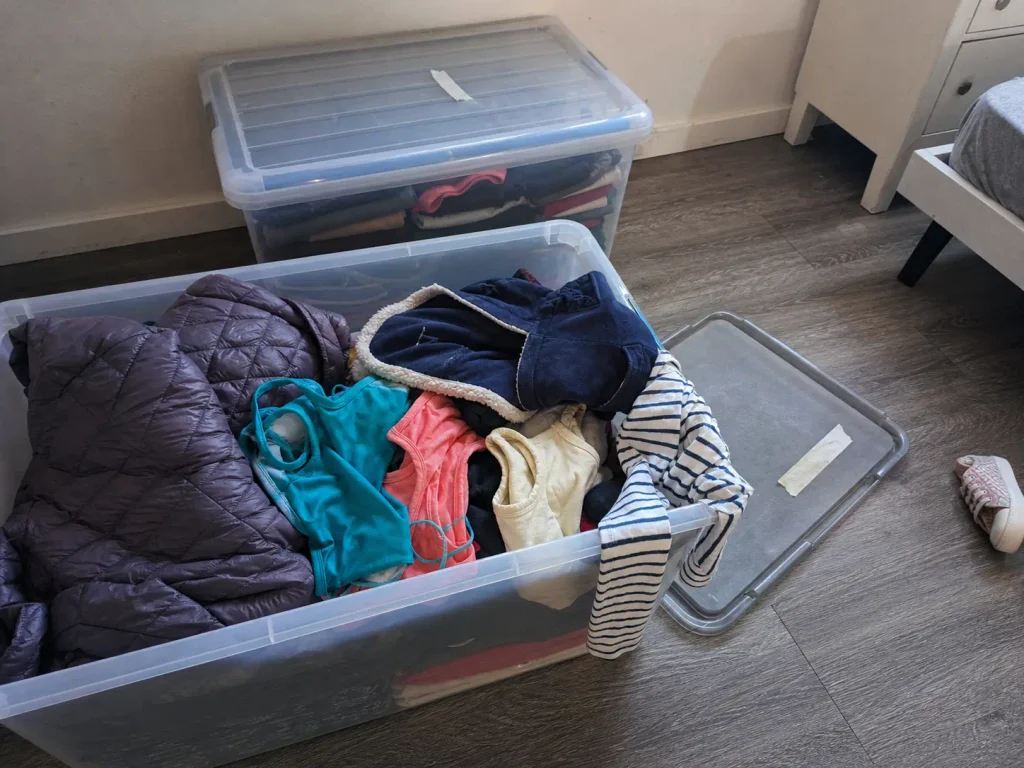
You did the sort. You bought the sorting bins, wrote the sizes on the front, stacked them in the closet, and for about six weeks it was the best-organized part of the house.
Then it stopped working, and the reason has nothing to do with follow-through. The system was built on one variable when a kid’s wardrobe runs on three: size, type, and season. It collapsed at the exact point where those three disagree.
The Size Label Is Only Half the Information
A bin marked “Size 6” tells you one true thing and hides two others. Inside, a size-6 winter coat and a size-6 swimsuit sit on top of each other with no logic separating them, because at the moment of sorting the only question asked was “what number is on the tag?” That’s the failure organizing threads name over and over: right size, wrong season, no way to tell from the outside.
So you open it in April looking for shorts and find fleece. You dig. And digging is what ends a system, not disorder in the abstract: after three or four digs people stop opening the bin and start buying replacements for things they already own.
Kids Outgrow Clothes Faster Than the Calendar Says
Between ages one and three, kids move through two to three clothing sizes per year, a size change every four to six months. Swap in September and again in March and you’ve built a six-month cycle around a kid who changes on a four-month clock. That gap is where the “nothing fits and I didn’t notice” mornings live.
The Bin Nobody Wants to Open
The third breakdown is the too small bin that mixes outgrown clothes with next-size ones. It starts as a laundry basket in the corner of the closet, and within weeks it holds outgrown pajamas, a jacket two sizes ahead, one shoe, and something that might be clean. Nobody sorts it, because sorting means forty small decisions at once, so it grows until it overflows and forces the issue.
That basket isn’t a maintenance problem, it’s a categorization problem wearing a maintenance costume. Two things that look alike have opposite futures: one pile leaves the house to donate clothes, one comes back in six months. Store them together and neither gets handled.
Apply the three-month test before you rebuild anything: would this bin still make sense to a tired adult at 9pm three months from now? If the answer needs you standing there explaining it, the system needs a second axis, not a bigger container.
None of this makes size sorting the wrong instinct. It’s the right instinct, half-built: size is genuinely the fastest way to answer the only question that matters at 7am. The rest of this article adds the two missing pieces, a second sorting axis inside the container and a trigger that tells you when to move, and the whole thing is one component of the wider kids bedroom system this sits inside.
Measure Before You Buy a Single Bin
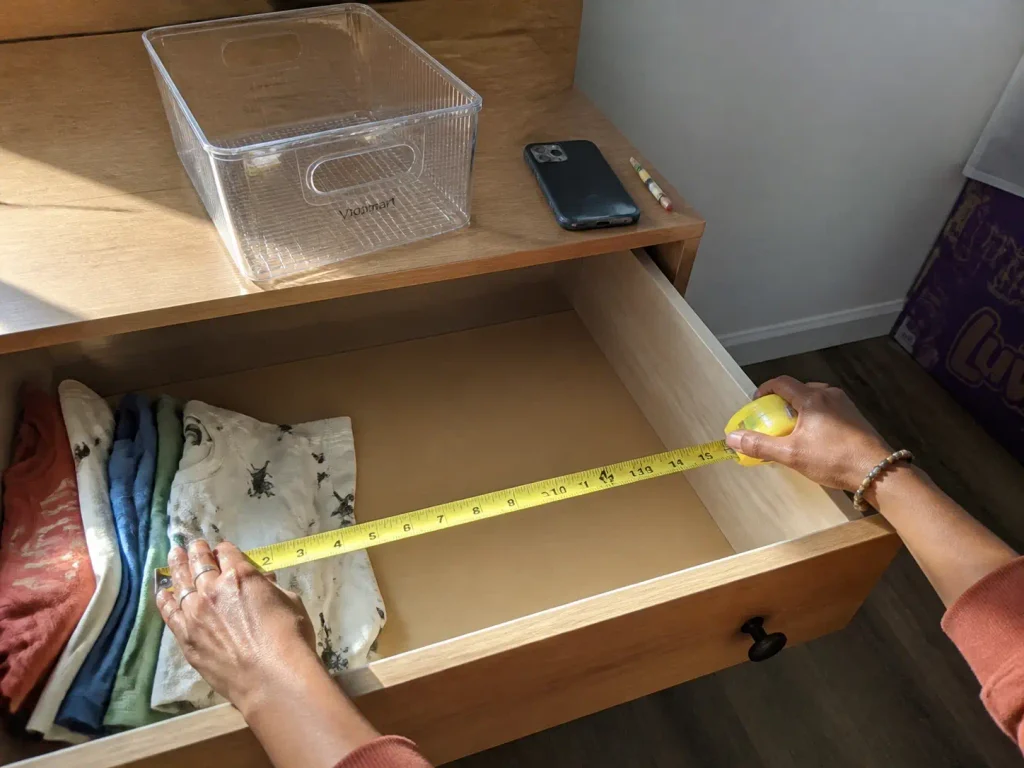
Everyone buys the containers first. The bins arrive, they’re a half-inch too deep for the drawer, and now your carefully planned system lives in a stack on the floor next to the dresser. Measuring takes ten minutes and it’s the only step here you can’t undo later by rearranging.
Interior Depth Is Not the Number on the Box
Kids’ dresser drawers typically run 18 to 24 inches in exterior depth, and the usable interior is three to six inches less. Drawer glides, the back panel, the frame around the opening: all of it eats space the product listing counts. Six inches is not a rounding error when you’re fitting a bin — it’s the difference between a container that drops in and one that sits proud of the rail and stops the drawer closing.
So measure the inside, front to back and side to side, with the drawer pulled all the way out, and measure the height of the opening rather than the drawer box. Do it for every drawer, because most dressers mix shallow top drawers with deep bottom ones, which changes how mixed-depth drawers change what fits where more than people expect.
How Many Outfits a Dresser Actually Holds
A standard six to nine drawer dresser holds between 36 and 90 folded outfits depending on depth, and a mid-size six-drawer unit lands around 50 to 60. That’s the practical ceiling. Past it the answer isn’t a bigger dresser, it’s the size-swap system doing its job, because a dresser holding two sizes at once is one where the current size stays buried behind clothes that don’t fit yet.
Dresser tops are less generous than they look either. A 36-inch top holds three to four containers with a two-inch front buffer, not six, and without that buffer the front bin gets knocked off every time a kid opens a drawer.
When There’s No Basement to Overflow Into
Every article about this assumes somewhere else to put things: a basement, a garage, an attic, a second closet. Plenty of people have none of those, and in a small closet with no overflow every cubic inch has to come from inside one bedroom. Under the bed, the shelf above the closet rod, the top of the dresser. That’s the whole inventory.
In practice that means one size ahead lives in the room, not three, and the too-small pile leaves on a schedule instead of waiting for a truck. It also makes the renter-friendly version the default here rather than a footnote, since none of it involves drilling or a storage unit.
Before you buy anything, raid what’s free. Diaper boxes are already the right rough footprint for one size of folded toddler clothes and rigid enough to stack two high, and dollar-store bins do the first pass fine. Run the system on free containers for one full size cycle, learn how many you need, then upgrade.
When you do, clear stackable bins are the upgrade worth making, because clear sides are the feature that matters: the Vtopmart 6 Pack Clear Stackable Storage Bins with Lids run roughly 11 by 8 by 6 inches each, about one size of folded shirts and pants for one kid, and the stackable lip keeps a multi-size stack from leaning. At 6 inches tall they won’t take a folded winter coat, so bulky outerwear needs a larger container or a spot on the rod. It’s budget-friendly storage that stays no-drill, which matters when the closet isn’t yours to modify.
Write your drawer and shelf interior measurements on a note in your phone the day you measure, labeled by drawer. You will be standing in a store or scrolling a listing within the month, and the alternative is guessing, which is how the bins end up on the floor.
Sort by Size First, Then by Type Inside the Bin
The argument online is size-first sorting versus type sorting, and both camps are half right, which is why the debate never resolves. You don’t pick one.
Size is the outer container because that’s the question you ask first at 7am (“does this fit him?”). Type is the divider inside because that’s the second question (“where are the long sleeves?”). One decision at the container level, one at the divider level, and the two stop competing for the same box.
The Three-Pile First Sort
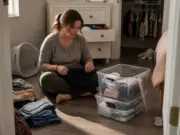
Pull everything out, including whatever is in the laundry, because a purge that works around a missing third of the wardrobe produces a system that breaks the day that third comes back. Then make three piles, not two: fits now, next size up, too small.
Three matters because the two-pile version quietly destroys value. When “too small” is one pile, the good stuff gets swept in alongside the stained and the pilled, and at donation time nobody re-sorts, so solid hand me down clothes leave the house. Splitting “hand down” out as its own category costs nothing and it’s the difference between clothing your second kid and buying that wardrobe twice.
One note on the labels themselves: toddler sizes jump between systems mid-wardrobe. Newborn sizes run by month, then 2T 3T 4T 5T, then kids size small medium large, and the same kid can wear all three notations in one year. Sort by the number on the tag, whatever system it belongs to, rather than trying to convert everything to one scale.
Size Is the Bin, Type Is the Divider
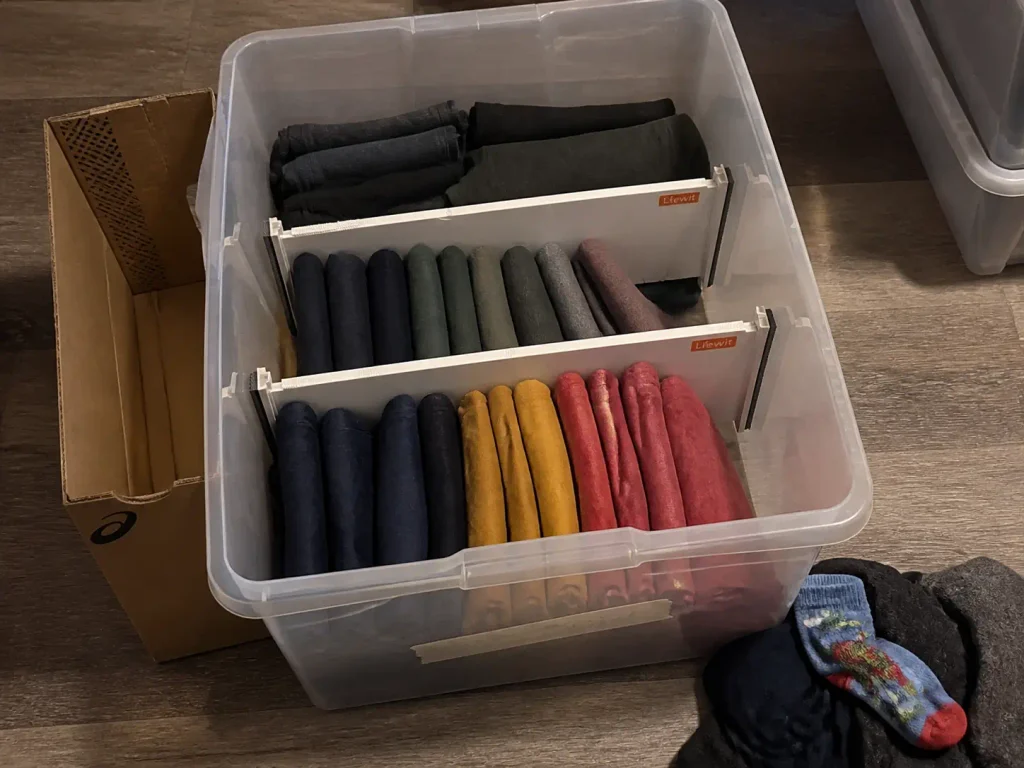
Now the fix for the half-the-bin-still-fits problem. Inside each size container, run three sections: tops, bottoms, and everything one-piece (pajamas, dresses, rompers, swimsuits). Three, because four is where people start hesitating about which section a thing belongs in, and hesitation at put-away time is how sections blur back into a pile.
Sections only stay readable if the clothes stand up. Stack a pile of folded shirts and you see one shirt; stand them on edge and you see twelve. It’s the single change that makes the type sub-split worth doing at all.
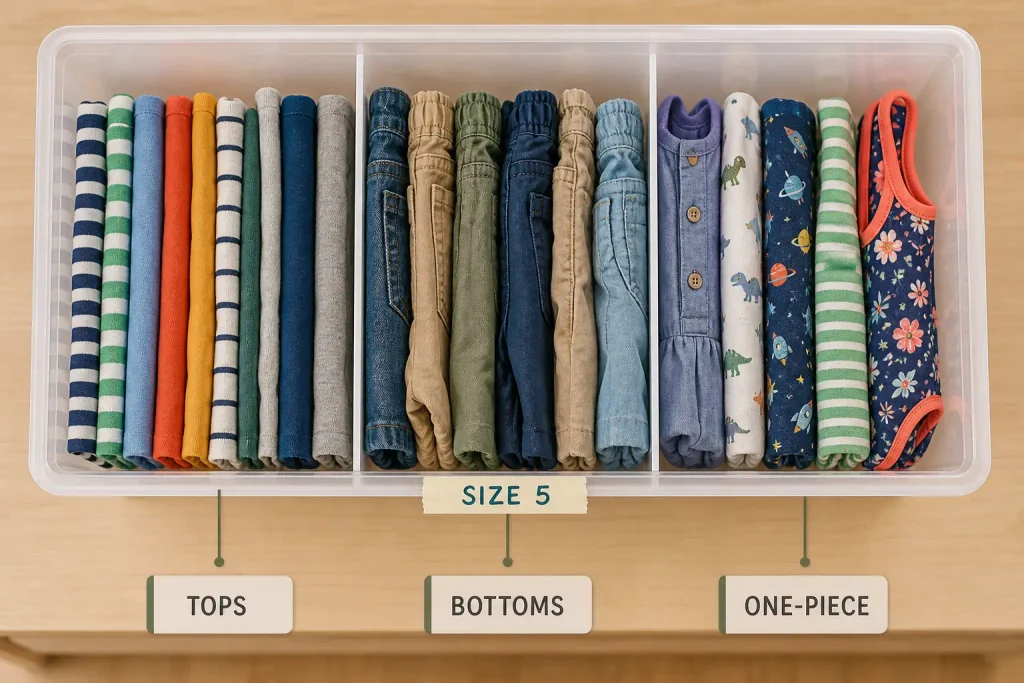
That standing-up part is vertical folding, sometimes called file folding, and it depends on how you fold clothes in the first place: folding pieces so they stand upright instead of stacking, plus something holding the rows apart.
Start free. Cut cardboard strips from a shoebox to the interior width you measured, and run the sub-split for a few weeks to learn whether three sections suits your kid’s wardrobe or whether two is enough. If it earns its keep, the Lifewit 4 inch High Upgrade Drawer Divider adjusts across roughly an 11 to 17 inch span, which is why one product covers the whole system: the same set fits both dresser drawers and the clear bins. At 4 inches high they sit below the rim of a 6-inch bin, and in a very deep drawer tall folded items can flop over the top.
I used to tell people to pick one axis and commit, size or type, on the theory that a simple system beats a clever one. The volume of “I opened the size-4 bin and half of it still fits” stories changed my mind. The single-axis version isn’t simpler in practice — it just moves the work from setup to every retrieval.
Where Season Fits Without Doubling Your Bins
Season is the third variable, and the trap is treating it like the first two. Give season its own bins and you’ve doubled the container count overnight: size 5 summer, size 5 winter, size 6 summer, size 6 winter, eight boxes where you had four.
Instead, season rides inside the size bin as a position, not a partition. Current season at the front of each section, off-season at the back. When the weather turns you flip the front-to-back order within each bin. Two minutes per size, zero new containers, and the clothing swap stops being an event.
One move shrinks the system before any container question comes up: build the wardrobe around three or four core colors, a tip that circulates constantly in parenting groups. Every top matches every bottom, so fewer pieces cover more days and sibling hand-me-downs drop into the same palette instead of becoming orphans.
Label the Size So Everyone in the House Can Read It
A system only you can read is a system you maintain alone. The label isn’t decoration and it isn’t for the after photo. It’s the instruction that lets your partner, a grandparent, or a babysitter put laundry away correctly at 9pm without texting to ask which bin the size 4 pajamas go in.
Label the Drawer, Not Just the Bin
Most people put size labels on the storage bins and stop, which covers half the problem. Bins hold clothes nobody is wearing right now. The drawer holds daily rotation, and the drawer is where wrong-size items get put away, because whoever is folding at 9pm matches garments to a location by memory, not by reading tags.
Put the size on the front edge of each drawer, visible when it’s closed, and on the outside of every bin, on the short side facing out. If bins are stacked, the label goes on the front face, not the lid. You can’t read a lid at the bottom of a stack.
Painter’s tape and a Sharpie do this for free, and for a lot of families that’s the end of it. The reason to go further isn’t looks: this system gets relabeled at every size cycle, two or three times a year for a toddler, and tape peeled and rewritten that often curls and smudges. If you’re relabeling on a four-month clock, the Brother P-Touch PTD220 Label Maker prints laminated tape that survives handling and comes off cleanly at the swap. The caveat: it’s the priciest thing here by a distance, it eats cartridges, and with one kid and one size cycle left the Sharpie is the better call.
A Size Wall for Hanging Clothes
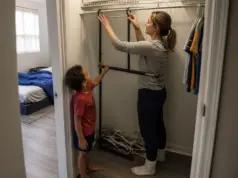
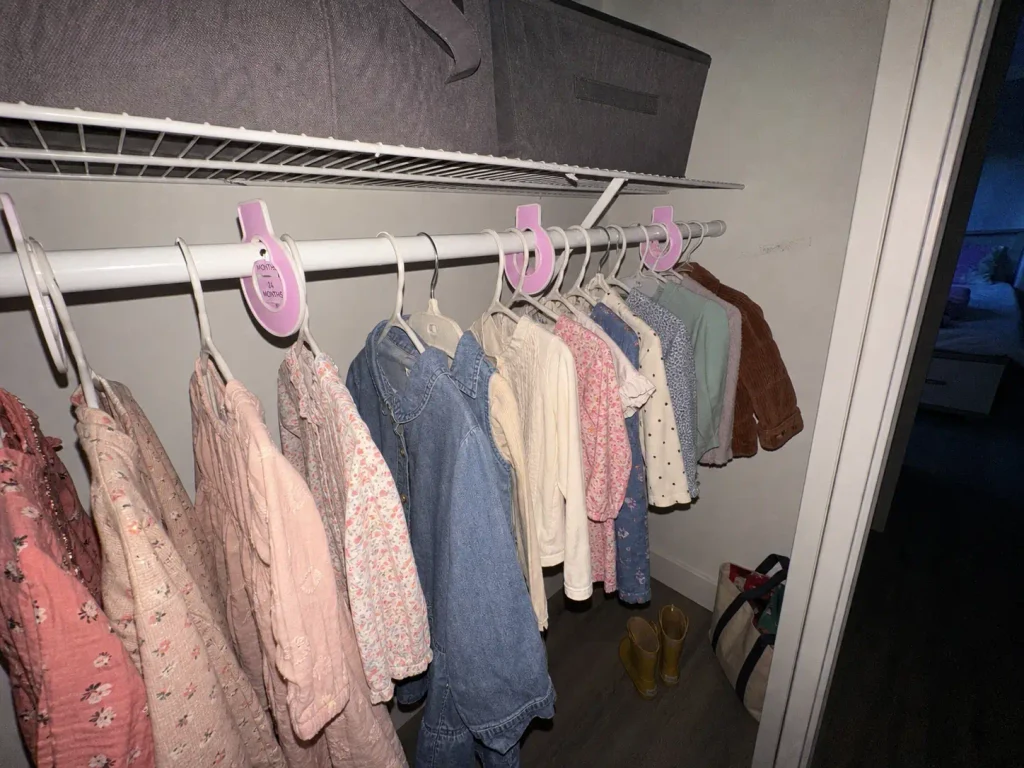
Labeled bins can’t help with anything on a hanger, which in most kids’ closets means dresses, button-ups, and jackets. When you hang clothes they need size markers on the rod itself, so sizes read as bands left to right instead of one undifferentiated row.
Index cards and binder clips do this for nothing: write the size, clip it to the rod, slide it along as sizes shift. The failure mode is cards spinning around to face the wall, so clip them tight. The purpose-built closet divider labels fix that with a molded collar: the Size-It Closet Organizers by Baby Buddy come pre-printed Newborn through kids size 8 plus six write-on blanks, and they sit flat against the rod facing forward. Past size 8 you’re back to the blanks, and at that point the index card was doing the same job.
Where the rod sits matters as much as what’s on it, and hanging the rod at your kid’s actual reach height is the difference between a closet a five-year-old uses and one only you can operate.
With multiple kids, add a layer costing seconds per garment: a Sharpie dot on the care tag. One dot means the item started with the oldest, two means it’s moved down, and you add a dot each time it changes hands. Professional organizers keep recommending it because a dot survives the wash where a sticker doesn’t, and in a shared closet it tells you at a glance whose band a garment belongs in.
Swap Sizes on Growth Signals, Not the Calendar
Nobody notices a growth spurt on the day it happens. You notice it doing laundry, folding a pair of pants that fit fine last month, when something about the hem looks wrong. That’s the trigger, and it beats any date on a calendar, because the date was a guess about how fast your kid grows and the hem is a measurement of it.
The Signals That Mean It’s Time to Size Up
The signals are physical and they arrive in a consistent order, because kids generally grow lengthwise before they grow outward. Short pants come first: the waist still fits but the hem rides above the ankle. Then tight snaps sitting unusually high on a onesie, and sleeves that stop reaching the wrist. Only later does the shirt go snug through the chest, which is the signal most people wait for and the last one to show up.
So watch the ankles and the snap line. Those are the growth-spurt signs that mean it’s time to size up — snug snaps, short hems, riding-up waistbands, and the parent doing laundry sees them weeks before the kid says anything feels tight. Kids almost never report this. They report not wanting to wear that shirt, which sounds like a preference and is frequently a fit complaint in disguise.
When two or three signals show up in the same week across different garments, that’s the swap. Not one pair of pants running short, but a pattern across the wardrobe.
Where Next-Size Clothes Wait When There’s No Basement
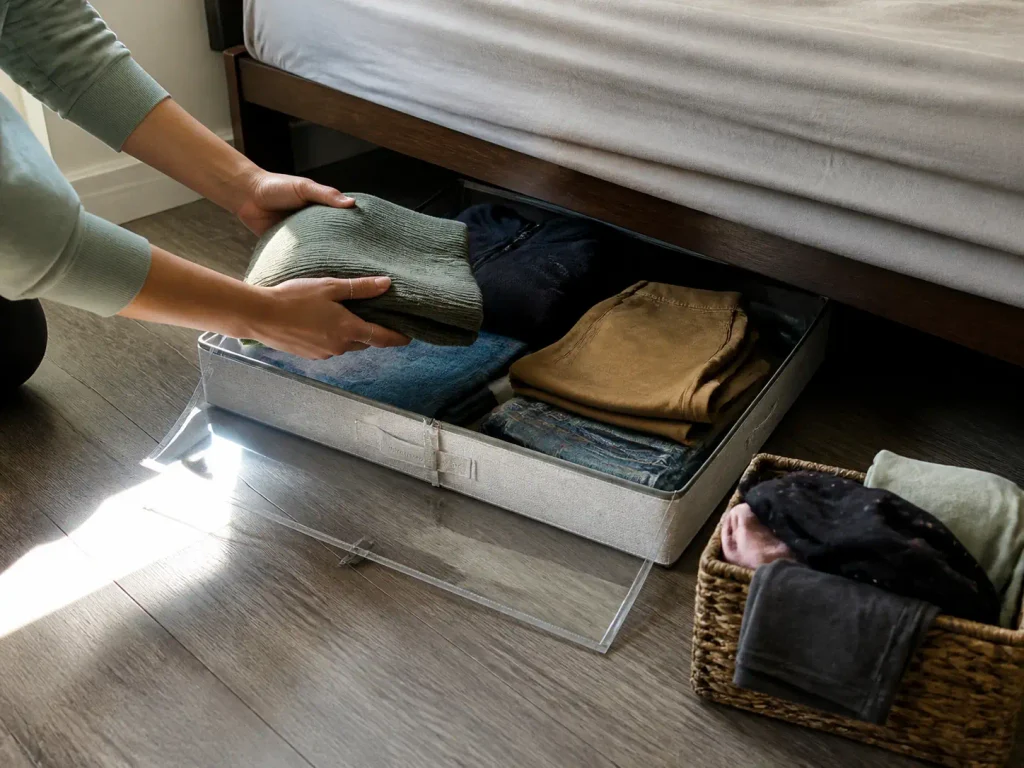
Next-size-up clothes need to be out of daily rotation but inside the room, and under the bed is usually the only place left. The rule that keeps it contained is one tote per size jump, not one giant bin holding everything the kid will ever wear. When that container empties into the dresser, the next one gets filled.
What decides whether under-bed storage works is clearance, not capacity, so measure floor to the underside of the frame first. An under-bed tote around 33 by 17 by 4.5 inches, roughly 45 liters, clears platform frames down to about 5 inches and holds 15 or more folded jacket- or sweater-weight pieces, about one size jump for one kid. The TidyCorner 2-Pack Under Bed Storage Containers hit that profile, and the two-pack maps onto the two things stored under there: next size up in one, off-season in the other. Low-profile totes without wheels take a real pull to slide out on carpet, and a fabric-sided one sags if you overfill past the rim.
Skip vacuum sealed bags for anything with down or wool in it. They win on volume, but compressed loft doesn’t always come back, and for one size jump the flat tote is already enough. Seasonal clothing storage extends well past kids’ clothes, which is worth a look if you’re storing off-season clothes when there’s no basement.
One safety note, since this section is about a dresser getting loaded and unloaded repeatedly: anchor it to the wall, whatever the sticker on the box says. Under the CPSC’s mandatory tip-over safety standard for dressers and clothing storage units, effective September 1, 2023 under the STURDY Act, dressers must pass stability tests with drawers loaded and open. That’s exactly the state a dresser is in during a size swap.
The Standing Too-Small Basket
The most useful container in this system is also the cheapest: a standing basket for outgrown clothes, within arm’s reach of wherever clothes get folded or the kid gets changed. Not in the closet behind the door. Not in the basement. Within reach, because the point is capturing the item in the two seconds you’re holding it thinking “this doesn’t fit anymore.”
Put the basket anywhere that requires a trip and the outgrown shirt goes back in the drawer instead, comes out next week, gets rejected, goes back again. That loop is what fills a drawer with clothes nobody can wear. The basket is really a one-in-one-out rule with a physical container: something arrives in the next size, something leaves in the last one.
Sort it every few months rather than waiting for a seasonal deep-clean, into the same three piles: hand down, donate, worn out. Fifteen minutes when it holds a quarter’s worth of clothes. An afternoon of second-guessing when it holds a year’s.
Passing Clothes Down Without Losing Track of Them
Twice a year at minimum, run the full declutter pass: donate, hand down, worn out and recycle. That’s the backstop schedule, catching whatever the growth signals missed, not the primary trigger.
Be selective about what you keep for the next kid, because keeping everything is how bins fill with things nobody will wear. The categories that hold value are the ones kids outgrow before they wear out: shoes in good condition, jackets and outerwear, swimwear, special-occasion clothes worn twice. Everyday tees and leggings reach the second kid already thin at the elbows, and two years in a tote doesn’t improve them.
When two kids share the room, the dot system does the tracking and the storage plan has to hold two wardrobes in the same square footage, which is its own set of decisions covered in when two kids share the room and the clothes.
Conclusion
Three things carry this system. Size is the bin and type is the divider: that two-axis sort is what stops the half-the-bin-still-fits problem before it starts. Measure the drawer interior before you buy anything, because that’s the one step you can’t fix later by rearranging. And swap on growth signals, not the calendar, because ankles and snap lines tell you months before a date does.
In three months, open the too-small basket. If it’s overflowing, nobody’s watching the swap trigger and the sort is running late. If it’s empty, either nothing has been outgrown yet or clothes that don’t fit are quietly going back into drawers where they don’t belong. Either answer tells you where to spend the next twenty minutes.
Start with one drawer and one size. Get that bin right (outer label, three sections inside, current season at the front) and build the rest around it once you’ve seen it survive a month of real laundry.
Frequently Asked Questions
01How do you organize kids clothes by size without a basement or attic?
Store next-size-up clothes flat under the bed in a low-profile tote, one per size jump rather than one giant bin for everything. A container around 4.5 inches tall clears most platform beds. The closet shelf holds the current size while the dresser runs daily rotation.
02How often should you go through kids clothes for sizing?
Twice a year at minimum, spring and autumn, but treat the calendar as the backstop rather than the trigger. Toddlers move through two to three sizes a year, so the real signal is physical: hems riding short, snaps sitting high, shirts snug through the chest.
03Should you sort kids clothes by size or by type?
Both, in that order: size decides the container and type decides the sections inside it. Sorting by size alone is what leaves you pulling a labeled bin and finding half of it still fits, because a size-6 swimsuit and a size-6 winter coat were never the same decision.
04What is the best way to keep track of hand-me-downs between kids?
Mark the garment tag with a Sharpie dot: one dot for the oldest child, two for the next, adding a dot as the item moves down the line. It takes seconds per item and survives washing better than a relabel, so you can see which pieces still have a kid waiting.
05What size clothes are actually worth keeping for the next kid?
Gently used shoes, jackets and outerwear, swimwear, and special-occasion clothes: the categories kids outgrow before they wear out. Everyday tees and leggings usually reach the next kid already worn thin, which is why keeping everything fills bins with things nobody will use.