




















In this article
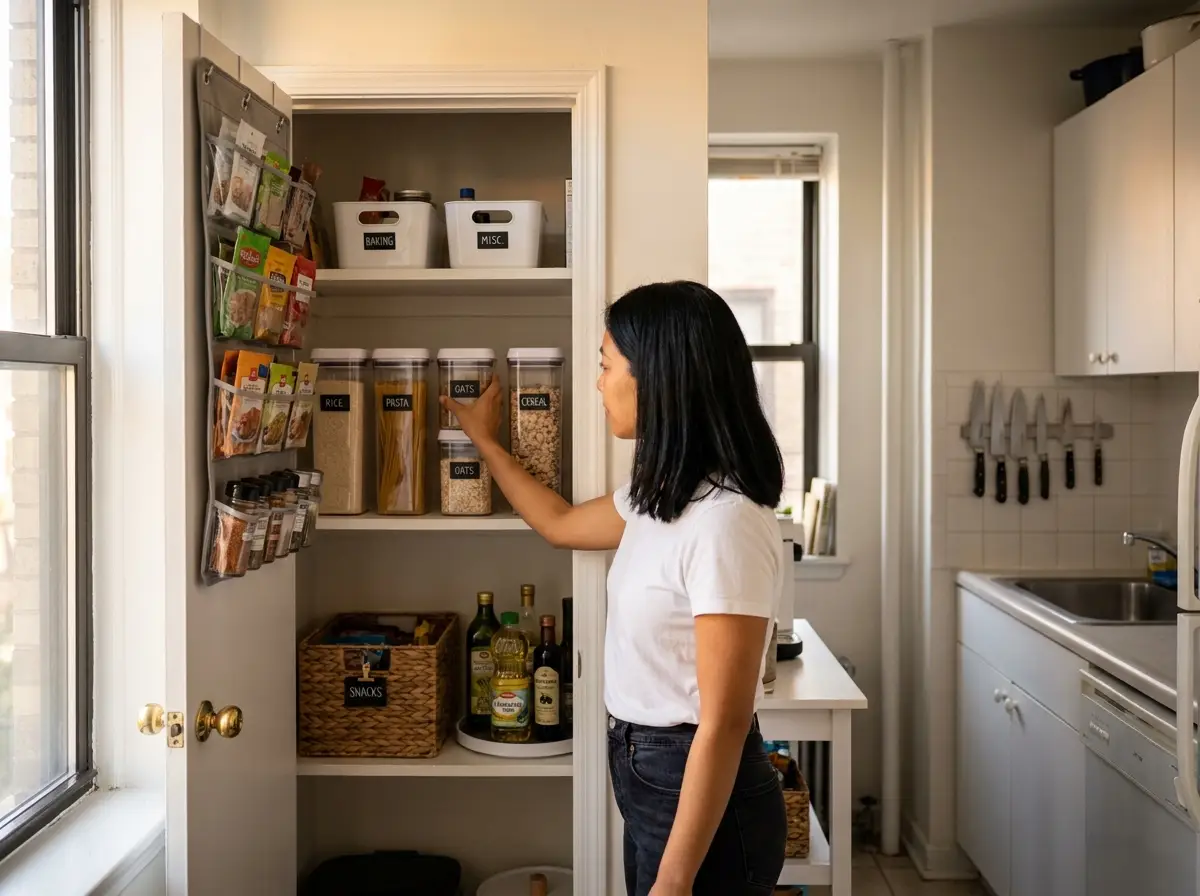
You’ve read the pantry organization guides. The ones with walk-in closets the size of your bedroom, custom shelving systems that cost more than your rent, and enough matching containers to fill an entire aisle at Target. None of that applies to you. Your pantry is a closet — maybe 24 inches wide, maybe three shelves deep — and every guide you’ve tried either wastes your space or wastes your money.
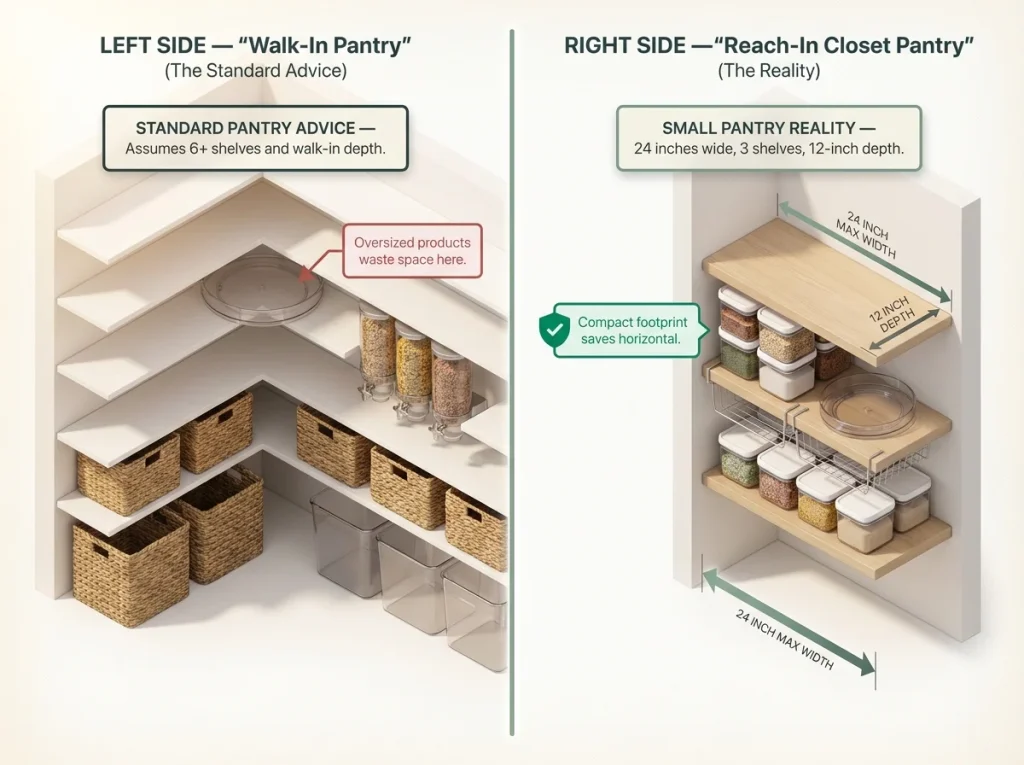
Small pantries don’t fail because you’re disorganized. They fail because most pantry advice is written for spaces three times the size of yours. This guide is specifically for reach-in closet pantries, galley kitchen cabinets, and any pantry where you can’t physically step inside. Everything here fits shelves as shallow as 12 inches and as narrow as 20 inches.
Quick Answer: To organize a small pantry with limited shelves:
- Measure shelf depth, width, and vertical clearance before buying anything
- Reduce to three zones max — daily, cooking, and weekly
- Use compact containers sized for your actual shelf dimensions
- Add shelf risers and under-shelf baskets to double your vertical tiers
- Skip oversized products designed for full-size pantries
- Do a five-minute weekly reset to prevent drift
For a broader overview of pantry organization principles that apply to any size pantry, start with our full guide. This article goes deep on the specific constraints and solutions that only matter when space is tight.
What Makes a Small Pantry Different (and Why Generic Advice Fails)
The Size Problem Nobody Quantifies
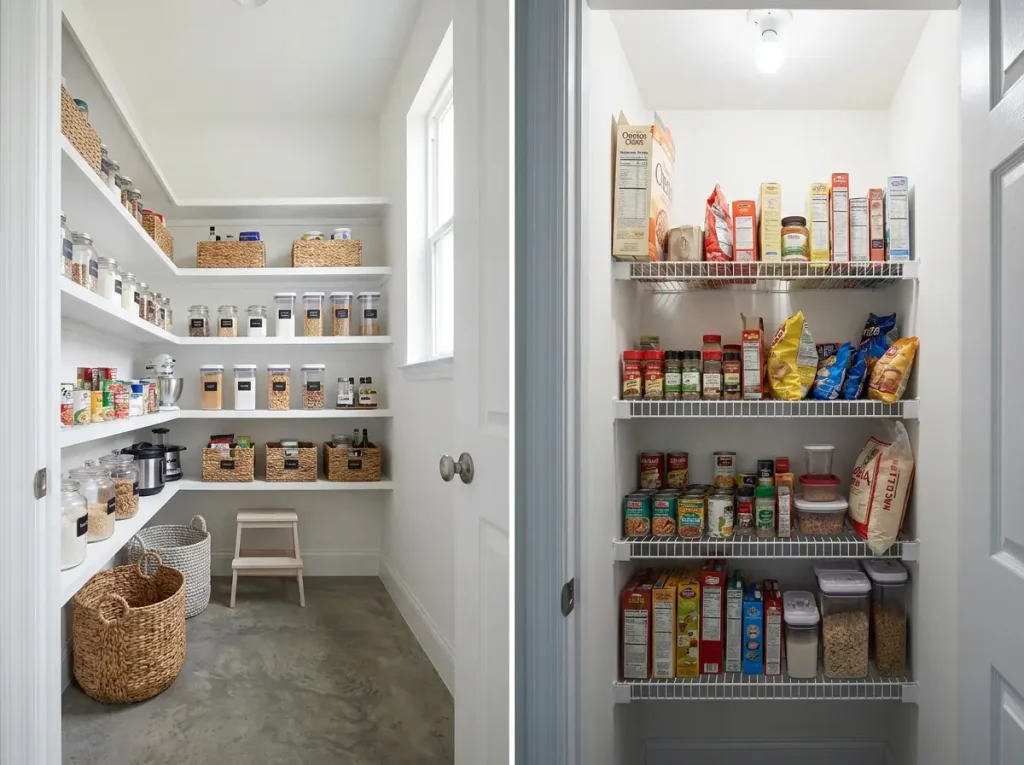
Most pantry guides never define what “small” actually means. They use the word, then show a pantry with six adjustable shelves and 20 inches of depth. That’s not small — that’s standard.
A genuinely small pantry is typically a reach-in closet with 20-26 inches of total width, 12-16 inches of shelf depth, and three to four fixed shelves. Many apartment pantries are even narrower. Some are just a single cabinet repurposed as food storage. If you can’t stand inside your pantry, you’re working with a fundamentally different set of constraints than someone with a walk-in.
Why Standard Advice Breaks in Tight Spaces
The “zone everything” approach works in a full-size pantry where you have eight shelves and room to spread. In a three-shelf closet, you don’t have room for seven zones. You might have room for three.
Every product recommendation that says “grab a 12-inch turntable” assumes you have 14 inches of depth to spare. On a 12-inch shelf, that turntable hangs over the edge.
The fundamental difference: in a large pantry, the organizing challenge is sorting. In a small pantry, the challenge is fitting. Every decision — what you keep, what container you buy, where each item sits — is a space equation first and an organization question second.
The Inventory Rule for Small Pantries
Before you organize anything, reduce what you store. A small pantry that holds two weeks of food for a family of four is a storage problem, not an organization problem. The target for a small pantry is five to seven days of staples plus the dry goods you use every week. The USDA FoodKeeper app can help you decide what actually needs pantry space versus what should be stored in the fridge or freezer instead.
Anything beyond that target belongs in overflow storage — a shelf in the garage, a bin in a closet, or a decision to buy smaller quantities more often.
This isn’t about deprivation. It’s about matching your inventory to your space instead of forcing your space to hold more than it was built for.
Measure First — The Numbers That Define Your Options
The Three Measurements That Control Everything
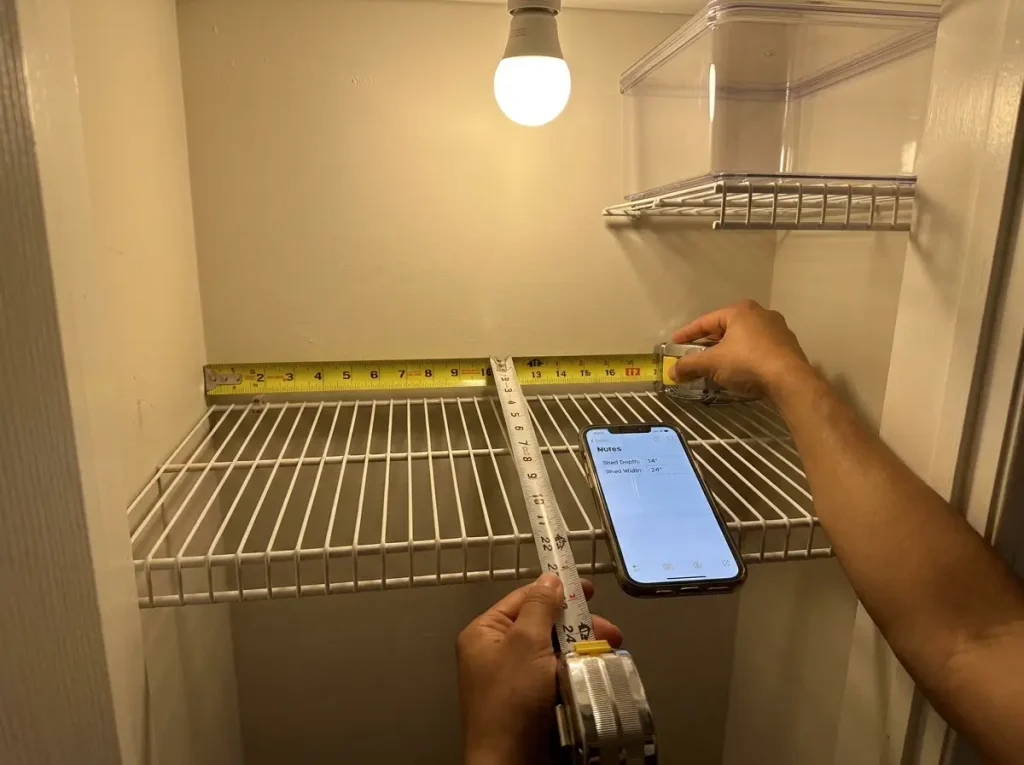
Grab a tape measure. You need three numbers before opening any shopping app:
Shelf depth (front edge to back wall). Small pantries typically run 12-16 inches. This number determines the maximum footprint of every container, bin, and turntable you’ll buy. Write it down in your phone.
Shelf width (left wall to right wall, or to the nearest bracket). This controls how many containers you can place side by side. In a 24-inch wide pantry, you can fit exactly two 10-inch bins with 4 inches left over — or one bin and a turntable.
Vertical clearance (bottom of the shelf above to the top of the shelf below). This ranges from 10-16 inches in most pantries. It determines whether you can stack containers, use shelf risers, or fit standard cereal boxes upright.
The Dimension Mistake That Costs the Most
In a full-size pantry, buying a container that’s slightly too big means it sticks out a bit. In a small pantry, it means the door won’t close. Or the container blocks the one next to it. Or you can’t reach past it to grab what’s behind it.
Every product in this guide includes its dimensions for a reason. Before you add anything to your cart, compare the product dimensions against your three measurements. If the depth exceeds your shelf depth by even half an inch, skip it.
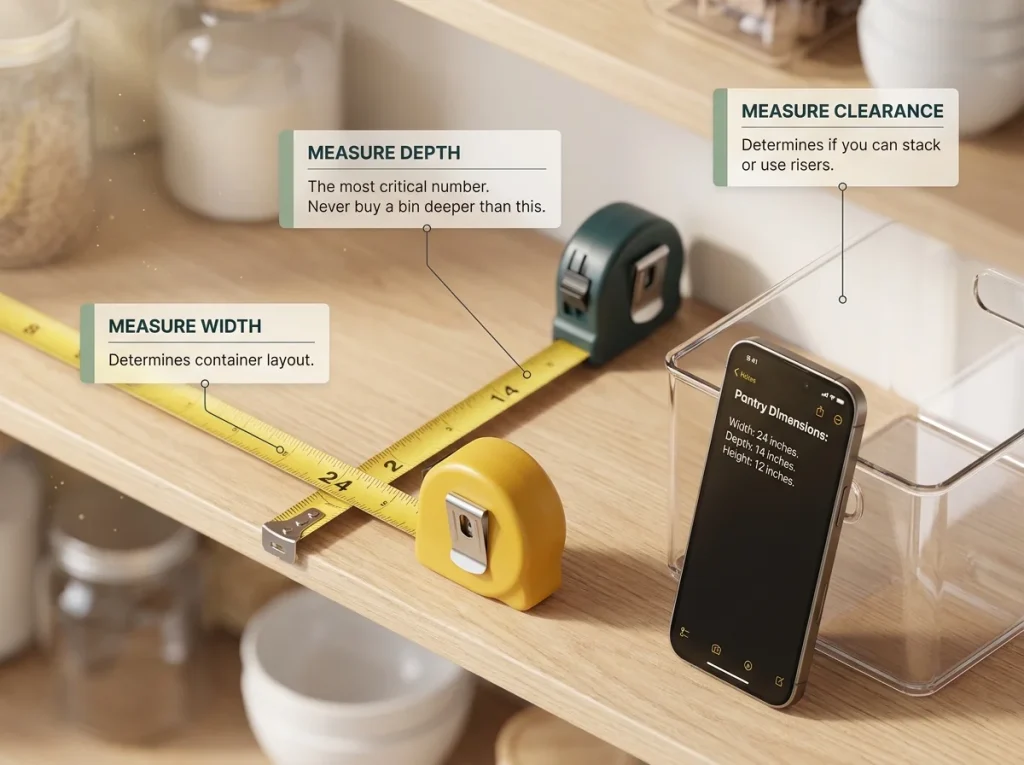
Pro tip: Photograph your tape measure readings on each shelf. Store the photos in a note on your phone titled “pantry dimensions.” You’ll reference these every time you consider buying any pantry product, and it takes the guesswork out of returns.
The Small-Pantry Zone System (Fewer Zones, Tighter Rules)
Three Zones, Not Seven
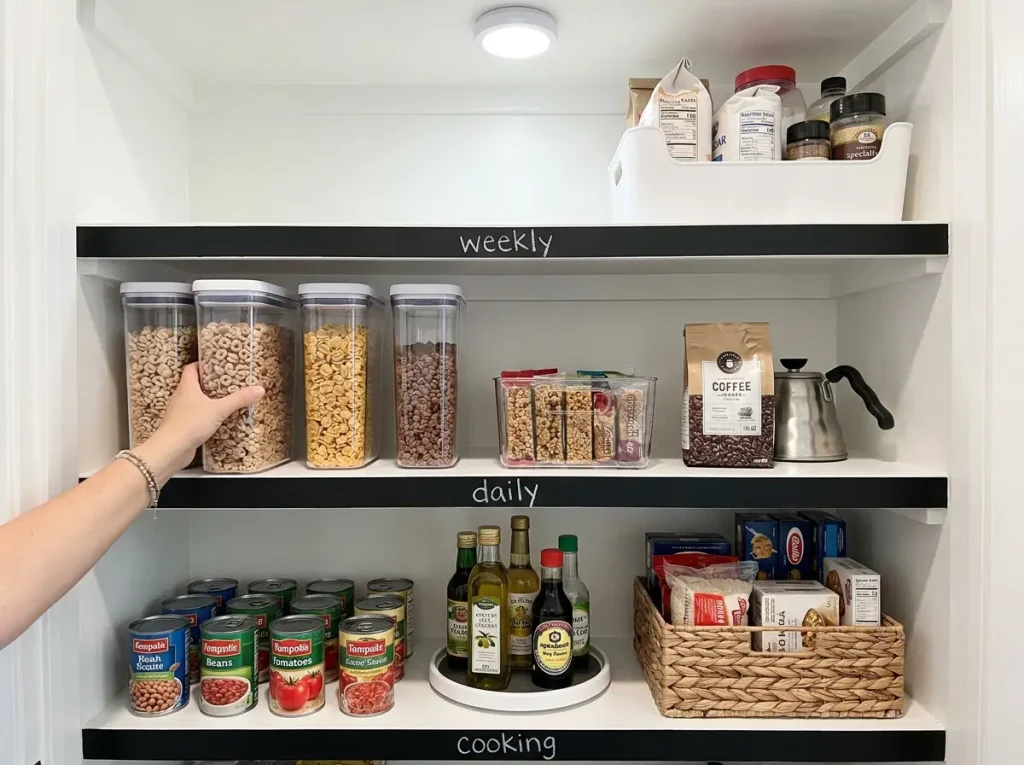
In a full-size pantry, you can assign zones for breakfast, snacks, baking, dinner, canned goods, beverages, and overflow. In a three-shelf small pantry, you get three zones. That’s it. Trying to create more than three zones in a tight space means each zone holds two or three items, and the boundaries become meaningless.
The three zones that work best for small pantries: Daily (eye-level shelf — breakfast, snacks, coffee, whatever you grab every morning), Cooking (below eye level — pasta, rice, canned goods, oils, sauces), and Weekly (top shelf — baking supplies, specialty items, backstock you access once a week or less). This frequency-based approach aligns with what the National Association of Productivity and Organizing Professionals recommends for compact spaces — fewer categories, stricter placement rules.
Why Frequency Beats Category in Small Spaces
Grouping by food type (all cans together, all boxes together) makes sense when you have room to browse. In a small pantry, you can see the entire contents at a glance. You don’t need to browse — you need to grab.
Frequency-based zones put your most-used items at arm height and your least-used items where they’re hardest to reach. The zone logic is: how often do I grab this, not what type of food is it.
Label the Shelf, Not Just the Container
Even with only three zones, label the front edge of each shelf with the zone name — “daily,” “cooking,” “weekly.” This matters more in a small pantry than a large one because items migrate faster in tight spaces. One misplaced bottle of olive oil on the “daily” shelf means your cereal containers no longer fit. The labels catch the problem during the weekly reset.
Pro tip: In a small pantry, every misplaced item causes a chain reaction. One thing in the wrong spot displaces something else, which gets shoved sideways, which blocks something behind it. Shelf-edge labels are your first line of defense.
Products That Fit Small Pantries (and What to Skip)
Containers Sized for Narrow Shelves
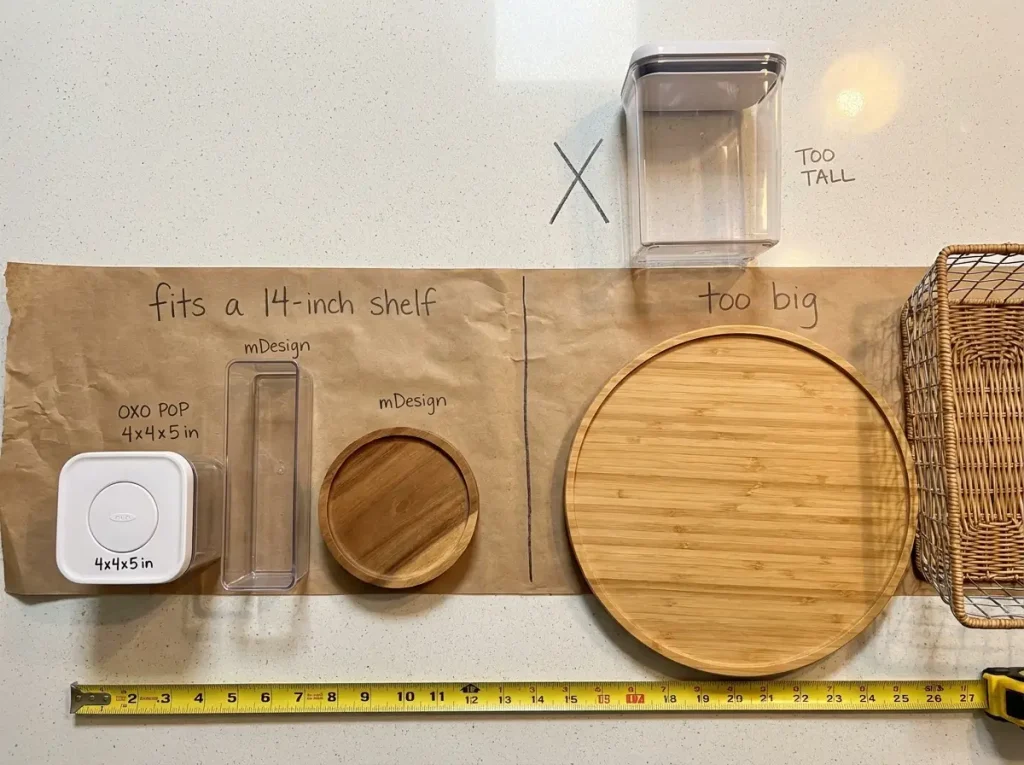
The most common mistake in small pantry organization is buying containers designed for standard-depth shelves. A container that’s 13 inches tall won’t fit a shelf with 11 inches of clearance. A 12-inch turntable won’t sit on a 12-inch shelf without hanging over the front edge.
The OXO Good Grips POP Container Set ($40-50 for a 5-piece) works in small pantries because the short square size (4x4x4.8 inches) stacks vertically without eating horizontal space. The push-button seal is one-handed — useful when you’re reaching into a tight closet. The square footprint wastes less shelf area than round containers.
If $40 is too much, the Utopia Home Airtight Containers ($22 for 7 pieces) are smaller individually and work well on narrow shelves. The seals aren’t as tight, but the footprint is compact.
For zone grouping, mDesign Stackable Bins ($22 for a 4-pack, 10x6x5 inches) fit a 14-inch shelf with 4 inches to spare behind them. Stack two high to double your storage without adding width. Dollar Tree bins ($1.25) work for lightweight items but flex under the weight of cans.
The Right-Size Turntable
Standard 12-inch turntables get recommended everywhere, but they only fit shelves 14 inches deep or more. If your shelf depth is 12-13 inches, you need the 9-inch version. The Copco Non-Skid Turntable 9-inch ($8-10) fits shelves as narrow as 12 inches and holds four to five standard bottles. The non-skid base keeps it from sliding on wire shelves — a real problem in small pantries where you’re reaching past items to grab things behind them.
What to Skip Entirely
Some products that work great in full-size pantries are a waste in small ones. Skip: large cereal dispensers (too tall for most small pantry shelf clearances), 12-inch or larger turntables (won’t fit shallow shelves), wide woven baskets (eat too much width in a 24-inch pantry), and can rack organizers (the 3-tier models need at least 10 inches of vertical clearance and 12 inches of depth — that uses your entire shelf for one item).
In a small pantry, every product must earn its footprint. If it solves one problem but creates a new space problem, it doesn’t belong.
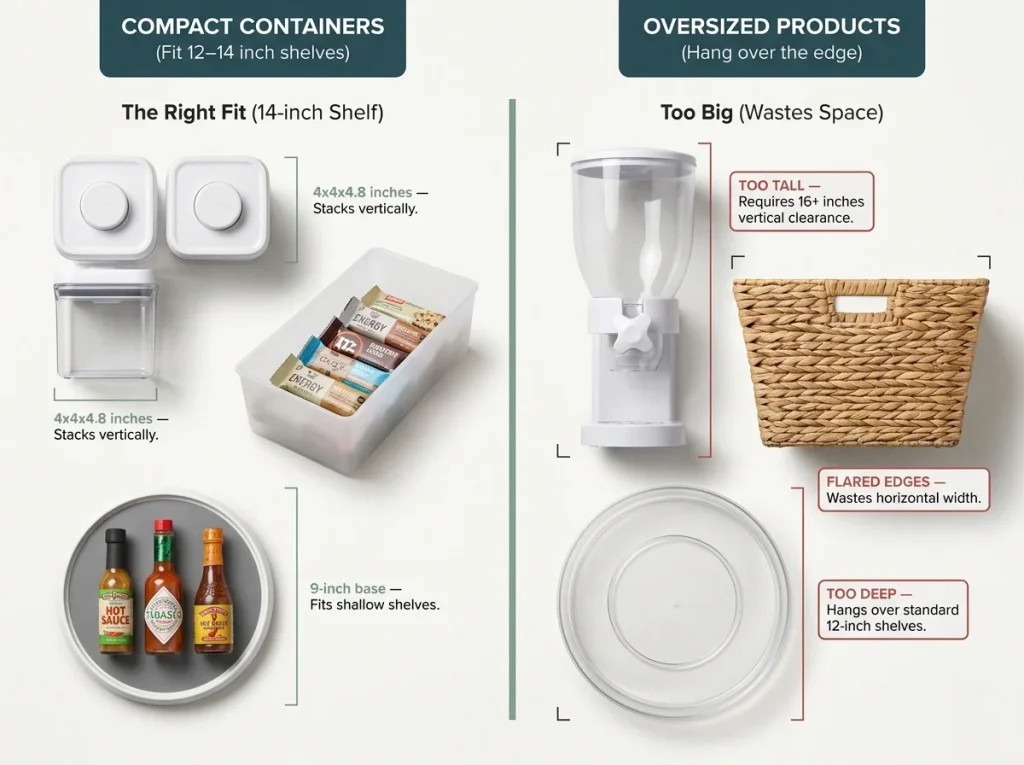
Pro tip: Before buying any pantry product, check the depth dimension first — not the width, not the height. Depth is the number that kills small pantry purchases. If the product depth exceeds your shelf depth, it’s an automatic skip.
Vertical Space Math — Getting More From Three Shelves
The Problem: Three Shelves Hold Three Shelves of Stuff
If your pantry has three physical shelves, your storage capacity is limited to three layers — unless you add vertical tiers within each shelf. This is the single most important strategy for small pantries, and most guides skip it because it’s not relevant in a pantry with six or eight shelves.
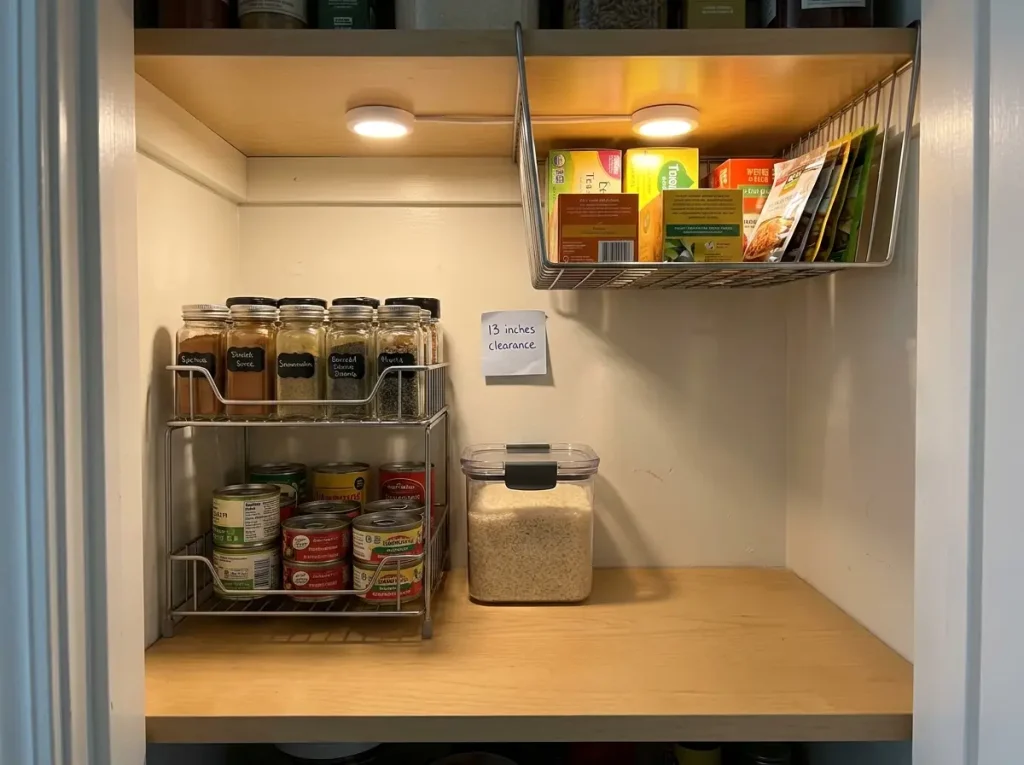
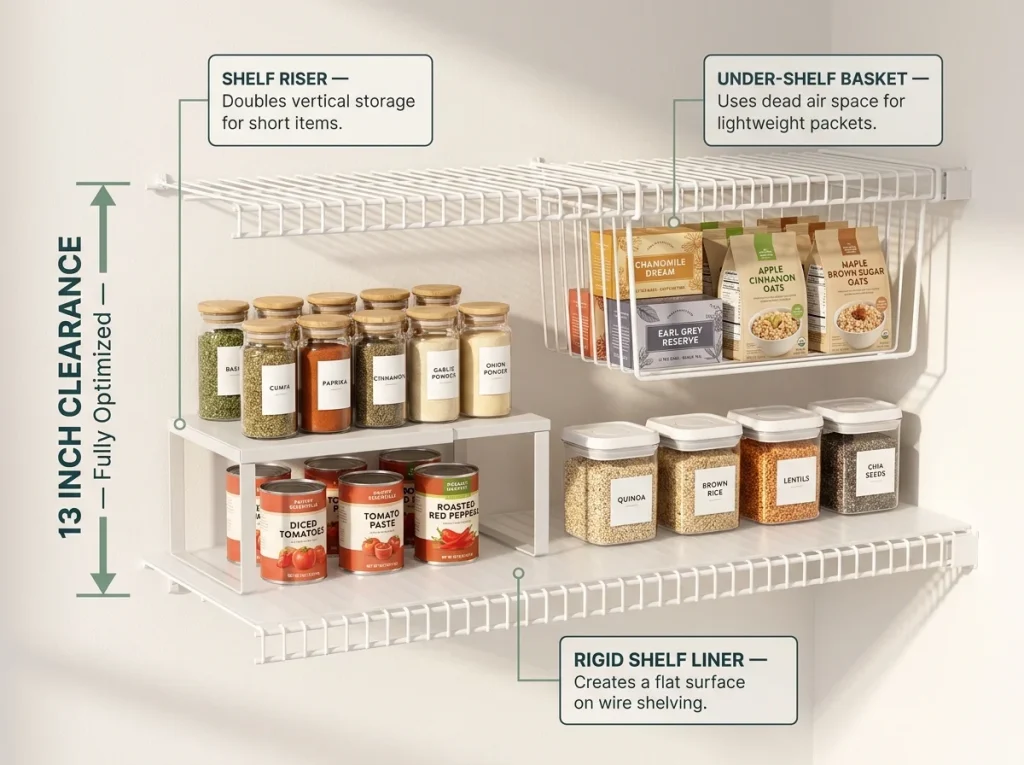
The math is simple. If your vertical clearance between shelves is 13 inches and your tallest item is 6 inches, you have 7 inches of unused air above every item. That’s wasted capacity. A shelf riser or under-shelf basket converts that air into usable storage.
Shelf Risers: Double the Tiers
The SimpleHouseware Expandable Shelf Rack ($16-20) adjusts from 15.5 to 25 inches wide and stands 10 inches tall. Place it on any shelf to create two tiers: the riser surface holds spice jars, small cans, or condiment bottles, while the space underneath holds flat items like pouches, packets, or short containers.
In a small pantry, one riser per shelf is usually the maximum — they add storage but also add visual complexity in a tight space. Use risers on the shelf with the most small items (usually the cooking zone with oils, spices, and cans).
Under-Shelf Baskets: Storage From Thin Air
Under-shelf wire baskets clip onto the shelf above and hang down, creating a suspended tier for lightweight items: tea bags, seasoning packets, snack bars, instant oatmeal. They work best on solid shelves. On wire shelving, the clips don’t grip consistently — use shelf risers instead.
One under-shelf basket per pantry is usually enough. Hang it from the middle shelf to create easy-access storage for grab-and-go items at arm height.
Wire Shelf Prep: The $12 Foundation
If your small pantry has wire shelving (most apartment pantries do), nothing else works properly until the shelves are flat. The Gorilla Grip Shelf Liner ($12-15 for a 17.5″ x 10 ft roll) clips onto wire shelves with locking tabs. No adhesive, fully removable for renters. The result is a smooth surface where bins sit level and risers don’t wobble.
The budget alternative — thick cardboard cut to size — works for a few months but sags under weight and can’t be wiped clean. For a small pantry where you’re stacking and organizing on every shelf, the liner pays for itself in stability.
The Minimalist Weekly Reset for Small Pantries
Five Minutes, Not Ten
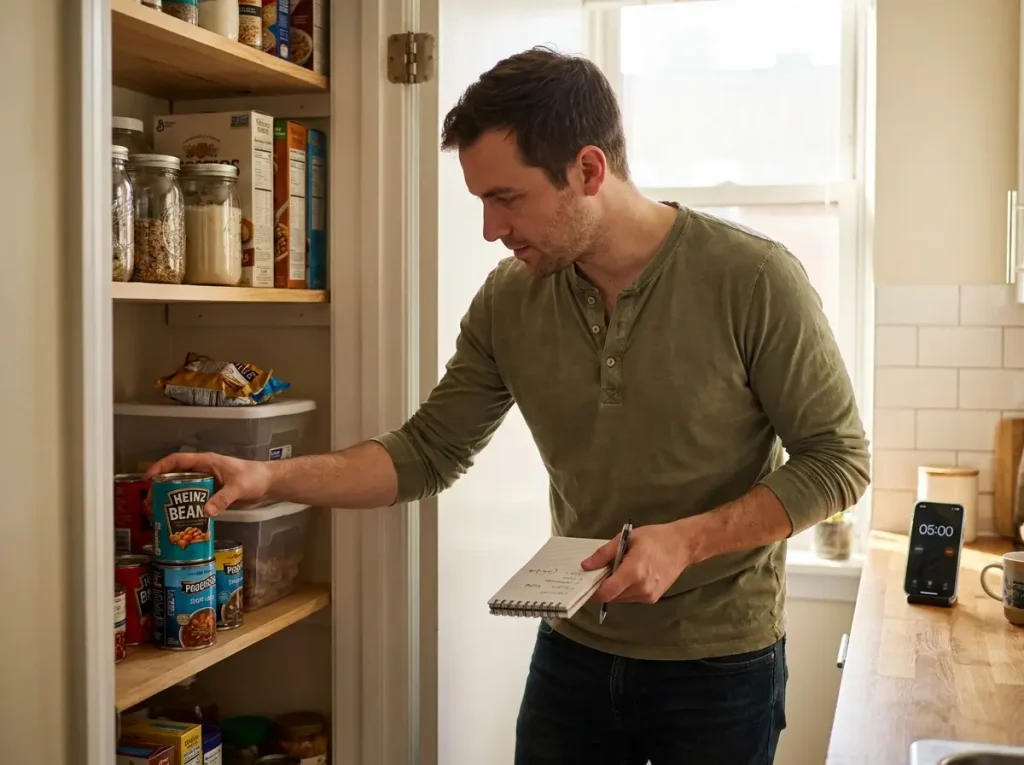
Full-size pantry resets take ten minutes because there’s more surface area and more items. A small pantry reset takes five minutes or less — you can see everything at once and you have fewer zones to check.
The routine: open the pantry, push items to the front of each shelf, check if any container is low (add to grocery list), return anything that migrated to the wrong zone, wipe any crumbs off the shelf liner. Done. This is maintenance, not a project.
The Grocery Rule for Small Pantries
The weekly reset includes one rule that doesn’t apply to large pantries: check for overflow before shopping. In a full-size pantry, you can fit extra items without thinking. In a small pantry, three extra cans and a new cereal box can collapse your zones. Before every grocery run, look at what’s already in the pantry and buy only what fits in the space available — not what’s on sale.
If you see a bulk deal on canned tomatoes, ask yourself: do I have room for six more cans? If the answer is no, buy two. The savings mean nothing if the cans end up stacked on top of your containers, pushing your whole system out of alignment.
The Three-Month Zone Check
Every three months, reassess whether your three zones still match how you eat. If you stopped making oatmeal and started eating yogurt for breakfast, the oatmeal container on your “daily” shelf is taking up the most useful real estate in your pantry. Swap it to the “weekly” zone and move something you actually grab every day into its spot.
In a small pantry, one misallocated shelf position has more impact than in a large one — you don’t have spare room to absorb the mistake.
Pro tip: Keep your grocery list inside the pantry — a small magnetic notepad on the door or a sticky note on the shelf edge. In a small pantry, you can scan the entire inventory while writing the list. No separate inventory check needed.
Conclusion
Small pantries reward precision. Measure before you buy, reduce your zones to three, and choose containers that fit your exact shelf dimensions. The difference between an organized small pantry and a chaotic one usually comes down to two or three inches of depth and one mismatched container.
Three-Month Check: Revisit your zone assignments in three months. If you’re shoving items wherever they fit instead of into their zone, the zones don’t match your current cooking habits — rename them and reallocate.
Start with one shelf. Get the measurements right, pick containers that actually fit, and live with it for a week before doing the next one.
Q1 How do I organize a pantry with very little space?
Measure your shelves first, then reduce to three zones: daily items at eye level, cooking staples below, and weekly items on top. Use compact containers that fit your exact shelf depth and add shelf risers to double your vertical tiers without adding width.
Q2 What size containers work best for small pantries?
Look for containers with a footprint under 5×5 inches for dry goods and bins no longer than 10 inches for zone grouping. The OXO POP short square (4x4x4.8 inches) and mDesign 10x6x5 bins fit shelves as shallow as 14 inches with room to spare.
Q3 How do I organize a small pantry on a budget?
Start with a shelf liner for wire shelves ($12), which makes everything else work. Use Dollar Tree bins for lightweight items, repurpose glass jars for dry goods, and add one shelf riser ($16) to double your most crowded shelf. Total cost under $30 for a working system.
Q4 Should I use a lazy susan in a small pantry?
Yes, but get the 9-inch version — not the standard 12-inch. The 9-inch turntable fits shelves as narrow as 12 inches deep. Use it for cooking oils and condiments that get pushed to the back. One turntable per small pantry is usually enough.
Q5 How often should I reorganize a small pantry?
Do a five-minute reset weekly: push items forward, check levels, return misplaced items. Do a zone reassessment every three months to make sure your shelf assignments still match how you cook. Small pantries drift faster than large ones because there’s less buffer space.