






















In this article
Every fall, you have good intentions. You pull out the bins, start sorting, get halfway through, and then run out of places to put things. The winter coats have nowhere to go, the storage space under the bed is still full from last spring, and by November you’ve shoved everything back in the closet — both seasons, one rod, maximum chaos. That’s not a motivation problem — that’s a system problem. This guide breaks down exactly why seasonal rotation fails and rebuilds it in a way that actually works for a reach-in closet in a real apartment.
Quick Answer: A seasonal closet rotation system works in five steps.
- Edit the wardrobe before touching a bin — donate anything not worn in a full year
- Sort remaining clothes into current-season, off-season, and donate piles
- Wash or dry-clean everything going into storage before packing it away
- Move off-season clothes to under-bed bins, vacuum bags (synthetics only), or packed suitcases
- Add cedar blocks to natural fiber bins and schedule your next rotation as a specific calendar date
Why Seasonal Rotation Keeps Failing
The capacity problem nobody names
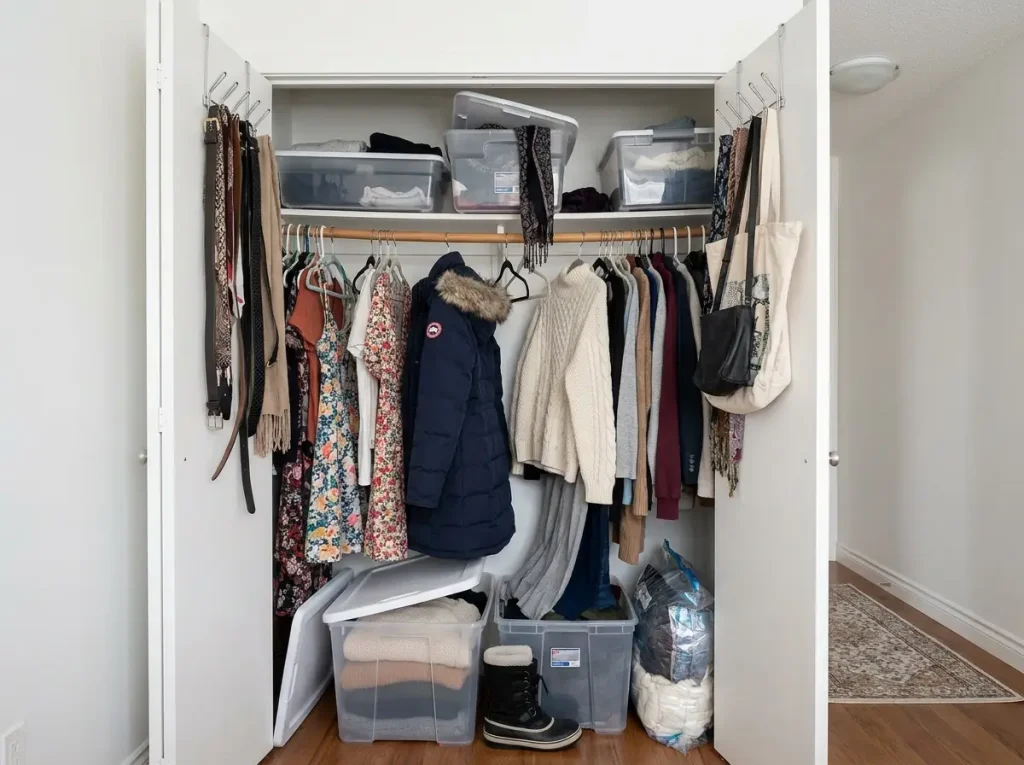
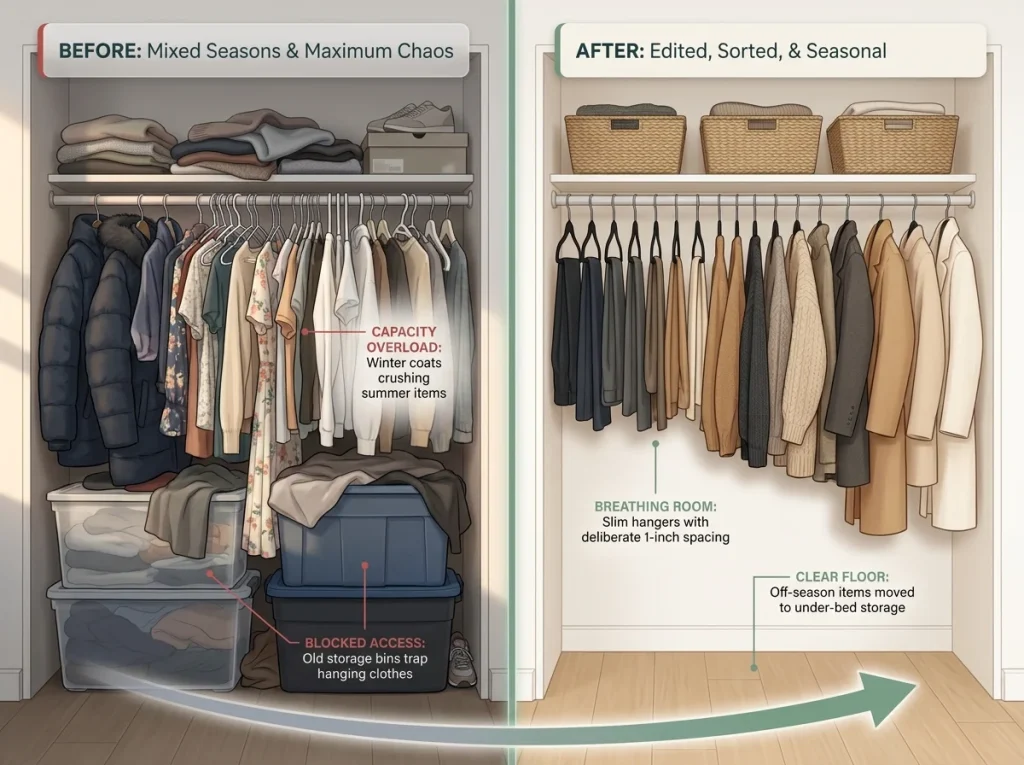
The most common reason seasonal rotation breaks down is simple: there are more clothes than the storage system can hold. Most guides skip this part because the math is uncomfortable. If your closet holds 40 hangers’ worth of clothes and your under-bed storage holds 20 sweaters’ worth of folded items, you can only rotate successfully if the off-season portion of your wardrobe is 20 sweaters or fewer. The moment your wardrobe exceeds your total storage capacity — closet plus external storage combined — rotation becomes shuffling clutter from one overflow zone to another. It never settles.
This is the closet capacity math that derails people before they open the first bin. You can buy all the vacuum bags in the world, but if there are 60 sweaters and room for 30, the system fails at a structural level — not an organizational one.
Why last year’s storage bins are still in your closet
Here’s the pattern that appears in almost every failed rotation: the storage containers from six months ago are still in the closet. They never fully got put away last spring because there was nowhere convenient to put them, so they stayed on the floor or the top shelf, mixed in with current-season items. Now it’s fall and you’re trying to rotate on top of a half-completed rotation from the last cycle. Every season starts from a worse position than the one before.
The one step that actually makes rotation possible
A wardrobe edit — meaning you remove clothes from the system entirely, not just rearrange them — has to happen before rotation can work. This is not optional. You cannot rotate a wardrobe that is already at maximum capacity. The edit is the first step of every seasonal rotation, not a one-time event.
If you do nothing else from this article, do this: before pulling out a single bin, spend 30 minutes going through your wardrobe with a “have I worn this in the past year?” rule. If the answer is no, it leaves. That creates the buffer your rotation system needs to actually function.
Pro tip: The backward-hanger test only works for clothes that were in your closet for a full season. Face all your hangers backward at the start of winter. Anything that hasn’t been flipped forward by spring hasn’t been worn — and those are your first candidates for the donate pile, not the storage bin.
The Pre-Rotation Edit (Do This Before You Move a Single Bin)
Pull everything out first
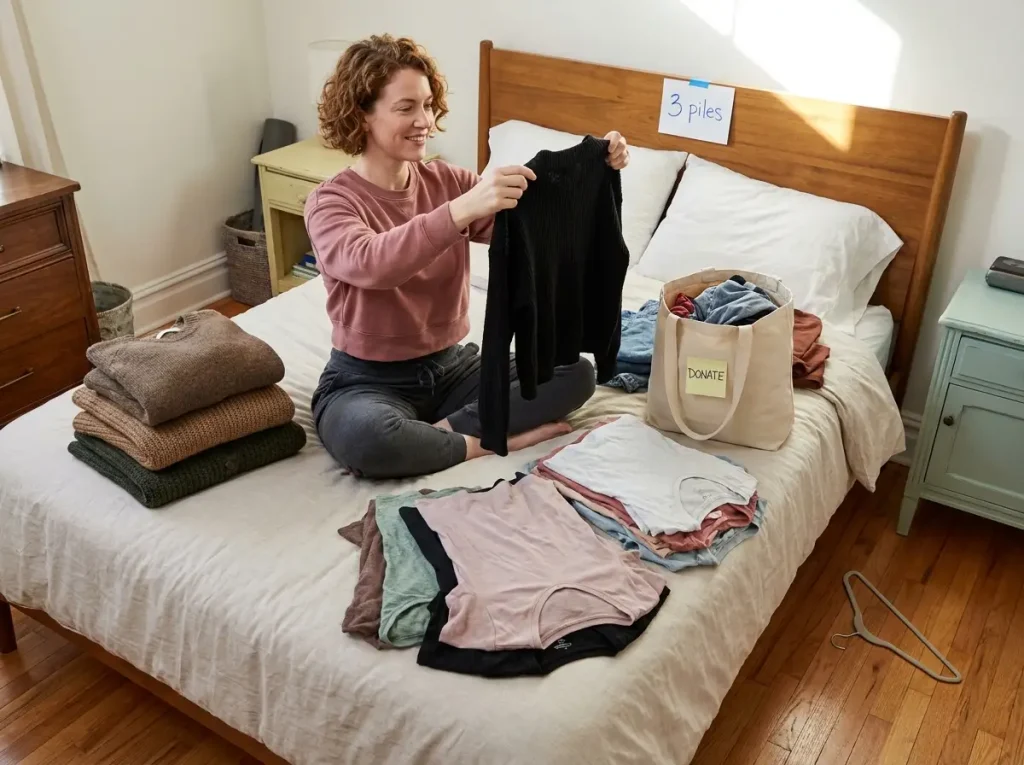
You cannot make accurate decisions about clothes you cannot see. The single most effective thing you can do at the start of a rotation is take everything off the rod and out of the shelves and lay it on the bed. All of it. This feels counterproductive when you just want to swap a few things, but it’s the difference between a rotation that lasts and one that reverts by December. You’re not just moving clothes — you’re resetting the system.
The three-category sort
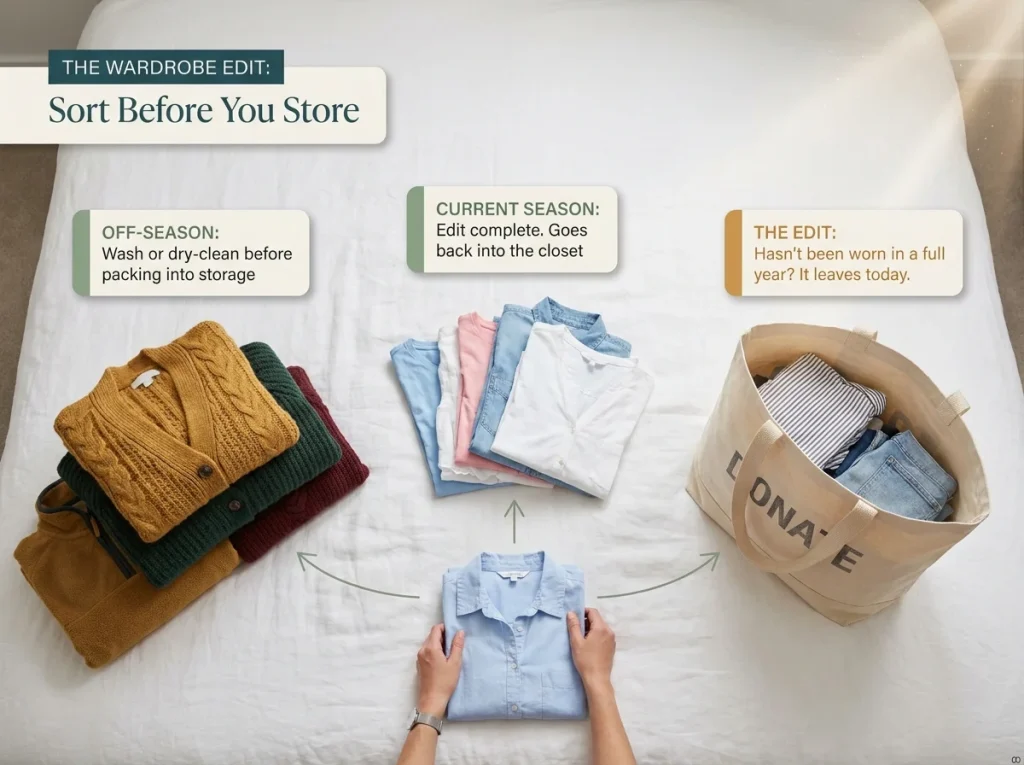
With everything visible, sort into three groups: current season (goes back into the closet after the edit), off-season storage (goes into bins or bags), and donate or toss (leaves the house entirely). The wardrobe edit process for the donate pile has one rule: if you haven’t worn it in a full year or it doesn’t fit today, it goes. Not next season. Not “when it fits again.” Today. The items at the back of the rod that you’ve been planning to wear are not keepers — they’re deferrals, and deferrals are how capacity gets worse with every cycle.
Clean before you store
Every item going into off-season storage should be washed or dry-cleaned first. Oils from skin and invisible food stains set into fabric during storage — what looks clean when you fold it away can come out with a permanent stain six months later. This is especially true for wool and cashmere, which are also the most appealing targets for moths.
A sweater that goes into storage with a faint collar stain comes out with a permanent one. Dry-clean wool before you box it, every time.
Pro tip: Don’t wait for rotation day to start the dry-cleaning pile. Put a bag near your closet two weeks before your scheduled rotation and drop things in as you identify them. By the time rotation day arrives, the dry-cleaning is already done and waiting.
Setting Up Your In-Season Closet

Front-of-rod frequency zoning
Once the wardrobe is edited and only the current season remains, the arrangement is straightforward. Items you wear weekly go at the front of the rod within easy reach. Items worn monthly — a blazer for occasional meetings, a dress for events — go toward the back. This isn’t a complex system. It’s just making the most-used things the easiest to grab. The daily-use zone starts from the left side of the rod and works inward — most of your routine outfits should live in the first 12 to 18 inches.
The transitional 20%
Every wardrobe has items that don’t belong to one season: a black blazer that works year-round, dark jeans that function from October through April, a lightweight cardigan that spans every season. These don’t rotate. They live permanently at the back of the rod in their own small section — 10 to 15 percent of your total hanging space — that doesn’t change when the seasons do. Mark it with a piece of tape or a labeled divider. When rotation time comes, skip this section entirely.
Top shelf as soft overflow
The top shelf of a standard rental closet is 12 to 14 inches deep — enough for one or two rows of folded items. Use it for the “almost current” season: the light sweaters you’ll reach for in three weeks, the scarves that cross seasons. This is soft overflow, not deep storage. If items on the top shelf haven’t been touched in six weeks, they belong in a bin under the bed. The top shelf folding strategy works best with shallow, clearly labeled bins that don’t require you to dig.
Where the Off-Season Clothes Actually Go (Renter Reality)
Most seasonal rotation guides assume you have a second closet, a basement, or a garage. If you do, the storage problem is mostly solved. This section is for everyone else — the apartment renter with one reach-in closet, a standard bedroom, and no secondary storage that didn’t require creative problem-solving.
Under-bed storage — measure before you buy
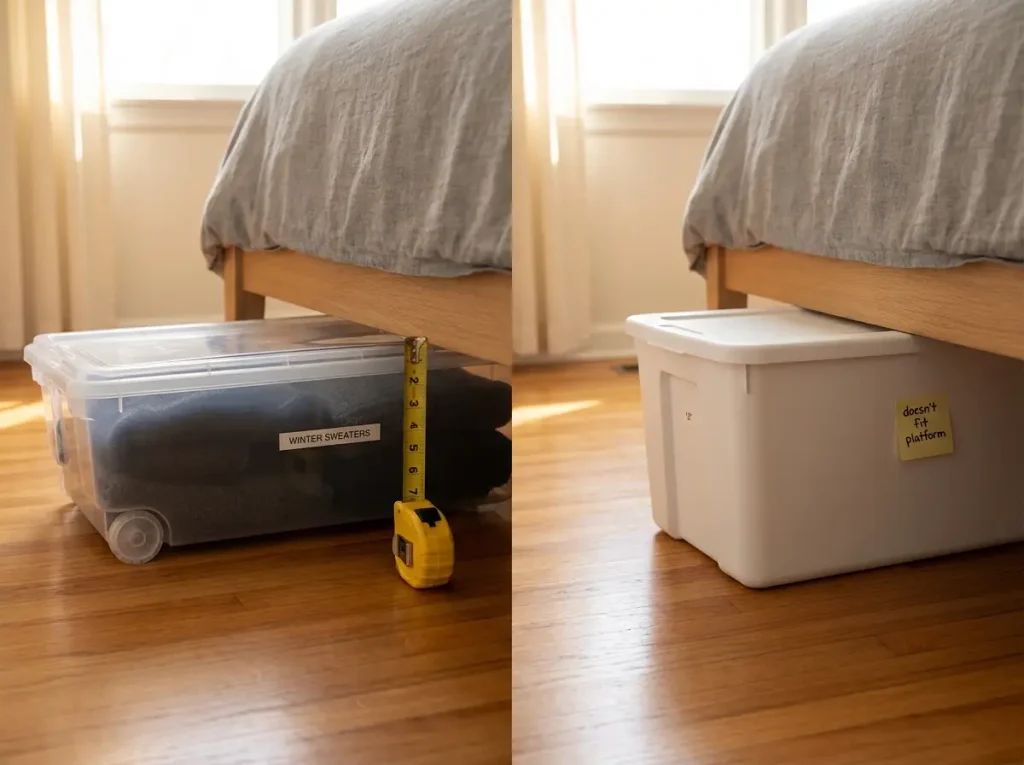
Measure the clearance under your bed before purchasing anything. Platform beds typically have 7 to 9 inches of clearance. Traditional raised frames have 13 to 15 inches. A standard storage container that’s 12 inches tall doesn’t fit under a platform bed — this is one of the most common storage mistakes, buying a bin that looks right online and discovering on rotation day that it can’t go where you planned. Low-profile rolling containers in the 5- to 7-inch height range are designed specifically for platform bed clearance.
For renter storage options without a garage or basement, under-bed is the highest-value real estate in the apartment. Use it for the bulkiest items — winter coats, heavy sweaters, thick blankets.
The vacuum bag truth for natural fibers
Vacuum storage bags compress clothes to roughly 20 percent of their original volume, which is genuinely useful for synthetic and cotton items. The SpaceSaver Premium Vacuum Storage Bags include a hand pump so you don’t need a vacuum cleaner nearby — useful if your storage is under a bed rather than next to an outlet. The Ziploc Space Bag XL is a solid budget alternative for the same types of items if you already have a vacuum accessible.
The warning that almost every other guide leaves out: do not use vacuum compression on wool, cashmere, down, or silk for more than six months. Compression permanently damages the fiber structure and insulating loft of natural materials. A down puffer coat that goes into a vacuum bag in October may come out in April looking permanently deflated — the fill can’t recover once it’s been crushed that long. Store natural fibers in breathable garment bags or loose-lid bins without compression.
Pro tip: Use one vacuum bag per item category rather than mixing: all cotton tees in one bag, all poly fleeces in another. If you need something mid-season, you’ll know immediately which bag to check — and which ones to skip entirely.
The suitcase method and other zero-cost options
If you have travel luggage that gets used once or twice a year, fill it with off-season clothes. A large rolling suitcase holds 15 to 20 sweaters with room for scarves and gloves. It rolls under the bed or sits on the top shelf of the closet and pulls double duty: luggage organized, off-season wardrobe contained. Zero additional cost. Suitcases you haven’t used in more than two years are a clutter problem in themselves — if you’re not traveling with it, the luggage might belong in the donate pile too.
Protecting Stored Clothes and Locking In Your Rotation Calendar
Cedar, sachets, and why mothballs are a last resort
Moths eat natural fibers — wool, cashmere, silk, alpaca. They don’t eat synthetics. This means your cotton tees in vacuum bags need no pest protection at all. Your wool sweaters in a breathable bin do.
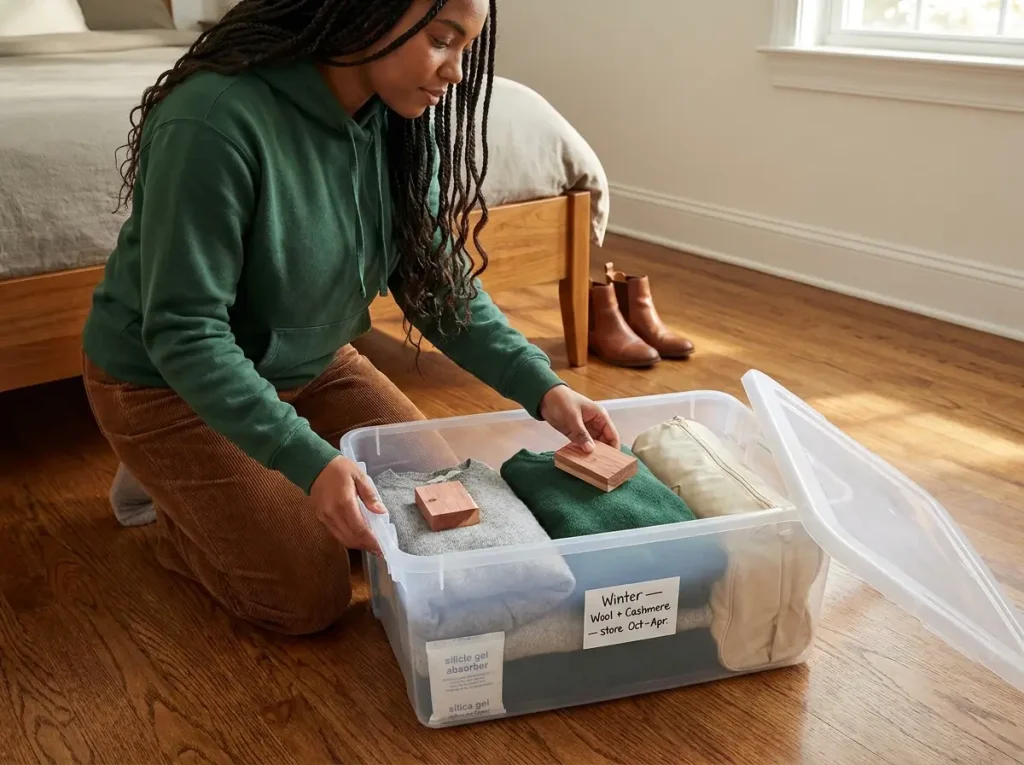
The Homode Cedar Blocks are an affordable way to handle this — two blocks per bin, placed on top of the folded items. Cedar deters moths by scent rather than eliminating them — the NC State Extension notes cedar repels adult moths but won’t stop an active infestation. The scent fades after 2 to 3 months; sanding the block surface with the included sandpaper refreshes it without requiring replacement. Lavender sachets work on the same principle and smell better in tight spaces.
Mothballs work, but they carry real tradeoffs: the chemicals are toxic around children and pets, and the odor absorbs into fabric over a 6-month storage period. Sweaters that go in smelling clean come out smelling like mothballs. Cedar is the right default for anyone sharing a space with small kids or pets.
Set a trigger date, not a season
“When it gets cold” is not a rotation date. It’s an intention, and intentions don’t show up in your calendar. The rotation that consistently happens is the one scheduled like any other appointment. Pick two specific dates: one in spring (the second Saturday in April, for example) and one in fall (the second Saturday in October). Put them in your phone right now, with a reminder two days before. Treat them like any recurring household task — not optional, not rescheduled because the weather hasn’t caught up yet.
If your climate is mild or unpredictable, schedule by calendar date rather than temperature. The rotation happens on its date whether or not it “feels” like winter yet.
The 10-minute mid-storage check
At the 3-month mark — roughly halfway through the storage period — open each bin briefly. Pull out anything that smells off (moisture got in; add a silica gel packet going forward), check that vacuum bags are still sealed, resand the cedar blocks. This takes about 10 minutes total and prevents the scenario where you pull out a winter coat in October that smells like a storage unit since April. One silica gel packet tucked against the inside wall of each bin handles humidity in most apartment environments.
Conclusion
The rotation fails for predictable reasons: more clothes than the storage capacity can absorb, no wardrobe edit before the swap begins, and off-season items with no specific home. Fix the capacity first — edit before you rotate, every single time. Know your under-bed clearance before buying storage containers. Use the right storage method for the right fabric: vacuum bags for synthetics, breathable bags for natural fibers, cedar blocks for anything wool.
Three months from now: open the bins, check for moisture, resand the cedar. It takes 10 minutes and saves you the sweater you’ve had since 2019.
Start with the wardrobe edit. Not the bins, not the vacuum bags — the edit. Get that right and the rest of the system follows.
Q1 How often should you rotate your seasonal wardrobe?
Twice a year covers most climates — once in spring, once in fall. The exact timing matters less than having a fixed calendar date. A specific scheduled date outperforms a vague seasonal intention every time.
Q2 How do you store off-season clothes in a small apartment with no extra storage?
Under-bed storage works for most apartments, but measure your clearance first — platform beds have 7 to 9 inches, which requires low-profile rolling bins. A packed suitcase stored under the bed or on the closet top shelf is the zero-cost option. The top shelf of a reach-in closet handles one soft-overflow layer for items transitioning between seasons.
Q3 Are vacuum storage bags safe for all types of clothes?
No. Vacuum compression works well for cotton and synthetic items — t-shirts, fleece, polyester blends. It damages wool, cashmere, down, and silk after six months of compression by permanently flattening fiber structure and insulating loft. Store natural fibers in breathable garment bags or loose-lid bins without compression.
Q4 What is the transitional wardrobe zone and how does it work?
The transitional zone is a small permanently assigned section of the rod — about 10 to 15 percent of hanging space — reserved for items that work across multiple seasons: dark jeans, a black blazer, neutral cardigans. These don’t rotate when the seasons change. When rotation time comes, skip this section entirely.
Q5 How do you protect stored clothes from moths without mothballs?
Cedar blocks placed on top of natural fiber items deter moths by scent. Two blocks per bin, sanded every 2 to 3 months to refresh the aroma. Lavender sachets work on the same principle. Neither option eliminates moths — they make the storage environment unappealing enough that moths avoid it. If you have an active infestation, freeze affected wool items for 72 hours before storage to address larvae.