





















In this article
You have a messy desk. You search for a desk organizer. You buy one. Two weeks later, your desk is messy again — now with an organizer sitting in the middle of it. I have tested over a dozen desk organizers across three different desk sizes in my own home office, and the pattern repeats: most people buy the wrong type of organizer for the space they actually have. These are the four worth buying, the two categories to skip entirely, and how to match the right organizer to your desk before you order.
These four desk organizers cover the most common desk setups — here is how they compare.
| Product | Best For | Footprint | Key Feature | Renter-Friendly |
|---|---|---|---|---|
| SimpleHouseware Mesh Organizer | Overall pick | ~14″ × 11″ | Sliding drawer + 5 sections | Yes |
| WALI Monitor Riser | Monitor + storage | 21.65″ × 11.81″ | Hidden drawer + side pockets | Yes |
| Gianotter 4-Tier File Organizer | Paperwork/files | ~9.5″ × 12.9″ | 4 independent sliding trays | Yes |
| Marbrasse Pen Organizer | Small desks | ~7.5″ × 5.5″ | 2 drawers + 5 pen slots | Yes |
The Problem With Buying More Desk Organizers
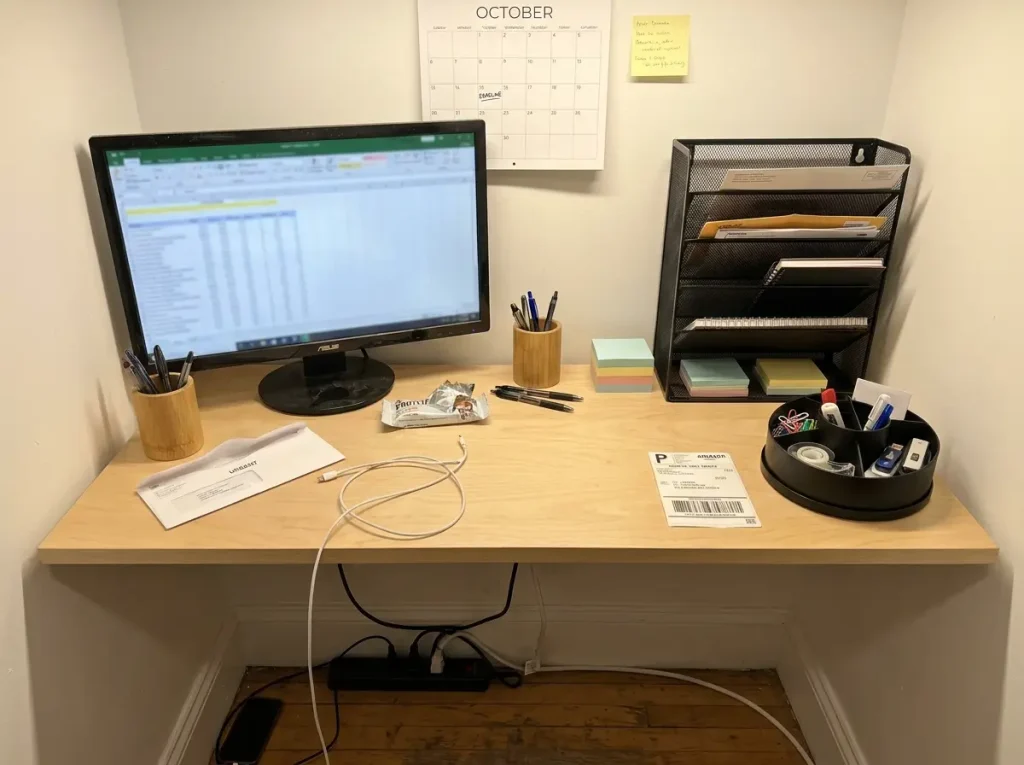
Why Three Organizers Won’t Fix One Messy Desk
Here is what actually happens when you buy a desk organizer without a plan. The organizer arrives. You load it up with pens, clips, and sticky notes. It looks great. Then, over the next two weeks, the flat desk surface around the organizer becomes the new dumping ground. Mail lands next to it. Your phone charger drapes over the side. A coffee mug takes up permanent residency six inches to the left.
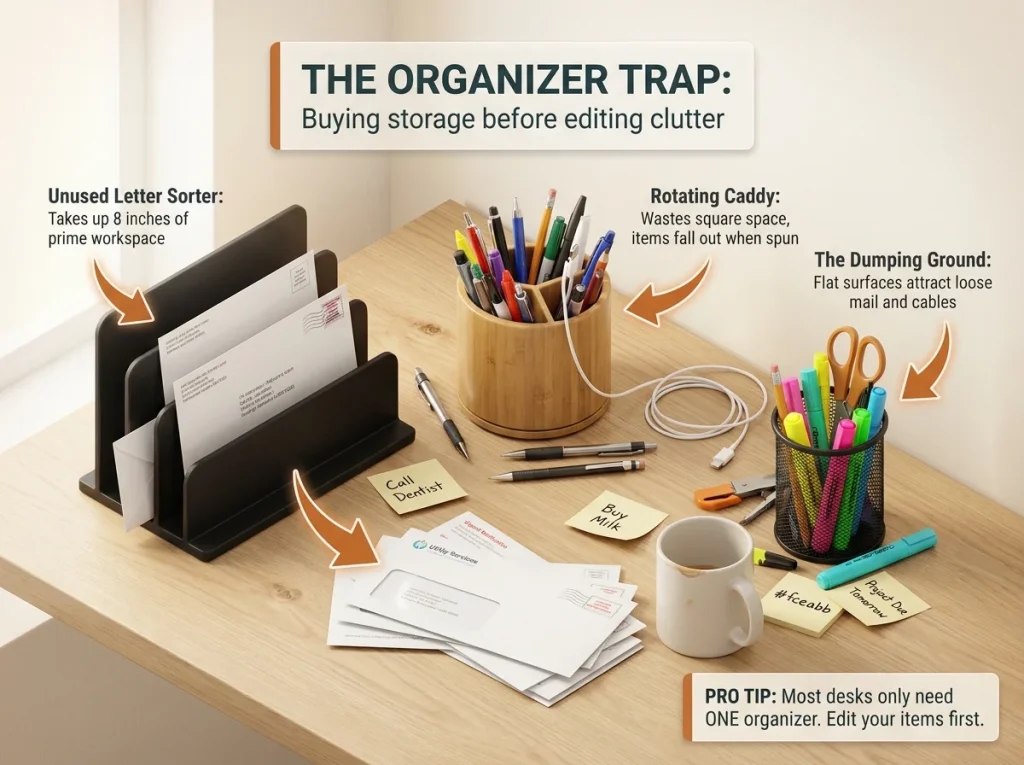
The problem is not the organizer — it is everything else on the desk that does not have a home. Before you spend money on any desk organizer, do a desk edit first: pick up every single item on your surface and sort it into keep, relocate, or toss. If you follow the 10-item desktop rule from a full desk organization system, you will end up with far fewer things that need organizing in the first place. Most desks only need one organizer. Two at most. The people with three organizers and a still-messy desk skipped the editing step.
Two Types of Desk Organizers You Should Skip
The title promised two to skip, so here they are.
Rotating desk caddies look clever in product photos. A round organizer that spins so you can reach every compartment. In practice, the spin mechanism loosens within a few months, small items shift and fall every time you rotate it, and the round footprint wastes square desk space. A 6-inch-diameter circle takes up more surface area than a 5-by-4-inch rectangular caddy with the same number of compartments. Every rotation also nudges whatever is sitting next to it. Skip these.
Multi-piece “complete desk organizer sets” are the second trap. These come with five or six separate pieces — a pen cup, a memo tray, a business card holder, a letter sorter, and sometimes a tape dispenser. The idea is a matching set that covers everything. The reality is five separate objects scattered across your desk, half of which solve problems you do not have. The business card holder sits empty. The letter sorter holds three envelopes and takes up 8 inches of prime desk surface. You end up with more organizer than desk.
Pro tip: If you already own a multi-piece set, keep only the one or two pieces you actually use every day. Put the rest in a closet. Your desk will feel bigger by the end of the hour.
Best Overall Desk Organizer

Why the SimpleHouseware Mesh Organizer Works
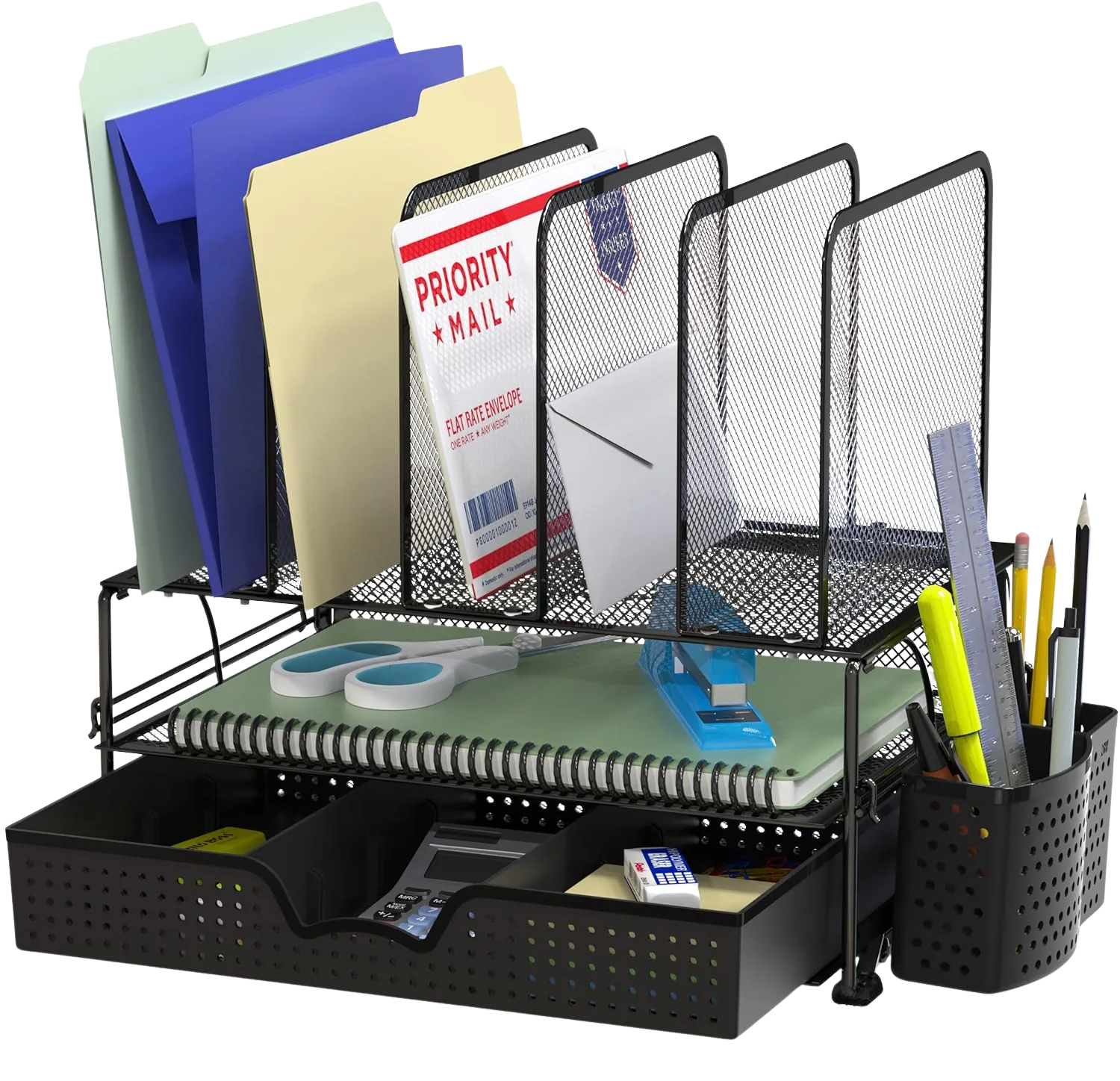
Most desk organizers force you to choose between holding files and holding supplies. The SimpleHouseware Mesh Desk Organizer does both in a single unit, which means you only need one piece on your desk instead of two. The five upright sections handle folders, notebooks, and letter-size papers, while the sliding center drawer tucks away paper clips, sticky notes, and charger cables you only need a few times a day.
At roughly 14 by 11 inches, this fits comfortably on a standard 24-inch-deep desk with working space to spare in front. No mounting, no adhesives, no drilling — you set it on the desk and it works. That makes it a straightforward pick for renters. The mesh construction keeps it light enough to move during cleaning without needing to unload it first.
One thing to check before ordering: it stands 13 inches tall. If your monitor sits directly on the desk surface without a riser, the organizer might block part of your screen depending on your monitor size and viewing angle. A monitor riser fixes that — and the next pick handles both problems at once.
Best Monitor Riser With Storage

How the WALI Riser Doubles Your Desk Space
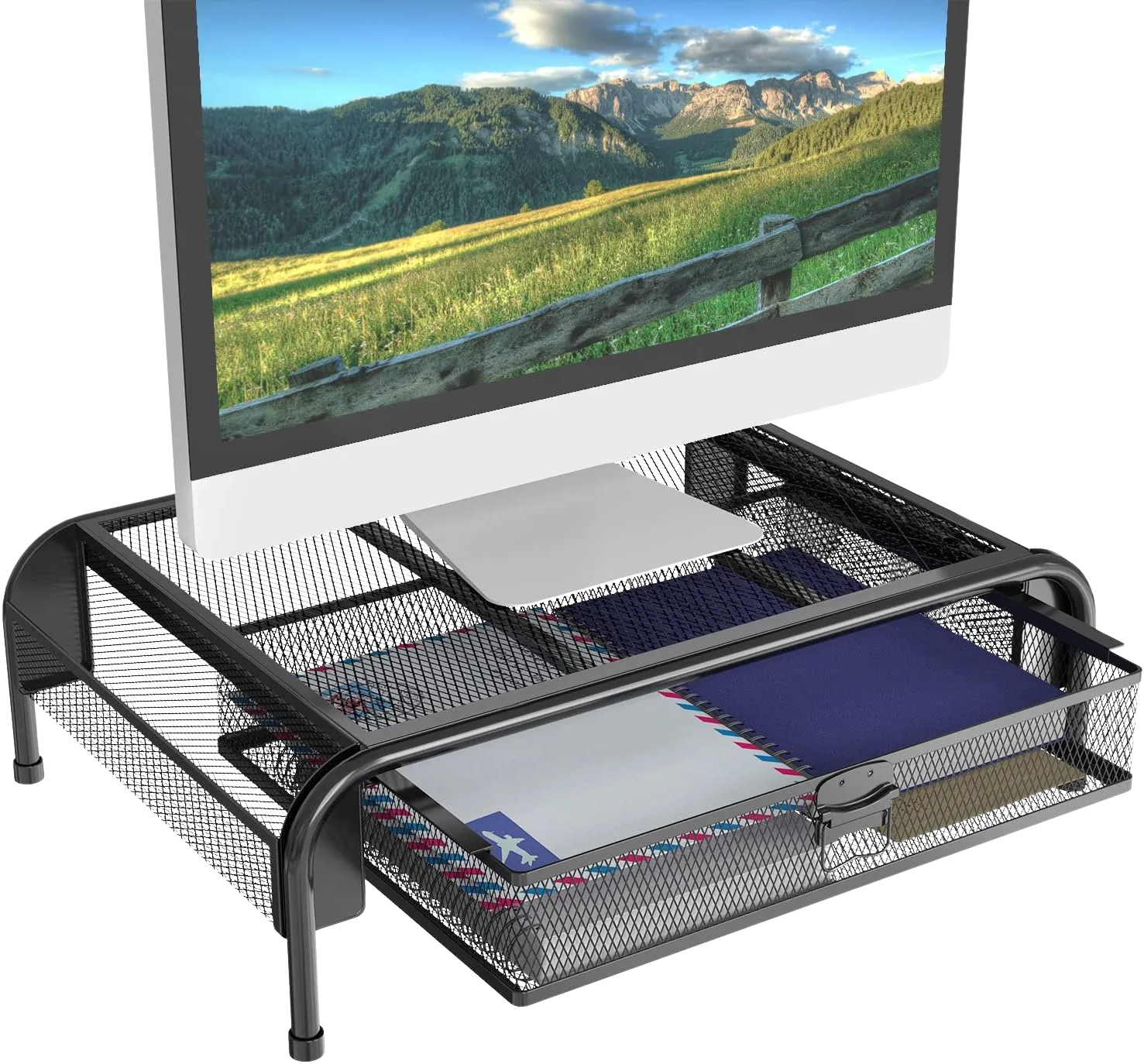
A monitor riser solves two problems at once: it lifts your screen to a comfortable viewing height and reclaims the desk surface underneath it. The WALI STT005-B takes this a step further with a full-width hidden drawer and mesh side pockets, so the cables, batteries, and USB hub that used to float around your desk now have a specific place to go.
The 21.65-inch width accommodates monitors up to 27 inches, and the rubber feet keep the riser planted when you reach for the drawer. I like that the side pockets are open-top — you can drop a USB-C hub in one side and a small notepad in the other without opening anything. If you have been looking for more desk organization ideas that use vertical space, a riser with built-in storage is one of the fastest wins.
The riser adds 4.33 inches of height to your monitor position. Check that your chair, desk, and eye level work with that added height before ordering. If your desk is under 20 inches deep, look at the Halter Monitor Stand Riser instead — it has a 9-inch depth versus the WALI’s 11.81 inches, so it leaves more working space on shallow desks.
Pro tip: Before placing any organizer on your desk, route your cables first. The cleanest desk setup starts with cable management, not with organizers. Once cables are handled, the organizer has a clear surface to sit on.
Best for Paperwork and Files
When You Need a Dedicated File System
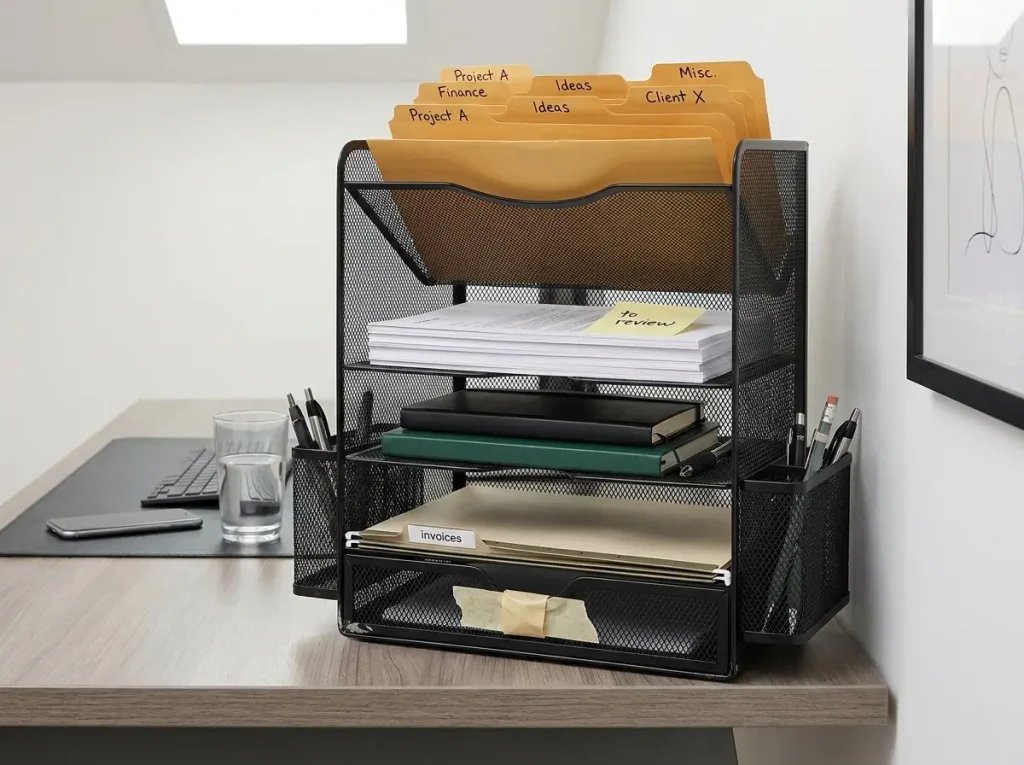
If your desk handles invoices, contracts, school forms, or anything that comes on paper more than once a week, a single-tray inbox is not going to cut it. Papers stack up, the bottom layer becomes invisible, and you end up lifting entire piles to find the one sheet you need. A tiered desk file organizer fixes this by giving each category its own visible, accessible slot.
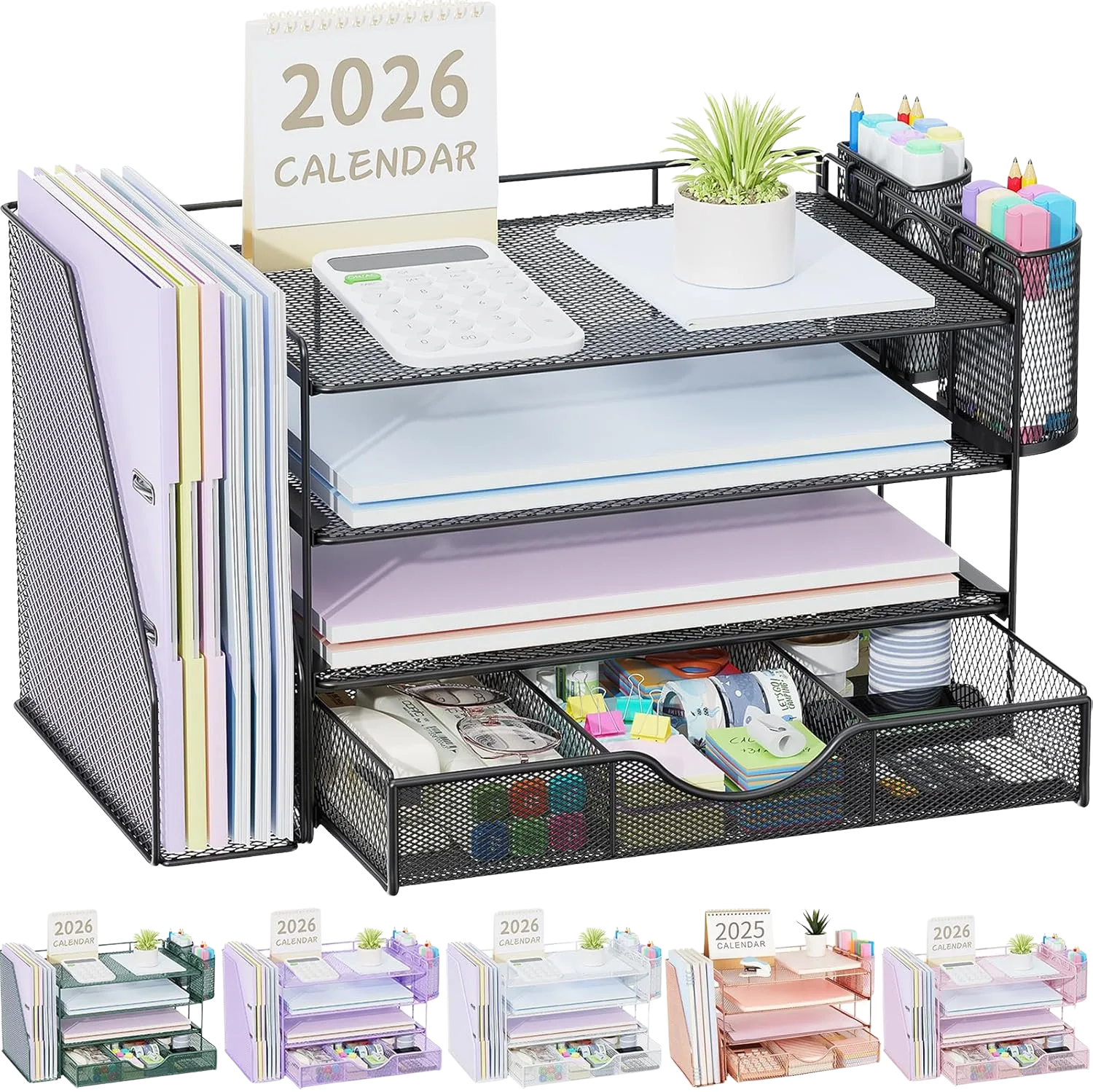
The Gianotter 4-Tier Desk Organizer has four independently sliding trays, and that sliding action is the detail that separates it from stacking trays. With standard stacking trays, you have to lift the top two to see what is in the third. With sliding trays, you pull the third one forward and check it directly. That difference means you will actually use all four tiers instead of treating the bottom two as a paper graveyard. The integrated pen holders on either side mean one less separate caddy on your surface.
At 9.5 by 12.9 inches and 13.5 inches tall, this organizer is a visible presence on your desk. It works best pushed against a wall or the back edge of a desk that is at least 22 inches deep. If your paperwork volume is lighter, the Marbrasse 5-Tier File Organizer with a handle offers a more portable alternative at a slightly lower price.
Best Pen Caddy for Small Desks
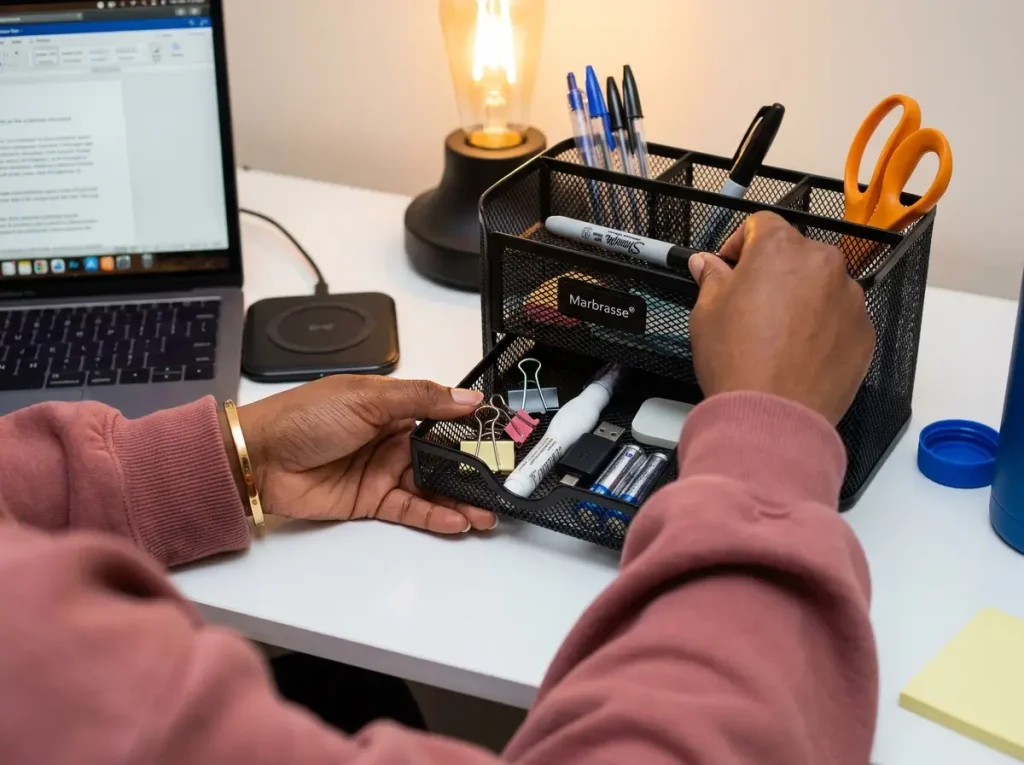
The Right Organizer for Desks Under 40 Inches
On a small desk, the organizer itself can become the clutter problem. A full multi-compartment system takes up 14 by 11 inches — that is over a third of a 36-inch desk gone just to hold pens and paper clips. When your desk is under 40 inches wide, you need an organizer that solves storage without eating your workspace. That means one compact piece that handles multiple item types, not three small pieces spread across the surface.
The Marbrasse Mesh Pen Organizer packs five pen compartments and two small pull-out drawers into a 7.5-by-5.5-inch footprint — the smallest in this roundup. That is less space than a standard paperback book. The drawers hold binder clips, USB adapters, charger cables, and the other small items that normally rattle around in a desk drawer or vanish behind the monitor. On a small desk, this caddy is your entire system. If you also deal with paper, you will need a wall-mounted file holder or a slim vertical sorter — this caddy does not handle documents.
If your desk is messy and small, the organizer is only half the fix. The full approach to fixing a messy desk starts with editing what is on the surface before adding any organizer to it.

What to Measure Before You Buy
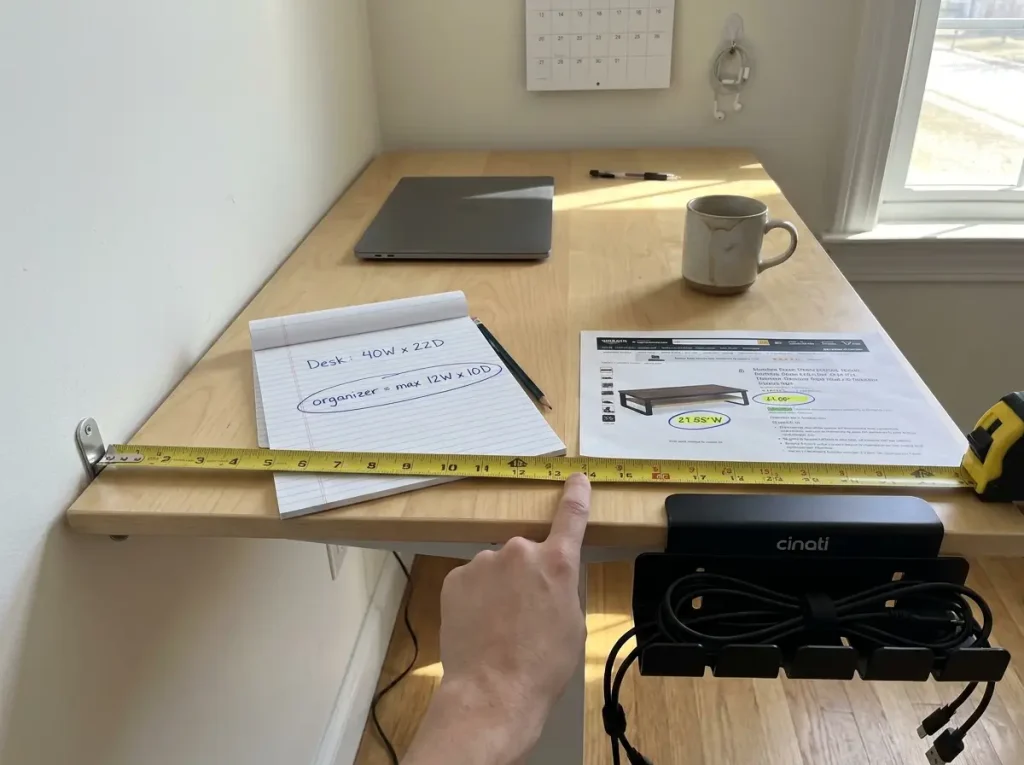
Three Numbers That Decide Your Organizer
Every desk organizer that ends up returned or shoved in a closet failed because of the same thing: it did not fit the desk. Not the wrong style, not the wrong color — the wrong size. Before you order anything from this list, grab a tape measure and write down three numbers.
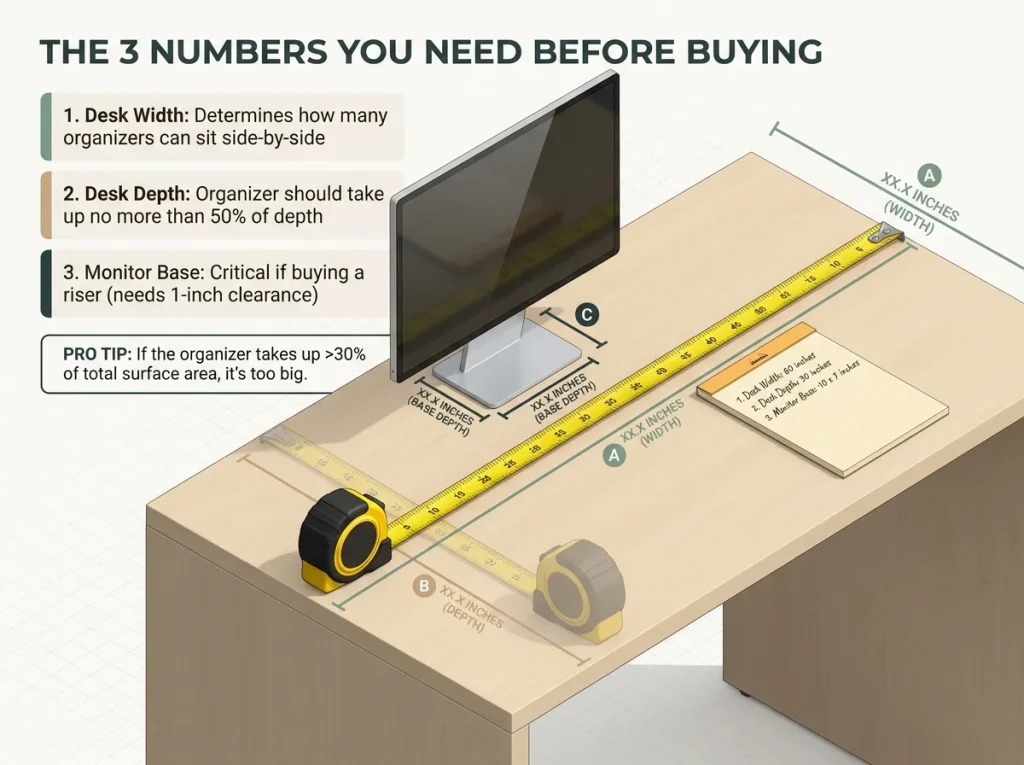
Desk width tells you how much organizer you can fit side by side. On a 48-inch desk, you have room for the SimpleHouseware organizer plus a monitor riser. On a 36-inch desk, pick one. Desk depth is the number most people forget. If your desk is only 20 inches deep and you put a 12-inch organizer against the back wall, you have 8 inches of working space left. That is not enough for a notebook and a coffee mug. Your organizer should take up no more than half your desk depth. Monitor base footprint matters if you are getting a riser — the riser needs to clear the monitor base with at least an inch of margin on each side.
Write the numbers down. Compare them to the footprint listed in the comparison table above. If the organizer takes up more than 25 to 30 percent of your total desk surface area, it is too big for that desk.
The Cable Step Nobody Talks About
You can put the best organizer on your desk and it will still look cluttered if three charging cables are draped over the edge and a power strip is visible on the floor. Cable management is the step that makes everything else work visually.
The Cinati 16-inch Cable Management Tray clamps to the underside of your desk — no drilling, no adhesives — and holds a full cable bundle from a two-monitor-plus-laptop setup. It fits desk thicknesses from 0.4 to 3 inches, so it works on everything from a thin IKEA desktop to a solid wood surface. If your desk is wider than 48 inches, the extendable 16-to-31-inch tray covers the full span.
Pro tip: Route your cables before placing your organizer. Once the tray is clamped and cables are bundled underneath, the desk surface is a clean slate. The organizer sits on top of a surface that already looks put together.
Standing Desk Compatibility
If you use a standing desk, not every organizer on this list works safely. Anything tall and heavy — like the Gianotter 4-tier file organizer loaded with papers — becomes a tipping risk when the desk motor raises or lowers the surface. Low-profile organizers like the WALI monitor riser are standing-desk safe because their weight sits close to the surface. The Marbrasse pen caddy is light and compact enough that it stays put during transitions. If you use a standing desk and need a file organizer, bolt-down or wall-mount options are safer than any freestanding unit.
Conclusion
Three things to take from this roundup:
- Match the organizer to your specific problem. A pen caddy will not fix a paper-heavy desk. A file organizer will not help if your issue is cables and chargers. Identify what is actually cluttering your surface before you shop.
- Measure your desk before ordering. Desk width, desk depth, and monitor base footprint — three numbers that prevent returns and wasted desk space.
- Skip rotating caddies and multi-piece sets. One well-chosen organizer that fits your desk and solves your actual problem beats three random ones every time.
In three months, check whether your organizer is still working as intended. If pens keep ending up next to the pen holder instead of in it, the system needs adjusting — not another organizer. That is the signal to reassign compartments or remove items that do not belong on the surface anymore.
Start by counting what is on your desk right now. If it is more than ten items, edit down to ten before you buy anything. The best desk organizer is less stuff.
Q1 What is the best desk organizer for a small desk?
The Marbrasse Mesh Pen Organizer has the smallest footprint of any desk organizer worth buying at just 7.5 by 5.5 inches. It fits desks as narrow as 30 inches while still providing five pen slots and two pull-out drawers. For desks under 40 inches wide, one compact organizer beats multiple small pieces.
Q2 Do desk organizers actually help keep a desk clean?
Desk organizers work only when you edit your desk contents down to essentials first, because without that step the clutter just moves around the organizer. An organizer gives each item an assigned home, which prevents the daily scatter of pens, cables, and papers. Skip the editing step and the organizer sits full while new clutter piles up beside it.
Q3 How many desk organizers do I need?
Most desks need exactly one organizer, or two at most if you have separate problems like pen storage and paper filing. Three or more organizers on a single desk usually means you added storage instead of reducing clutter. Pick one organizer that matches your main problem and start there.
Q4 Are desk organizers worth it for renters?
Every desk organizer in this roundup is freestanding and requires zero drilling, zero adhesives, and zero wall mounting. They sit on the desk surface and move with you to the next apartment without leaving marks. The cable management tray clamps to the desk edge and also removes clean.
Q5 What should I look for when buying a desk organizer?
Measure your desk width and depth first, then check that the organizer footprint leaves at least 70 percent of your surface free for working. Match the organizer type to your main clutter problem: mixed supplies need a multi-section unit, papers need tiered trays, and pen-and-cable clutter needs a compact caddy with drawers.