




















In this article
You’ve done this before. Spent a Saturday pulling everything out of closets, filling trash bags, feeling like you finally got control of your space. Two months later, the clutter was back — different stuff, same problem. That’s not a willpower failure. That’s a systems failure, and it starts with the order you tackle the rooms.
After decluttering my own apartment three separate times before landing on a system that actually held, I can tell you the difference between a weekend purge and a lasting reset comes down to sequence, session limits, and one habit most people skip entirely. This is the room-by-room method that builds momentum instead of burning it out, with the maintenance piece that stops everything from reverting.
Quick Answer: To declutter your home room by room and make it stick:
- Set up four sorting boxes (keep, donate, trash, relocate) before starting
- Begin with the bathroom or entryway for fast, low-stakes wins
- Move to the kitchen — countertops first, cabinets second
- Tackle bedroom and closet next, where decisions get harder
- Save storage rooms (garage, basement, attic) for last
- Schedule a three-month reset to stop the reversion cycle
Set Up Your Sorting System Before You Touch a Single Room

Most people start decluttering by walking into whatever room annoys them most and just pulling stuff out. No system, no containers, no plan for where things go after they leave the room. That’s why piles end up on the dining table, donation bags sit by the door for weeks, and “I’ll deal with it later” becomes permanent.
The Four-Box Rule and Why Most People Do It Wrong
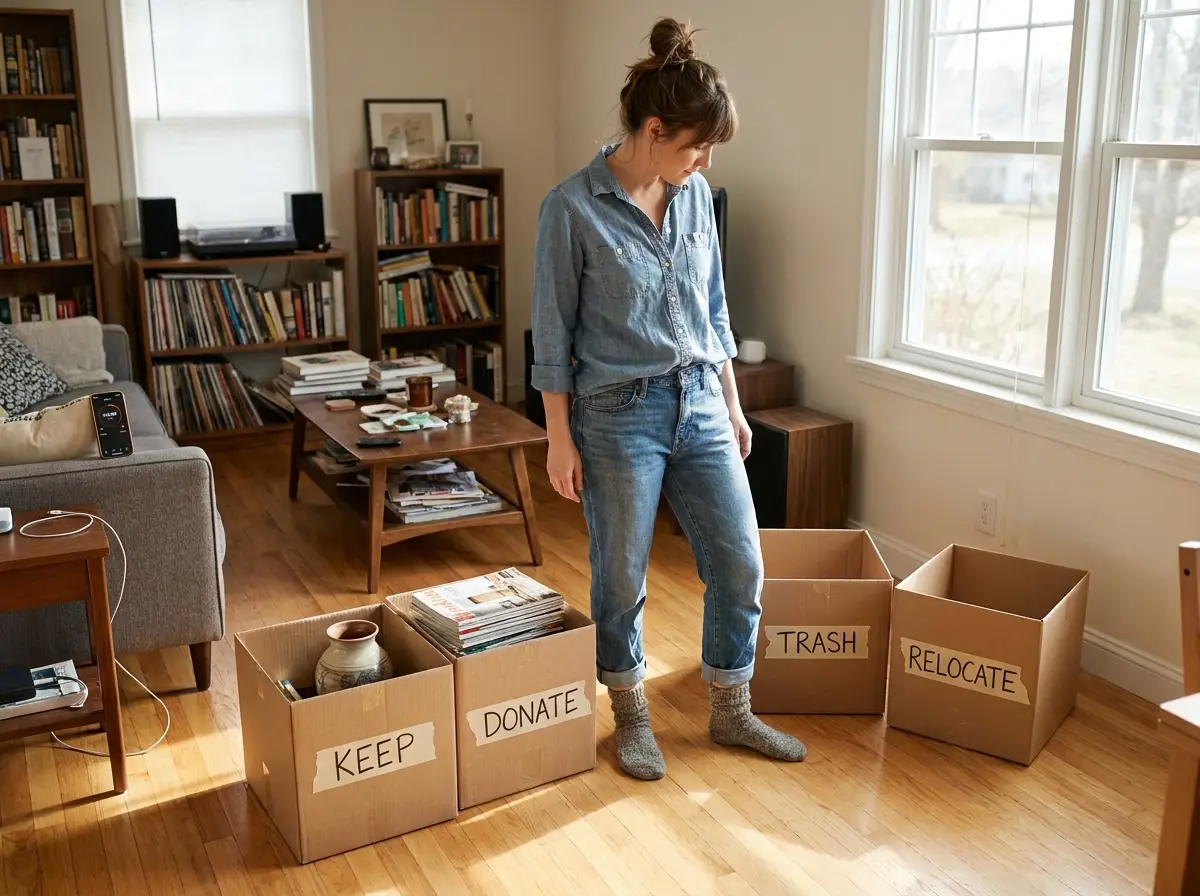
The four-box method is simple: every item goes into one of four categories — keep, donate, trash, or relocate. Relocate is the one most people forget, and it’s the reason decluttered rooms fill back up. That sweater sitting on your desk chair doesn’t belong in the trash or the donation pile. It belongs in your closet. Without a relocate box, it stays on the chair.
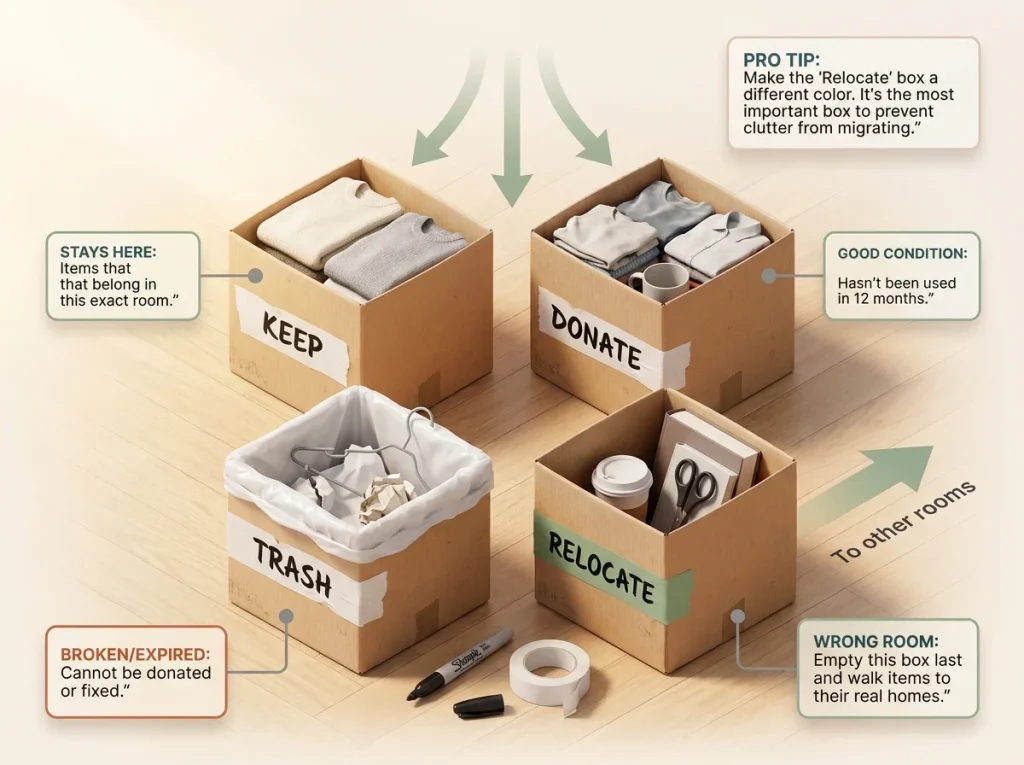
Label your boxes before you start. A strip of white masking tape and a thick permanent marker work perfectly for this — you probably have both in a junk drawer already. If you’re the kind of person who will reuse these labels for future sessions or pantry organization, a label maker like the Brother P-Touch PTD220 (5.9″ × 1.9″ × 2.6″) prints clean, repositionable labels and runs on batteries. But the masking tape method works just as well for a one-time declutter, and it costs nothing.
Pro tip: Make the RELOCATE box a different color or mark it with an X. At the end of each session, empty it first — walk every item to its correct room. If you skip this step, the relocate box becomes a permanent clutter pile with a label on it.
Cap Each Session at 2 Hours (Here’s Why)
Two hours is the limit. Not because the work is physically hard, but because decision fatigue compounds in a way most people don’t expect. Your first thirty minutes of sorting feels easy — obvious trash, obvious keeps. By minute ninety, you’re staring at a kitchen gadget for three minutes trying to decide if you might use it someday. By hour three, everything starts going back in the keep box because your brain is done making choices.
This isn’t a discipline problem. It’s how human decision-making actually works — your ability to make clear choices degrades with volume. The fix is sessions, not marathons. Two hours, then stop. Even if the room isn’t done. You’ll make better decisions fresh on Tuesday than exhausted at hour four on Saturday.
The Two Questions That Replace Every Decluttering Rule
Every decluttering method has its own framework — KonMari asks if it sparks joy, minimalists count possessions, the 20/20 rule asks if you can replace something for under twenty dollars in under twenty minutes. They all work for some people and fail for others. But two questions cut through all of them.
First: “Have I used this in the last twelve months?” Not “would I use it” or “could I use it” — have you actually used it. The fantasy self version of you who bakes sourdough every weekend and journals by candlelight is not the person making these decisions. The real you is. If you haven’t touched it in a year, you have your answer.
Second: “If I lost this in a fire, would I replace it?” This one separates genuine value from guilt. That bread maker your aunt gave you that you’ve used twice in four years — you wouldn’t replace it. You’re keeping it because getting rid of a gift feels wrong, not because the item serves your life.
Start Where Momentum Is Cheapest to Build
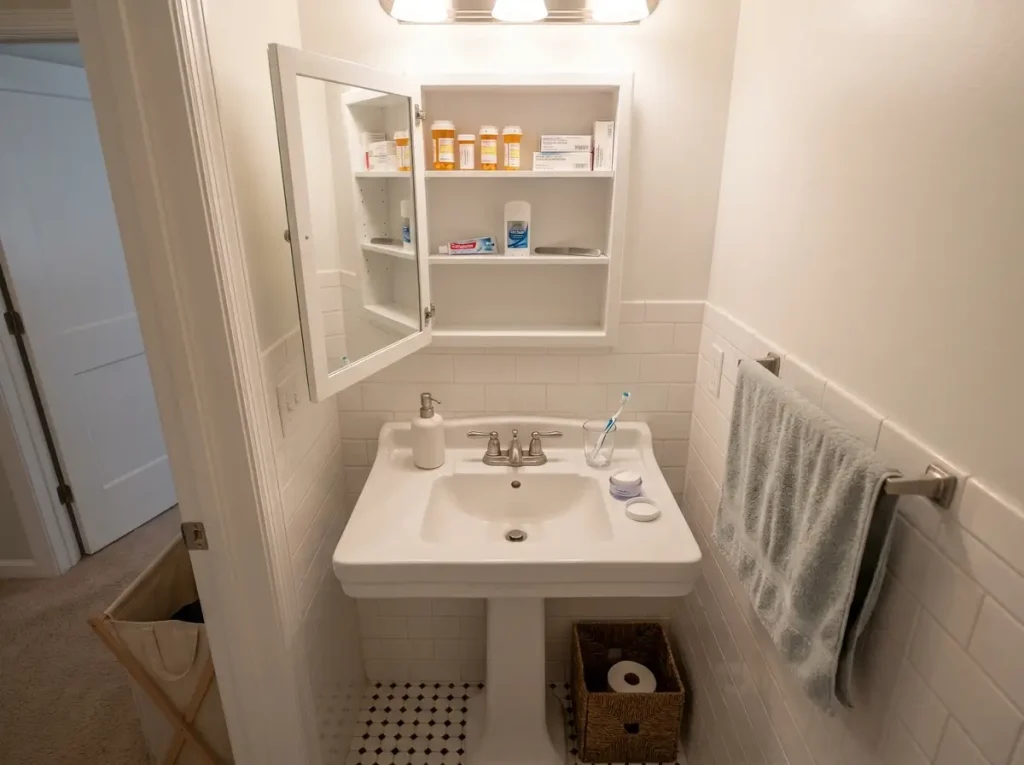
The biggest mistake in room-by-room decluttering is starting with the hardest room. Your bedroom closet, the garage, the storage unit — those feel urgent, but they’re the worst starting points. Every item in those spaces has emotional weight or requires complex decisions. Start there and you’ll burn out before you build any momentum.
The Entryway: Clear the Path First
Your entryway or front hallway is the fastest win in the house. It’s small, the items are functional (shoes, coats, bags, keys), and almost nothing there is sentimental. You can sort an entryway in under thirty minutes.
Pull everything out. Trash the broken umbrella, the single glove, the takeout menus from 2023. Keep only what you actively grab on your way out the door. If you have eight pairs of shoes by the front door and you wear three of them, relocate the other five to your bedroom closet. The entryway should hold today’s rotation, not your full inventory.
The Bathroom: The One Room Where Nothing Is Sentimental
Bathrooms are the second-best starting room because nobody has an emotional attachment to expired medication or a half-empty bottle of hotel shampoo. The decisions here are almost mechanical: expired goes in the trash, duplicates get consolidated, empty bottles get recycled.
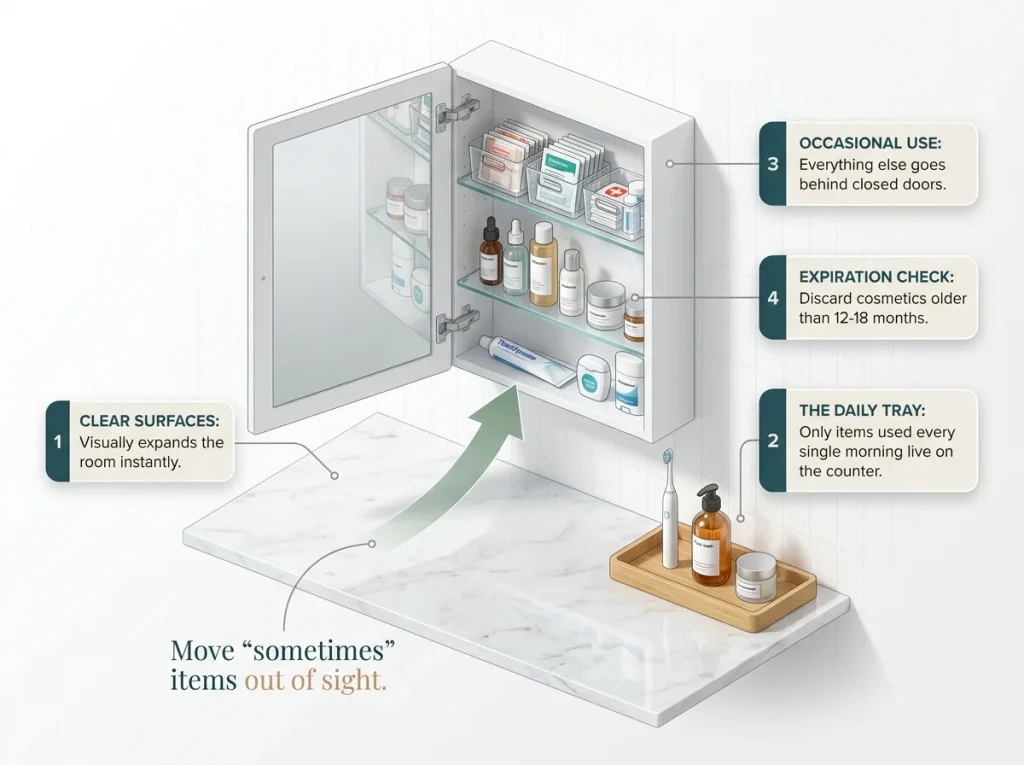
Open your medicine cabinet and check expiration dates on everything. You’ll find at least two things you forgot you owned and one medication that expired years ago. According to NAPO, over half of Americans report feeling overwhelmed by their belongings — and that overwhelm shrinks fastest when you start with a space where every decision takes two seconds. The bathroom is that space.
Once you’re done, you’ll have a finished room in under an hour. That momentum is real — it’s what carries you into the kitchen. If your bathroom needs organizing beyond the declutter, that’s a separate project (we cover it in our small bathroom storage guide).
Pro tip: Keep one shallow tray or small bin on the bathroom counter for daily-use items (toothbrush, face wash, moisturizer). Everything else goes inside the cabinet or under the sink. If it doesn’t fit in the tray, it doesn’t live on the counter.
Kitchen Decluttering Without Buying a Single Organizer

The kitchen is where decluttering gets real. It’s the most-used room in most homes and the one where “I might need this” gets weaponized. You don’t need to buy a single organizer to declutter your kitchen. You need to empty, sort, and be honest about what you actually cook with.
Countertops First, Cabinets Second, Junk Drawer Never First
Start with your countertops because they’re the visual reset you’ll feel immediately. Pull everything off. Wipe the surface down. Now put back only what you use daily — the coffee maker, the knife block, the cutting board. If the toaster oven comes out once a month, it goes in a cabinet.
Move to the cabinets next. One cabinet at a time, not all at once. Pull everything out of a single upper cabinet, sort into your four boxes, and put back only what stays. The items you’re relocating to other rooms or donating go straight into their boxes — not onto the counter. That’s how counter clutter starts.
The junk drawer is last because it’s a trap. It feels productive to organize, but junk drawers are tiny spaces with minimal impact. Doing the junk drawer first gives you a false sense of progress while the real clutter — the overstuffed cabinets and buried pantry shelves — remains untouched.
The Kitchen Tools You Keep for a Cook You’re Not
This is where the fantasy self problem hits hardest. The mandoline slicer still in its packaging. The spiralizer from your low-carb phase in 2021. The fondue pot that came out once for a New Year’s party and has collected dust behind the slow cooker ever since.
These aren’t bad purchases. They were bought by a version of you that doesn’t exist anymore, and keeping them fills cabinet space that the real you needs for tools you actually reach for. Go through your kitchen cabinets and pull out every gadget, pot, and utensil. Group the ones you’ve used in the past three months on one side. Everything else gets the twelve-month question: have you actually used this in the last year? The answer is usually on the item itself — clean gadgets without water spots or scratches haven’t been touching food.
Pantry Decluttering Is Different from Pantry Organization
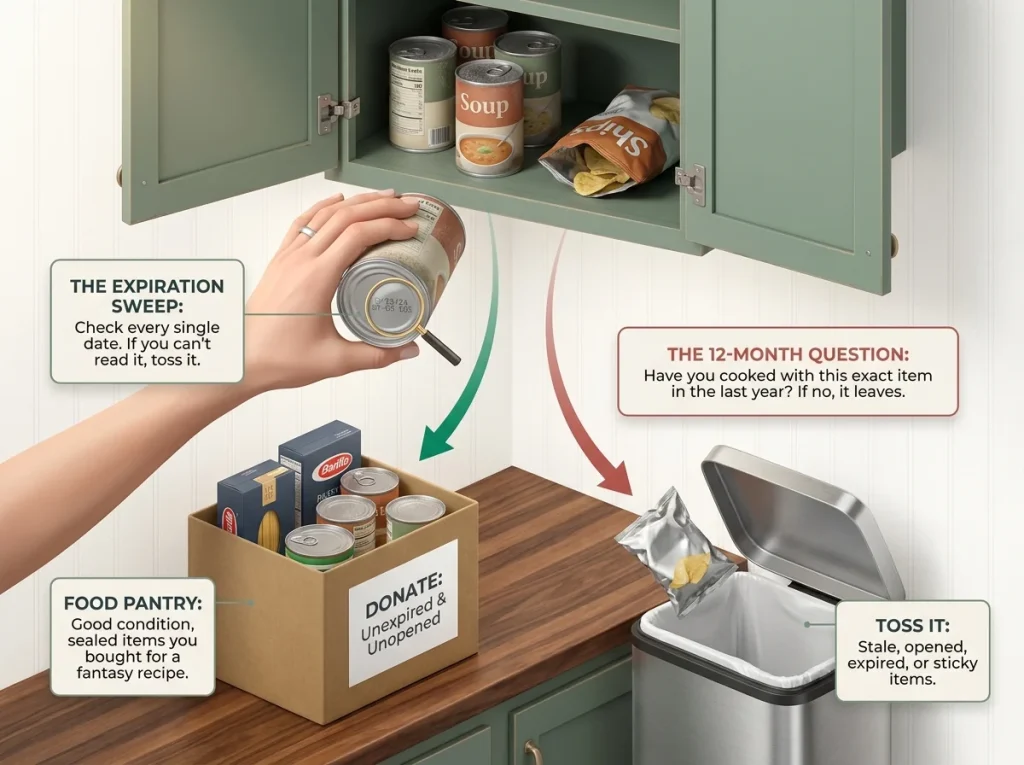
Decluttering your pantry and organizing it are two different steps, and doing them at the same time is why most pantry projects take three hours and leave you too exhausted to finish the system. Right now, you’re just removing what shouldn’t be there: expired items, duplicates you bought because you couldn’t see the first one, the specialty ingredient from that recipe you tried once in 2022.
Check every expiration date. Pull cans from the back — the ones you can’t see are the ones that expire. Consolidate duplicates (yes, you probably have three open bags of brown sugar). Anything opened and stale gets trashed. Anything sealed but past its date gets trashed. Your pantry might lose a third of its contents just from this sweep.
Once the clutter is out, you can organize what’s left. But that’s a different skill set — if you want the full system for keeping a pantry organized long-term, we built a complete pantry organization guide that walks through zoning, containers, and the weekly reset that prevents reversion.
Bedroom and Closet — Where Most People Quit
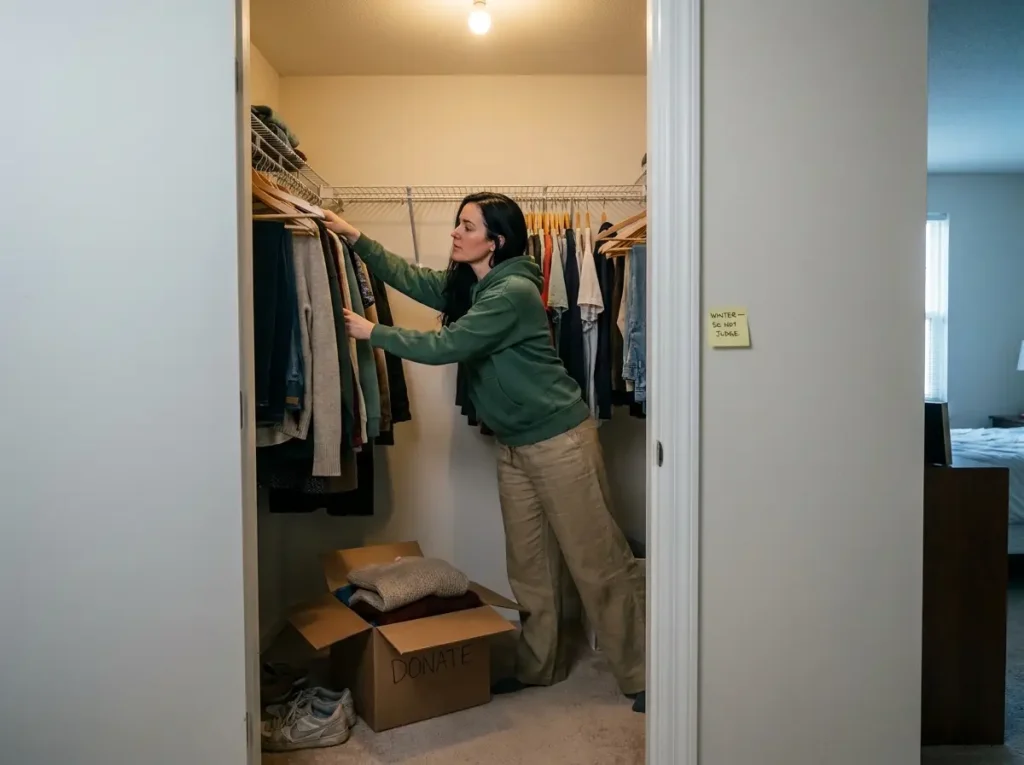
The bedroom is the psychological inflection point in a whole-home declutter. Everything in this room is personal — your clothes, your bedside reading, the box of letters in the closet. Decision fatigue from earlier rooms is already building. This is where most people stall out or give up, which is exactly why it comes after the bathroom and kitchen, not before them.
Start with the Closet Before the Dresser
Open the closet first. The dresser is easier to sort because you can see everything by pulling drawers open, but the closet is where the real volume lives and where avoidance hides the most. If you have a standard reach-in closet — single rod, one shelf — you’re probably using about half the available space and keeping clothes you haven’t worn in over a year.
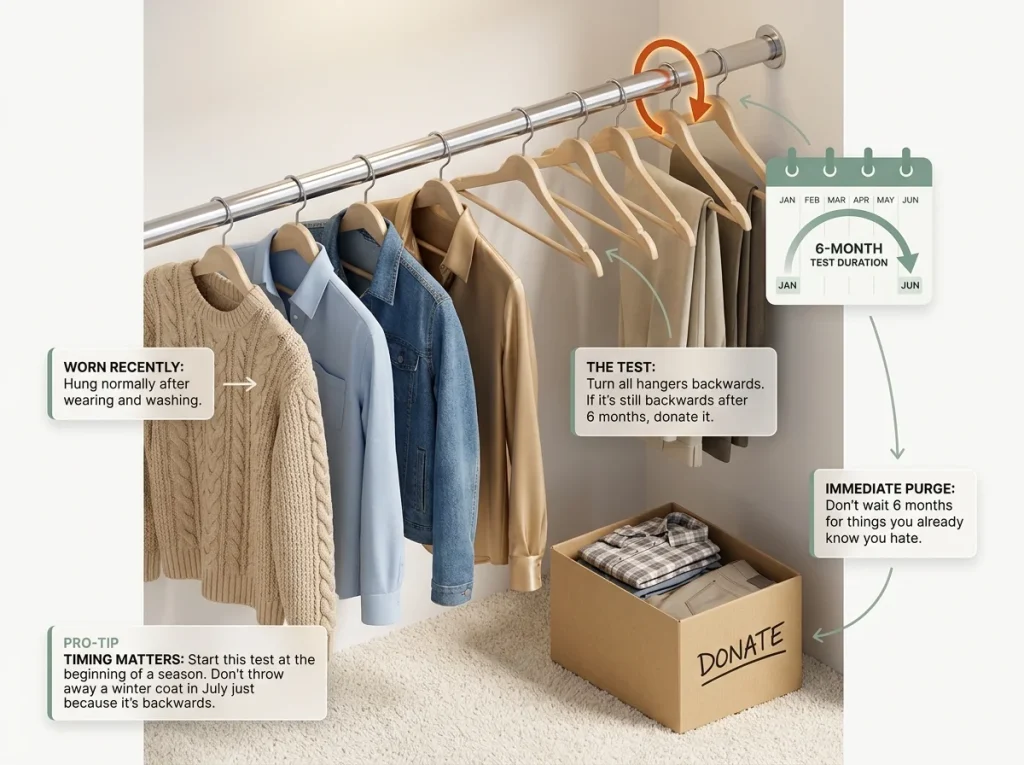
The backwards hanger test is one of the most-referenced closet decluttering methods online, and it has a flaw nobody talks about. The idea: flip all your hangers backwards, and after six months, donate anything still facing the wrong way. The problem is timing. If you start this test in April, you’ll flag every winter coat, heavy sweater, and wool layer you own — things you genuinely need but won’t touch until November. Start the backwards hanger test at the beginning of the season when you’d actually wear those clothes. Or better yet, do the twelve-month question right now and skip the six-month waiting game entirely.
Pro tip: While you’re in the closet, check the shelf above the rod. That’s where things go to be forgotten — seasonal items that missed the last rotation, bags you haven’t carried in years, hats you bought for one trip. If dust has settled on it, that’s your answer.
Dresser, Under the Bed, and Nightstands
Dressers are straightforward: pull each drawer, sort, and put back what you wear. The under-bed space and nightstand drawers are the bedroom’s hidden clutter reservoirs — small spaces that accumulate random belongings because they’re out of sight. Pull everything out from under the bed. If you can’t remember what’s under there without looking, that’s a sign those items aren’t serving you.
Nightstand drawers follow the same rule as junk drawers: everything goes out, only daily-use items go back. Phone charger, sleep mask, current book, lip balm. The expired cough drops, the charging cables for phones you no longer own, the three pens — those go into your sorting boxes.
Bedroom Surfaces and the “Just for Now” Trap
Bedroom surfaces — the top of the dresser, the desk corner, the chair — are where the “just for now” trap lives. You set something down “just for now” after work, and it stays for six weeks. The chair becomes a laundry staging area. The dresser top becomes a catch-all for receipts, loose change, and things from your pockets.
The fix isn’t willpower. It’s recognizing that “just for now” items are relocate items without a box. They belong somewhere else in the house, and they’re sitting on bedroom surfaces because there’s no system to route them. When you declutter bedroom surfaces, don’t just clear them — figure out where each item actually lives and put it there. If it doesn’t have a home, that’s the real problem to solve.
Common Spaces — Living Room, Home Office, and Laundry
Common spaces accumulate differently than private rooms. Bedrooms fill with your stuff. Living rooms and shared spaces fill with everybody’s stuff plus communal items that nobody claims ownership of. The decluttering approach shifts here — you’re sorting by function and frequency, not by personal attachment.
Living Room Surface Clutter and the “Doom Pile” Problem
If you have a spot in your living room where stuff just accumulates — the end of the couch, a corner of the coffee table, a side chair — that’s a doom pile. It looks like laziness, but it’s actually a routing problem. Items land there because they came into the room (mail, packages, things from your bag) and there’s no designated spot for them to go next.
Sort the doom pile into your four boxes. Then ask yourself: where did most of these items actually belong? If half of them were mail, you need a mail processing spot near the door. If half were things from your bag, you need a landing zone near where you set your bag down. The doom pile tells you what your home is missing — a system for incoming items, not more storage for existing ones.
Home Office and the Paper Black Hole
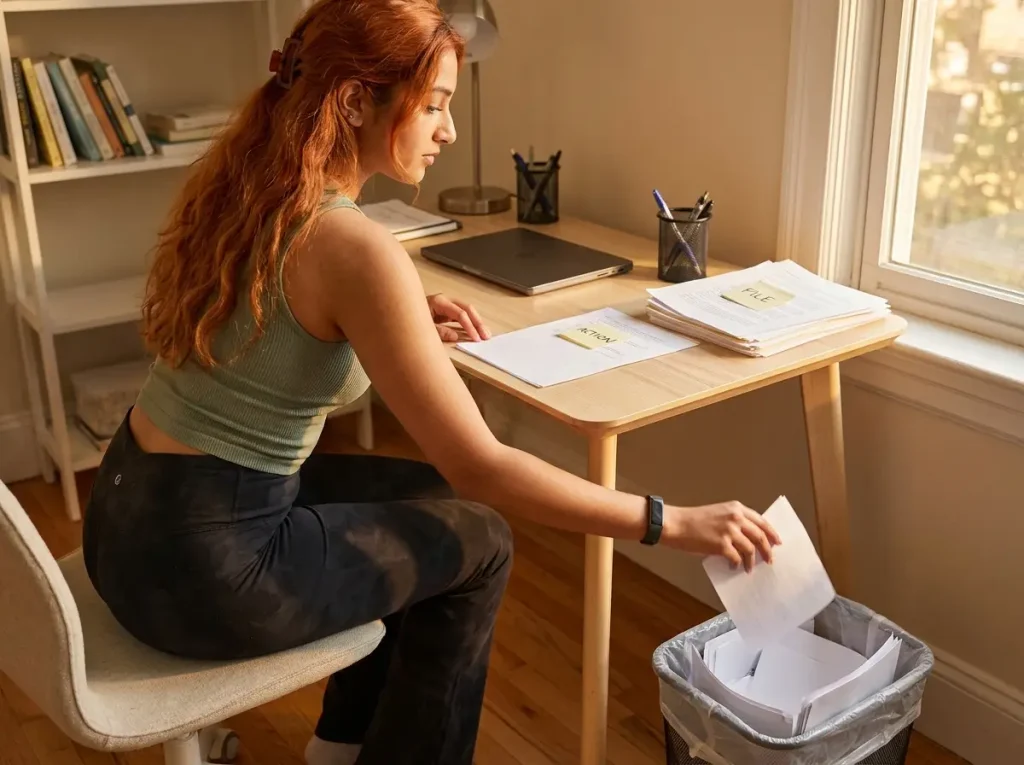
Paper is the silent clutter source in any home office space. It doesn’t look like much — a few stacks here, a pile there — until you actually sort it and realize you have three years of utility bills you’ll never look at again, expired coupons, and instruction manuals for appliances you no longer own.
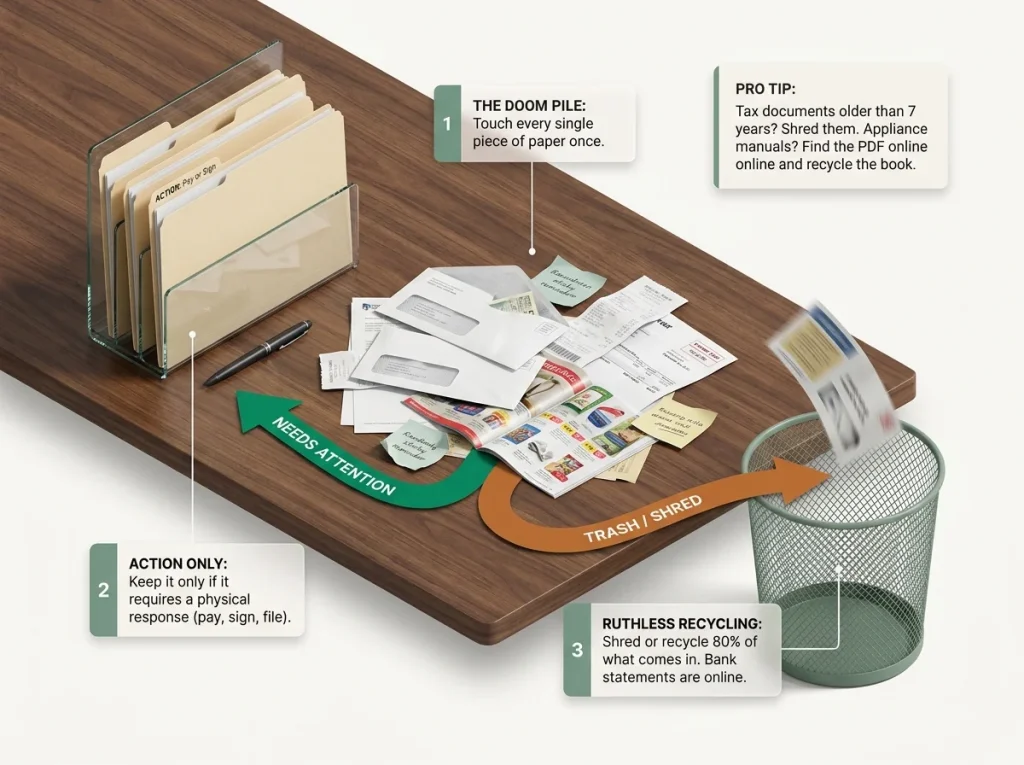
The paper sort is binary: action or recycle. Action means you need to do something with it — pay it, file it, respond to it. Everything else gets recycled. You don’t need to keep paper records for most things anymore. Bank statements are online. Tax documents older than seven years can go (check your specific situation, but most people are hoarding paper they could access digitally). The goal is to reduce the physical paper in your office to only what requires a physical response.
Pro tip: Once you’ve sorted the papers, designate one vertical file holder for action papers — bills to pay, forms to fill out, things that need a response. Review it weekly. If it grows past what the holder can fit, you’re avoiding something in there.
Laundry Room — Where Decluttering Stalls
The laundry room (or laundry closet, or laundry corner — renters know the range) is small, functional, and usually overstocked with cleaning supplies. People buy a new bottle of something because they can’t see the half-full one behind three other bottles.
Pull everything off the shelves or out from under the utility sink. Consolidate duplicates — pour two half-empty bottles of the same detergent into one. Trash anything dried out, crusted over, or so old the label is fading. What’s left probably fits in half the space you were using. The laundry room doesn’t need an organizing system after decluttering — it needs so few items that organization happens by default.
Storage Rooms Go Last — Garage, Basement, Attic
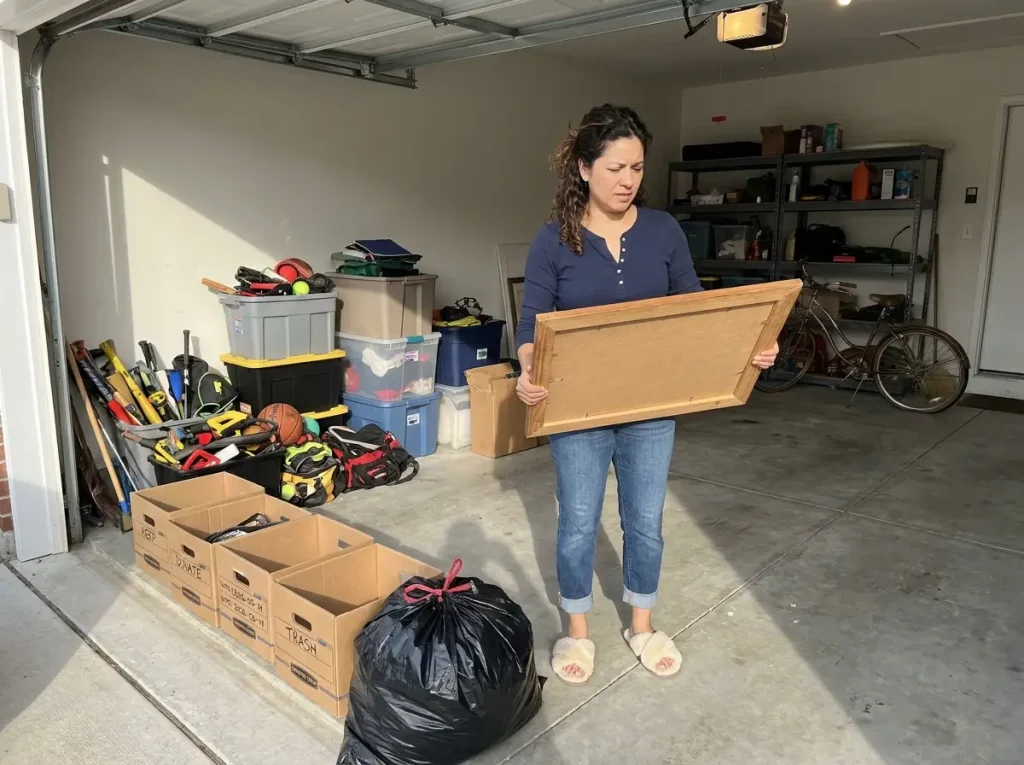
If you started here, you made the hardest possible choice first. Storage rooms — the garage, the basement, the attic — are where things go to be forgotten. They’re the largest spaces with the most stuff and the least emotional urgency, and that combination makes them the worst starting point and the best finishing room.
Why Storage Rooms Are Last (And Why That Feels Wrong)
It feels wrong because the garage or basement is usually the most visibly cluttered space in the house. It nags at you every time you walk through it. But here’s what happens when you start there: you spend an entire weekend sorting through boxes, you fill up your car for a donation run, and you feel accomplished. Then you go back inside and the kitchen counters are still buried and the closet still won’t close. You fixed the room you spend the least time in and left the rooms you live in every day untouched.
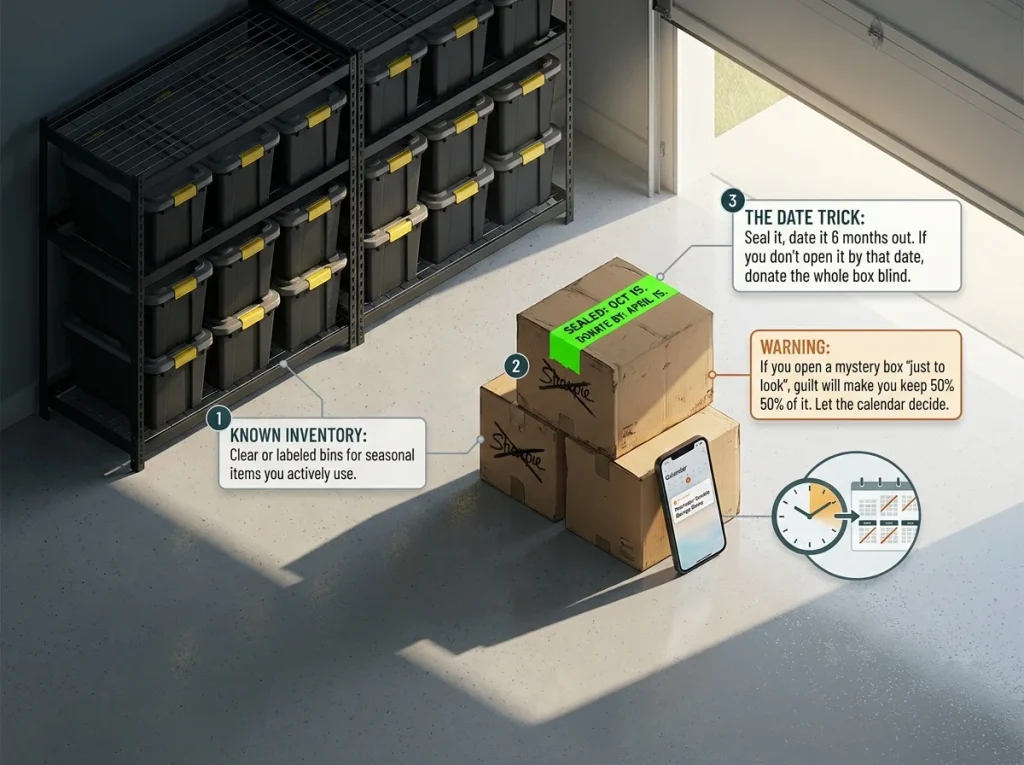
By the time you reach the garage after doing every other room, two things have changed. First, you’ve already made hundreds of sorting decisions, so your system is fast and automatic. Second, a lot of what’s in storage has already been addressed — the kitchen gadgets you relocated, the bedroom items you donated, the bathroom extras you trashed. The garage is half-sorted before you touch it.
The Box-and-Date Method for Mystery Boxes
Every storage area has mystery boxes — sealed or half-open boxes you moved from your last place (or the place before that) without ever opening. You know the ones. They have a moving company label or a Sharpie note that says “misc” or “bedroom stuff.” The box-and-date method handles these without requiring you to make decisions about every single item inside.
Write today’s date on a piece of tape and stick it on each unopened box. Put the boxes back. Set a calendar reminder for six months from now. If you haven’t opened the box by that date — if you haven’t needed a single thing inside it — donate the entire box without opening it. Whatever’s in there, you went six months without it. You’ll go the rest of your life without it too.
Pro tip: This only works if you commit to not opening the box when the reminder fires. If you open it “just to check,” you’ll keep half the contents out of guilt. Seal it, date it, forget it. Let the calendar do the deciding.
Renter Considerations for Storage Rooms
If you’re renting, your storage situation might be a shared garage, a small storage closet, or a rented storage unit you’re paying monthly for. The decluttering approach is the same, but the stakes are different. That storage unit has a monthly cost — every month you pay to store things you haven’t touched is money spent on keeping clutter.
For renters with limited storage access, prioritize ruthlessly. If it doesn’t fit in your allotted space after decluttering, it needs to leave. Renting a larger unit to hold things you rarely use is almost never worth it. The rental cost over two years usually exceeds the replacement cost of everything inside.
Why Your Decluttered Rooms Fill Back Up Within Weeks
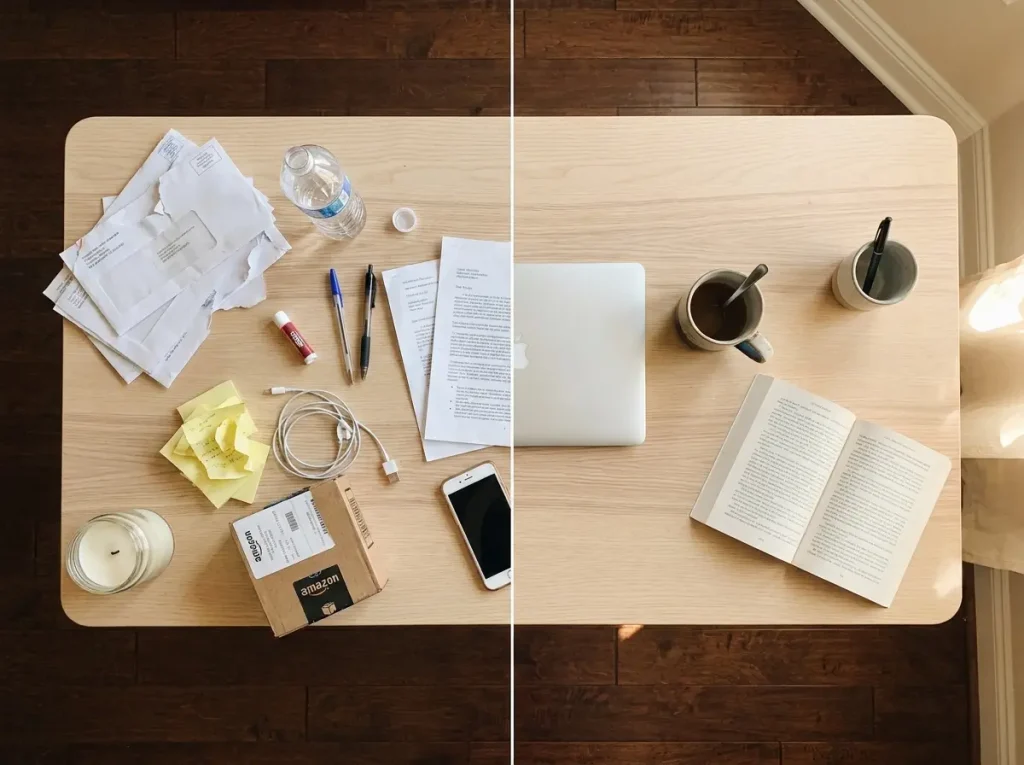
This is the section most decluttering guides skip, and it’s the reason the word “sticks” is in the title. Decluttering a room is a one-time event. Keeping it decluttered is a system. Without that system, your freshly sorted spaces revert to their pre-declutter state within weeks — and it’s not because you’re messy or undisciplined. It’s because stuff moves.
The Stuff Migration Problem Nobody Mentions
Clutter doesn’t accumulate in one spot. It migrates. You bring mail inside and set it on the kitchen counter. The counter gets full, so you move the mail pile to the dining table. The table needs clearing for dinner, so the pile moves to your desk. Your desk gets overwhelmed, so the pile goes to the bedroom. Each room looks fine for a day or two, but the clutter is just rotating through your home.
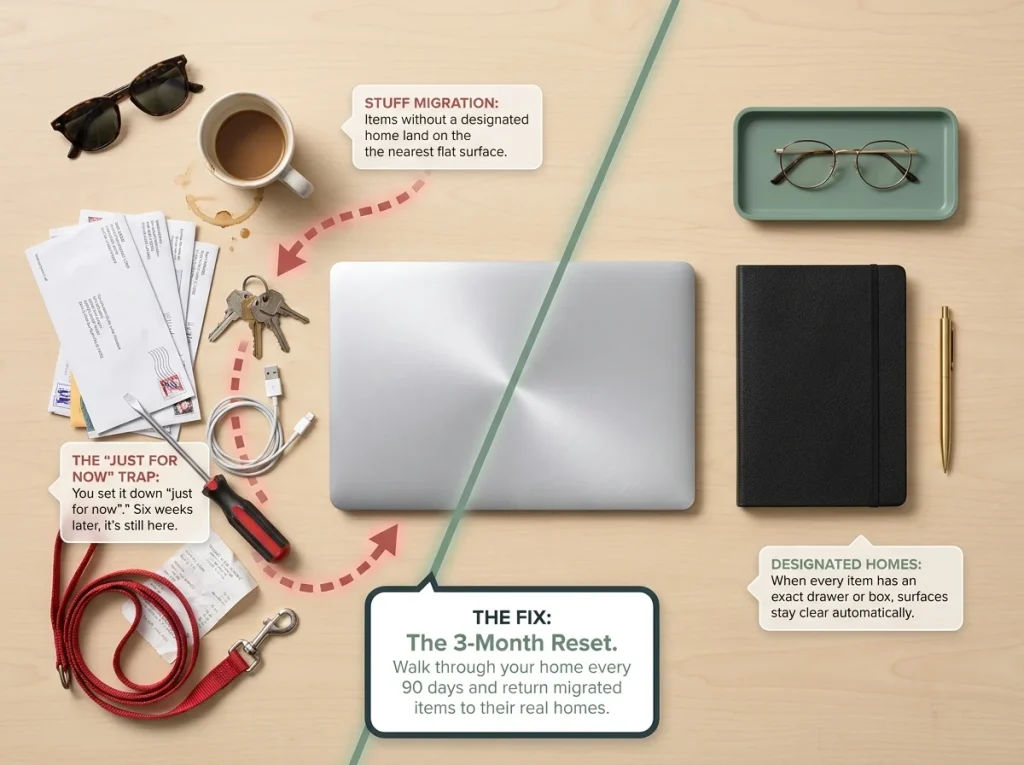
According to NAPO, most disorganization isn’t about the volume of belongings — it’s about belongings without a fixed location. The migration stops when every item in your home has a specific place it belongs. Not a general area. Not “somewhere in the kitchen.” A specific shelf, drawer, or bin. When you know exactly where something goes, putting it away takes three seconds. When you don’t, it sits on a surface.
The Three-Month Reset Habit
Schedule a three-month reset on your calendar right now — the day you finish your initial declutter. Not a full re-declutter. A ninety-minute walkthrough of every room with your four sorting boxes, checking for reversion.
You’ll find it. Every home drifts. The junk drawer slowly fills. The bathroom counter creeps outward. The closet shelf accumulates things you shoved up there “temporarily.” The three-month reset catches the drift before it becomes a full re-clutter. After two or three resets, you’ll know your home’s weak spots — the rooms and surfaces that revert fastest — and you can focus future resets there.
The One-In-One-Out Rule Done Right
The one-in-one-out rule sounds simple: for everything new that enters your home, something old leaves. In practice, most people forget about it by the third Amazon delivery. The rule works only if you pair it with a physical trigger.
Keep a small bag or bin near your front door or in your closet — the outbox. Every time something new comes in, something from the same category goes in the outbox. New shirt in, old shirt in the outbox. New kitchen tool in, one from the gadget drawer goes in the outbox. When the outbox is full, it goes straight to donation. The physical container makes the rule automatic instead of aspirational. You don’t have to remember the rule — the growing bag reminds you.
Conclusion
Three things determine whether your room-by-room declutter sticks or reverts:
- Order matters. Bathroom and entryway first for momentum, bedroom and closet in the middle when you’re practiced, storage rooms last when your system is automatic. Starting with the hardest room is starting with failure.
- Two-hour sessions, not weekend marathons. Decision fatigue is real, and it gets worse the longer you push. Short sessions with clear stopping points produce better results than eight-hour purges that end with everything going back in the keep box.
- The three-month reset is the entire system. Decluttering without a maintenance schedule is a weekend project, not a lifestyle change. Schedule it now — ninety minutes, four boxes, every room. The drift stops when you catch it early.
Three-Month Check: Set a calendar reminder for three months from today. Walk every room with your sorting boxes. Focus extra time on whatever surfaces reverted fastest — those are your home’s weak spots.
Start with one bathroom. It takes forty-five minutes, it requires zero emotional decisions, and it gives you a finished room before lunch. That’s your proof this works. Everything after that is just repeating the system in a bigger room.
Q1 What should you declutter first in your home?
Start with the bathroom or entryway — small spaces with almost no sentimental items where you can finish in under an hour. The quick win builds momentum for harder rooms like the bedroom closet and kitchen cabinets.
Q2 How long does it take to declutter a house room by room?
A full home declutter in two-hour sessions takes most people two to four weeks, depending on the number of rooms and how much you’ve accumulated. Rushing through in one weekend leads to decision fatigue and poor choices you reverse later.
Q3 What is the fastest way to declutter your home?
The fastest practical method is the four-box sort (keep, donate, trash, relocate) done room by room starting with the smallest space. Setting a phone timer for two hours per session keeps decisions sharp and prevents the mental exhaustion that slows most people down.
Q4 How do you declutter when you feel overwhelmed?
Pick the smallest room with the fewest sentimental items — usually the bathroom. Set a timer for thirty minutes and sort only that one space. Finishing one small room breaks the paralysis because you can see a concrete result.
Q5 What is the 20/20 decluttering rule?
The 20/20 rule says if you can replace an item for under twenty dollars in under twenty minutes, let it go. It works best for inexpensive household items and kitchen tools where replacement is easy, but it’s less useful for specialty items or anything with personal meaning.