





















In this article
Forum threads run spice drawer vs spice rack like a poll. Team drawer, team rack, everyone votes, nobody measures. In practice a shallow drawer or a short upper cabinet rules one side out entirely before anyone’s preference gets a vote, because a tiered riser needs roughly 4.5 inches of drawer clearance to let the drawer close and most pull-out racks need more than 12 inches of vertical cabinet clearance to exist at all. There’s a second constraint people find out about later: a rack mounted where you actually cook sits in heat that costs you flavor. Below you’ll get what each option really is, what it costs in space, visibility and potency, a four-question framework to settle it, and what both look like after three months of daily use.
| Factor | Spice Drawer | Spice Rack |
|---|---|---|
| Space cost | Zero new footprint | Counter, wall or door swing space |
| Visibility while cooking | Top-down, needs labeled lids | Front-facing, read the label itself |
| Spice freshness | Dark and away from the burner | Only if mounted away from the stove |
| Install effort | Drop the insert in | Screws, adhesive or freestanding |
| Renter-friendliness | Lifts straight back out | Only no-drill models |
| Capacity | Limited by drawer width | Roughly 20 to 40 jars on a pull-out |
What Counts as a Spice Drawer vs. a Spice Rack
Most people picture a wooden step rack on a countertop when they hear “spice rack,” then buy a pull-out cabinet unit and wonder why none of the advice they read applies. Those two words hide wildly different footprints and install commitments, which is why this comparison goes sideways so often. It helps to treat the choice as one decision inside the wider spice organization picture rather than a standalone verdict.
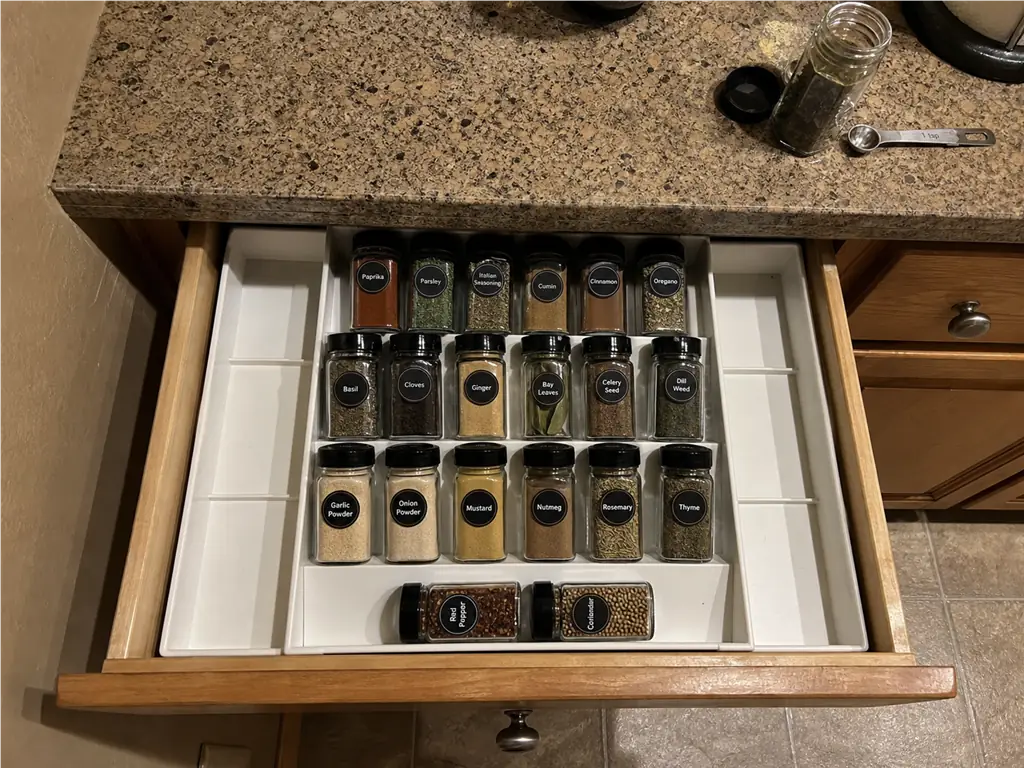
A spice drawer is not a special drawer. It’s an existing drawer plus an insert: a flat non-slip liner, a tiered riser that steps spice jars up toward the back, or an expandable drawer rack that adjusts to your drawer width. Some sellers list that last one as an in-drawer spice rack, which is the same object under a different name. That’s the whole definition. The Dial Industries Expandable Kitchen Drawer Spice and Season Jar Organizer Tray is the canonical version, since its expandable side panels adjust to standard drawer widths instead of forcing you to find a tray that happens to match. The catch is the one that runs through this entire article: a stepped tray only works if the drawer has enough clearance for the tallest jar to clear the countertop above it. If you want the setup depth rather than the definition, the full drawer setup walkthrough covers liners, jars and the restock rule.
“Spice rack” covers five distinct subtypes: the wall-mounted spice rack, the cabinet door spice rack, the freestanding spice rack (also sold as a countertop spice rack), the pull-out cabinet unit, and the carousel spice rack or lazy susan. They share almost nothing except that spice bottles stand up and face you. A cabinet-door rack and a pull-out drawer unit have opposite install requirements, opposite capacities and opposite failure modes, and lumping them together is why so much rack advice reads as contradictory.
The structural difference between the two sides is footprint. The drawer adds zero new territory, because it uses cabinetry the kitchen already has. Every rack subtype except the pull-out claims something new: counter, wall, or the swing space on the inside of a cabinet door. On capacity, a pull-out commonly holds 20 to 40 jars depending on width and jar diameter, roughly two to four jars per inch of rack width per tier, while drawer capacity is a flat function of drawer width and jar diameter with no tiers to multiply it.
One more thing the poll framing hides: plenty of people skip the either/or entirely. A Houzz respondent landed on a two-tiered carousel inside a wall cabinet next to the stove, which solved visibility while still fitting taller containers. That hybrid answer surfaces constantly once people have lived with either pure option for a while.
Space, Installation, and Renter-Friendliness
The install question is where “it’s just a spice rack” quietly becomes “it’s four screw holes in a rental cabinet door.” And the free option, a drawer you already own, has its own hidden veto that nobody mentions until the drawer won’t close.
Start with the envelope. Per the NKBA’s standard 12-inch wall cabinet depth, wall cabinets run 12 inches deep and base cabinets 24 inches deep. A cabinet-door or wall rack has to live inside that 12-inch envelope. A pull-out tucked into a base or corner cabinet has close to double the room to work with, which is exactly why pull-outs hold more and why they’re so often the wrong recommendation for someone with only upper cabinets.
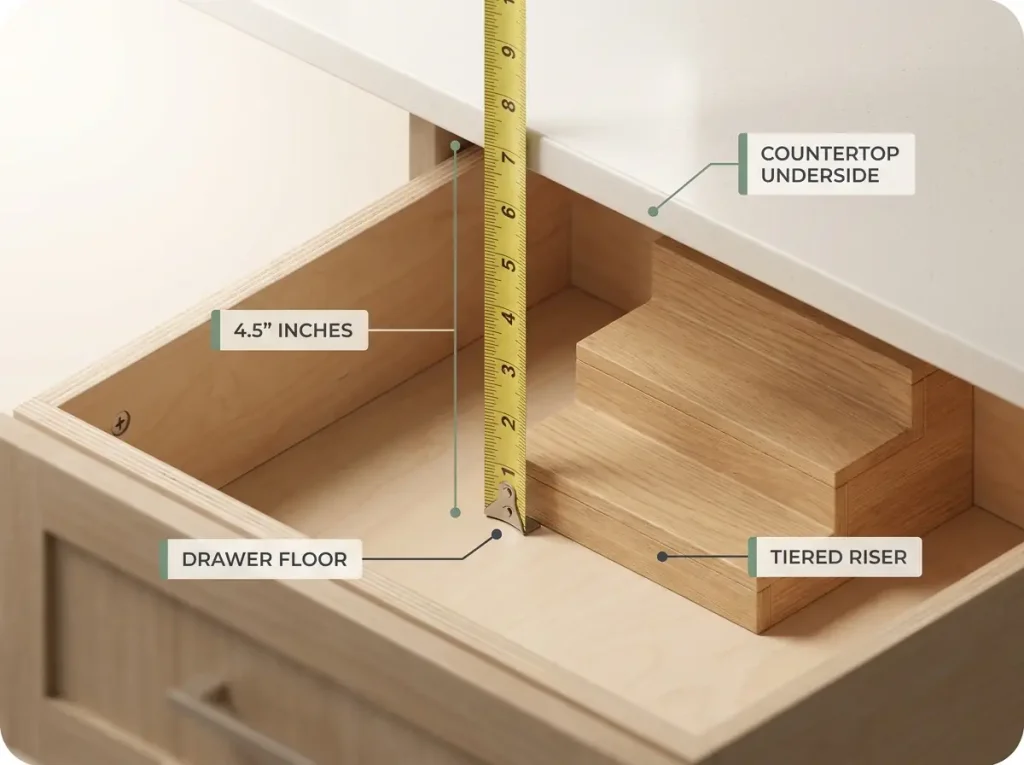
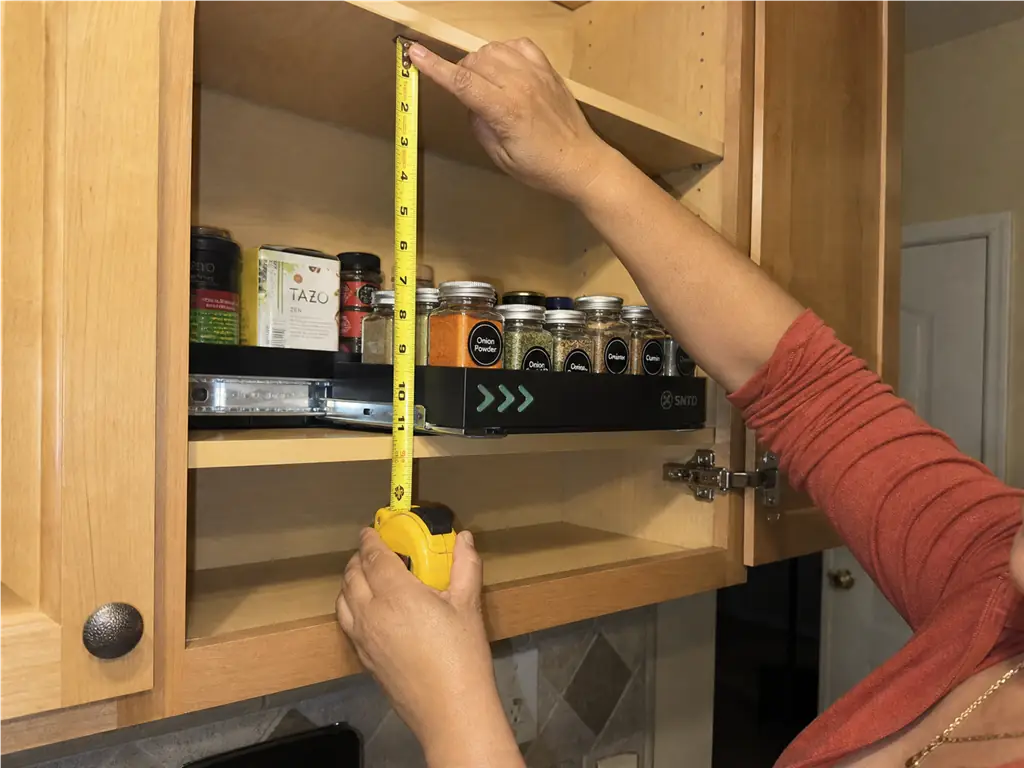
Here are the two numbers that decide most of this. Most pull-out spice racks need more than 12 inches of vertical clearance, 4 to 12 inches of width with 9 inches being typical, and more than 11 inches of depth. A short upper cabinet rules the pull-out out before a single feature matters. The drawer side has the mirror-image gate: a tiered riser needs roughly 4.5 inches of drawer clearance for the drawer to close over the tallest jar. Under that number, a flat liner is your only drawer option, and no amount of shopping changes it.
If you want to see how the mechanism justifies the space it takes, which pull-out organizers earn their cabinet space breaks that down by cabinet type.
Countertop and wall racks look like the low-commitment answer because there’s no drilling. They still cost you roughly 12 to 18 inches of counter or wall real estate, permanently, in the part of the kitchen you use most. “No drilling required” and “free” are not the same sentence.
For renters, screws are the actual gate, and it removes several rack subtypes on its own. Renter-friendly here means one thing: removable, with nothing left behind that a walkthrough inspection can find. Two no-drill routes survive it. Nano-adhesive pull-out racks mount inside an existing cabinet without putting holes in the cabinet walls, which is what the SNTD Pull Out Spice Rack for Upper Cabinet is built around: an expandable 4.1 to 7.2 inch frame, 10 inches deep and 2.2 inches tall, on ball bearing glides that give you close to full extension so the back row isn’t a guess. Measure your cabinet’s vertical clearance before you order it, because the adhesive mounting solves the landlord problem and does nothing about the geometry one.
Command-strip wall racks avoid screws entirely, with a maintenance cost we’ll get to in the last section. The same logic applies across the room, and no-drill kitchen cabinet fixes that come back off covers the deposit-safe versions of the rest.
Measure the drawer with your tallest jar standing in it, not with a tape measure alone. Interior clearance is measured from the drawer floor to whatever the drawer slides under, and that lip is almost always lower than the countertop you were eyeballing. Stand the jar in, close the drawer slowly, and listen.
Visibility and Reach While You’re Actually Cooking
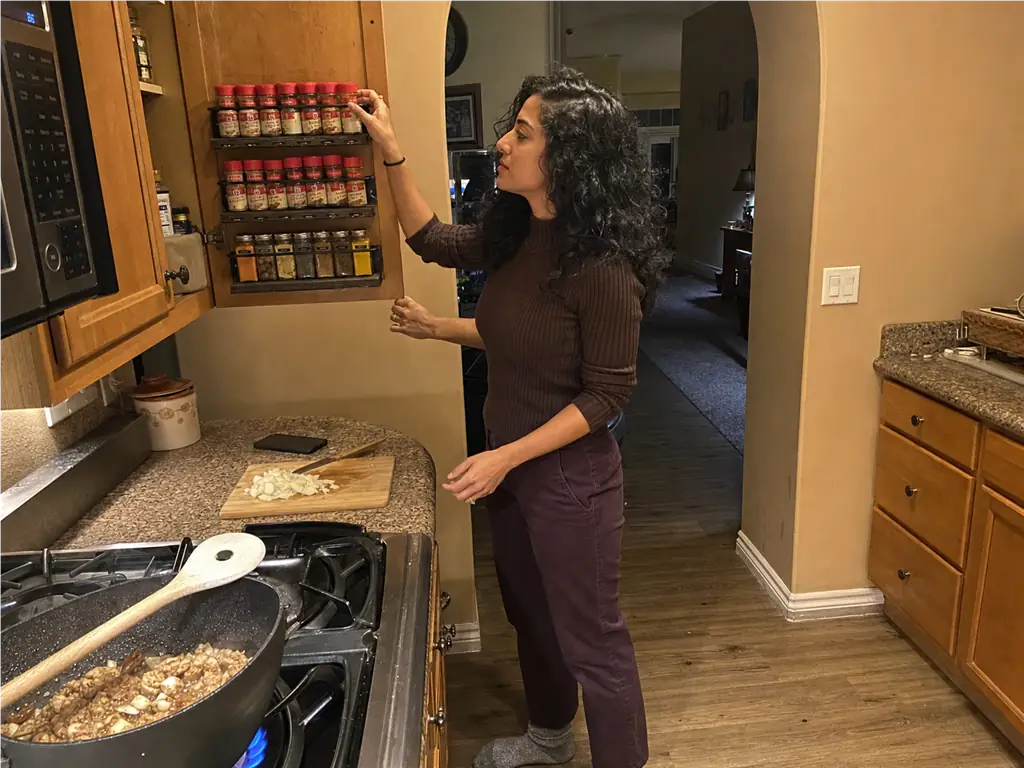
The drawer wins on tidiness and loses on the six seconds you spend hunting for cumin with a pan already smoking. A rack wins the opposite trade. This is the factor people feel every single day, and it’s the one most comparison articles reduce to “racks are easier to see.” What they’re really comparing is accessibility inside your kitchen workflow: how many steps and how many seconds sit between wanting cumin and holding it.
The real difference is viewing angle. A drawer gives you a top-down view, so every lid faces up. That’s excellent if your lids are labeled and close to useless if they aren’t, which is why a drawer setup and a label maker tend to arrive together. A rack gives you a front-facing view, where you read the jar’s own label with no top labeling required, but only from the one angle the rack faces. Tiered risers exist specifically to buy back some of that drawer visibility by angling jars so labels read at a glance instead of presenting a grid of identical lids.
Placement matters as much as the format. Spices get used in two places: the cook zone at the stove, where you’re seasoning something already hot, and the prep zone at the cutting board, where you’re measuring into a bowl. A rack serves whichever zone it’s mounted next to and nothing else, while a drawer under the prep counter serves that zone well and the stove badly.
Reach geometry matters more than people expect. NKBA puts the standard clearance between countertop and the bottom of a wall cabinet at 18 inches, and that’s the entire envelope a countertop or under-cabinet rack lives in. Taller bottles eat it fast, and a rack that doesn’t fit under the cabinets ends up somewhere worse. Drawers ask for something different: a free hand and enough standing room to pull the drawer open, which is its own problem in a galley kitchen when the dishwasher door is down.
Once the front-facing advantage is clear, the cheapest way to test it is a door-mounted rack rather than a wall commitment. The SpaceAid Spice Rack Organizer for Cabinet Door or Wall Mount runs four tiers and mounts either inside a cabinet door or on a wall, which covers two rack subtypes with one purchase. Check the door swing clearance first, because a loaded door rack needs the shelf behind it to be shallower than you think. For readers already leaning rack, rack types ranked by where they mount picks the actual model.
I used to treat visibility as the tiebreaker in this comparison. After enough threads where people described pulling a drawer open mid-recipe and finding jars rolled to the back, unreadable from above, versus glancing at a wall rack and spotting what they needed in about three seconds, I moved it down the list. Visibility is real, but it’s fixable with labels and a riser. Clearance isn’t fixable at all. If you have a dead corner to work with, a carousel in a corner cabinet gets you front-facing labels without giving up counter.
Which One Actually Keeps Spices Fresher
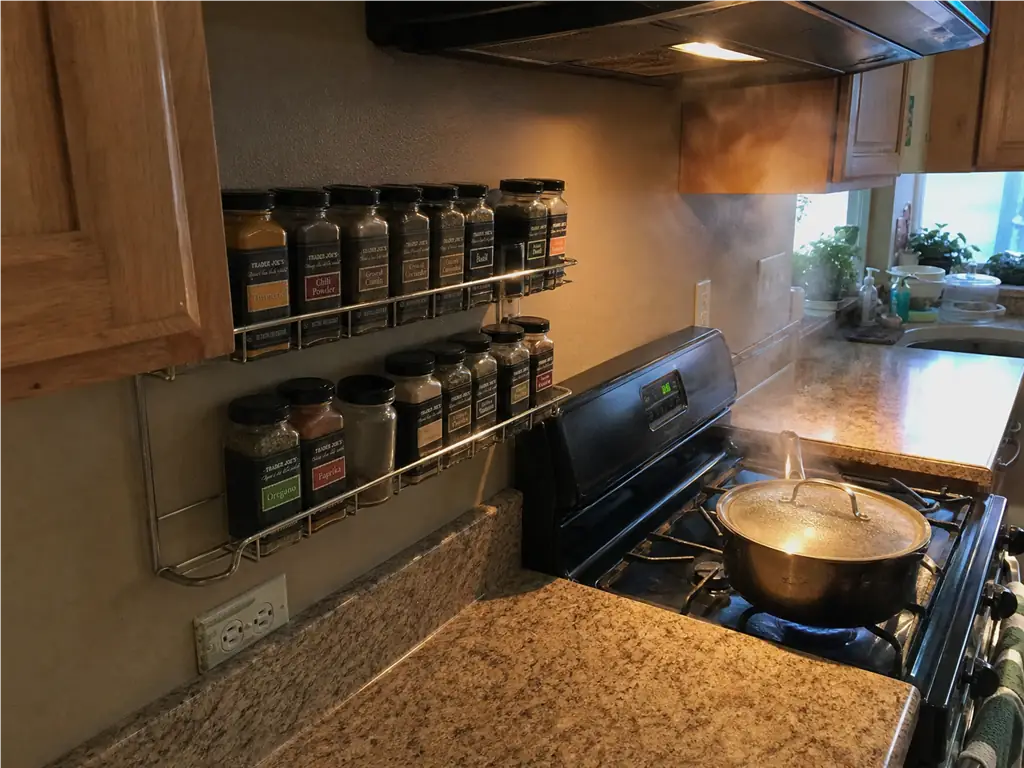
Spices don’t technically spoil, but they do lose potency, and “fresher” in this comparison means how fast that potency drains. Spice preservation comes down to two variables you control with placement: heat exposure and light exposure. The rack goes by the stove because that’s where you cook. That’s exactly the problem, and the math is worse than it sounds.
A rack mounted near the stove commonly sits at 120 to 140°F while you’re cooking. A cabinet or drawer across the room sits at roughly 70°F. Here’s the part that reframes it: every 18°F rise roughly doubles the rate of chemical degradation. A gap of 50 to 70°F isn’t “a bit worse.” It compounds, and at the top of that range you’re looking at flavor degradation running something closer to four times faster during every cooking session, repeated daily for as long as that jar lives there. The jar that empties in six weeks doesn’t care. The smoked paprika you use twice a year absolutely does.
Light is a second and completely independent path. UV and visible light break down the volatile aromatic oils that carry both flavor and color, which is why the prettiest setup is usually the worst performing one. Clear glass jars on an open rack under a window are the extreme case, and this happens regardless of which storage method wins the rest of the comparison.
The conventional wisdom is to store everything in a cool, dark place and stop thinking about it. In practice that advice loses to convenience within about a month, because a jar you have to walk across the kitchen for is a jar you stop reaching for. Storage that’s technically perfect and practically annoying gets abandoned, and then the spices sit untouched for two years, which is its own kind of potency loss.
The drawer’s advantage here isn’t clever, it’s structural. A drawer is dark, and it’s away from the burner by default, without you doing anything right. A rack can match that performance, but only by giving up the stove-adjacent position that made it appealing in the first place. Once you move the rack across the kitchen to protect the spices, you’ve traded away the reach advantage from the previous section, which is the honest tension nobody names.
Split the collection by turnover instead of picking one location. Keep the four or five spices you reach for daily on the rack by the stove and accept that they’ll fade, because you’ll finish them before it matters. Park the slow movers, whole spices, and anything you bought for one recipe somewhere dark. Fast turnover beats perfect storage every time.
How to Decide Which One Fits Your Kitchen
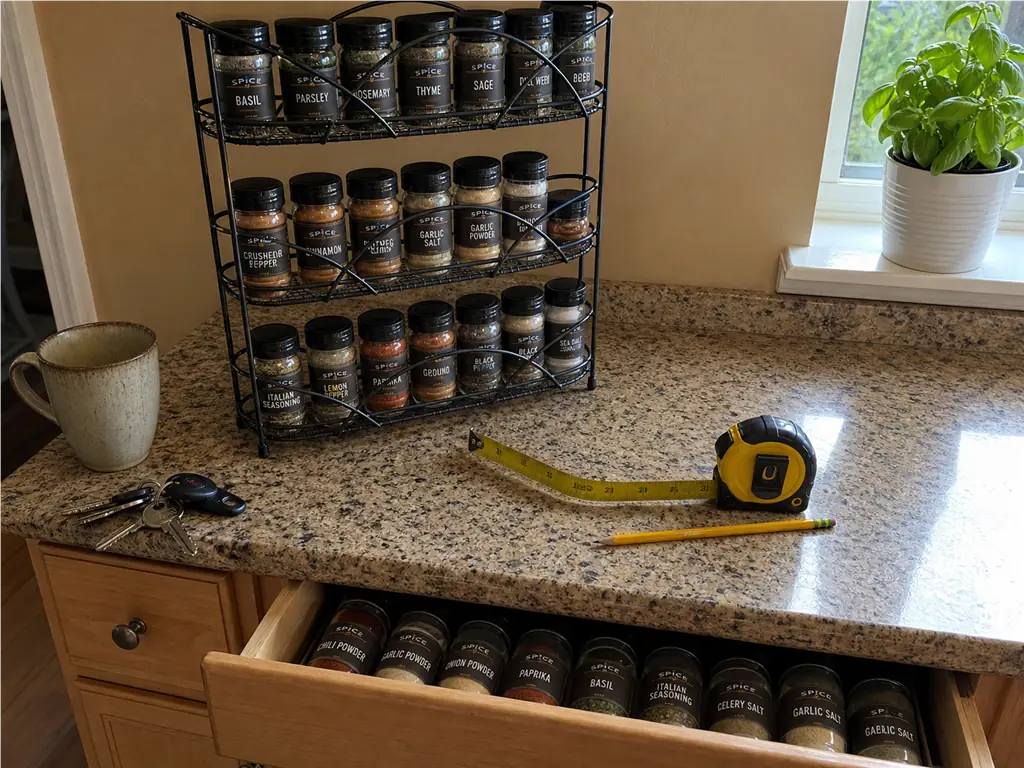
This is where the poll framing finally breaks. It isn’t a preference. It’s four questions in a fixed order, and most people have their answer before question three. The order matters more than the questions do: measurement first, permissions second, habits third. Reversing it is how people end up with a pull-out that doesn’t fit sitting in its box on the counter.
Start With What You Can Measure
Two measurements, five minutes, before you open a single shopping tab (use a real tape, not the app on your phone). First, interior drawer clearance: under about 4.5 inches and the tiered riser is out, leaving a flat non-slip liner as your drawer option. Second, vertical cabinet clearance: under 12 inches and the pull-out is out, along with most of the capacity advantage the rack side was promising.
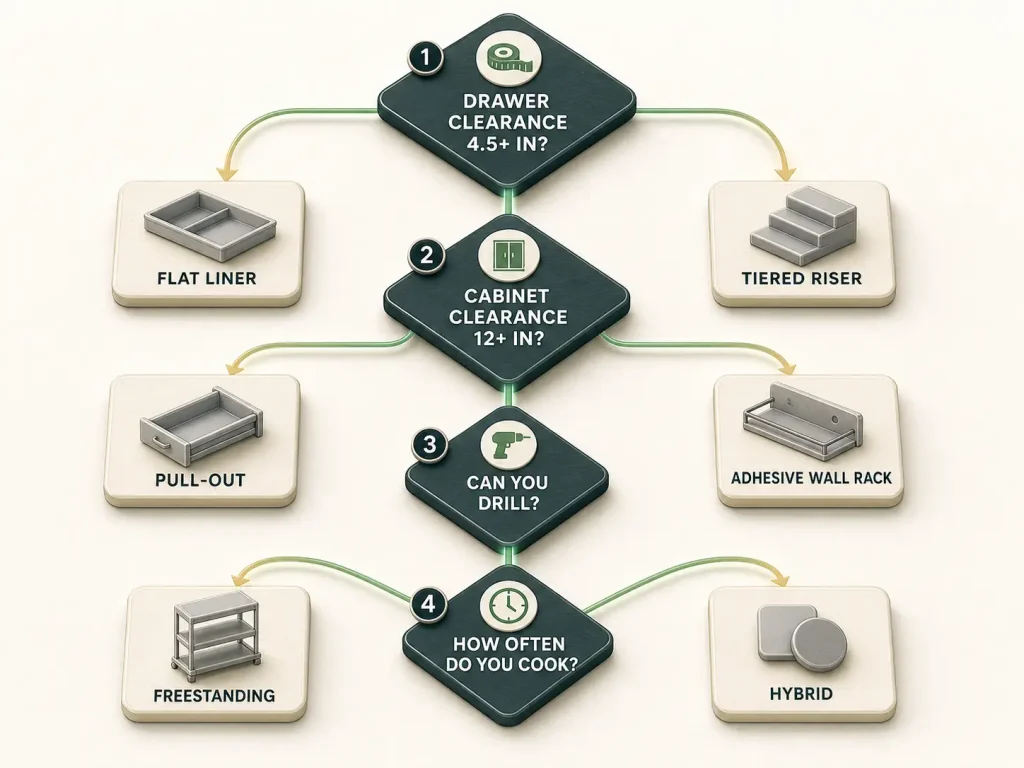
Run both even if you’re confident you know the answer, because these two numbers eliminate more options than every feature list combined. If you’re working in a tight footprint, the full measuring framework for a small kitchen extends this into the rest of the storage decisions.
Then Check What You’re Allowed to Change
Renter status is a gate, not a footnote. Screw-mounted wall racks and drilled cabinet-door racks come off the table, along with anything that needs a pilot hole in cabinetry you don’t own. What stays: nano-adhesive pull-outs, Command-strip wall racks, freestanding countertop racks, and the entire drawer side, since an insert leaves nothing behind at all. Homeowners get every option, which means they get to skip straight to question three.
Then Match It to How You Cook
Frequency does the rest. If you cook most nights and run 20 or more jars, weight visibility and reach, because you’ll pay the hunting cost several times a week. If you cook occasionally with eight jars, weight footprint and freshness instead, since those jars will sit long enough for heat and light to matter. Either way, group by frequency of use rather than alphabetically. Alphabetical looks organized in a photo and puts the salt somewhere between the paprika and the sumac in real life. Grouping by cuisine is the one alternative worth the effort, and only if you cook in distinct modes and reach for six jars at once when you do.
Cost tier is the last thing to worry about, not the first, since a budget-friendly liner in the right drawer outperforms a splurge pull-out in a cabinet that can’t take it.
If the kitchen has no spare drawer at all, the drawer branch closes immediately and the question simplifies to which rack subtype. That’s common enough to deserve its own answer, and a kitchen with barely any drawers to spare works through it. If there’s no wall space either, the back of a pantry door is the third location most people forget they own. And in a kitchen with few drawers and no door to spare, magnetic spice containers on the side of the fridge or the hood are the last surface left, as long as you accept the light exposure that comes with it.
When the Answer Is Both
The hybrid is where the forum respondents converge once they’ve lived with either pure option: daily jars on a small rack or carousel within arm’s reach of the stove, backstock in a drawer or a dark cabinet. It solves the tension between the visibility section and the freshness section instead of pretending one wins.
There’s also a version for the “I’m not sure yet” branch, which is most renters and anyone who might move within a year. Several countertop racks ship with an optional wall mount, so you buy one product, use it freestanding now, and mount it later if you buy the place. The Spectrum 3 Tier Spice Rack Organizer in Black works that way at 13 inches long, 2.75 inches wide and 13.25 inches tall, which is a real bite out of a small counter. Take that footprint seriously before you commit.
Neither answer here is permanent, which is the part that should lower the stakes. A drawer insert lifts out. A freestanding rack moves. The only expensive mistake in this whole comparison is the drilled option chosen before measuring.
What Happens After a Few Months
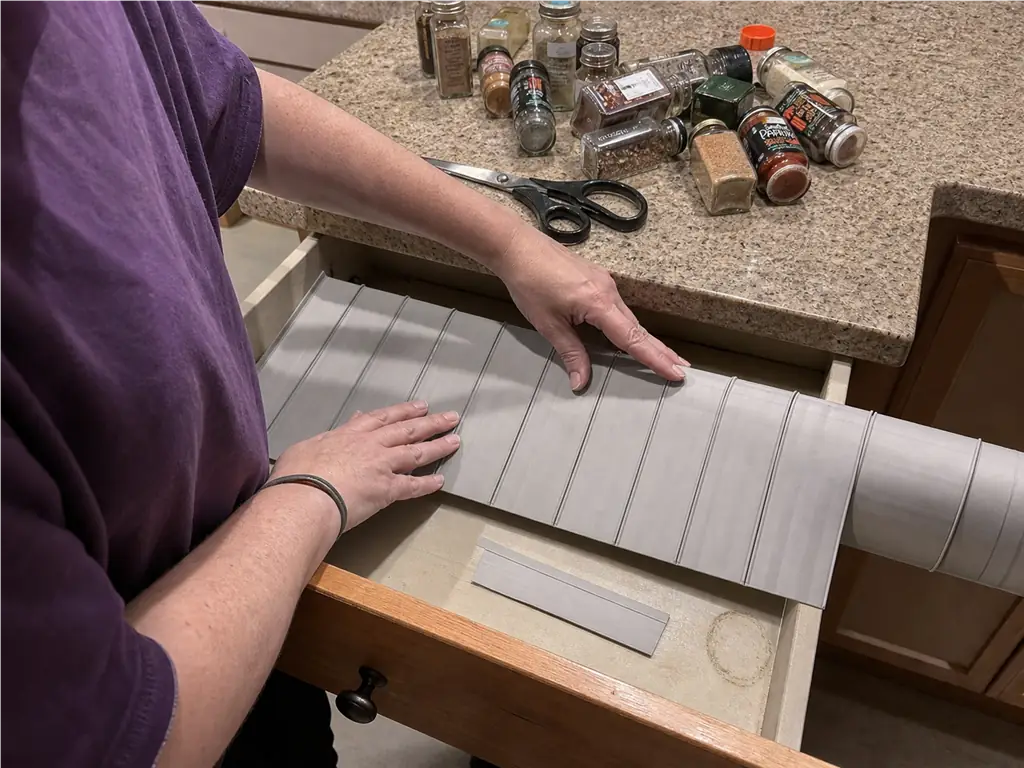
Both options photograph beautifully on day one. Month three is where they separate, and the failure modes have nothing in common.
The drawer fails by rolling. Jars tip and slide to the back every time a heavy drawer gets shut hard, and jars rolling out of order is the entire reason in-drawer organizers exist at all. The fix is cheap, which makes it mildly infuriating that almost nobody mentions it upfront. A trimmable non-slip roll like the YouCopia SpiceLiner Spice Rack Drawer Organizer handles it, and it’s also the only drawer option left for a drawer that failed the 4.5-inch riser test earlier. It won’t hold jars upright the way a riser does, so expect a flat grid of lids and label accordingly. For inserts that keep their dimensions through a season of slamming, drawer organizers that hold their size is the deeper list.
The rack fails by film. An open wire rack mounted beside or above the stove picks up a greasy layer after a few months of regular cooking, because it lives inside the aerosolized fat that comes off a hot pan. Nobody wipes a spice rack down weekly. By month three it shows on the jars, the rails and the labels (the rails are the worst of it, since nothing you own is shaped right for cleaning them). That’s an observed pattern rather than a measured statistic, but it’s consistent enough that grease buildup should be part of the decision if the rack is going anywhere near the burner.
Material decides how well the system survives that. A metal spice rack wipes clean and shrugs off steam. Racks and drawer inserts built from MDF, plywood, or veneered wood swell at the edges once moisture gets past the finish, and melamine-faced pieces chip along the front lip where you grab them. None of that shows up on day one, which is exactly why it belongs in a three-month conversation instead of a features list.
Adhesive mounting carries a scheduled cost most people never budget for. Per Command’s own weight-limit guide for kitchen strips, kitchen-mounted strips should be replaced every 6 to 12 months, since heat and grease shorten adhesive life faster in a kitchen than anywhere else in the house. A loaded spice rack is not a light object, and the failure isn’t graceful.
Carousels have their own quirk: mismatched bottle heights jam a two-tiered carousel once it’s packed, so height uniformity matters more than jar count. Whichever system you land on, run the same three-month test. Pull everything out, note what you never once touched, and check whether the labels are still readable at a glance. Those two signals say more about your setup than any comparison article can.
If you go adhesive, write the mount date on a strip of masking tape and stick it inside the nearest cabinet door. Adhesive failure is silent right up until it isn’t, and a date you can actually see turns a surprise into a five-minute swap on a Saturday.
Conclusion
Measure before you shop. Roughly 4.5 inches of drawer clearance and 12 inches of cabinet clearance decide more of this comparison than taste ever will, and both numbers take a minute to check.
A rack buys you visibility and pays for it in counter or wall space, plus potency if it lives near the stove. A drawer buys you freshness and pays for it in a top-down hunt that only labels can fix. And renter status is a gate rather than a footnote, because it removes half the rack subtypes before the comparison starts.
In three months, pull every jar out and look for the two tells: spices you never once reached for, and labels you can no longer read at a glance. Both mean the system needs a small adjustment, not a replacement.
Grab a tape measure and check one drawer and one cabinet. That’s the whole decision. Buy after.
Frequently Asked Questions
01What is a spice drawer?
A spice drawer is an ordinary kitchen drawer fitted with an insert, either a non-slip liner, a tiered riser, or an expandable tray, so jars sit stable and readable from above. It’s a setup rather than a special drawer, which is why almost any drawer with about 4.5 inches of clearance can become one.
02What are the benefits of using a spice drawer?
A drawer keeps spices dark, cool and away from the stove, which is the single biggest factor in how long they hold flavor. It also adds zero footprint, no counter, wall or cabinet door required, and the insert lifts straight back out, making it the safest option in a rental.
03Is a spice rack a good idea?
A spice rack is a good idea when you cook often, want jars readable without opening anything, and have wall, cabinet-door or counter space to give up. It’s a worse idea directly above or beside the stove, where the rack sits at 120 to 140°F while you cook and spices lose potency several times faster.
04What is the best container to store spices?
An opaque or tinted airtight jar stored away from heat and light holds flavor longest, since both UV light and warmth break down the aromatic oils. Clear glass looks better on a rack and performs worse, so if you want the look, keep clear jars in fast rotation and store the backstock somewhere dark.
05Is a spice drawer or spice rack better in a rental?
In a rental the drawer usually wins, because a drawer insert leaves nothing behind. If you want a rack, stay with freestanding, nano-adhesive pull-out, or Command-strip mounted models, and plan on swapping kitchen strips every 6 to 12 months since heat and grease shorten adhesive life.