






















In this article
You spent a Saturday on that room. Bins for everyone, a clear line down the middle, both kids nodding along like they understood the assignment. It held for about four months, and then one afternoon you opened the door and it looked exactly like the day you started, so you decided the problem was the kids.
It wasn’t. The most common failure in shared kids room organization is physical, not behavioral: the younger sibling got taller, grew into storage that used to be out of reach, and the sibling boundary you built quietly stopped existing. The split that lasts a full year is measured (rod height, shelf inches, a floor line a child can see) rather than agreed to out loud. Here’s the closet split, the floor space division, the boundary object, the personal space piece, and the short routine that keeps all of it from aging out.
Quick Answer
Divide a shared kids room by reach height first, then by floor space, in this order:
- Split the closet rod by reach height, not left and right: low rod for the younger child, upper rod for the older one.
- Give each child a measured stretch of shelf with a physical divider, not a verbal agreement.
- Draw one floor boundary with furniture, a bookshelf, or painter’s tape, so a child can see it.
- Give each child one ownable, private object inside their own zone.
- Re-measure the split every school year, because reach heights change and the system doesn’t.
Why Shared Kids Room Systems Revert (and It Isn’t the Kids)
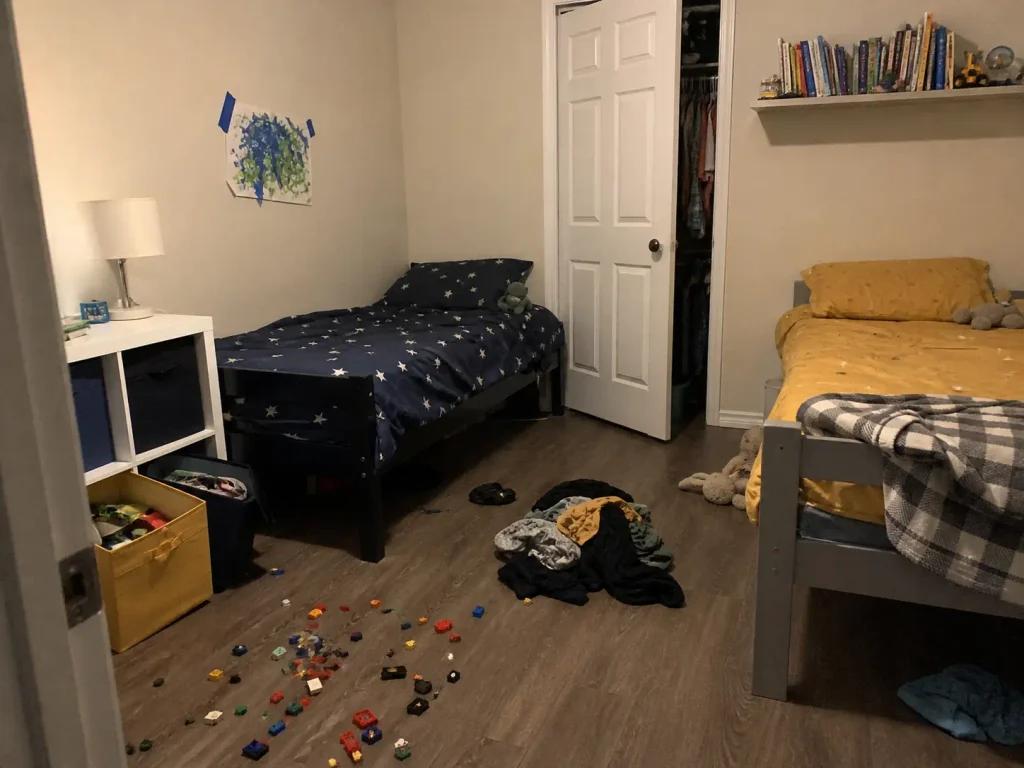
Every parent who has reorganized a shared bedroom has had the same thought around month four: I did all of this and they wrecked it in a week. The system didn’t fail. It aged out, which is why this piece treats the two-kid room as a scaled version of the whole-room kids bedroom system rather than a different animal.
Here’s the mechanism. When you built the first system, the height difference between your kids was doing invisible work for you. The four-year-old physically could not reach the shelf where the eight-year-old’s Lego sat, so that zone stayed intact without anyone enforcing a rule.
Twelve months later the younger one has gained three or four inches, reaches that shelf on tiptoe, and a boundary that was never a rule has dissolved. That’s zone creep. One widely read shared-room writeup fixed it by rotating storage cubes from horizontal to vertical, pushing the older child’s boxes above the younger child’s reach. Same furniture, different geometry.
The second mechanism is volume left in constant reach. If a bin of small-parts toys sits open at knee height, the floor around it regenerates within the same day, no matter how good the labeling is. The fix that worked in real households wasn’t more toy containment, it was removing constant access: the high-volume bins moved to a closet shelf, where retrieval takes a parent. A toy rotation system does the same work from the other direction, keeping minimal toys in the bedroom and the rest boxed elsewhere.
Before you re-zone anything, stand in the doorway and note which of your kids’ things are within the shorter child’s arm reach. That band of the room, roughly floor to shoulder height, is where 90% of the daily mess is generated. Everything you move above it stops being a daily problem immediately.
The third piece is accountability. In an undivided mess, no child owns any of it, so no child cleans any of it. Ask a seven-year-old to pick up the floor and you get a reasonable objection: half of that isn’t mine. A defined half turns an unanswerable argument into a visible fact.
One caveat before you move a single bin. Two kids’ belongings inside one room’s storage is a volume problem before it’s an organization problem, and no division scheme survives a room 30% over capacity. If you haven’t done the whole-room purge and zone pass recently, do that first. Splitting overflow in half gives you two overflowing halves.
Split the Closet by Reach Height, Not Left and Right
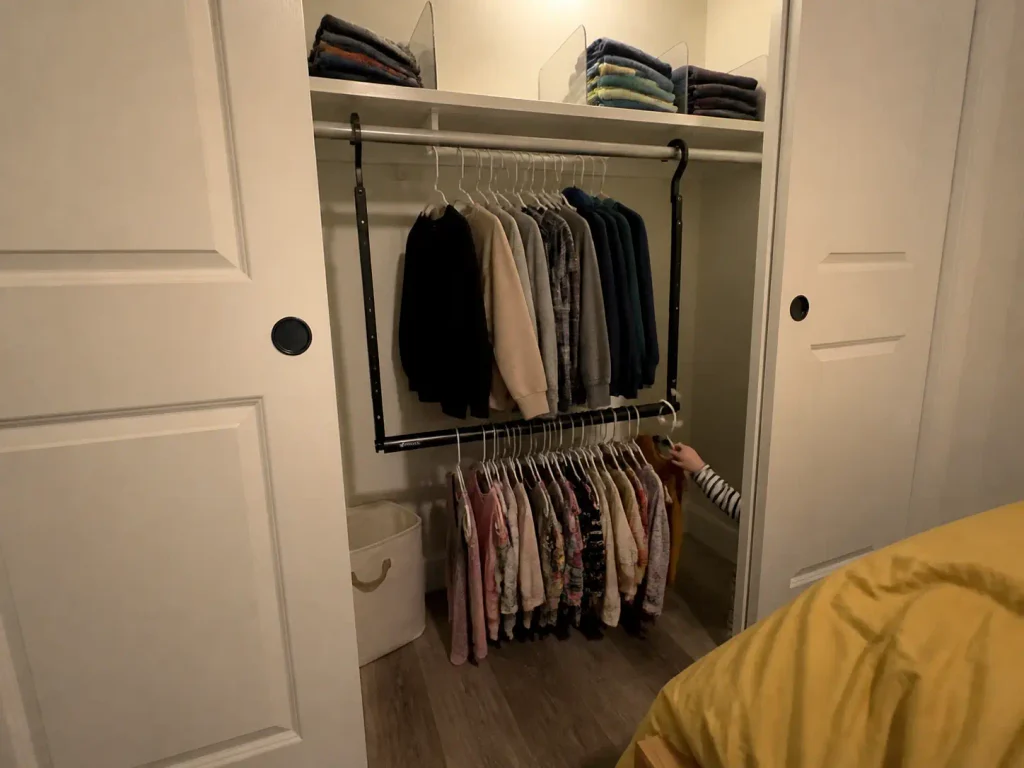
The instinct is to draw a vertical line down the rod. Your half, their half, done in ten minutes. It looks like justice and fails inside a month, because the four-year-old cannot reach their own half and the eight-year-old can reach both. What you’ve built is one child’s closet with a decorative border.
The numbers make the case better than the argument does. Reach height by age is the whole calculation: a rod a toddler can use independently sits about 36 to 42 inches off the floor, school-age kids do well between 42 and 48, and a standard reach-in closet rod (the one already in your house) sits at 60 to 66. That last one is a ceiling built for an adult and a stool.
So the vertical line splits a rod only one child can operate. Split it horizontally instead: lower rod for the younger child’s everyday clothes, upper rod for the older child, or for out-of-season and grow-into pieces if the age gap is wide. Same logic as hanging everything at your kid’s reach height, applied to two kids.
A double rod makes that split physical. The STORAGE MANIAC Adjustable Closet Double Rod mounts inside the existing closet frame and turns one adult-height rod into a two-level system, rated to 110 lb across the 2-pack. Its limitation: it needs enough clearance below the original rod to leave usable hanging depth on both levels. If a shelf sits low over your rod, measure the drop first, because a 20-inch gap doesn’t hang much beyond toddler shirts.
Hanging rod space is only half the closet. Shelf space is where “roughly half” stops meaning anything, because a stack of folded clothes migrates. It leans, it slides, and within two weeks the older child’s sweatshirts rest on the younger child’s half with nobody having decided anything.
HBlife Acrylic Shelf Dividers slot onto shelves between 9/16 and 1 inch thick and hold about 15 lb each, making the halfway point something you see from the doorway instead of something you remember. Clear acrylic disappears visually, and that matters: a shelf with a line through it feels fairer to kids than one with an opaque wall in the middle. The trade-off is that dividers need a shelf edge to grip, so they won’t work on thick built-ins or wire racks. Book ends do the same job on a bookshelf for less.
Measure your kids against the closet, not the closet against a chart. Have each child stand at the open door and reach up with a flat hand. Mark both heights on the frame in pencil. Those two marks are your rod heights, and they beat any age-based recommendation, including the ones in this section.
Before you buy hardware, run the cheaper move first. A capsule wardrobe per child, or a family closet holding the overflow in another room, reduces the rod space each kid needs at all. It costs nothing, and it’s the fix families who edited before shopping keep recommending. Pair it with a seasonal donation purge twice a year and the closet stops being the bottleneck.
For the arithmetic on how many inches of rod a wardrobe consumes, the rod-capacity math for a shared closet is written for adults but transfers exactly. Renters, the good news: the double rod hangs off the existing rod by clip and tension pressure. Nothing goes into the wall. Color-coded hangers, one color per child, cost almost nothing and make a drifting stack obvious at a glance.
Draw the Floor Boundary Before You Buy Anything
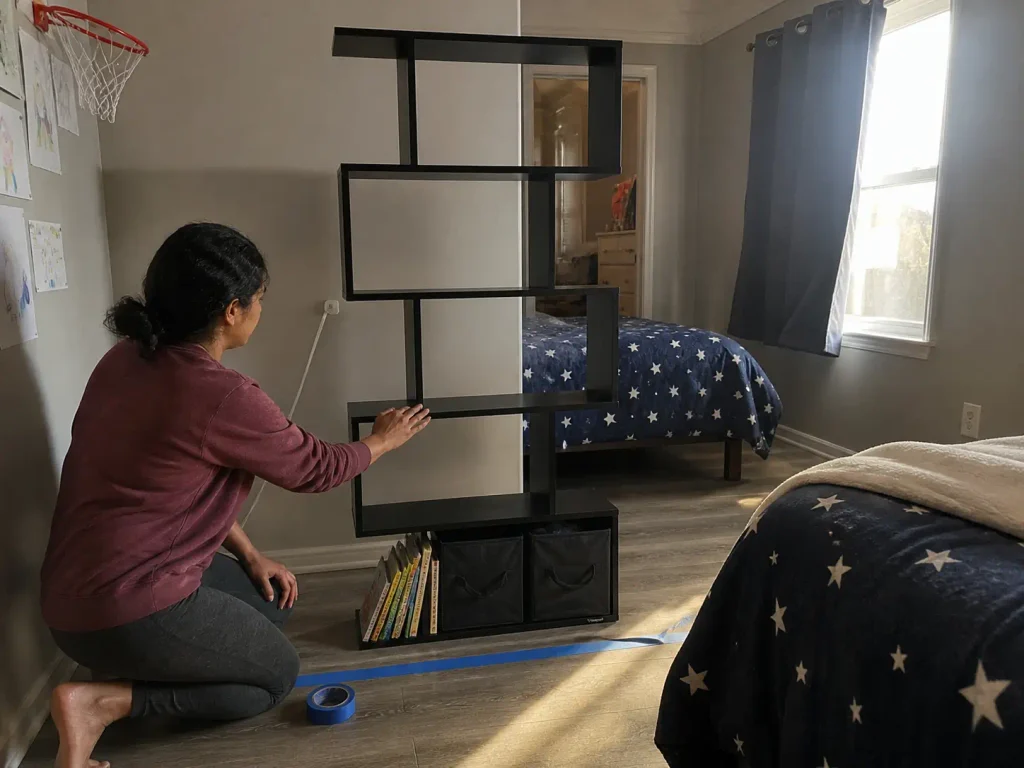
A verbal boundary is invisible to a six-year-old in the middle of playing. “That’s your side” is a sentence, and sentences evaporate the moment a game gets interesting. A boundary a child can see, walk around, or trip over is one they’ll actually respect.
Work through three room divider tiers, cheapest first, and genuinely start at the bottom. Tier one costs nothing: a painter’s tape line plus repositioning furniture you already own so beds, dressers, and shelves define the zones. Run that for two weeks before spending a dollar.
Kids’ zones move in ways no floor plan predicts, and the tape shows where the boundary wants to live before you commit furniture to the wrong spot. This is where fitting two zones into one small bedroom becomes a clearance question rather than a taste one, since a divider blocking a walkway gets pushed aside by week three.
Tier two is the renter tier, the one nobody writes about. Tension-mounted systems hold by spring pressure between two surfaces, no drilling and no anchors. Home in Bold Tension Rod Shelving expands to fit the span and gives you a vertical boundary that also holds each child’s things. A sheer curtain divider on the same tension rod is the softer version, marking the line without blocking light.
The caveat matters more here than anywhere else in this article: a rod rated for a curtain panel is rated for a curtain panel. Hanging a shelf’s worth of books and toys on hardware sized for fabric is how a divider comes down at 6 a.m. Match the rating to the load, and note that no-drill setups that don’t cost your deposit apply to dividers as directly as to closets.
Tier three is furniture, where every competing article starts. An open-back bookshelf perpendicular to the wall works because light and sightlines pass through, so the room still reads as one room, and a folding room screen does the same job when you need it to move. First the rule: anti-tip hardware is not optional on a freestanding shelf used as a divider. A shelf mid-room has no wall behind it, making it more tippable than the same shelf against drywall, not less.
The Tangkula 5-Tier Geometric Bookshelf suits this job: 27.5 inches long, 9.5 deep, 62.5 tall, open-back frame, anti-toppling device included. Watch that 9.5-inch depth, because a divider deeper than about 12 inches starts eating walkway. Its open back also means things on it are visible from both sides, so it’s a boundary for storage, not privacy. If the floor genuinely has no room for one, a floating wall bookshelf on each child’s side, or corner shelves in the two opposite corners, buys the same storage without a footprint.
A full-height divider makes a small shared room feel like two closets. A waist-height one keeps the room feeling like a room while still marking the line, and it lets you see both zones from the doorway. In anything under about 120 square feet, go low.
The best floor boundary does two jobs at once. A low cube unit like the AWTATOS Stackable Cube Organizer sits freestanding at roughly a child’s waist height, marks the line, and contains toys inside the same footprint, so the divider isn’t dead square footage. Stackable also means it grows upward later if the room’s needs change. Just don’t stack it tall and leave it unanchored on the boundary line, where it’s the most climbable object in the room.
Age Gap Rules That Override Everything Else
Every shared-room article opens with a bunk bed as though it were a settled question. If one of your kids is under six, it isn’t, and this is the one place in this article where the constraint isn’t a preference you can weigh against other preferences.
The federal bunk bed safety standard sets the minimum age for top-bunk use at 6 years old, and the same standard requires guardrails on both sides, a top rail at least 5 inches above the mattress surface, and openings in the upper structure kept under 3.5 inches so a child’s torso can’t pass through where their head can’t follow. CPSC’s bunk bed rule caps most top bunks at a 200-pound weight limit. If you have a three-year-old and an eight-year-old, the bunk bed everyone recommends buys you nothing for three more years.
So what do you do in the meantime? Both kids on the floor, with vertical storage doing the work a bunk bed with storage would have done. This is where the closet and the walls carry the room, which is why the reach-height split above is the load-bearing decision for age gap siblings. A storage bed with drawers underneath recovers some of it, and a hanging wall organizer or a stuffed animal hammock in each child’s corner recovers the rest at almost no cost.
Push storage above the younger child’s reach, keep the floor clear for two beds and a shared play strip, and plan as though the bunk doesn’t exist. Put the older child’s small-parts sets and keepsakes up there too and you’ve prevented most cross-zone conflict. Not most of the mess. Most of the fighting, which is a different and more exhausting problem.
In an age-gap room, the older child needs one surface the younger one physically cannot reach, and it doesn’t have to be big. A single shelf mounted above the younger child’s fingertip height, holding the in-progress build and the fragile things, resolves more sibling conflict than any rule you can enforce verbally.
When a family with three kids in one bedroom shared their system publicly, the loudest response was “this only works because your kids are the same gender.” Their answer: gender and sibling count weren’t doing the work. Zoning, a visible boundary, and consistent bedtime rules were.
Containment in an age-gap room has to be per child, not per room. That’s the whole difference between this and organizing a single kid’s bedroom.
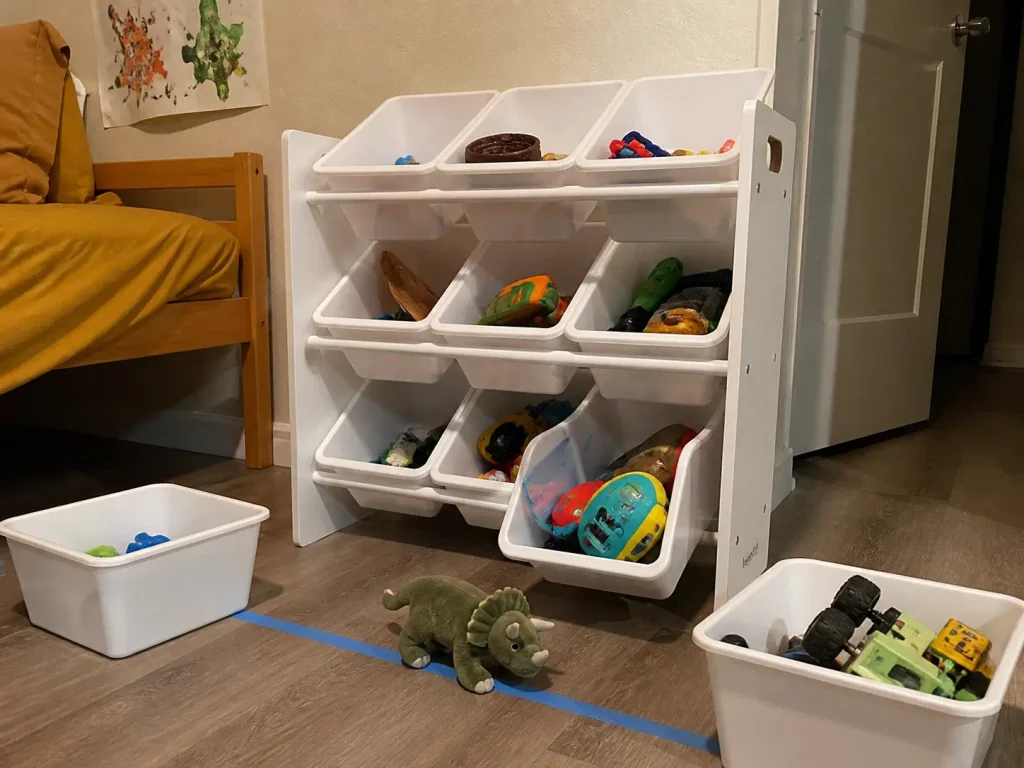
The Humble Crew Kids Toy Organizer works here because its nine bins lift out of the 3-tier frame, so each kid carries their own bins to their own zone instead of both digging through one pile. The frame stays on the boundary and the bins travel, backwards from how most toy furniture works. Its limit is footprint: in a tight room it should replace something rather than join it. For the version scaled to a room with no spare floor, toy storage that holds up in a small room covers the containment logic this section applies per child.
Give Each Child One Thing That’s Only Theirs

Kids who share a room never get to close a door on anyone. That’s the actual deprivation, and better bins don’t solve it. The standard answer is a reading nook with a canopy, a lovely idea for a room with 15 spare square feet, and most shared kids’ rooms have none.
The real answer is smaller and cheaper: one object each child owns completely. This is method, not sentiment. Professional organizers recommend giving each child a clearly defined half of a shared room rather than an unspoken agreement to share everything, and ownership is what makes a defined half mean something to a six-year-old.
The Display Surface
Vertical space costs nothing in a small room, which makes a corkboard above each bed the highest-value square footage in shared kids room organization. It’s a surface each child controls completely: their drawings, their medals, their friend’s birthday invitation, arranged however they want, at zero floor cost.
The Woovio Cork Board comes as a 36 by 24 inch felt bulletin board or as 12 by 12 inch modular tiles, and the tile format is the renter answer because it mounts with self-adhesive backing instead of screws. Buy one tile per child before the 6-pack: a single 12-inch square is enough for most kids, and you’ll know within a month whether they use it.
Two caveats. Adhesive backing and textured or freshly painted walls are a poor match, so test one tile in a corner first, and felt takes push pins better than heavy items. If a child’s things need hanging rather than pinning, a small pegboard panel does the same job for that side of the room and holds real weight.
The Private Box
The board handles what a child wants seen. The box handles what they don’t. Ask any parent of siblings which objects start the most fights and you’ll hear the same list: the tiny thing the toddler will lose or swallow, the birthday money, the keepsake from a grandparent, the diary. The community’s phrasing for the fix is a special box, and then, almost always, “bonus points if it locks.”
The Frcctre Kids Safe Bank is a lock box at 7 inches tall by 4.7 by 3.9, with a combination and a key lock, a genuinely private object inside a room the child can’t lock themselves. It’s small on purpose: a child choosing what goes in a 7-inch box is doing something more useful than storing things. One limitation, a combination stays private only if a four-year-old can’t watch it being opened, so keep it in the older child’s zone rather than on shared furniture.
Across bins that stay shared, labeled bins are the low-cost version of ownership. A name or a color on every bin front makes cross-contamination visible, so “that’s not yours” becomes a fact both kids can check rather than a claim one of them makes. Talented Kitchen Playroom Organization Labels come as 120 preprinted, water-resistant labels.
For kids who don’t read yet, color-coding by child makes the system work before literacy does. Stock runs thin on this set, and painter’s tape with a marker covers the same job meanwhile. All of it makes the cleanup rule enforceable: you can’t ask a child to be responsible for their side if nothing on that side is theirs.
The Routine That Keeps a Shared Room Split Working
The reason your first system lasted four months isn’t that it was badly built. It’s that nobody re-measured it when the kids changed size. Maintenance in a shared room isn’t tidying. It’s re-fitting.
Daily and Weekly
The daily piece is per child: a short daily tidy time where each kid resets their own zone before bed, which is only possible because the zones are visible. Assign specific areas by name, so responsibility traces to a person rather than to “the room.” A four-year-old can put bins back on a shelf. An eight-year-old can clear a surface and a floor.
Neither can clean a shared mess, and asking them to is how this becomes a nightly negotiation. A chore chart splitting the room by zone rather than by task is the version that survives contact with actual siblings, because it answers the “half of that isn’t mine” objection in advance.
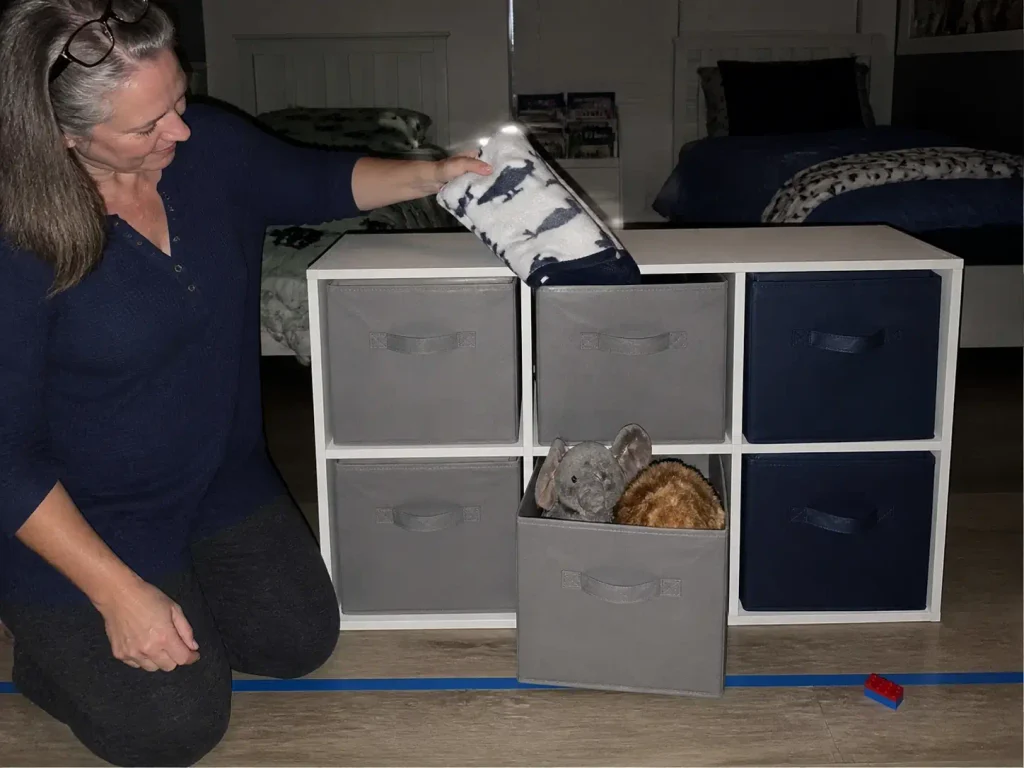
Per-child bins make the reset finish in minutes. The Amazon Basics Collapsible Fabric Storage Cubes come as a 6-pack of 13 by 13 by 13 inch cubes, fitting the standard cube-shelf opening, and they’re cheap enough to buy in the quantity the room needs.
That last part is the requirement: a per-child reset only works when nothing is homeless, and buying four when you need eight is why resets stall. Fabric sags under heavy books, so keep dense things on rigid shelving.
The weekly piece is the only part of a cleaning schedule this room actually needs, and it covers what nobody owns: the floor between the zones, the top of the divider, the shelf that never got split. Unowned surfaces are where a shared room degrades, because both kids are technically right that it isn’t their job. Ten minutes, both kids, once a week. Under-bed space belongs in this pass too, and it’s worth understanding why under-bed storage gets messy in a week before you assign either child a bin down there.
The School-Year Re-Measure
Here’s the piece that separates a system that lasts a year from one that lasts four months. At the start of each school year, re-measure both kids against the closet rods, against the shelf you decided was above the younger one’s reach, and against the divider. Kids grow through their systems. The system does not grow back.
What changes in that annual pass is usually small: the lower rod goes up two inches, the “out of reach” shelf moves up one level, one child graduates from bins to hangers. Since the renter-friendly closet organizers doing this work are adjustable by design, re-fitting is a screwdriver job, not a shopping trip. Ten minutes in September prevents the March afternoon where parents describe digging themselves out of the hole.
I used to think maintenance in kids’ rooms was mostly about consistency and follow-through. Enough shared-room reversion stories point the other way: the systems that fail aren’t the inconsistently enforced ones, they’re the ones nobody re-fitted. Consistency keeps a correctly sized system running. It can’t rescue one your kids have outgrown.
Conclusion
The split that survives a year is measured. Rod height by each child’s actual reach, a divider making the shelf halfway point visible, and a floor boundary a kid can see from across the room. Everything else in shared kids room organization is downstream of those three measurements.
When it reverts, re-zone the room instead of the kids. Reversion is a reach problem before it’s a behavior problem, and the younger sibling growing into the older one’s storage explains more collapsed systems than mess tolerance ever will.
Give each child one thing that’s entirely theirs. A corkboard tile and a small locking box cost close to nothing, take no floor space, and they’re what makes every other rule in the room enforceable.
In three months, stand in the doorway and look at where things have actually drifted. If one child’s belongings keep landing in the other’s zone, either the boundary isn’t visible enough or the reach heights have already moved on you.
Start with the closet rod. Measure both kids against it before you buy a single bin.
Frequently Asked Questions
01How do you organize a shared kids room?
Split the closet rod by reach height rather than left and right, give each child a measured stretch of shelf with a physical divider, and draw one visible floor boundary. Then give each child a single ownable item inside their zone. Re-measure every school year, because the kids’ reach changes even when the furniture doesn’t.
02At what age should children stop sharing a bedroom?
No federal rule requires siblings to stop sharing a bedroom at a specific age. Local housing occupancy codes set minimums for room size and number of occupants, and those vary by city. What is federally regulated is bunk beds: the CPSC standard restricts top-bunk use to children 6 and older.
03How do you give kids their own space when they share a room?
Give each child one object they own completely instead of trying to carve out floor space. A corkboard above the bed and a small locking box cover both halves of the need, a surface they control and a place nobody else opens, and neither costs floor square footage the room doesn’t have.
04How do you divide a shared kids room fairly with a big age gap?
Divide by reach height instead of floor area. Put the younger child’s everyday clothes on a lower rod and store the older child’s small-parts toys and keepsakes above the younger one’s reach. If one child is under 6, the top bunk is off the table under the federal standard, so plan the room without it.
05What’s the cheapest way to divide a shared kids room?
A painter’s-tape line on the floor plus repositioning furniture you already own. It costs nothing, and running it for two weeks shows you where the boundary actually wants to sit before you spend money on a divider that ends up in the wrong place.