












In this article
Your bathroom is probably 40 square feet. Maybe 50 if you got lucky. And you’re trying to store shampoo, towels, cleaning supplies, backup toiletries, and whatever else accumulates when the only storage you have is a medicine cabinet and a vanity that’s mostly pipe. The problem isn’t that you own too much — it’s that most bathroom storage advice ignores how these rooms are actually shaped. Here are 11 small bathroom storage ideas I’ve tested in real rental bathrooms, sized for the spaces you actually have.
Quick Answer: The best small bathroom storage ideas target dead space you’re already ignoring.
- Measure every gap before buying — most returns come from 1-inch miscalculations
- Use the vertical space above your toilet with a freestanding shelf
- Add an expandable organizer under the sink that wraps around the pipe
- Mount no-drill floating shelves and over-door organizers on empty walls
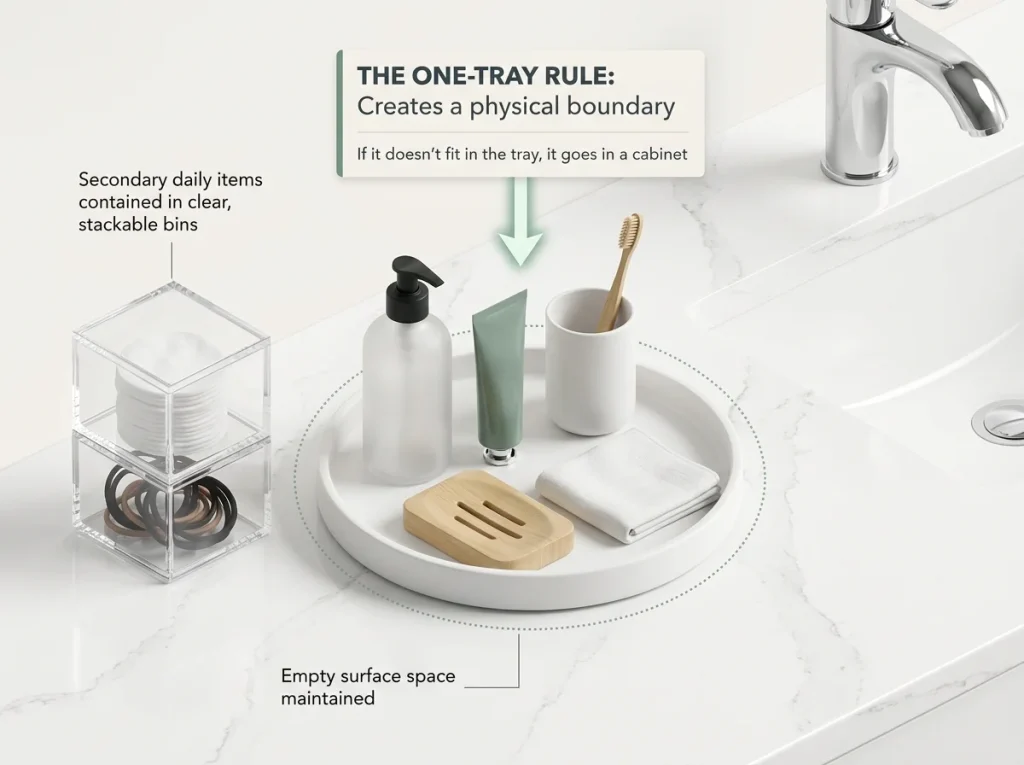
- Keep counter items to one tray — everything else goes inside a cabinet
- Fill the narrow gap beside your toilet with a slim rolling cart
Measure First, Buy Second
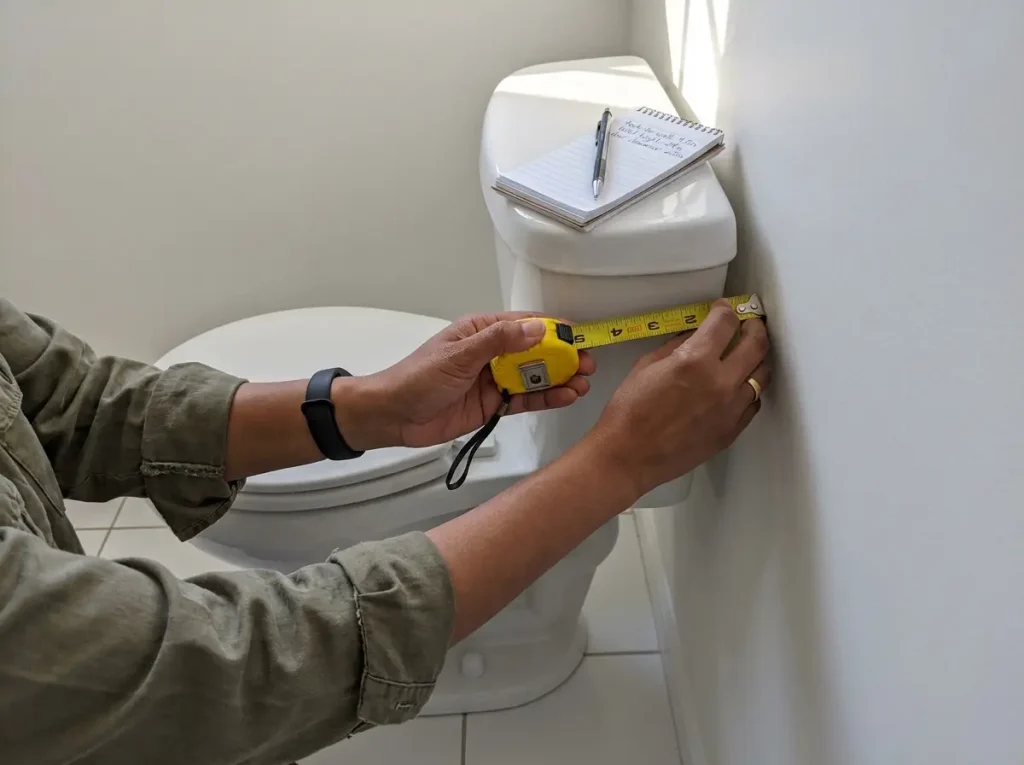
Every failed bathroom organizer purchase starts the same way: someone eyeballs a space, guesses it’s “about 6 inches,” and orders something that turns out to be 7.5. Returns in the home organization category are disproportionately caused by fit problems — not quality issues, not wrong color, just wrong size.
What to Measure Before You Buy
Grab a tape measure and write down four numbers before you open a browser: the gap between your toilet tank and the wall behind it, the width between your toilet and vanity (or wall), the clearance under your sink around the P-trap, and the depth of your vanity cabinet from front to back.
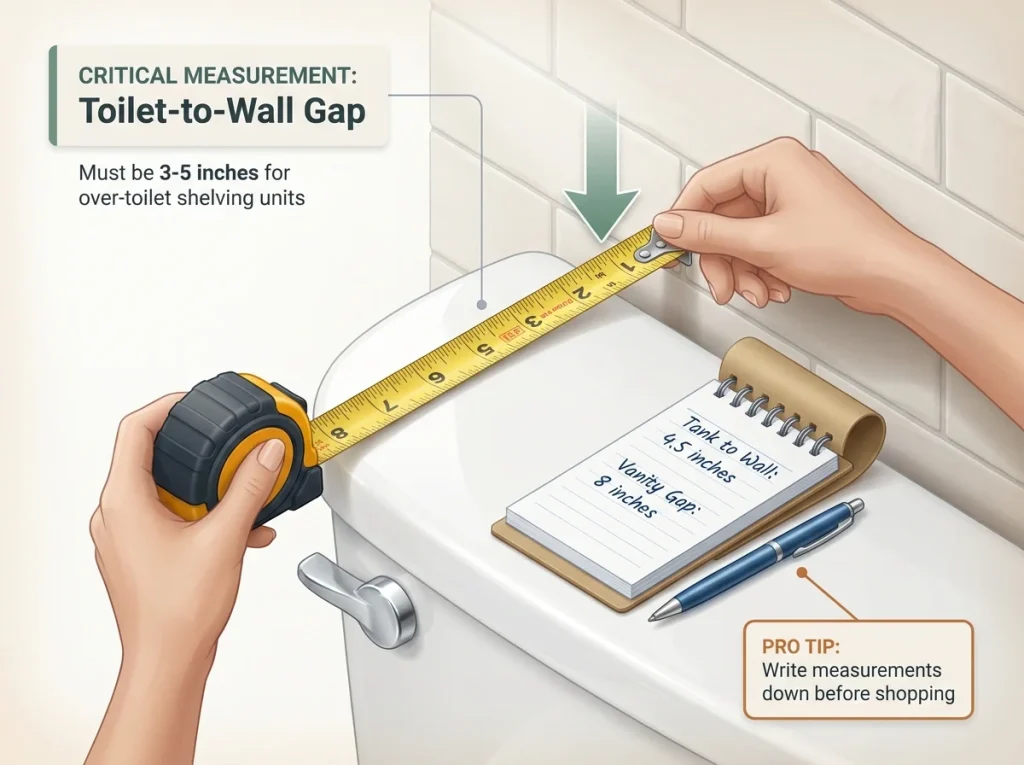
These four measurements rule out 80% of products that won’t fit and point you toward the 20% that will. The toilet-to-wall gap matters because over-toilet shelving units need 3–5 inches of clearance behind the tank. The toilet-to-vanity gap tells you whether a slim cart will slide in. Under-sink clearance determines whether an expandable shelf can arch over your pipe. Cabinet depth tells you what bin size actually fits without jamming.
Pro tip: Write measurements on a sticky note and keep it in your phone case. You’ll need them next time you’re in a store or scrolling Amazon at midnight.
Over-Toilet Storage That Doesn’t Fall Over
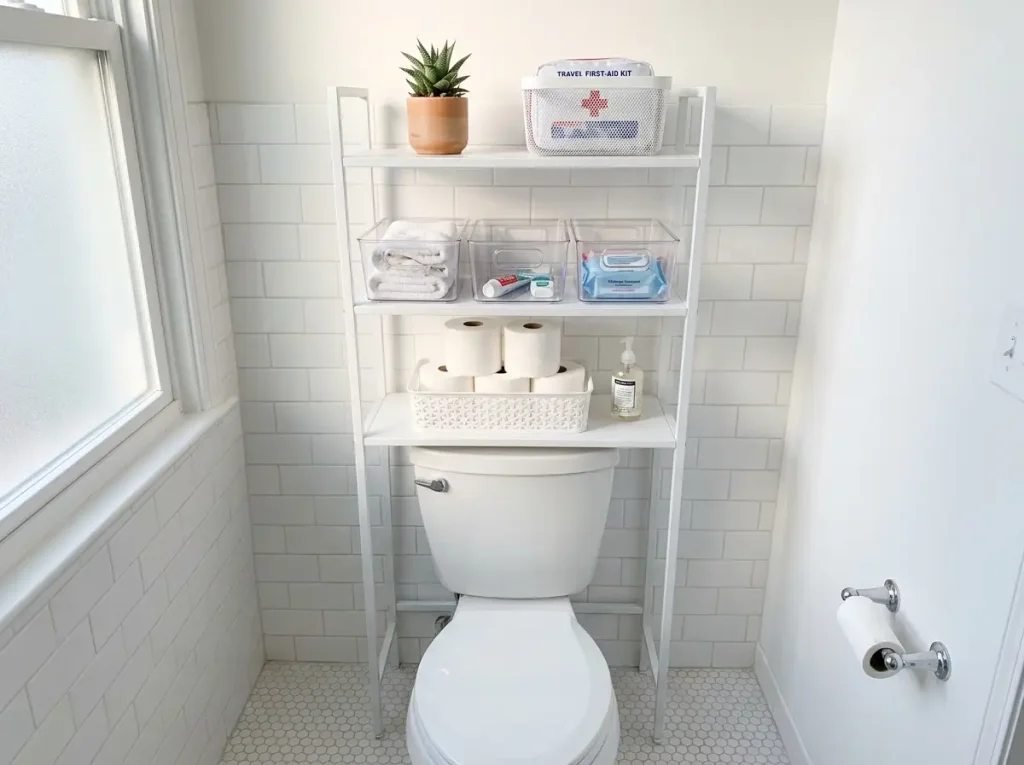
The space above your toilet is 4–5 feet of vertical storage that most people leave completely empty. The reason people avoid it: they bought a wobbly unit once, it tipped when they grabbed a towel, and they never tried again.
Why Over-Toilet Units Tip Over
Most over-toilet shelves tip because the legs don’t straddle the tank properly. If the unit’s base is narrower than your toilet tank — or wider than the space between the toilet and both walls — the physics don’t work. The unit rocks every time you reach for the top shelf. The feet can’t grip smooth tile. And if one leg is on the bath mat and one isn’t, it’s already leaning before you load a single item.
The Setup That Actually Stays Put
A tension rod shelf is the cheapest option here — two rods plus a wooden plank for under fifteen bucks if you already own a saw. But if you want something that holds real weight across three tiers, the UTEX 3-Tier Over-Toilet Storage Shelf is about 25 inches wide and 8 inches deep, with legs that bracket the tank on both sides. The bottom shelf starts at 33 inches up — high enough to clear a standard toilet tank lid by about 2 inches.
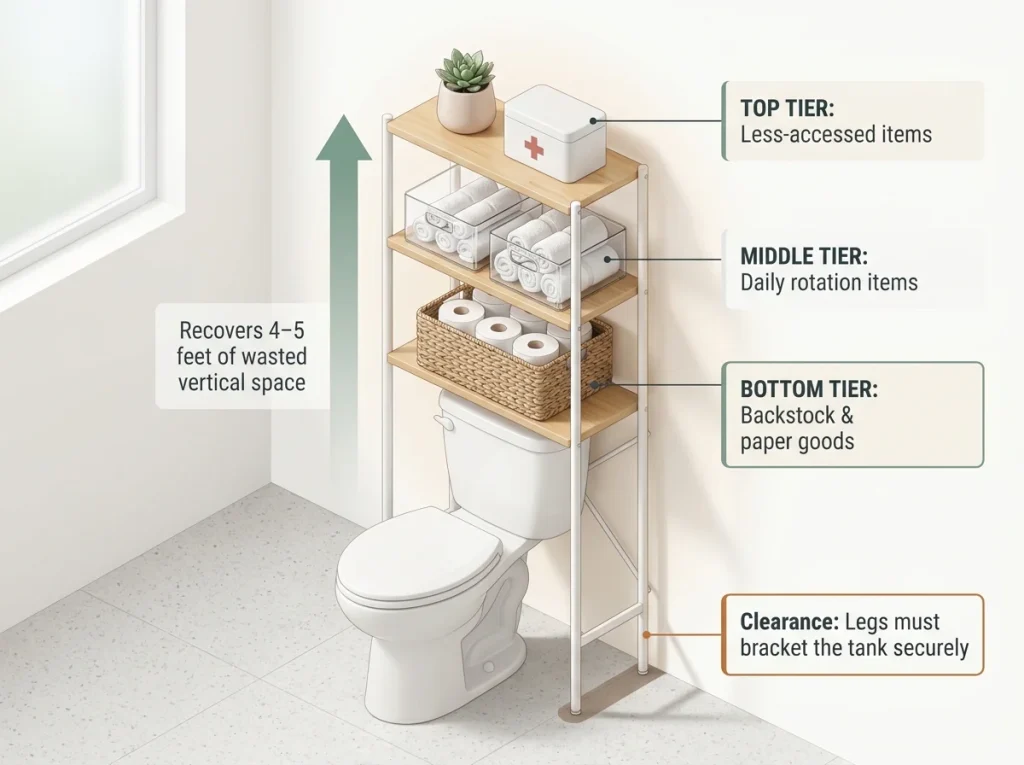
It’s freestanding, no drilling required, and it fits the standard 20-inch-wide toilet most apartments have. Use the bottom tier for backstock (extra toilet paper, backup soap), the middle for daily-rotation items (washcloths, dental supplies), and the top for things you grab less often. The limitation: if your toilet is wider than 22 inches or sits in an alcove with less than 26 inches of wall-to-wall clearance, this specific model won’t fit. Measure first — see why that section exists before this one.
Under-Sink Storage You Can Actually Reach
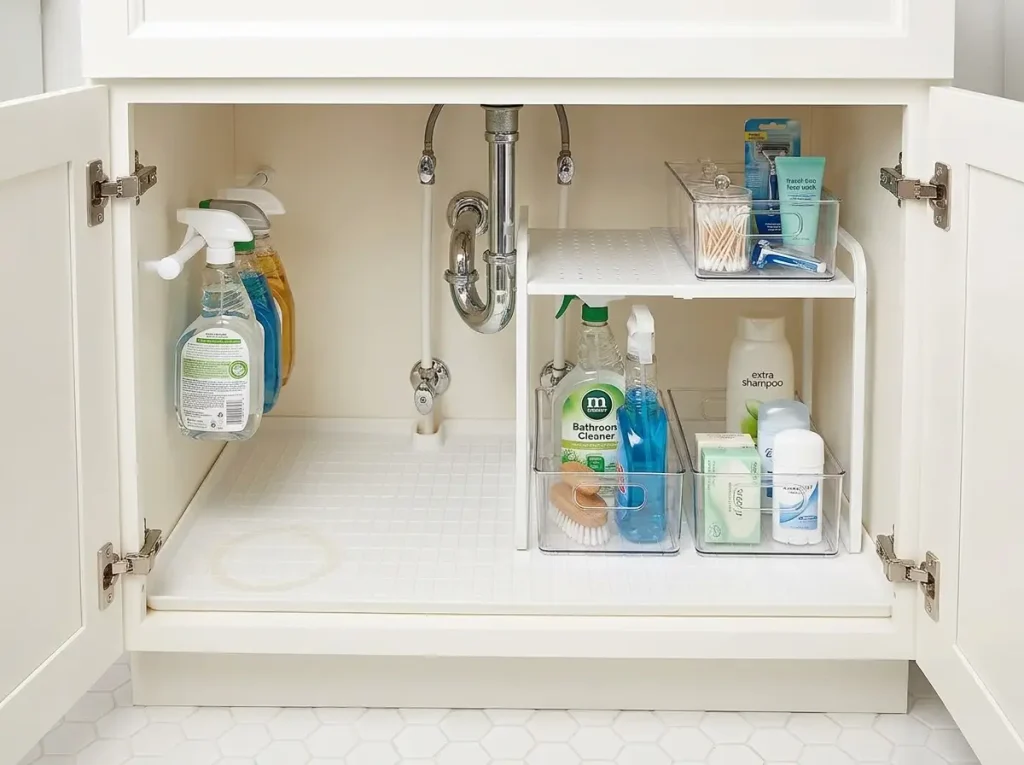
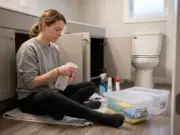
The cabinet under your bathroom sink is probably a mess right now. Not because you’re bad at organizing — because the space is designed terribly. It’s deep, dark, has a P-trap pipe splitting the middle, and everything slides forward every time you open the door.
Working Around the P-Trap
The pipe is the reason flat bins don’t work under most bathroom sinks. You need something that arches over it or adjusts around it. The SimpleHouseware 2-Tier Expandable Shelf Organizer adjusts from 19.5 to 32 inches wide and has an open arch in the center that clears the P-trap. It gives you two tiers on each side of the pipe — effectively doubling your usable vertical space inside the cabinet.
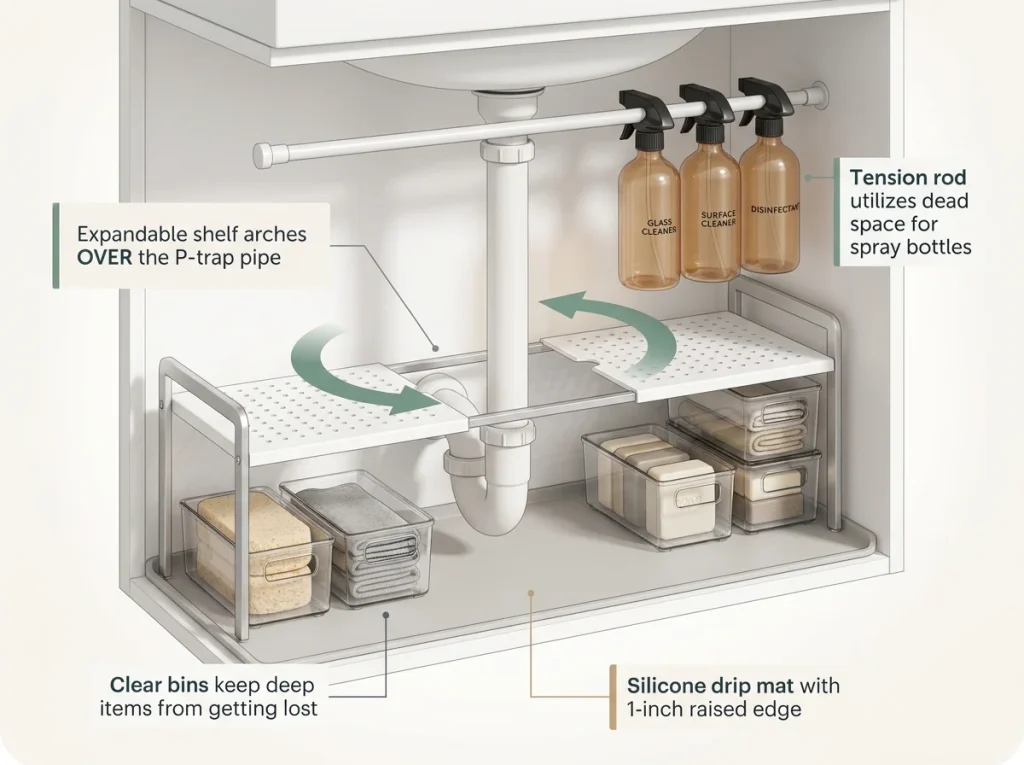
Pair it with a tension rod mounted wall-to-wall inside the cabinet, about 6 inches below the sink basin. Hook spray bottles by their triggers — they hang below the rod and use space that was otherwise dead. This is the same under-sink organization approach that works in kitchen cabinets, just scaled to the smaller bathroom vanity dimensions (most are 21–22 inches deep instead of 24).
Pro tip: Mount the tension rod BEFORE putting the expandable shelf in. It’s nearly impossible to tighten a rod with a shelf blocking your reach. Ask me how I know.
Protecting the Cabinet Floor
One thing nobody mentions until you’ve already stained a cabinet floor: P-trap connections drip. Slowly. Just enough condensation or micro-leak moisture to leave a white ring on the wood over six months. In a rental, that water stain can cost part of your security deposit.
A silicone drip mat with 1-inch raised edges catches it before it reaches the wood. This one is 34 by 22 inches — large enough to cover the full cabinet floor in a standard 24-inch vanity. The raised edges contain any pooled water so it doesn’t seep to the corners. Budget alternative that still works: peel-and-stick contact paper as a surface protector — but it has no raised edges, so water just spreads sideways.
Walls, Doors, and Vertical Space
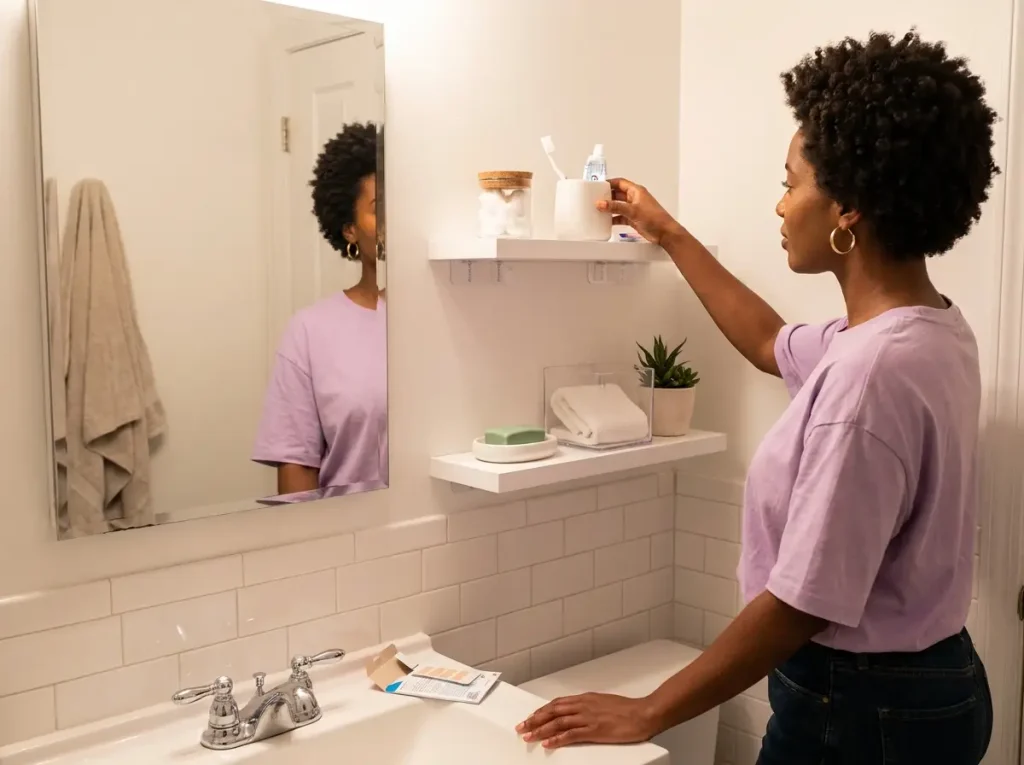
In a 40-square-foot bathroom, your walls are the biggest unused storage surface. The floor is limited, the counter is small, and the cabinet under the sink is already full. But you’ve got 8 feet of vertical wall space on three to four surfaces — and most of it holds nothing but a towel bar.
Adhesive That Survives Humidity
Here’s the thing about standard adhesive hooks in a bathroom: they fail. The humidity from daily showers weakens the adhesive bond within weeks. You hang something, it holds for a month, then you hear it crash at 2 AM while you’re half asleep. This is the one room where you need humidity-rated adhesive specifically.
The Command Bath Large Water-Resistant Adhesive Strips 16-pack are designed for bathroom moisture levels. Each strip holds up to 5 pounds, and a 16-pack gives you enough for multiple shelves or hooks throughout the room. They’re the foundation for everything else in this section — if you’re mounting anything on a bathroom wall without drilling, start here. The no-drill mounting principles are the same across every room, but the adhesive type matters more in humid spaces than anywhere else.
Budget alternative: suction cup hooks on non-porous surfaces (glass, smooth tile) cost nothing if you already have old ones in a drawer. They won’t hold as much weight, but for a single washcloth or loofah, they work.
Floating Shelves Without Drilling
The narrow strip of wall beside your bathroom mirror — usually 4 to 6 inches of clearance from the mirror edge — fits a floating shelf perfectly. Most people ignore this space because they assume shelves require screws. They don’t anymore.
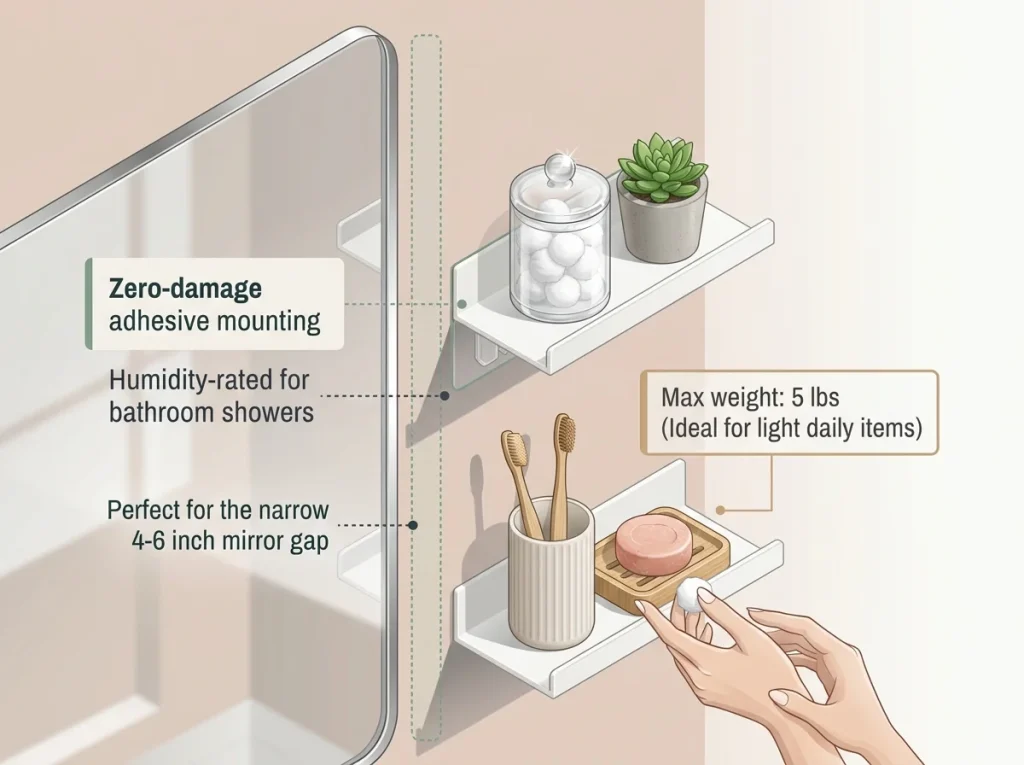
The No-Drill Floating Wall Shelf 16.5-inch 2-Pack comes with its own adhesive mounting system — no Command strips needed separately, no screws, no holes. Each shelf is wide enough for a soap dish, a small jar, and one decorative item. The limitation: these hold lighter bathroom items (cotton balls, a small plant, a hand soap). Don’t load them with full shampoo bottles — they’re not built for that weight. Budget alternative: a Command Picture Ledge (model B01C60CA8Q) holds 5 pounds across 21 inches and costs less, though it’s narrower front-to-back.
The Back of the Door
The bathroom door has two sides. Right now you’re using zero of them for storage. An over-door organizer gives you five tiers of storage on a surface that’s otherwise completely wasted — and you never think about it because the door is always open when you’re in the room.
The SimpleHouseware Over-The-Door Organizer 5-tier has five solid wire shelves — not fabric pockets that sag and let bottles tip sideways. It hooks over any standard interior door that has 1.5 to 2 inches of clearance between the top of the door and the frame. Check that gap before buying: open your door fully and look at the hinge side where it meets the frame.
Pro tip: Put the heaviest items (full shampoo bottles, cleaning products) on the bottom two tiers. Weight distribution keeps the organizer flush against the door instead of swinging outward when you open it fast.
Counter Organization That Doesn’t Revert
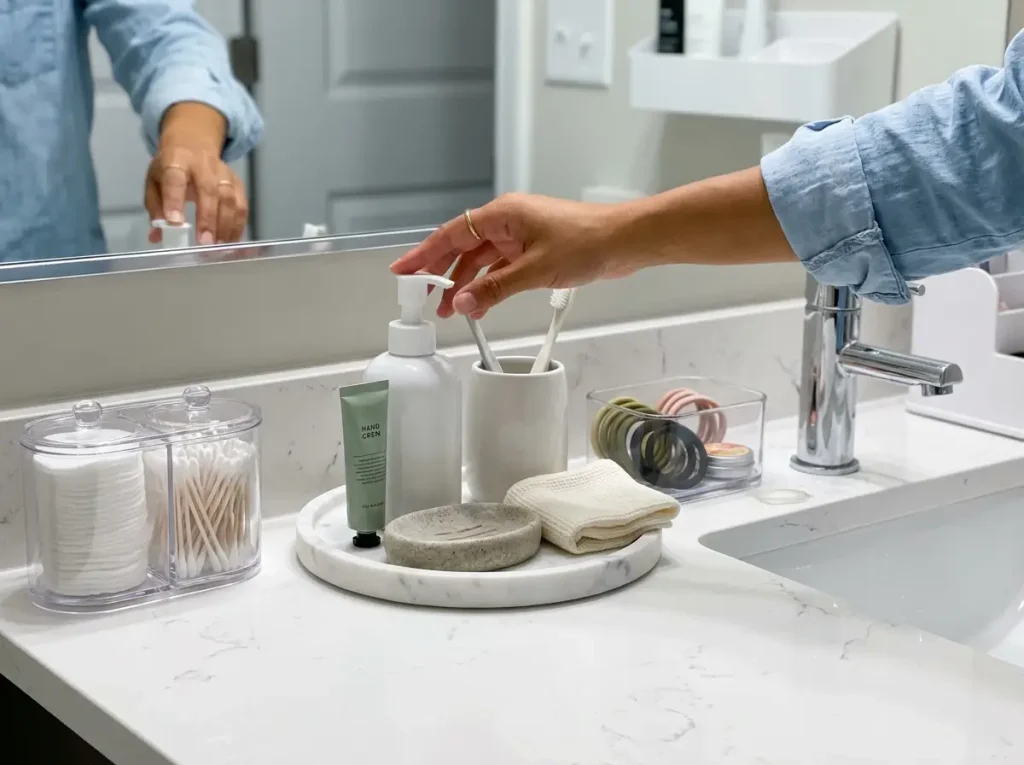
Your bathroom counter reverts to chaos within a week because there’s no physical boundary stopping items from spreading. You clean it, it looks great, and by Thursday there are six products scattered across a 24-inch surface again. The issue is not discipline — it’s a missing physical constraint.
The One-Tray Rule
One small tray. Round or rectangular, 6 to 8 inches across. Everything that lives on your counter must fit inside it. If it doesn’t fit, it goes inside the cabinet or gets moved to the shower caddy. This is the single most effective counter organization rule I’ve tested — and I’ve tested it in bathrooms from 35 to 70 square feet. The tray creates a visible boundary that your brain registers as “full” or “not full.” Without it, the entire counter surface reads as available space, and items drift outward until the whole surface is covered again.
What Lives Outside the Tray
Secondary items — the cotton rounds you grab every night, the Q-tips, the hair ties — belong in clear bins beside the tray. Not on the counter loose. Not shoved in a drawer you’ll never open. The mDesign Stackable Plastic Storage Bins 4-pack are about 10 by 6 by 3 inches each, which fits most bathroom counters without taking over. Clear walls mean you see what’s inside without lifting lids or guessing.
The budget alternative that works just as well: mason jars or repurposed glass containers you already own. The key is containment — any vessel with walls that separates categories works. What matters is the “one category per container” rule, not whether the container matches your soap dispenser.
Rolling Carts and Freestanding Solutions
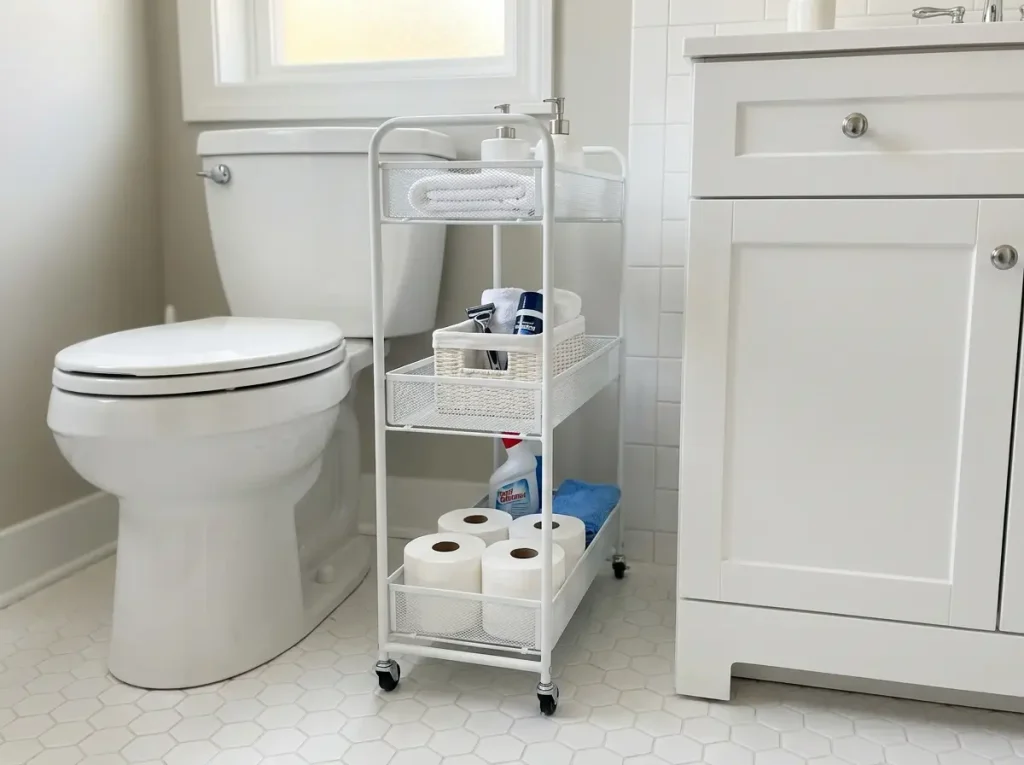
Look at the gap between your toilet and your vanity. Or between your toilet and the wall. There’s almost always a 7- to 10-inch sliver of floor space there that nothing occupies. It’s too narrow for a shelf. Too deep for a basket. And most people just let it collect dust bunnies for years.
Finding and Using the Gap
A slim rolling cart is the only storage solution shaped specifically for this dead zone. The Slim 3-Tier Rolling Cart is about 7 inches wide with three open tiers on caster wheels. It slides into the gap, holds toilet paper backstock on the bottom, daily personal care items in the middle, and a hand soap dispenser with a folded towel on top.
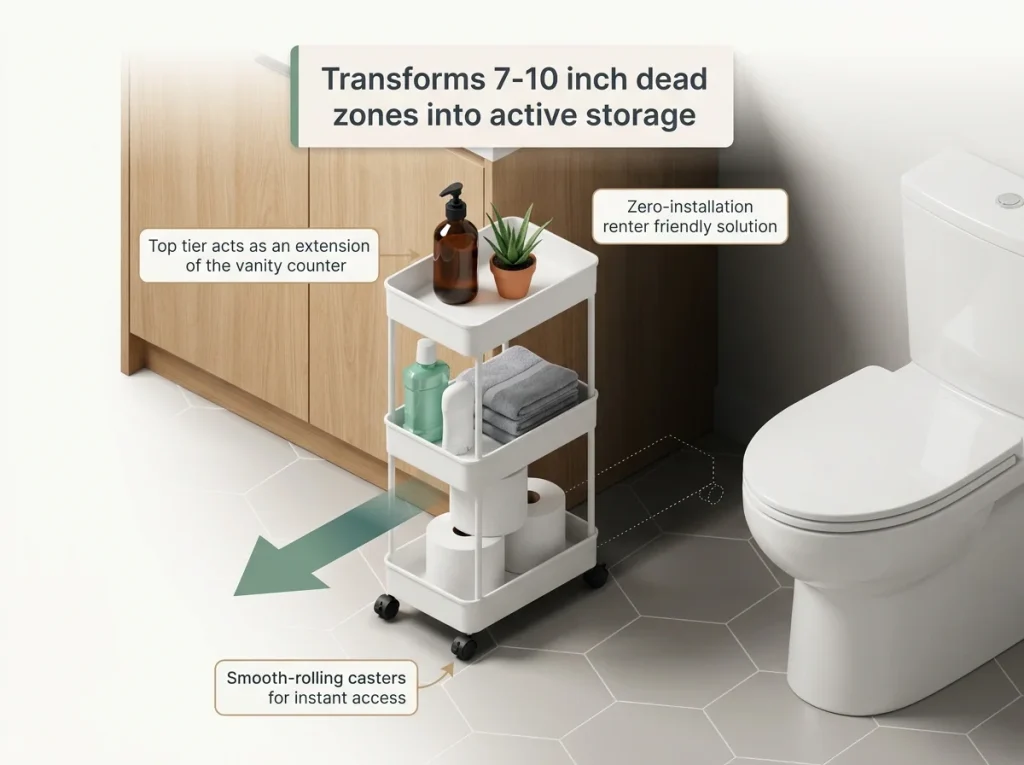
Roll it out when you need access, slide it back when you don’t. Zero installation. Zero wall damage. You take it with you when you move — and you will, because this is one of those solutions that earns its space within the first week. The limitation: if your gap is under 8 inches, it won’t slide smoothly. And if your tile floor has raised grout lines, cheap casters catch on them. Check that the wheels roll freely across your specific floor before committing.
The NAPO (National Association of Productivity & Organizing Professionals) recommends maximizing vertical and hidden storage in bathrooms before adding freestanding furniture — and a rolling cart that disappears into a gap falls perfectly into that philosophy.
Why Small Bathroom Organization Always Reverts
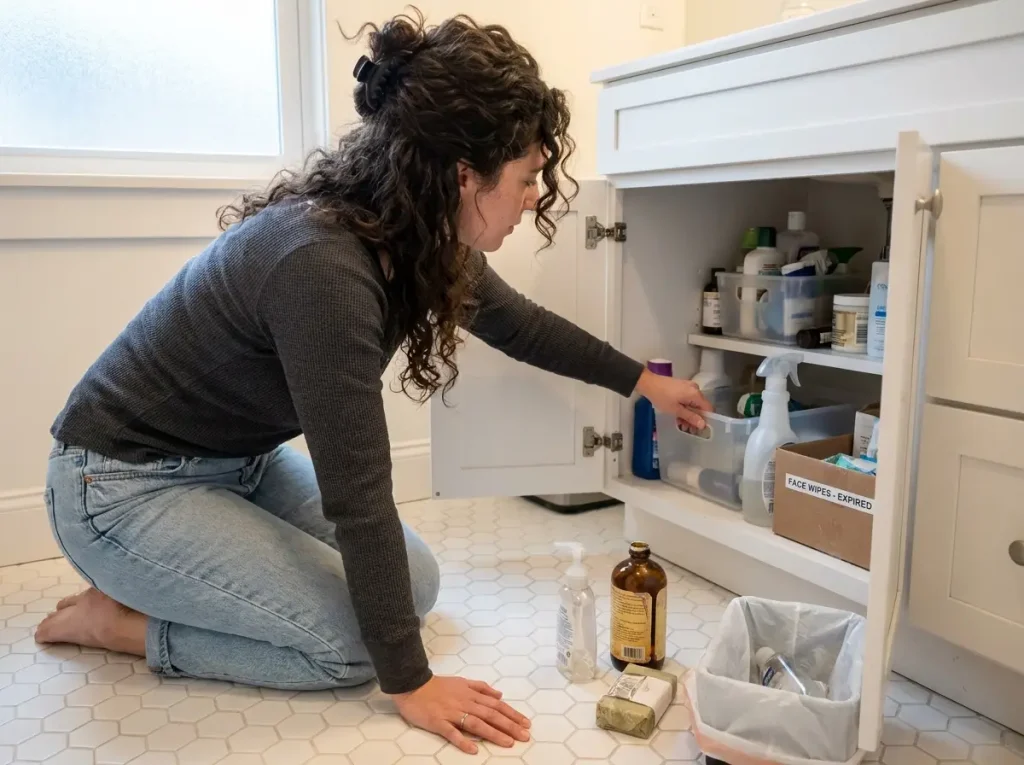
You set everything up perfectly. The shelves are loaded, the bins are labeled, the counter is clean. And four weeks later, it’s sliding back toward chaos. This isn’t a personal failure — it’s the natural entropy of any system that doesn’t include maintenance built into the routine.
The Five-Minute Monthly Reset
Every organizational system needs a reset interval. For a bathroom this small, once a month is enough. Set a phone reminder. On that day, open every cabinet and pull out anything that’s migrated from its assigned spot. Check for empties (the almost-gone shampoo hiding behind the full one), expired products (yes, sunscreen expires), and items that wandered into the wrong bin because someone was in a rush.
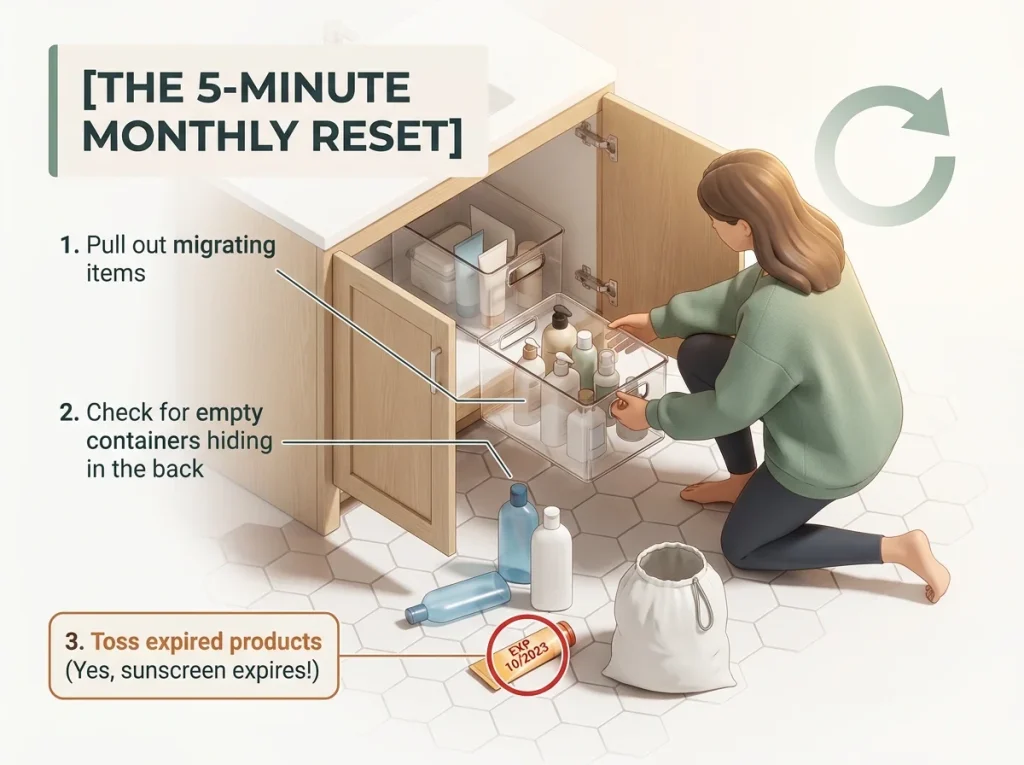
The reset takes five minutes if you do it monthly. If you skip it for three months, it takes thirty minutes and feels like starting over from scratch. That’s why systems revert — not because the organizational products failed, but because nobody scheduled the maintenance. A system without a maintenance schedule is just a delayed mess with nicer bins.
Pro tip: During your monthly reset, check the drip mat under the sink. If there’s standing water, your P-trap connection may need tightening — a ten-second fix that prevents a much larger problem down the road.
Conclusion
Three things to take with you: measure every gap before you buy anything, use the walls and vertical surfaces you’re currently ignoring, and build a five-minute monthly reset into your routine. The products are just tools — the system is what makes them work past the first week.
Three-Month Check: Revisit your over-toilet shelf and under-sink bins in 90 days. If items are piling up or migrating to the wrong tier, that section needs fewer categories, not more products.
Start with the measurement step. Grab a tape measure, write down four numbers, and you’ll know exactly which of these 11 ideas fits the bathroom you’re standing in right now.
Q1 How do I organize a small bathroom with no storage?
Use vertical surfaces: over-toilet shelving, over-door organizers, and adhesive floating shelves add storage without taking floor space. A slim rolling cart fills the unused gap between toilet and vanity. Most no storage bathrooms actually have 15–20 square feet of unused wall and gap space.
Q2 What is the best storage solution for a small bathroom?
A freestanding over-toilet shelf gives the highest storage density per dollar in most small bathrooms. It uses 4–5 feet of vertical space above the toilet that’s otherwise empty, requires no installation, and works in any rental without modifications.
Q3 How do I organize under the bathroom sink?
Use an expandable shelf that adjusts width and arches over the P-trap pipe. Add a tension rod for hanging spray bottles and a silicone drip mat to protect the cabinet floor. Group items in clear bins by category — one bin per type, nothing loose on the shelf surface.
Q4 How do I keep my bathroom counter from getting cluttered?
Use the one-tray rule: choose a tray small enough to hold only your daily essentials. Everything else goes inside the cabinet or in a clear bin beside the tray. The physical boundary signals full to your brain and stops items from spreading across the entire counter.
Q5 Do Command strips work in bathrooms?
Standard Command strips fail in bathrooms because humidity weakens the adhesive bond over weeks. Use the water-resistant bathroom-specific version — Command Bath strips are formulated for humid environments and hold up to 5 pounds per strip on clean, dry surfaces.