




















In this article
You decluttered last January. Probably the spring before that too. The donation bags went to Goodwill, the shelves looked clear for a few weeks, and by March everything was right back where it started.
I’ve worked through this exact cycle in spaces from a 400-square-foot studio to a four-bedroom family home, and the fix was never “more motivation.” This is a room-by-room decluttering checklist with one difference: it includes the decision logic for each category so you stop freezing up mid-session, honest time estimates so you don’t start something you can’t finish, and a maintenance reset so this doesn’t become next January’s project again.
Quick Answer: Every room hoards different things, so every room needs a different checklist. Here’s what to hit:
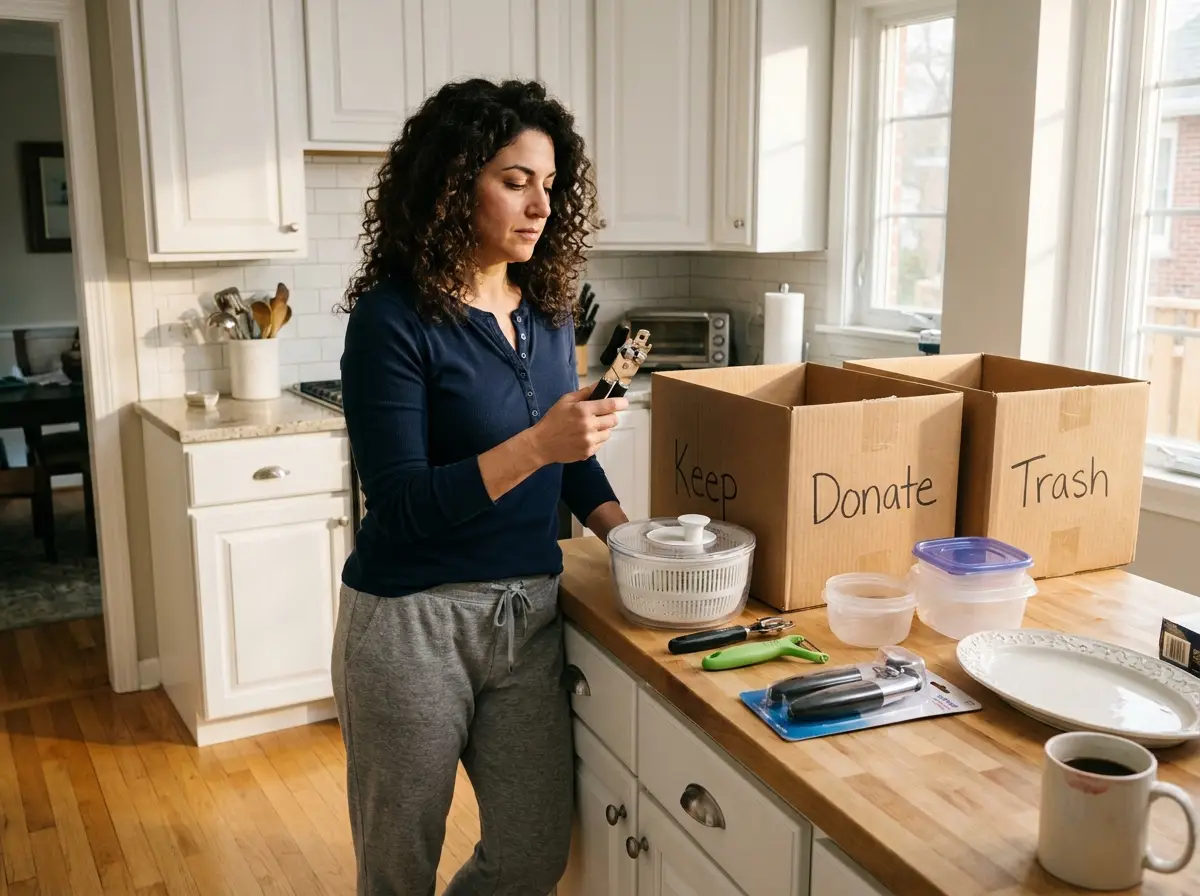
- Kitchen (3-5 hours): expired food, duplicate gadgets, mismatched containers and lids, countertop appliances used less than weekly
- Bedroom and closet (3-4 hours): clothing unworn for 12+ months, guilt-kept gifts, mismatched bedding, seasonal items stored without a system
- Bathroom (45-90 minutes): expired medications, opened skincare older than 12 months, hotel samples, stained towels
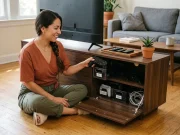
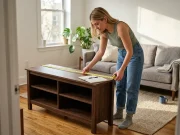
- Living room and entryway (2-3 hours): items that migrated from other rooms, tech for devices you no longer own, the catch-all basket or bench
- Home office (1-3 hours): paper older than one tax cycle, mystery cables, dead pens, more than 10 items on the desk surface
Why Your Last Declutter Didn’t Stick
The Checklist-as-Event Problem
Most decluttering checklists treat the process like a weekend event. Pull everything out, sort it into bags, haul the bags to Goodwill, done. Six weeks later you’re standing in the same cluttered kitchen wondering what happened.
The problem isn’t that you decluttered wrong. Stuff enters your home faster than you evaluate it. Without a system for what comes IN after the session, you’re running a faucet into a bathtub and blaming the mop.
Professional organizers at NAPO call these “critical zones” — the spots where new items enter and pile up. Clearing the zones without changing how things flow through them guarantees reversion.
The “Just in Case” Trap
Decision fatigue hits after about two hours of keep-or-toss choices. Your brain defaults to “keep” — not because the item is worth keeping, but because deciding costs energy you’ve already spent. That’s why items at the END of a decluttering session are always the least edited.
Then there’s the “just in case” category. The bread maker you used once in 2021. The extra charging cable for a phone that doesn’t exist anymore.
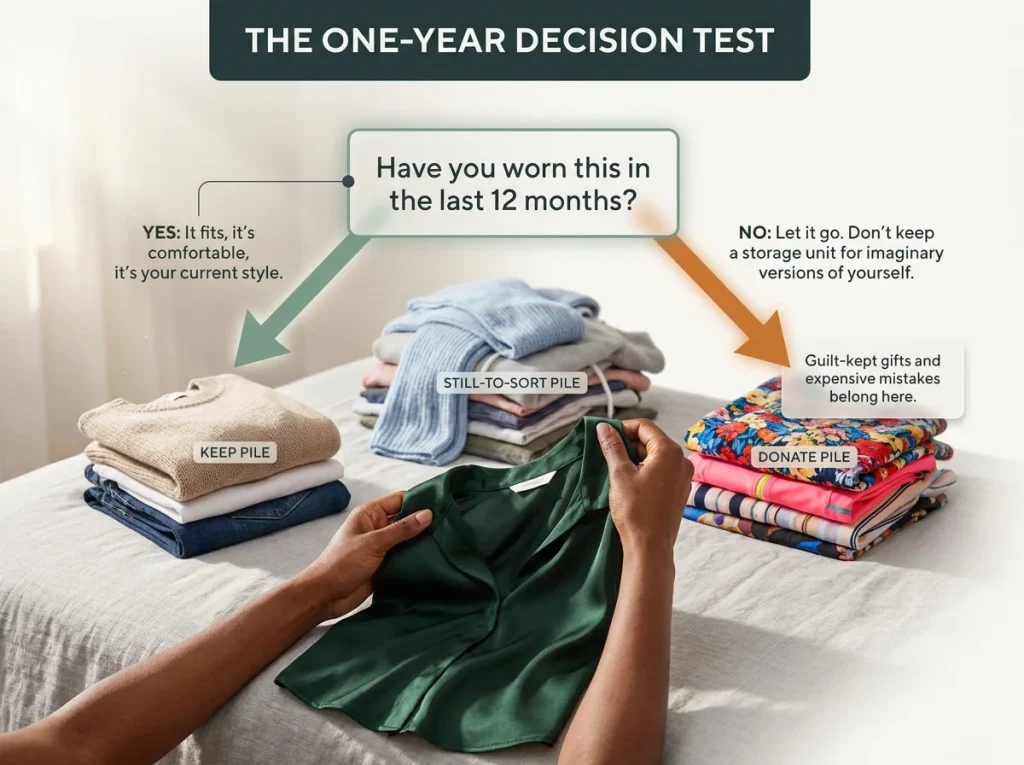
The shirt that fit you three years ago. One Reddit user described it perfectly: “‘just in case’ turned my home into a storage unit for imaginary versions of myself.”
The 20/20 rule dissolves most of these: if you could replace the item for under twenty dollars in under twenty minutes, let it go. Most people find that 90% of “just in case” items are never missed — because the imaginary scenario never happens.
What This Checklist Does Differently
Every section below includes the actual decision framework for each item category (not just “donate what you don’t use”), an honest time budget so you can plan without abandoning the session halfway through, and at the end, a quarterly maintenance reset so this doesn’t become an annual ritual. If you want a deeper look at how to design your room-by-room decluttering sessions — session caps, room sequence, how to manage decision fatigue across multiple rooms — that guide covers the process. This one covers the checklist itself.
Kitchen Declutter Checklist (Budget 3-5 Hours)
Pantry and Food Storage
The kitchen takes the longest because it has the most categories of stuff, not because any single category is hard. Start with the pantry — it’s the fastest kitchen win because expiration dates make the decisions for you.
Pull everything off one shelf at a time. Anything expired, stale, or so far back you forgot it existed goes immediately. The sneaky category is “still good but you’ll never use it.”
That jar of specialty tahini from a recipe you tried once. The protein powder from your fitness phase. If you open something and have to think about what you’d use it for, you have your answer. Consolidate duplicates — three half-used bags of brown sugar become one, and the freed containers go back to the cabinet they came from.
Pro tip: Pull every item from ONE category at a time — all canned goods, all spices, all baking supplies. Duplicates become obvious instantly when they’re sitting next to each other on the counter.
Cabinets, Drawers, and Gadgets
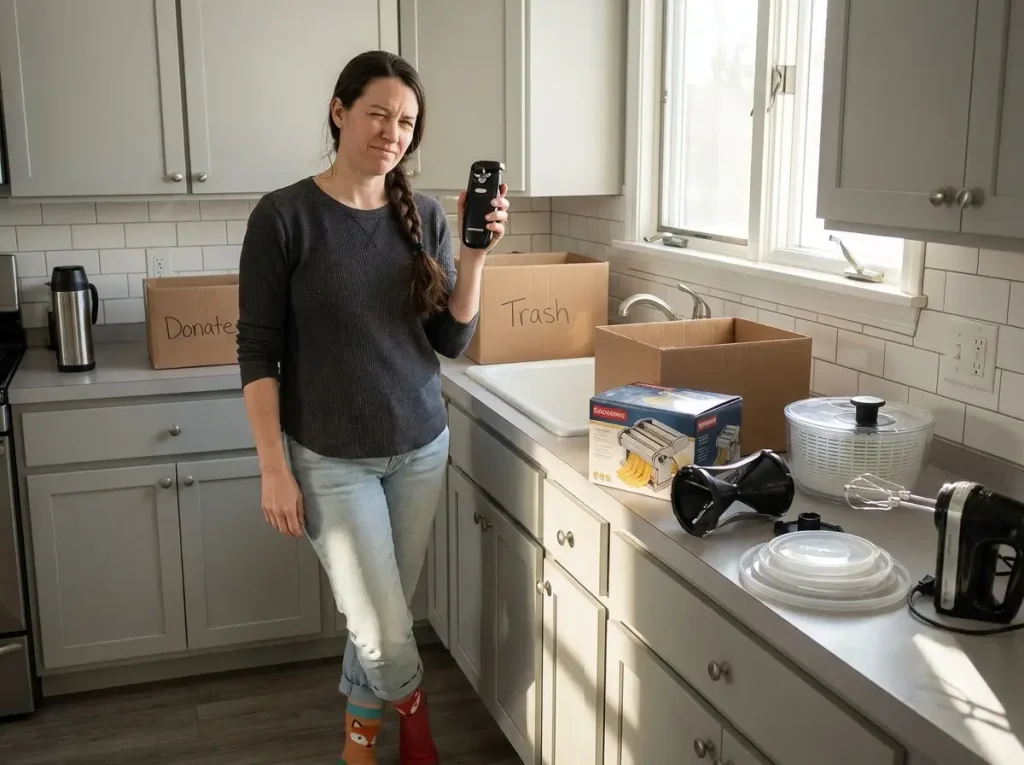
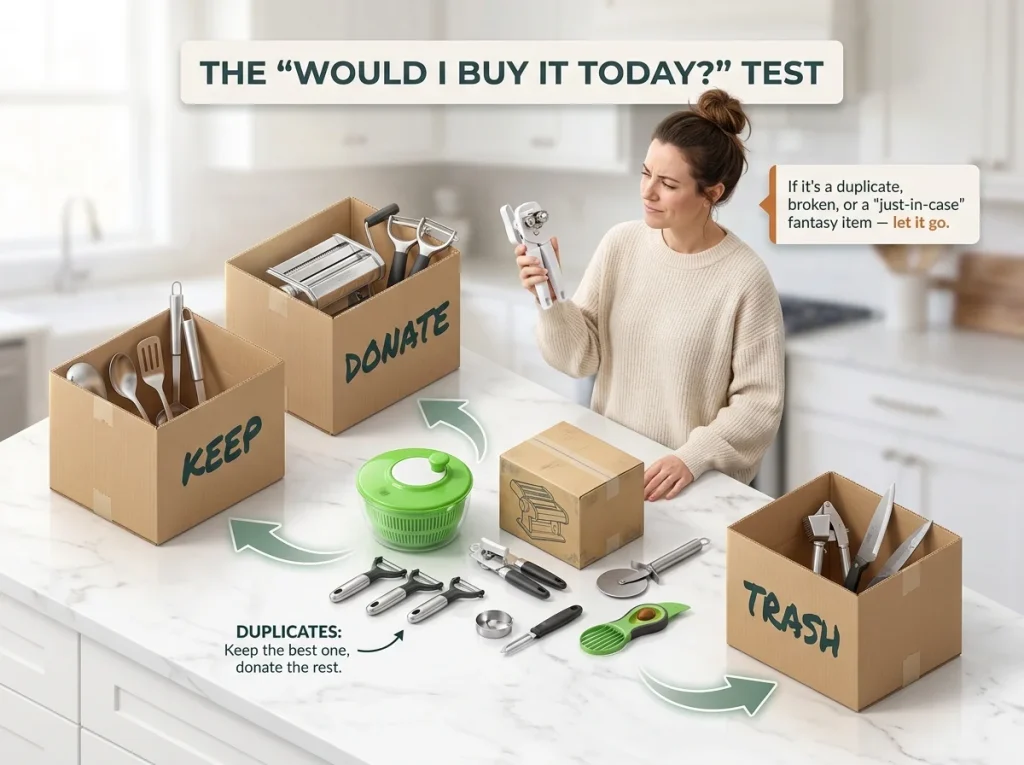
Open every drawer and ask one question per item: would I buy this today? Not “could I use this someday” — that answer is always yes for everything. Would you walk into a store right now and spend money on this exact item? The garlic press with the broken hinge, the avocado slicer you thought you needed, the third pair of kitchen scissors — they all fail that test.
Mismatched container lids are the kitchen’s biggest space thief. Spend ten minutes matching every lid to its container. Any orphan — lid without a container or container without a lid — goes in the recycling. This single exercise can clear an entire drawer.
The junk drawer gets its own moment. Empty it completely onto the counter. Batteries, takeout menus, mystery keys, rubber bands, expired coupons — only return items that have a specific, current use.
The drawer should close easily when you’re done. If it doesn’t, you kept too much.
Countertops and Surfaces
The rule for countertops: only daily-use items stay visible. Your coffee maker earns its counter spot every morning. The toaster that gets pulled out on Sundays only can live in a cabinet. The goal isn’t an empty counter — it’s a counter where everything visible earns its place through daily use.
Items that belong elsewhere in the kitchen go back now. Items that belong in other rooms go in a relocation basket — deal with them at the end of the session, not during.
Bedroom and Closet Declutter Checklist (Budget 3-4 Hours)

Clothing — The One-Year Decision Test
The bedroom closet generates the most emotional resistance because clothes carry identity. You’re not deciding whether to keep a shirt — you’re deciding whether to keep the version of yourself who wore it. That’s why generic advice like “donate what you don’t wear” doesn’t work. You need a faster, more mechanical test.
For every garment: have you worn this in the last twelve months? If no — why not? There are only four honest answers: it doesn’t fit, it’s uncomfortable, it’s not your style anymore, or you forgot you had it. None of those reasons improve with more closet time.
Pro tip: Flip all your hangers backward today. In three months, any hanger still backward holds a garment you haven’t worn — and probably won’t.
Items kept out of guilt are the hardest category. Expensive mistakes, gifts worn once out of obligation, clothes that fit you from a different year. “Should” is not a reason to keep something.
If you’re holding onto a dress because your mother gave it to you and you’ve worn it once in four years, you’re keeping it for her, not for yourself. Take a photo if the memory matters, then let the garment go to someone who’ll actually wear it.
If the KonMari method handles sentimental items differently in a way that resonates with you, use that framework for the emotional pieces. But don’t skip the category entirely — those guilt-kept items take up more mental space than physical space.
Bedside, Dresser, and Surfaces
The nightstand is a clutter magnet because it’s the last thing you touch before sleep and the first thing you reach for in the morning. Limit it to a lamp, one book you’re actively reading, and one personal item. Everything else — the stack of books you’ll “get to eventually,” the phone charger tangled with earbuds, the receipts from last month — gets sorted or moved.
Dresser tops follow the same rule: if it’s not daily-use, it doesn’t live on the surface. The pile of change, the random decorative objects, the overflow from other drawers — they go.
Under the Bed and Seasonal Storage
Under-bed storage should hold only seasonal or low-frequency items: extra bedding, off-season clothing in sealed containers, rarely used luggage. If you’re storing things under your bed that you forget about between seasonal swaps, they’re donation candidates. Open those containers now and apply the same decision test.
For renters in shared spaces: coordinate with your roommate before touching anything in shared closets or common storage areas. Only declutter what is clearly yours.
Once the closet is empty of what doesn’t belong, you can organize it so the system holds — but the edit has to happen first, or you’re just rearranging clutter.
Bathroom Declutter Checklist (Budget 45-90 Minutes)
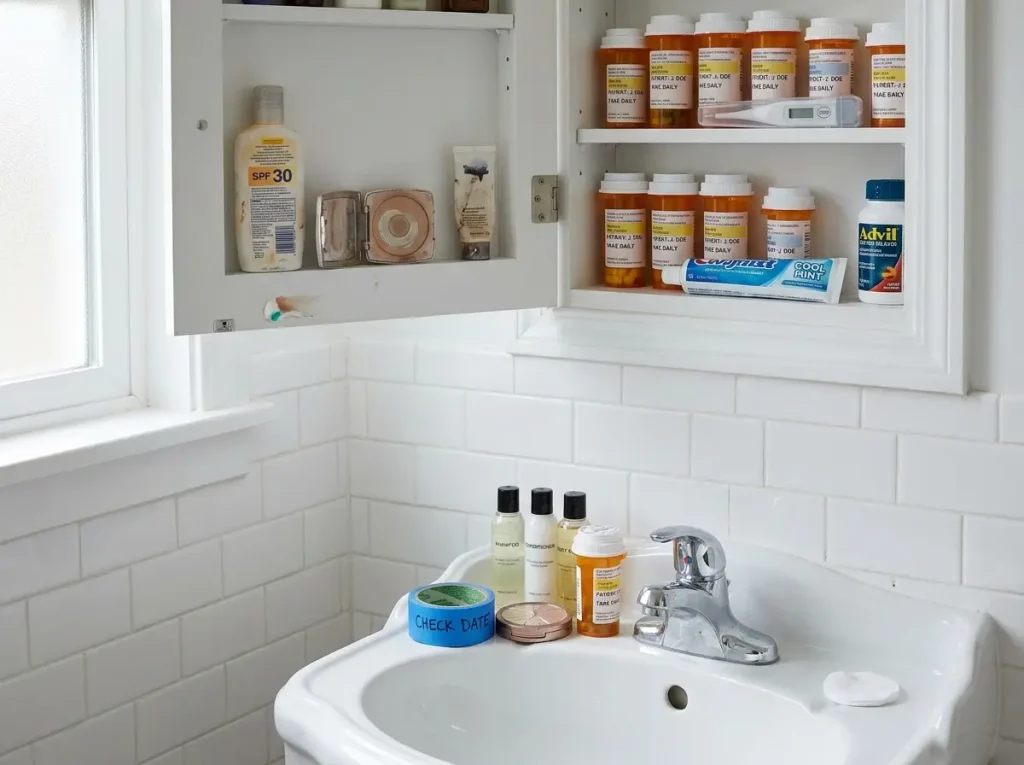
Medicine Cabinet and Medications
The bathroom is the fastest room and the best place to start if you’ve been stuck on getting going. Nobody has ever looked at an expired moisturizer six months later and thought “I should have kept that.”
Medications go first. Check every expiration date. Anything past its date is chemically degraded and goes — but don’t flush them.
Most pharmacies run take-back programs for expired medications. Peel off the label before disposal for privacy.
That bottle of pain reliever from 2023 isn’t doing what you think it’s doing. Replace it with a fresh one.
Beauty Products and Skincare
Most opened beauty products expire 6-12 months after first use. Look for the small open-jar icon on the packaging with “6M” or “12M” printed inside — that’s the manufacturer’s window. If the product has changed in smell, texture, or consistency since you opened it, it’s done regardless of the printed date.
Hotel minis and product samples: if they’ve sat in a basket or drawer for more than three months, you’re not going to use them. Donate unopened hotel toiletries to a local shelter — they’re always needed there.
Pro tip: Pull everything out from behind the front row. Products migrate to the back of cabinets and drawers, and the oldest ones hide behind the newest purchases. You can’t sort what you can’t see.
Linens and Towels
The “guest towel” test: how often do guests actually come? If you have eight guest towels and host twice a year, you’re storing six towels that take up space 363 days a year. Keep what matches your actual hosting frequency plus two spares. Stained, threadbare, or musty-smelling towels become cleaning rags — or most textile recycling programs will take them.
After the bathroom purge, if you need help organizing what stays in a small bathroom, that guide covers storage by zone.
Living Room and Entryway Checklist (Budget 2-3 Hours)

Surfaces, Shelves, and Furniture
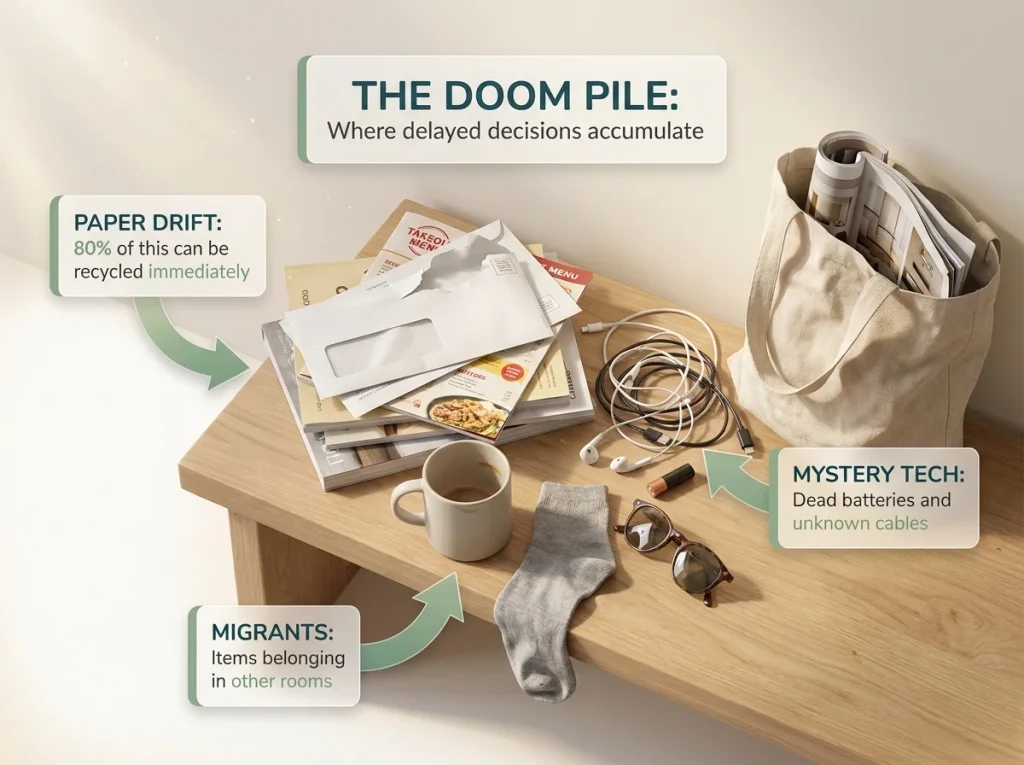
The living room has the sneakiest type of clutter: items that don’t belong here but have lived here so long nobody questions them anymore. Before you sort anything, walk through with a laundry basket and collect everything that belongs in another room. In most living rooms, 30-40% of visible clutter isn’t local — it migrated from bedrooms, kitchens, and home offices.
Pro tip: Before you declutter surfaces, grab a laundry basket. Walk room to room and collect everything that belongs somewhere else. You’ll remove a third of the visible clutter before making a single keep-or-toss decision.
Bookshelves deserve honest editing. Set a number of books you’ll realistically engage with in the next year and keep that many. Donate the rest. Books are among the easiest items to re-acquire if you change your mind — libraries, used bookstores, and digital versions exist for almost everything.
Decorative items: “because I bought it” is not a reason to display something. Empty surfaces are not a problem to solve. They’re breathing room.
Tech and Entertainment
DVDs nobody watches, gaming accessories for consoles you’ve replaced, remote controls for devices that aren’t connected, and the universal drawer of mystery cables. The five-year rule applies to all consumer tech: if you haven’t used it in five years and it’s not a current-generation device, it’s not coming back into rotation.
E-waste has specific disposal requirements. Most Best Buy locations and local e-waste drop-offs accept electronics for free. Don’t put them in regular trash.
The Entryway Catch-All
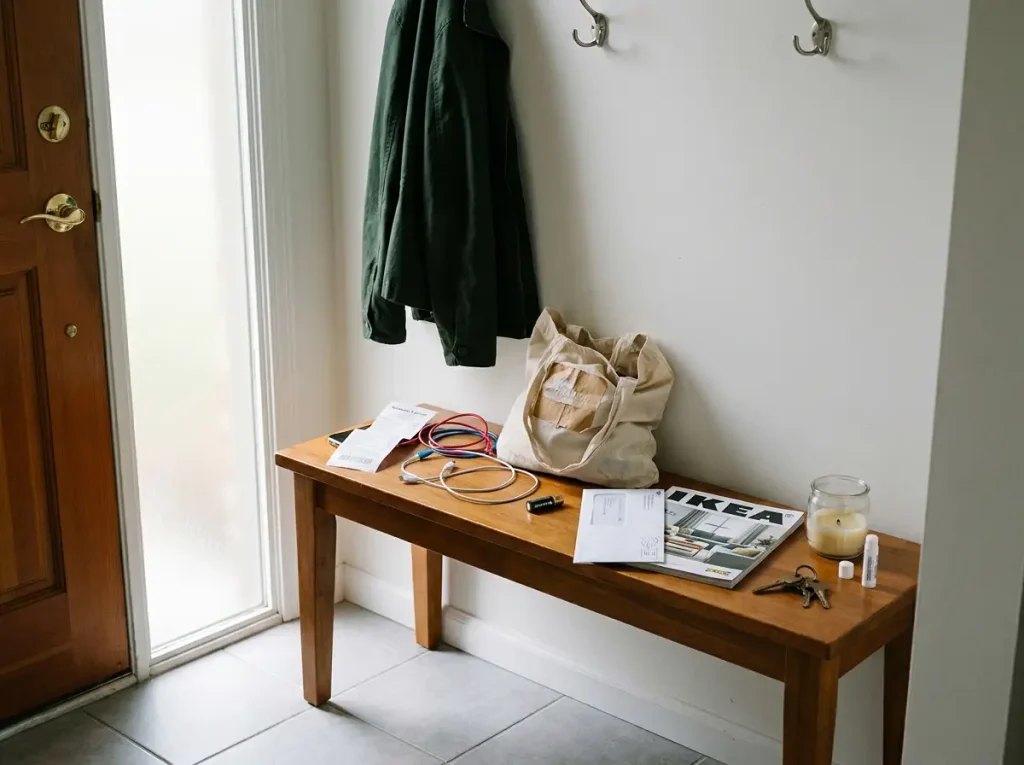
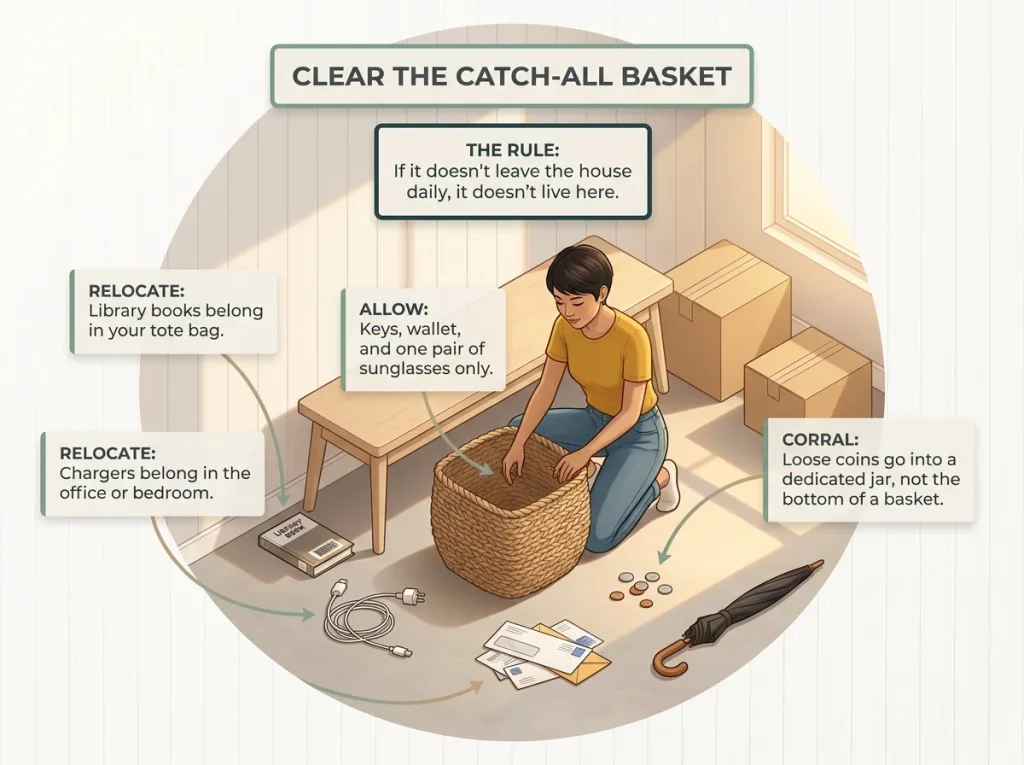
Every home has a landing zone — the bench, basket, hook, or bowl where things get dropped the moment you walk in the door. Over time, that zone expands until the entire entryway becomes a catch-all for things that don’t have a home elsewhere.
Clear it completely. Then re-establish what actually belongs here: keys, one daily-use bag, and shoes in active rotation. Everything else gets relocated to wherever it actually belongs. The landing zone only works if it has strict rules about what lives there.
Home Office Declutter Checklist (Budget 1-3 Hours)
Paper and Documents
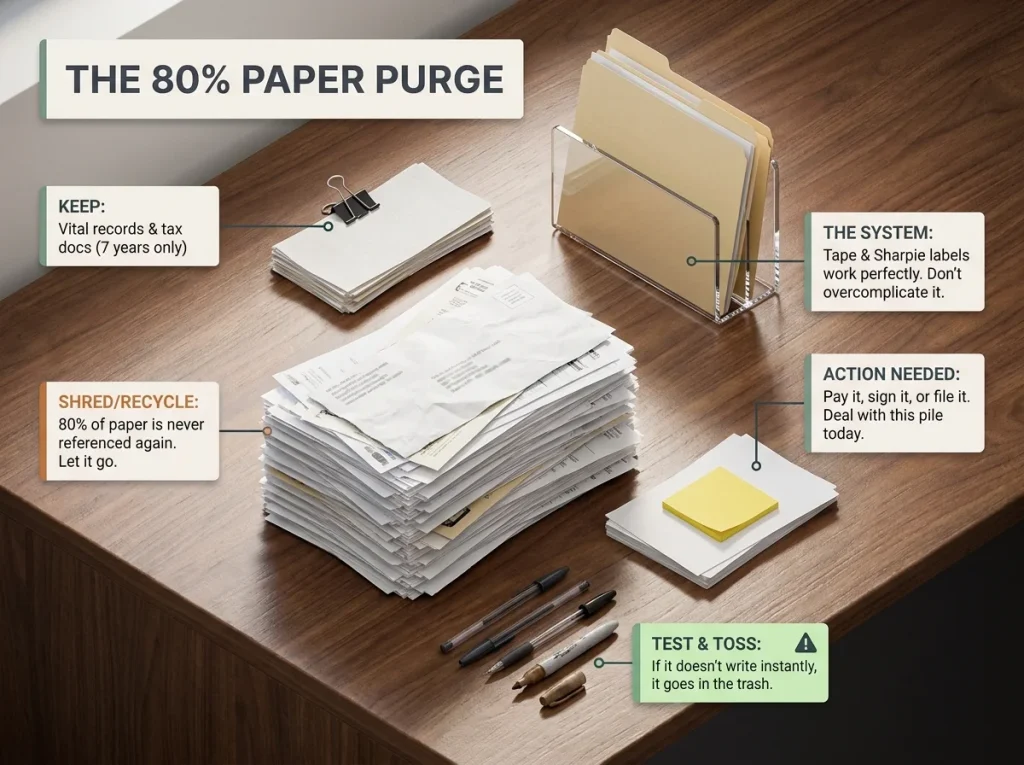
The home office is the “I’ll deal with it later” room, because paper feels important even when it isn’t. Here’s the reality: 80% of paper that gets saved is never referenced again.
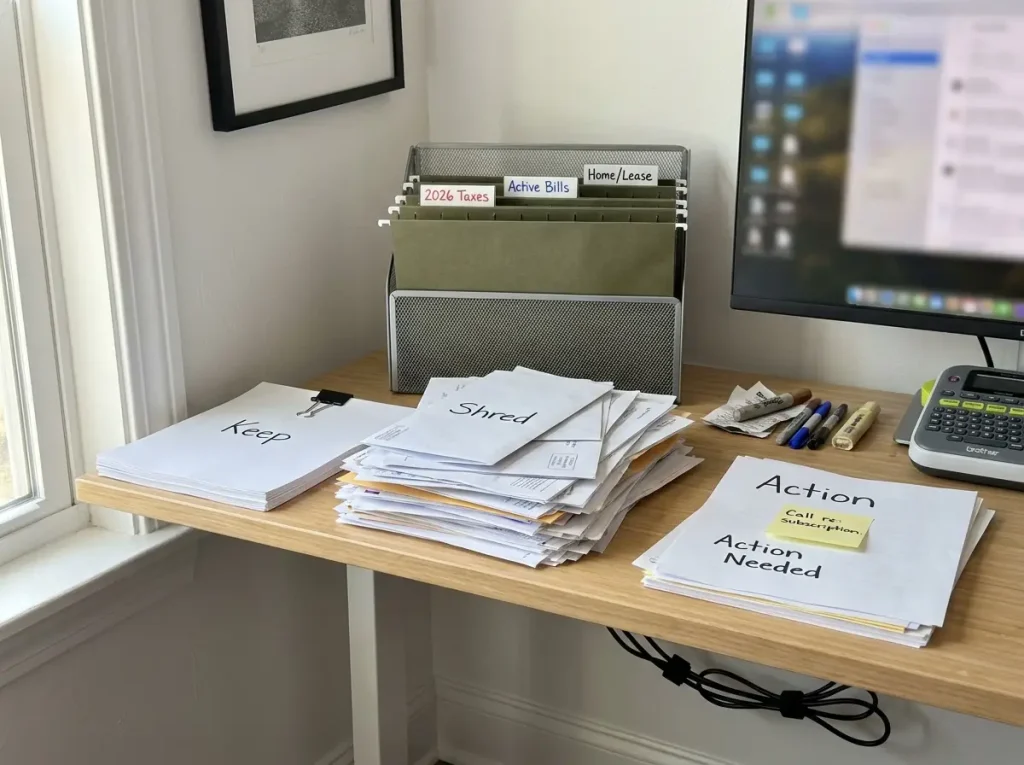
Keep: active contracts and bills, tax documents for the last seven years, and vital records (birth certificates, Social Security cards, property deeds) permanently. Shred or recycle everything else. Old magazines, expired coupons, printed articles you bookmarked by putting them in a pile — all of it goes. If you need the information, it exists online in a more current version than the printout from 2022.
Tech, Cables, and Supplies
Mystery cables are the office equivalent of mismatched container lids. If you don’t know what it connects to, test it or toss it. A box of cables for phones, laptops, and devices you haven’t owned in years is dead weight taking up drawer space.
Test every pen right now. Any pen that doesn’t write immediately goes in the trash. Nobody needs forty-seven pens, and the ones that don’t work just make it harder to find the three that do.
The Desk Surface
After the paper purge, this is the moment to set up a labeling system for what remains. Masking tape and a Sharpie work perfectly for file folders and storage bins — you don’t need to buy anything to get started. If you plan to label containers, drawers, and shelves across multiple rooms and want a cleaner look, the Brother P-Touch PTH110BP is about the size of a stapler, simple to use, and prints durable laminated labels. Either approach works — the point is that “this goes here” gets decided once and stays visible.
Apply the 10-item rule to your desktop: no more than ten items on a working surface. Monitor, keyboard, mouse, lamp, phone, one pen cup, one file tray — that’s already seven. Everything else earns its spot or gets stored in a drawer.
If you want a full system for organizing the desk after decluttering it, that guide covers zones, drawers, and cable management.
The Three-Month Reset — How to Keep This From Reverting

The One-In-One-Out Rule
Every space you just cleared will start to refill. That’s not failure — it’s how households work. Packages arrive, gifts happen, sales tempt.
The simplest countermeasure is the one-in-one-out rule: anything new that enters your home means something existing leaves. Clothes, kitchen gadgets, books, bathroom products — the rule applies to all of them. Exceptions: consumables like food and cleaning supplies.
This doesn’t require willpower. It requires a trigger.
When you unbox a new kitchen tool, immediately identify what it replaces. When a new shirt arrives, one old shirt goes in the donation bag. The decision happens at the point of entry, not during a dedicated session.
The 10-Minute Quarterly Room Scan
Schedule a 10-minute room scan every three months. Put it in your calendar now while the motivation is fresh. Walk through one room, pick up anything that doesn’t belong, apply the four-box sort (keep, donate, trash, relocate), and act on each item immediately. No “decide later” piles — that’s exactly how doom piles start.
The rooms that need the most quarterly attention: kitchen (food expiry and new gadgets accumulate), closet (seasonal turnover brings new items in), bathroom (beauty products multiply quietly), and home office (paper regenerates weekly without a system).
Pro tip: Keep a donation bag in your closet at all times. When it’s full, it leaves the house that day — no waiting for a Saturday session. You’ll never need a full-house purge again if this bag stays active.
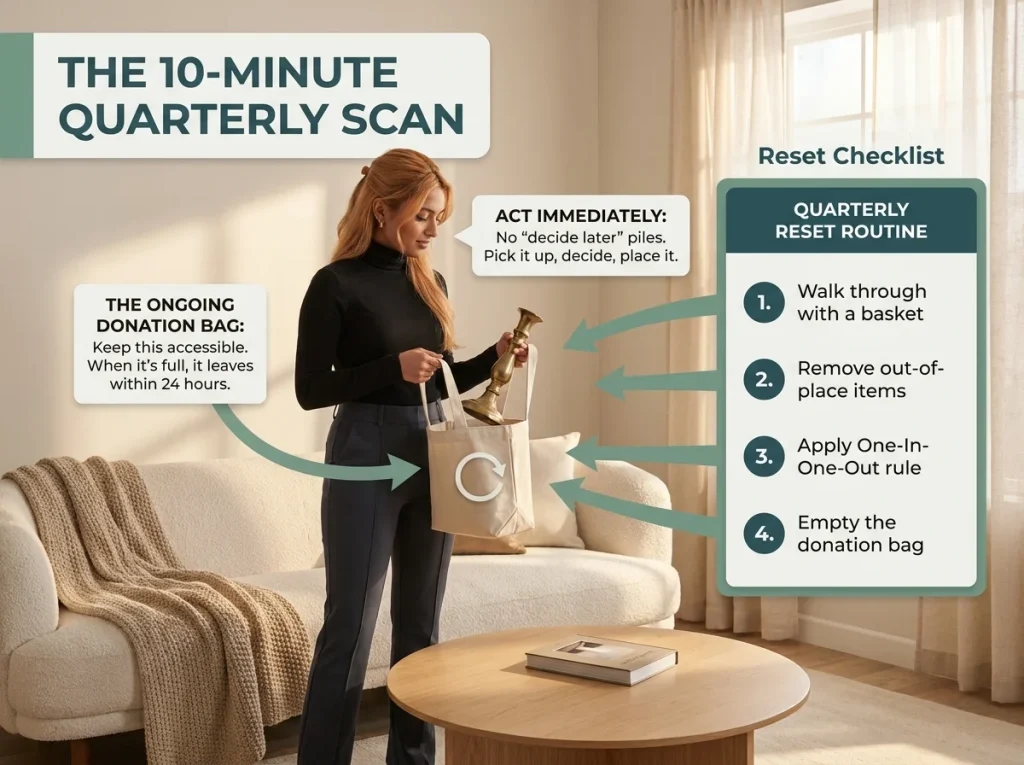
The Ongoing Donation Box
The donation box method isn’t just for the initial session — it’s the maintenance engine that prevents full reversion. Place a labeled box or bag in your closet, under your desk, or in the laundry room. Whenever you pick something up and think “I don’t need this anymore,” it goes straight in.
No second-guessing, no “I’ll decide later.” When the box is full, it leaves the house within 24 hours.
For renters: check that ongoing donation box before move-out. Items that seemed “worth keeping” in your current apartment rarely survive the scrutiny of packing for a new one.
For a broader look at all the decluttering methods that work past the first week — including the four-box method, the one-in-one-out rule, and how to design sessions that don’t burn out your decision-making — that guide covers the full framework.
Conclusion
Three takeaways from this checklist:
- Start with the bathroom. It takes 45-90 minutes, produces visible results for the least effort, and builds momentum for the harder rooms that follow.
- Use one decision test everywhere. Would you buy it today? Have you used it in the last year? If not — why not, and is that reason good enough to keep paying it space in your home?
- A 10-minute quarterly scan prevents the next full-house session. The work you did today is worth protecting. A donation bag in the closet and a calendar reminder in 90 days keep everything from reverting.
Three-month check: Open your donation box. If it’s filling up naturally, the system is working. If it’s empty, walk through one room with the checklist above and ask yourself what crept back in.
Pick one drawer right now. Empty it. Sort it. Return only what passes the test. That single drawer proves this is manageable — and you don’t have to do the whole house today.
Q1 What should I declutter first in my home?
Start with the bathroom — it takes 45 to 90 minutes and produces visible results fast. That momentum makes kitchen and closet sessions feel more achievable. Avoid starting with sentimental items or childhood memorabilia. Those are the last stop, not the first.
Q2 How long does it take to declutter an entire house?
A realistic estimate is 12-20 hours total across multiple sessions. Kitchen and closets take 3-5 hours each, while bathrooms need only 45-90 minutes. Most people finish over two to four weekends rather than one marathon day.
Q3 What is the 20/20 rule in decluttering?
If you can replace an item for under twenty dollars in under twenty minutes, let it go. The rule breaks the just in case hold on things you rarely touch. Most people find that 90% of items released this way are never needed or missed.
Q4 What do I do with items after decluttering?
Donate usable items to Goodwill, Habitat for Humanity ReStore, or local shelters. Sell higher-value pieces on Facebook Marketplace or ThredUp for clothing. Recycle electronics at Best Buy or a local e-waste drop-off. Take expired medications to a pharmacy take-back program.
Q5 How do I declutter when I feel completely overwhelmed?
Pick one drawer, not one room. Remove everything expired or broken and close the drawer. That takes under fifteen minutes and proves the process is manageable. The goal for your first session isn’t to finish — it’s to build the habit of making quick decisions about what stays.