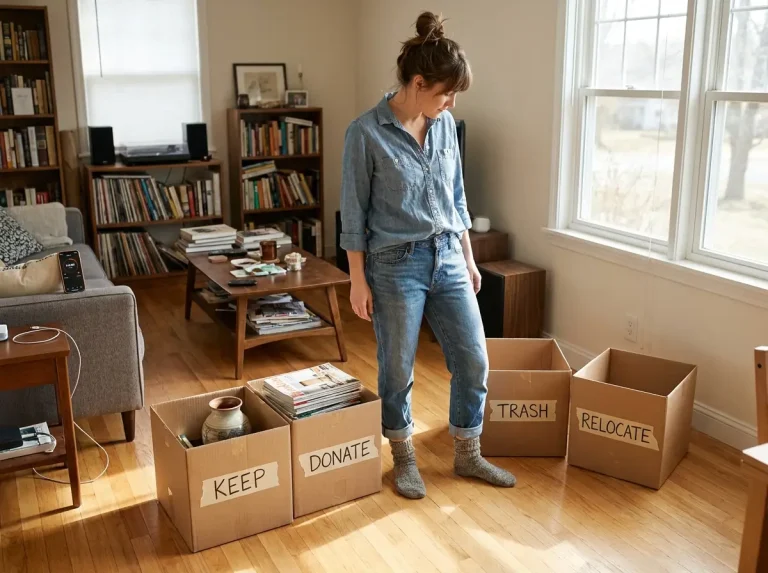

The name scares people off. Swedish death cleaning sounds like something grim, something you do when you’ve given up. I’ve helped people in their 30s use this method to clear out apartments they’d been avoiding for years — and the result wasn’t depressing, it was the first time they could actually breathe in their own space. It’s a practical framework for deciding what stays and what goes, built on one question most decluttering methods ignore. This guide breaks down how the method works, where to start, and why it succeeds where other approaches stall out.
Quick Answer: Swedish death cleaning (döstädning) is a Swedish method of gradually removing belongings so others won’t have to. You start with impersonal items, work toward sentimental ones, and keep a private “throwaway box” for things meant to leave with you. It works at any age — not just end-of-life.
What Döstädning Actually Means (It’s Not What You Think)
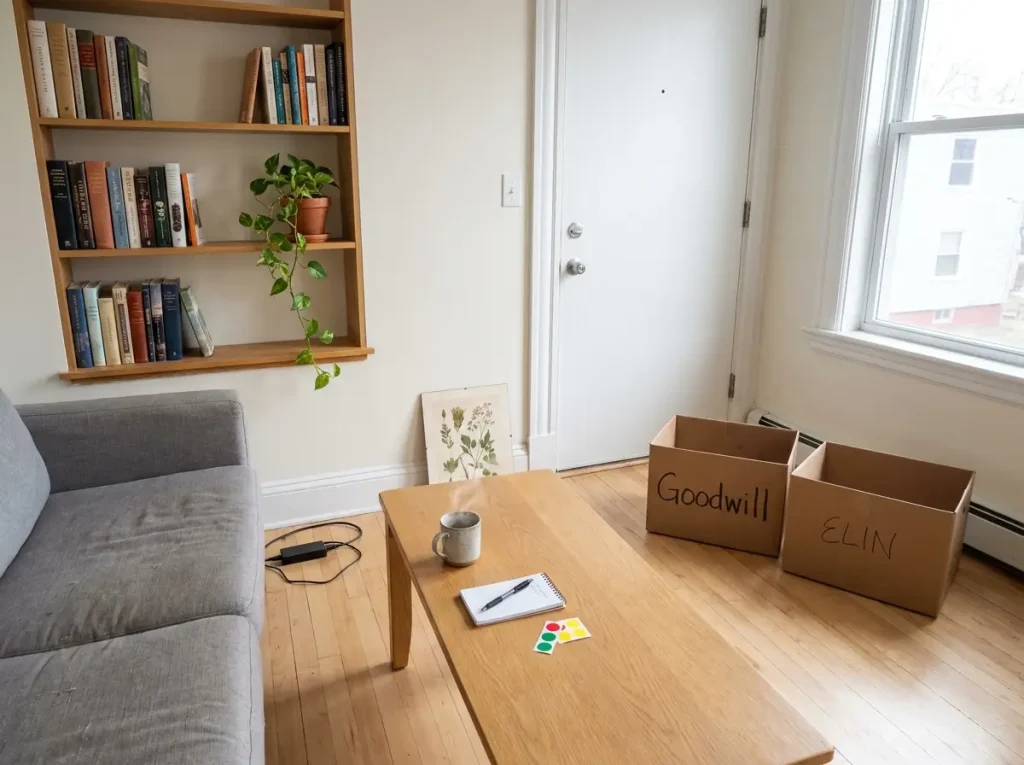
The Scandinavian relationship with mortality
In Sweden, talking about what happens after you’re gone isn’t morbid — it’s practical. Döstädning (roughly “dö” = die, “städning” = cleaning) is a cultural norm where you gradually sort your belongings so your family doesn’t inherit a house full of someone else’s decisions. That sounds heavy, but in practice it looks a lot like what you already want to do: figure out what matters, get rid of what doesn’t, and stop letting stuff sit in piles because you can’t decide.
The difference between döstädning and a standard weekend declutter is the lens. Most decluttering methods that actually stick past the first week ask “Do I want this?” Swedish death cleaning asks a different question — and that shift changes how fast you make decisions.
The question that changes how you see everything
Here’s the core of the method: “Will someone I love have to deal with this when I’m not here?” That’s it. Not “Does this spark joy?” or “Have I used it in the last year?” — those are fine questions, but they keep the focus on you. Magnusson’s question turns it outward.

When you hold up a kitchen gadget and ask whether your daughter would want to sort through it, the answer comes fast. When you look at a closet full of clothes you haven’t worn in three years and ask whether your partner would know what to keep, the answer is even faster. This outward-facing question removes the self-negotiation that slows every other method down.
I’ve watched people spend 20 minutes debating a single sweater when the question was “Do I still love this?” The same person, asked “Would my sister know this sweater matters to me?” made a decision in five seconds. The question isn’t about guilt. It’s about clarity.
Swedish death cleaning at any age — not just 65+
Magnusson wrote her book after 65, but the method isn’t age-locked. If you’re in your 30s and you’ve moved three times dragging boxes you never opened, you’re already living with the problem Swedish death cleaning solves. The stuff you avoid sorting doesn’t get easier to sort over time — the sentimental weight compounds.
People who start this process younger have a real advantage: they haven’t accumulated decades of “maybe I’ll need this.” A 35-year-old sorting a box of college textbooks moves through it in an hour. A 65-year-old sorting the same box plus 30 years of accumulated meaning takes a full afternoon. Start earlier, and the whole process stays lighter.
Pro tip: You don’t need a life event to start Swedish death cleaning. If you’ve moved in the last five years and there are boxes you never unpacked, that’s your signal. Those boxes are making the decision for you — they’ve already told you they don’t belong in your daily life.
Where to Start — The Swedish Sequence

Start where nothing hurts (impersonal items)
The method has a specific order, and it exists for a reason. You start with things that carry no emotional weight: duplicate kitchen tools, expired pantry items, that drawer of random cables, the bathroom cabinet with three half-used bottles of the same thing. These are warm-up decisions. You’re training your sorting muscle on items where the stakes are low.
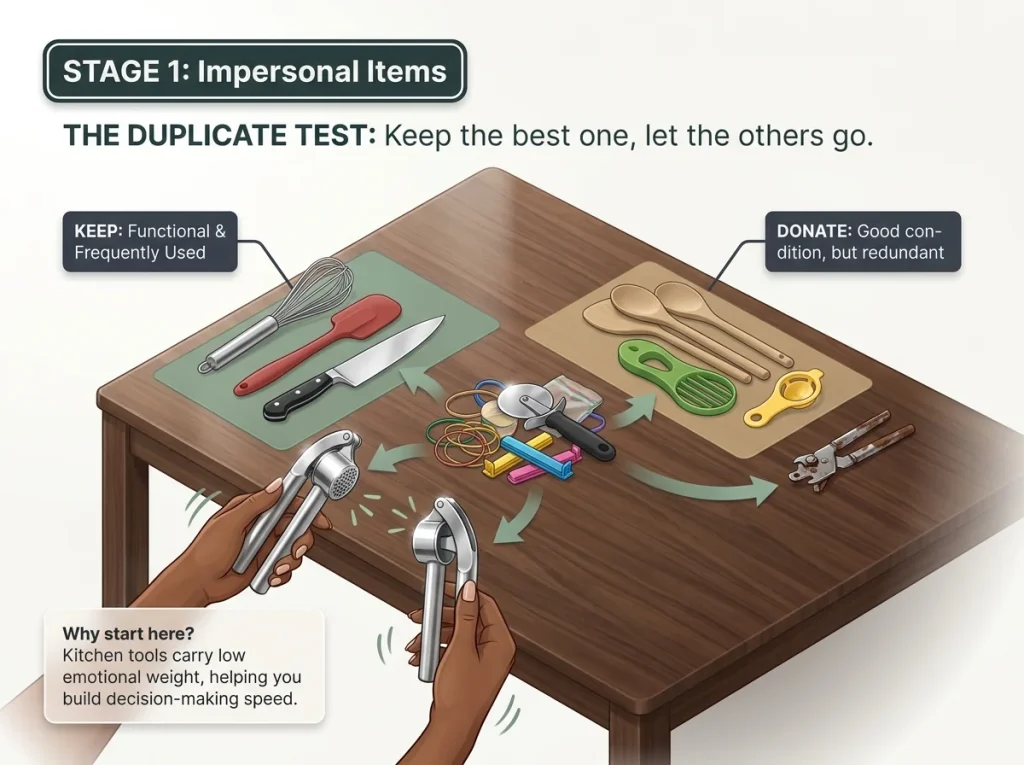
Most people who stall during decluttering started in the wrong place. They opened the memory box before they’d practiced on the junk drawer. The Swedish sequence exists because decision-making is a skill that warms up, and impersonal items are how you build speed without burning out.
I’ve seen the difference firsthand. Someone who starts with the kitchen can clear 50 items in 90 minutes and feel energized. Someone who starts with the hall closet full of family photos makes it through 12 items in two hours and needs a break. Same person, same day — just a different starting point.
The practical middle stage
After impersonal items, you move to functional belongings: clothes, books, furniture, tools. These carry some meaning but not the deep sentimental weight of photos or letters. This is where most of the volume lives, and where the method starts to feel productive.
For clothes, room-by-room decluttering helps if you share your space with someone — work through the bedroom closet together, then the hallway coat storage, then seasonal items separately. The Swedish sequence doesn’t prescribe a room order, just an emotional difficulty order: low stakes to high stakes.
The Gentle Art of Swedish Death Cleaning by Margareta Magnusson lays out the full sequence and the philosophy behind each stage. It’s a short read — you can finish it in an afternoon — and it’s the only place where Magnusson explains the throwaway box, the sorting order, and why she insists you never start with photographs. It reads more like a conversation than a step-by-step manual, so expect philosophy over checklists. If your library has a copy, start there.
Why sentimental items always come last
Sentimental items are the boss level of decluttering. They carry meaning that has nothing to do with function, and every decision triggers a memory. Magnusson puts them last because by the time you reach them, you’ve made hundreds of easier decisions. You’re faster, you’re more confident in your sorting criteria, and you’ve already freed up physical space — which makes the emotional work feel less overwhelming.
There’s a practical reason too. Sentimental items are where people quit entirely if they start there. I’ve watched it happen: someone opens a box of old letters, gets lost in one from 1998, and the whole afternoon disappears. No sorting happened, no space was reclaimed — they just re-experienced the past and put everything back where it was.
The Throwaway Box (and What to Do with Digital Clutter)
What goes in the throwaway box (and why Magnusson insists on it)
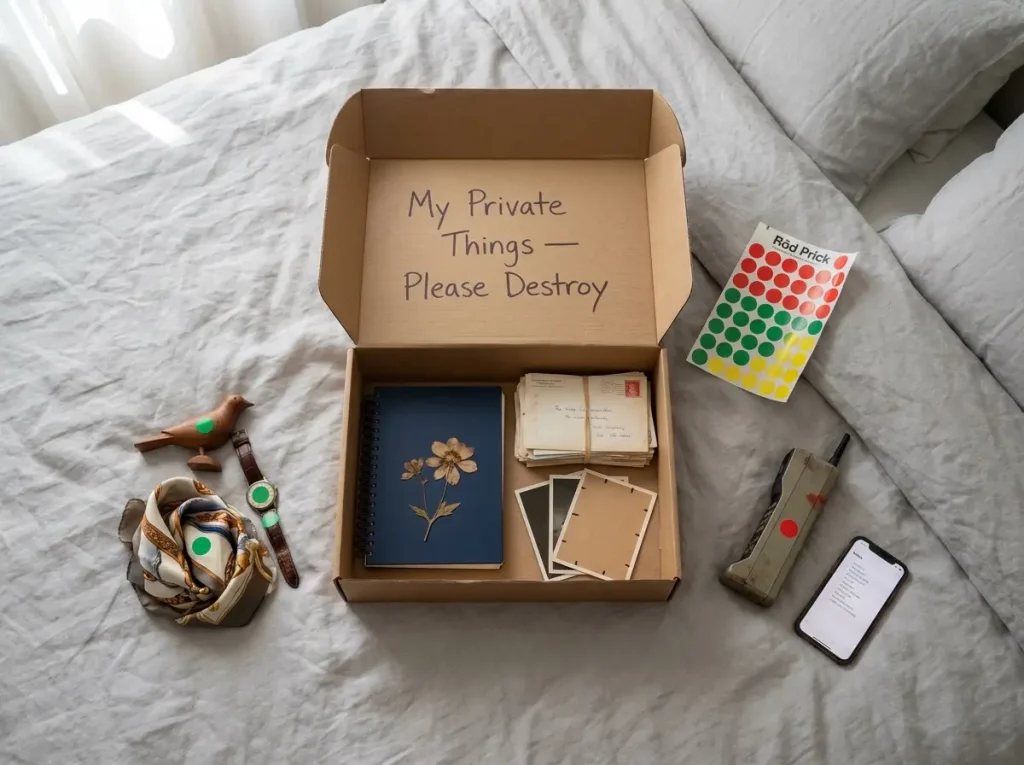
This is the piece of Swedish death cleaning that people either love or find uncomfortable. The throwaway box is a container — any box, any size — where you put things that are private enough that you don’t want anyone else to see them after you’re gone. Old journals. Letters you kept for reasons only you understand. Photos that tell a story nobody else lived. Magnusson’s instruction is simple: label it so someone knows to discard it without opening it.

The throwaway box isn’t about shame. It’s about acknowledging that some things have an audience of one — items where the meaning lives entirely in your experience of them. They don’t need to survive you, and that’s fine.
What surprised me when I first tried this: the box stayed small. Most people expect they’ll fill it with years of accumulated secrets. In practice, it’s a handful of items. The real value of the box is that it gives you permission to keep things that have no practical use and no audience, without needing to explain or justify them.
The red dot system for daily sorting
Magnusson describes a system where you mark items with colored stickers to indicate who should receive them. A red sticker means “dispose of.” A green sticker means “give to [specific person].” This isn’t something you do in a single afternoon — it’s something you do gradually, over weeks or months, as you encounter items in daily life.
The sticker system works because it separates the decision from the action. You can mark a lamp with your niece’s name on a Tuesday morning and not have to box it up, deliver it, or even tell anyone. The sticker is a note to your future self — or to whoever handles your things eventually.
Pro tip: Use the dot system even if you’re in your 30s doing a standard declutter. Placing a colored sticker on something you’re keeping “for someone specific” forces you to name the person. If you can’t name anyone, that’s your answer — the item doesn’t have a destination, and it’s been waiting for one.
Digital death cleaning — the part nobody talks about
Your digital life accumulates faster than your physical one. Photos on three devices, documents across four cloud services, passwords nobody else has, subscriptions billing to a card that will eventually close. Digital döstädning means organizing your digital footprint with the same question: “Would someone else know what to do with this?”
Start with access. Keep a document — encrypted or physically secured — with your password manager login, your primary email credentials, and a list of accounts that matter (financial, social media, cloud storage). A digital estate planning checklist from Death with Dignity covers what most people miss.
Then handle the volume. Your phone probably has thousands of photos you’ll never look at again. Set a recurring 15-minute session once a month to delete screenshots, duplicates, and blurry shots. This isn’t the sentimental photo sort — this is the digital equivalent of clearing the junk drawer. The meaningful photos come later, on their own schedule.
Swedish Death Cleaning vs. KonMari — Which One Is Right for You

The decision question that separates them
Both methods work. Both have millions of people who swear by them. The difference isn’t quality — it’s the question each method asks you to answer.
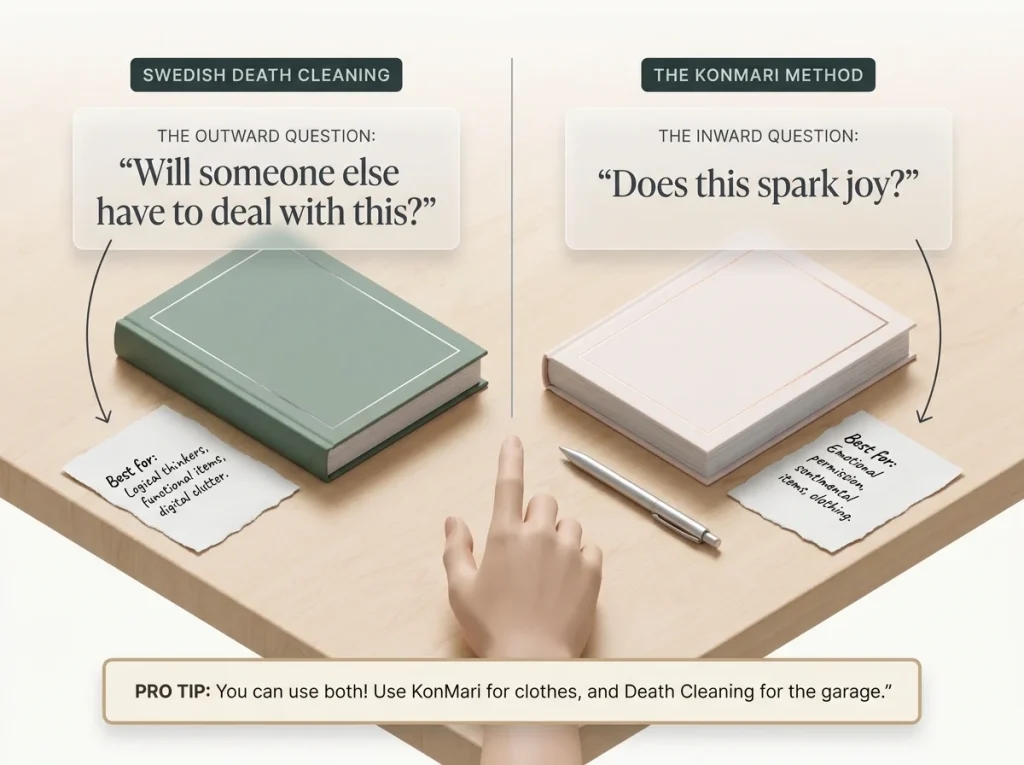
The KonMari method asks: “Does this spark joy?” It’s an inward question — your feelings about the object are the deciding factor. Swedish death cleaning asks: “Will someone else have to deal with this?” It’s an outward question — your impact on others drives the decision. Neither question is better, but they appeal to different personality types.
Who succeeds with each method
KonMari works best for people who need emotional permission to let go. The “spark joy” question gives them a framework to honor their feelings while still making progress. If you tend to keep things because you feel guilty about discarding them, KonMari directly addresses that guilt.
Swedish death cleaning works better for logical thinkers. If “Does this spark joy?” makes you roll your eyes because your toolbox doesn’t spark joy but you still need it, the Swedish approach gives you a more practical filter. The question “Would my family know what to do with this?” doesn’t require emotional introspection — it requires an honest assessment of usefulness.
The National Association of Productivity and Organizing Professionals has noted that matching your organizing method to your decision-making style matters more than which method you pick. A method that fights your natural thinking process won’t survive the first hard decision.
When to use both at the same time
Here’s what nobody tells you: you can run both methods simultaneously. Use KonMari for categories where emotion dominates — clothes, books, sentimental items. Use Swedish death cleaning for categories where function dominates — kitchen tools, documents, garage items, digital accounts.
Pro tip: If you’ve tried KonMari and stalled at the “komono” (miscellaneous) category — which is where most people stall — switch to the Swedish death cleaning question for that category. “Would someone know what to do with this?” cuts through the decision fatigue that “Does this spark joy?” creates when you’re looking at a box of cables.
This hybrid approach isn’t a compromise. It’s using the right tool for the right category. A single-method-fits-all mindset is why most people don’t finish.
Why People Stall (and How to Keep the Process Alive)

The sentimental items wall — and how to get through it
Almost everyone hits the same wall: printed photographs. Not because photos matter more than anything else you own, but because every single one triggers a story. You can sort kitchen gadgets at a pace of 30 per hour. Photos slow you to 10 per hour — sometimes less — because you can’t sort memories at the same speed as objects.

Set a timer. Two hours per session for sentimental items, maximum. When the timer goes off, you stop — even if the box isn’t done. This isn’t about willpower. It’s about recognizing that emotional decision-making is a finite resource, and you’ll make worse decisions after two hours of it.
The other thing that helps: sort photos by person, not by event. A pile of “vacations” forces you to relive each trip. A pile of “photos with Mom” lets you select the best five and let the rest go. The category frame changes the emotional weight of every decision in the stack.
SDC as a practice, not a project
Swedish death cleaning isn’t a weekend event. Magnusson describes it as something you do gradually, woven into daily life. You notice the drawer that sticks because it’s overfull, and you spend 15 minutes sorting it. You open a closet to grab a jacket and notice three you haven’t worn in two years, and you pull them out.
This is the opposite of the “declutter blitz” mentality. Blitz decluttering creates dramatic results that revert in three months because the system was never designed for maintenance. Swedish death cleaning builds the maintenance into the process — you’re constantly making small decisions, so the big sort never arrives.
The key is regularity, not intensity. Fifteen minutes every few days does more than an eight-hour marathon once a season. After six months of small decisions, your spaces stay cleaner because you’ve been editing as you go — not because you had one heroic Saturday.
One-in-one-out and the re-accumulation trap
You’ve cleared space. Your closets breathe. Your kitchen drawers close without force. Now comes the part that derails most decluttering efforts: re-accumulation.
The one-in-one-out rule is the simplest maintenance system, and it works because it requires no planning. Every time something new enters your home, one thing of similar type leaves. Buy a new sweater, donate an old one. Get a new kitchen gadget, let go of the one it replaces.
Where people fail with this rule: they treat it as a guideline instead of a boundary. “I’ll deal with the old one later” means you never will. The Swedish approach strengthens one-in-one-out because every new item that enters your home is something someone else might have to sort eventually. That thought alone slows down unnecessary purchases.
Conclusion
Swedish death cleaning works because it asks a question that cuts through the usual decluttering hesitation. Three things to remember:
- Start with the impersonal stuff. Kitchen duplicates, expired products, cable drawers. Build your decision-making speed before touching anything that carries meaning.
- The throwaway box is permission, not shame. Some things have an audience of one. A labeled box gives them a place without requiring explanation.
- Match the method to your brain. If the outward-facing question resonates, use it everywhere. If it works better for functional items but you need KonMari for emotional ones, combine them.
Three-month check: Revisit your throwaway box and your sticker assignments after 90 days. If the box has grown significantly, you might be using it as a “decide later” container — which defeats the purpose. If your sticker assignments still make sense, the system is working.
Start with one drawer. Not the sentimental one — the easy one. Sort it using the Swedish death cleaning question: “Would someone else know what to do with everything in here?” If the answer makes you uncomfortable, you’ve found your starting point.
Q1 What is the difference between Swedish death cleaning and KonMari?
Swedish death cleaning asks Will someone else have to deal with this? while KonMari asks Does this spark joy? — one is outward-facing and practical, the other is inward-facing and emotional. Both work, but they suit different decision-making styles and can be combined for different item categories.
Q2 What age should you start Swedish death cleaning?
You can start Swedish death cleaning at any age — the method works whenever you have more belongings than you actively use. Magnusson wrote about it after 65, but people in their 30s and 40s benefit from the same framework, especially after moves or major life transitions.
Q3 How long does Swedish death cleaning take?
Swedish death cleaning has no fixed timeline because it’s designed as a gradual practice, not a weekend project. Most people see significant results within three to six months of regular 15-minute sorting sessions woven into daily routines.
Q4 What do you do with items you don’t want during Swedish death cleaning?
Sort unwanted items into three groups: donate to a specific charity, give to a named person using the colored sticker system, or dispose of responsibly. The key is assigning each item a destination immediately — putting it in a deal with later pile creates the same problem you started with.
Disclaimer: ClutterlessNest is a participant in the Amazon Services LLC Associates Program. As an Amazon Associate we earn from qualifying purchases. This article may contain affiliate links — if you buy through them, we may earn a small commission at no extra cost to you. We only recommend products we have tested or genuinely believe in.