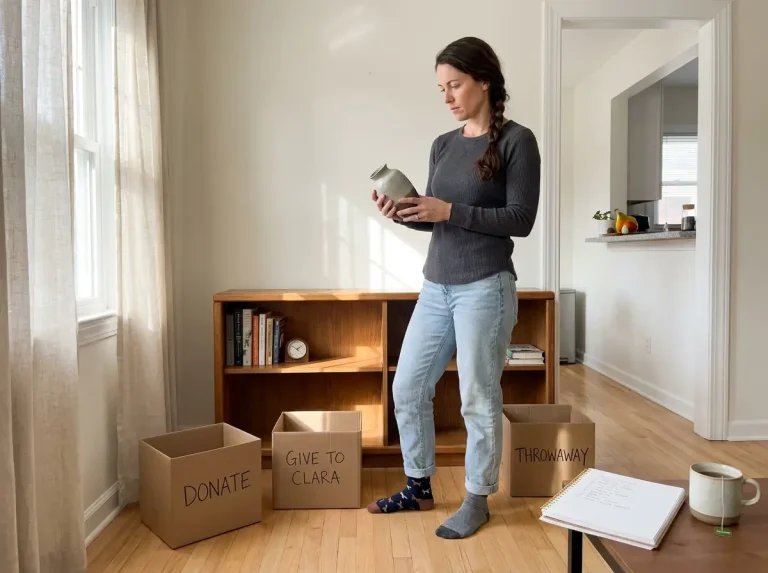

You’ve already done the hard parts — the kitchen, two closets, the junk drawer, the bathroom cabinet with three half-empty bottles of the same lotion. By now you’re good at this. Then you pull the box down from your mom’s old house, sit on the floor to open it, and forty minutes later you’re still holding the same birthday card, having made exactly zero decisions. I’ve watched this happen to people who are ruthless about everything else they own. Sentimental items are a different category, and they need a different approach — not more willpower, but a framework built for each type of thing in the box.
Quick Answer
Decluttering sentimental items is less about willpower and more about having a system for each type:
- Start with the easiest category, not the most emotional one.
- Decide your space limit before you open a single box.
- Set a 15-minute timer to prevent decision fatigue.
- Photograph items first, then release the physical copy.
- Keep what you love, not what guilt demands.
- Donate to places where the items get used again.
Why Sentimental Items Break Every Decluttering Rule You’ve Learned
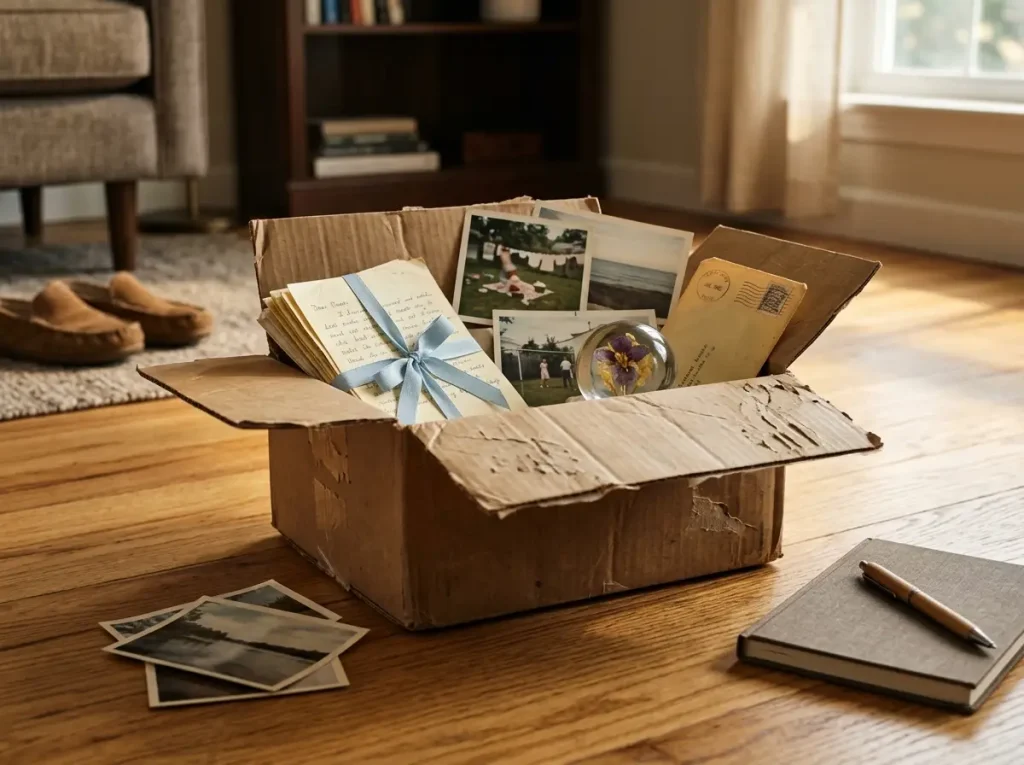
Every decluttering method you’ve ever tried assumes the same thing: that your decisions are basically practical. The four-box method, the one-in-one-out rule, the “does it spark joy” test — they all work because most of the stuff in your house is just stuff. You can look at a spatula and decide.
Sentimental items break that assumption completely, because the decision isn’t really about the object. It’s about identity, memory, and grief, which is why the usual tools stall out the second you reach the keepsake box.
Here’s the part nobody explains. When you feel like throwing out an old photo album means losing the memory itself, that feeling isn’t drama or weakness. It’s a real psychological mechanism called object-memory conflation — your brain links the memory to the physical thing, so releasing the thing genuinely feels like erasing the moment.
Researchers who study why we get attached to belongings describe objects functioning as tangible anchors to our own history and identity. Once you understand that the guilt has a mechanism, it stops feeling like a character flaw and starts feeling like something you can actually work around.
This is also why sentimental clutter is heavier than regular clutter. Professional organizers treat it as a separate kind of work — emotional, not logistical. One detail that surprises people: you can grieve for someone who’s still alive but no longer in your life. Items from a past relationship, an estranged parent, or an earlier version of yourself carry that same weight as items from someone you’ve actually lost.
The certified professional organizers who describe sentimental clutter as emotional work aren’t being soft about it. They’re naming why the standard “keep or donate” logic falls apart here.
Your guilt is real — but it’s misdirected
The guilt isn’t actually about the item. It’s about a fear of losing the person, the moment, or the version of you that the item stands in for. That’s a much bigger thing than a coffee mug, which is exactly why a coffee mug can freeze you for twenty minutes. Once you can see what the guilt is really protecting, the object itself gets lighter to hold.
So here’s the reframe that does the most work: your memories are stored in your neural pathways, not in your possessions. The photo of the birthday cake doesn’t contain the birthday. Your brain does.
Releasing the object doesn’t touch the memory at all — you will remember the person, the trip, the wedding, the kid’s first day of school, whether or not you keep the matching ticket stub. That sentence sounds simple. It changes how the whole box feels.
Why “does it spark joy?” isn’t enough here
Marie Kondo puts sentimental items dead last in her system — after clothes, books, papers, and miscellaneous everything-else — and she does it on purpose. The idea is that you build a decision muscle on easy stuff first, because the spark-joy test isn’t strong enough to carry the hardest category cold. Even inside KonMari, sentimental keepsakes get treated as their own separate, harder tier. There’s a reason it’s one of the hardest categories in any decluttering method.
The spark-joy question works great for a wooden spatula or a pair of jeans. It breaks down the moment every single item in the box sparks joy and guilt and grief all at once. What do you do with a thing that makes you happy and sad and anxious in the same three seconds?
Swap the question. Instead of “does this spark joy,” ask “who is this for?” Are you keeping it because it genuinely makes your present life better, or because letting it go feels like a betrayal? Those are different reasons, and they have different answers.
Permission is often the thing people are waiting for
Organizers report something quietly powerful: clients describe getting “permission to say goodbye” as feeling like a gift. A huge number of people who are stuck on sentimental items aren’t actually undecided. They’re waiting for someone to tell them it’s okay.
So here it is. It’s okay. The person who gave you that item did not hand you an obligation to store it forever. The gift, the heirloom, the card — it did its job when it was given and received.
Letting it go now isn’t a moral failure, and it isn’t disrespect. You’re allowed to keep the memory and release the object. They were never the same thing.
Do This Before You Open a Single Box
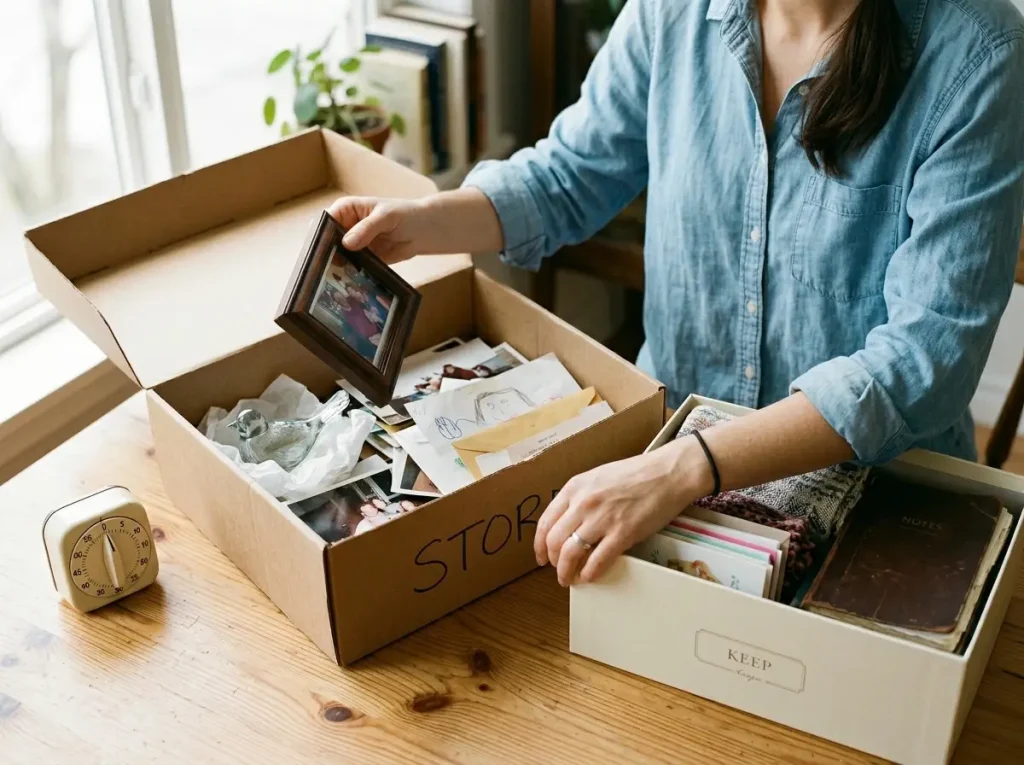
The most useful piece of advice I’ve ever heard about sentimental decluttering is also the most counterintuitive: you don’t sort first and then decide how much to keep. You decide how much you’re willing to keep, and then you sort. One organizer frames it as deciding how much space you’ll give your keepsakes before a single lid comes off.
The physical limit — one box, one shelf, one drawer — is what turns “keep everything just in case” into actual choices. Without it, you’re grocery shopping without a budget. You come home with all of it.
This is the fix for the most common failure in the whole category: the sealed-box pattern. You know the one. Everything gets “resolved” by being boxed up for later, moved to the attic, and then later never comes.
I carried a banker’s box of my own through three apartments over about six years and opened it exactly once — by accident, digging for a phone charger. That’s not storage. That’s a doom box with a deadline you keep extending. The constraint you set up front is what stops the box from becoming a permanent piece of furniture.
The one-box rule (and what to do when it’s full)
Pick one physical container per category: one box for kids’ artwork, one for inherited family items, one for relationship mementos. That’s it. When the box is full, you don’t get a second box — you go back through the first one and decide what stays.
The container isn’t a destination, it’s a fence. The fence is what forces the real decision instead of letting you defer it indefinitely.
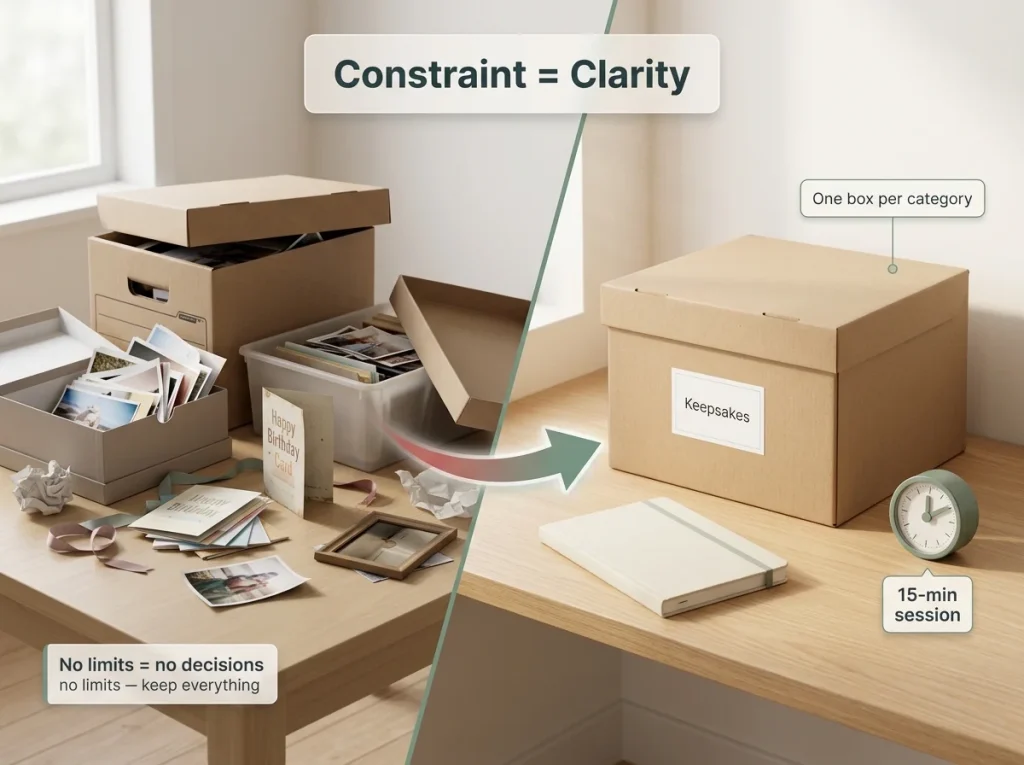
On sizing: a standard banker’s box runs about 15 by 12 by 10 inches, and it holds more than you’d think — a stack of photo albums, a few hundred loose prints, or a genuinely meaningful collection of small keepsakes. For most people, one box per category is enough room to keep what matters without keeping everything.
If your category is so big it can’t possibly fit one box, that’s not a sign you need more boxes. That’s the signal that this category needs the most work, and it’s usually the kids’ art.
How long to go and when to stop
Set a timer for 15 to 20 minutes before you start, and when it goes off, close the box and walk away — even mid-pile, even if you’re not done. This is the exact technique professional organizers use with clients, and it’s not about being delicate. It’s about avoiding decision fatigue.
Push past twenty minutes on emotional sorting and you stop making good calls; you start defaulting to “keep it” on everything just to make the discomfort stop. It’s the same exhaustion that stalls a whole-home declutter, and the fix is identical — our guide on the decision fatigue that freezes people mid-declutter breaks down why short sessions beat marathons.
Four fifteen-minute sessions beat one three-hour marathon every time. The marathon ends one way: exhausted, overwhelmed, and shoving everything back in the box to deal with “later.” Schedule the next session before you leave the room so it actually happens.
Before your first session, photograph the whole open box top-down in one shot. If you get interrupted — and with this category you will — that photo lets you pick up exactly where you left off instead of re-deciding things you already sorted. It also quietly shows you the volume you’re actually dealing with, which is its own motivation.
The waiting period for inherited items
If you’ve recently lost someone and inherited their belongings, wait at least three months before deciding to release anything. Grief distorts how important objects feel, in both directions — some things feel impossible to part with now that won’t in six months, and occasionally you’ll want to purge in a way you’d regret later. The acute phase is not when you make permanent calls.
During that waiting period, keep everything together in one labeled container instead of scattering it across rooms. Scattered items can’t be reviewed as a group, and they have a way of becoming permanent fixtures wherever they land. One box, one label, one decision point a few months out. That’s the whole setup.
Children’s Artwork — the Highest-Volume Sentimental Category
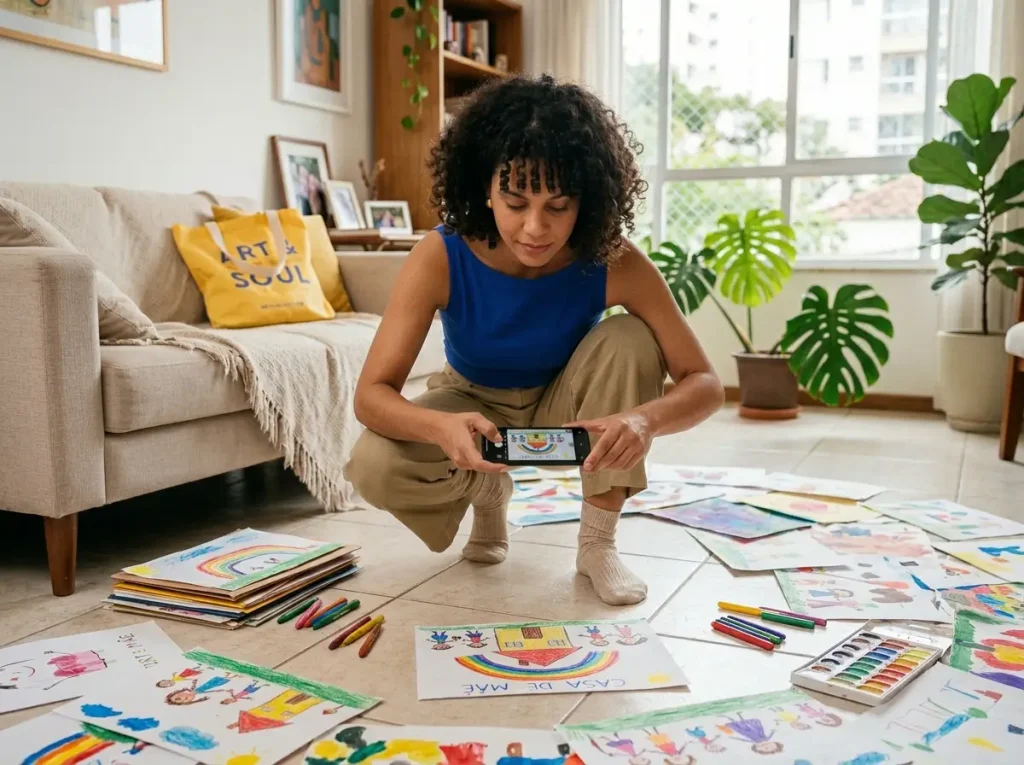
Every parent knows the specific guilt of putting a kid’s drawing in the recycling. What most parents have never done is the math — and once you see the math, keeping a small handful per year stops feeling ruthless and starts feeling obvious. This is the single highest-volume sentimental category there is, and it’s the one that most reliably produces the “I can declutter anything except my kids’ art, there’s just so much of it” wall.
A child produces somewhere between 5 and 10 pieces a week during a school year. Across a 38-week year, that’s roughly 190 to 380 pieces. Keep all of it from kindergarten through senior year and you’re looking at somewhere north of 2,500 pieces of paper for one child.
That’s not a keepsake collection. That’s a storage problem the size of a small bedroom, and it’s the textbook version of sentimental hoarding — emotional attachment quietly overriding any practical judgment about volume.
The math no one does for you
Keep one piece per school day across thirteen years and you end up with about 4,700 pieces of paper. Say that number out loud. The reframe that makes this manageable is to stop thinking of it as throwing things away and start thinking of it as choosing what to keep.
You’re not deciding what to discard. You’re deciding which five or ten pieces a year actually tell the story.
A well-chosen set of five pieces per year — about 65 pieces across K through 12 — tells the complete arc of a child’s development, from the first scribble to a real drawing with perspective. Everything else is variation on a theme. Thirty rainbows is not thirty memories. It’s one memory, photographed thirty times.
This is the same logic behind why KonMari saves sentimental items for last: you need the editing instinct built up before you can look at a pile of beloved drawings and keep only the ones that matter.
What to keep and what the criteria actually are
Keep the technique milestones. The first drawing where a person has arms instead of legs sprouting from a head. The first time letters actually form a name. The first attempt at shading or perspective or a horizon line.
Those are developmental markers, and they’re genuinely interesting to look back on. A hundred similar drawings from the same month are not.
Beyond milestones, keep anything the child is honestly proud of — and here’s the trick, ask them. Kids are usually far less attached than their parents are. “If you painted thirty sunsets, pick your favorite one to keep” is a sentence a five-year-old can handle better than most adults.
And keep one piece per year that’s just very them: not the best one technically, but the one that captures their personality at that age. That’s the piece you’ll actually want when they’re twenty.
The digitize-then-decide system
Before you touch the physical pile to sort it, spend twenty minutes photographing everything — one shot per piece, flat on the floor, decent natural light. Now you have a complete digital record of the entire year’s output, which makes releasing the physical copies dramatically easier. It’s a different feeling to recycle a drawing when you know the image is safe on your phone.
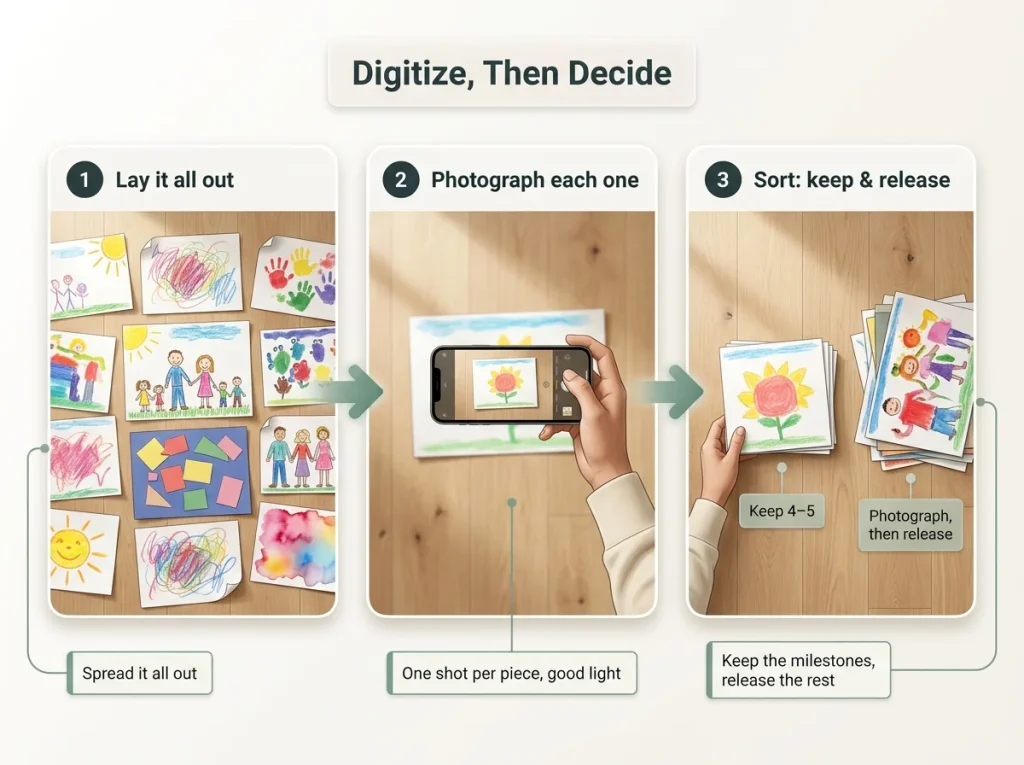
I used to tell people to scan every single piece on a flatbed for archival quality. After watching exactly how many parents bought a scanner, used it twice, and let it become its own clutter, I changed the advice. For 80% of children’s artwork, your phone camera in good light is genuinely enough — those images are for screens and sharing, not museum walls.
Save the real scanner for the irreplaceable stuff: a one-of-a-kind watercolor, an old photograph you can’t reprint, a letter in someone’s handwriting. For those, the Epson Perfection V600 is the standard home pick because it handles flat documents, film negatives, and slides without needing professional lighting, and it sits on a normal desk. Just be honest with yourself about whether you’ll use it, because a scanner you don’t use is the most expensive way to feel organized.
Set up a free private shared album in Google Photos for the digitized artwork and add the grandparents to it. They get to see everything the kids make, you stop feeling pressure to keep physical copies “for them,” and nobody’s printing duplicates for four relatives. It also gives the art a second audience, which is honestly the thing most of it was made for.
Inherited Items and Family Heirlooms — the Obligation Category
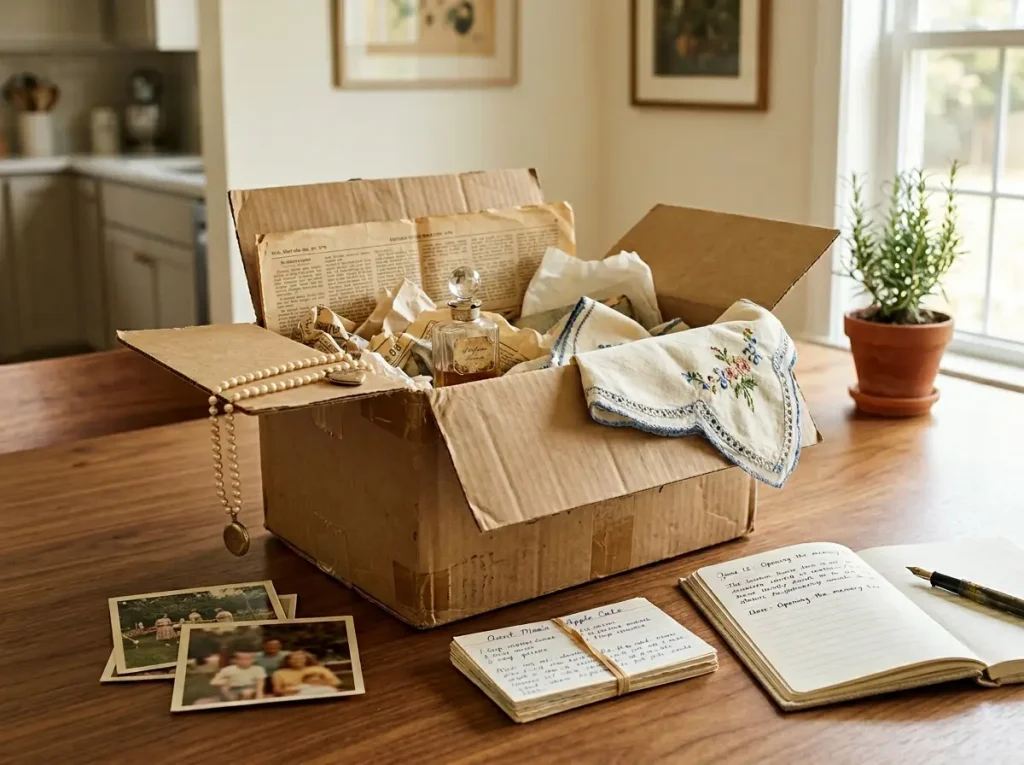
Inherited items carry a doubled weight, and naming that weight is half the battle. These weren’t just your things — they were someone else’s sentimental items first, which means you inherited the object and a quiet sense that you’re now responsible for treating it the way they did. That second part is the trap. You can keep what’s actually meaningful to you and let go of the rest, and doing so is not a betrayal of the person who left it.
Start with the key distinction: you inherited the item, not a lifelong contract to store it. The person who left it to you would almost certainly rather you use and enjoy what they had than box it away where neither of you ever sees it. A useful test for the dishes-from-grandma situation — the ones you never use and can’t fit in your cabinet — is to ask honestly who the keeping is serving. If the answer is “her memory,” try keeping one piece you’ll actually use, and let the rest go to someone who’ll set their table with them.
The video below shows a professional organizer walking a real client through exactly this kind of decision, and it does something text can’t — it shows the pauses, the second-guessing, the actual emotional pace of the work.
The inheritance doesn’t include the obligation
When you inherited a box of someone’s belongings, you inherited what was in the box. You did not sign a contract to store it for the rest of your life. That distinction sounds almost too simple, but it’s the thing most people never give themselves permission to believe.
Here’s a reframe that tends to land. If the roles were reversed, would you want your own kids spending thirty years feeling guilty about a box in their attic they’re afraid to open? Almost nobody says yes.
The people who loved us didn’t leave us their things hoping the things would become a burden. The items that belonged to people you loved are still yours to decide about — you’re allowed to choose what you keep, and that choice honors them more than guilt-storage ever could.
Items from people who have passed — the waiting room
The first three months after losing someone are not the time to make permanent decisions about their belongings. Put everything together in one labeled container and leave it there. Don’t scatter it through the house where each item ambushes you separately. This is a waiting room, not a decision point.
When the waiting period is up, come back to the box with one specific question for each item: does keeping this make my daily life better, or does it just feel wrong to release it? Those are genuinely different reasons with different answers, and only one of them earns shelf space. Then choose a few things you can actually live with — a piece of jewelry you’ll wear, a mug you’ll drink from, a cookbook you’ll cook out of.
This is where the Swedish approach to sorting a lifetime of possessions is useful, because it’s built around exactly this question of what’s worth passing on versus what’s just being stored. The pieces that stay deserve to be used, not archived in a dark box for another generation to inherit unopened.
Items from difficult relationships
Not every inherited or kept item comes from a relationship you want to memorialize. You are not obligated to maintain a shrine to pain. Items tied to a relationship that hurt you — a person, or a version of your life you’ve moved past — do not need to be preserved out of some sense of fairness to the past. Grief shows up here too, even when the relationship was hard, and that’s normal.
When the feelings are genuinely mixed — the relationship was complicated, not all bad — the “one representative item” approach works better than all-or-nothing. Keep a single photo instead of a whole box. Keep the one thing that holds the best of what was good and lets you set down the rest.
You don’t have to choose between keeping everything and erasing a chapter of your life. One item is allowed to stand in for a complicated story.
Gifts from Living People and Items from Past Relationships
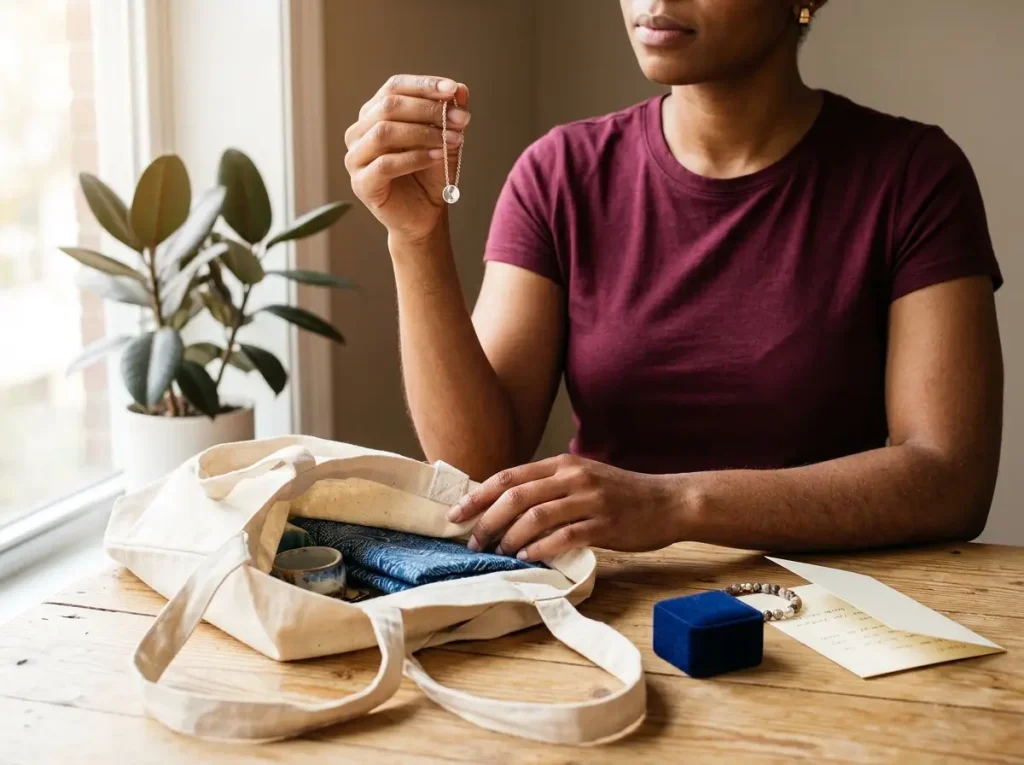
These two categories share the same guilt engine running on slightly different fuel. Gifts trigger the fear of hurting a living person’s feelings; relationship items trigger the fear of erasing a former version of yourself. Both dissolve under the same insight, which is that the object is not the relationship.
The card is not your aunt. The concert shirt is not who you were at 23.
This is also where obligation clutter lives most densely — the stuff kept purely because of perceived social rules nobody actually enforces. The decorative thing you don’t like but display because the giver visits. The gift you’ve never used but feel watched by. Naming it as obligation clutter, rather than as a beloved keepsake, is what lets you finally deal with it.
The gift obligation myth
The social transaction of a gift is complete the moment you receive it graciously. There is no fine print requiring permanent storage. The giver gave you a gift, not a storage assignment. If you haven’t used a gift in a year, you’ve already made the decision in practice — you just haven’t acted on it yet.
The honest test: if the giver asked “are you enjoying the thing I gave you?”, could you say yes and mean it? If the answer is no, the item isn’t serving either of you, and passing it to someone who’ll genuinely use it is the more generous outcome for the gift itself.
For gifts from people still in your life, you also don’t owe anyone a report. You don’t have to announce the donation. You just quietly let it move on to someone who wants it. This is the same principle our room-by-room guide points to when it covers what to do with the sentimental items you find in each room — the obligation is almost always one you assigned yourself.
The conventional advice is to donate any unwanted gift guilt-free and move on. And that works — unless the giver is someone you see every week and will notice the thing is gone. In that case, rotating it into a drawer before visits and displaying what you actually love is a fair middle path, or you have the honest, kind conversation. Either one beats quietly resenting an object on your shelf for a decade.
Items from past relationships — identity vs. memory
The discomfort of releasing something from a past relationship is usually about the version of yourself embedded in the object, not the other person. You’re not keeping the item so much as keeping proof that a certain you existed — the one who wore that band shirt, took that trip, lived in that apartment. But that version of you was real whether or not you keep the physical evidence. You don’t need a receipt for your own life.
Ask the direct question: if I released this, would I lose the memory? Almost every time, the answer is no. The memory predates the item and will outlive it. What’s worth keeping from a chapter like that is the one thing you genuinely love and would actually use or look at — one item per significant relationship or era is nearly always plenty. The rest is storage masquerading as loyalty.
The victory lap — one final use before releasing
For the items you’re attached to but know you should release, there’s a method that prevents the “but I never even got to use it” regret. Courtney Carver of Be More with Less calls it giving the item a kind of final, intentional send-off, and it works because it creates a real ending instead of an abrupt one. Use the thing one more time on purpose, then let it go.
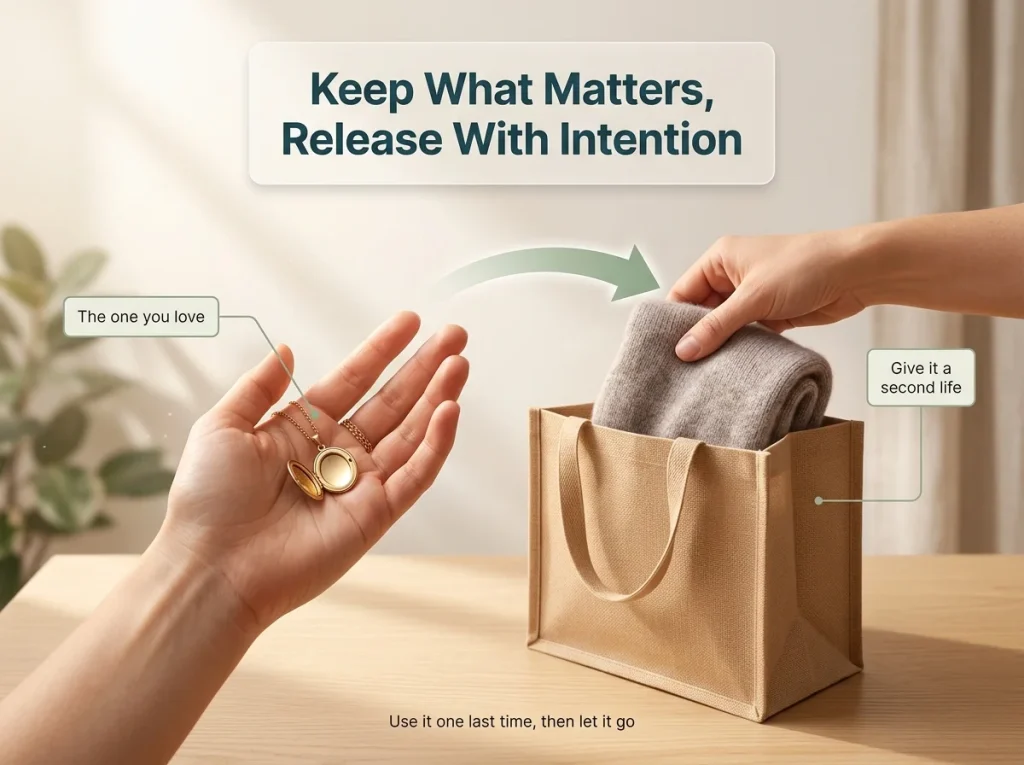
Wear the dress to a dinner you’d otherwise have skipped dressing up for. Put the inherited china on the table for one good meal with people you love. Hang the painting for a month, really look at it, and then pass it on.
The item gets honored, you get a clean goodbye instead of a guilty one, and it moves to someone who’ll use it daily instead of sitting in your closet absorbing obligation. As Carver puts it, your heart was never trying to hold on to stuff — it’s holding on to love, and love doesn’t live in the box.
After the Sort — Keeping the Pile From Coming Back
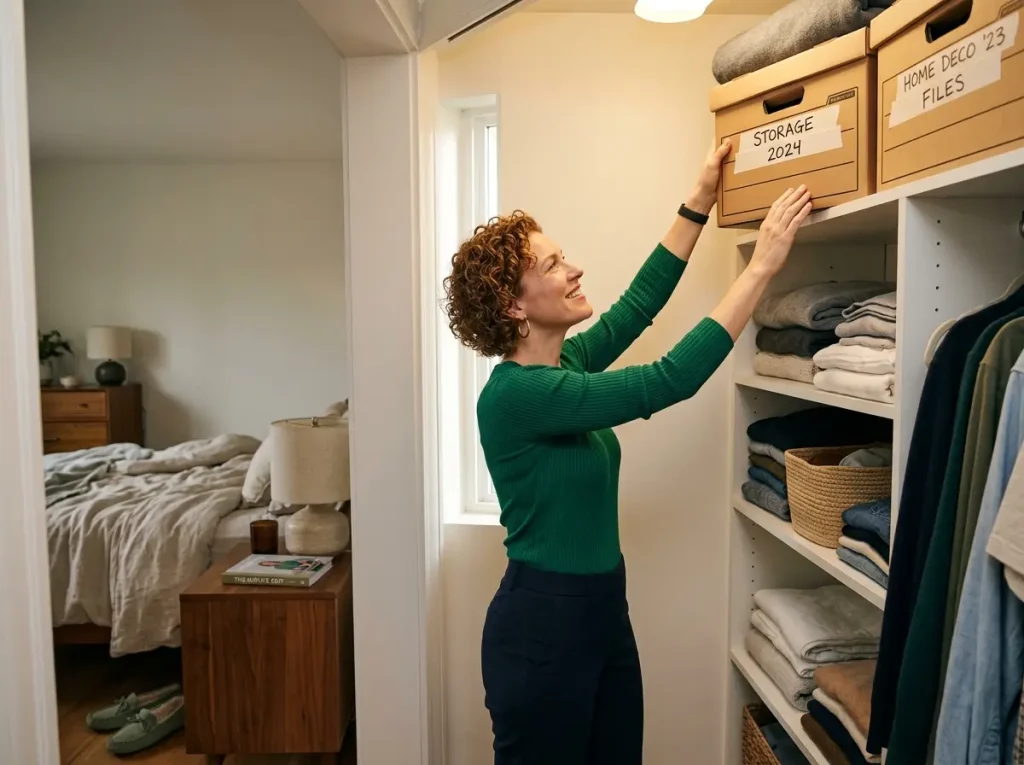
Every other article ends at the sort. This is the part that actually determines whether any of the work sticks, because without a system for what comes next, the sentimental pile quietly rebuilds in two or three years.
The next birthday card arrives. The next round of kids’ art comes home. Another relative passes and another box lands in your hands. A one-time purge with no maintenance plan is just a really emotional afternoon you’ll repeat.
The reason this matters: the sealed box ten years from now is exactly what you’re trying to prevent, and it builds itself out of small, individually reasonable additions. One card here, one keepsake there, and the box you so carefully sorted is overflowing again. The maintenance system is what stands between you and a future three-hour excavation of stuff that’s been taped shut since before your kids could walk.
The one-in-one-out rule for keepsakes
Apply the same rule to keepsakes that works for shoes and kitchen gadgets: when something new comes in, something old goes out. This doesn’t mean mechanically tossing a memento every time a birthday card shows up. It means the keepsake container has a fixed physical limit, and that limit gets enforced when the box is full instead of being quietly ignored.
Over time, this gets easier, not harder. The items that survive each round are the ones with the strongest pull, and the ones that leave were sitting at the edge of the collection anyway. A box with a real ceiling slowly distills itself down to the genuinely irreplaceable. A box with no ceiling just becomes another doom box with a nicer label.
The annual keepsake review
Once a year, open the keepsake containers and spend exactly 30 minutes reviewing them. Pick a date you’ll actually remember — a lot of people tie it to a birthday, the new year, or tax season, because anchoring it to something that already happens is the only reason it gets done. For each item, ask: does keeping this still feel necessary, or has the need quietly resolved itself?
Some things that felt impossible to release at the first sort feel completely different twelve months later. Grief changes with time, and the box should be allowed to change with it. Our guide to maintaining the decluttered state after the initial purge covers this same review habit applied to the rest of the house.
The review runs both directions, which people forget. It catches items that have quietly grown in meaning, too — the thing you kept because it was “fine” that has become genuinely precious as the years stacked up. Thirty minutes a year is a rounding error against the alternative.
If you’re storing actual photo prints long term, the box matters more than people realize. Regular cardboard off-gasses acids that fade and warp photos in as little as ten to fifteen years. An acid-free option like the Pioneer Photo Albums storage box holds well over a thousand prints and is built for decades, not seasons. This is the one spot in this whole article where the cheap shoebox genuinely falls short for the job — a lidded carton is fine for cards and trinkets, but not for prints you want your grandkids to see.
What to do when new sentimental items arrive
Holiday and birthday cards: keep the ones with a real handwritten note, photograph the cover if it’s meaningful, and release the rest. The pre-printed greeting was never the keepsake — the handwriting is. That one rule cuts the card pile by about ninety percent without losing anything that mattered.
New kids’ artwork gets photographed the day it comes home, not stacked in a “deal with it later” pile that becomes next year’s overwhelm. Decide on the spot whether it goes in the physical box or stays digital.
And inherited items from extended family get the one-box-per-category test: if the new thing is better than something already in your box, swap it in; if it isn’t, thank the relative for thinking of you and let it move on. You’re allowed to be grateful for the gesture and still not keep the object. Those are two separate things, and pretending they’re the same is how the pile comes back.
Conclusion
Three things to carry out of here. First, understand the mechanism before you fight it — the guilt is real, but it’s object-memory conflation, not a verdict on your character, and the memory lives in your brain, not the box. Second, decide your space limit before you start sorting, because the constraint is what makes the decisions possible instead of harder.
Third, different categories need different frameworks: kids’ artwork is a volume problem, inherited items are an obligation problem, gifts are a permission problem, and relationship items are an identity problem. One-size-fits-all advice fails here because the items aren’t all the same kind of hard.
In three months, check the “maybe” pile you couldn’t decide on. If those items still haven’t been used, displayed, or even looked at, they’re almost certainly obligation clutter, and they’ll be much easier to release with that distance.
Start with your easiest category, not your heaviest one. If kids’ art is your biggest pile, start there: set a 15-minute timer, photograph everything first, then sort. When the timer goes off, close the box and call it done for the day. You don’t have to finish today. You just have to start with the right tool.
Frequently Asked Questions
01How do I let go of sentimental items without feeling guilty?
Name the guilt for what it really is: fear of losing the memory, not the object. The memory lives in your brain, not the item, so releasing the thing doesn’t erase what it stood for. Start with your easiest category to build confidence before the hard ones.
02What should I do with sentimental items I can’t keep?
Photograph them first, then donate to a place where they’ll actually get used — a school, a shelter, or a thrift store that funds a cause you believe in. Knowing the item gets a second life makes it far easier to release than tossing it in the trash.
03How do I declutter gifts that people gave me?
The gift’s job ended the moment you accepted it graciously — there’s no rule requiring permanent storage. If you haven’t used it in a year, passing it to someone who will is more honest than resenting it in a drawer. You don’t owe the giver a report.
04What do you do with inherited items you feel obligated to keep?
You inherited the item, not a lifetime obligation to store it. Keep one or two pieces you’ll actually use or display, and let the rest go to people who will use them. Wait three months after a loss before making any permanent decisions.
05How do I know which sentimental items are worth keeping?
Keep what genuinely improves your present life, not what only feels wrong to release. If an item makes you smile when you use or see it, it earns its space. If it just generates guilt from inside a sealed box, it’s obligation clutter.
Disclaimer: ClutterlessNest is a participant in the Amazon Services LLC Associates Program. As an Amazon Associate we earn from qualifying purchases. This article may contain affiliate links — if you buy through them, we may earn a small commission at no extra cost to you. We only recommend products we have tested or genuinely believe in.