

You walk into the room you’ve been meaning to declutter for six months. You stand there for a minute. Then you go make a coffee and close the door behind you. That pattern — the freeze, the retreat, the quiet guilt — isn’t laziness.
A UCLA research team found that household clutter triggers a measurable cortisol spike, and your brain is doing exactly what it’s designed to do when it calculates hundreds of keep-or-toss decisions waiting in a single room: it shuts down before it starts. After helping dozens of people through this exact freeze, I can tell you the problem is never motivation — it’s always the method. Here’s what’s actually happening in your brain when you stall, and the session-based system that gets the declutter done without a marathon weekend you’ll never schedule.
Quick Answer: To declutter when overwhelmed, follow this sequence:
- Start with the bathroom — expired products need zero decisions
- Set a 15-minute timer and stop when it rings
- Sort into four labeled containers: keep, donate, trash, relocate
- Pre-decide one rule: anything untouched for 12 months goes
- Remove donations the same day — not “this weekend”
- Label where every kept item lives to prevent reverting
Why You Freeze Before You Even Start

The reason you can’t start isn’t a motivation problem — it’s a math problem. Your prefrontal cortex handles every single keep-or-toss decision, and it has a hard daily limit. When it looks at a cluttered room and calculates the decision load ahead, it does the rational thing: it refuses to engage. Understanding this changes how you approach the whole project, because the fix isn’t willpower. It’s reducing the number of decisions per session. If you’ve been cycling through decluttering methods that work past the first week, this is the biology underneath all of them.
The Real Reason “Just Start” Doesn’t Work
“Just start anywhere” is the most common decluttering advice online, and it’s the most useless. The problem isn’t that you lack the physical ability to pick up an object. The problem is that picking up that object triggers a decision — keep it, donate it, trash it, move it somewhere else — and your brain knows there are 200 more of those decisions behind it.
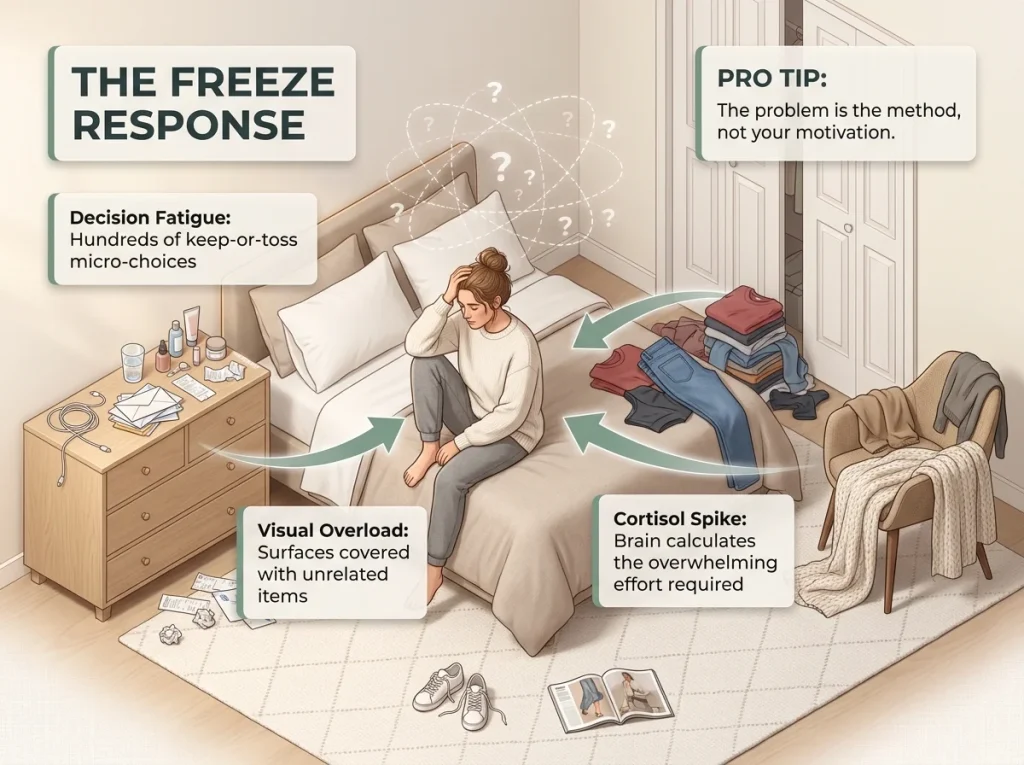
Think about the last time you stood in front of a messy room and felt your chest tighten before you even touched anything. That physical reaction isn’t dramatic. It’s your amygdala interpreting the decision load as a threat — the same brain system that handles “there’s a bear” is handling “there are 400 micro-choices in this closet.” When the amygdala fires, your prefrontal cortex goes offline. You freeze. You walk away. You feel bad about it later, which makes the next attempt harder.
What Your Brain Is Actually Calculating
Not all clutter is equal in decision cost. A junk drawer has more decisions per cubic inch than a bookshelf. That’s why the junk drawer feels impossible and the bookshelf feels manageable — even though the bookshelf holds more stuff. Your brain isn’t counting objects. It’s counting the difficulty of the decisions those objects require.
An expired bottle of sunscreen under the sink? One second. Done. A box of your kid’s old drawings? That’s ten minutes of emotional processing for a single item. When your brain scans a room, it’s running a rough calculation of total decision cost — and if that number is too high, it pulls the emergency brake before you spend a single unit of willpower. This is decision fatigue working exactly as designed.
The Cortisol Connection
Here’s the part that makes the “just push through it” crowd uncomfortable: clutter doesn’t just feel stressful — it is biologically stressful. UCLA’s research on household clutter and chronic stress found that women in cluttered homes had consistently elevated cortisol levels throughout the day. Not just during cleaning. All day. The mess on the counter was raising their baseline stress hormone whether they were looking at it or not.
If you live in a small apartment, this hits harder. Less square footage means more visual clutter per room by default. The same number of possessions that spread comfortably through a three-bedroom house creates a constant background hum of stress in a studio. That’s not a character flaw. That’s geometry.
The Two Types of Overwhelm (and Why the Fix Is Different)
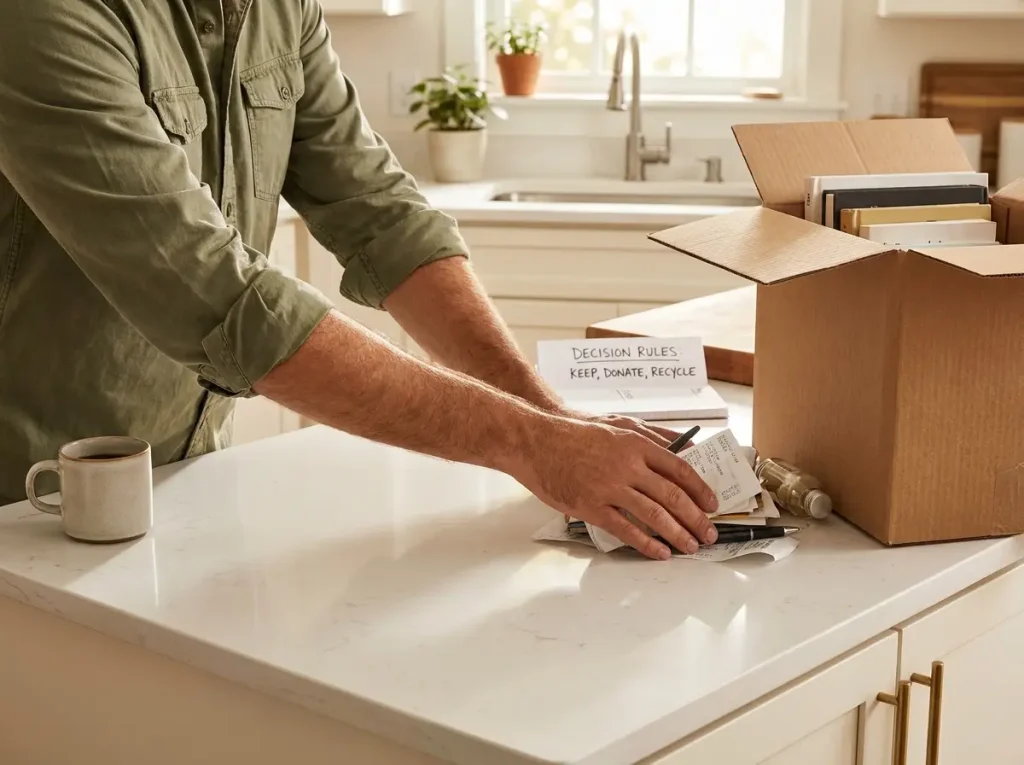
Most people treat overwhelm as one thing. It’s two. There are two distinct types, and applying the wrong fix to the wrong type is why people stall out after the first shelf. The difference matters because each type needs a different first move.
Visual Overwhelm: When the Problem Is What You Can See
Visual overwhelm happens when the sheer volume of visible stuff makes your brain unable to prioritize. Every surface is covered. Every corner has a pile. Your eyes don’t know where to land. The fix for this type isn’t sorting — it’s clearing. Move things off surfaces and into boxes, bags, or another room. Not permanently. Just temporarily. The goal is to reduce the visual noise so your brain can function.
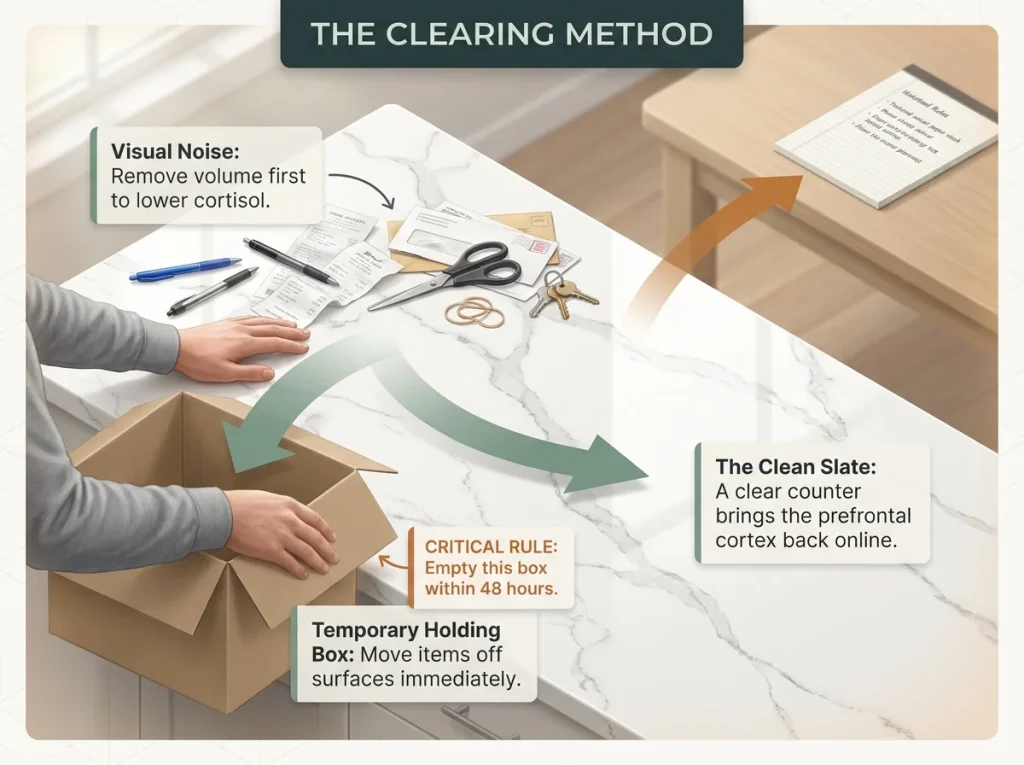
This feels wrong. It feels like you’re not really decluttering — you’re just relocating the mess. But here’s what actually happens: once the surfaces are clear, your cortisol drops, your prefrontal cortex comes back online, and the sorting decisions that felt impossible ten minutes ago become manageable. You’re not avoiding the work. You’re making the work possible.
Decision Overwhelm: When the Problem Is Inside Your Head
Decision overwhelm looks different. The room might not even be that messy — but every item you pick up triggers a negotiation. “I might need this someday.” “This was a gift.” “I paid good money for this.” The pile isn’t growing because of volume. It’s growing because each item requires emotional processing you don’t have bandwidth for.
The fix is pre-deciding your rules before you enter the room. Write them down on paper. “If I haven’t used it in 12 months and I can’t name a specific upcoming use, it goes.”
That single rule handles 70% of the items in most rooms — because it turns individual negotiations into a binary check. You made one decision that made hundreds of future decisions automatic.
The DOOM Pile Trap
DOOM stands for Didn’t Organize, Only Moved — and it’s the specific trap that catches people with visual overwhelm who never circle back for the decision layer. You sweep items off the counter into a bag. The bag goes in the closet. Six months later you have eight bags in the closet and the counter is cluttered again.
The move felt productive. Nothing actually left the house.
The fix: every cleared-off pile gets a 48-hour deadline for actual sorting. Not two weeks. Not “when I have time.” Forty-eight hours, using the session system below. Once you understand your overwhelm type, you can pair it with a room-by-room sequence that builds on this momentum and keep the progress going.
Where to Actually Start (the Bathroom Rule and Why It Works)

When someone tells me they don’t know where to start, I say: bathroom. Every time. Not because bathrooms are special — because they have the lowest decision density of any room in your home.
The Bathroom-First Rule
Open the medicine cabinet. Pull out every bottle and tube. Check expiration dates. Anything expired goes straight in the trash — no guilt, no debate, no “but I might use this.”
You’ll find at least three products that expired before the last election cycle. That’s not a declutter. That’s a trash run with a dopamine hit attached.
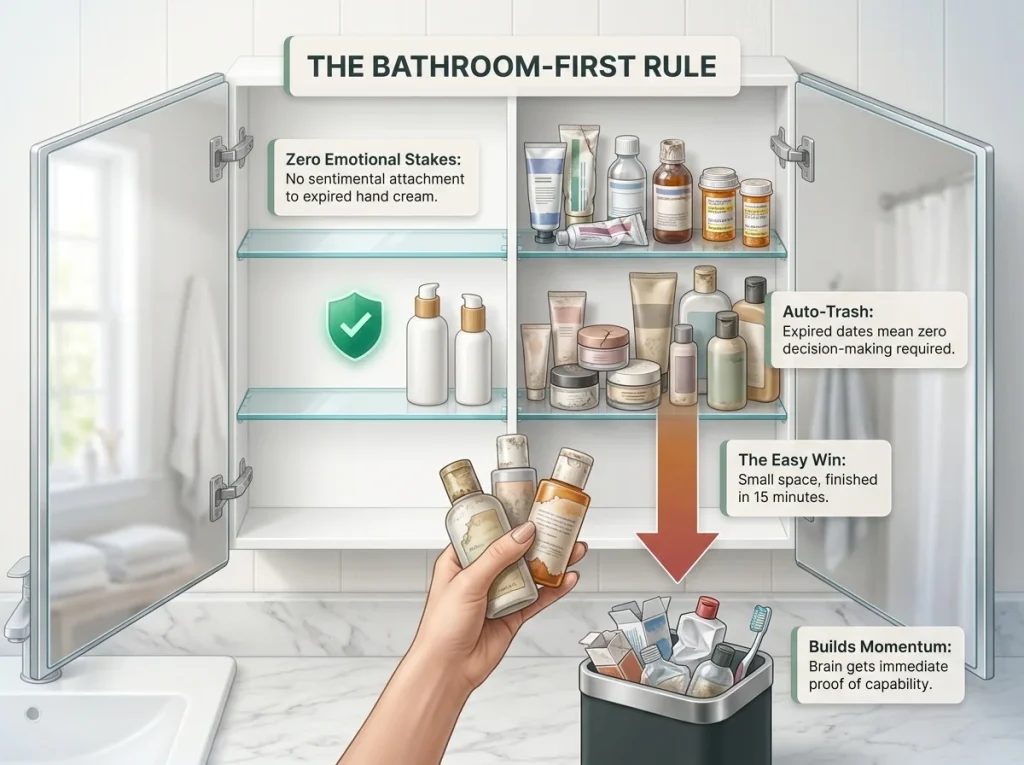
The bathroom works because the emotional stakes are zero. Nobody has a sentimental attachment to expired hand cream. The space is physically small — you can finish in one 15-minute session. And the visible before-and-after in a single cabinet gives your brain the proof it needs that you’re capable of doing this. That proof is what carries into the harder rooms later.
The Decision Density Sequence
After the bathroom, follow the decision density gradient — from easiest to hardest:
- Bathroom — expired products, duplicates, samples you’ll never use
- Junk drawer — broken items, mystery keys, dried-out pens
- Bookshelves — books you’ve read and won’t re-read, outdated reference material
- Kitchen counter — mail, receipts, items that belong in other rooms
- Clothing — higher emotional stakes, requires more energy per item
- Sentimental items — always last, never first
This sequence isn’t arbitrary. Each step trains your decision-making muscle on progressively harder items. By the time you reach clothing, you’ve already made 50+ easy decisions and your brain has a sorting pattern to follow.
Why Sentimental Items Are Not Day-One Work
The photo album spiral is real. You open a box to sort it, find the photos from college, and 45 minutes later you’re on the floor reading old cards and nothing has been decluttered. That’s not procrastination — that’s what happens when you hit high-emotion items before your sorting reflexes are warmed up.
Pre-decide a “memory box” — one box, a specific size you choose now. Everything sentimental goes in there for the time being. You’ll sort it last, after you’ve built the momentum and the decision stamina from easier rooms. The KonMari method also starts with clothes and saves sentimental items for last for the same reason — it’s not avoidance, it’s smart sequencing.
The 15-Minute Session System

The single most counterintuitive thing about decluttering when overwhelmed: more time does not equal more progress. After 15-20 minutes of continuous decision-making, your brain literally makes worse choices. I’ve watched people who decluttered for four hours straight put things back in bags they’d already sorted out — because by hour three, the prefrontal cortex was running on fumes and “just in case” became the answer to everything.
Why 15 Minutes (Not 5, Not 45)
A well-known study on judicial decisions found that judges granted parole 65% of the time at the start of a session and nearly 0% right before breaks — not because the cases changed, but because decision fatigue is a measurable cognitive phenomenon. Your decluttering decisions follow the same curve. Minute one: clear-headed choices. Minute 25: “I’ll keep it just in case” for everything in the pile.
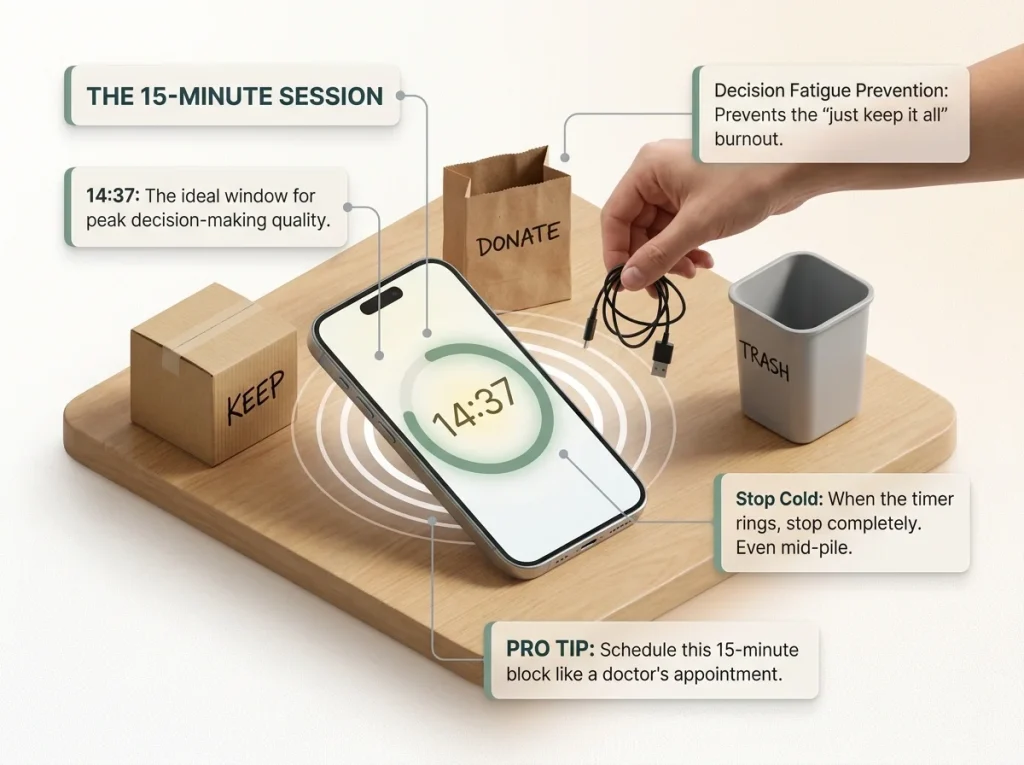
Five minutes isn’t enough to get into a sorting rhythm — you spend the first two just warming up. Forty-five minutes puts you deep into the decision fatigue zone where you start keeping things you’d have easily donated at minute five. The 15-to-20-minute window is where you’re making quality decisions at a steady pace, and you stop before the quality drops off a cliff.
The Stop-Cold Rule
When the timer rings, stop. Even if you’re mid-pile. Especially if you’re mid-pile — because the urge to “just finish this section” is exactly the trap that turns a productive 15-minute session into a four-hour marathon followed by a week of avoidance.
Bag up whatever you were working on. Label the bag with where you stopped and what’s in it. Set it aside. Walk away.
Your phone timer is all you need for this. But if you’re running multiple sessions across several days, collapsible fabric bins with label slots hold up better than cardboard and fold flat between sessions — useful if you’re working in a small apartment where the mid-sort pile can’t just sit on the floor for a week.
Pro tip: The first time you stop cold on a timer, it will feel wrong. Do it anyway. The session you quit on time is the one you’ll actually finish — because you’ll actually come back tomorrow.
Scheduling Your Sessions Like Appointments
“I’ll declutter this weekend” means “I won’t declutter this weekend.” According to professional organizing research, treating organization as a scheduled commitment — not a mood-dependent activity — is the single biggest predictor of actually finishing the project.
Put “Declutter — 15 min” on your calendar. Sunday morning, 9:00-9:15. Not “sometime this weekend.” Not “when I feel motivated.” A specific time, a specific day, a specific 15-minute block. Three of those sessions across a week will clear more than one guilt-fueled Saturday marathon that you keep postponing.
The Sort: Four Boxes and One Rule
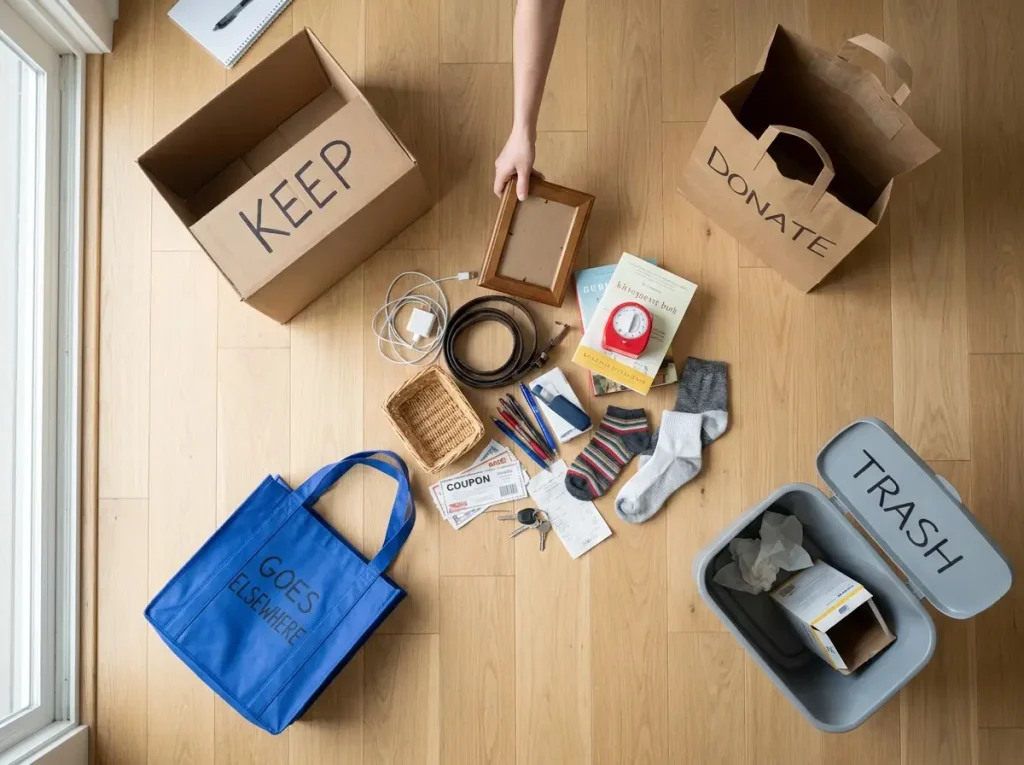
You have a system for timing. Now you need a system for deciding. The four-box method gives every item exactly one destination, and the one pre-decided rule handles most of the decisions before you pick anything up.
Setting Up the Four Boxes (Anti-Sell Version First)
You need four labeled containers: Keep, Donate, Trash, and Relocate (goes to another room where it actually belongs). Cardboard boxes work. Paper grocery bags work. Laundry baskets work. The point is labeled zones, not matching storage sets. Grab a marker and four containers you already own — you’re ready to start right now.
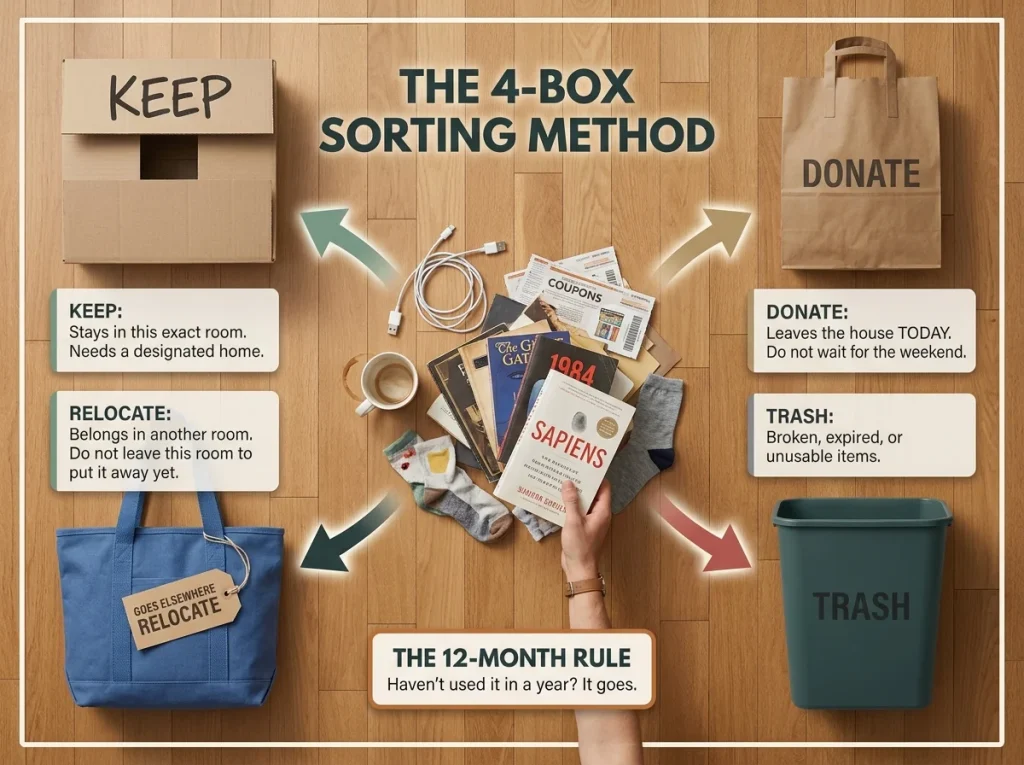
If you’re working through multiple rooms over several days and your cardboard boxes are getting soggy, the Fabric Storage Bins with Labels (Set of 6, Collapsible) store flat when you’re not using them and the included label slots let you re-designate bins across sessions without peeling off tape. Six covers the four-box method plus a maybe box and an outbox. But seriously — start with what you have. Don’t let buying supplies become the reason you postpone session one.
The Pre-Decided Rule That Handles 70% of Decisions
Write this down before you pick up a single item: “If I haven’t used it in 12 months and I can’t name a specific upcoming use, it goes.” Not “I might need it someday.” Not “it was expensive.” A specific upcoming use you can name out loud right now.
That single sentence eliminates the internal debate for most household items because it replaces an emotional judgment with a factual check.
For the items that genuinely stump you, add a fifth container — the Maybe Box. Seal it with tape. Write today’s date on the outside. Set a 30-day calendar reminder.
If you haven’t opened the box to retrieve something in 30 days, donate it without opening it. Swedish Death Cleaning’s throwaway box uses the same 30-day principle — the time limit turns “maybe” into a clear yes or no without you having to agonize over it twice.
Pro tip: Label your donation bag before you start, not after. Once items are sorted in your head as “donate,” putting them in an unlabeled bag creates a decision re-check every time you pass it. Labeled and sitting by the door — they’re already gone mentally.
Getting It Out the Same Day
The number one failure mode in decluttering isn’t the sorting — it’s the donations sitting in bags by the door until someone in the household retrieves an item “just in case.” Get it out the same day. Drive it to the drop-off. Make it happen before bedtime.
If you’re in an apartment without a car, post items on Facebook Marketplace’s free section, list them on Freecycle, or schedule a Habitat for Humanity pickup — all free, no vehicle required. Every day the donation bag stays in your home is a day someone might reopen it. The bag doesn’t leave on its own schedule. It leaves on yours, and that schedule is today.
After the Sort: Keeping the Room From Reverting

Every person I’ve helped declutter reports the same thing: the “after” looks great for two to four weeks. Then life happens. By month three, it’s drifting back toward the before. Not because the declutter failed — because nothing changed about how stuff enters and lives in the space. This is the maintenance layer that most guides skip entirely.
Give Every “Keep” Item One Designated Home
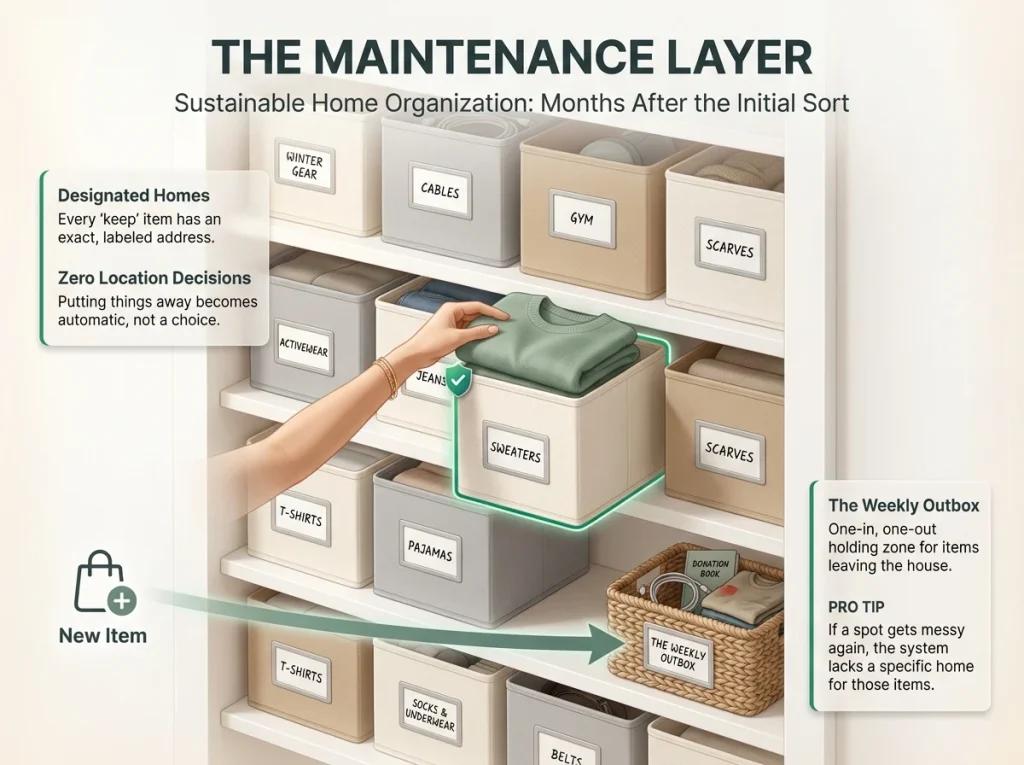
The keep pile needs more than a shelf. It needs a specific, labeled spot where each category lives. Not “somewhere on this shelf” — a bin, a drawer section, or a basket where that item type always goes.
When putting something away requires zero decisions about location, it actually gets put away. When it requires even one decision — “does this go here or here?” — it ends up on the counter. You’ll notice this pattern within the first week.
Masking tape and a marker do this job for free. If you want cleaner labels that survive daily handling and actually get read by other people in the household, the Brother P-Touch PTD220 Label Maker prints adhesive labels that stick to bins, shelves, and drawer faces without leaving residue when you rearrange — renter-friendly and no batteries to deal with since it runs on AC. But tape and a Sharpie get you 90% of the same result today, for nothing.
The One-In-One-Out Rule (and When to Apply It)
This isn’t a minimalist philosophy. It’s capacity math. Your shelf holds 12 items. If you add a 13th without removing one, the system breaks within a week.
The one-in-one-out rule works best in spaces you’ve already decluttered — closets, bathroom cabinets, kitchen drawers — because those spaces now have a defined capacity you can see.
The trick is making this automatic rather than willpower-dependent. Keep a small outbox bin in the closet or by the front door. When something new comes in, one thing goes in the outbox. At the end of the week, the outbox goes to donation. No negotiation, no emotional processing — just a bin that fills and empties on a weekly cycle.
Pro tip: The outbox bin is not failure. It’s infrastructure for a household that includes other humans. Everything that lands there gets a weekly five-minute sort — where does it actually go? — rather than a daily negotiation about who left what on the counter.
The Three-Month Check
Set a calendar reminder for 90 days from today. Walk through the decluttered space. Look for the spots where items have started piling up again. Those spots tell you exactly one thing: the system doesn’t have a home for those items yet. Don’t re-declutter the whole room. Fix the specific gap — add a bin, add a label, add a rule for that category.
If nothing has accumulated, the system works. If one spot has drifted, that’s a five-minute fix with a new label or container. If the whole room has reverted, it usually means the “keep” items never got designated homes in the first place — go back to the labeling step and be more specific about where things live.
Conclusion
Three things to take from this:
- The freeze is biological. Decision fatigue and the amygdala response are real and measurable. Understanding this removes the shame spiral and gives you a different strategy — reduce the decision load per session, don’t try to push through it.
- Start with the bathroom and a 15-minute timer. These two decisions handle the hardest part of beginning — where to start and when to stop.
- The after photo isn’t the finish line. The three-month check is. A declutter only worked if the system is still holding up when normal life has had 90 days to test it.
In three months, walk through the space again. If something has drifted back into a pile, fix the system — not yourself. The goal was never a perfect room. The goal was a room that works without you having to manage it every day.
Set a timer for 15 minutes. Go to the bathroom. Start with the expired products. When the timer rings, stop. That’s session one. The rest follows from there.
Q1 What is the fastest way to start decluttering when you’re overwhelmed?
Start with the bathroom medicine cabinet and a 15-minute timer. Expired products require zero emotional decisions, the space is small enough to finish in one session, and the visible progress gives your brain proof that you can do this. That momentum carries into harder rooms.
Q2 What order should you declutter your house?
Follow the decision density sequence: bathroom first, then junk drawer, bookshelves, kitchen surfaces, clothing, and sentimental items last. This order moves from low-emotion items to high-emotion ones, training your decision-making stamina on easy wins before you reach the harder categories.
Q3 How do you let go of things when decluttering is hard?
Pre-decide one rule before you start: If I haven’t used it in 12 months and can’t name a specific upcoming use, it goes. This removes the in-the-moment debate for most items. For genuinely uncertain things, use a sealed maybe box with a 30-day deadline — if you don’t open it to retrieve something, donate it unopened.
Q4 How do you keep clutter from coming back after you’ve decluttered?
Label where every kept item lives so that putting things back requires zero decisions. Use the one-in-one-out rule for closed spaces like closets and drawers. Set a 90-day calendar reminder to walk through the space and check for re-accumulation — then fix the gap in the system, not the symptom.
Disclaimer: ClutterlessNest is a participant in the Amazon Services LLC Associates Program. As an Amazon Associate we earn from qualifying purchases. This article may contain affiliate links — if you buy through them, we may earn a small commission at no extra cost to you. We only recommend products we have tested or genuinely believe in.