
















In this article
You organized the living room. Bought the baskets, got the storage ottoman, put everything in its place. For about two weeks it looked great. Then the ottoman filled up with things that had nowhere else to go, the coffee table reappeared under a layer of remotes and charging cables, and the baskets started holding everything and organizing nothing. Most storage advice skips the question that determines whether a system survives past the first month — what are you actually storing, and does the container you bought match the category of stuff going into it?
This covers six storage strategies for small living rooms — starting with the diagnostic question that most people skip, and ending with the monthly reset that keeps any system working three months later.
Quick Answer: The best living room storage for small spaces combines the right containers with the right rules.
- Identify every clutter category in your living room before buying anything
- Use storage ottomans for bulky soft items only — not as a catch-all
- Go vertical with freestanding bookshelves anchored by anti-tip straps
- Assign one category per basket or bin and label it
- Use dead zones under and behind furniture for hidden storage
- Run a 10-minute monthly reset to correct drift before it compounds
The Question Nobody Asks Before Buying Storage
The storage ottoman is not a living room problem solver. It is a container. Whether it solves your problem depends entirely on what your problem is — and most people buy the container first and discover the mismatch later. That is how you end up with an ottoman full of charging cables buried under two throw blankets and a pair of socks nobody claimed.
Before you buy a single bin, basket, or piece of storage furniture, you need to know what categories of clutter are actually living in your room. Once you know what you’re storing, the small living room layout rules you follow become specific instead of generic — because now you are choosing furniture with a storage purpose, not just a style preference.
What You’re Actually Storing
The average small apartment living room has between seven and nine distinct categories of stuff that need a home: throw blankets, remote controls, charging cables, books and magazines, kids’ or pet toys, seasonal decorative pillows, games or entertainment accessories, and mail or keys that migrated from the entryway. Each category has different physical requirements — a throw blanket needs volume, a remote control needs accessibility, and a charging cable needs containment so it does not turn into a tangled knot behind the sofa cushion.
Here is the diagnostic: walk through your living room right now and write down every type of item that is currently sitting on a surface, on the floor, or crammed inside something. That list is your storage blueprint. Everything else — what to buy, where to put it, how big it needs to be — flows from that list.
Pro tip: Do the category inventory on a weekday evening, not a Sunday after you have already tidied up. You want to see the living room in its natural state — the honest version, not the company-is-coming version.
Why the Living Room Is the Hardest Room to Organize
Your kitchen has cabinets. Your bathroom has a vanity. Your bedroom has a closet. Your living room has nothing. It is the only room in most apartments that comes with zero built-in containment — no drawers, no cabinets, no shelving. Every single item in the room is inherently homeless unless you create a designated spot for it.
This is why the living room is where organization systems go to die. Multiple people’s clutter converges in a room with no natural containers, and without a clear “home” for anything, flat surfaces absorb the overflow. The coffee table becomes what organizers call a doom pile — the spot where random items accumulate because nobody has dealt with them yet. The sofa arm becomes the blanket shelf. The floor near the outlet becomes the charging station. This is surface creep in action, and it happens in every living room that lacks designated containers for its actual clutter categories.
The Container-Category Mismatch
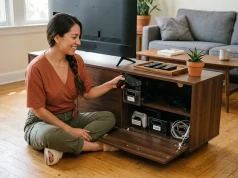
A storage ottoman is designed for soft, bulky items — blankets and pillows. Its deep interior makes it terrible for small, flat items like remotes and cables, which sink to the bottom and never get retrieved. An open basket on a shelf works for remote controls because they are easy to grab, but that same basket fails for mail because mail piles up horizontally and becomes a stack nobody sorts through. An uncovered bin within arm’s reach of the sofa works for items you grab multiple times a day. A lidded box works for seasonal items you need once every few months.
The mismatch is why most living room storage “fails.” The container was fine, but it was assigned the wrong job. Putting remotes in a deep ottoman is like storing your daily shoes in a locked attic trunk. The system works on paper and fails in practice because retrieval is too inconvenient. You will learn this the first time you dig past two blankets and a pillow to find the remote you dropped in there three days ago — and after that, the remote lives on the couch cushion forever.
Furniture That Stores While It Does Something Else
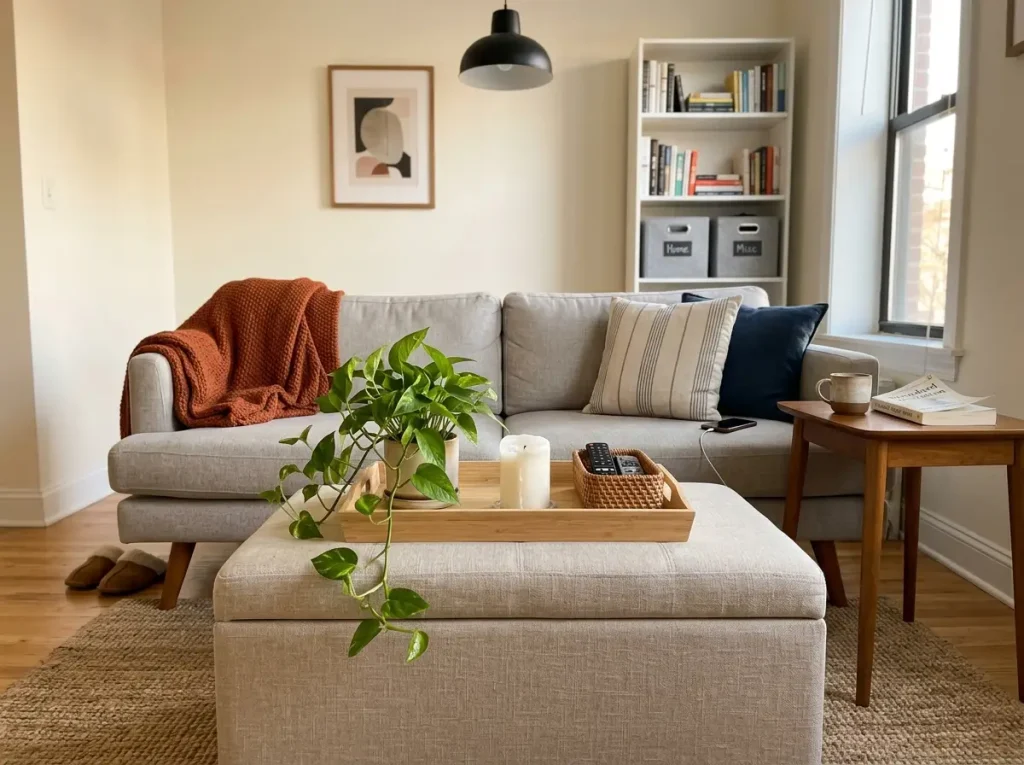
The furniture piece that does two things is always worth more in a small living room than two pieces that each do one thing. A coffee table that also holds books underneath takes up the same floor space as a coffee table that does nothing — but one of them is working for you and the other is just sitting there. The trick is buying the right size, because most multi-functional storage furniture is designed for large living rooms and just makes small ones feel cramped.
Storage Ottomans — What Size Actually Works
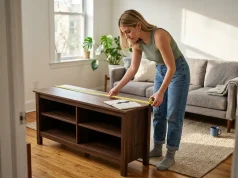
Before you buy a storage ottoman, measure the distance from your sofa to the opposite wall or TV stand. Subtract 18 inches on each walkway side — that is the minimum clearance you need so people can walk around it without turning sideways. Whatever width is left is your ottoman’s maximum size. Most living rooms between 100 and 130 square feet work best with an ottoman between 40 and 48 inches wide.
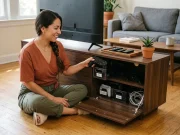
The SONGMICS Storage Ottoman Large in linen fabric measures roughly 43 by 16 by 17.5 inches — big enough to hold two to three adult throw blankets inside, with a flat top surface that doubles as a coffee table when you add a tray. The 17.5-inch height matches standard sofa seat height, so it sits flush visually. The limitation: at 43 inches wide, it fills the room in apartments under 100 square feet — measure first. If your space is tighter, the SONGMICS Storage Ottoman Bench runs slightly narrower at 43 by 15 by 15.7 inches and works the same way at a lower price point.
Pro tip: Put a fitted tray on top of the closed ottoman and it becomes a coffee table surface — remotes go in a small basket on the tray, and the blankets stay hidden inside. One piece, three functions.
Coffee Tables That Pull Double Duty
A coffee table with a lower storage shelf beats a lift-top coffee table in almost every daily-use scenario. The shelf is always accessible — you reach down and grab what you need. A lift-top requires clearing the surface, lifting the mechanism, retrieving the item, closing it, and replacing whatever was on top. That is a lot of friction for grabbing a book or a charging cable, and friction is what kills storage systems.
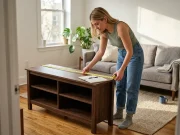
The VASAGLE Coffee Table with Lower Storage Shelf in dark walnut puts that lower shelf on constant display, which creates a natural accountability loop — you see what is stored there every time you walk past, so things stay organized because they are visible. The darker walnut finish hides dust better than light wood, which matters in a high-traffic living room where you are not wiping surfaces every other day. The limitation: the open shelf means everything on it is visible, so it works best for books and a neat basket — not for a pile of miscellaneous stuff you want hidden.
If you want more flexible floor coverage instead of a fixed coffee table, a set of nesting tables gives you surface area when you need it and stacks away when you do not — no storage shelf, but more walkway space on demand.
The Console Table Behind the Sofa
If your sofa sits even eight to ten inches away from the wall — and in open-plan apartments and studios it usually does — that gap is a console table opportunity. A narrow console table about 12 inches deep and two to four inches shorter than the sofa back fits directly behind the sofa and creates a surface you did not have before: a lamp, a few books, a small basket for cables and a phone charger.
This setup also changes how the room feels. The console table creates a visual separation between the seating area and the wall, which makes a small living room read as two zones instead of one compressed space. For more ways to get double duty from your living room furniture, check out multi-functional furniture choices for small apartments.
Getting Vertical Without Drilling a Single Hole
The standard advice for small living room storage is “put up floating shelves.” For renters, that is not advice — that is a security deposit problem. But there are three vertical storage approaches that work without a single drill hole in the wall, each with different load capacity and different use cases. Understanding the weight limits before you buy anything is what separates a shelf that holds your books for two years from a shelf that pulls off the wall at 3 AM and scares the cat.
Freestanding Bookshelves (and the Safety Step Everyone Skips)
A freestanding narrow bookshelf is the renter-correct alternative to wall-mounted shelves for actual storage. No installation, moves with you, and holds more weight across five shelves than any adhesive option can handle on one. The key measurement is depth — anything wider than 14 inches starts protruding into your walking path, and in a small living room that means you are brushing past it every time you cross the room.
The VASAGLE 5-Tier Narrow Bookshelf at 11.8 inches deep by 13.3 inches wide by 66.9 inches tall fits into a 14-inch wall gap without cutting into your walkway. Five shelves give you enough zones to separate books, decor, and bins by category. The limitation: at 66.9 inches tall and only 13.3 inches wide, it is top-heavy when loaded — which means it needs to be anchored.
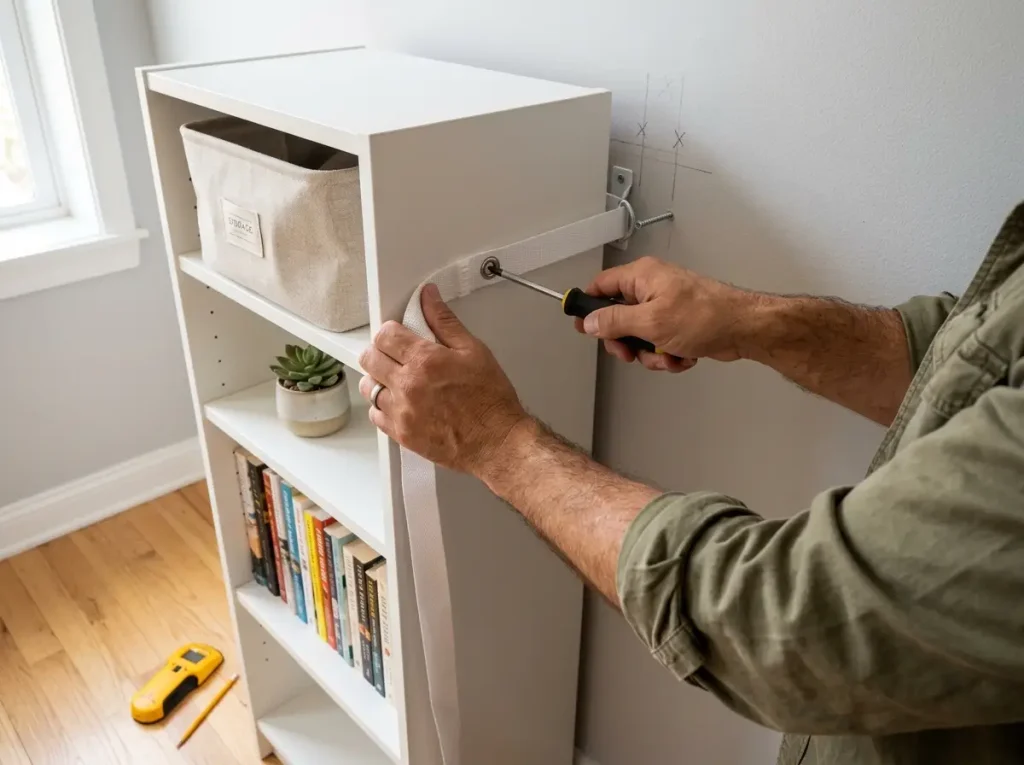
This is the safety step everyone skips. Furniture tip-overs cause approximately 25,500 emergency room injuries per year in the US, according to CPSC data. Any freestanding bookshelf taller than your waist should be anchored with two nylon anti-tip straps screwed into wall studs — not drywall, studs. Use metal or nylon straps, not the plastic zip-tie kits that CPSC recalled in early 2024. The screw holes are tiny and patch invisibly with a dab of spackle when you move out. Check Consumer Reports’ testing of anti-tip anchor kits if you want to see which kits actually hold.
If you have already figured out where the bookshelf goes from your furniture arrangement for small apartment living rooms, anchoring it is a 15-minute job with a stud finder and a Phillips screwdriver.
Pro tip: When you anchor a freestanding bookshelf, use two straps — one on each side of the top panel. A single center strap allows the bookshelf to pivot sideways if bumped hard from one side.
What No-Drill Adhesive Shelves Can Actually Hold
Adhesive floating shelves are rated for 10 to 15 pounds maximum. That is three to four framed photos, a small pothos plant, and maybe two candles. It is not a row of hardcover books. It is not a bin with items inside it. It is not anything you plan to lean on while reaching for something else.
The Floating Wall Shelf No-Drill 16.5-inch 2-Pack mounts with adhesive — no drill, no holes, deposit-safe. A two-pack gives you two shelves above a sofa or beside the TV for photos, small plants, and decorative items. The limitation is the weight ceiling — use these for display, not for storage. If you put books on an adhesive shelf rated for 15 pounds and you load 20 pounds of paperbacks, it is coming off the wall eventually. Command strips run about 16 pounds per set, which is roughly the weight of four to six hardcover books — also not enough for functional storage.
The bottom line for renters: if you want to store actual stuff on walls — books, bins, real weight — a freestanding bookshelf with anti-tip straps is the correct solution. Adhesive shelves are for making the wall look good, not for holding your book collection. For more approaches to going vertical in every room, see vertical storage ideas for apartments.
Ladder Shelves as Display + Soft Storage
Ladder shelves fall somewhere between furniture and decor. They look good leaning against a wall, and they hold lightweight items — a throw blanket draped over one rung, a small plant on another, maybe a couple of books on the widest shelf. Most ladder shelf rungs are rated for 15 to 25 pounds each, which is enough for display but not enough for a bin full of remote controls and cables.
Use a ladder shelf when you want to show off a few things and drape blankets for easy access. Do not use one when you need actual concealed storage or high-capacity shelving — that is what the freestanding bookshelf is for.
Baskets, Bins, and the One-Category Rule
A basket is not an organizing tool. It is a container. An organizing tool has rules. When a basket has a rule — “this holds blankets and only blankets” — it works indefinitely. When it has no rule — “throw stuff in here” — it becomes a problem with a lid. The difference between a living room that stays organized and one that reverts in two weeks is not better baskets. It is better rules.
Why the Basket Stops Working After Two Weeks
The failure mechanism is predictable. You buy a nice basket. You put a few things in it. It looks organized. Then someone adds a remote control on top of the blanket. Then a charging cable gets dropped in. Then a magazine. Within two weeks the basket holds six categories of items and retrieving anything specific means digging through all of them. Digging is annoying, so people stop using the basket. Items go on the coffee table instead. The basket sits in the corner holding a random pile, and you start thinking about buying a different basket — as if the basket were the problem.
The basket was never the problem. The missing rule was the problem. An unlabeled open basket in a shared living room becomes a catch-all within a week. An overfilled basket with no lid is worse than no basket at all — it signals “this area is already messy” to everyone in the room and attracts more clutter around it. This is not a guess. It is what happens in every shared space where containers do not have an assigned category and a capacity limit.
Assigning One Job to Each Container
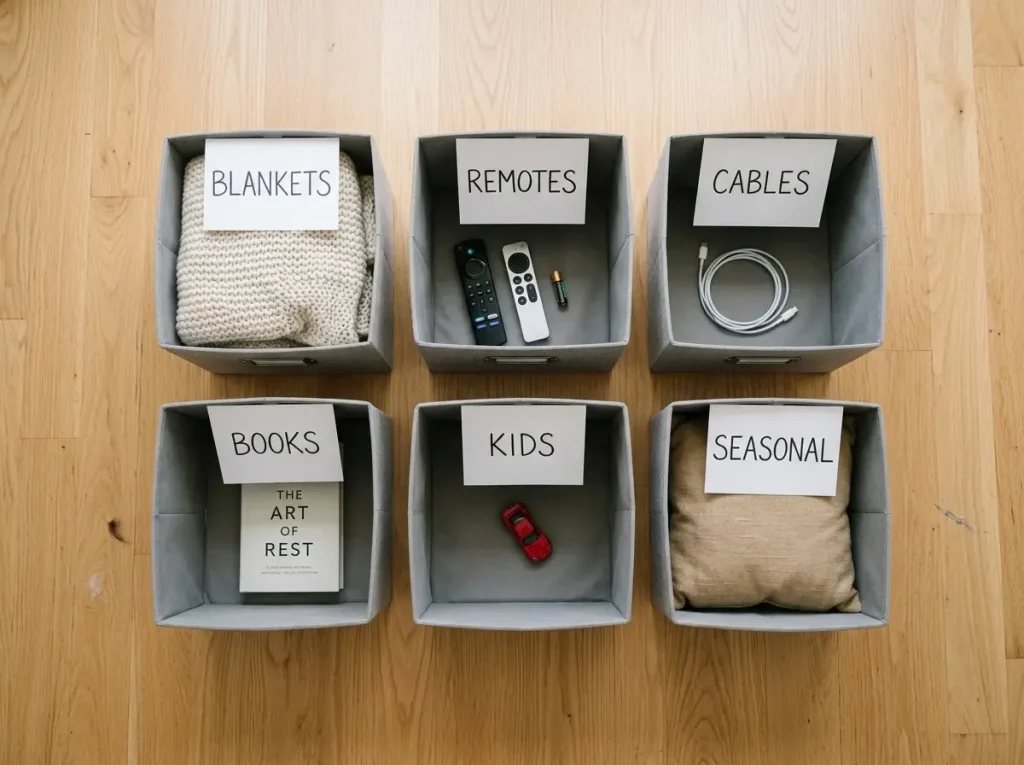
Go through every basket, bin, and box currently in your living room. Give each one a single category: blankets, remotes, cables, books, kids’ items, seasonal. If a container is holding more than one category right now, pick the category that matches the container’s size and accessibility, move everything else out, and put those orphaned items on a list for their own container.
The Fabric Storage Bins with Labels, Set of 6 come with built-in label pockets on the front of each bin — you write the category on a card and slip it in. Six bins maps directly to the six most common living room clutter categories. They collapse flat when not in use, so you are not storing empty bins that take up shelf space. The limitation: fabric bins work for lightweight categories like cables, remotes, and small items, but they do not hold their shape well when stuffed with heavy hardcover books — use shelf space directly for books instead.
Labels are the enforcement mechanism. Even in a living room with a clean neutral palette, a simple handwritten label inside the bin — or in the clear pocket facing out — tells every household member what goes in and what does not. If you share the space, labels are not optional. They are how the system survives the person who does not read your mind about what goes where.
For more ways to apply this one-category approach across your apartment, check out apartment organization ideas that use the same principle in every room.
Where to Put the Bin So It Actually Gets Used
Proximity is compliance. A remote-control bin that sits on a bookshelf across the room will be ignored — the remote will end up on the sofa cushion every time. The remote bin belongs within arm’s reach of the seating position: on the side table, under the coffee table’s lower shelf, or in a small basket on the ottoman tray. If reaching the bin requires getting up, the item goes on the nearest surface instead. That is not laziness — that is physics meeting human nature.
Blanket storage belongs at the end of the sofa or in the corner nearest to where blankets actually get used. Cable baskets belong near the outlet where phones charge. The bin’s location should match the item’s natural resting place — not the place that looks best in a photo, but the place where the item would end up if no bin existed at all. Put the bin there. If the bin and the item’s natural landing spot are more than two steps apart, the bin loses.
The Dead Zones — Under, Behind, and Around Your Sofa
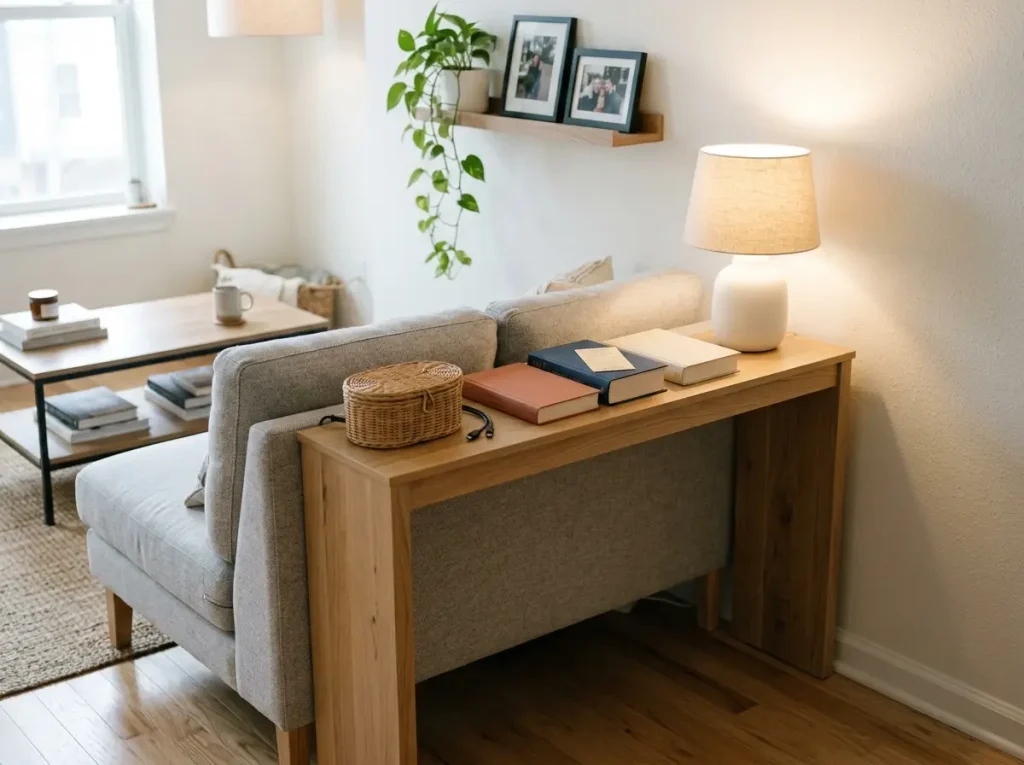
Your living room floor is not just what you walk on. A sofa with legs has storage under it. A sofa pushed eight inches from the wall has a console table opportunity behind it. A corner with nothing in it has a rolling cart opportunity beside it. Most small living rooms ignore three distinct storage zones they already own — and these zones add up to real capacity without taking any additional floor space.
Under the Sofa (Check the Legs First)
Before you buy under-sofa storage bins, get down on the floor and measure the clearance between the floor and the bottom of the sofa frame. Sofas with four to five inches of clearance need flat bins no taller than 3.5 to 4 inches — these exist, but the selection is limited and they hold only flat or thin items like extra pillowcases, seasonal table runners, or kids’ coloring books. Sofas with seven or more inches of clearance can use standard rolling bins and hold bulkier items like extra throw blankets or board games.
Sofas with no legs — the kind that sit directly on the floor with a full skirt around the base — have no accessible under-sofa storage. Do not try to force it. Move on to the other dead zones.
The Console Table Behind the Sofa
In apartments where the sofa floats away from the wall to define the living area — open-plan layouts and studios especially — the back of the sofa becomes a room divider by default. A console table two to four inches shorter than the sofa back, and no deeper than 12 inches, slides into this gap and creates a surface that holds a table lamp, a couple of books, and a small covered basket for charging cables and a power strip.
This works because the sofa back hides whatever is on the console surface from the main seating view — you only see it when you walk behind the sofa or lean back and look over your shoulder. It is hidden-in-plain-sight storage that does not require any installation. The console table just sits there, doing its job, and moves out with you when the lease ends.
Corners and the Rolling Cart Solution
The dead corner beside a TV stand or next to a sofa arm is typically 12 to 18 inches wide. Nothing useful fits there — except a narrow rolling cart. The Slim 3-Tier Rolling Storage Cart at roughly 7 inches wide slides into most of these corners and provides three separate tiers for organizing by access frequency: most-used items on the top tier, occasionally used items in the middle, and rarely touched items on the bottom.
Pull it out when you need something. Push it back in when you are done. No drilling, no commitment, moves with you. The limitation: at 7 inches wide, each tier holds only a few small items — this is for remotes, cables, a small charging hub, or gaming accessories, not for throw blankets or books.
If you are looking for more ways to put dead space to work, see maximizing space in a small apartment.
The 10-Minute Reset That Keeps the System Alive
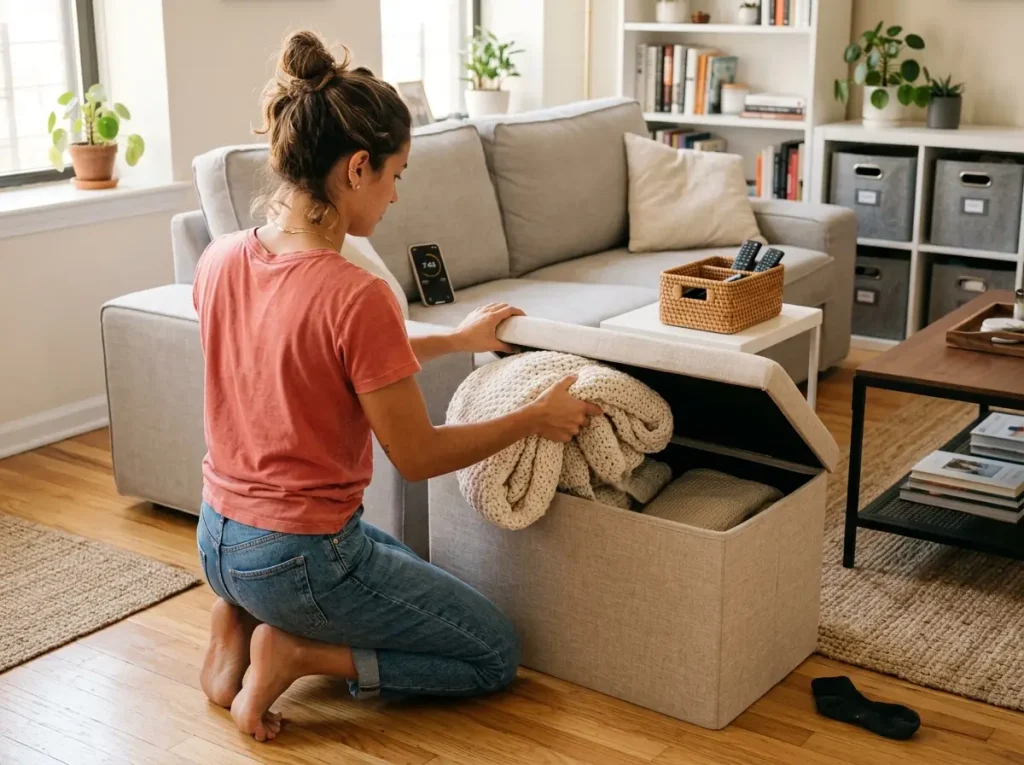
Every organization system you have tried probably worked for the first two weeks. That is not a failure of the system — that is the initial motivation wearing off while life keeps happening. The throw blanket did not go back in the ottoman after movie night. A cable got dropped into the wrong bin. A new book joined the coffee table stack without replacing the one you finished. None of these are catastrophic on their own. But after six weeks of small drift, the system is unrecognizable — and now it feels like you need to start over instead of just correcting course. The systems that last are not the most perfectly organized ones. They are the ones that require the least effort to maintain.
Why Small Living Room Storage Fails at Month Two
Month two is the tipping point. The initial energy that created the system is gone. The daily habits that maintain it have not fully formed yet. And the drift — one misplaced item per day — has compounded into a visible mess. The ottoman that held only blankets now holds blankets plus two phone chargers, a pair of socks, and three TV remotes. The labeled bin that said “Cables” now holds cables plus a set of earbuds, a pen, and a hair tie.
The storage furniture is still there. The baskets are still there. So you look at the room and think the storage system worked — it just got messy again. But the system did not get messy. The system was never finished. A storage system without a maintenance step is like a garden without weeding — it looks great on planting day and slowly gets overtaken by whatever drifts in.
This is the part none of the other living room storage guides cover. They stop at “buy these things and put them here” as if the work ends on setup day. Setup is day one. Maintenance is the other 364.
The 10-Minute Monthly Reset
The reset is not re-organizing. It is drift correction. Once a month — pick a day, set a timer for 10 minutes — go through each container in the living room and remove anything that does not belong in it. Remote in the blanket basket? Goes back to the remote bin. Charging cable on the coffee table? Goes back to the cable basket. Book finished but still on the side table? Goes to the bookshelf or out of the apartment.
That is the entire protocol. No deep cleaning. No pulling everything out and starting from scratch. Just putting things back where they belong before the drift gets too far ahead. If you notice a container that is consistently overfull at reset time, the bin is too small for the category — either size up or pare down the contents. If a container is consistently misused, the location is wrong — move it closer to where those items naturally end up.
For a broader approach to reset systems across every room, see small apartment organization systems and one-bedroom apartment organization.
Pro tip: If you share the living room with a partner or roommate, the person who cares less about organization should be the one to do the reset. If it takes them 10 minutes, the system is intuitive enough. If it takes them 30, the container labels or locations need to be simpler.
Designing the System for the Lowest-Maintenance Person
If you live with someone — partner, roommate, kids — design the storage system for the person who will put things away with the least thought. Not because they are careless, but because a system that requires remembering a rule will fail the moment someone is tired, distracted, or just does not care as much as you do about where the remote goes.
Labeled bins at logical locations. Open containers for daily-use items. Every category in a spot that is the obviously correct place — not the theoretically correct place that requires training. If a visitor could walk into your living room and figure out where the remote control goes within five seconds, the system is intuitive enough. If it requires an explanation, it is too complicated for the way people actually live.
Conclusion
Three things make a small living room storage system last. First, identify what you are actually storing before buying any container — every category of living room clutter needs a different solution, and the wrong container for the wrong category fails within a month. Second, every container needs one job: when a basket holds blankets and only blankets, it stays organized indefinitely. Third, storage without a reset system reverts — a 10-minute monthly check is the maintenance layer that makes any system work past the initial motivation.
In three months, look at each container in the living room. If any is chronically overfull, the bin is too small for the category — size up or pare down. If any is consistently misused, the location is wrong — move it closer to where the items are naturally generated.
Start with one clutter category that currently has no home in your living room. Give it a bin, put the bin in the right spot, and label it. One category. Get that right before adding the next.
Q1 What is the best storage for a small living room?
A storage ottoman sized for your room paired with one small bin per clutter category works better than any single large piece. Measure sofa-to-wall clearance before buying the ottoman, and assign one job to each container so nothing becomes a catch-all.
Q2 How do you organize a living room with a lot of stuff?
Start with a category inventory — list every type of item in your living room without a designated spot. Then assign a container and location to each category. The issue is usually not too much stuff but too many categories sharing the same container.
Q3 How do I add storage to my living room without taking up space?
Go vertical with a freestanding narrow bookshelf at 13 to 14 inches wide, use the space under your sofa if the legs give you four or more inches of clearance, and put a slim rolling cart in the dead corner beside the sofa or TV stand. None require drilling.
Q4 What storage ideas work for renters in a small living room?
Freestanding narrow bookshelves anchored with anti-tip straps to studs, storage ottomans, console tables behind the sofa, and rolling carts all work without permanent modifications. Avoid adhesive floating shelves for anything heavier than decor — they max out at 10 to 15 pounds and will fail under books.
Q5 How do you hide clutter in a small living room?
Use lidded containers for items you do not need constant access to — seasonal pillows, extra throws. Use open labeled bins for daily-use items like remotes and cables. The goal is not hiding everything but giving everything a visible designated spot so it never becomes clutter in the first place.