






















In this article
You bought a shower caddy, mounted it on a Sunday, loaded it with full bottles, and found it on the shower floor Monday morning. Or the tension pole that seemed rock solid for four days and then started its slow creep toward the drain.
The reason almost never has anything to do with the caddy being cheap. Across reviews and organizing threads, the same failures repeat with the same causes, and every one of them traces back to a single question nobody asks before buying: what is this thing actually gripping? This guide sorts the best shower caddies and organizers by how they mount, gives you a named pick for each shower setup, tells you what survives past year one, and ends with an honest verdict on when the budget option is genuinely enough.
Quick Answer
Pick the caddy by what your shower can hold, not by how it looks:
- Fixed showerhead → over-the-showerhead hanging caddy
- Handheld on a slide bar, or a corner stall → tension pole
- Smooth uninterrupted tile face → adhesive corner shelf
- Dorm, roommates, shared bath → portable mesh tote
- Renters: measure floor-to-ceiling and check your tile before you order anything
The 4 Shower Caddy Types and Which One Fits Your Shower
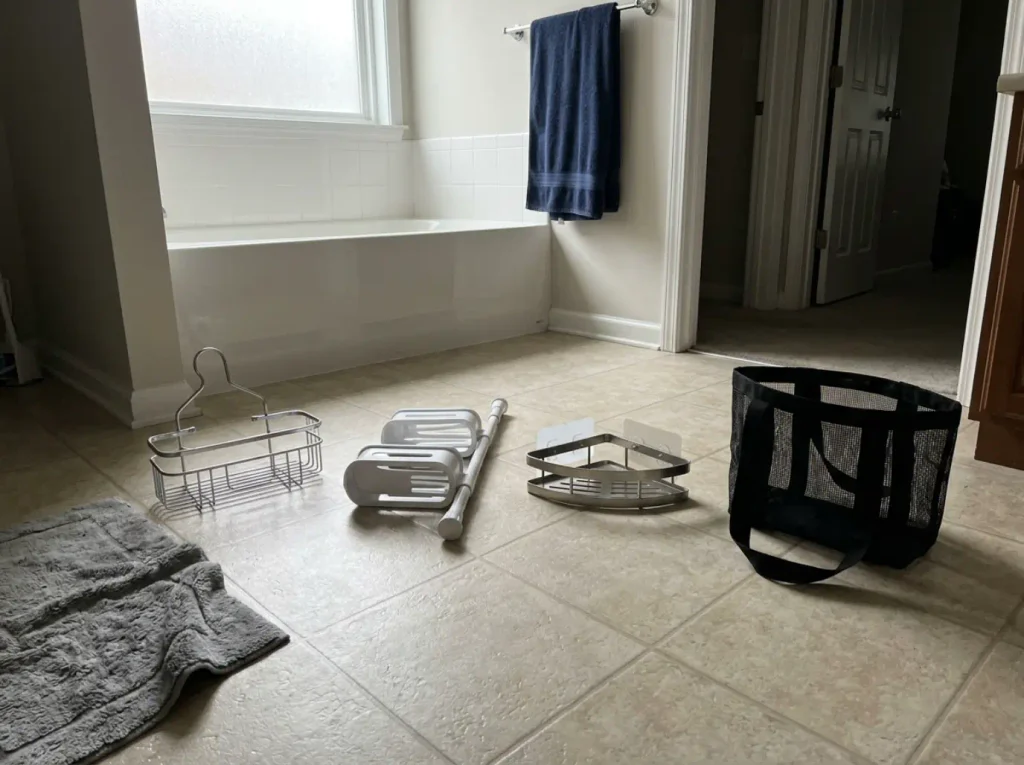
Almost everyone shops this backwards. You see a caddy you like, you buy it, and then you discover your shower cannot hold it. The variable that decides whether a caddy works is not the number of shelves or the finish or the brand. It is the surface the caddy grips, and there are only four options: your showerhead arm, your ceiling, your tile face, or nothing at all.
Sort by that first and the rest of the decision gets small. Every shower organizer on the market is really just one of those four mounts wearing a different finish. If you want the wider picture beyond product selection, the full shower and bath organization guide covers how the whole space fits together.
Here is the part that makes this worth doing before you open a product page. Each of the four types has a surface that defeats it, and that surface is usually invisible in a listing photo.
The hanging caddy needs a rigid arm. The tension pole needs a flat ceiling. Adhesive and suction need a smooth uninterrupted tile surface with no seam running through it.
The mesh tote needs nothing, which is exactly why it is the only type that cannot be defeated by your bathroom. Walk through the four below with your actual shower in front of you.
Hanging Caddies: What They Need From Your Showerhead
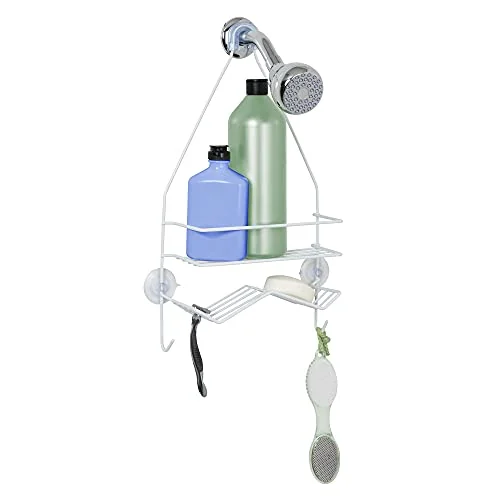
A hanging caddy drops over the shower arm, the metal pipe that comes out of the wall, and hangs there under its own weight. That is the entire mechanism. No adhesive, no suction, no cure time, nothing touching the wall. It is the highest-percentage mount in the whole category for one reason: the arm is already bolted through the wall and rated to hold a showerhead that gets yanked on daily.
The mismatch that trips people up is a handheld showerhead on a slide bar. If your head slides up and down a vertical rail, there is no fixed horizontal arm to hang from, and a hanging caddy has nowhere to go. This is the single most common wrong purchase in the category.
Same story with rain heads mounted flush from the ceiling and with wall-mount heads on a very short arm where the caddy would sit directly against the tile and rock. Look at your showerhead before you look at anything else.
Tension Poles: What They Need From Your Ceiling
A telescoping pole runs floor to ceiling and holds itself up with spring pressure at both ends. This is the same spring-loaded pole mechanism a tension rod uses across a cabinet opening, just turned vertical and given shelves. It puts four shelves of storage into a corner without touching a wall, which makes it the go-to answer for handheld setups and corner stalls, and the whole install is tool-free.
The catch lives at the top of the pole.
Textured or uneven ceilings fight the grip. A popcorn ceiling gives the top pad a crumbly, inconsistent surface to press into, and TowelExpert flags this specifically as a case where the pole may need extra tension or repositioning to hold. If your bathroom ceiling is popcorn or heavily stippled, a pole is the riskier choice, and you should know that going in rather than after you have assembled six feet of stainless in a wet room. Flat drywall or a smooth painted ceiling is what the mechanism was designed for.
Check your ceiling with your hand, not your eyes. Bathroom ceilings get repainted often enough that a lightly textured surface can read as flat under the light. Run your palm across the corner where the pole will land. If it feels like sandpaper, the pole will still work, but plan on retensioning it once a month instead of never.
Adhesive and Suction: What They Need From Your Wall
These two get lumped together because they both mount to the wall face, but they fail differently. Suction needs a smooth, non-porous surface with enough uninterrupted area for the whole cup to seat: tile face, glass, fiberglass, or finished stainless. Adhesive needs the same smoothness plus a clean dry surface plus roughly 24 hours to cure before it carries any weight.
The failure everyone repeats in reviews is a suction cup shower caddy mounted straight across a grout line. The cup cannot pull a vacuum against a recessed seam, so it holds for a day or two on friction alone and then lets go. Rosenberry Rooms names the same set of surfaces that defeat suction: grout lines, textured builder tile, unfinished wood, wallpaper, and old porous ceramic.
None of that is a defective product. It is the wrong surface, and it will do the same thing to an expensive caddy as it does to a cheap one.
So before you buy anything suction or adhesive, go measure your grout spacing. If your tile is four inches square, you have maybe three and a half inches of uninterrupted face between seams, and most caddy mounting plates are wider than that. Larger format tile, a glass enclosure, and one-piece fiberglass surrounds are where a wall-mounted shower shelf actually earns its place.
Portable Totes: The Type That Needs Nothing at All
The fourth type is the one that sidesteps the entire surface question. A mesh tote does not mount. You carry it in, you set it on the tub ledge or hang it on a hook, you carry it out.
No grout spacing to measure, no ceiling height, no cure time, no arm required. It is the only type in this guide that works in literally any shower, and I think most people writing about caddies undersell it badly because it is inexpensive. Cheap and correct are not opposites.
One safety note that no competitor in this category seems willing to state plainly, and it matters. A shower caddy is a storage product. It is rated for ten to forty pounds of bottles, not for a person. No caddy in this guide is weight-bearing in the sense that matters here.
Do not treat any caddy, however solidly mounted, as something to steady yourself on. That job belongs to a grab bar, unlike a properly installed grab bar, which is rated to support 250 pounds or more and anchored into structure rather than tile face. If steadying yourself in the shower is a real concern in your household, the caddy is not the product to solve it.
Best Shower Caddy for a Fixed Showerhead
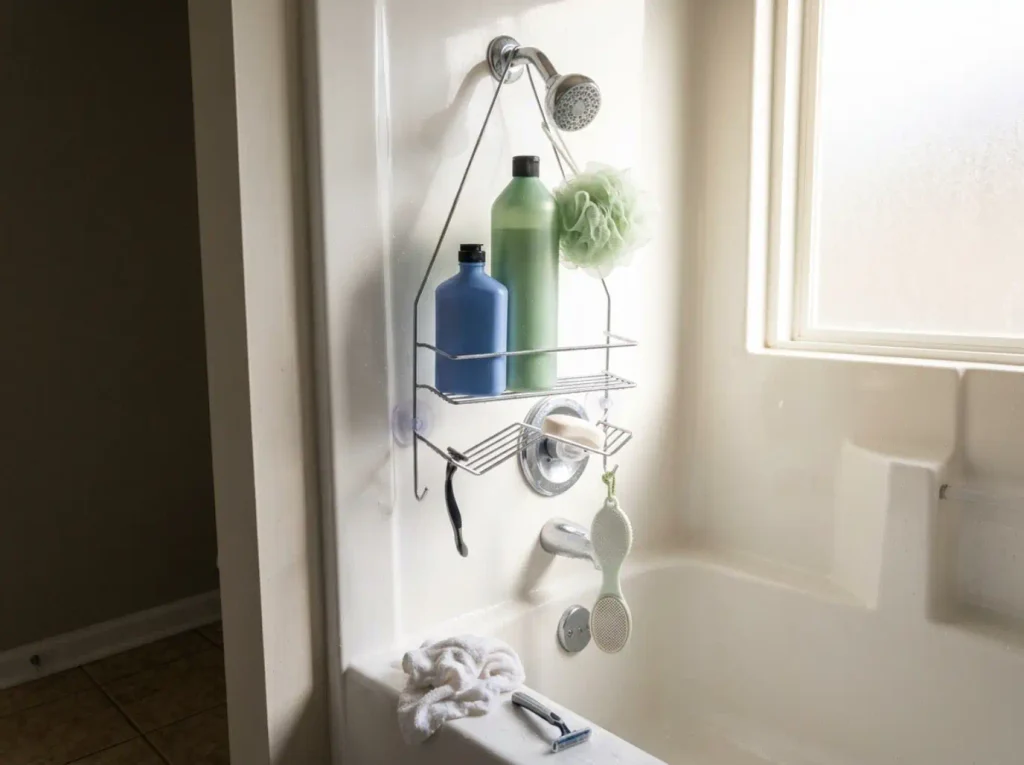
If you have a standard fixed showerhead, you have the easiest shower in this guide to solve, and you are probably overthinking it. There is already a steel arm bolted through your wall at exactly the right height, sitting exactly where you want your bottles. The right caddy hangs off it and touches nothing else. No cure time, no measuring grout, no ceiling to check, and on move-out day it comes off in one motion and leaves the wall exactly as you found it.
Before you buy anything, one free check. If your current caddy slides down the arm or rotates when you reach into it, the problem is often just a smooth arm and a missing gasket. Most hanging caddies ship with a small rubber shim for exactly this.
Find it, wrap it around the arm under the hook, and see whether that solves the whole thing for nothing. It frequently does.
The Pick for a Two-Person Shower
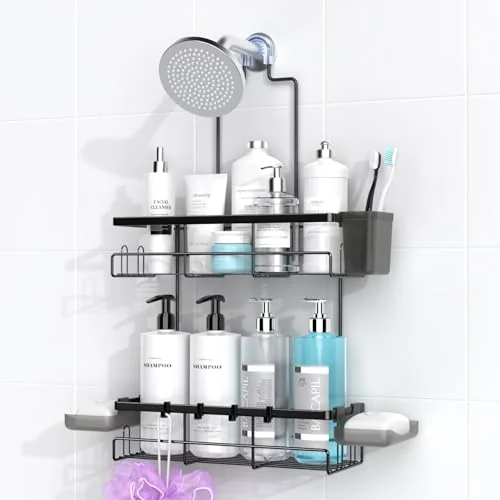
Here is the capacity math nobody states plainly. A hanging caddy rated for 40 pounds comfortably holds a full rotation of bath products for one person: shampoo, conditioner, body wash, a loofah, two razors, and a bar of soap.
That is roughly the practical ceiling for what should live on one caddy regardless of the rating, because past that point you are reaching around bottles to get to bottles. For two people sharing a shower, you need the hook count and the second tier more than you need the extra weight rating. Eight side hooks and two soap dishes is the configuration that keeps two rotations from becoming one pile.
The Pick for One Person and Fewer Bottles
If you shower alone and own four bottles, the two-tier caddy above is more shelf than you will fill, and an empty tier in a shower is just another surface collecting soap scum. One wide shelf and a built-in soap dish covers a single rotation without the extra footprint. Smaller is a feature here, not a compromise.
How to Stop a Hanging Caddy From Swinging
The one genuine complaint about hanging caddies is that they swing when you reach into them. There are two fixes and one of them is better than most people assume.
The first is the suction stabilizer that ships with many models, which pins the lower edge to the wall. It works well, but only on the surfaces from the section above: smooth tile face, glass, or fiberglass, and never across a grout line. If your wall defeats suction, the stabilizer is a piece of packaging, not a feature.
The second fix costs nothing. Load the caddy front to back by weight, with the heavy bottles on the wall side of each basket and the light items at the front. A caddy that swings is a caddy whose center of mass sits out past the arm. Push the weight back toward the wall and most of the movement stops on its own.
This is also where the “no-drill” search term earns its keep, and it is worth naming because it is the exact phrase renters use. No-drill, removable, and damage-free all point at the same intent: I want a deposit-safe setup that does not cost me my security deposit.
A hanging caddy is the literal answer. It never touches a wall surface, so there is nothing to remove, nothing to scrape, and no residue to argue about at move-out. If you want to run that same logic across the rest of the room, the rest of the no-drill bathroom storage playbook applies the same filter to the vanity, the walls, and the back of the door.
Best Shower Caddy for a Handheld Showerhead or Corner Shower
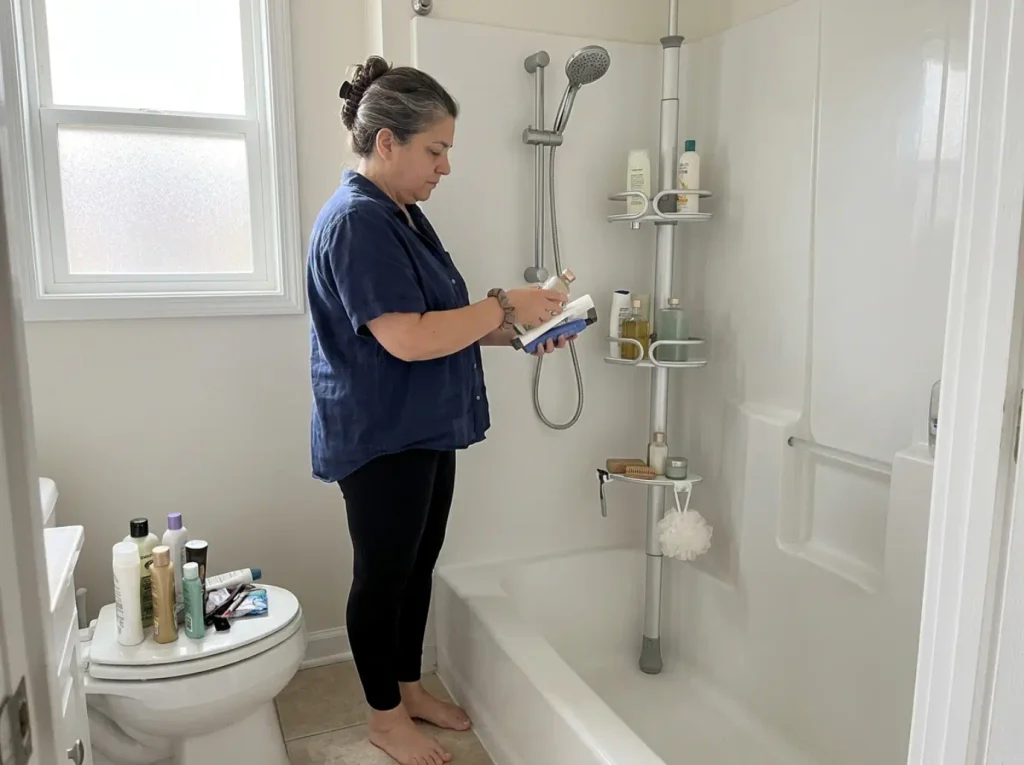
This is where most buying guides quietly fail their readers. Handheld showerheads on slide bars and corner stalls are everywhere, and the over-the-arm hanging caddy that leads nearly every top-ten list has nothing to hang from in either. If that describes your shower, you have two real answers: a tension pole or an adhesive corner shelf. They suit very different people and very different walls.
Measure Your Ceiling Before You Buy a Pole
Here is the rule that decides whether a tension pole holds or creeps, and it is the single most useful measurement in this article. Measure floor to ceiling first, then buy a pole whose stated range comfortably clears that number by a couple of inches. The pole holds itself up with spring compression, so it needs squeeze left over after it reaches your ceiling. TowelExpert puts it in assembly terms: set the pole about an inch taller than the actual span, then let the tension mechanism take up the difference.
The version of this that shows up over and over in organizing threads is the person who bought a pole sized to their exact ceiling height. Technically in range on the box. Zero spring left in practice.
It stands up fine on install day, and then it walks down the tile a fraction of an inch at a time until the top pad is dangling and the whole thing tips into the corner sometime in week one. That is not a defective pole. That is a pole with nothing to push against.
Most poles cover roughly 5 to 9 feet, or 62 to 108 inches, so a standard 8-foot ceiling sits comfortably mid-range with plenty of margin. The two situations that need checking are a low basement bathroom and a vaulted or sloped ceiling, either of which can fall outside a given model’s range entirely. Measure. It takes a minute and it is the difference between a pole that stands for years and one that becomes a return.
Measure inside the tub or stall, not on the bathroom floor next to it. Tub decks, shower pans and curbs raise the floor by anywhere from two to eight inches, and a pole ordered off the wrong measurement is off by exactly the margin it needed.
Load distribution is the other half of pole stability, and it is what separates good vertical storage from a slow lean. Individual pole shelves typically hold about 10 pounds each, which sounds generous until you realize the whole trio of full-size shampoo, conditioner and body wash only runs three to five pounds.
The number is not the limit you will hit. The problem is stacking every heavy thing on the bottom shelf because it is the easiest to reach, which puts the load below the pole’s midpoint and gives it a slow lean over months. Spread bottles across shelves instead. Heavy items near the middle, light items top and bottom.
The Stainless Pick and the Aluminum Pick
With the measurement handled, the choice comes down to material, shelf count, and how much you want to spend. The stainless option is the one that shows up as a top pick across the tested roundups, and it is built like it intends to be there in ten years.
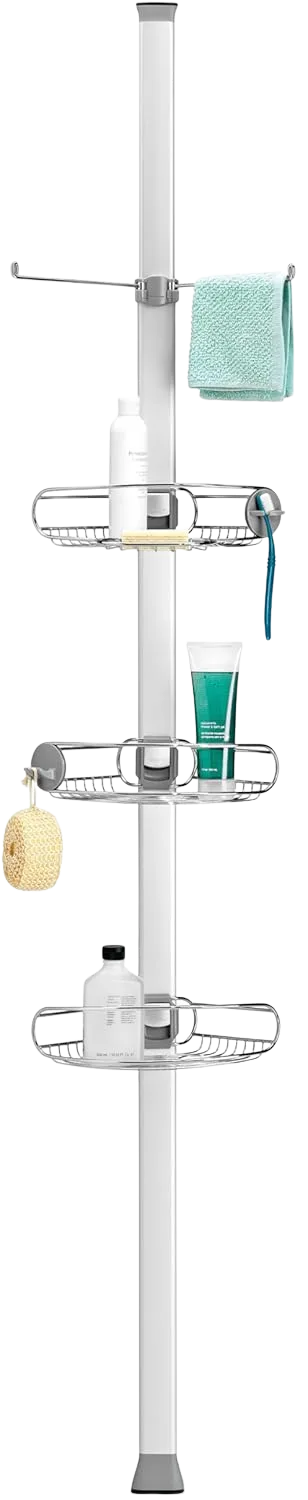
I used to treat anodized aluminum as the compromise material in this category, the thing you accept to save money. That was wrong, and the corrosion research is what changed my mind. Anodizing builds an oxide layer that repairs itself when scratched, which is the same trick that makes true stainless work.
It is not a downgrade from stainless. It is a different route to the same outcome, and it happens to cost less.

The Adhesive Corner Shelf Option and the 24-Hour Rule
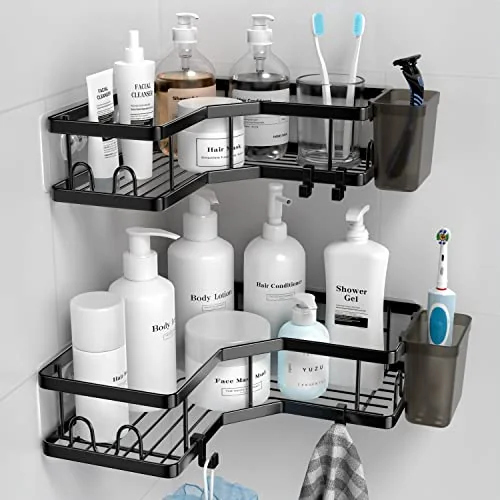
If your stall is too small for a pole, or your ceiling is fighting you, an adhesive corner shelf is the other answer for a corner shower. It needs smooth uninterrupted tile face or a fiberglass surround, per the surface rules above. And it needs one thing more, which is the piece almost nobody reads before mounting.
Adhesive pads need roughly 24 hours of cure time on a clean dry wall before you load any weight onto them. Mount it and stack full bottles on it the same afternoon and you are testing the bond at its absolute weakest point. That is the whole mechanism behind “it fell the next morning,” which shows up so often in caddy reviews that it functions as its own genre.
Almost every one of those is a cure-time mistake wearing the costume of a defective product. Wipe the wall with rubbing alcohol, press the pad, walk away until tomorrow.
For renters, adhesive is the one mount in this guide that carries genuine residue risk, so it comes with an exit plan attached. Removal goes heat first, then scrape, then solvent: two to three minutes with a hair dryer to soften the glue, a plastic scraper at a shallow angle, and rubbing alcohol on whatever is left. Never a metal blade, and never a straight yank, which is how tile face and paint come off with the pad.
Rosenberry Rooms documents the safe way to remove adhesive shower caddy residue without damaging the wall in that same sequence. Photograph the wall before you mount anything, so you have a record of what was already there.
Best Portable Shower Caddy for Dorms and Shared Bathrooms
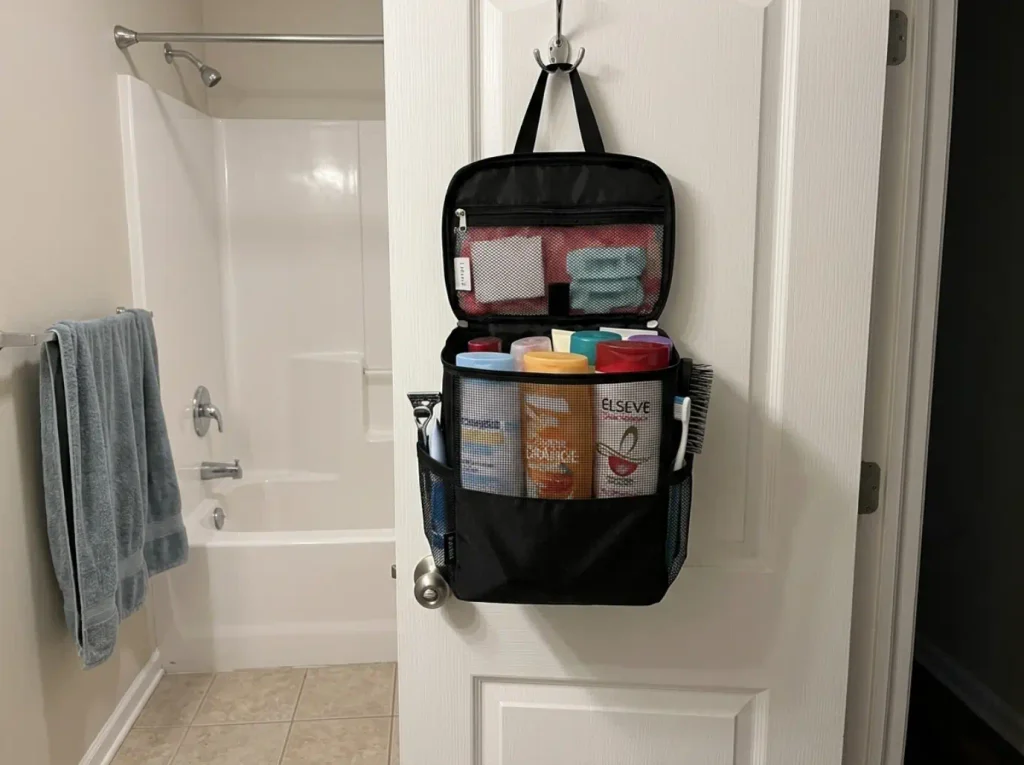
Everyone treats the mesh tote as the consolation prize, the thing you settle for when you cannot afford a real caddy. That framing is backwards, and it sends people to the wrong product constantly.
In a shared or communal bathroom, the goal was never to build a permanent system. It was to move your things in and out without leaving them sitting there for four other people to knock over, borrow, or resent. If shared-space friction is the recurring problem in your bathroom, why small bathroom storage tends to unravel again covers the same pattern across the rest of the room.
Why a Tote Isn’t Just the Cheap Option
State the rule and the confusion dissolves. Mounted caddies are for a shower that is yours long-term. Portable totes are for a shared shower, or a wall you are not allowed to touch.
Price is not the variable that separates them. Ownership of the shower is.
Once you look at it that way, a lot of bad purchases make sense. The student who mounts an adhesive corner shelf in a communal bathroom instead of buying a dorm shower caddy, and comes back to find someone else’s razor on it. The roommate who installs a tension pole in the shared bath and then has to negotiate whose bottles get which shelf.
Neither of those is a product failure. Both are permanent solutions applied to a temporary, shared space.
Zero wall contact is also the only mounting category in this entire guide with literally no deposit risk. A hanging caddy comes close, and it is genuinely excellent for renters, but it does assume the shower is yours to arrange. Even a correctly removed adhesive pad leaves some possibility of residue on a bad tile finish.
A tote touches nothing, ever. If your landlord is the kind who inspects with a flashlight, this is the category that ends that conversation before it starts.
What to Look For in a Portable Caddy
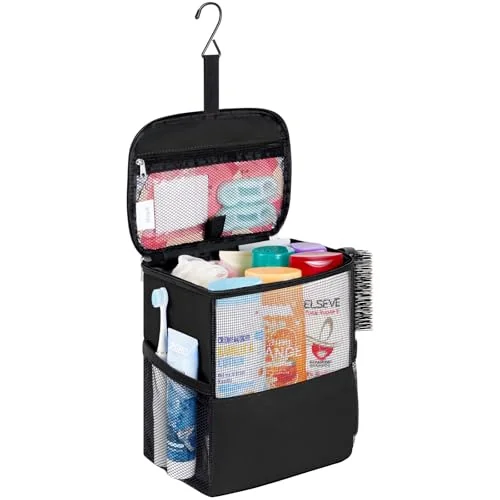
Construction matters more than it looks like it should, and it comes down to drainage. A tote that holds water becomes a mildew problem in about two weeks, because it goes from a wet shower to a dark closet or a dorm room floor with a puddle in the bottom. Mesh sides and a quick-dry mesh bottom work like oversized drainage holes, letting the whole thing air out between uses instead of holding a shallow pool where mold gets its start.
A solid-bottom plastic caddy does the opposite, and that is the whole difference between a tote you use for years and one you throw out in a semester.
Size is the other decision. A medium tote in the 9 by 8.5 by 8.5 inch range is the sweet spot: it fits in one hand, holds a full rotation plus a razor and a toothbrush cup, and hangs on a door hook between showers. Bigger totes exist and they get awkward fast in a hallway.
Also check the handles. Tote-style handles that meet at the top let you carry your toiletries and a towel in the same trip, which sounds trivial until you are doing it twice a day.
Give the tote a home the day you buy it. The reason portable caddies end up on the floor of a shared bathroom permanently is that nobody assigned them a hook. An over-the-door hook on the inside of your bedroom door takes thirty seconds and is the entire maintenance system for this product.
What Actually Holds Up Past Year One
Every caddy in this category looks the same on day one. They are all shiny, they all say rust-resistant somewhere on the box, and they all photograph identically. The difference shows up somewhere between month twelve and month twenty-four, which is comfortably after the return window closed and roughly when you have stopped thinking about it. This is the section that decides which of the picks above was actually worth the money.
The 12-to-24-Month Rust Clock
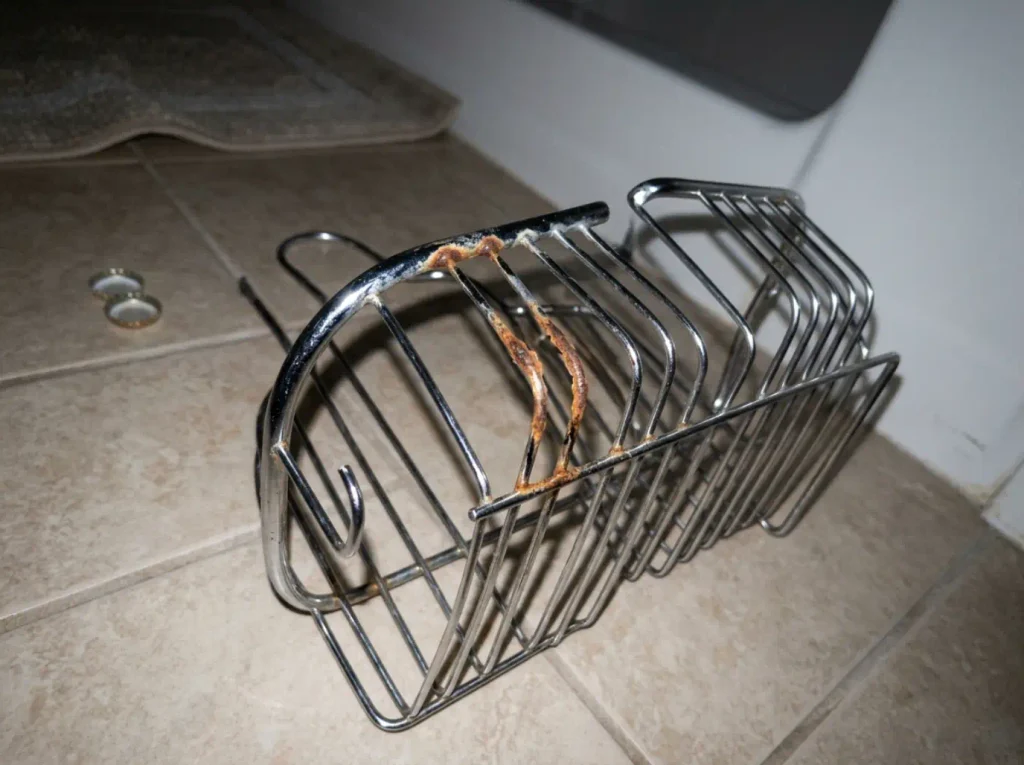
Chrome-plated steel typically starts corroding at seams and chip points within 12 to 24 months of regular shower use. That is the consensus across the forum threads where people post photos of what their supposedly rust-proof caddy looks like two years in, and it is remarkably consistent.
The mechanism is simple: chrome plating is a thin layer over ordinary steel. As long as it is intact, nothing happens. The moment it is scratched through, water reaches the steel underneath and rust spreads outward from that one point.
What starts the clock is a scratch, and a shower is full of things that scratch. Razors dropped into a shower basket. Metal bottle caps set down on a cross-hatched wire shelf. The caddy itself knocking against tile every time someone bumps it.
None of those feel like damage. All of them are, and the failure is completely invisible on day one, which is exactly what makes this hard to shop for. You cannot look at two caddies in a photo and tell which one is going to be fine.
The story that keeps surfacing in these threads is the caddy that looked identical to real stainless in the listing, sailed through its first year without a mark anyone noticed, and then started leaching a rust stain down the tile from a single scratch near a razor hook. By the time it is visible, the plating is already compromised across the surface, and there is no fixing it. You replace it.
What “Stainless Steel” Actually Means on a Listing
Here is the shopping rule that comes out of all this, and it is usable in about ten seconds on a product page. True 304-grade stainless steel, roughly 18% chromium and 8% nickel, forms a self-repairing oxide layer that resists corrosion indefinitely. Scratch it and the layer reforms.
Anodized aluminum does the same thing by a different route. Those two materials are the ones that beat the clock.
The problem is that “stainless steel” on a listing is not a grade. Plenty of budget caddies use lower grades that still rust, and some are chrome-plated steel described loosely enough to imply otherwise. This is why “stainless steel” in scare quotes has become shopper shorthand in these threads for a claim that turned out to mean nothing once rust appeared.
So look for the number. If a description says 304, that is a specific verifiable claim. If it says only “stainless steel” and the price is unusually low for the size, treat the rust-resistance claim as marketing rather than a spec.
Search the reviews rather than reading them. Type “rust” into the review search box on any caddy listing and read what comes back. Reviews at the 12-month mark are the only real durability data available for this category, and they are far more useful than anything in the product description.
The Maintenance That Buys You Years
Two habits meaningfully extend the life of any metal caddy, and both take under a minute. First, do not store razors sitting in a basket. Hang them on the hooks they came with, blade side out, so the metal edge is not resting against the caddy’s finish. Nearly every rust-from-a-scratch story starts at a razor hook or a loofah hook, or the spot right under one.
Second, wipe the caddy dry maybe once a week, particularly the seams and the underside of the shelves where water sits after everyone is done showering. Standing water at a seam is where corrosion starts even on good material.
The bigger habit is to look at it occasionally. A caddy that is starting to go gives you warning: a faint orange freckle at a weld, a dull spot where the finish has worn thin, a shelf that has started to feel gritty. Catch it there and you replace on your schedule instead of finding a rust ring baked into the tile grout. The same material test applies elsewhere in a humid bathroom, and the same material test applies to under-sink organizers, where the humidity is lower but the airflow is worse and cheap coated wire fails just as reliably.
When Spending More Actually Buys You Something

The honest answer is that most people are fine with the budget pick, and the guides that will not say so are usually the ones earning a larger commission on the expensive one. Multiple tested roundups have landed on budget picks outperforming pricier ones in daily use, which should tell you that price is a poor proxy for quality in this category. But there are exactly two situations where the money buys something real, and they are worth naming precisely so you can tell whether you are in one.
When the Budget Pick Is Genuinely Enough
For one person in their own shower, a basic hanging caddy or a mesh tote covers roughly 90% of what a premium pick does. You have four or five bottles. They need to be off the tub deck, reachable, and draining. That is the entire job description, and it does not require a stainless pole that costs more than the towels.
The variable that would justify more money is capacity, and capacity means shelf count and hook count, not brand and not finish. If your current rotation fits on one shelf with room to spare, more shelves buy you air. Skip it.
And here is the piece that saves the most people the most money. If your caddy is failing right now, check whether the problem is the caddy or the surface before you buy a replacement. A suction caddy on a grout line, an adhesive shelf that was loaded on day one, a pole sized to the exact ceiling: none of those get fixed by spending more.
Buy the identical failure at triple the price and it fails on the same schedule. A budget shower caddy on the right surface outlasts a premium one on the wrong surface every time. Go back to the first section, identify what your shower can actually grip, and then shop.
The Two Situations That Justify Spending More
The first is a shared household. More people means more bottles, and more bottles means you need shelves to distribute them across rather than one basket everyone digs through. A four-shelf pole earns its price in a two- or three-person shower where a single-shelf hanging caddy would be overloaded and permanently annoying. This is the capacity argument, and it is legitimate.
The second is material, but only if the shower is genuinely wet and heavily used. A guest bath that runs twice a month does not care what its caddy is made of. A primary shower running two or three times a day, with razors and a real bottle count, will find the weak point in chrome plating well inside that 12-to-24-month window. That is where true stainless or anodized aluminum pays back, because you buy once instead of every other year.
Where the money buys nothing: finish, brand name, and features you will not use. A second soap dish you never fill is not capacity, it is a surface that grows soap scum. Matte black looks great for exactly as long as it takes hard water to spot it.
Be honest about whether you are buying a real upgrade pick or just a nicer finish. If you want to run that same filter across the rest of the room rather than just the shower, the same worth-it filter applied across the whole bathroom sorts the zones the same way.
Conclusion
Match the caddy to what it grips: your showerhead arm, your ceiling, your tile face, or nothing at all. That single decision matters more than which model you end up with, and it is the one nearly every buying guide skips.
Measure before you order. Floor to ceiling for a pole, with a couple of inches of margin left over. Smooth uninterrupted face area for anything adhesive or suction. Thirty seconds of measuring prevents the most common return in this category.
For one person in their own shower, the budget pick is genuinely enough. Capacity is what justifies spending more, and finish never is.
In three months, look at the seams and any spot where the caddy has been scratched or knocked. Surface rust starting at a chip is the early signal of that 12-to-24-month clock, and catching it there means you replace on your own schedule rather than discovering a rust ring on the tile.
Start by looking at your showerhead and your ceiling, not at a product page. Once you know which type your shower can actually hold, the field narrows to two or three options and the whole thing stops being a gamble.
Frequently Asked Questions
01Do shower caddies rust?
Chrome-plated steel caddies typically start corroding at seams and chip points within 12 to 24 months of regular shower use. True 304-grade stainless steel and anodized aluminum both form a self-repairing oxide layer and resist corrosion far longer. The grade in the listing matters more than the words stainless steel.
02How do you keep a shower caddy from falling?
Match the mount to the surface, then respect the cure time. Suction needs smooth non-porous face area with no grout line under it, adhesive needs a clean dry wall and roughly 24 hours before you load any weight, and tension poles need a couple of inches of squeeze against a smooth flat ceiling.
03Are adhesive shower caddies better than suction cup ones?
Adhesive holds more weight and holds it longer, but it carries residue risk on removal. Suction leaves nothing behind and can be repositioned, though it fails on grout lines, textured tile and older porous ceramic. For a rental, that trade-off usually favors suction or skipping wall mounts entirely.
04What size tension pole shower caddy do I need?
Measure floor to ceiling, then pick a pole whose range clears that measurement with a couple of inches to spare. Most poles cover roughly 5 to 9 feet, so a standard 8-foot ceiling sits mid-range. A pole sized to your exact height has no tension left and creeps down within days.
05Can you use a shower caddy in a rental without losing your deposit?
Yes. Hanging over-the-showerhead caddies and portable mesh totes never touch the wall at all. If you do use adhesive, remove it with 2 to 3 minutes of hair-dryer heat, then a plastic scraper at a shallow angle, then rubbing alcohol on any residue. Photograph the wall before you start.