





















In this article
You already cleared this counter once. Maybe it was a Saturday, and for one glorious evening you could see the whole butcher block. By the next weekend the mail was back, the keys landed by the toaster, and two mugs were holding down the corner again. That backslide is the most repeated story in kitchen organizing threads, and here’s the thing worth knowing before you start: the fix is almost never a bigger bin or a prettier tray. Counters re-clutter because they are a convenient default, not because you’re messy. This guide walks you through the decision process that actually clears the counter, and the reset habit that keeps it clear.
Quick Answer
Declutter kitchen counters in six moves, then protect the clear space with a daily habit:
- Clear the entire counter onto a table.
- Sort every item into keep, relocate, or toss.
- Give each keeper a designated home off the counter.
- Leave out only genuine daily-use items.
- Corral mail and paper as its own category.
- Run a two-minute nightly reset to hold it.
Why Your Kitchen Counters Keep Cluttering
Before you clear anything, it helps to understand why the same counter fills back up no matter how many times you tidy it. If you skip this part, you’ll do the work and watch it undo itself in two weeks. The mechanism is simple once you see it, and it’s the reason the rest of this guide is built around decisions and habits instead of storage bins.
The counter is a landing zone by default
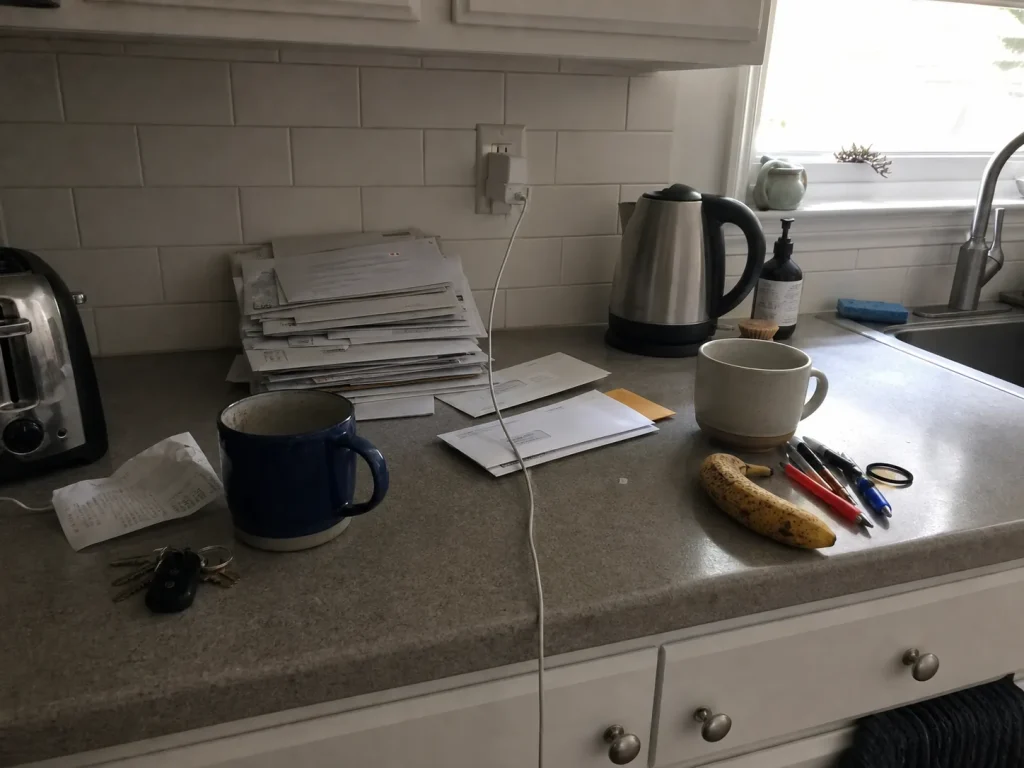
Your kitchen counter is usually the first flat surface you reach when you walk in with your hands full. So it collects things. Mail, keys, the receipt from the pharmacy, the mug you meant to rinse. Organizing communities have a name for this: the landing zone, the spot everything gravitates to because it’s convenient. Nobody dumps a full inbox on the counter at once. It drifts, one envelope and one mug at a time, in layers too thin to notice, until a stretch you could actually prep on just isn’t available anymore.
That’s why the counter feels like it clutters itself. It kind of does. The fix isn’t more willpower, it’s removing the reasons the counter is the easiest place to set something down.
Every item out is an unmade decision
Here’s the part that explains the two-week backslide. Every object sitting on your counter is a decision you haven’t made yet: keep it here, move it somewhere, or get rid of it. Stack up enough unmade decisions and you get real decision fatigue, the same brain-drain that stalls any declutter. It’s the reason clearing the same counter feels harder the second week than the first. You’re not lazy. Your brain is treating the pile as an unresolved to-do every time you walk past it, and it’s the same decision fatigue that stalls any declutter session once it grows too big to face.
There’s a compounding effect that makes this worse over time. The first mug you leave out lowers the bar for the second, because a counter that already has something on it doesn’t feel violated by one more thing. A completely clear counter, on the other hand, makes you hesitate before you set anything down.
That’s why the drift accelerates once it starts, and why “just be tidier” never works as a fix. You’re fighting the physics of a surface that has already given itself permission to collect.
Clear the decisions and the counter clears with them. That’s the whole game, and the steps below are just a reliable way to make those decisions fast.
Start by Clearing the Entire Counter

You can’t decide what belongs when it’s buried in what doesn’t. The first move is physical and a little dramatic: pull everything off the counter and put it on the kitchen table or an empty stretch nearby. Everything. The goal is a bare surface, because a bare counter resets your eye and turns every item into a deliberate choice about whether it earns a spot back.
Pull everything off, then wipe
Once the counter is clear, wipe it down before a single thing goes back. This isn’t a cleaning tangent. A clean, empty surface quietly raises the bar for what you’ll set on it, and it gives you a reference point for every decision that follows. From here you’re adding back, not digging out. Watching someone do the full clear-and-sort in real time makes the motion obvious, and this short walkthrough shows exactly that.
Why half-measures fail
The reason “I’ll just tidy around the edges” never works is that you’re organizing the clutter instead of removing it. You shuffle the same items into neater piles and call it done, and neat piles are still piles. It will look worse before it looks better, because now your whole counter’s contents are spread across the table. That’s normal. Push through it.
Set a timer for the clear-off, not the whole project. Fifteen minutes to strip the counter is doable on a weeknight. The sorting can happen at the table while dinner cooks, so the counter is never held hostage by a big all-day reorganization you keep postponing.
Sort Every Item with a Keep, Relocate, Toss Rule
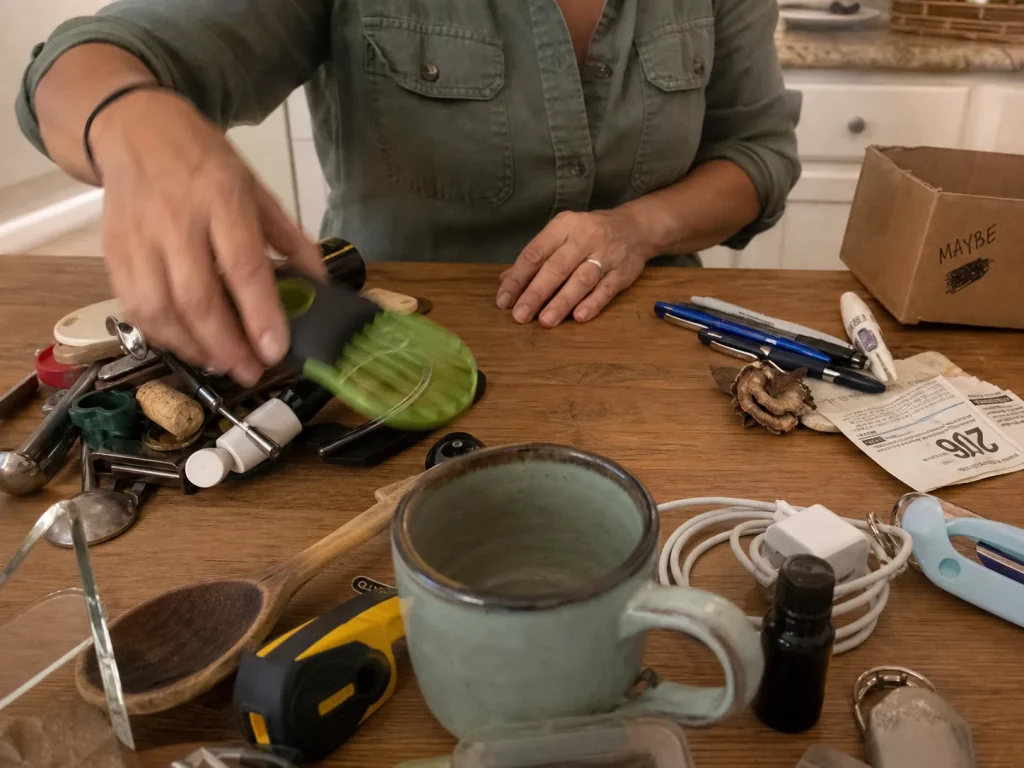
“Get rid of what you don’t use” is useless advice the second you’re holding the waffle maker you’ve used twice but might use again. You need a process for the ambiguous stuff, not a guilt trip. Sort everything on that table into three groups: keep on the counter, relocate elsewhere in the kitchen, or toss. Most items sort themselves in a second. The rest go through a few quick filters.
The frequency filter
Start with frequency, because it settles most items fast. Professional organizer Aaron Traub’s three-question test is the cleanest version: Do I need this? Have I used it in the last 6 to 12 months? Would I rather have this item or the space it takes? Say them out loud for anything you’re unsure about. The third question is the one that does the heavy lifting, because it reframes the object as a trade against something you actually want, which is a clear counter.
I used to tell people the rule was simple: if you haven’t used it in a year, it goes. In practice, that rule freezes people the moment they hit duplicates and sentimental items, so now I run the survivors through two more checks before anything earns a spot.
The duplicate and elsewhere-home checks
Anything that passes the frequency filter gets two more questions the usual advice skips. First, the duplicate check: do you already own two of this? The second bottle opener, the backup can opener, the third pair of kitchen scissors. Duplicates are counter clutter wearing a disguise, because each one feels useful on its own. Keep the best one, relocate or toss the rest.
Second, the elsewhere-home check: does this already have a spot in a drawer or cabinet? If it does, the copy on the counter isn’t a real need, it’s just an unmade decision you’ve been walking past. Put it away where it already lives. This one check clears a surprising amount of surface, because so much counter clutter is stuff that already has a home you’ve stopped using.
What to do with the “maybe” pile
You’ll be left with a small maybe pile: the duplicates you’re not ready to release, the seasonal gadget, the thing with a little sentimental weight. Don’t let it stall the whole session and don’t force it onto the counter. Give it a holding zone instead. Put it in a box, write today’s date on it, and set a reminder to revisit in 30 days. If you didn’t reach for anything in that box within the month, you have your answer. Sentimental items are their own category here, and if that’s where you get stuck, the sentimental keepers that stall every sort deserve their own slower pass rather than a rushed counter decision.
Label the maybe box with the date it can be opened, not the date you packed it. “Open after August 12” is a decision you already made; a box marked “misc” is a decision you’ll keep avoiding until it becomes permanent counter backup in the cabinet.
Give Every Keeper a Home Off the Counter
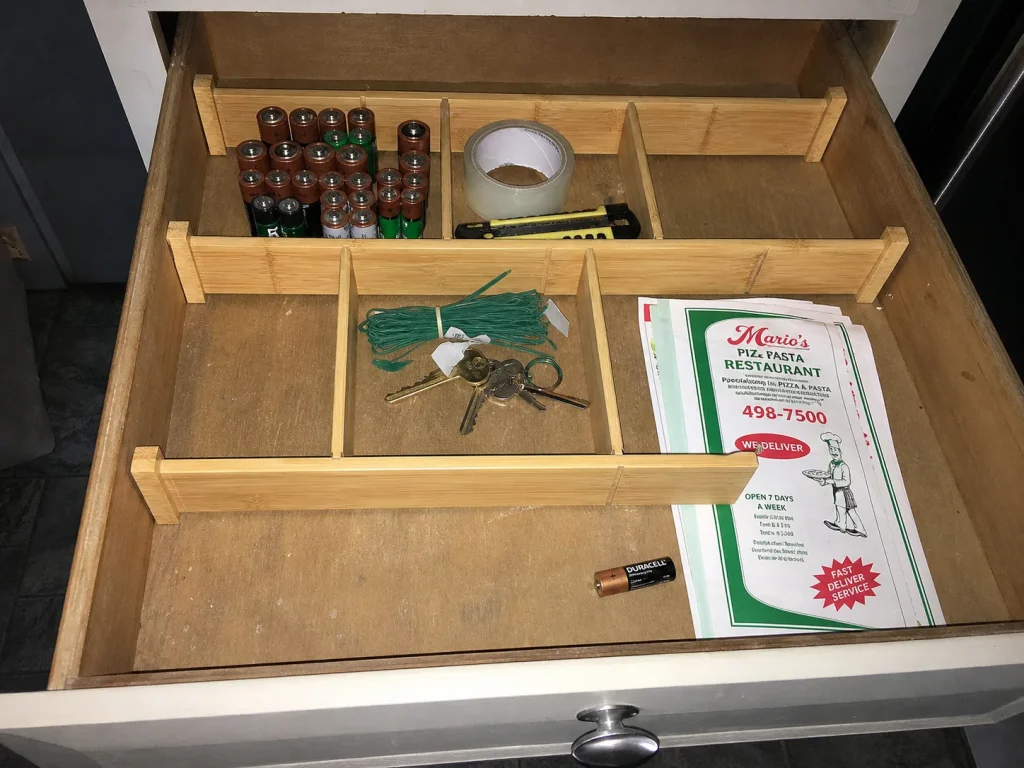
A counter clears itself once everything that stays in the kitchen has somewhere else to be. The relocate group from your sort now needs real addresses, because if the relocated pile just becomes a drawer avalanche, you’ve moved the problem instead of solving it. Once each activity has a home that isn’t the counter, the counter stops being the default drop spot and it actually starts to feel wrong to leave things there.
Give the junk drawer a rule per section
The junk drawer, or the everything drawer as some threads call it, is where relocation usually goes to die. Dump the relocated items in loose and within a week it’s one undifferentiated pile again. The fix is a rule for every section: batteries here, tape and twist ties there, takeout menus in the back. The one thing that kills a junk drawer every time is a “miscellaneous” compartment (there’s always a tempting one), because a catch-all section quietly eats the whole drawer. Give every zone a job and no zone the job of “whatever.”
Free dividers before you buy
Before you buy anything, cut a piece of cardboard or repurpose a shoebox to split the drawer into compartments. It’s free, it works, and it’s the swap budget organizing threads reach for first. If the cardboard version proves the layout works and you want something sturdier, a set of adjustable dividers is the low-cost upgrade. The SpaceAid Bamboo Drawer Dividers expand to fit a standard kitchen drawer without measuring perfectly, so each relocated category gets a fixed compartment instead of sliding into the next one. They won’t stop a drawer that has no rules, though. The dividers only hold if every section has a job. For the bigger picture beyond this one pass, a systems-first counter setup covers how the zones fit together.
Decide What Actually Earns Counter Space
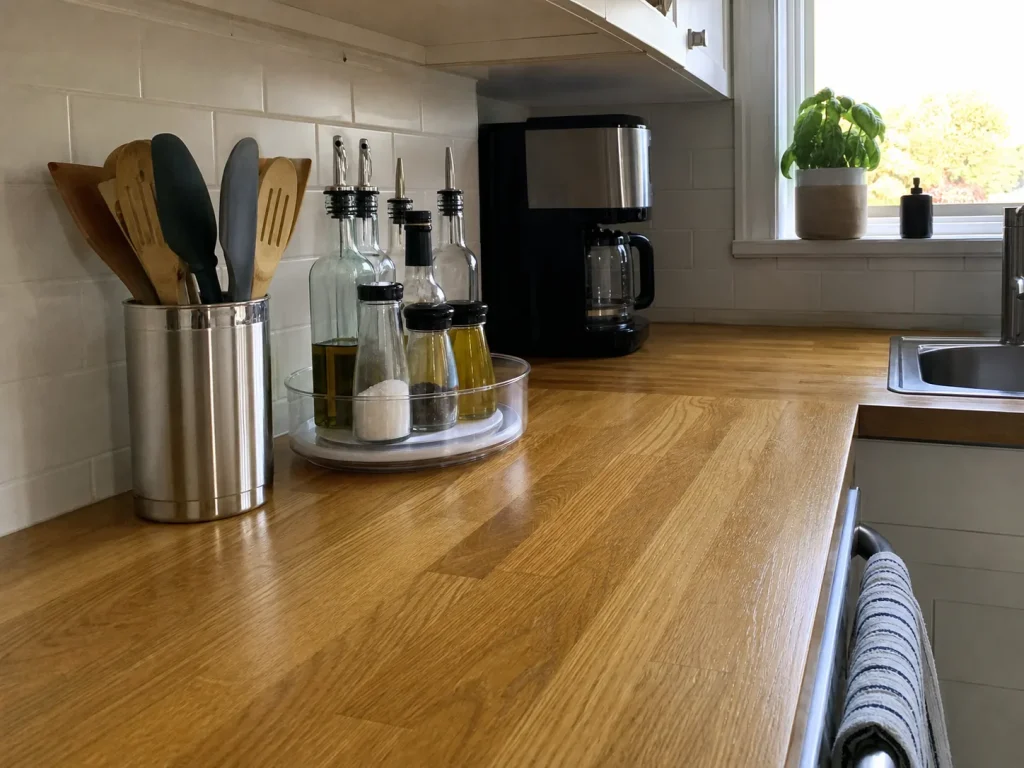
The counter isn’t storage. It’s your prep zone, borrowed by whatever crept onto it. So the question for everything in your keep pile is narrow: does this earn a permanent spot on the best flat surface in the kitchen? For most items the honest answer is no, and that’s fine, because they have homes now.
The daily-driver test
Only genuine daily drivers, the handful of things you truly use every single day, earn permanent counter space. Frequency decides this, not size and not looks. A small decorative item you never touch loses to a bulky appliance you use every morning. Organizer Amélie Saint-Jacques makes the one sensible exception: heavy daily-use appliances like the coffee maker or the stand mixer stay out, because hauling them out of a low cabinet at 6 a.m. is how a good system dies by week two.
The conventional wisdom is to hide every appliance for a clean look. In practice, hiding the ones you use daily just guarantees you’ll leave them out anyway, so keep the true daily appliances on the counter and send the rest to a cabinet.
Rotate the once-a-week appliances out
The air fryer you use on weekends, the blender for the occasional smoothie, the waffle maker from the frequency test earlier: none of these need a weekday counter footprint. Rotate them into a cabinet, or a dedicated appliance garage if your kitchen has one, and pull them out when you need them. If cabinet space is the bottleneck, a cabinet system that hides the once-a-week appliances is worth setting up before you resign yourself to a crowded counter.
Consolidate the survivors into one object
Whatever does earn a spot should read as one object, not a scatter. Loose utensils spread across the counter invite more scatter; the same utensils standing in one utensil crock hold the line. An empty jar or a wide mug works for free, and if you want something sturdier that wipes clean, the Oggi Stainless Steel Utensil Holder has a small footprint that suits a compact counter in a small kitchen, though a heavy fistful of utensils can make the lightest crocks tip. The same logic applies to the oils, salt, and condiments that live next to the stove. Four or five scattered bottles become one tidy zone on a turntable. A cake stand or large plate does the job, and the OXO Good Grips Lazy Susan Turntable spins them into reach without you shoving bottles around, as long as your tallest bottle doesn’t overhang the edge and catch on the backsplash.
Corral Mail and Paper Before It Piles Up
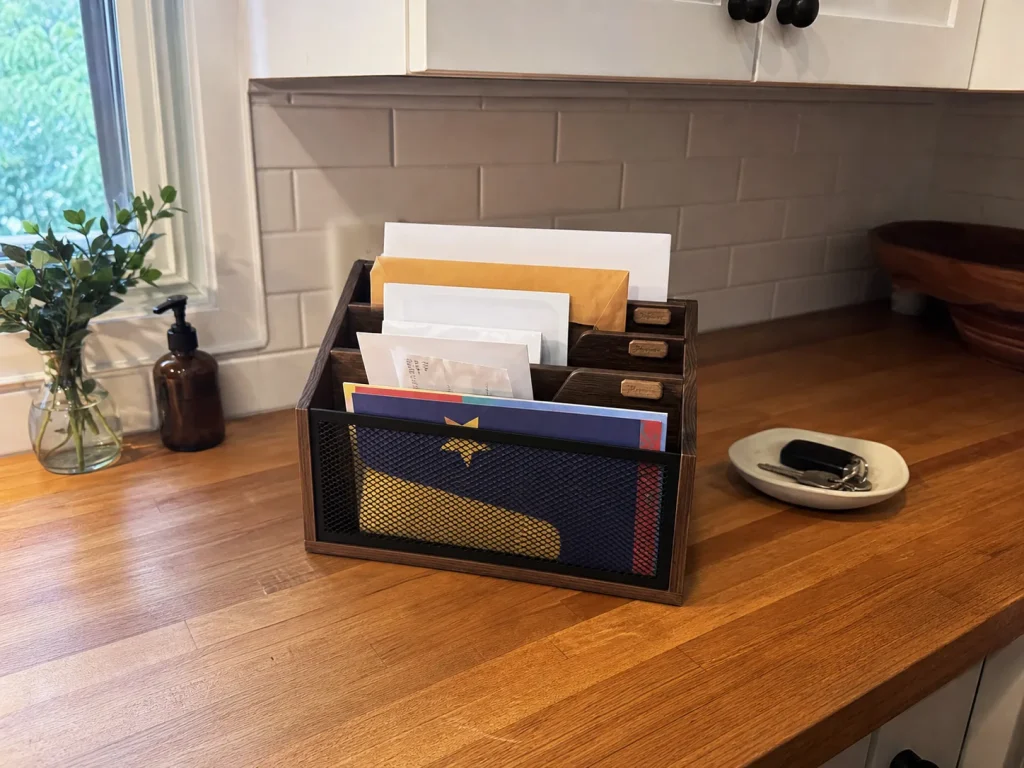
Mail is the category that regrows fastest, so it earns its own step. Paper clutter is the classic landing-zone offender: it arrives daily, it feels important, and it stacks up in the exact spot you want clear. Handle it as its own system or it will quietly rebuild the whole pile by itself.
One mail pile just defers the decision
Here’s the trap. You designate a single spot for mail, a bin or a tray, and it feels organized for a week. Then it fills, because a single catch-all pile doesn’t eliminate the sorting decision, it just defers it to later. And later never comes. You re-declare the same pile “organized” and abandon it again. That’s the most common mail failure in organizing threads, and it’s why one bin is never enough.
I used to tell people a single mail bin was plenty. After enough of those two-week-backslide stories, I switched to sorting at drop-off instead of deferring it, because the decision you make the moment mail lands is the only one that actually sticks.
Pre-sort by category at drop-off
The move that works is pre-sorting the moment mail hits the counter, into a few fixed categories: needs a signature, bills to pay, receipts to keep, kid and school paper. Professional organizers with NAPO recommend sorting mail into categories the moment it lands rather than building one undifferentiated stack. A shoebox or a drawer tray with hand-labeled sections does this for free. If you’d rather keep it upright and visible, the freestanding YINMIT Mail Organizer Countertop sorter has separate slots that enforce the categories, and because it stands on the counter with nothing mounted, it’s a no-drill option that suits renters who can’t put holes in the wall. The honest caveat: a slotted sorter still needs you to empty it, so pair it with a weekly toss of the recycle slot. And if mail doesn’t really need to live in the kitchen at all, move mail off the counter to a drop spot by the door and the counter never sees it.
Know How Much Counter to Leave Empty
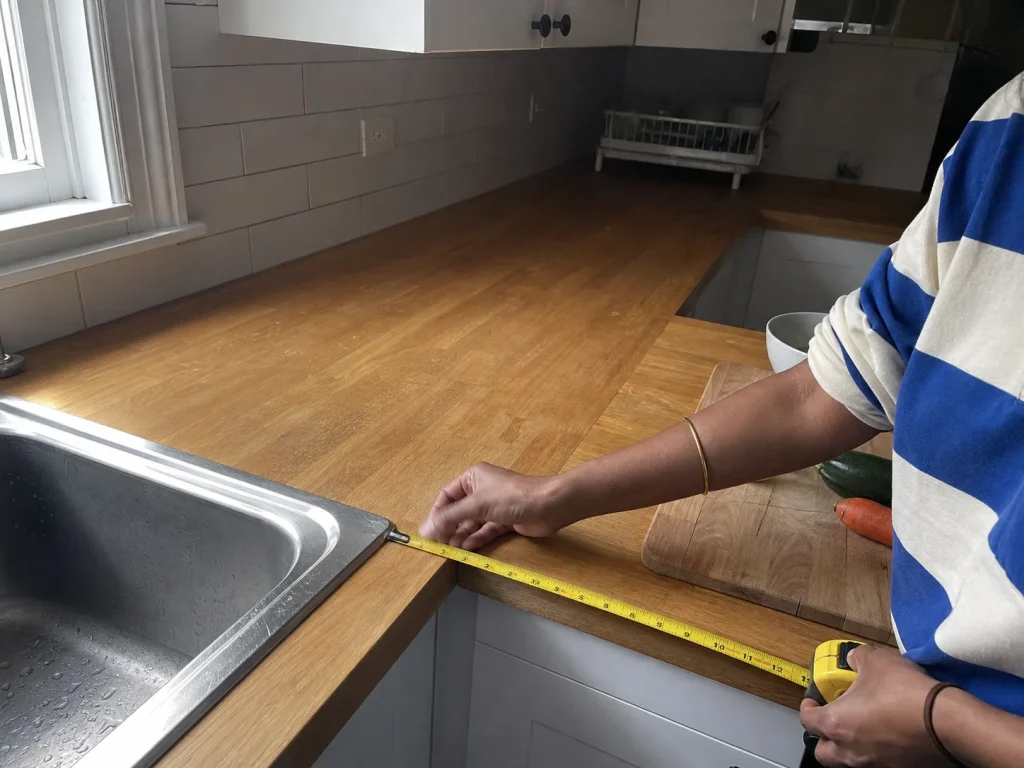
“Keep it clear” stays vague until you know what clear actually means. There’s a real benchmark, and once you’ve measured your own counter against it, you stop treating the empty stretch by the sink as decoration space and start protecting it as the working surface it’s meant to be.
The prep-zone benchmark next to the sink
The clearest standard comes from kitchen design, not organizing blogs. Aim for a continuous clear stretch of counter beside the sink, wide enough to lay out a cutting board, a bowl, and your ingredients in one uninterrupted run. If you can’t do that, you don’t have a working prep zone yet, and that empty space is the first thing to protect, not the first thing to decorate. The National Kitchen & Bath Association’s minimum prep-zone clearance sets specific clear-space targets on both sides of the sink, with more room on your dominant-hand side.
The reason to measure both sides of the sink separately is that they do different jobs. One side is your set-down space for dirty dishes and things coming out of the sink; the other is your working prep run. Load up the prep side with a knife block and a paper-towel stand and you’ve technically kept the counter “organized” while wrecking the one stretch you actually cook on.
That’s the trap of organizing by appearance instead of by function. The clear space isn’t empty because it looks better empty. It’s empty because that’s the space doing the work.
Measure your actual clear run once. It reframes every future decision as this item versus that empty inch, which is a much easier call than a vague “should I keep this?”
Why clutter piles in the unusable spots
Notice where your clutter actually collects. It’s often the stretch under a low cabinet or in a corner with tight overhead clearance, a spot that was never really usable for prep in the first place. So it becomes a dumping shelf by default. Naming that helps, because you stop trying to keep the wrong spot clear and start protecting the stretch that matters. You don’t need to renovate to hit the benchmark either. You hit it by removing, which is free and completely reversible, so it works whether you own or rent.
Keep Counters Clear with a Reset That Survives Real Life
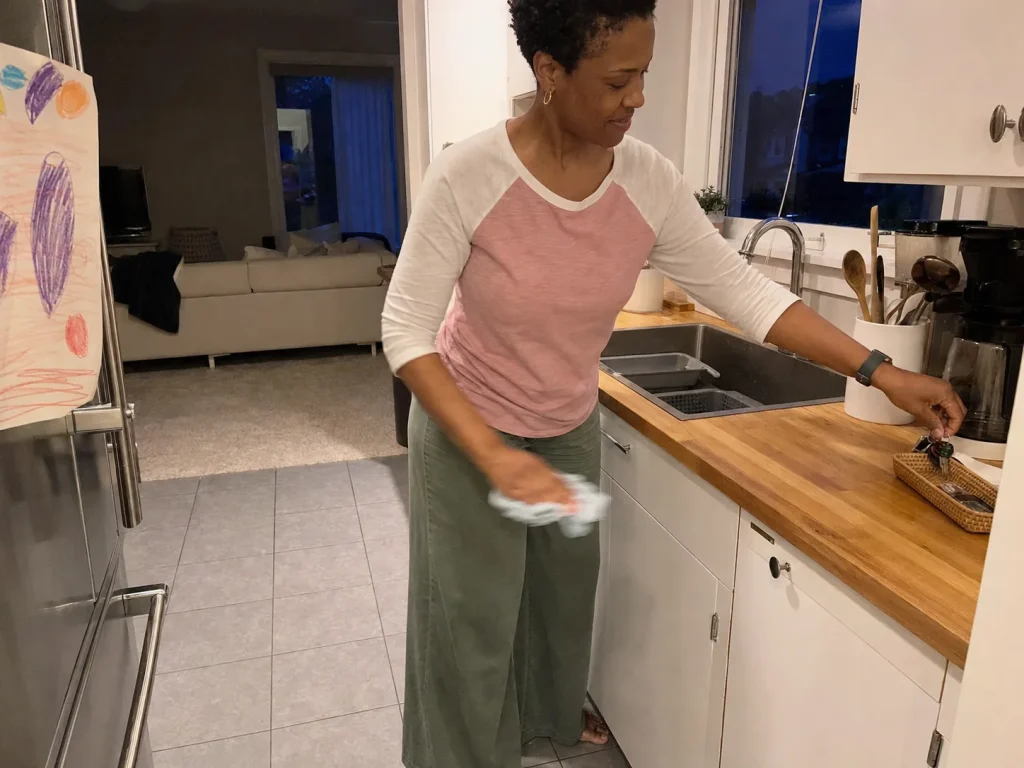
The clean counter isn’t the finish line. Tuesday night is. A reset habit is what turns a one-time declutter into a counter that’s still clear in three months, and it has to survive a household where your partner drops keys wherever and the kids abandon homework mid-counter. Build for that reality, not for a photo.
The two-minute nightly reset
Every night, spend two minutes returning whatever drifted onto the counter to its designated home. That’s it. Two minutes, tied to a cue you already have, like right after you load the dinner dishes. The reason this works where a big weekly cleanup doesn’t is that daily drift never gets a chance to compound into a decision-fatigue pile. You’re resetting five items, not fifty. Attach the reset to the clean state immediately, because the backslide happens specifically when nothing keeps the “after” from drifting.
One-in-one-out as the gatekeeper
For anything new that wants counter space, run one-in-one-out: something new earns a spot only when something old gives one up. It’s the gatekeeper that stops slow re-accumulation, the drift that rebuilt your pile the first time. This is less a chore than a question you ask at the moment a new gadget shows up, and asking it once is cheaper than another full declutter in six months. For a maintenance rhythm that carries past the kitchen, the three-month reset that keeps any room from sliding back uses the same logic at the whole-home level.
Build for the household you actually have
Here’s where most systems break: they assume everyone will follow the rules perfectly, and nobody does. Don’t fight it. Set up one designated catch-basket at the edge of the counter for other people’s stray stuff, the keys and the receipts and the mystery cables that aren’t yours (there are always mystery cables). It’s the “close enough” version of the system, and close enough is what survives real people. A shared space needs its users involved, so a basket that contains the chaos beats a filing system nobody else respects. It matters beyond looks, too. A cluttered kitchen is linked to more snacking and higher daily stress, so the reset protects your evenings, not just your countertop.
Empty the household catch-basket once a week on a set day, not when it overflows. If it overflows first, it stops being a catch-basket and becomes a second landing zone, which is the exact thing you just spent a Saturday eliminating.
The Counter That Stays Clear
Clearing your kitchen counter for good comes down to three things. Counters re-clutter because they’re a convenient default, not because you lack discipline, so you remove the reason rather than just the pile. The declutter itself is a decision process, frequency then duplicate then elsewhere-home then a dated maybe box, not a one-time sweep. And the clean counter only holds if a two-minute reset is attached to it and the system is built to survive a household that won’t follow the rules.
Give it the three-month test: look at what has crept back onto the counter. Those categories are telling you they still need a designated home, not that you failed. Fix the home, don’t restart the project.
Clear one counter tonight and give just the mail a home. Get that holding for a week. Then take the next category.
Frequently Asked Questions
01How do I keep my kitchen counters clutter-free for good?
Attach a two-minute nightly reset to the clean counter and use one-in-one-out for anything new. Counters stay clear when every item has a designated home to return to and a daily trigger sends drifted items back. A one-time clear without a reset habit reverts within about two weeks.
02What should you not keep on your kitchen counter?
Anything you don’t use daily. Small appliances used once or twice a week, duplicate tools, unsorted mail, and “just in case” items belong in a cabinet, a drawer, or gone. Only genuine daily drivers, plus heavy daily-use appliances like the coffee maker, earn a permanent spot.
03How do you declutter kitchen counters when you have too much stuff?
Clear the entire counter first, then sort every item with a frequency test, a duplicate check, and an elsewhere-home check. Box anything you’re unsure about, date it, and revisit in 30 days. Sorting against an empty counter makes each decision deliberate instead of automatic.
04How much of the kitchen counter should stay empty?
Enough for a continuous prep stretch next to the sink, with room to lay out a cutting board, a bowl, and your ingredients in one run. The National Kitchen & Bath Association sets clear-space targets on both sides of the sink. If clutter eats into that, it’s a workflow problem, not a styling one.
05Why do my kitchen counters get cluttered so fast?
The counter is usually the first flat surface you reach walking in, so it becomes a landing zone where mail, keys, and miscellany accumulate in layers too thin to notice one at a time. Giving each of those categories a home away from the counter removes the reason it collects them.