


















In this article
Most spice organization projects start in the wrong place. Someone buys a set of matching jars, decants everything on a Sunday afternoon, takes the photo, and never asks the one question that decides whether any of it lasts: where in this specific kitchen are these jars actually going to live? Two things settle that question, and neither one is the jar. The first is the space your kitchen genuinely gives you, measured rather than guessed. The second is that heat and light are working against every jar the whole time, which means the most convenient spot is often the worst one. Storage type comes first here, then containers, labels, and arrangement as systems that hold up no matter where the spices end up.
Quick Answer
Good spice organization follows one order: pick the location first, then the containers, then the labels, then the arrangement. Measure the space, keep the jars out of heat and direct light, and make every label readable without moving a single jar. Everything else is preference.
Start Your Spice Organization With Storage Type, Not Jars
This is the part almost every spice article skips. You are standing in your kitchen holding a jar of paprika with nowhere obvious to put it, and the article you just opened already assumed you picked a drawer. Anyone who has set up a lot of kitchens asks two questions before recommending anything: what free surface do you actually have, and what did you measure?
Take Two Measurements Before You Look at a Single Product
Two numbers decide almost everything that follows, and the first is cabinet depth. Standard kitchen cabinets run about 12 inches deep up top and 24 inches deep on the bottom, and that gap is the whole reason a rack that works beautifully in one kitchen buries jars in another. A rack sized for a base cabinet swims in a shallow cabinet up top. A rack sized for an upper leaves half a base cabinet unused behind it.
The second number is vertical. Counter-to-upper-cabinet clearance runs roughly 18 inches in most kitchens, and that is the real ceiling on jar height plus the room your hand needs, not the height printed on a product page. If you are considering a countertop rack or a wall shelf, measure that gap before anything else. It is the number that quietly disqualifies half the products people order.
The Six Places Spices Actually Live in a Real Kitchen
There are six honest locations, and your kitchen probably offers three of them. A shallow drawer. An upper or lower cabinet. The countertop. A wall. The inside of a cabinet door. The side of the fridge. Pantry shelving counts as a seventh for households that keep spices with dry goods rather than near the stove.
Each one has a cost. Counter space is the most expensive real estate in the kitchen, so a freestanding spice rack on the counter has to earn its footprint against everything else competing for that surface; the same logic applies to the countertop organizers that actually earn their footprint elsewhere in the kitchen. Cabinets are free but deep, which creates the back-row problem covered in the next section, and they interact with organizing the cabinet those spices are going into as a whole. Doors and fridge sides are surfaces you already own and almost certainly are not using (go look at the side of your fridge right now; there is a good chance nothing is on it). If spices currently live on pantry shelving, the shelf-depth math applies there too, usually worse.
One more constraint if you are thinking about a pull-out or pull-down mechanism: those need a cabinet opening somewhere in the 9 to 24 inch range. Under 9 inches, the hardware physically will not fit, no matter what the listing says.
When a Drawer Is the Right Answer, and When It Isn’t
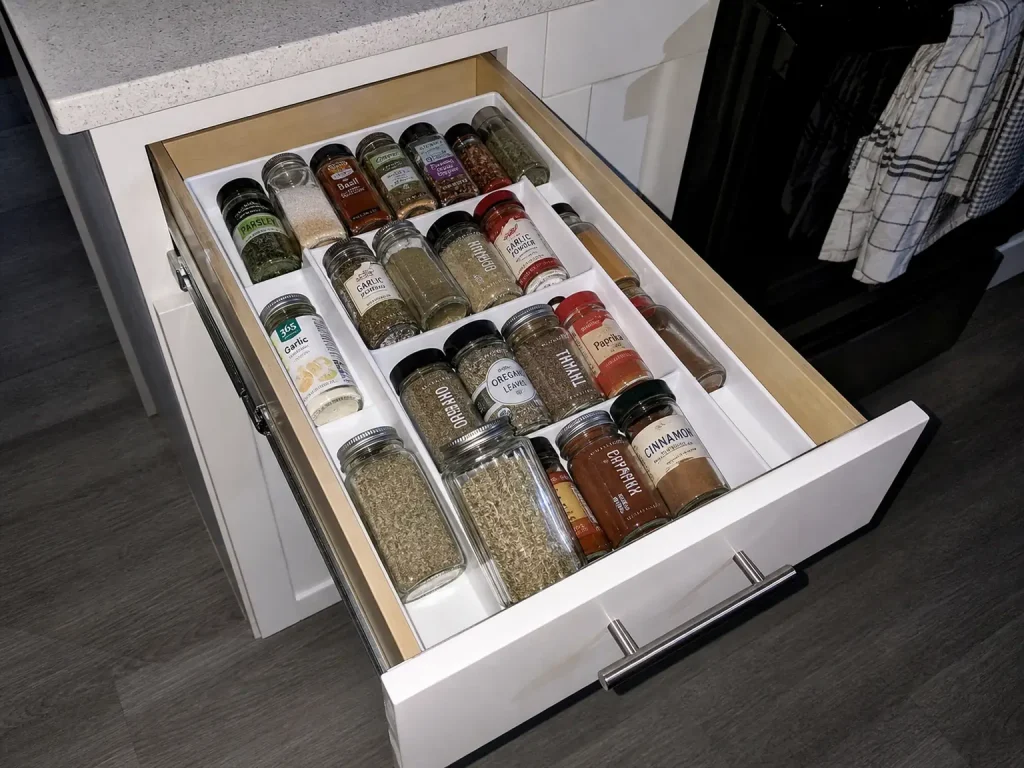
A drawer is the best spice location most people already have and the one they dismiss fastest. Jars laid on their sides with the lids facing up give you something no shelf does: every label visible at once, from above, with nothing behind anything. The catch is depth. A drawer much deeper than the jars themselves wastes everything above them, drawer width decides how many jars you get per row, and a drawer with no divider lets everything roll into a pile the first time you close it hard.
That is what an expandable tray fixes. The Dial Industries Expandable Spice Organizer Tray widens to match the drawer you have rather than the drawer the manufacturer imagined, which is what makes a shallow drawer workable without custom inserts. It does assume standard-diameter jars, so tall or square bottles will sit awkwardly in the channels. The deeper mechanics, riser versus liner, clearance math, and keeping jars from rolling in a spice drawer, get worked out in full elsewhere. Here the drawer is one option among six.
Renter Check — Which Locations Need Tools
Before you commit, sort your shortlist by one question: does this need tools and permanent hardware, or does it come off clean? Drawers, cabinets, countertops, and the fridge side need nothing. Cabinet doors are usually a middle case, since many door racks offer both screw-mount and adhesive or hook versions. Wall shelves are the only location that genuinely pushes you toward drilling, and even that has adhesive answers covered later on.
Sort the list this way now and the renter section stops being a separate article you have to go read. It becomes a filter you already applied.
Why Visibility Beats Aesthetics in a Spice Setup
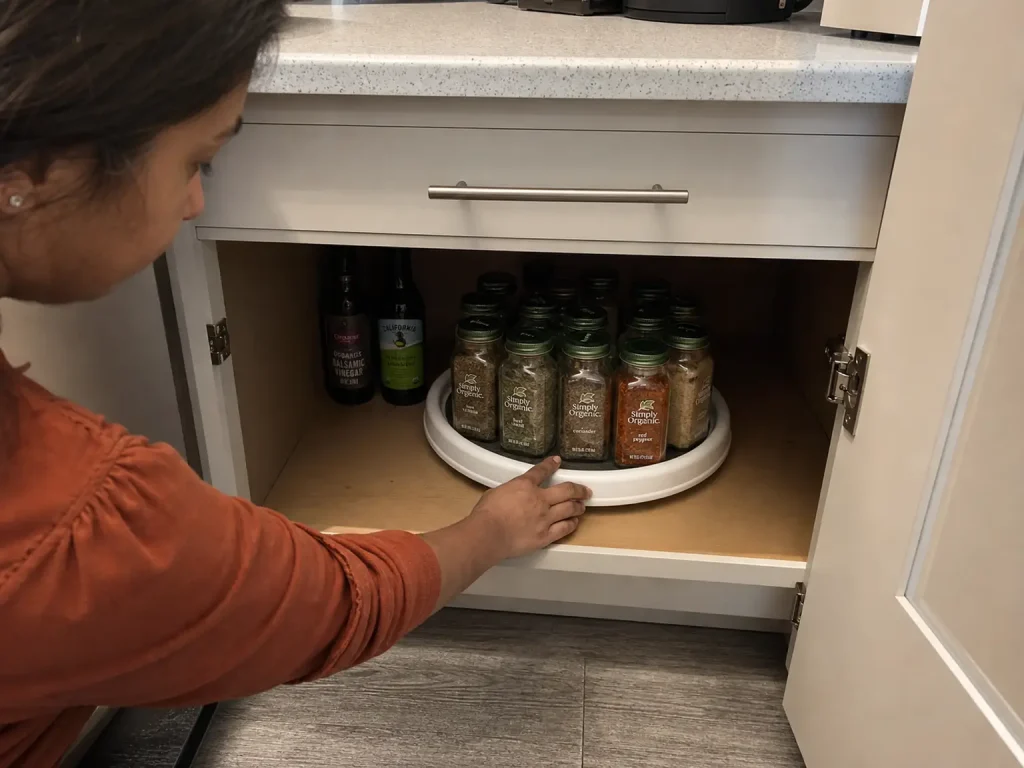
The setups that survive are not the prettiest ones. They are the ones where you can read every label without moving anything. The test is a Tuesday night with a pan already hot: if finding the oregano means lifting three jars out first, the system loses, no matter how good it looks in daylight.
Every Label Should Be Readable Without Moving a Jar
The whole design principle fits in one sentence. Every label readable at a glance, no jar hidden behind another. Tiered risers, jars laid on their sides with lids up, and turntables are three different ways to buy the same thing, which is sightline. Once you see them that way, choosing between them stops being a style question and becomes a question about the shape of your space.
Depth Is What Hides Your Spices
Depth is what defeats visibility. The deeper the shelf, the more rows you create, and the back row quietly stops being storage and becomes stuff you own without knowing it. A 24-inch base cabinet swallows several rows of standard jars front to back. You will use the front ones.
A turntable fixes this by spinning the back row to the front instead of asking you to reach past everything (which is also why it beats a deeper rack in a corner, where reaching is the whole problem). The Copco Non-Skid Turntable 9-inch measures 9 inches across, which fits a standard cabinet shelf run with room to spare, and its non-skid surface keeps jars from sliding off mid-spin. But nine inches is small for a full collection, so treat it as the fix for one shelf or one awkward corner rather than the whole system. For blind corners specifically, the real fix for a corner cabinet is a different mechanism entirely.
The Solid-Base Rule for Racks and Turntables
Turntables and racks need a solid base, meaning a flat, rigid surface directly underneath. Put one on a bare wire shelf and the jar bases catch in the gaps, the rotation stutters, and the whole thing tips over the first time you spin it fast. A shelf liner under the mechanism solves it for a couple of dollars.
Weight is the other half of that rule. Fully loaded door-mounted and hanging organizers commonly carry weight capacity ratings in the 20 to 30 pound range, and adhesive-mount versions rate lower than screw-mount ones. Two dozen glass jars weigh more than they look like they do.
Load a door rack or hanging organizer with everything you plan to keep in it before you commit to the mount, then open and close the door twenty times. Adhesive that holds a static load often fails under the repeated swing, and you would rather find that out over a counter than over the floor.
Choosing Spice Jars and Containers That Earn Their Space
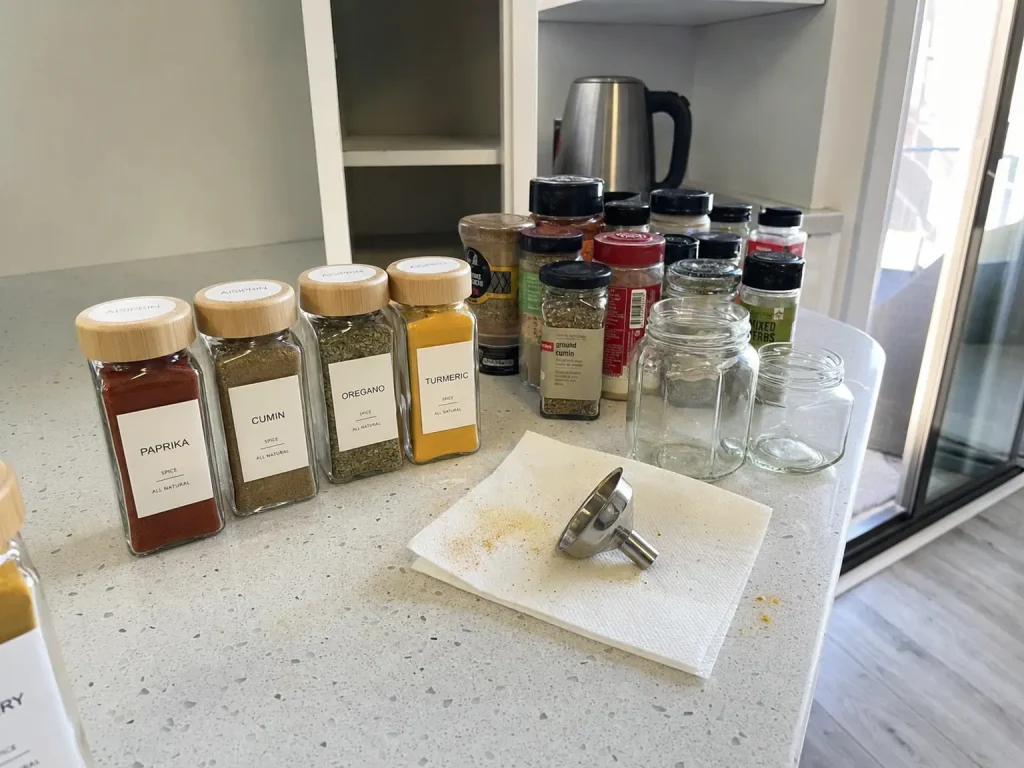
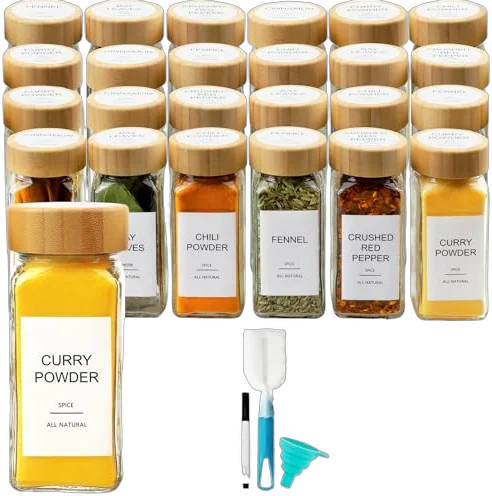
The matching-jar aisle is where most of the money in spice organization gets spent, and it is the one decision that can safely wait. Uniform size is doing the real work in those photos. The bamboo lid is not.
Uniform Size Matters More Than Uniform Style
Same footprint means no wasted shelf gaps and no tall bottle hiding a short one behind it. That is the entire benefit, and you can get most of it by grouping the bottles you already own by height rather than buying anything. Square jars use rack width more efficiently than round ones, since round jars leave a small dead triangle between every pair. Round jars wipe clean faster, which matters more than it sounds like it should for anything stored near a stove.
Glass or Plastic, and When Each One Wins
Glass handles grease and steam without clouding and does not stain from turmeric or paprika, both of which will permanently tint cheap plastic. Plastic is lighter and far more forgiving overhead or on a door rack, where a dropped jar is a real possibility rather than a theoretical one. Height of storage decides this more often than preference does.
Decanting Versus Keeping the Original Bottles
Here is the free version, stated before any product: keep the original store bottles, or wash and reuse jam and baby food jars, and hand-label them. Decanting is an upgrade, not a prerequisite. I used to treat matching jars as step one of any spice project. After reading enough threads where the beautiful set turned out to be the wrong height for the shelf it was bought for, I moved it to step three, after the location and the layout are settled.
Four ounces is the practical middle size for most home cooks. Big enough for the spices used weekly, small enough that a set of 24 still fits a normal shelf run without spilling onto a second one. And if you do decant, use a small funnel: pouring straight from a store bottle into a narrow jar turns a tidy afternoon into a counter you have to wipe twice.
Labeling Systems That Survive Real Kitchen Use
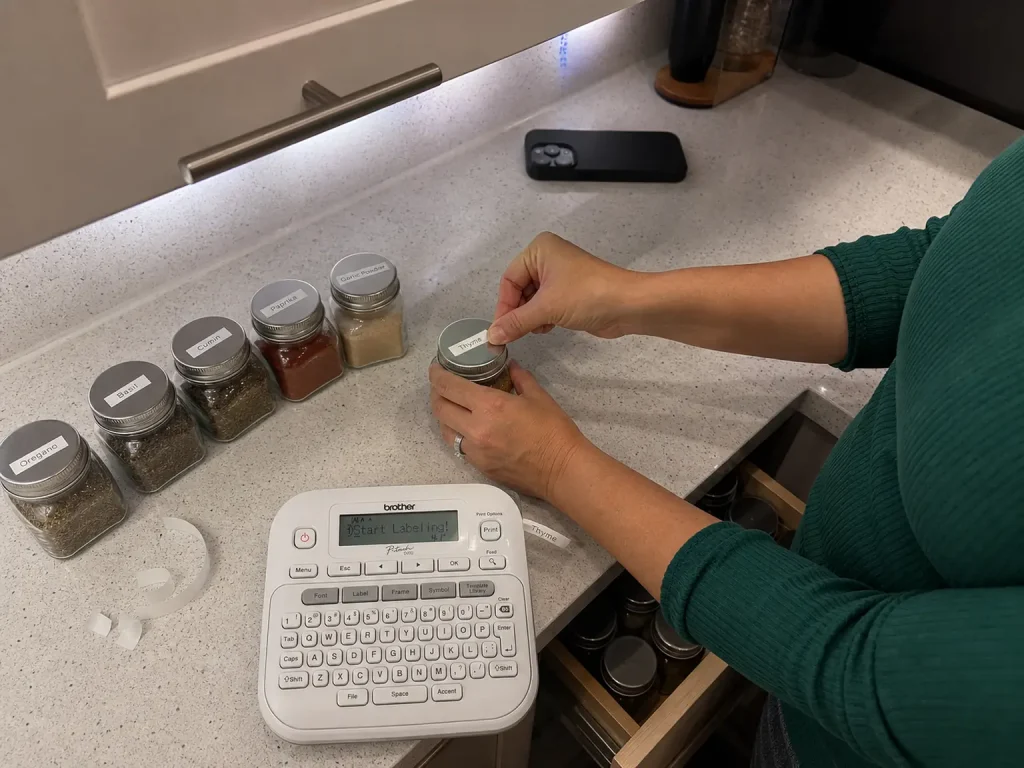
Labels fail in two ways nobody warns about. They end up on the wrong face of the jar for how you actually look at it, and they peel off over a hot stove. Both are fixable in the first ten minutes, and both are nearly impossible to fix later without redoing everything.
Label the Lid or the Front — Match It to How You’ll Look at It
Match the label to the viewing angle, not to the jar in your hand. Drawers are viewed from above, so the lid gets the label. Shelves, racks, and door mounts are viewed from the side, so the front gets it. Setups that span both, which is most kitchens, need labels in both places.
People get this wrong constantly, and the reason is understandable. You label the jar while holding it at eye level on a counter, which is the one position it will never be in again.
What Actually Survives Steam, Grease, and Handling
Durability is a materials question. Chalk markers and adhesive dot labels are the near-free path and they work well, with one caveat: chalk rewrites easily, which is a feature for rotating blends and a liability in a shared kitchen where someone else can smudge a label with a wet thumb. Paper stickers and masking tape curl at the edges within a few months of ordinary kitchen humidity. If you want to know exactly why, the adhesive mechanics behind why pantry labels peel off in a month apply identically to spice jars.
Laminated label maker tape is the version that survives. The Brother P-Touch PTD220 label maker prints tape with a clear protective layer over the ink, which is the specific reason it holds up to steam, grease, and being handled with oily hands several times a week. It is worth buying only once your setup is settled, since relabeling is the real cost of changing your mind.
Leave Room for a Date
Leave space on every label for a refill or purchase date. It is the only way to know whether a jar is still worth using without opening it and second-guessing your nose. Ground spices in particular go quiet long before they look different.
Write the month and year on the lid label in pencil or chalk marker even when the name is printed. The name never changes and the date always does, so keeping them on different materials means one refill does not cost you a whole new label.
Alphabetical, Frequency, or Cuisine Grouping
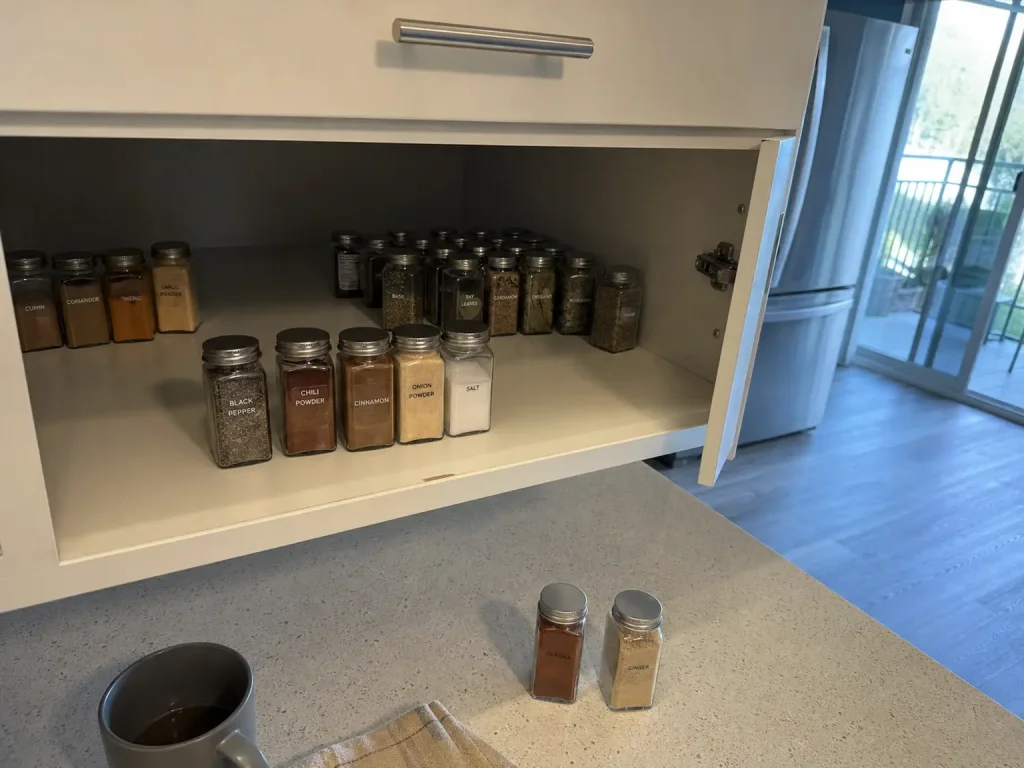
There is no universal right answer here, and the articles that declare one are guessing about your kitchen. The order that works is the one that matches how you decide what to cook, and more importantly, who else in the house has to find the cumin.
Alphabetical Is the Order Other People Can Follow
Alphabetical is the most teachable order in existence. Anyone who walks into your kitchen can both find a jar and put it back correctly without being told the rules, which makes it the strongest choice in a shared kitchen or a household with kids. Its weakness is real: it scatters the eight spices you reach for every week across the entire run, so your most-used jars end up at both ends and the middle.
Frequency of Use Wins on a Weeknight
Frequency-of-use puts the everyday eight at the front and everything else behind them. It is the fastest possible order on a weeknight and the hardest for anyone else to follow, because the logic lives in your head and nowhere else. That is exactly why it collapses in shared kitchens, a pattern that shows up constantly in organizing threads: a roommate or partner puts the cumin back where it looks like it belongs, not where the system says, and within a few weeks the front zone is meaningless.
Cuisine Grouping for How You Really Cook
Cuisine or flavor profile grouping matches how a lot of people actually cook, reaching for a cluster of three or four jars rather than a single one. It works best for cooks with a large collection and clear patterns, and poorly for anything that belongs to three cuisines at once, which describes cumin, coriander, and most of the peppers.
The hybrid that holds up in practice: a small front-of-house frequency zone for the weekly spices, with everything behind it alphabetical so it stays findable by someone who did not build the system. You get the weeknight speed without the drift.
Spice Organizer Types at a Glance
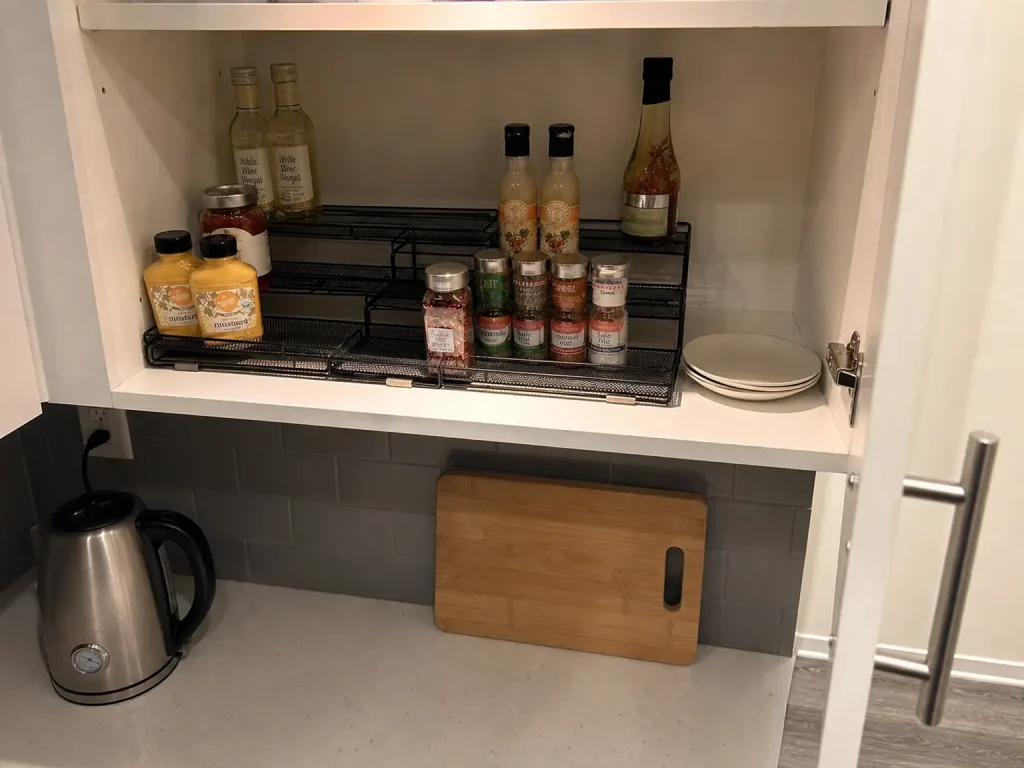
Six mechanisms cover nearly everything on the market. Once the location is settled, this section gets short, because each location has one or two mechanisms that fit and several that simply do not.
Tiered Risers and Expandable Racks
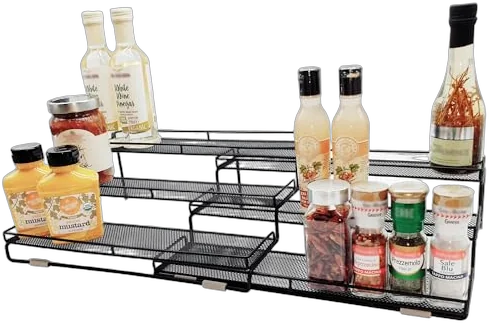
A tiered spice rack uses step design so the back rows sit higher and stay readable, which is the visibility principle in physical form. Expandable models commonly cover a width range of roughly 12.7 to 29.1 inches and hold anywhere from 18 to 48 jars, and that spread is exactly why measuring came first. Buy for the cabinet you have, not the collection you imagine.
Turntables and Pull-Outs for Deep Cabinets
Turntables solve corner and blind cabinets by spinning instead of asking you to reach, with the solid-base caveat from earlier still applying. Size it before you buy, since a tray too wide for the opening cannot rotate and a tray too small wastes the shelf; the same sizing a lazy susan before you buy it logic carries over directly from pantry work.
Pull-out and pull-down cabinet mechanisms bring the whole shelf to you, need that 9 to 24 inch opening, and are by far the most involved to install. They are the right call in a permanent kitchen and almost never the right call in a rental.
Door-Mounted and Magnetic Systems
Door-mounted racks claim a flat surface nearly every kitchen already has and nobody uses: the inside of a cabinet door. Weight rating matters more here than anywhere else in the article, and the clearance between the rack and the shelf edges is the second thing to check, which the full rundown of what to check before buying a door organizer covers in detail. The SpaceAid Spice Rack Organizer mounts to a cabinet door, a wall, or a pantry side panel with the same hardware, which makes it the practical answer to “no drawer, no counter space,” and the 415 included labels close the loop with the labeling section above. Check your door clearance first, though, since a loaded rack needs the shelf edges to sit back far enough for the door to close.
Magnetic tins claim vertical surfaces most kitchens ignore entirely, and they get their own treatment in the next section where the no-drill angle belongs. Expandable drawer inserts round out the six, handed off to the drawer guide. If you want the mechanisms sorted by cabinet type rather than by spice, the breakdown of cabinet organizers by cabinet type picks up where this survey stops.
Renter and Small-Space Spice Solutions
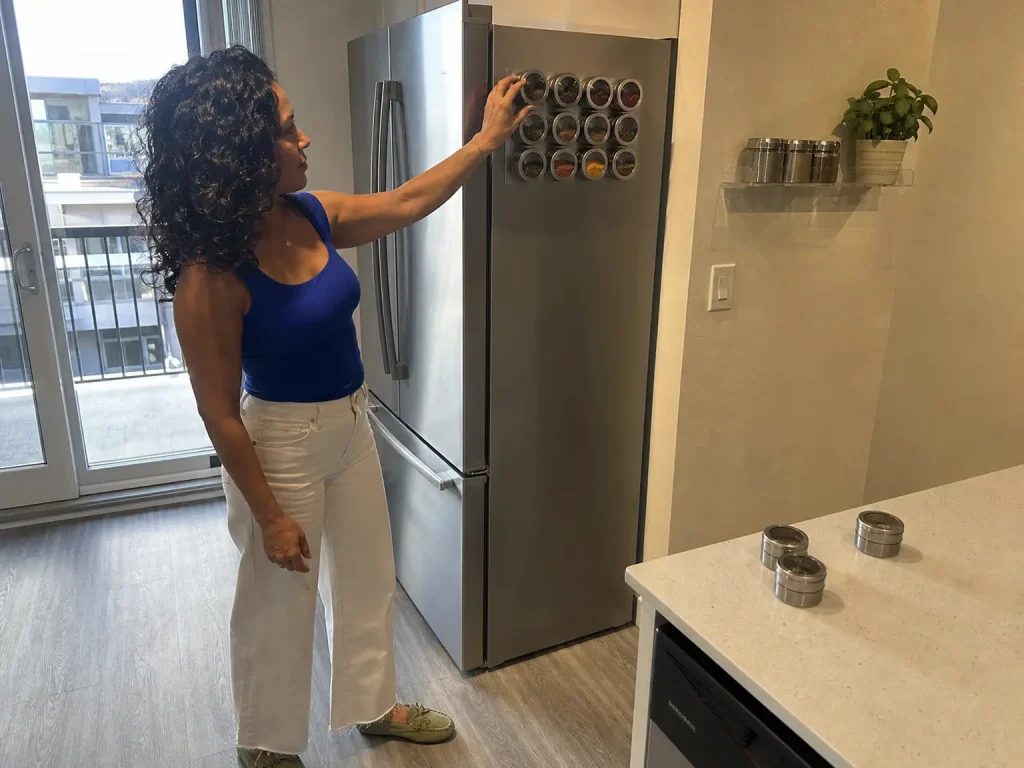
Renters get told to mount a floating shelf beside the stove, which is wrong twice over. It puts holes in a wall that is not yours, and it is the worst available spot for the jars. There are better answers, and they come off clean at move-out.
No-Drill Options That Come Off Clean
Group every option by the question competitors never ask: does this need tools and permanent hardware, or is it fully removable? Adhesive shelves, magnetic bases, and door racks with tension or adhesive mounting are the removable tier, and that tier is larger than most renters realize. The same sorting logic behind no-drill kitchen cabinet organization applies to every category here.
Start free. A tension rod or spare shelf you already own, set inside a cabinet, gives you a second level at zero cost, and it tells you whether you actually needed more surface or just better sightlines. If the answer is genuine surface, an adhesive shelf is the next step up. The 2-Pack No-Drill Acrylic Wall Shelves create a small spice ledge near the cooking zone without a single hole, and the clear acrylic keeps a small kitchen from feeling more crowded than it is. Adhesive mounts are picky about surface texture, so a lightly textured or freshly painted wall will hold far less than the package assumes.
Magnetic systems claim the surface almost nobody counts: the side of the fridge. The DIY version is free, since reused tins with adhesive magnets on the back do the same job. The Sanvcomy 12 Magnetic Spice Jar Containers come with a base plate that mounts to any flat surface with adhesive strips, so they work on a fridge side, a wall, or the inside of a cabinet door. The tins are small, which is fine for the spices you use weekly and frustrating for anything you buy in bulk.
The Spot Beside the Stove Is the Wrong Spot
Here is the rule almost nobody states out loud. Heat speeds up the breakdown of the essential oils that carry spice flavor, and UV plus ordinary kitchen light degrades the carotenoids in paprika and turmeric and the terpenes in cumin and dill. The rack mounted beside the stove for convenience is quietly shortening the life of everything on it, every single time you cook. Spice suppliers are direct about this: heat, light, and humidity are the three things that quietly reduce spice potency.
The practical translation is small. Spice shelf life is a storage variable, not a fixed date printed on the jar, and a cabinet or shelf a few feet from the stove, out of direct sun, keeps spices potent for months longer than the convenient spot does. And you can check the difference yourself without any equipment: paprika that has gone dull brick-red instead of bright red has already lost most of what you bought it for. Open the jar you keep closest to the burners and compare it to one from the back of a cabinet. The gap is usually obvious.
The conventional advice is to keep spices within arm’s reach of where you cook. In practice, three steps away costs you two seconds and buys you months of flavor, which is a trade almost everyone takes once they see the faded paprika.
Awkward Cabinets and Corners in a Small Kitchen
Corner and blind cabinets in small kitchens are a reach problem, not a spice problem. The instinct is to buy a spice-specific product for that dead corner, and the better move is a turntable that serves whatever ends up there. Save the spice-specific purchase for the location you actually chose.
Small kitchens also reward vertical thinking more than anything else. The gap above a cabinet door, the side of a fridge, the strip of wall beside a window: none of it is prime real estate, but a small kitchen has no prime real estate to spare either. If drawers are the constraint you are working around, a small kitchen with almost no drawers has more options than it looks like from the middle of the floor.
Before any adhesive mount goes up in a rental, clean the surface with rubbing alcohol rather than a kitchen spray. Kitchen cleaners leave a thin film that adhesive strips grip badly, and a shelf that falls two weeks later usually failed because of what was on the wall, not what was on the shelf.
Why Spice Systems Fail After the First Month, and How to Start for Free
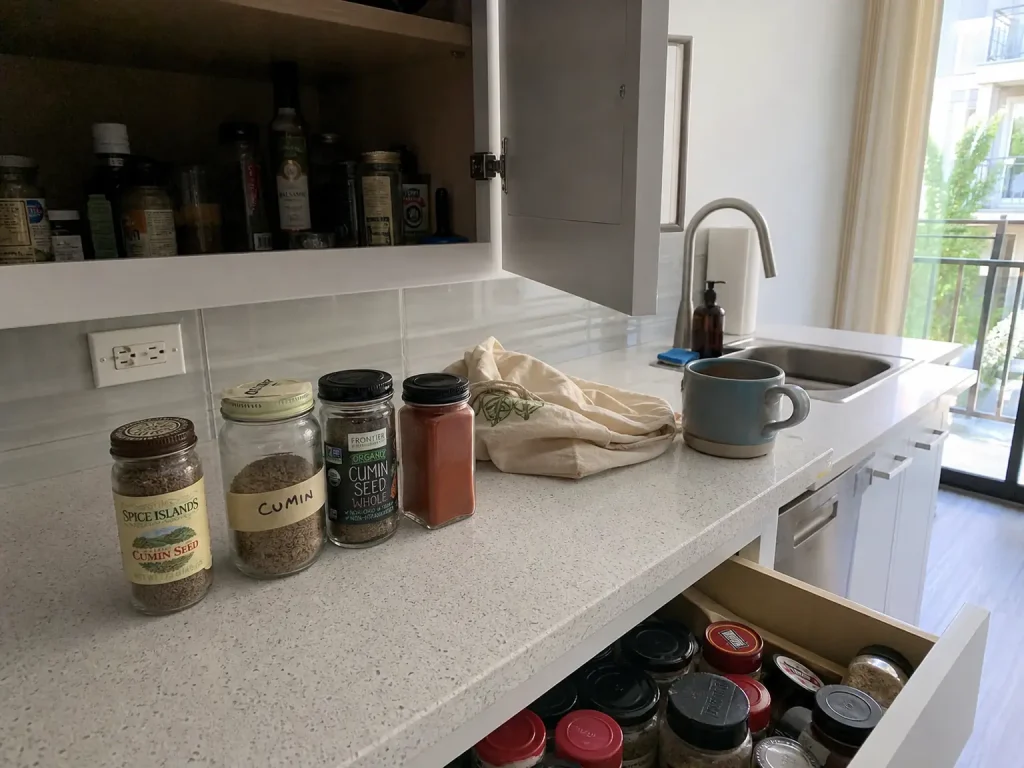
Every article shows the after photo. Almost none show the same cabinet in October. The failures are boringly consistent across kitchens, and not one of them is about the product you bought.
Invisible Inventory and the Three Jars of Cumin
Failure number one is invisible inventory. A jar hidden behind a taller bottle gets bought again, and then again, and the day you find three jars of cumin in the same cabinet is the day the back row tells you it was never really storage. It was a place things went.
This is why depth, not quantity, is usually the actual problem. People respond to the three-jars discovery by deciding they own too many spices, and then they throw out duplicates and the pattern repeats within a year because nothing about the sightlines changed. Fix the visibility and the duplicate buying stops on its own. The order you shop in changes too, because you can see what you have from the door instead of guessing in the aisle.
Systems Break When More Than One Person Uses Them
Failure number two is household drift, which is really a household maintenance problem wearing a design costume. A system that only one person understands stops being a system the first time somebody else puts a jar back where it looks right. This is the single strongest argument for alphabetical order in a shared kitchen, and it is the reason a frequency layout that works beautifully for a solo cook falls apart in a house with roommates.
The fix is not enforcement. It is choosing an order that survives someone who did not read your reasoning, and labeling clearly enough that putting a jar back correctly takes no thought at all. If two people cook, both people need to be able to run the system without asking.
Start Free, Then Buy Only What the Gap Requires
Failure number three is the missing reset. “Set it and forget it” gets used as a compliment, and it is the exact reason setups revert. Fifteen minutes every few months keeps one alive: pull everything out, wipe the shelf, put the strays back, and pull the jars that have gone flat. That last part is not tidying, it is a potency decision, since ground spices lose their punch faster than whole ones do and the date on the label from earlier finally earns its space.
Now the budget path, stated plainly. Lay the jars you already own on their sides in a shallow drawer, labels or lids facing up, using containers already in the house. That is a working spice system at zero cost, the most budget-friendly version of every idea in this article, and it delivers the one thing that matters most, which is seeing everything at once. Honestly, it outperforms a lot of purchased setups, because a drawer viewed from above has no back row at all.
Buy a rack only when a specific gap shows up. A cabinet too deep to see into wants a turntable or a tiered riser. A kitchen with no free drawer wants a door rack. No counter space and no drawer wants magnetic tins on the fridge side. Every purchase should have a sentence behind it that names the problem it solves, and if you cannot write that sentence, the purchase is decoration. The same durability logic behind drawer organization ideas that actually last applies here: the systems that survive are the ones that ask the least of you on a bad day.
Photograph the finished setup with your phone and keep the photo in a shopping list note. It takes ten seconds, it settles the “do I already own coriander” question in the store, and it doubles as the reference for putting everything back after the next reset.
Conclusion
Three things carry the whole system. Decide where the spices live before you buy a single jar, because the location sets every other choice you are about to make. Judge the result by whether you can read every label without moving anything, not by how it photographs. And keep the jars out of heat and direct light even when that means giving up the most convenient spot on the counter.
In three months, open the spice cabinet and look at the back row. Anything you have not touched, and any paprika that has gone dull, tells you whether the layout is working or just looking tidy.
Start with the spices you actually reach for this week. Get those visible and labeled. The rest can wait until the system has proven it holds.
Frequently Asked Questions
01Where should you not store spices in a kitchen?
Avoid anywhere warm or brightly lit: directly above or beside the stove, on a sunny windowsill, and next to the dishwasher vent. Heat breaks down the oils that carry flavor and light fades the pigment in paprika and turmeric, so the most convenient spot often costs you the most potency.
02Should you decant spices into matching jars or keep the original bottles?
Keep the original bottles until the storage location is settled, because decanting is an upgrade rather than a starting requirement. Matching jars pay off when mismatched bottle heights are the thing blocking your sightline or wasting shelf space, and they cost you nothing but consistency until then.
03Is it better to organize spices alphabetically or by how often you use them?
Alphabetical if anyone else in the house cooks, frequency of use if the kitchen is effectively yours alone. Frequency is faster on a weeknight, but the logic lives in your head, so it drifts the first time someone else puts a jar back where it looks right.
04How do you stop buying spices you already own?
Make the back row visible, whether with a tiered riser, a turntable, or by laying jars on their sides with labels facing up. Duplicate buys come from jars hidden behind taller bottles, which is why shelf depth, not quantity, is usually the real problem.
05What is the cheapest way to start spice organization?
Lay your existing jars on their sides in a shallow drawer with the lids labeled and facing up, using containers you already have. It costs nothing, delivers the visibility that makes any system work, and shows you exactly which gap a purchased rack would need to fill.