















In this article
Open the cabinet under your bathroom sink and count what’s in there. Odds are you’ll find a toilet bowl cleaner, a glass cleaner, a half-empty jug of bleach left over from some project two apartments ago, three sponges, and a bottle whose label peeled off so long ago you’ve stopped wondering what it is. All of it standing shoulder to shoulder in the dark.
The under sink cabinet is the one storage zone people organize by appearance and never by content, which is why the bins go in, the photo looks better, and the actual risk sits exactly where it was. Here’s what comes out first, which two products should never touch, how to lock the door without drilling, which containers fit around the pipe, and where the bottles that travel between rooms should live. For the broader method, the seed guide on organizing under a bathroom sink walks the whole cabinet; this one goes deep on the cleaning supplies specifically.
Quick Answer
Organize cleaning supplies under a sink in five moves, in this order:
- Take everything out and bin anything expired, unlabeled, or duplicated.
- Separate bleach-based products from ammonia-based ones, never stored touching.
- Put a waterproof mat down before anything goes back in.
- Contain by frequency: daily sprays at the front, backstock on a turntable behind.
- Add a no-drill magnetic lock if kids or pets can reach the door.
Empty It Out and Decide What Actually Stays
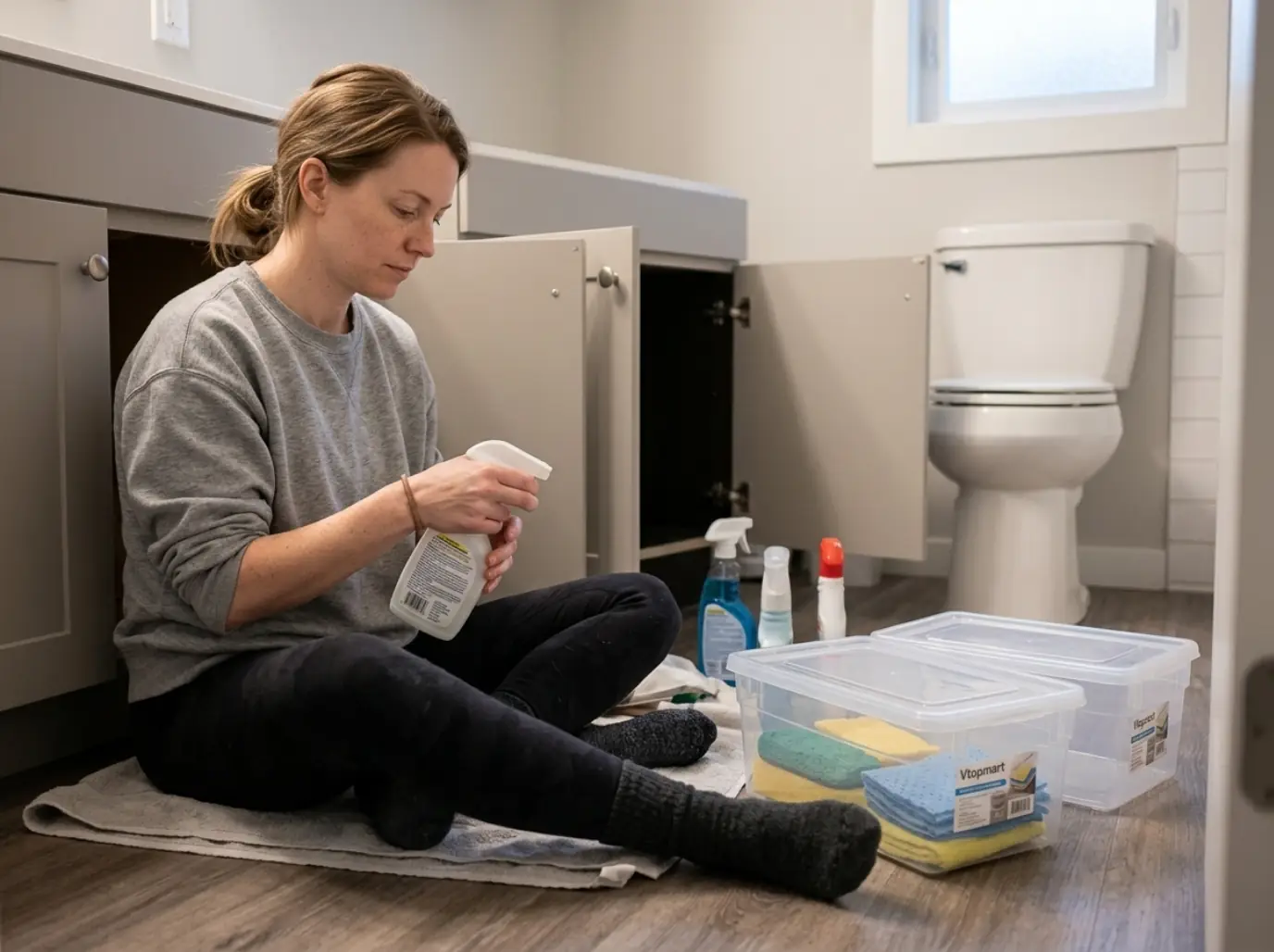
Every under-sink reset starts the same wrong way: someone buys bins. The bins are step four. Step one is finding out that half of what’s under there is a bottle nobody has touched since a previous apartment, and that the disinfectant you’ve been trusting stopped disinfecting somewhere around last spring.
What’s Actually Under There (and What Shouldn’t Be)
Pull everything out onto a towel on the floor, including the things wedged at the very back, because the back of the cabinet is where dead bottles go to be forgotten. Declutter it into three piles: keep, toss, relocate. That third pile is the one people skip, and it’s usually the biggest. If the full empty-sort-measure sequence is what you’re after, the sibling guide runs it end to end; this article assumes the cleaning supplies won the cabinet and picks up from there.
Anything that isn’t a cleaning product should leave. Spare medication, backup toothpaste, paper goods, the hair dryer (yes, even though it has lived there for four years and has nowhere else to go). Not because of tidiness, but because the cabinet you’re about to lock and treat as a chemical zone shouldn’t also be the place someone reaches into half-asleep.
How to Tell if a Cleaner Is Still Doing Its Job
Cleaning product shelf life is shorter than most people assume, and there’s rarely a printed expiration date to warn you. Opened bleach loses most of its strength in roughly six months. Disinfectant sprays hold up closer to two years. Dish detergent runs somewhere in the 12 to 18 month range.
That bleach jug from last spring still smells exactly like bleach. The smell outlives the function by a wide margin.
Here’s the distinction nobody makes. Expired doesn’t mean hazardous. It means weak. An old all-purpose spray still cleans a countertop fine. An old toilet bowl cleaner or bathroom disinfectant wipes a surface without sanitizing it, and that’s a failure you can’t see, smell, or test at home.
Treat anything past a year or two as “wipe, not sanitize,” and replace it if you’re relying on it to do more than move dirt around.
Write the month and year on the bottle with a permanent marker the day you open it, right on the shoulder where you’ll see it. Manufacture dates are usually stamped in a code you can’t read, and “when did I open this” is the only question the shelf-life numbers actually require you to answer.
Getting Rid of the Rest Without Wrecking Your Pipes
Proper disposal is simpler than it sounds: most standard household cleaners can go down the drain with running water or into the trash, depending on local rules. The exception people pour out anyway: solvent-based products should never go down the drain, into the trash, or down the toilet. Use them up, or hand them to someone who will.
Check the American Cleaning Institute’s disposal guidance for cleaning products if the label is vague. Thirty seconds of reading beats a plumbing bill.
Clear stackable bins with lids are what keep the categories legible once everything goes back. Before you buy any, check what you already own: repurposed clear food-storage containers with lids do this job for free, and they’re the swap budget-organizing threads suggest first every time. If you’d rather not raid the kitchen, the Vtopmart 6 Pack Clear Stackable Storage Bins with Lids and Handles run about 11 x 8 x 6 inches each and stack two deep in a standard vanity.
The lid matters more than it sounds: the cabinet is dark, and a lid lets you pull the top bin off without the contents of the bottom one shifting. One caveat that comes back later: don’t seal chemical bottles inside an airtight lidded bin.
Protect the Cabinet Floor Before Anything Goes Back In
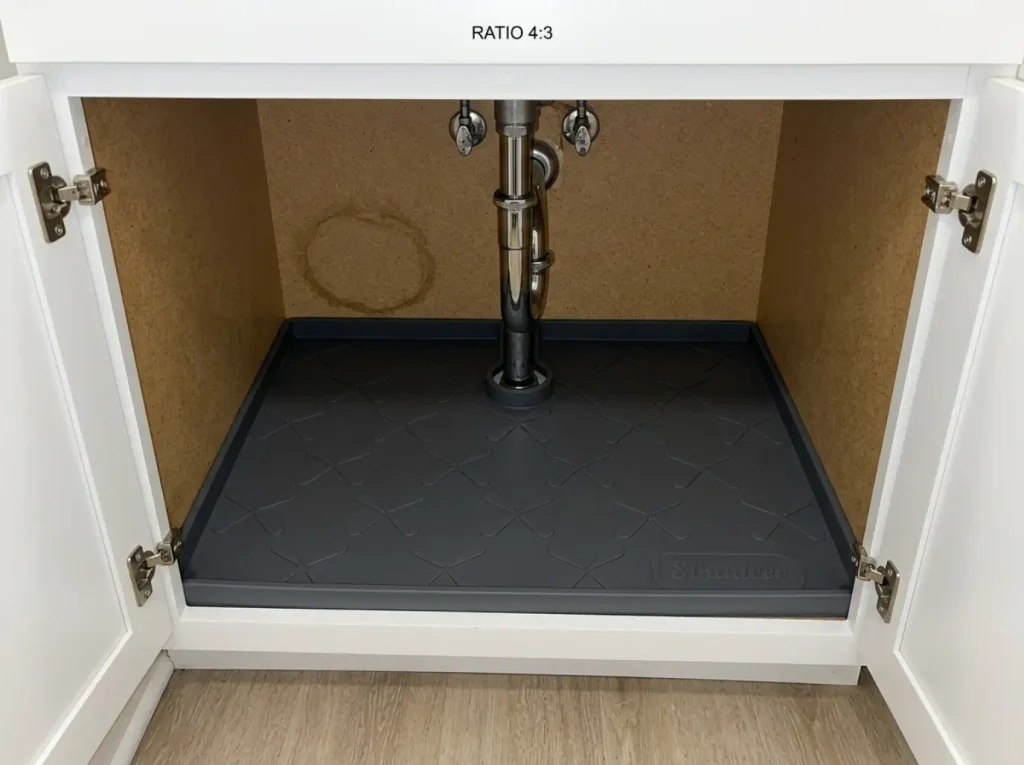
Here’s the check almost nobody runs. People swap out an old bottle for a new one without ever looking at what the old one left behind. A sticky ring on the particleboard, a faint smell that doesn’t leave when you air the room out, a corner of the cabinet floor gone soft. That’s a slow leak, and it started long before the swap.
Put something waterproof down before anything returns. A cut-to-size vinyl placemat or a length of shelf liner does this for essentially nothing. The upgrade is a purpose-made protective mat with a raised edge, which catches seepage instead of letting it run to the cabinet edge.
The SIKADEER Waterproof Under Sink Mat measures 34 x 22 inches and trims down with scissors for narrower vanities, and the raised lip means a tipped bottle stays a puddle instead of a swollen cabinet base. It won’t stop a leak. It just gives you a chance to notice one.
The Two Bottles That Should Never Share a Shelf
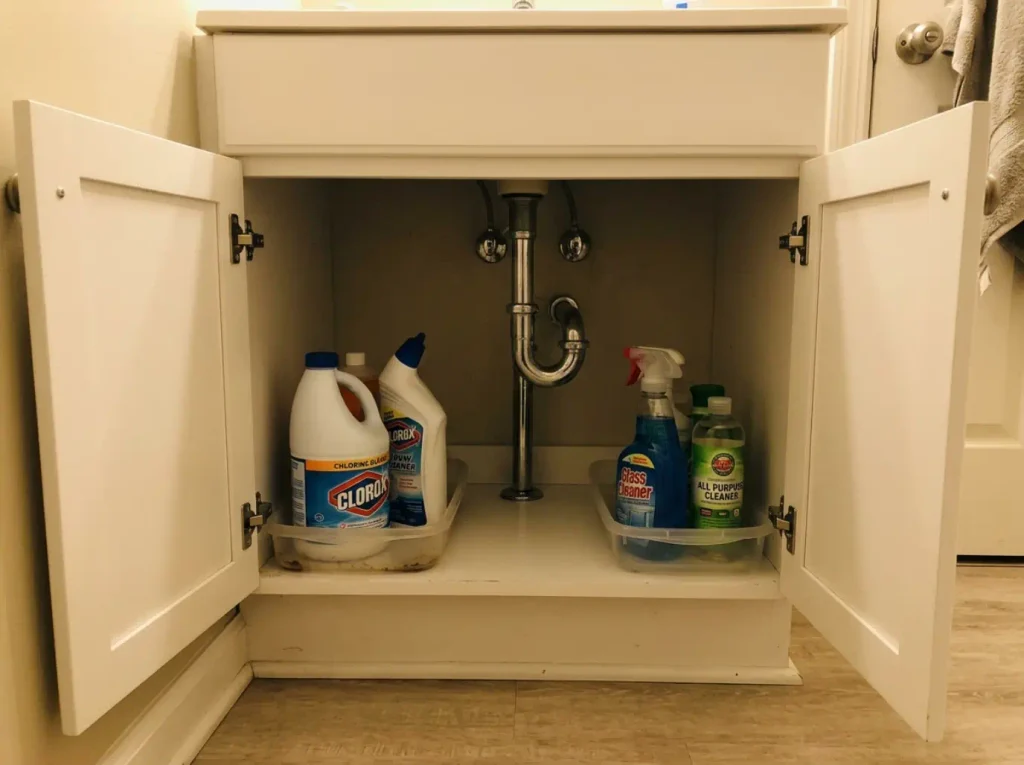
Chemical safety under a sink comes down to one pairing, and nobody deliberately mixes bleach and ammonia. That’s not how this goes wrong. It goes wrong when a cap loosens on a bottle that’s spent a summer sweating in a closed cabinet, and the two things that were never supposed to meet are sitting an inch apart in the dark with nobody watching.
Bleach and Ammonia: The Pairing to Separate First
Chlorine bleach and ammonia-based cleaners react to produce chloramine gas. It irritates eyes and airways at low concentrations, and at higher ones it causes nausea, vomiting, and lung tissue damage. That’s not a warning-label abstraction; it’s the chemical reaction between bleach and ammonia-based cleaners doing exactly what chemistry says it will.
The part that catches people out is identification. Everyone knows which bottle is the bleach. Almost nobody clocks the glass cleaner as the ammonia bottle, and that’s usually the one sitting right next to it. Some multi-surface sprays and a fair number of floor cleaners are ammonia-based too.
Flip every bottle over and read the ingredients once. Five minutes, one pass, and you’ll never have to do it again.
Then build the layout around what you found. Bleach-based products get their own contained zone with a physical barrier between them and anything ammonia-based. Opposite sides of the cabinet, different bins, different shelves if you have them.
A bin with a raised edge isn’t decoration in this context. It’s containment, and it’s the difference between a leak that stays in a bin and a leak that crosses the cabinet floor to the wrong neighbor.
Why a Closed Cabinet Raises the Stakes
An under-sink cabinet is a sealed box with a door that opens twice a day, sitting directly under a source of heat and moisture. It runs through real temperature swings, it holds humidity, and both degrade plastic bottles over time. That half-used bleach jug from last year isn’t just weaker than it was. It’s structurally older too, and more likely to crack, sweat, or seep at the cap.
Which brings up ventilation. If you open the cabinet and smell something, that’s not “the cleaning cabinet smell.” Something in there is off-gassing, and the closed door is the only reason you don’t notice it constantly. Let the cabinet air out while you work.
And here’s the caveat from earlier: don’t seal chemical bottles inside airtight lidded bins. Lids are excellent for wipes, cloths, sponges, anything dry. For a spray bottle with a trigger that might weep, an open-topped bin with a raised edge is the better call, because a slow leak needs somewhere to go that isn’t a sealed container you’ll open with your face over it.
I used to recommend lidded bins across the board down here, on the logic that a lid keeps dust out and lets you stack. After reading enough versions of the same story in organizing threads, where someone pops a lid and gets a chestful of fumes that had been concentrating for a month, I split the rule. Lids for dry goods. Open bins for liquids that can weep.
Store every spray bottle upright with the trigger locked, and put the bleach zone on the side of the cabinet away from the pipe. Condensation collects on cold plumbing, drips, and the last thing you want under a drip is the one bottle whose label you need to stay readable.
Label Everything You Decant (or Don’t Decant at All)
Decanting cleaning products into matching spray bottles looks tidy. It also strips off the only copy of the hazard warnings and first-aid instructions you own. Never pour a cleaning chemical into an unmarked container, and never into a reused drink bottle, which is the version of this that goes badly fastest. If you do relabel a bottle, copy the warning text across with it.
“Bathroom spray” written on masking tape is a name, not a label, and the person who needs the label most is someone who wasn’t there when you filled it.
Locking the Door When Kids or Pets Are in the House
The under-sink cabinet is the one door in the bathroom nobody child-proofs, because it’s “just cleaning stuff.” It’s also floor-level, unlatched, and stocked with the exact products a poison control line asks about first. The bathroom door being closed most of the time is not a system. It’s a habit, and habits have gaps.
Child-Resistant Caps Are Not Childproof
This distinction is written into the regulation itself. The Poison Prevention Packaging Act requires child-resistant packaging on 30 categories of household chemicals, and the Consumer Product Safety Commission’s poison prevention guidelines are explicit that child-resistant is not the same thing as childproof. The cap buys time. It doesn’t stop anyone.
A determined three-year-old with four uninterrupted minutes is the design case, and the cap was never meant to win that.
For scale, so this doesn’t read as an edge case: U.S. poison control centers field over a million calls a year about unintentional poisonings in children under five involving medicines and household chemicals. That’s roughly 2,700 a day.
The recurring version of this story in parenting threads always has the same shape. The door gets pulled open during the two minutes somebody turned their back to answer the door or start the bath. Not negligence. Just the two minutes.
So the control point has to be the cabinet, not the bottle.
No-Drill Locks That Renters Can Actually Use
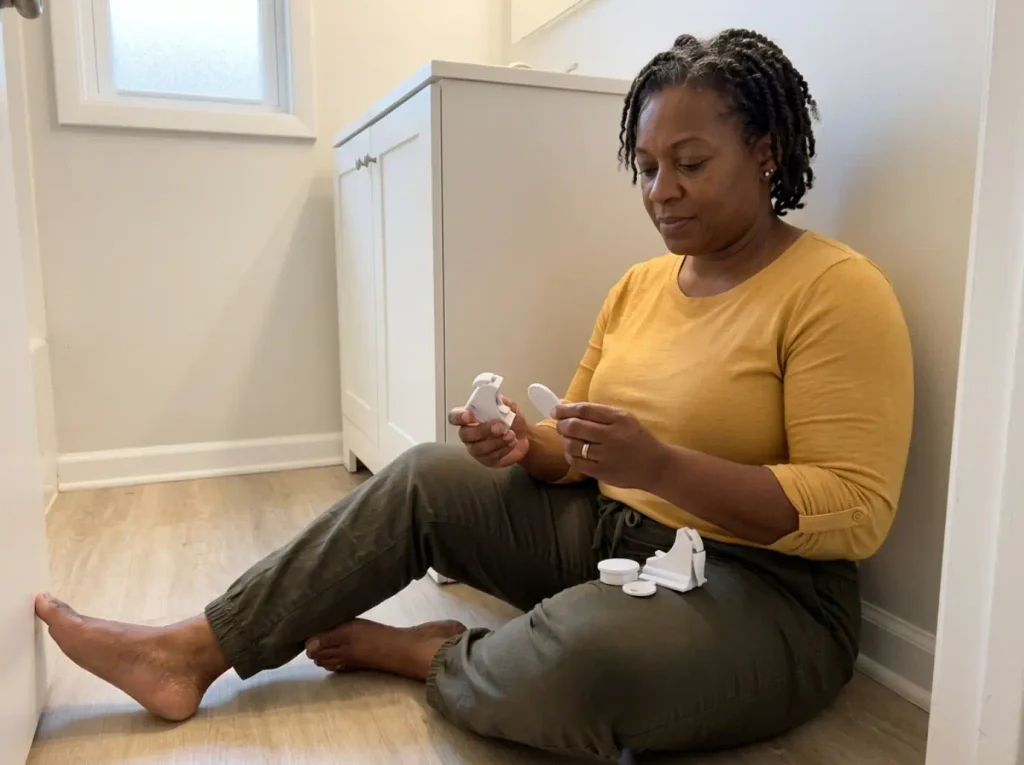
The good news for anyone who doesn’t own their vanity: this is one of the rare renter-friendly bathroom safety fixes that costs nothing in deposit risk. Magnetic and adhesive-mount cabinet locks install with 3M strips in under three minutes. No tools, no drilling, no holes, and they peel off cleanly at move-out with a bit of heat from a hairdryer. It’s the same no-drill logic that runs through the same no-drill approach that works across a rental, applied to the one cabinet where the stakes are highest.
If this is the only cabinet in the house that needs securing, a single strap-style lock is cheaper and sold in small counts, and it’s the honest answer for a one-bathroom apartment. But if you have a kitchen, a laundry cupboard, and a bathroom vanity all holding chemicals, buying locks one at a time is how three of the four never get done. The Norjews 20 Pack Child Safety Magnetic Cabinet Locks come with three keys and fit doors up to 35mm thick, which covers most standard vanity and kitchen cabinet doors.
The trade-off worth knowing: magnetic locks live on the inside of the door, so you need the key to get in, and the key is a small magnet that will end up somewhere. Stick it high on the side of the fridge on day one.
Pet-proofing is the case people skip entirely. A dog nosing a cabinet door open is the same failure as a toddler pulling it, and dogs are considerably more persistent about repeating an experiment that worked once. The same magnetic lock handles both.
When the Answer Is Moving the Bottles Instead
Sometimes a lock isn’t on the table. Cabinet doors that don’t sit flush, a frame that adhesive won’t grip, a landlord clause you’d rather not test. Relocate instead.
Move the concentrated products, meaning bleach, toilet bowl cleaner, and drain cleaner, up to a high shelf in the linen closet, and leave only the low-risk bottles under the sink. But relocation is a legitimate fix, not a consolation prize.
Containers That Fit Sprays, Jugs, and the Pipe in the Middle
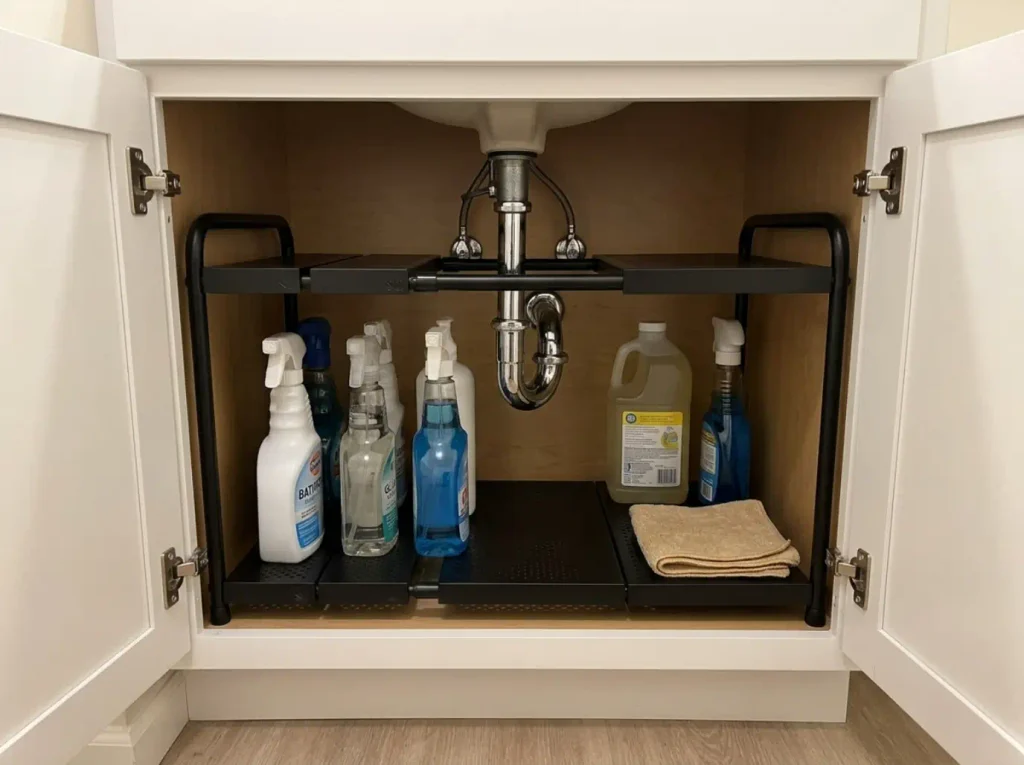
Cleaning supplies are the worst-shaped things you can ask a cabinet to hold.
Tall trigger sprays that tip. Wide squat refill jugs that don’t stack. Boxes of wipes that are neither. And a P-trap running straight through the middle of the space you’d otherwise be using.
This is why generic bin advice falls apart here. The bins are fine. The geometry is the problem.
The Pipe Decides Your Layout, Not the Bins
The pipe eats the center of the cabinet, which is why a flat shelf across the full width doesn’t work and never has. Two-tier organizers with a narrow top and a wide bottom exist for exactly this reason: they step around the plumbing instead of fighting it, reclaiming the dead space above the trap that a flat shelf can’t reach. The raised edge board on the front is the other half of the design, and it keeps a top-heavy trigger spray from tipping every time the door swings shut.
If your cabinet’s shape cooperates, a repurposed dish rack or plain dollar-store bins cover this job at no meaningful cost, which is the most budget-friendly answer on this page. When it doesn’t, an expandable rack is the answer, because the width you need is different in every vanity. The Simple Houseware Under Sink 2-Tier Heavy Duty Expandable Organizer adjusts to the opening you actually have and clears the trap on the narrow upper tier.
Check one limitation first: measure from the cabinet floor to the underside of the sink basin, because a two-tier unit needs vertical pipe clearance that a shallow vanity depth may not give you. The same math applies one room over, so if you’re solving the same pipe problem in a kitchen cabinet, the constraints are identical with a garbage disposal added in.
Front Row, Back Row: Sort by How Often You Reach for It
Sort by frequency, not by category. The bathroom cleaner you use every weekend goes at the front, in the daily-reach zone; the refill jug you touch twice a year goes behind it, in the backstock zone. Sorting by product type instead, all sprays together and all refills together, is precisely what buries the daily bottle behind the annual one.
The failure this prevents is the most common one in under-sink threads by a wide margin. People stack bottles two and three deep against the back wall, and within a month the “organized” cabinet is a dig-and-search again. Frequency zones are the fix.
That’s where a turntable earns its place, and its job is narrower than people assume. It isn’t for the daily stuff. It’s for the backstock, so the second bottle of anything rotates into reach without lifting the first one out.
The OXO Good Grips Lazy Susan Turntable is 16 inches across, which is a lot of cabinet, so measure your clear floor space first. If the P-trap comes down close to the cabinet base, it jams against the pipe on every half rotation.
A smaller 9-inch tray fits where the big one won’t, but the honest version of this recommendation is that a turntable needs open floor the pipe may simply not leave you. If it doesn’t, use a shallow bin you can pull out by the handle instead. The sibling guide on which organizer types hold up in a humid bathroom cabinet breaks the options down by material, which matters more under a sink than anywhere else in the house.
Give Every Bin a Rule (or It Reverts)
Labeling isn’t about neatness. It’s about what happens the first time someone who didn’t build the system puts something away. Once one spray goes back in the wrong slot the whole zone starts blurring, and a few weeks later the bins are just walls between piles.
Every bin needs a rule specific enough that a second person can follow it without asking (and the second person here is whoever puts things away when you’re not the one doing it). “Bathroom” is not a rule. “Toilet and tub” is. And “miscellaneous” is not a rule at all; give a bin that label and give it a month, and it will eat everything around it.
Measure the Opening Before You Buy Anything
The usable width isn’t the cabinet width. It’s the opening minus the door hinges, which can steal a couple of inches on a face-frame vanity and is the most common reason a returned organizer gets returned. The usable depth is whatever the pipe leaves you at the height you’re stacking, and that number changes as you go up.
Measure at two heights: at the cabinet floor and at the trap.
That’s it. Two numbers, written down before you open a single product page.
The Bottles That Don’t Actually Live There
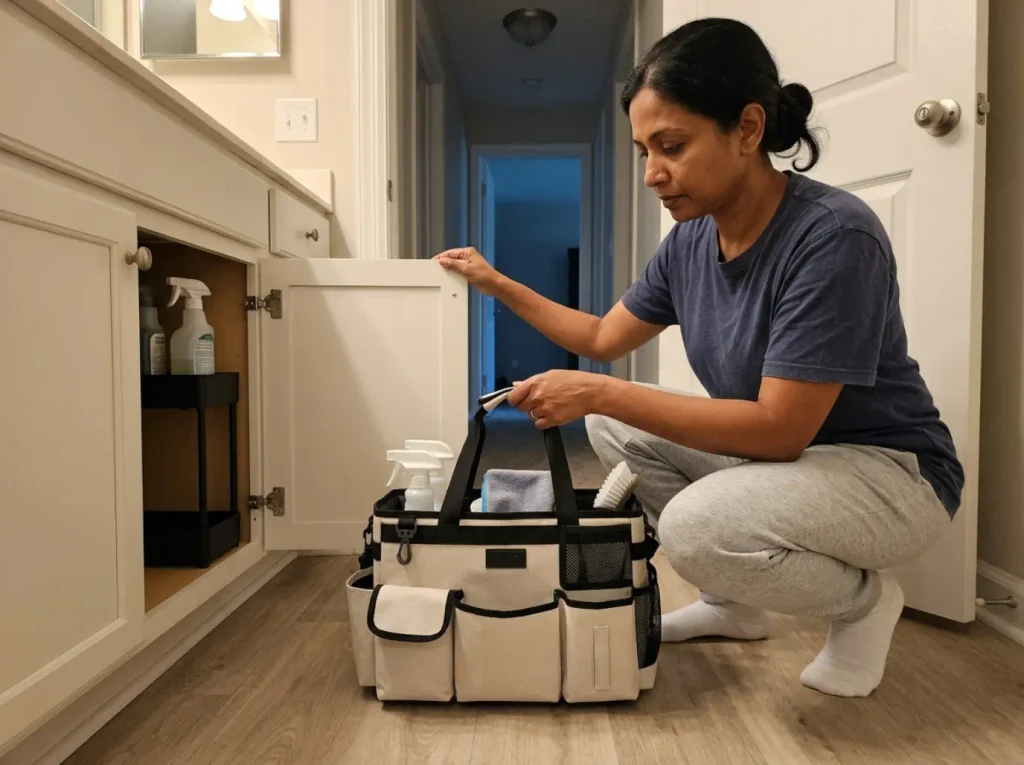
There’s always one bottle with no home. The all-purpose spray under the bathroom sink also wipes the kitchen counter, so it lives on the bathroom shelf, or on the kitchen counter, or in transit somewhere between the two. No amount of cabinet organizing fixes that bottle, because the cabinet was never where it belonged in the first place.
Stationary Supplies vs the Ones That Travel
Split the supplies into two categories and the problem resolves. Stationary supplies stay put: toilet bowl cleaner, tub scrub, drain cleaner, the refill jugs. Mobile supplies leave the room constantly: all-purpose spray, microfiber cloths, disinfecting wipes, gloves. Mobile supplies need a carrier, not a shelf.
Assigning a shelf spot to a bottle that leaves the room five times a week is exactly why it ends up on the counter instead, and then you blame yourself for not putting things away.
The moment that gives this away is one most people recognize instantly: reaching for the bathroom cleaner to wipe a kitchen counter, and realizing the bottle doesn’t live anywhere. Nobody ever designed it a spot, so it lives wherever it was last set down.
A Caddy Costs Less Than You’d Think (and You May Already Own One)
The fix is a grab-and-go caddy with a center handle, and this is the section where the honest answer is usually “you don’t need to buy anything.” A dollar-store tote does this. So does a small bin with a handle or a shower caddy you stopped using.
If it holds four bottles upright and you can carry it with one hand, it qualifies. That’s the entire spec.
If you’d rather have one sized properly for trigger sprays, the Cleaning Caddy Organizer with Handle is 15 x 8 x 10.5 inches, which lets a standard spray bottle stand upright without the head catching on the cabinet frame. It’s a convenience upgrade, not a requirement. Whichever you use, the portable caddy lives on the cabinet floor and leaves with you, so the mobile bottles finally have a home that moves at the same speed they do.
Keeping It Working Past Month Three
Notice what this whole system didn’t require: a single hole. Adhesive locks, an expandable rack that tensions into place, a mat that lies flat, a tote on the floor. That’s deliberate, and it means the setup comes with you when you move.
And maintenance is smaller than you’d expect. Twice a year, flip the bottles and check the dates, glance at the bleach zone to confirm nothing has drifted next to the glass cleaner, and lift the corner of the mat to look for the ring you didn’t notice.
That’s the entire upkeep. The cabinet doesn’t need reorganizing every season; it needs someone to look under the mat occasionally. And if your bathroom has no cabinet at all, the caddy system is the closest equivalent, alongside the storage options when there’s no cabinet at all in the pedestal-sink guide.
Put the caddy audit on the same day you change the smoke detector batteries. Twice-a-year tasks with no natural trigger get skipped, and pinning this one to a date you already keep is the difference between a system that lasts and one that quietly stops.
Conclusion
Three things carry the whole system. Sort by chemistry before you sort by category, so the bleach and the ammonia-based products get separated first and everything else falls in after. Zone by how often you reach for something rather than by what it is, with weekly bottles at the front and backstock behind them on something that spins. And if a child or a pet can reach that door, the lock isn’t optional, and the no-drill version takes three minutes.
In three months, open the door and look at the cabinet floor before you look at the bins. A ring on the mat means a bottle is failing, and that’s the only thing under there that gets worse on its own while you’re not watching.
Start with the sort. Get everything out on the floor, throw away what’s dead, and separate the bleach from the glass cleaner. You can buy the bins next weekend.
Frequently Asked Questions
01What should you not store under the sink?
Keep bleach-based and ammonia-based cleaners apart, and keep anything that suffers in humidity out entirely: paper goods, spare medication, and small appliances. The under-sink cabinet runs through temperature swings and damp, which weakens plastic bottles and cardboard over time. Concentrated products belong in a locked cabinet or on a higher shelf.
02How can I organize everything under my bathroom sink?
Empty it completely, throw out anything expired or unlabeled, then put a waterproof mat down before anything goes back. Return items in frequency zones: daily sprays at the front on a two-tier rack that clears the pipe, backstock behind on a turntable. Keep cleaning supplies and toiletries in separate labeled bins.
03Is it safe to store cleaning products under the bathroom sink?
Yes, with two conditions: incompatible chemicals stay separated, and the door is locked if kids or pets can reach it. The real risk isn’t storage itself, it’s a leaking bleach bottle sitting next to an ammonia-based glass cleaner in a closed cabinet. Contained zones and a raised-edge mat handle both.
04What are the most common mistakes when organizing under-sink storage?
Stacking bottles two and three deep against the back wall is the big one, because the product you use weekly ends up behind the one you use twice a year. The other two are skipping the mat, so a slow leak reaches the cabinet floor unnoticed, and using unlabeled bins that blur back into one pile.
05How often should you replace cleaning supplies?
Opened bleach loses most of its strength in about six months, disinfectant sprays hold up closer to two years, and dish detergent runs 12 to 18 months. Expired products aren’t hazardous, just weaker, which matters most for anything you rely on to disinfect rather than only clean.