

















In this article
You’ve cleared the junk drawer three times. Three times, within a month, it filled back up with mystery cables and dead batteries, and somewhere around the third round you started to wonder if the problem was you.
After years of organizing shared spaces under real constraints, here’s what I keep coming back to: the problem usually isn’t the drawer, and it isn’t entirely your partner either. Decluttering with someone who keeps everything is a systems problem stacked on top of a psychology problem, and most advice only tries to fix one of them. This guide covers how to work on both, in the right order, even if you live in a studio where “give them their own room” was never on the table.
Quick Answer
There’s no single trick here, but there is an order that works:
- Identify the type: resistant accumulator, chronic acquirer, or clinical hoarding
- Declutter your own belongings first, visibly and without commentary
- Time the conversation right and use “I” statements, never ultimatums
- Define zones with physical containers, not room-level promises
- Seal a limbo box for uncertain items, two months, no reopening
- Build an incoming-items rule so cleared spaces stay clear
What Kind of Partner You’re Actually Dealing With

Most advice treats “hoarder” as one category. It isn’t. The same gentle approach that nudges a “just in case” keeper toward letting go will, used on someone with clinical hoarding disorder, make everything worse.
So before you try a single tactic, you need to know which of three people you’re actually living with, because the wrong read doesn’t just slow you down. It backfires.
The Resistant Accumulator (This Is Most People)
The resistant accumulator keeps things for a hypothetical future that rarely shows up. The broken lamp that might get fixed, the cables for devices you no longer own, the four extra travel mugs because what if guests come. This is “just in case” thinking, and it’s the most common version of the problem by a wide margin. These partners aren’t ill; they’re attached to the idea that an item might one day earn its keep, and that attachment loosens under the right conditions.
What works here is patience and a lack of pressure: gentle questions, time-limited experiments, and watching you do it first. If your partner’s resistance is more sentimental than practical, that’s still this category, just with a different emotional engine. Partner resistance is also one of the most common KonMari stall points, so if you’ve tried a named method together and hit a wall, you’re in good company.
The Chronic Acquirer (When Stuff Keeps Coming In Faster Than It Goes Out)
The chronic acquirer is a different animal. They may be perfectly willing to let go of old things, but new things arrive faster than old ones leave, so the net volume climbs no matter how much you both purge. The one-in-one-out rule gets recommended everywhere for this. And it works, honestly, unless acquisition is the real driver, in which case removing one item while three arrive is just bailing a boat with a teaspoon.
With a chronic acquirer you need two systems at once: one that governs what goes out, and an explicit agreement about what comes in. Skip the second one and you’ll work hard and go nowhere.
Clinical Hoarding Disorder (A Completely Different Category)
Clinical hoarding disorder is a recognized condition, not a stubborn personality trait. The International OCD Foundation’s guidance on hoarding disorder describes the DSM-5 markers: persistent difficulty discarding regardless of an item’s actual value, real distress at the thought of letting go, and living spaces so congested they can’t be used for what they’re meant for. Roughly 2.5% of adults meet these criteria, about one in forty.
Here’s the part most articles skip: about 92% of people with clinical hoarding disorder also have at least one other condition underneath, like anxiety, ADHD, or depression. The stuff is the symptom, not the disease. One person I know finally heard it from a therapist, that the hoarding was never about the things, and that she’d spent years treating the symptom while the real problem sat underneath untouched. It landed harder than any decluttering tip ever could.
Why Misreading the Type Makes Everything Harder
The tactics that help a resistant accumulator, a bit of pressure, quietly removing things, a fast whole-room clear-out, are the same tactics that traumatize someone with clinical hoarding disorder and entrench the behavior. Get the diagnosis wrong and you don’t just stall. You make the next attempt harder than this one.
Use one quick test to separate “messy” from clinical: can the space still do its job? If the bed is for sleeping, the stove is for cooking, and the couch is for sitting, you’re almost certainly dealing with a resistant accumulator, not a clinical case. When rooms can no longer do what they’re named for, that’s the line where professional support matters more than any bin.
Declutter Your Own Stuff First (Before You Say a Word)
The first time I sorted my own half of a shared closet without announcing it, I expected nothing to come of it. I pulled everything off my side, made a keep pile and a donation bag, and worked through it on a Saturday morning. My partner walked in halfway through and asked what I was doing. That question, not any speech I’d planned, opened the first real conversation we’d had about the stuff in months.
Why Modeling Works When Pressure Backfires
There’s a reason therapists who treat hoarding use motivational interviewing instead of confrontation: change that comes from inside a person sticks, and change you push onto them gets pushed back. When you declutter your own things, you take pressure off the table entirely. You’re not asking them to do anything. You’re just showing what it looks like, and you let the contrast do the talking.
What to Declutter First (Your Half, Not Theirs)
Start with the stuff that is unambiguously yours: your side of the closet, your nightstand, your own “just in case” backstock of cables and chargers and hotel toiletries. Going first earns you credibility you can’t get any other way, and it quietly lowers the decision-fatigue temperature in the whole home. The same minimalist decluttering tactics that clear your own backstock apply here, like the rule that anything cheap and easy to replace doesn’t need to be stored “just in case.”
What not to do: announce your sort as a demonstration, line your donation bag up next to their stuff for comparison, or finish and immediately tell them they should do the same. The moment it reads as a setup, you’ve turned modeling back into pressure.
Fill the donation bag and get it out of the home the same day. A full bag that lingers by the door for two weeks teaches everyone watching that decluttering is just relocating things, which is the exact lesson you don’t want a reluctant partner to absorb.
The Enabler Check (What You Might Be Contributing Without Knowing It)
This part stings a little, so I’ll be quick. If your response to your partner’s accumulation has been to buy more bins, sort their stacks, and arrange their collections neatly, you may be growing the total volume rather than shrinking it. Organized clutter feels acceptable. It removes the visual pressure that might otherwise prompt a decision, and it quietly signals that the answer to “too much stuff” is “better containers.”
I used to think helpful organizing was the supportive move. After watching neat, well-labeled overflow keep expanding year after year, I stopped tidying other people’s hoards and started asking whether the volume itself needed to come down first.
The Conversation That Actually Works
The timing of this conversation matters more than the words in it. The exact same sentence, something like “I feel overwhelmed by how full the apartment has gotten,” opens a door on a calm Tuesday and starts a three-day standoff on a day the clutter is already a sore spot. The difference is almost never the script. It’s whether the other person felt ambushed.
When to Have the Conversation (Timing Beats Script)
Don’t raise it during or right after an argument, and don’t raise it on a day the mess is visibly bad, because then it sounds like an accusation with evidence attached. Wait for a moment when you’re both calm, fed, and not already tense about something else. Part of why these talks escalate so fast is plain depletion; decision fatigue is part of why decluttering conversations go sideways, and a tired brain treats a request as a threat.
The Language That Opens Doors vs. Slams Them
Lead with how you feel and what you need, not with what they’re doing wrong. “I feel boxed in when the hallway is too full to walk through easily, can we figure out a system that works for both of us?” lands completely differently than “you have too much stuff and it has to go.” Then ask questions that let them name their own reasons: “what would it feel like to find the thing you’re looking for the first time you look?” Change they talk themselves into is far stickier than change you hand them.
What reliably backfires: calling them a hoarder, saying “normal people don’t keep this much,” issuing ultimatums with deadlines, and removing anything without permission. Each one raises the defenses and, in practice, speeds accumulation up rather than slowing it down.
When the Conversation Keeps Going Nowhere
If every version of the talk dead-ends, a couples counselor isn’t a sign the relationship is failing. It’s a neutral third party who removes the adversarial dynamic and gives both of you somewhere to actually be heard. This short talk from a certified couples therapist walks through how to approach a hoarding partner without turning it into a fight, and it’s worth watching together.
Zone Agreements for Shared Spaces (Especially Small Apartments)
“We live in 650 square feet. Every guide told me to give him a room. We don’t have a room, we have one closet and a bed.” That’s the gap nobody writing about this seems to notice. The advice to hand your partner their own space was written for people with spare rooms, and most apartments don’t have one. So the zone logic has to work at shelf level, not room level, and a physical container turns out to be a more reliable boundary than any promise, because a bin doesn’t get renegotiated on a bad day.
Why “Give Them a Room” Fails in Apartments
In a studio or a one-bedroom, the “designated hoard room” is also the bedroom, the kitchen, the office, and the place you watch TV. There’s nowhere for the overflow to go that isn’t also somewhere you live. So instead of assigning a room, you assign surfaces and containers, and you define them specifically enough that there’s nothing left to argue about later.
Zone Logic at Surface and Container Level
A workable studio split looks like this: the space under the bed is their autonomous zone, their half of the closet is their territory, one freestanding shelf unit is their visible bounded space, and the shared surfaces stay clear by default. Each zone has an edge you can see and touch.
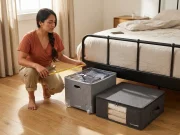
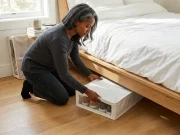
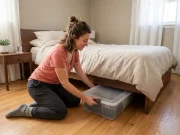
A freestanding cube unit pulls double duty here as a room divider and a contained “their stuff” zone, which gives an accumulating partner real, visible autonomy without needing a door. For the under-bed zone, a flat container does the defining. The storageLAB Under Bed Storage Container with Lid runs about 33 by 17 inches with a 4.5-inch profile, low enough to slide under most platform beds, and the hard part is that it physically can’t overflow into the room the way a loose pile can. Measure your clearance first, though; if your bed sits under five inches off the floor or has a center support bar, check the dimensions before you order, and the IRIS USA under-bed box is a slightly slimmer alternative for tight frames.
The Always-Clear Surfaces Agreement
Pick a few surfaces that will never hold “stuff,” and pick them together. The kitchen counter, the coffee table, the bathroom sink ledge are the usual ones (pick whichever you actually use every day, not whichever looks worst right now), and the reason isn’t tidiness, it’s function. You need to cook on the counter, not clear it first every single night. These designated surfaces are the apartment-scale substitute for a hoard room: small, specific, and defended by agreement rather than by walls.
When the Bin Is Full, It’s Full
The whole point of a physical limit is that it argues for you, neutrally, without blame. When a bin is full, it’s full, and that’s a fact nobody has to enforce in the moment. Before buying anything, see whether dollar-store bins or boxes you already own can mark the zones, because the container’s job is to set an edge, not to look impressive.
If you do want something sturdier and stackable for shared cabinet shelves, the mDesign Stackable Plastic Storage Bins come in a four-pack sized for standard cabinet depth, and once one is full the agreement is simply that nothing else joins it until something leaves. The caveat: they’re shallow by design, so they’re for small overflow categories, not bulky gear. Once zone agreements are holding, a room-by-room decluttering checklist is the natural next step for when you’re both ready to work through shared spaces together.
Define the zones while the space is calm, not mid-cleanup. Agreeing that “the left two cubes are yours, the counter stays clear” is an easy conversation on a quiet evening and an impossible one when you’re both standing in a mess and already frustrated.
The Limbo Box System
The limbo box works because it splits apart two decisions most people smash together: “should I keep this forever?” and “can I live without it for two months?” The first question is paralyzing for an accumulator, because it feels permanent. The second one quietly answers itself, because almost nothing in the box gets missed.
How the Limbo Box Works (And Why It Bypasses the Resistance)
Your partner, not you, packs the uncertain items into a box. They write the date on the outside, seal it, and it goes out of sight. Nothing is being thrown away, which is the whole reason the resistance drops; they’re not losing anything, they’re running a test.
Their things, their hands, their timeline. Your only role is to suggest the experiment, never to pack it for them.
The Two-Month Rule and the Non-Reopening Commitment
Two months is the sweet spot, long enough to prove nothing was missed, short enough to feel manageable. The catch that makes or breaks it: if the box goes the full two months unopened, it gets donated without being reopened, and that commitment has to be made before the box is sealed, not after.
I learned this the slow way. The first box I ever did, I cracked the lid “just to check” at week six, and an hour later half of it was back on the shelf, suddenly precious again. Now I write the donate-by date on the box instead of the packing date, so the deadline is the first thing you see, not the last.
Sentimental Items and the Photo Preservation Workaround
For sentimental things, the limbo box stalls, because the fear isn’t “I’ll need this,” it’s “I’ll lose the memory.” That’s why a quick phone photo before anything leaves does more heavy lifting than any container (one shared album, not a folder buried three taps deep, or nobody will ever open it). A photo album of “things we had” costs zero square footage and removes the memory-loss anxiety almost entirely. It helps to understand why sentimental items feel so much harder to release than practical ones, because once you see that the object and the memory are two separate things, keeping the memory and releasing the object stops feeling like a betrayal.
Store the limbo box somewhere genuinely out of sight, a closet shelf, under the bed in a separate area, a storage unit. A box that sits in the hallway for six months doesn’t test anything; it just becomes more ambient storage, and the deadline that makes the whole thing work never kicks in.
Why Progress Collapses at Month 3 (And How to Prevent It)
Three times I cleared that junk drawer. Three times it was full again within a month, the same tangle of cables and dead batteries, and I was so focused on the clearing that I never once asked why it kept refilling.
The answer wasn’t the drawer, and it wasn’t laziness. We had never decided where things were supposed to go when they came into the apartment, so the cleared drawer just became the nearest open landing pad. This is the part almost nobody talks about, and it’s where most couples actually lose.
The Five Reasons the Cleared Drawer Fills Back Up
There are five usual culprits, and most month-three collapses are some mix of them:
- No incoming-items rule, so the cleared surface becomes the new dumping ground.
- No assigned home for each type of thing, so new arrivals default to the closest surface.
- The limbo box never got a real deadline, so things drifted back out of it.
- One partner did all the organizing, so the other built no habit to maintain it.
- The acquisition itself was never addressed, so you clear the output while the input runs wide open.
That last one is the quiet killer. Clutter creep is just a hundred small daily additions, each too trivial to challenge on its own.
The Incoming-Items Protocol
The fix is a rule for anything that crosses the threshold: it either has a named home and goes there now, or it goes through a fast decision, keep and place, donate, or return. “I’ll deal with it later” is the exact phrase where the drawer refills. If you’ve ever used the staging zone and 7-day rule that make one-in-one-out actually hold, this is the same muscle, pointed at the front door instead of the closet.
Every Item Needs an Address, Not Just a Container
Here’s the single principle that prevents re-accumulation better than anything else: every item needs a home inside the home. Cleared surfaces fill back up because new things have no address, and a surface is the default address when nothing else is assigned.
The cheapest way to give things addresses is masking tape and a marker, which honestly works just as well as anything fancier for most shelves. If you want something cleaner and more permanent, the Brother P-Touch PTD220 Label Maker makes a labeled bin’s purpose unarguable, so “put it away” becomes a clear instruction instead of a daily negotiation. One caveat from experience: labels peel in humid rooms, so keep the machine for dry storage areas and use tape where it’s damp.
Labeled bins are what turn an agreement into something visible and defensible, which matters more with a partner who churns, moving things from pile to pile without ever deciding. The Fabric Storage Bins with Labels come collapsible in a set of six and fit standard shelves, so empty ones fold flat instead of adding their own clutter, though they will sag if you overstuff them past their shape. Then keep a short cadence: a 15-minute reset walk-through once a month beats a dreaded quarterly deep-dive every time, because brief and regular never lets the buildup reach doom-pile size in the first place.
When to Get Help (And When to Accept a Livable Ceiling)
Nobody tells the non-hoarding partner that there’s a ceiling. Not every accumulating partner will become a minimalist, and that’s genuinely fine, but some situations are also beyond what any organizing strategy can reach. Knowing which one you’re in changes what “success” is even supposed to look like.
Signs This Is Beyond Organizing Strategies Alone
A few signals mean this has moved past bins and agreements: living spaces that can’t be used for their purpose, real health or safety issues like mold, pests, or blocked exits, a partner in visible distress about the items rather than just resistant, and relationship damage that’s gone deeper than a disagreement about tidiness. If you’re seeing those, the goal shifts from organizing to support.
What Professional Support Actually Looks Like
Therapy for clinical hoarding is a long road, not a weekend, typically 20 or more weekly sessions over several months to a year, and home visits tend to improve the outcome. The honest framing: about 70 to 80% of people show meaningful progress, but “meaningful progress” can still leave a home fuller than you’d prefer, and the aim is improved, not cured.
On the organizing side, a professional organizer certified through NAPO who specializes in chronic disorganization works with the accumulating partner on their terms, collaborative sorting with consent built in rather than imposed clear-outs, which is consistently the approach that doesn’t make things worse. Couples counseling, separately, is for the relationship strain the clutter created, the part an organizer can’t touch.
This talk featuring a leading academic researcher on hoarding speaks directly to what spouses go through and what help exists.
Deciding What “Good Enough” Actually Means for Your Apartment
When you’re deciding whether to keep pushing, three questions cut through the noise: is the clutter a safety issue, is it a health issue, and is it a real functional problem you can’t work around? If the answer to all three is no, then a negotiated livable state may be the right finish line, not a magazine spread, just a shared space both of you can actually use.
Forcing rapid change on someone with clinical hoarding tends to damage both the relationship and the long-term outlook, so “livable” isn’t settling. It’s strategy. If you’d rather start from a shared method than a standoff, browsing other decluttering methods worth trying together can give you both a neutral starting point that doesn’t feel like one person winning.
Where to Start and What to Expect
Three things matter more than the rest. Diagnose before you strategize, because the tactics that help a resistant accumulator actively backfire with clinical hoarding. Declutter your own things first, not as a demonstration but as the groundwork that earns credibility and opens the conversation without pressure. And remember that cleared spaces refill when items have no assigned home, so the incoming-items rule is the only maintenance system that actually holds past month three.
In three months, check one specific thing: do new items coming into the shared spaces have an automatic destination? If a thin layer of “stuff” is building back up on a cleared surface, the incoming-items rule isn’t working yet, and that’s the piece to fix before anything else.
Start with your own half of the shared closet this weekend. Declutter it. Don’t announce it. See what happens.
Frequently Asked Questions
01How do you get a hoarder to throw things away?
You don’t force it; you remove the pressure that triggers resistance and let them keep control of the decision. Use a sealed limbo box for uncertain items and gentle questions instead of ultimatums, since pressure reliably backfires.
02What do you do when your partner refuses to declutter?
Start with your own belongings instead of theirs, since modeling shifts the dynamic that arguing never will. Declutter your half of the shared closet visibly and without commentary, and let the contrast open the conversation on its own.
03How do you live with a partner who won’t get rid of anything?
Define physical zones so their things stay contained without daily negotiation, and protect a few always-clear shared surfaces. Give them one bounded territory, like an under-bed container or a single shelf unit, and when it is full, it is full.
04Is hoarding a mental illness?
Clinical hoarding disorder is a recognized condition in the DSM-5, affecting roughly 2.5% of adults, and about 92% of those also have another condition like anxiety or ADHD. But most partners who simply resist decluttering do not meet that clinical threshold.
05How do I declutter when my spouse is a pack rat?
Figure out whether they keep things just in case or actively bring new things in, because each pattern needs a different fix. Pair an outgoing system with an incoming-items rule so cleared spaces do not refill within a month.