



















In this article
You buy the matching bin set on a Saturday morning, high on the idea of a finished room. Sunday night it looks like a catalog. Three weeks later there is a fresh pile on the floor and two of the bins are still empty. Nothing went wrong with your effort; the order was wrong, because you bought containers sized for a toy collection that still included everything you were about to give away.
Learning how to organize kids room chaos in one sitting is less about the storage you buy than about running four steps in a fixed sequence, which is what professional organizers describe when they say to clear the space and categorize before deciding what stays. Below is that sequence, time-boxed for one afternoon, plus what to do when the room has years of accumulation behind it. If you want the standing framework rather than today’s session, the full kids’ bedroom system covers the zones and stages this process executes against.
Quick Answer
Organize a kids’ room in four steps, in this order, over roughly 2 to 4 hours:
- Purge first, with a timer and a keep, donate, not-sure-yet split
- Set four zones: sleep, play, dressing, homework or craft
- Measure reach height and closet rod height before buying anything
- Contain in open bins at that height, labeled with pictures and words
- Run a 5 to 10 minute nightly reset the child does, not you
Why the Room Reverts Before You Even Start Buying Bins
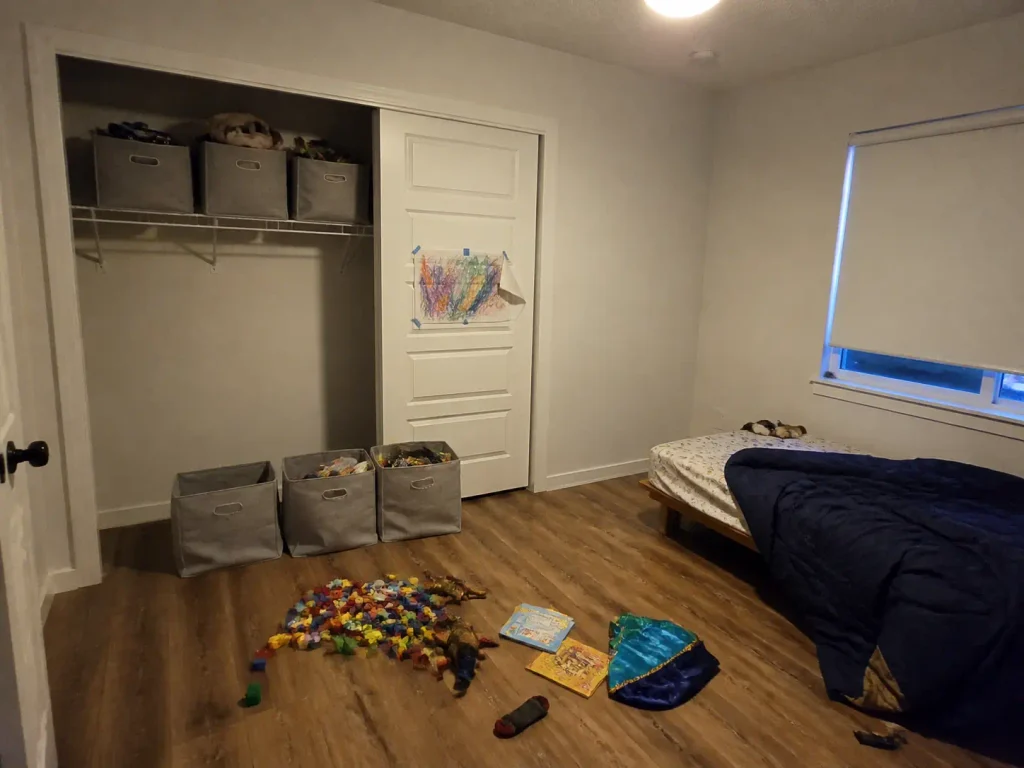
The reversion is not a discipline problem, and it is not a sign your kid is messier than other kids. It is a sequencing problem, and it fails the same ways in almost every room.
The first is buying containers before the purge. Organizing threads are full of the same confession, phrased almost identically every time: bought bins that didn’t fit what’s left.
You size the bins to the collection you have on Saturday, then spend Sunday removing a third of that collection, and now the geometry is wrong in both directions at once. Half the bins hold air. The categories you actually kept overflow, and overflow goes where it always goes, which is the floor.
The second is adult-logic categories. A parent shelves a room the way a store shelves an aisle: by material, by type, by what looks coherent from the doorway. A child files by what they were doing five minutes ago. If your kid cannot predict which bin a thing lives in without asking you, the labels are decoration and you are still the system.
The instruction gives it away. “Clean your room” stalls out because there is no discrete task and no finish line, while “put the dinosaurs in the blue bin” gets done.
Third, and almost nobody plans for this one: the undecided items. Every purge produces a stack of things nobody can call. The outgrown-but-beloved stuffed animal, the toy with one missing piece, the gift from a relative who asks about it.
With only two destinations available, those items get put back “for now,” and for now is the seed of the next pile. It is why the same three-week reversion pattern shows up in bedrooms generally, not just kids’ rooms.
Then there is the intake rate. Goodie bags, fast-food giveaways, the grandparent who cannot walk past a toy aisle. Toy volume climbs quietly between sessions, faster than any single purge accounts for, so a one-and-done afternoon reverts within a season if nothing changes what comes through the door.
Which means you are probably not re-organizing because you did it badly. You are re-organizing because step three happened before step one.
Before you start, photograph the room from the doorway. Not for a before-and-after post. Three weeks from now that photo tells you which specific corner rebuilt itself first, and that corner is the one whose category is wrong.
Step One: Purge With a Decision Framework and a Timer
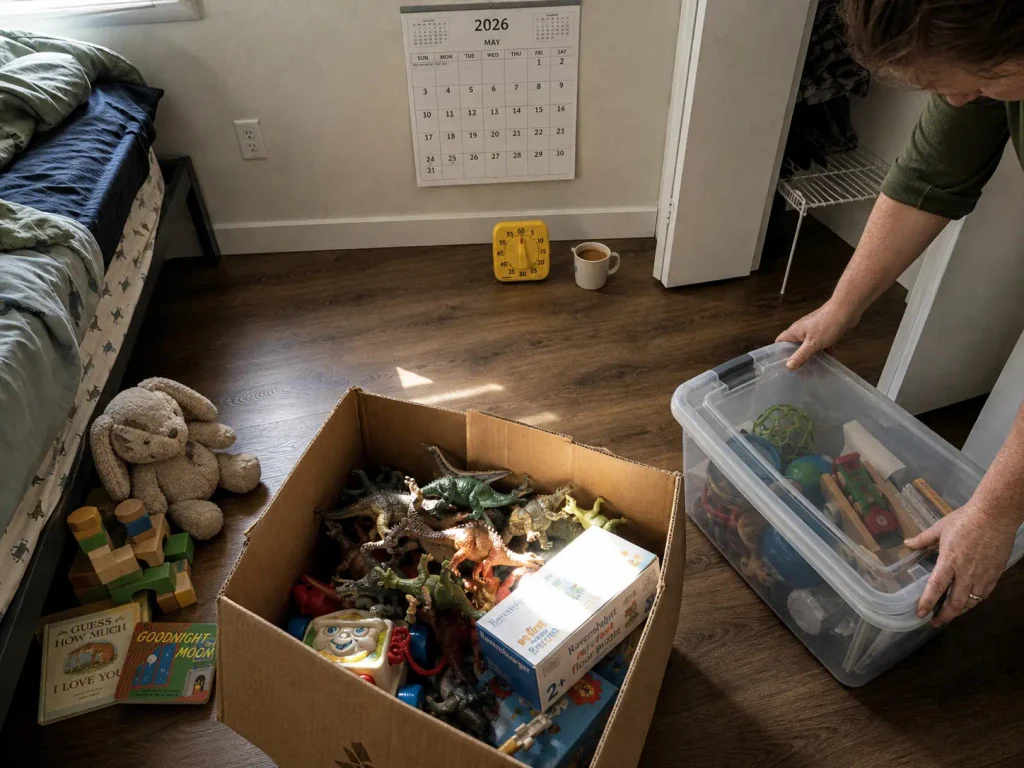
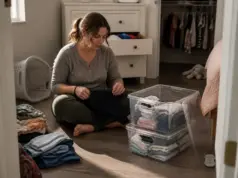
This is where most sessions die, and not because purging is emotionally hard. It dies because a parent tries to make two hundred individual keep-or-donate calls, with a child in the room, and no clock running. Both have a fix and neither costs anything.
Start with the number nobody gives you. A focused single-room purge runs about 2 to 4 hours, depending on the child’s age and how long their attention holds. If the room has years of accumulation behind it, do not force it into one afternoon: split it across several shorter sessions, a week of short evenings or two lighter weekends.
Set the timer out loud, where the kid can hear it. A visible endpoint changes how a seven-year-old behaves in hour two.
The sequence inside the purge matters as much as the sequence of the afternoon. Clear first, categorize second, decide third. Empty the space, group everything by type so all the stuffed animals are together and all the blocks are together, and only then make calls category by category. As professional organizers interviewed by NPR put it, clear the space and categorize before you decide what stays.
Deciding item by item while you are still pulling things out of the closet is what produces the paralysis, because every object arrives without context. Twelve toy cars in a pile is a decision. One toy car in your hand is a debate.
The duplicate rule does the heavy lifting once things are grouped: one or two of each toy type stays, unless a duplicate genuinely does something different developmentally. Keep the favorite, donate the other four. A kid usually accepts that, because they are choosing the winner rather than losing the category. This is quality over quantity toys applied with an actual rule instead of a sentiment, and it is the fastest way to cut volume without a single argument about a specific beloved object.
Then the piece almost every kids’-room guide skips: the third box. The full split is keep, donate, not sure yet. The maybe box is a real labeled container with a date written on the side, and the date is the whole point. Whatever is still sealed and unmissed on that date leaves.
Without that third destination, undecided items quietly re-enter the room and become next month’s pile. If you want the formal version, this is a fourth destination for the genuinely undecided inside a standard sorting method. Sentimental items get their own pass on a different day, kids’ artwork especially, because kids’ artwork needs its own decision pass with different rules and a slower clock.
And do not buy anything yet. For the sorting phase, use shoeboxes, laundry baskets, and the dresser drawers already in the room. Empty totes from the garage work too, and so does the floor with masking-tape borders. Free, thirty seconds, and the exact opposite of the mistake this room already made once.
Schedule the donation pickup or put the drop-off in your calendar before the purge starts, not after. Bags that live by the front door for two months are not decluttering, they are relocation.
Step Two: Set Up Zones and Measure Before You Buy
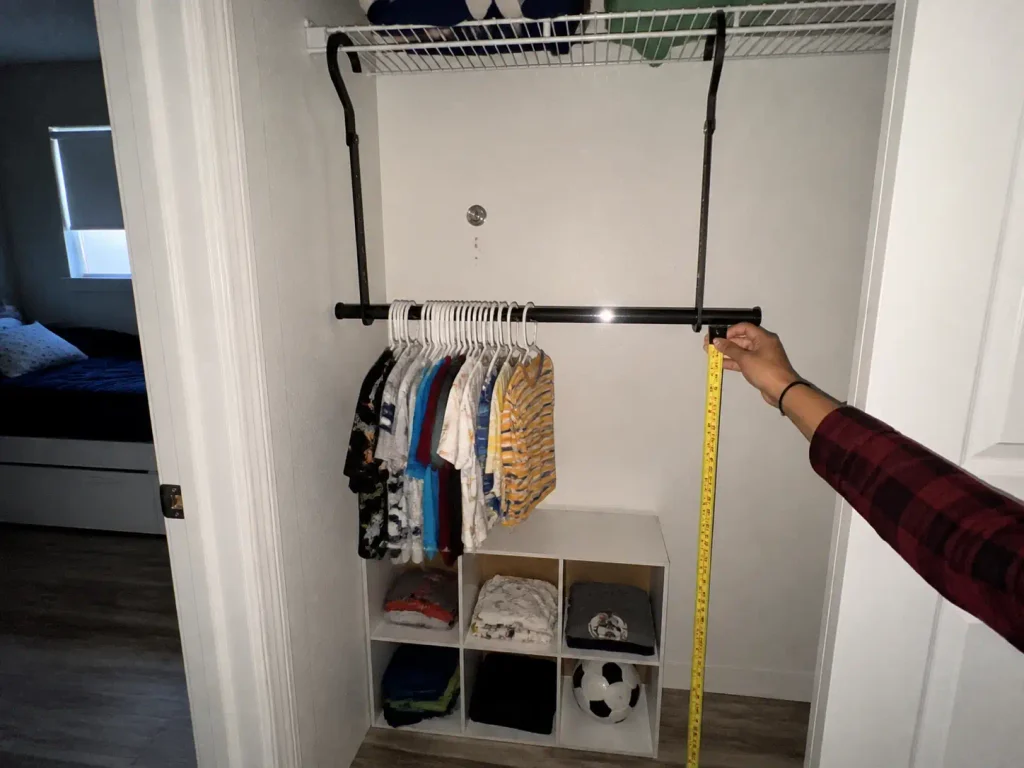
This is the step where a tape measure saves you a return trip. Most kids’ rooms have a closet doing about half its job and at least one shelf set at a height the child physically cannot use. Both are fixable in twenty minutes with no-drill storage alone, and both have to be settled before a single bin gets ordered. Good kids room organization is decided here, with a pencil, not at checkout.
The Four Zones Every Kids’ Room Needs
Four zones: sleep, play, dressing, and homework or craft. Their real function is not tidiness. Zone-based organization converts “clean your room” into a task with a visible finish line, because every object now belongs to a place, and cleanup becomes a sorting task, which children are genuinely good at.
In a small or shared room, zones overlap by function rather than by furniture, and this is where parents overspend: the closet interior is the dressing zone, the play zone borrows floor space in front of the bed by day, and a rug is often the only boundary marker you need. If the kid’s room is also the small room in the house, the same zone-then-measure order for a small bedroom applies with almost no changes.
Reach Height Is the Measurement That Decides Everything
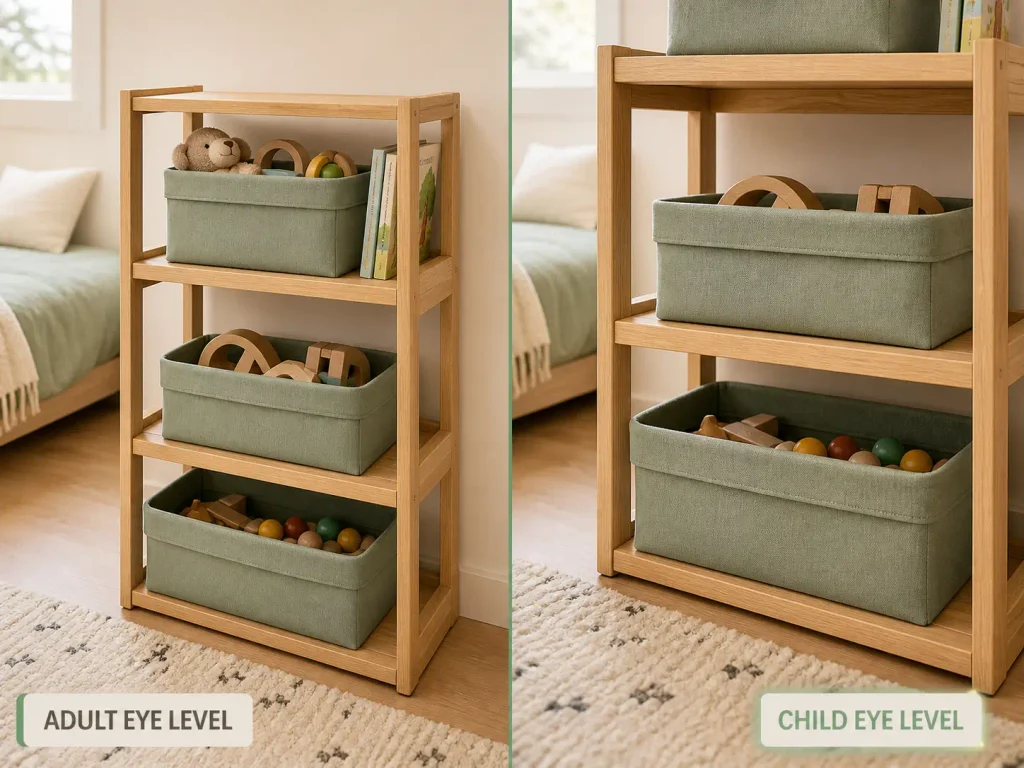
A child-height shelf, the kind holding the open bins your kid uses daily, sits roughly 12 to 18 inches off the floor for a toddler and climbs as the child does: about 24 to 30 inches for toddlers, 36 to 42 inches for ages three to seven, and 48 to 60 inches for ages seven to twelve. Set the shelf to the age band’s number, not to what looks balanced from the doorway. Every toy storage decision that follows depends on this one number.
The failure this prevents is the quietest one in the room, because everything looks finished while it happens. A parent builds a genuinely good shelf setup, the child cannot reach past the second shelf, so the child plays from whatever is on the floor. The floor stays populated and the shelves stay untouched.
Squat to your kid’s eye level and look at the wall. The top bin does not exist from down there.
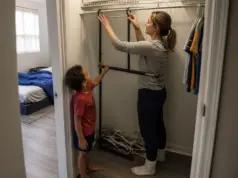
Have the child stand flat-footed against the wall and reach up with a pencil. Mark it. That line, minus a couple of inches so they are not straining on tiptoe, is the top of your usable storage. Everything above it belongs to you, not to them.
The Closet’s Dead Space, and the No-Drill Way to Take It
A standard closet rod sits at about 66 inches. Your six-year-old is roughly 45 inches tall. Everything between the floor and that rod is dead air with a few shoes in it, which is why kids’ closets feel full while holding almost nothing.
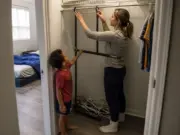
A second closet rod at roughly 33 inches doubles hanging capacity in the same footprint. Adjust by age: around 24 inches for a toddler, 30 to 36 inches at school age. Give each half roughly 38 inches of vertical clearance so shirts on the lower rod are not dragging and jackets above are not resting on them. That is the standard double-hang math from the reach-in closet layout most kids’ rooms are working with, scaled to a person four feet tall.
If you already own an adjustable tension rod, use it at the age-band height and skip the purchase. If not, the STORAGE MANIAC Adjustable Closet Double Rod comes as a 2-pack rated to 110 pounds and hangs from the existing rod rather than the wall, which makes it renter-friendly in the strict sense and puts it in the category of no-drill closet setups that keep the deposit intact. If your closet is wide enough, a small dresser in closet placement under the upper rod turns the same dead space into folded storage instead. One real limitation: it transfers its load to the original rod and brackets, so if yours is the flimsy hollow chrome tube some builders use, check it is not already bowing before you double what hangs from it.
The closet floor is the other half of the same dead space. Stacking bins you already own work here, or a bookshelf laid on its back. Check your closet depth before you commit to anything, because a unit that overhangs the door track turns a working closet into one that no longer closes.
If you want a cube storage unit that sizes to the opening, a freestanding AWTATOS Stackable Cube Organizer in a 6-cube configuration fills the floor without a single screw. Freestanding cuts both ways: nothing to patch when you move out, but nothing holding it to the wall either, which matters for the next section. If drilling is off the table entirely, command strips carry a fabric wall pocket for soft toys, and that is roughly where adhesive mounting stops being honest about weight.
Step Three: Contain and Label So a Child Can Actually Use It
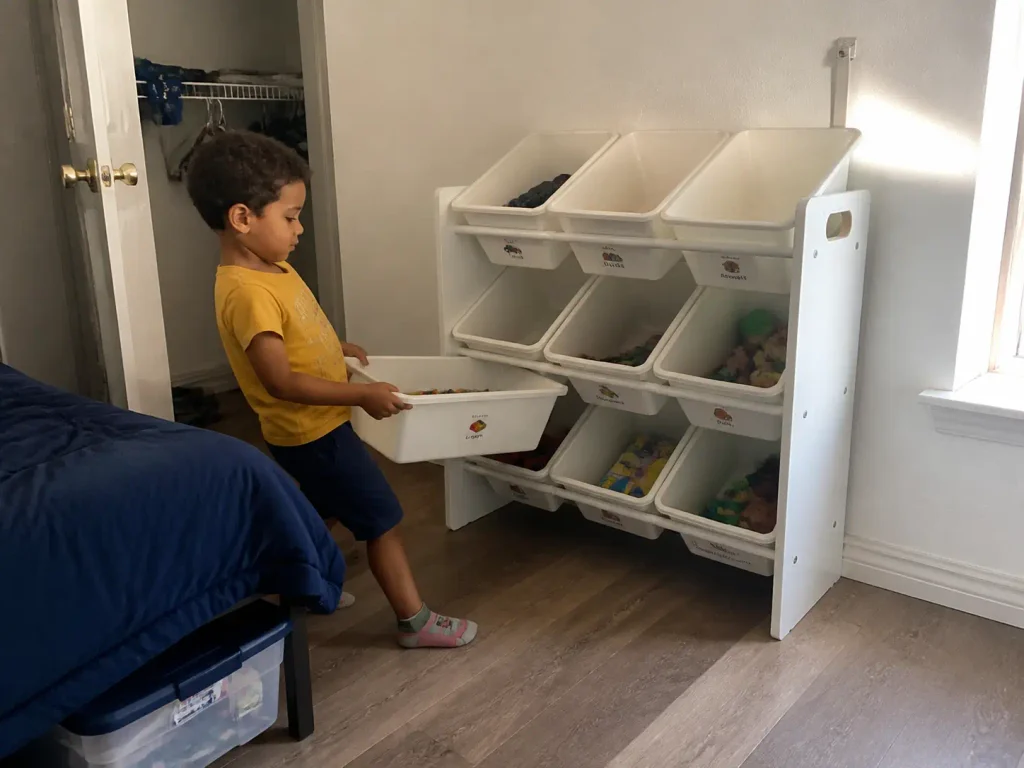
Containment is where adult taste and child usability pull hardest in opposite directions. Lids look tidy in photographs and quietly break the system. Matching bins photograph beautifully and mean nothing to a four-year-old who cannot tell them apart.
Open Beats Lidded, Every Time
A lid is one extra step between your child and putting the thing away, and one extra step is the whole margin. The kid holds the toy, sees the closed lid, and sets the toy on top of the bin. Now the lid cannot open without moving the toy, so the next toy goes on the floor beside it. Two days of that and the bin is furniture.
Open-front bins at the reach height from step two are what actually get used. One bin per category, sized to the category after the purge, not before, which is the entire reason this step is third and not first. Keep the category bins broad, too: “vehicles” is a bin a five-year-old can file into, while “cars, trucks, and construction vehicles” is three decisions they will not make. Bins and baskets from elsewhere in the house go first, always, and which stackable bins hold up to real use is worth ten minutes before you buy.
If the surviving categories need more than you can scrounge, a tiered unit solves reach and sorting in one purchase: the Humble Crew Kids Toy Organizer puts nine removable open bins across three tiers at child height, and removable is the feature that matters, because a kid can carry the whole dinosaur bin to the rug and back. The caveat: a 3-tier frame is exactly the shape that gets climbed, which is what the anchoring section below is about.
Labels a Pre-Reader Can Read
Picture-plus-word labels decide whether the child can self-maintain the system or you do it for them. A word-only label on a bin for a four-year-old is a label for you. Add the picture and the same kid puts things away alone, and can tell a visiting friend where the blocks go, which is the actual test.
I used to think labels were mostly theater in a kids’ room, until enough organizing threads landed on the same detail: the labeled bin is the only part of the system a child can operate without asking an adult a question. The label is not for tidiness. It is the interface.
Free version first, and it works fine: write on masking tape with a marker and draw the picture yourself. Your drawing does not have to be good (kids read a lopsided rocket ship without hesitating, and mine would not survive a fridge door). The downside is that tape peels within a few months of sticky hands. Preprinted sets like the Talented Kitchen Playroom Organization Labels run 120 water-resistant picture-and-word labels that survive handling in a way tape does not, with the trade-off of fixed categories: some labels you never use, and one category the set forgot.
Anchor Anything Taller Than the Child
This part is not optional and it takes four minutes. Roughly half of fatal child injuries involving furniture happen in bedrooms, and the CPSC’s Anchor It! campaign reports that nearly 80% of furniture tip-over fatalities involve children age five and under.
The mechanism is exactly what you just built: bins at the bottom, something interesting at the top, and a child newly encouraged to take things off shelves alone. Shelves get climbed. That is not misbehavior, it is the system working as designed by a four-year-old.
So anything taller than the child gets anchored to the wall before it goes into service. Not later, before. And use the right hardware: pediatric safety guidance recommends metal anchor brackets over the plastic anti-tip straps that ship in the box, because plastic goes brittle and fails on a timeline nobody is tracking. Renters, this is the one place to spend two spackle-sized holes: a pair of screw holes behind a bookcase is a five-minute patch at move-out.
Under the Bed, and the Step Stool Question
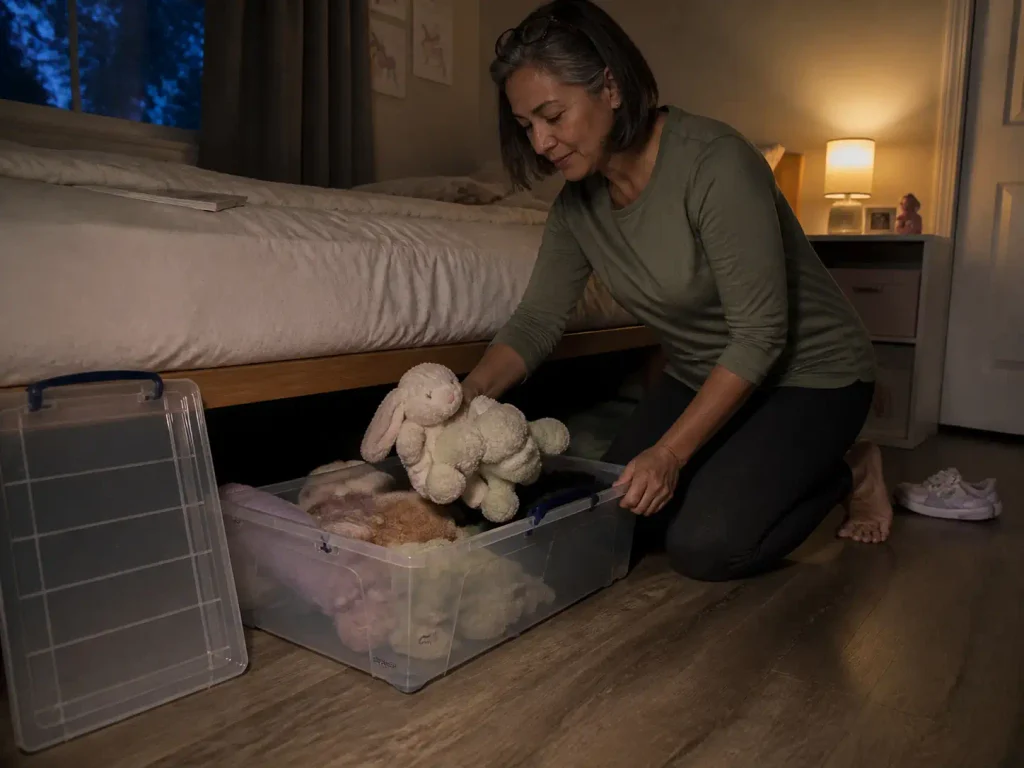
Under-bed space is the right home for off-season clothes and the overflow that does not earn a visible shelf. Anything flat that clears your bed frame works: a shallow box, a zip bag, the lid-less drawer from a dresser you no longer own. Measure the bed frame clearance first, because the number is almost never what you would guess, and kids’ under-bed storage turns over so fast largely for clearance reasons.
If you are buying, wheels are the deciding feature rather than a nice extra, which is why rolling bins win here over flat lidded boxes. The Superio Under Bed Storage Containers with Wheels come as a set of three at 26 by 16.5 by 6.3 inches, and that 6.3-inch height is the number to check against your frame before ordering. Rolling matters because a child can pull a wheeled container out unaided, where a lift-and-drag box needs an adult every time, and anything that needs an adult stops being part of the child’s system.
Last piece: sometimes one shelf lands slightly above the age band’s reach height, and re-hanging every shelf to fix it is absurd. Nothing needed if your shelves already sit right. If not, a dual-height non-slip stool like the COOSEYA 2-Step Stool is the cheap bridge and buys a couple of years as the child grows. One honest caveat: a stool is also a climbing aid, which loops straight back to anchoring the tall furniture first.
Step Four: The Maintenance Reset That Keeps It From Reverting
Everything so far was the afternoon. This part decides whether the afternoon was worth it, and it comes down to a number, a rule about who does it, and one free move.
The number is 5 to 10 minutes of nightly tidy-up, with a 15-minute timed reset when things drift over a busy week. Pair that daily pass with a monthly reset that checks the bins themselves: which category outgrew its container, which one sits empty, which label nobody uses.
That range is deliberately small. A 45-minute nightly routine is a fantasy that collapses by Wednesday, and a system that collapses by Wednesday is worse than no system because it also carries guilt. Five to ten minutes is short enough that a family sustains it, and sustainability is the only metric that means anything here.
The child does the daily reset, not you. If you are still the one who knows where things go, the system failed back at step three, and the diagnosis is usually a label a pre-reader cannot use or a shelf above the reach line. Give specific instructions instead of the broad one: “everything in the play zone goes back in its bin” completes, “clean your room” does not. Involve the child in the purge decisions too, not just the cleanup, because a kid who chose what left defends the system instead of resenting it.
A toy rotation system is the free move that beats another purge. Keep a portion of the collection in visible bins, store the rest out of sight, and swap every few weeks. The same collection feels manageable in a smaller visible footprint, nothing gets bought, and the returning bin lands like new toys. I would run rotation before a second purge on any room already purged once this year.
Then control the intake or you repeat this afternoon in four months. Goodie bags, giveaways and relatives outrun any single session, and a one-in-one-out rule at the door is what bends the curve, especially when the child picks what leaves. Put the maybe box’s revisit date in your calendar tonight, while you remember. For the standing framework this routine plugs into, the full week-three system for a kids’ bedroom picks up where this session ends.
Conclusion
The order is the method. Purge, then zone and measure, then contain and label, then maintain. Buying bins first is what produces the third-week pile, every time, and no amount of nicer bins fixes a sequencing error.
Two numbers decide whether any of it gets used: the reach height for your child’s age band, and the 5 to 10 nightly minutes. And the test for everything you set up today is simple: a child who cannot reach it or cannot read the label will not maintain it. Build for the person doing the maintaining.
In three months, re-measure the reach height. Kids age out of a shelf position faster than parents expect, and a shelf that was right in August is often two inches too low by November, which quietly turns a working zone back into storage.
Set a timer for two hours and empty one zone. Do not buy anything until it is empty.
Frequently Asked Questions
01What is a good layout for a kids room?
Four zones: sleep, play, dressing, and homework or craft. In a small room, let the zones overlap by function rather than adding furniture. The closet interior becomes the dressing zone, and the play zone borrows floor space from the sleep zone during the day.
02How do I organize my kids’ small room?
Run the same four steps, with the containment step doing more of the work. Vertical space and the closet dead space below the standard 66-inch rod matter more in a small room than any storage furniture you could add to the floor.
03How to help ADHD kids have organized rooms?
Use fewer categories, open containers, and picture labels. Every step between the child and putting something away is a place the system breaks. Lids, stacked bins and fine-grained categories each add a step, so strip them out and accept broader bins.
04What are some ways to divide a room for kids?
Furniture placement, a rug that marks the play zone, and open shelving used as a low divider. Anything taller than the child gets anchored to the wall before it divides anything, since a freestanding divider is also a climbing frame.
05How long does it take to organize a kids room?
Two to four hours for one room, depending on the child’s age and attention span. A room with years of accumulation behind it is better split across a 7-day plan or two shorter weekends than forced into a single marathon session.