






















In this article
You measured the width, the box arrived, and the drawer unit stops two inches short because the drain pipe sits exactly where the back panel wants to be. That return story is the most repeated one in under-sink threads, and it happens because almost everybody buys first and measures second. The best under sink organizers for bathroom cabinets are picked against two filters most roundups skip: whether they clear your P-trap, and whether they survive three months of shower steam. What follows is organized by type rather than brand, and it names the pedestal-sink answer no other list here does.
Quick Answer
Six organizer types cover almost every kind of under bathroom sink storage. Pick by what your plumbing allows, not by what photographs well.
- Expandable 2-tier rack: the default pick, splits around the P-trap
- Pull-out sliding drawer: only if you measured the pipe’s vertical drop first
- Clear stackable bins: for backstock on the bottom
- Turntable or wedge bin: for the clear corner span
- Door-mounted rack on humidity-rated adhesive: the renter answer
- U-shaped wraparound cabinet: for a pedestal sink with no cabinet at all
Why Most Under Sink Organizers Get Returned
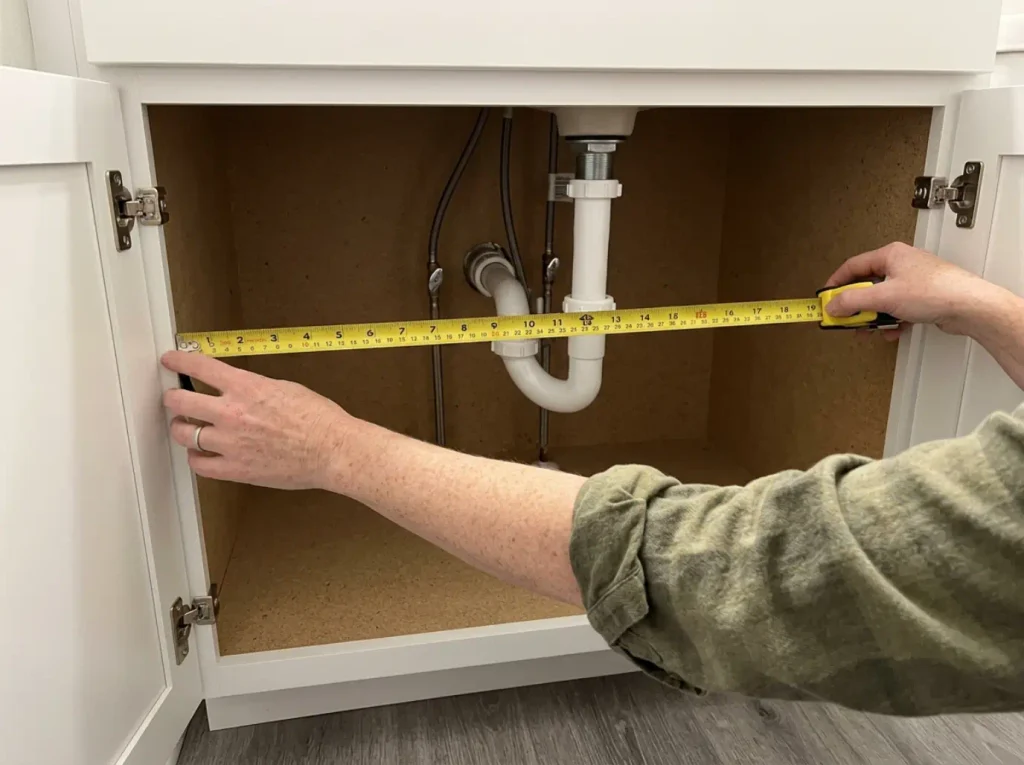
A bathroom vanity cabinet is the only storage space in the house with plumbing running through the middle of it, and that fact invalidates most of what gets recommended for it. Every other cabinet is an empty box. This one has a drain assembly bolted through the center, which is why P-trap clearance decides what fits before anything else does.
The Three Measurements That Decide Everything
Three numbers decide every purchase here, and none is the cabinet’s width. First, interior depth, from the inside face of the door to the back panel. Second, the clear span on each side of the drain pipe, the actual usable footprint. Third, the one nobody writes down, the vertical gap under the drain assembly, floor to the lowest point of the pipe.
Write them on your phone before opening a single listing. A full-size vanity and a small-bathroom vanity are different cabinets wearing the same category name, and guessing costs you a return. This is not a blog opinion either. It is the approach behind the National Kitchen and Bath Association’s clearance guidelines, which set minimum clearances around the vanity zone precisely because the space is tighter than it looks.
Why the P-Trap Beats the Tape Measure
Here is the mechanism the roundups skip. The sink drain sits centered and mid-height, typically 18 to 20 inches above the floor, not tucked at the back where you would want it. So the pipe does not just steal floor space. It steals a band across the cabinet’s middle, exactly the band a full-depth drawer unit needs.
That is why a drawer system can pass the width test, pass the depth test, and still fail. The footprint fits, the path does not.
You slide it in, the top rail meets the trap, and you are boxing it back up. Checking that vertical drop takes 30 seconds and prevents the most repeated return in this category.
What “Fits” Means in a Listing Photo
Listing photos are shot in cabinets chosen to flatter the product, usually a wide one with the plumbing pushed to the side. Yours probably is not that cabinet, so treat every hero image as a demonstration of what the product does, never as evidence it fits.
Measure twice, order once. If you have not done the full empty-and-sort yet, the process node covers the empty-sort-measure process in order.
Take a photo of the empty cabinet with the tape measure held against the pipe, and keep it in your phone. You will be standing in a store or scrolling a listing at some point without a tape measure, and one photo settles the question faster than any spec sheet.
Expandable Racks and Pull-Out Drawers
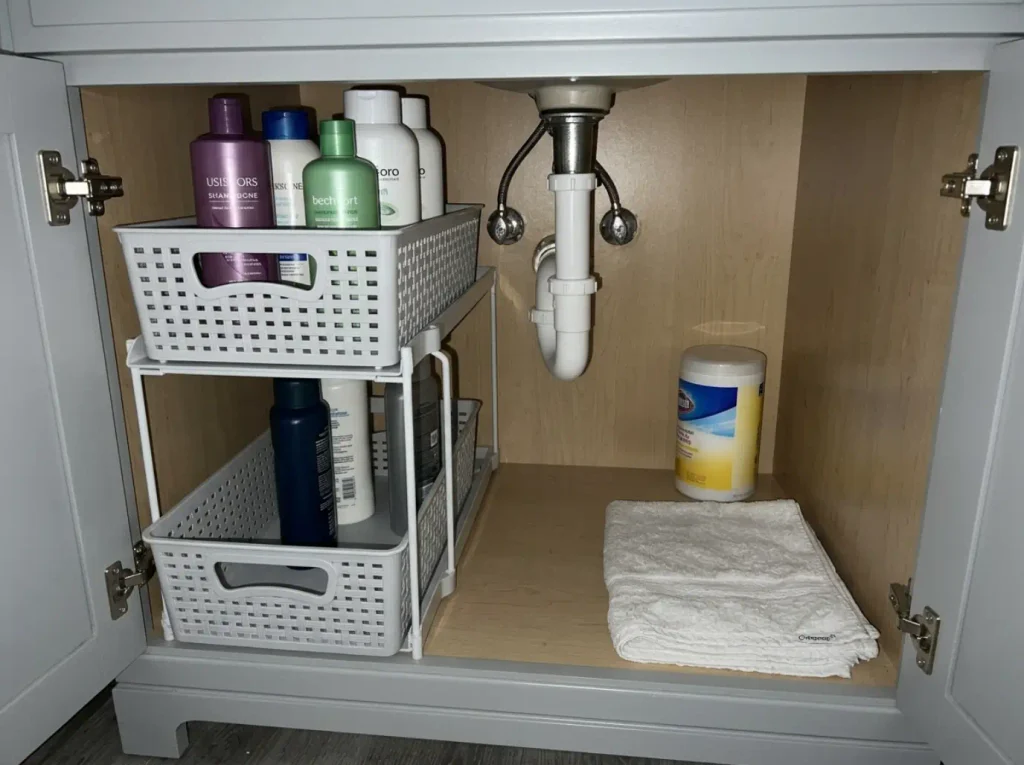
Two organizer types dominate this cabinet, and they take opposite approaches to the plumbing. The expandable rack works around the pipe. The slide-out drawer assumes you have the pipe clearance already. Only one forgives a measurement you got slightly wrong.
The Expandable Rack Is the Safe Default
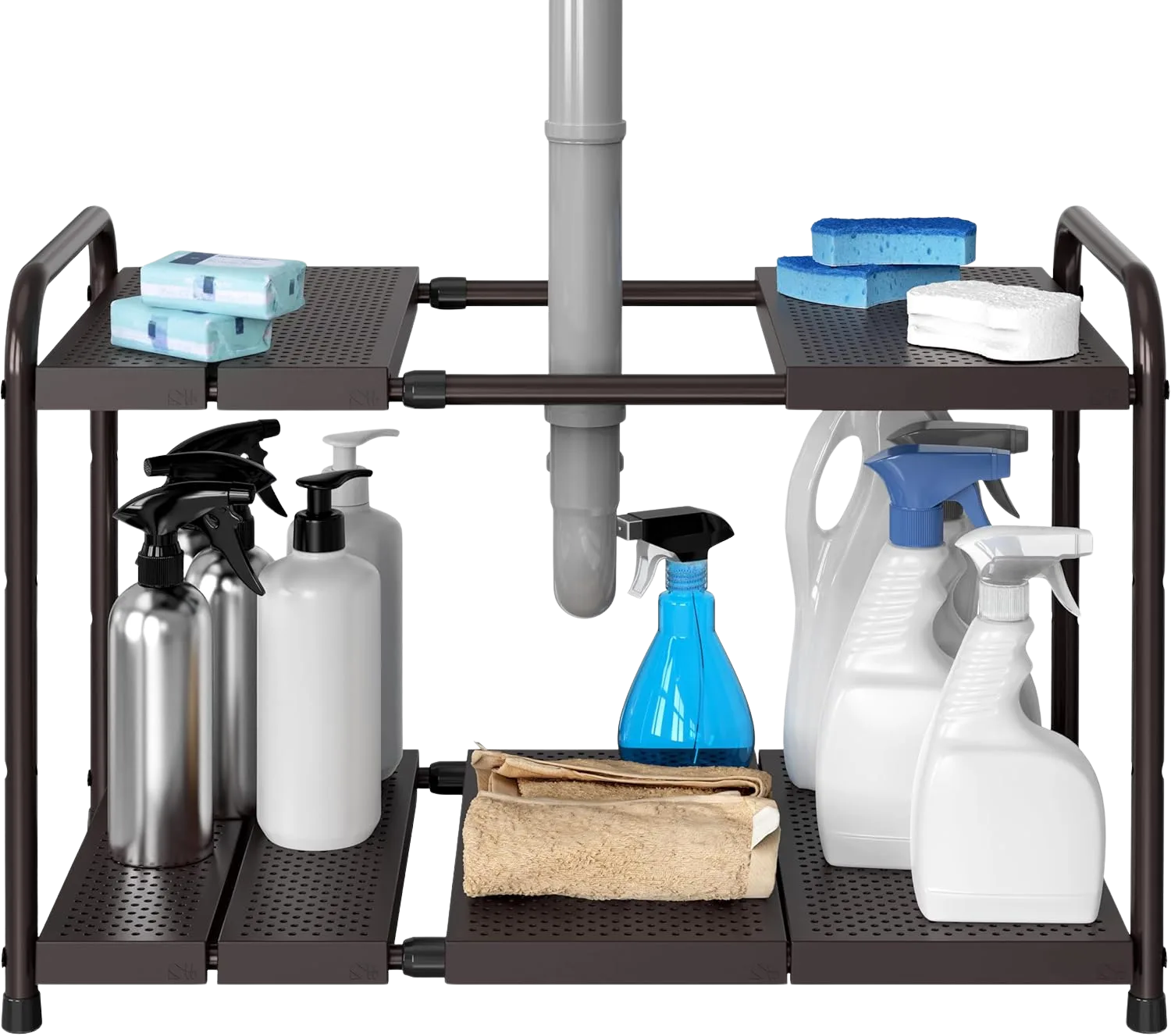
An expandable rack sits on either side of the plumbing rather than acting as one continuous shelf: two independently adjustable sections, each sliding to whatever width the pipe leaves it. That flexibility is why it is the safe first purchase, because you do not have to be right to the inch about where your drain sits. The rack adapts once it is in the cabinet.
The trade is that it does not come to you. You reach in.
When a Pull-Out Drawer Earns Its Place
A pull-out drawer organizer gives you full-extension access, which a static rack never does. Everything comes to the front, including whatever migrated to the back six months ago.
I used to recommend the pull-out drawer as the default here, because the access is genuinely better. After enough returns-and-regret posts in under-sink threads, I moved the expandable rack into that slot and left the drawer as the upgrade you take deliberately. The drawer is not worse. It is less forgiving, and most people buy without a measurement in hand.
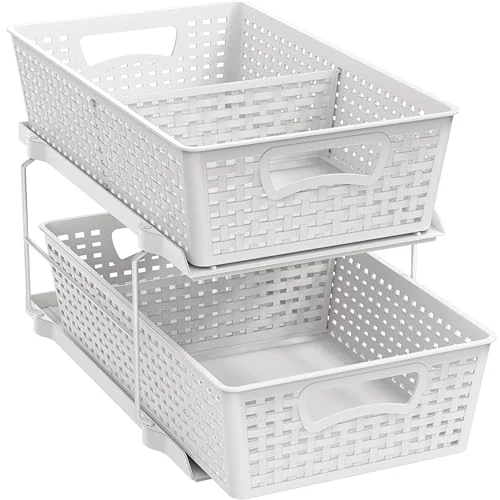
The Clearance Check Before You Order Either
Declutter first, before buying anything: empty the cabinet and see how much of it the pipe actually claims. Plenty of vanities have one generous side and one narrow one, so the answer is a single rack on the wide side plus a bin on the other, not two matched products. Buying less is the cheapest fix here, and you edit before organizing for the same reason.
Then check your numbers against the norm. Because standard vanity depth runs about 21 inches, with shallow models several inches under that, a product built for the deeper cabinet overhangs the door frame in the shallow one, and you notice every time the door will not latch.
The expandable rack costs a fraction of a name-brand pull-out system and solves the same problem, so flexibility is what you are paying for, not the brand plate. For the full method, the seed guide has the full under-sink measurement walkthrough.
What Survives a Bathroom and What Warps
The material decision gets made on looks and paid for in month three. Every hero photo is taken on day one, in a dry studio, before anyone ran a shower ten feet away twice a day for a season. A bathroom cabinet is a humidity box with a door on it, and materials that are fine in a pantry behave differently here.
Bamboo Looks Best on Day One
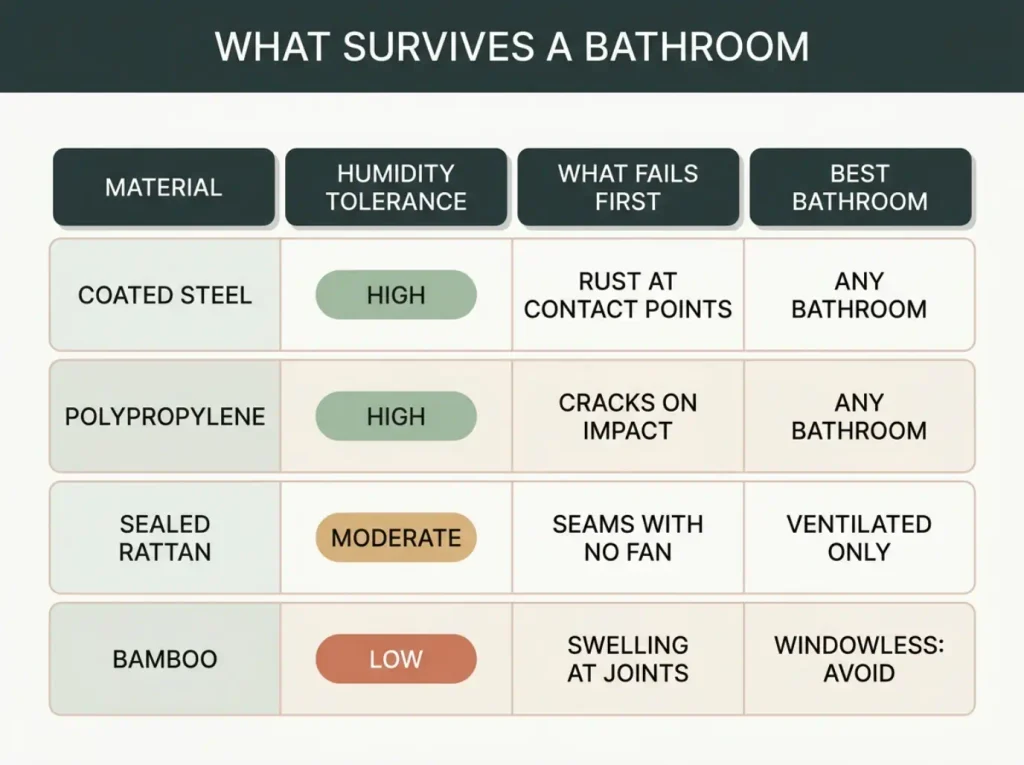
Bamboo photographs beautifully and drinks water at every seam. Nothing about a bamboo organizer is warp-resistant in a room that steams twice a day. Across negative reviews of bamboo bathroom organizers, water damage and warping show up in a large share of complaints, and the pattern is consistent about where it starts: the joints, the unsealed holes where the fasteners go in, and the bottom shelf sitting closest to floor-level humidity.
The specific version of this failure is worth naming, because no other roundup will. You open the caddy three months in, the back seam has a dark water stain spreading along the grain, the panel has swelled just enough that the joint no longer sits flush, and there is a faint mildew smell. Nothing broke. It quietly went bad in the part of the cabinet you never look at.
Coated Steel vs Bare Wire
Uncoated wire rusts at the contact points, exactly where water pools: the feet, the joins, the underside of the bottom shelf. A coated rust-resistant steel basket is a genuinely different material tier, not a marketing word. A recycled plastic bin is fine too, but plastic cracks when knocked onto tile, and tile is what bathrooms have.
For a humid cabinet the list of genuinely humidity-safe materials is short. Coated steel and polypropylene first, both of which shrug off water. Sealed rattan next, but only with a working exhaust fan. Bamboo last.
The Exhaust Fan Changes the Answer
Whether you have a working exhaust fan, and whether anyone runs it, moves the material ranking more than any product feature. A bathroom with a fan running through the shower is a mildly damp room.
A windowless one with a fan nobody switches on is a steam chamber twice a day, and there the wood and rattan picks stop being an option at any price. Answer the room first.
The Cabinet Floor Fails First
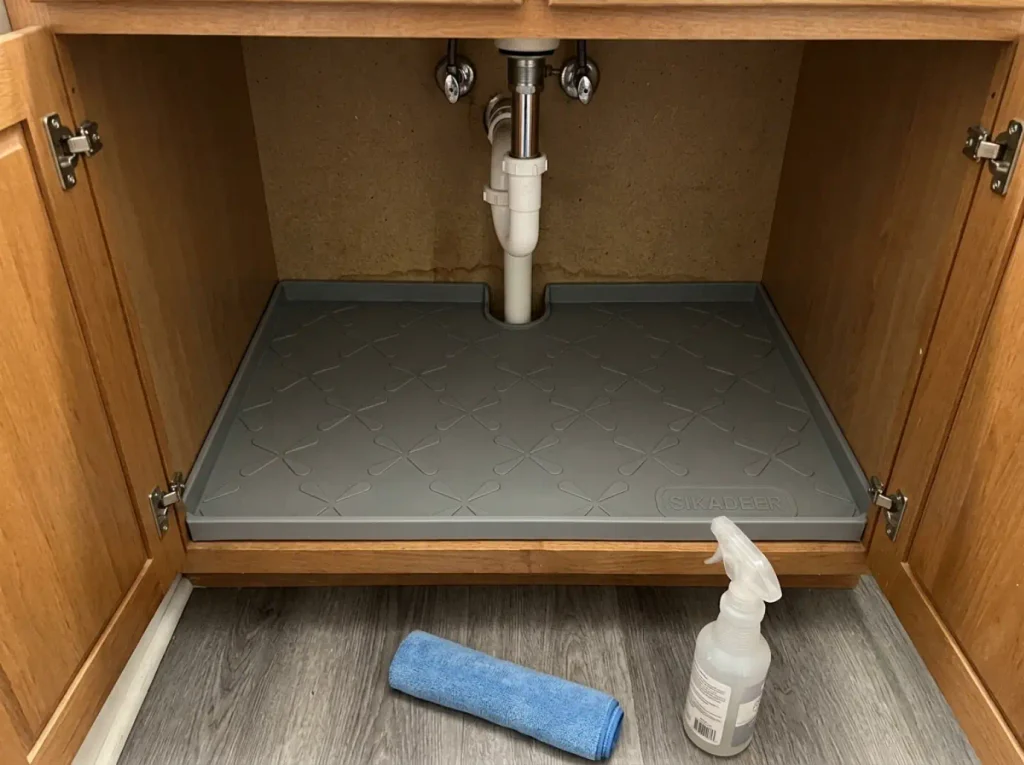
Every organizer here sits on a cabinet floor that gets wet eventually. Rarely from a burst pipe: from condensation on the cold supply line, a connection weeping a few drops a week, a bottle knocked over and never wiped up. Particleboard absorbs all of it and tells you nothing until the swelling is permanent.
Before buying a liner, look for one you already own. A rimmed baking tray you never use is a functional liner today, for free, the same instinct professional organizers at NEAT Method use when they reach for a ceramic tray instead of a purpose-made one. The catch is coverage: a tray protects the footprint of a tray. To catch a slow leak before it eats the base, you want a moisture-resistant liner sized to the whole floor.
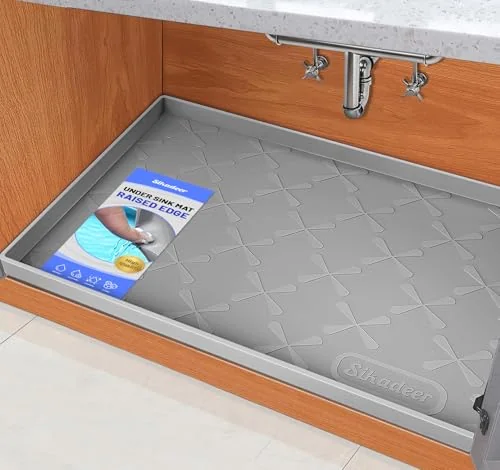
Pull the mat once a quarter and look underneath. That is the entire maintenance routine for this cabinet, and it is the difference between finding a slow leak in week two and in year two. For the rest of the room, the zone-by-zone bathroom organizer guide covers the five zones this article leaves alone.
Bins and Turntables for the Space You Have Left
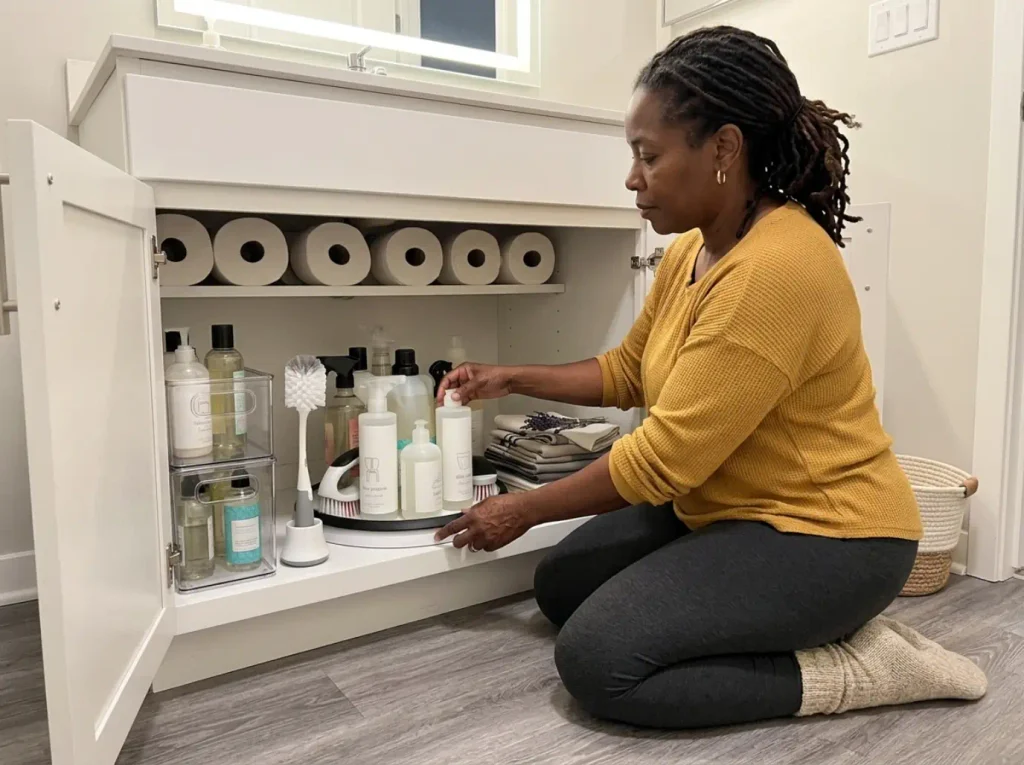
The rack solves the structure. It does not solve the daily annoyance: reaching past three bottles you use twice a year to get the one you use every morning. Different problem, and it wants containers rather than shelving.
Daily-Reach Versus Backstock
Organizing communities split this cabinet into two zones, and the language makes the buying decision obvious. The daily-reach zone is whatever you can grab without crouching or moving something first, and it holds the three to five things you touch every day. Everything else is backstock: spare shampoo, bulk cotton rounds, the second bottle of whatever was on sale. Bathroom toiletries and cleaning supplies both end up in here, and both belong low and behind once they are duplicates.
Why Clear Beats Pretty Down There
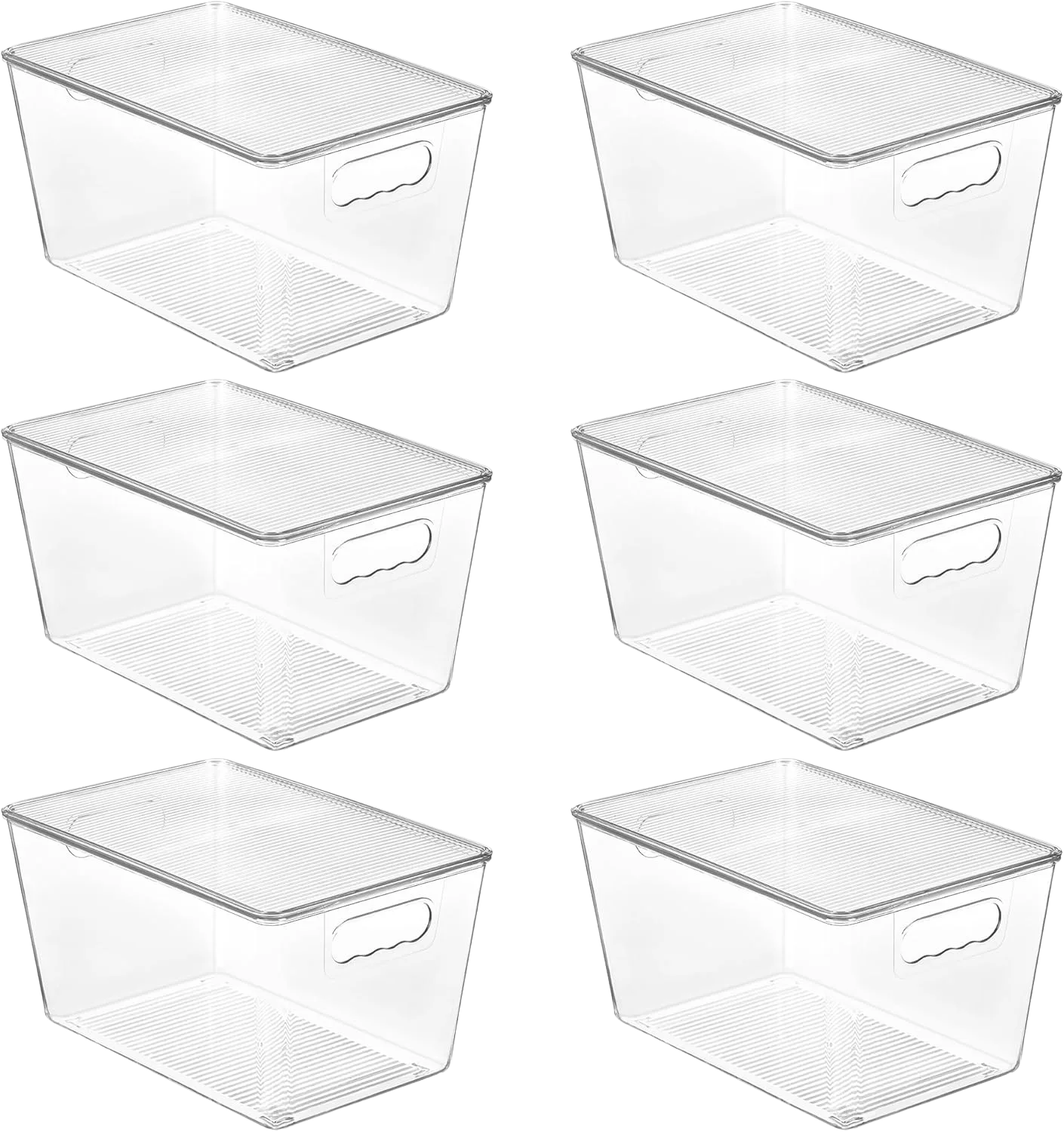
Nobody sees inside this cabinet but you, and you are seeing it in bad light while half awake. Clear bins end the digging because the container tells you what is inside without being opened. An open basket or a fabric tote works for the daily set, where you are reaching in rather than reading labels, but a lidded opaque bin costs you ten seconds every morning.
And ten seconds, twice a day, is the whole reason people give up on a system. Professional organizers split it the same way: deep open-top bins for daily items, stacking drawers when the pipe has eaten the center.
Sizing a Turntable Around a Pipe
Turntables under sinks fail for one predictable reason, the same one in every thread where somebody reports theirs jamming: the pipe catches the tray partway through the rotation. The fix is arithmetic, not a better turntable. Measure the widest clear span between pipe and cabinet wall, subtract a few inches so it can spin freely, and that is your maximum diameter. A 16-inch turntable in a pipe-crowded cabinet jams no matter how good it is.
The same math applies one room over, which is why the same pipe-clearance math under a kitchen sink gives the same answers with different products. If your span checks out, the full circle is the better daily experience.
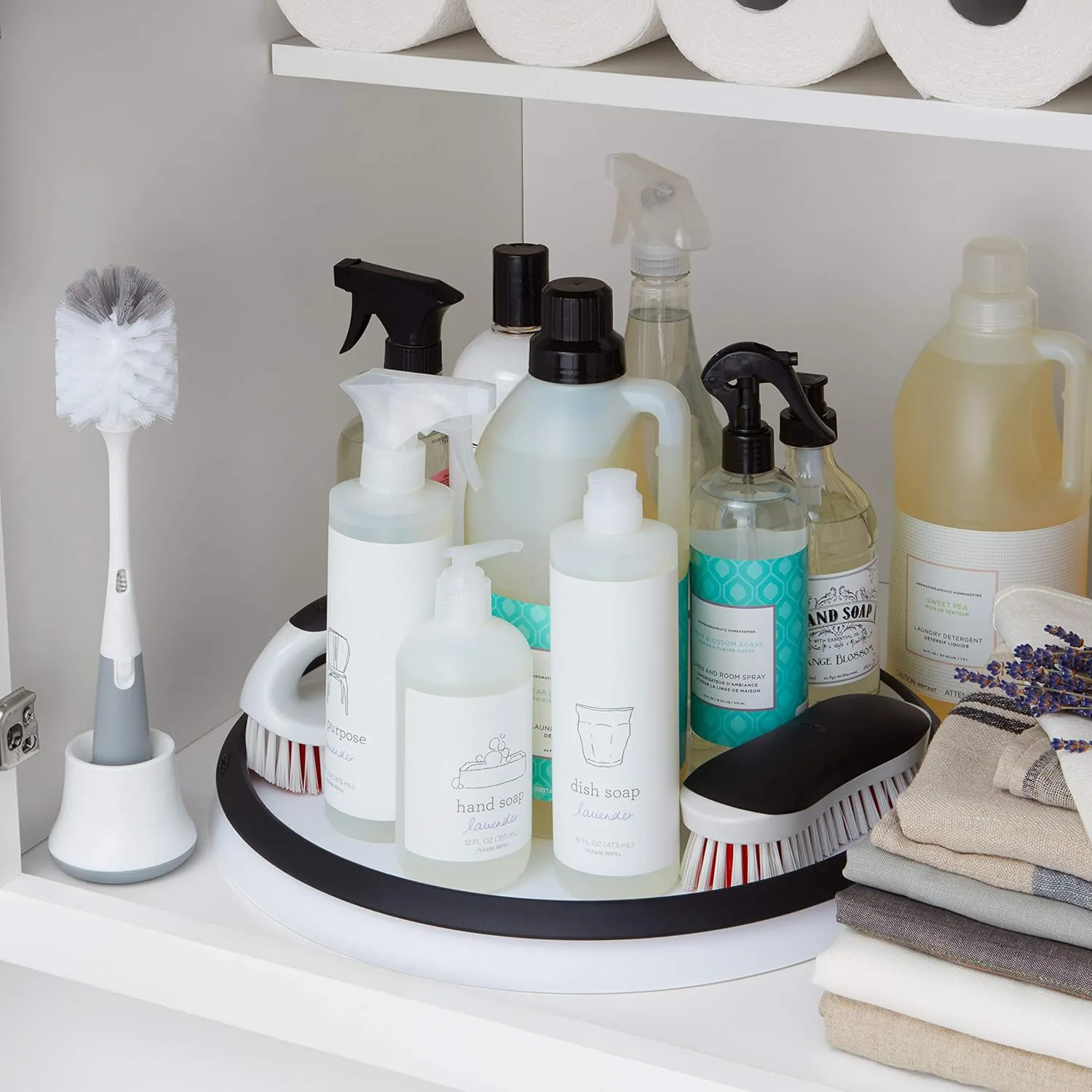
In a tight cabinet the budget-friendly wedge bin is not just cheaper, it is the smarter fit. A quarter-circle reaches the dead corner a full circle cannot, and in a vanity where the pipe already claimed the middle, corners are most of what you have left.
Load a turntable with the tallest bottles toward the center, not the rim. Tall items on the outer edge catch the cabinet frame as the tray comes around, which is what people mistake for a jammed bearing when the bearing is fine.

No-Drill Door Racks for Renters
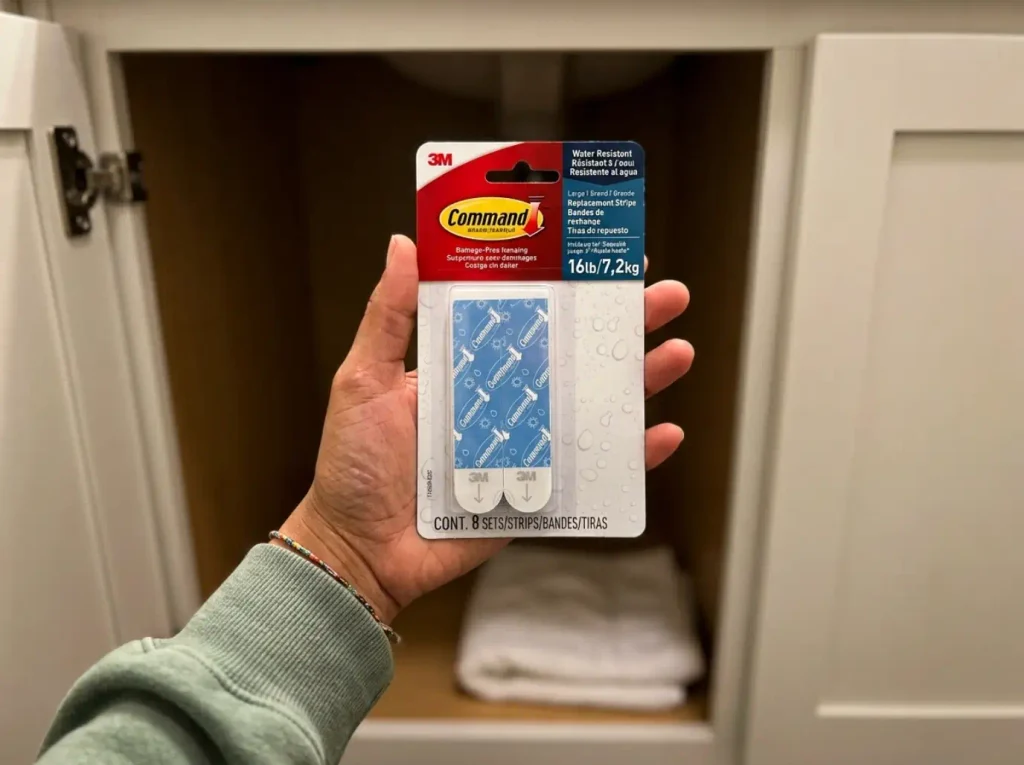
The inside of the vanity door is the most wasted square footage in the bathroom, and the reason renters skip it is a screw they are not allowed to drive. An adhesive door organizer solves it, but only with the right strip behind it, and this is where most no-drill bathroom storage advice quietly falls apart.
What Belongs on a Cabinet Door
A cabinet door is flat, vertical, and unclaimed, which makes it perfect for flat things: hairbrushes, small bottles, a coiled hair dryer cord, a stack of washcloths. All of those waste depth on a shelf, taking a full slot to store an inch of thickness. A shallow door-mounted organizer or a wire grid basket turns that inch into usable storage, while a full over-the-door organizer is the wrong scale here, because a vanity door is nothing like a pantry door.
Weight discipline matters more here than anywhere else. The door swings every time you open it, putting repeated shock load on the mounting. Light items only. But that is not the constraint that trips people up.
Before you mount anything on the door, close it with your hand inside and feel where the shelf edges are. A door rack that clears the frame but collides with the top shelf is the second most common no-drill mistake, and you only find it after the adhesive has cured.
Water-Resistant Strips Are Not the Standard Ones
This is the distinction almost every guide misses. Command’s water-resistant line is a different product from the standard indoor strip, rated for bathrooms and high-humidity spaces, and inside a vanity that difference decides whether your rack holds or lets go at 2 a.m.
Shower steam gets in every time the door opens, the cabinet does not ventilate, and the adhesive sits in that air all day. A standard indoor strip is not built for it, and the failure mode is not gradual. It holds fine for weeks, then releases everything at once.
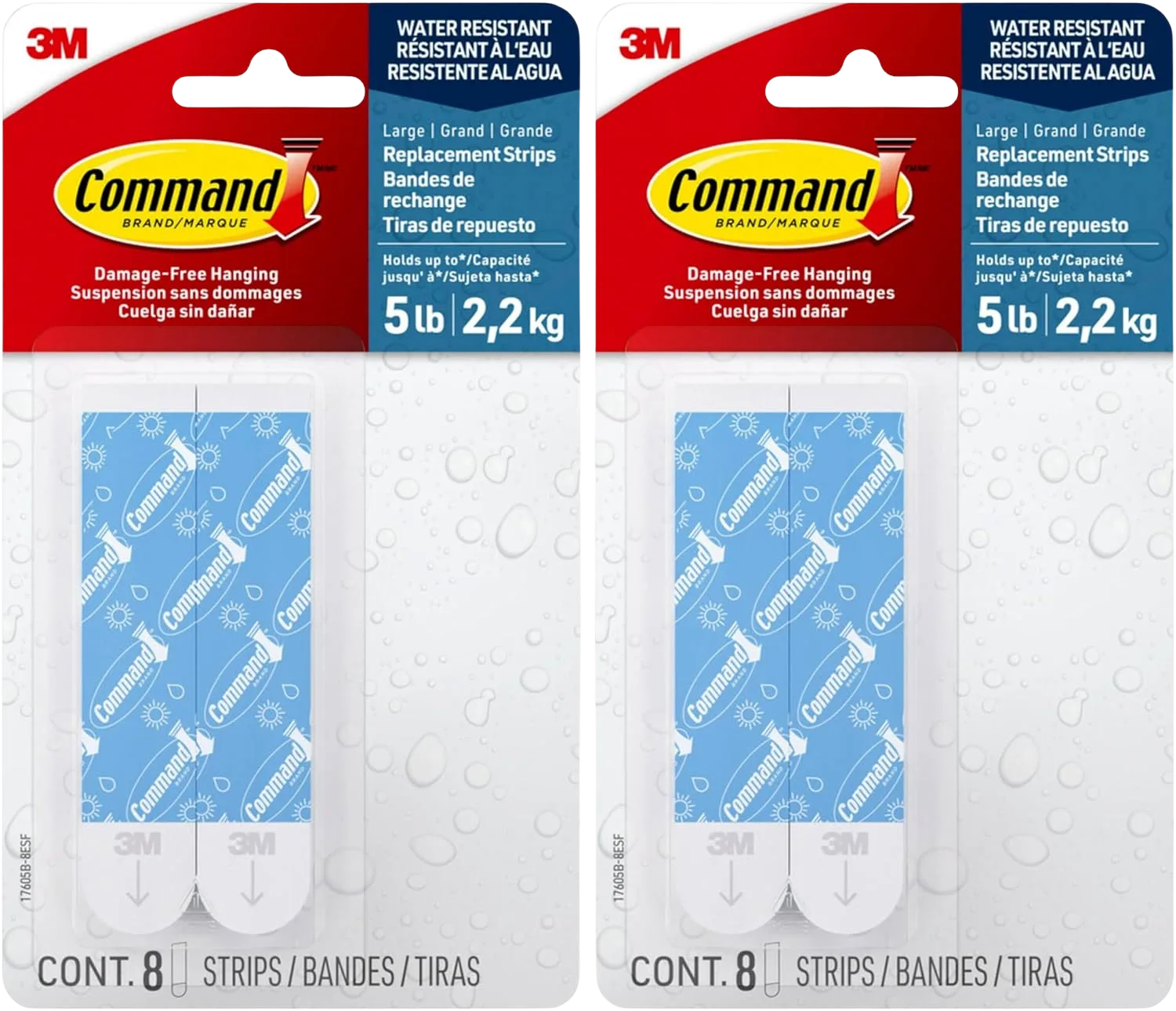
Before buying a purpose-made door rack, check whether a couple of strips plus a caddy you already own does the job. Frequently it does.
Coming Off Clean at Move-Out
Renters have a second constraint nobody writes about: whatever goes on that door has to come off without taking the finish with it. That is the real argument for adhesive over screws, and it is why the pull-tab removal matters as much as the hold strength. Pull down slow, straight along the surface, never out and away.
For the rest of the room, renter bathroom storage without the deposit risk applies the same no-drill logic beyond the vanity.
Pedestal Sinks and the Cabinet You Do Not Have
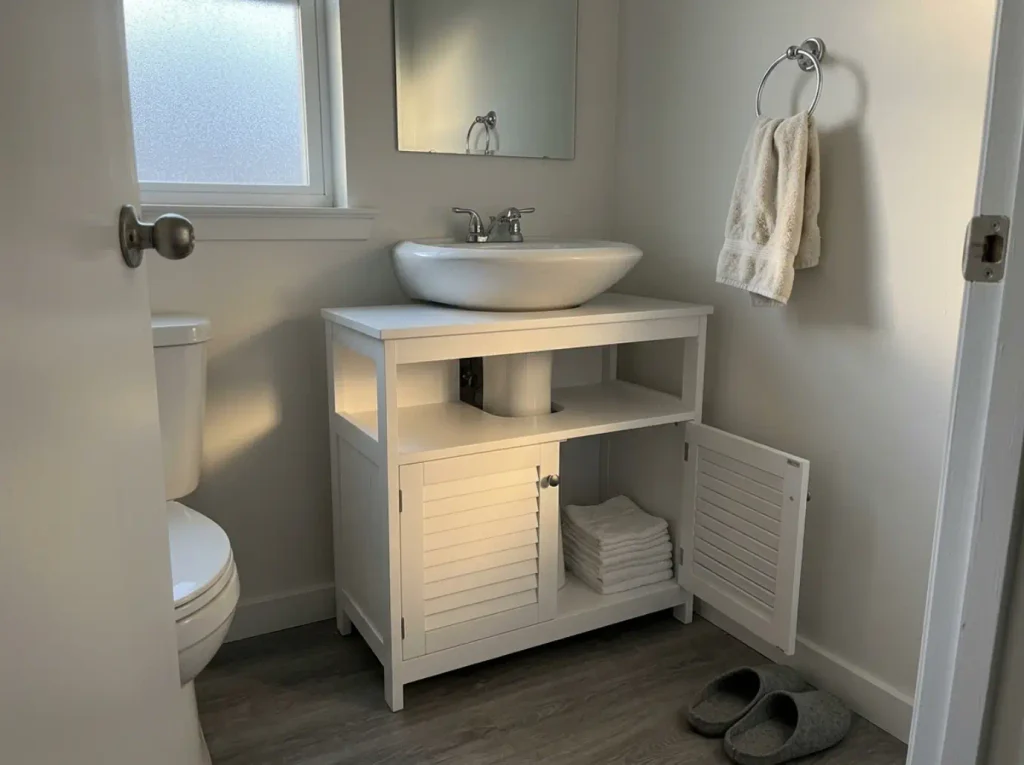
Every best-under-sink-organizer list assumes a vanity. Stand at a pedestal sink and the whole category evaporates: no interior to organize, no shelf to expand, no door to mount anything on. Just a column, a basin, and nowhere to put the shampoo. If that is your bathroom, you have read four of these roundups and found nothing you could buy.
Measure the Pedestal, Not the Sink
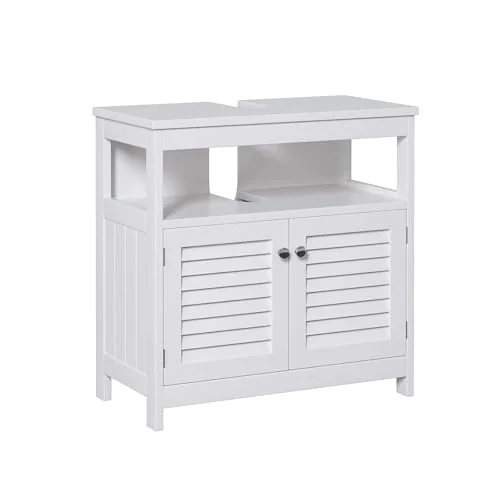
The pedestal sink organizer category that exists for you is the U-shaped wraparound cabinet: a freestanding unit with a cutout that clears the pedestal base at floor level, so the wrap-around pedestal storage surrounds the column instead of competing with it. That cutout, not the overall footprint, decides whether it fits.
Measure the pedestal’s width and depth where it meets the floor, because the column flares. Knee height and floor level are different numbers, and the wider base measurement is the one that matters. Get it wrong and the cabinet sits proud of the wall, blocking the doors from opening square.
What a Wraparound Cabinet Actually Holds
A wraparound cabinet is not a vanity, and its storage is shallow by design because the pedestal occupies the middle. It holds the daily set plus modest backstock: towels on the open shelf, bottles behind the doors. If the unit has a shallow drawer, drawer dividers and a wipe-clean vinyl drawer liner keep small items from sliding into one pile every time it opens.
For renters, the important part is what it does not require. No wall penetration, no plumbing work, no landlord conversation. It walks out with you.
If the pedestal sink is one symptom of a bathroom with no cabinets anywhere, the no-cabinet bathroom system works the whole room.
The Rolling Alternative
In a genuinely small bathroom, a wraparound may be more furniture than the floor can spare. The alternative is a narrow rolling two-tier beside the sink instead of around it, with no cutout to measure and no measurement to get wrong. Less capacity, zero fit risk. It also rolls: pull it out to clean behind, push it back.
Conclusion
Measure the clear span and the vertical drop before you open a single listing, because the pipe decides the product and the photo decides nothing. Buy for the humidity rather than the picture: coated steel and polypropylene hold, bamboo swells at the seams by month three. And split the cabinet into daily-reach and backstock before buying a single bin, because most cabinets need fewer products, not more.
Make it a three-month reset. Pull the mat and look underneath, then check whether anything has crept into the daily-reach zone that you do not use daily. Both take two minutes, and together they tell you whether the system is holding.
Start here: empty the cabinet, run a tape measure past the pipe, and write down three numbers. Buy nothing until you have them.
Frequently Asked Questions
01What is the best way to organize items under the sink?
Split the cabinet into a daily-reach zone at the front for the three to five things you use every day, and a backstock zone low and behind for refills. Then add structure around the P-trap rather than across it, using an expandable rack instead of one continuous shelf.
02Are under sink organizers worth it?
They are worth it when the cabinet has usable vertical space sitting empty above a single layer of bottles. They are not worth it if the real problem is volume. If the cabinet is simply too full, an organizer just rearranges the overflow, and the fix is emptying it first.
03What is the best pullout organizer for under sinks?
The Simple Houseware 2 Tier Pull-Out Sliding Drawer is the pick, with one precondition: measure the vertical gap under your drain first, because a sliding drawer needs that clearance to work. If the pipe hangs low or sits dead center, an expandable 2-tier rack is the safer default.
04What is the best bathroom organizer for organizing my bathroom?
There is no single best bathroom organizer, because the right pick is zone-specific. Under the sink, an expandable 2-tier rack handles the plumbing better than anything else. For the other zones, see the zone-by-zone bathroom organizer guide.
05Can you use under sink organizers with a pedestal sink?
Yes, but not the organizers in most roundups, since those assume a cabinet. The category that works is a U-shaped wraparound cabinet that surrounds the pedestal column. Measure the pedestal base where it meets the floor, because the cutout dimension is what decides the fit.