













In this article
You finished a four-box session last Saturday. The keep pile is back in the closet, the trash is gone, and the donate bag is parked by the door. And there’s a stack of three boxes labeled “storage” in the corner that you still haven’t touched — which is the whole problem, and the part almost nobody warns you about. I’ve run this method in dozens of rooms, my own and other people’s, and watched it fail in the same spot nearly every time. This article covers how the four-box method actually works, the one box that quietly sinks the whole thing, and what to pair it with so the reset lasts past the first season.
Quick Answer
The four-box decluttering method sorts every item into one of four categories — Keep, Donate, Trash, or Relocate — so each thing gets one decision and the “maybe” pile never forms. It only sticks when the relocate box has a labeled destination and a review date. Without both, it quietly becomes a second pile in a new corner.
What the Four-Box Decluttering Method Actually Is

Most people have already tried a rougher version of this. You pull everything out, make piles on the bed, and somewhere around hour two the piles bleed into each other and you’re shoving half of it back in a drawer just to sit down. The piles failed because nothing in them had a next action. The four-box decluttering method fixes that by giving every single item one of four defined destinations before it leaves your hand.
The four categories explained
The four boxes are Keep, Donate, Trash, and Relocate. Keep is for things that stay in this exact room and earn their spot. Donate is for working items someone else could use — they leave the house. Trash is for broken, expired, or unusable stuff. Relocate (some people call it Storage) is for items that belong in a different room or are genuinely seasonal, with a real home to go to. It’s a sorting framework used by certified professional organizers, not a personality system, which is exactly why it works for any room and any kind of clutter.
Why the method works: ending the “maybe”
The engine of the whole thing is that there is no fifth box. There’s no “maybe,” no “I’ll decide later,” no “set this aside for now.” The maybe pile is the failure state every other approach collapses into, and the four boxes exist specifically to make it impossible. Every item gets a decision and a handoff in the same motion. That’s the feature. Sorting without a defined handoff is just clutter you’ve rearranged into nicer rows.
Four-box vs. three-box vs. KonMari
The three-box method drops the Relocate box and folds “put this elsewhere” into a vague leftover pile, which forces a second round of decisions later — you’ve just deferred the work. The four-box system resolves trash and relocate in one pass. It’s also a different animal from the KonMari method, which sorts by category across your whole home (all your clothes at once, then all your books) and asks whether each item sparks joy. Four-box is spatial and room-by-room, so it’s faster for knocking out a single space; KonMari is built for one big whole-house reckoning. If you want the full range of options, it’s worth seeing how it fits among the broader set of decluttering methods before you commit a weekend to any one of them.
What You Actually Need to Run a Session (Nothing You Don’t Already Own)
Every four-box guide opens by telling you to “get four boxes.” That single instruction is where more sessions die than anywhere else. The conventional advice is to buy matching containers before you start. In practice, the trip to buy boxes is the thing that never happens — you mean to go Saturday, then it’s three Saturdays later and the room is still a wreck. You almost certainly own four usable containers right now.
The zero-purchase substitution kit
Here’s the free kit, and it works as well as anything you’d buy. Use a laundry basket for Keep, a canvas grocery tote or a paper grocery bag for Donate, a trash bag propped open in the corner for Trash, and a second laundry basket or another paper bag for Relocate. For labels, masking tape and a marker cost nothing and do the entire job. That’s it. The method requires zero spending to start, and the “buy boxes first” framing is a barrier competitors invented and never questioned.
Before you pick up a single item, open the trash bag and prop the donate container all the way open. The half-second of friction from “where does this even go” is what stalls a session mid-room. If every box is open and ready, your hand has somewhere to drop things the instant you decide.
Setup order before you touch the first item
Set the four containers down in the room before you start, not in the hallway. The donate and trash containers go open and within arm’s reach, because those are the two you’ll reach for most and the two people instinctively avoid. Put the keep basket where the keep items will eventually live if you can. The whole point of the setup is to remove every excuse your brain invents to put something down “just for a second.”
When to upgrade to actual bins (repeat sessions vs. one-time reset)
If this is a one-and-done reset, skip the shopping entirely — the laundry baskets are fine. But if you’re running the method across more than one room, or you already know you’ll do it again next season, that’s the point where reusable bins start to earn their place. The mDesign Stackable Plastic Storage Bins (4-pack) are clear, so you can see what’s inside without lifting a lid, and they fit a standard closet shelf with room to stack two high. The catch is that clear plastic shows every speck of dust, so they look messier faster than fabric if they sit out in the open. What you don’t need: matching colors, calligraphy labels, or any “getting ready to get ready” purchase that pushes your start date back two weeks.
How to Run a Four-Box Session Step by Step
The first time I ran this in my own bedroom, my keep basket was full forty minutes in and I still had an entire dresser to go. I almost quit right there. Instead I carried the basket to its spots, put everything away, came back with it empty, and kept sorting — and a session that should have died at the dresser finished in just under three hours. The execution details are the difference between finishing and abandoning a half-sorted room.
The right starting position and working direction
Start in one corner and work in one direction around the room. Don’t hop across to grab the “easy” items on the far shelf, because that just smears the mess around instead of clearing it — corner-to-corner consistency is what prevents the room from looking worse at hour two than it did at the start. Work surfaces and floors first. Save the drawers and closed containers for a second pass, when you’re warmed up but not yet fried.
The decision framework (20-second rule + “buy again today” reframe)
Speed is the method’s friend here, not its enemy. If an item takes more than twenty seconds to decide on, it goes in the donate box — long hesitation is your gut telling you the attachment is uncertain, and uncertain almost always means you won’t miss it. When you get stuck, swap the question. Instead of “should I keep this,” ask “would I buy this again today?” That reframe, which professional organizer Di Ter Avest popularized, flips your default from keep to release, and it cuts through the decision fatigue that builds as the pile shrinks. If that fatigue tips into full overwhelm and you feel yourself shutting down, that’s a sign to step back — when decision fatigue kicks in mid-session the fix is usually a shorter session, not more willpower.
The trash box is the one people under-equip. Any bag you already own works, but a flimsy one splitting halfway through a heavy run will stop your momentum cold. If you want one that stretches instead of tearing at the seams, the Glad ForceFlex Tall Kitchen Trash Bags (13-gallon) handle a broken lamp and a fistful of dead batteries without giving out. They’re tall-kitchen sized, so they slump inside a big box — prop the box against a wall or it folds in on itself.
When the keep box overflows: the mid-session rescue
The keep box filling up before you’re done is the most common stall point, and the instinct is to stop. Don’t. Pull the keep items out, walk them to where they actually live, put them away properly, and come back with the empty basket to finish the sort. It feels like an interruption, but it’s the opposite — you’re banking finished work and clearing the container that lets you keep going. A session only truly stalls when you let a full box become a reason to sit down.
Decision Guide for Each Box (Real Examples by Item Type)
“Keep or donate” is where sessions turn into staring contests. The fix is concrete criteria per box, so you’re checking an item against a rule instead of relitigating your whole relationship with it. Here’s how each box earns its contents.
Keep and Relocate: the criteria that matter
An item earns Keep if it’s functional, belongs in this room, and you’ve actually used it in the last twelve months. A jacket worn once in three years isn’t a keep, no matter how good it looked at the store. Relocate is narrower than people treat it: it’s for things with a confirmed, existing home in another room, or genuinely seasonal items that have a real storage spot to go to. The trap is using Relocate as a soft Keep — if an item doesn’t have a confirmed destination, it isn’t a relocate, it’s a donate or a trash you haven’t admitted to yet.
Donate and Trash: making the call faster
Donate is for anything in working condition that someone else could use. The “buy again today” reframe resolves most donate decisions faster than any pro-and-con list. Trash is for broken, expired, missing-parts, or genuinely unusable items — and there’s no “I’ll fix this someday” exception. If it’s been broken for eight months, that’s not a someday, that’s data. And the thing about a real trash bag (not a “maybe I’ll sell it” purgatory) is that the decision is final the second it goes in.
Sentimental items: why they need their own protocol
Sentimental items break the whole system if you let them in early. The box of birthday cards, the kid’s first drawings, your grandmother’s recipe tin — these are the items that turn a 90-minute session into a three-hour cry. So they get their own rule: set them aside in a dedicated corner of the keep box on the first pass, and don’t decide on a single one until the very end, when your decision-making is warmed up and your fatigue is lowest. Never sort sentimental things first. They genuinely need a different process, and sentimental items need a different approach than the twenty-second rule you used on the junk drawer.
The Storage Box Trap (The Part Nobody Warns You About)
I ran a four-box session on my own spare room two winters ago and ended up with one box marked “storage — sort later.” It went on the closet shelf. I found it again the following November while digging for wrapping paper. Inside: a phone charger I’d already replaced, an invitation to a wedding that had already happened, and one lonely curtain hook. Eleven months. That box was never storage. It was a decision I refused to make, with a lid on it. If you’ve done a four-box session before, you almost certainly have one of these somewhere in your home right now.
How the storage box quietly becomes another pile
The storage box fails because it breaks the one rule that makes the method work. Keep, Donate, and Trash all carry an immediate next action. Storage doesn’t — it defers the decision to a future moment that never arrives. There are three documented ways it goes wrong. The first is no destination: the box gets filled but has nowhere to physically go, so it sits in a corner and the corner becomes a pile. The second is no deadline: a vague “someday” label means the review never triggers and the items default to permanent keep. The third, and most common, is guilt-free-keep abuse — the storage box becomes a third Keep category for things you’re too uncertain to donate but don’t actually use. Professional organizer Hester Van Hien describes the end state precisely: a loft full of boxes whose contents you can no longer remember. That’s what organizing communities call a doom pile — stuff with no home, no decision, and no deadline.
The fix: label + destination + review date
A storage box only works when it carries three things the other boxes don’t need, written right on the outside: a contents list, a specific destination, and a review date. Contents so you don’t have to open it. Destination so it has somewhere real to go. And a review date so the decision actually comes due. Miss any one of the three and you’ve built a doom pile with a lid.
The review date is the part everyone skips, and it’s the one that does the work. Write an actual month on the box — “review by October 2026” — not “someday.” A dated box forces a real decision when the date arrives. An undated box just ages quietly until you move house.
Masking tape and a marker handle the labeling for free, and honestly that’s all most people need. I used to leave it there. But after watching too many neatly labeled boxes survive a full year untouched, I started pushing the date harder than the label — because a clear contents list can actually make a box easier to ignore, since you already know what’s inside and feel no urgency to open it. If you relabel boxes often enough that the tape look wears on you, the Brother P-Touch PTD220 Label Maker prints a strip you can read from across a closet. It won’t fix a bad system, though — a tidy label on an undated box is still a doom pile, just a better-looking one.
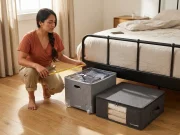
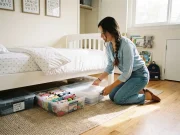
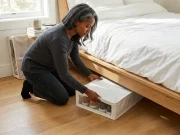
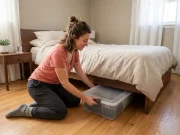
For the boxes themselves, the shipping cartons from your last few deliveries are free and exactly the right size. If you want something that survives more than one session, the Fabric Storage Bins with Labels (Set of 6, Collapsible) fold flat when you’re done, so they don’t become clutter between sessions, and the built-in label slot gives the contents a fixed home. They’re soft-sided, so they won’t protect anything fragile — keep breakables out of these. And when something genuinely needs long-term storage, clear and rigid beats cardboard every time. The IRIS USA 72 Qt Stackable Storage Boxes (4-pack, clear) hold 72 quarts each, run roughly 25.6 by 16.6 by 13.3 inches, and the latching lids stay shut when you stack them or slide them under a bed. The clear sides are the entire point — they end the “mystery box” problem before it starts. At that size, though, three full ones are about the most you’ll want to stack safely.
The apartment modification: when there’s nowhere to store things
Here’s the constraint no competitor article addresses: what if you don’t have a loft, a basement, a garage, or a storage unit? A friend in a 500-square-foot one-bedroom asked me to help with her session, and when we hit the fourth box we both just stared at it. “Storage” had nowhere to physically exist. So we renamed it on the spot, and split it into three. The first is “Belongs Elsewhere in This Apartment” — items simply in the wrong room, handled with a fifteen-minute walk-around the same day, never left overnight. The second is “Seasonal Only,” which must fit inside the storage you already have (one under-bed bin, one top-shelf bin) or it doesn’t qualify. The third is “Storage Unit Required” — and if you don’t have a unit, those items get re-evaluated as donate or trash, full stop. That reframe is the difference between decluttering an apartment and just rearranging it. If you’re organizing a smaller space with no real storage, this split is the whole game.
How Long the Four-Box Method Actually Takes (Room by Room)
Nobody talks about time honestly in organizing content. “Set aside a weekend” is useless when you’re standing in front of a packed closet at 8 p.m. on a Tuesday. So here are the real numbers, the kind you can actually plan around, from rooms I’ve timed.
Small wins first: junk drawer, nightstand, single shelf (15–30 min)
Start microscopic. A junk drawer, a nightstand, or a single shelf takes fifteen to thirty minutes, and that’s exactly why it’s the right first move — visible progress in a short window is what gives you the nerve to take on a bigger space. The four-box method works at this scale just as well as at room scale; you’re just using four small zones instead of four containers.
Half-day spaces: bedroom and closet (3–4 hours)
A bedroom is a three-to-four-hour job, not a morning project you squeeze in before lunch. A closet stuffed with clothes lands in the same range, sometimes longer if every hanger needs a decision. In my experience, the safest plan is to treat it like the half-day commitment it is — a full Saturday morning with a real break in the middle, not an optimistic hour after work.
Multi-session spaces: kitchen and garage
The kitchen runs six to eight hours and should be split across two separate sessions of three to four hours each. The garage is a full weekend, two days minimum, because muscle fatigue stacks on top of decision fatigue out there. There’s a hard cap worth respecting in every space: stop at three hours. Past that, a real “tired-keep” effect kicks in, where you start keeping things because you’re worn out, not because they deserve to stay — and you’ll regret those calls when you find them next session.
When you have to stop mid-room, mark a stopping line with a strip of painter’s tape on the floor. Everything on the “done” side is fully decided; everything on the other side is untouched. Next session you know exactly where you stood, instead of re-sorting items you already cleared because you can’t remember what was finished.
What to Do After the Boxes Are Full (the Completion Step Everyone Skips)
The session ends when the boxes are full — except almost nobody tells you what “full” actually requires. The gap between “the boxes are done” and “the space is genuinely clear” is where this method stalls permanently, and it’s a quieter failure than the storage box because it feels like you finished.
Immediate completion actions (same day)
Within a couple of hours of finishing, four things have to happen: the trash bag goes to the bin, the donate bag leaves the building, the keep items get put away in their actual spots, and the storage box gets its label and destination set. Same day. Not “this week.” The session isn’t over when the sorting is over — it’s over when the items are physically gone or genuinely home.
The donate bag trap and the one-step fix
This is the one that gets everybody. “I’ll drop it off tomorrow” turns into a donate bag that lives by the front door for three months, slowly becoming furniture you step around. The items left the piles but never left the house, so the clutter is technically still there — it just has a handle now. My own fix was stupidly simple, and I resisted it for years: the donate bag goes straight into the car, not by the door. By the door, it’s a permanent fixture. In the trunk, it’s gone the next time you pass the drop-off on a grocery run. Getting items out of the building is the completion step. Sorting was never the finish line.
Pairing the method with a maintenance system
Here’s the truth no competitor says out loud: the four-box method is a reset, not a system. Run it once and do nothing else, and the space rebuilds to baseline clutter in three to six months, because the inflow of new stuff never stopped. That slow return even has a name in organizing circles — clutter creep. The fix is to pair the reset with one ongoing habit. The simplest is a standing donate bag in the closet that you feed continuously, so items leave in a trickle instead of one annual flood. The other is the one-in-one-out rule — one thing in, one thing out — which keeps the volume flat after your reset instead of letting it creep back up. Pick one. Either turns a one-time sort into something that actually holds.
Conclusion
The four-box method works because every item gets a defined destination — Keep, Donate, Trash, or Relocate — which is the thing that ends the maybe pile that makes loose-pile sorting collapse. The storage box only works with three things written on the outside: contents, destination, and a review date. Without all three, it’s a doom pile with a lid. And the method itself is a reset, not a system — pair it with one ongoing habit, a standing donate bag or the one-in-one-out rule, and the reset lasts past the first season instead of unraveling by fall.
In ninety days, walk the room with one question: are the surfaces covered again? If they are, run a twenty-minute mini-session on the worst spot before it needs a full reset.
Start with the junk drawer. It’s the whole method in twenty minutes, and if it works there, you’ll know exactly how to run it in the bedroom.
Frequently Asked Questions
01What is the four-box method of decluttering?
The four-box method is a sorting framework where every item in a space goes into one of four labeled categories — Keep, Donate, Trash, or Relocate. It forces an immediate decision on each item and removes the maybe pile that makes most decluttering sessions stall.
02What are the four boxes in the four-box decluttering method?
Keep (stays in this room and gets used), Donate (leaves the house in working condition), Trash (broken or unusable), and Relocate or Storage (belongs in another room with a confirmed home, or is genuinely seasonal with a labeled destination and review date).
03How long does the four-box method take by room?
A junk drawer takes 15 to 30 minutes, a bathroom 45 to 90 minutes, a bedroom 3 to 4 hours, and a kitchen 6 to 8 hours across two sessions. Cap any session at 3 hours, since fatigue past that point quietly pushes your keep-rate up.
04What are the most common mistakes with the four-box method?
The biggest mistake is filling the storage box without a destination and a review date, so it becomes a pile in a new corner. The second is treating the session as a finished system — without a maintenance habit, the space reverts within 3 to 6 months.
05How is the four-box method different from KonMari?
The four-box method is spatial — you sort one room at a time, corner to corner. KonMari is category-based, sorting all clothes, then all books, across the whole home at once. Four-box is faster for single rooms; KonMari is built for one full-house reset.