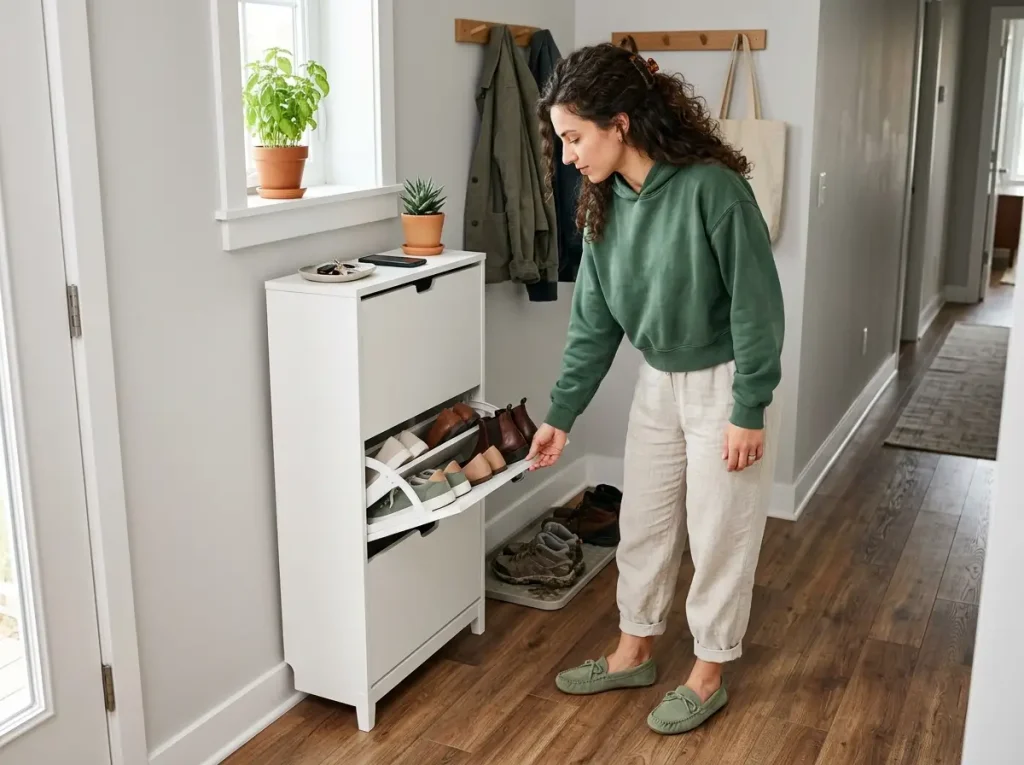
The shoe pile by your front door isn’t a discipline problem. It’s a math problem. I’ve set up shoe storage in studio apartments, shared rentals, and one closet so shallow the door wouldn’t close over a standard rack — and the systems that held up had almost nothing to do with how the “after” photo looked. They held up because the storage matched the number of pairs, the type of shoes, and how many seconds anyone was actually willing to spend putting a shoe away. This guide covers every place shoes live — closet floor, entryway, under the bed, small-space corners, and seasonal storage — plus the pair-count math and depth measurements most shoe organization guides skip.
Quick Answer
Shoe organization that survives real life comes down to six steps, done in order:
- Declutter first, then count your pairs.
- Sort by shoe type — boots, sneakers, and flats store differently.
- Keep daily pairs at the door in a no-friction drop zone.
- Store weekly pairs in the closet on a rack or in clear boxes.
- Move seasonal pairs to flat under-bed bins or the top shelf.
- Reset monthly, and swap footwear in October and April.
Before You Buy Anything: Declutter and Count Your Shoes
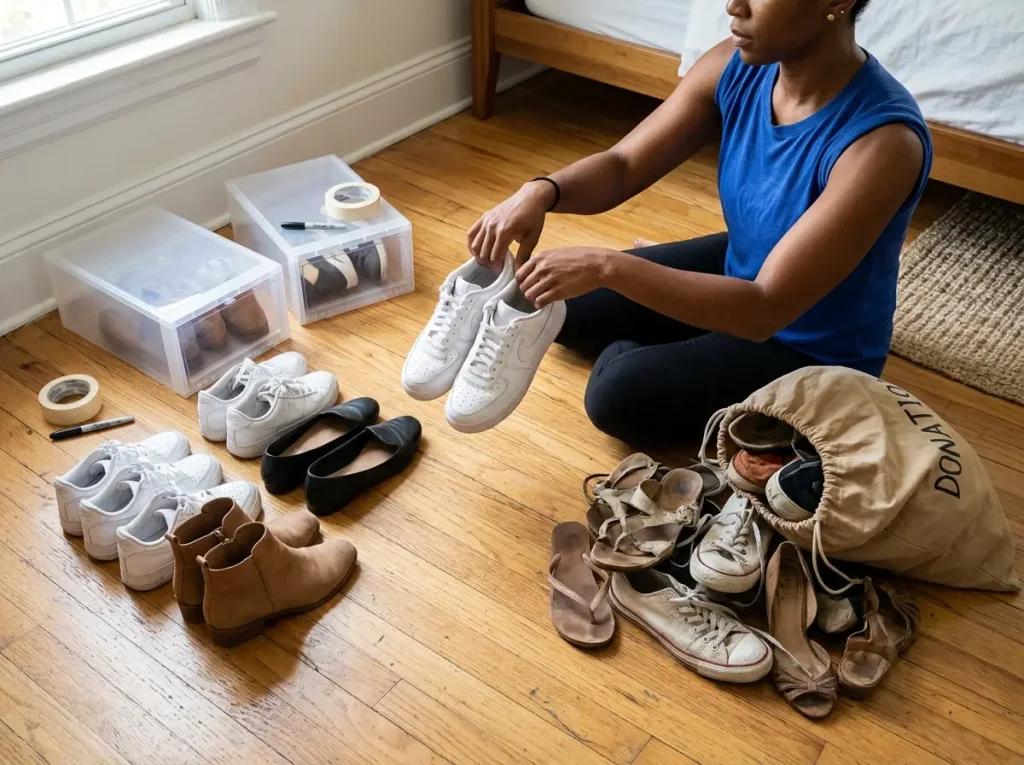
I once had a shoe cabinet by the door that held twelve pairs. My household had closer to thirty in regular rotation. The cabinet wasn’t the problem — it was a good cabinet. The math was the problem. Every shoe organization guide jumps straight to products, but the storage keeps getting calibrated for the wrong number of pairs, and no rack on the market corrects for a collection it was never sized to hold.
Professional organizers — the kind certified through groups like NAPO — start every job the same way: empty the space, sort what’s there, then decide on storage. Not the reverse.
The Pair-Count Framework
Here’s the framework no rack box will tell you, because it has nothing to sell. Under 15 pairs, you’re a single-zone household: one rack or one under-bed bin handles everything, no rotation needed. Between 15 and 30 pairs, you need a zoned system — an entry zone for the 5 to 8 pairs in daily use, a closet zone for weekly rotation, and a seasonal zone for the rest. Past 30 pairs, rotation stops being optional; without it, any method overflows within about two months no matter how good the product is.
The number of pairs decides how many zones you need. That’s the whole diagnostic, and the bracket you land in — not the brand of rack — is what determines whether the system holds.
The Two-Pile Edit
Decluttering shoes is faster than almost anything else, because shoes give you honest data: the soles wear, the leather creases, and you remember which pairs hurt. Make two piles. Pile one is wear-tested — anything you’ve worn in the last twelve months or genuinely have an event for. Pile two is everything else. “I might wear these” is not wear-tested; it’s pile two.
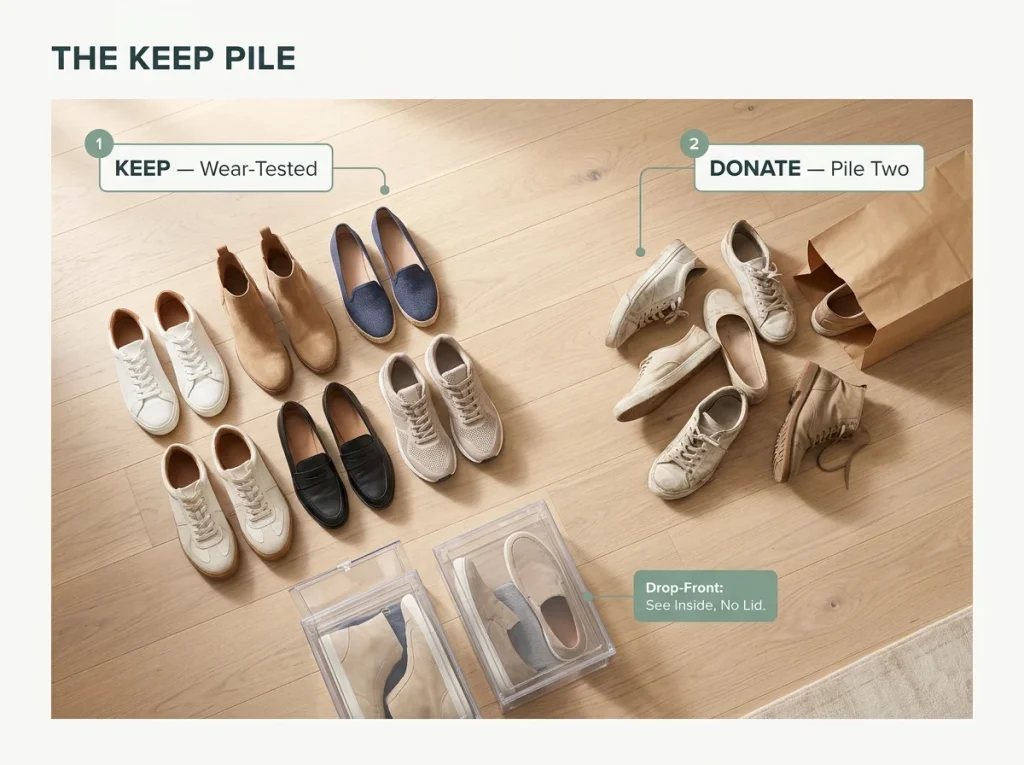
Most people surface eight to twelve pairs they haven’t touched in over a year — ghost shoes that quietly eat the prime storage your daily pairs should own. Worn-out, painful, and orphaned-single shoes leave entirely. For the keep pile, clear drop-front shoe boxes like these stackable ones protect heels and let you see what’s inside without lifting a lid — though the original cardboard box with a photo taped to the front does the same job for free.
Why Counting Changes Everything
Almost every failed shoe system traces back to one thing: the storage was sized for a collection that doesn’t exist. Counting turns “a lot” into a number, and a number maps cleanly onto zones. Five minutes, and every product decision that follows gets easier.
The Shoe Type Framework
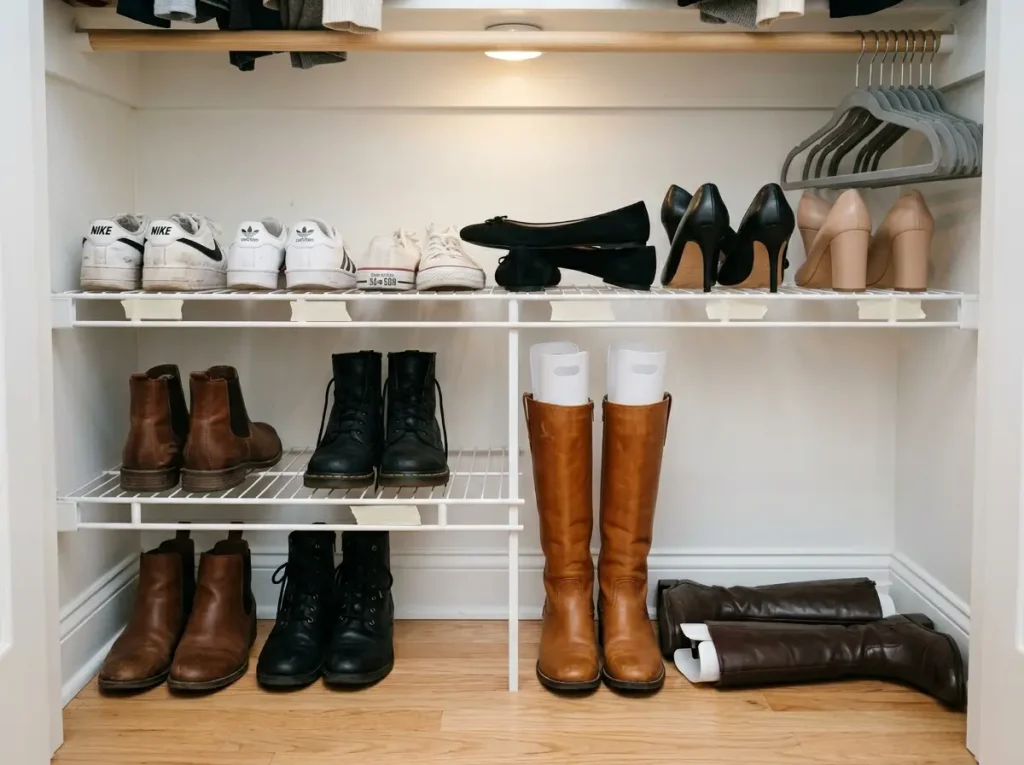
Every rack promises it holds twelve pairs. Twelve pairs of what, though? A knee-high boot and a flat sandal have nothing in common as storage objects. Buying storage without sorting by type first is how you end up with a rack that fits your sneakers and laughs at your boots.
Sneakers and Athletic Shoes
Sneakers are deeper than people expect. A standard adult sneaker runs about 12 inches long, so it needs a rack at least 12 inches deep with tier spacing around 5.5 to 6 inches to sit flat. The number-one complaint about canvas over-door organizers comes straight from this: standard pockets are only 5 to 6 inches wide, so a men’s size 11 sneaker won’t go in. If sneakers are most of your collection, check the standard shoe rack dimensions against the product spec before ordering.
Dress Shoes, Heels, and Flats
This is the easy group — the most compact thing you own, happy with standard 5 to 5.5-inch tiers. The one trick worth knowing is free: alternate pairs heel-to-toe on an open shelf and you reclaim roughly 30% more depth, fitting four pairs where three used to go. Heels scuff against each other, so clear boxes earn their place here more than anywhere else.
Boots and the Shaft-Collapse Problem
Boots are the demanding ones. A knee-high boot needs at least 16 inches of vertical clearance to stand, and most closet shelves are spaced at 12 to 16 inches — so the boot folds over the edge or doesn’t fit. I used to tell people to stand every boot upright on principle. Then I watched a pair of knee-highs fold over the front of a 14-inch shelf for a week before the owner gave up. Now I say it plainly: if it doesn’t clear 16 inches, lay it flat.
The catch with flat storage is shaft collapse — without support, leather and fabric shafts crease and the fold becomes permanent within weeks. Boot shapers like these inserts hold the shaft upright in flat or boxed storage, and a tightly rolled magazine does the same in a pinch. For renters with no floor to spare, a hanging boot organizer on the closet rod is the only no-drill way to keep tall boots upright. It’s not pretty. It works.
Closet Shoe Organization
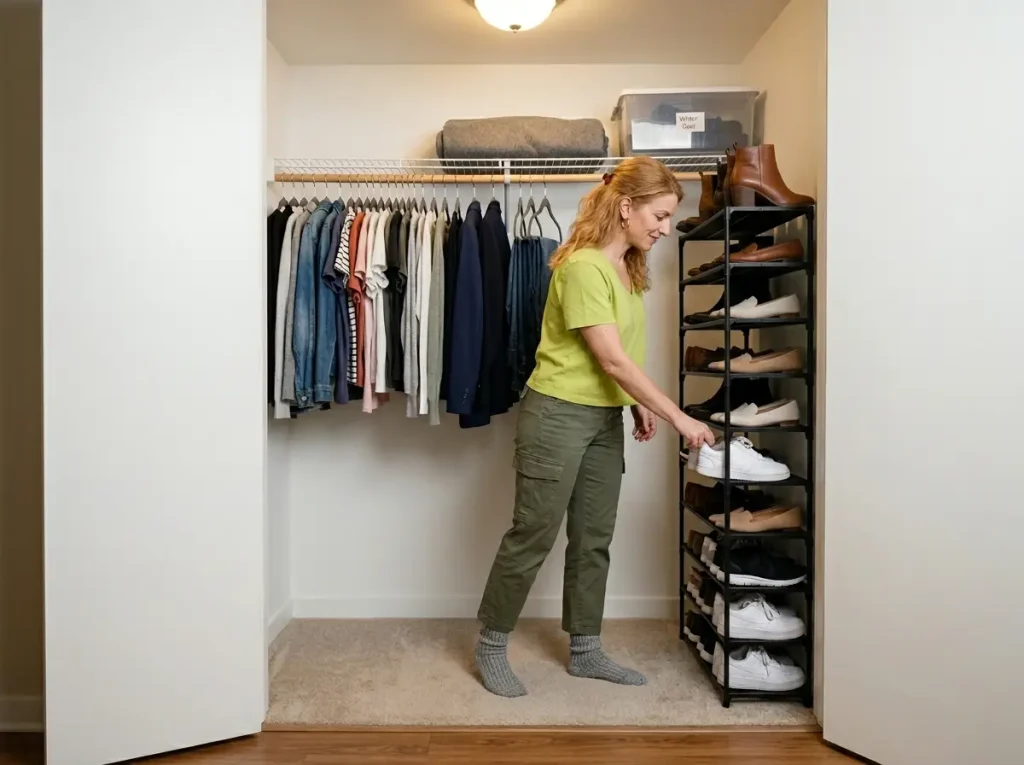
The closet floor is where most shoe systems live and where most shoe systems die. The tiered rack looks clean for about three weeks, then one tier becomes a flat pile and the rest overflow sideways. The fix is rarely a better rack — it’s a rack matched to your closet’s actual depth.
Tiered Racks on the Closet Floor
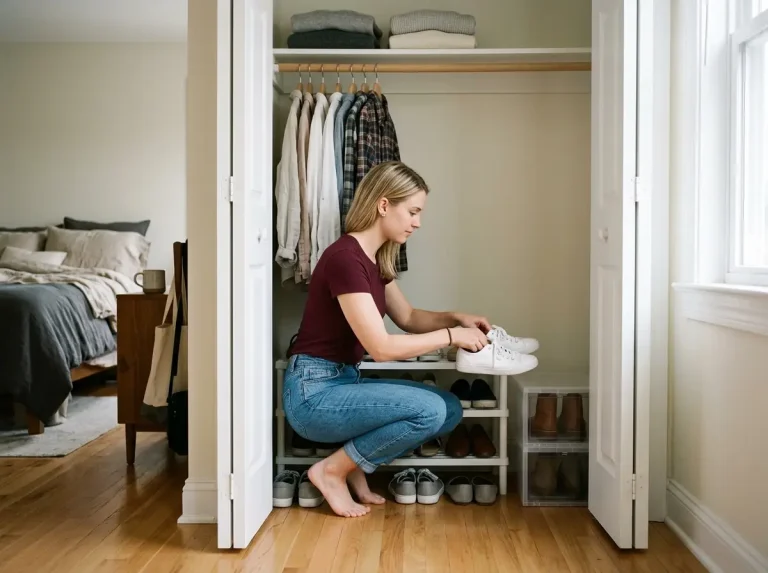
Measure your closet floor depth at the door frame first, not the back wall, because the frame is the real bottleneck. Many reach-in closets give you only 12 to 14 inches of usable floor, which is why a standard 12-inch rack fits sneakers and flats but an 18-inch boot rack won’t let the door close. For renters, freestanding is the whole game: the SONGMICS 8-tier rack at 12 inches deep stands in a corner with no screws, and the LANTEFUL 10-tier at 11.5 inches square has the smallest footprint I’ve found for a tight corner. Load the heaviest pairs on the bottom tiers, though, or a tall narrow tower gets tippy.
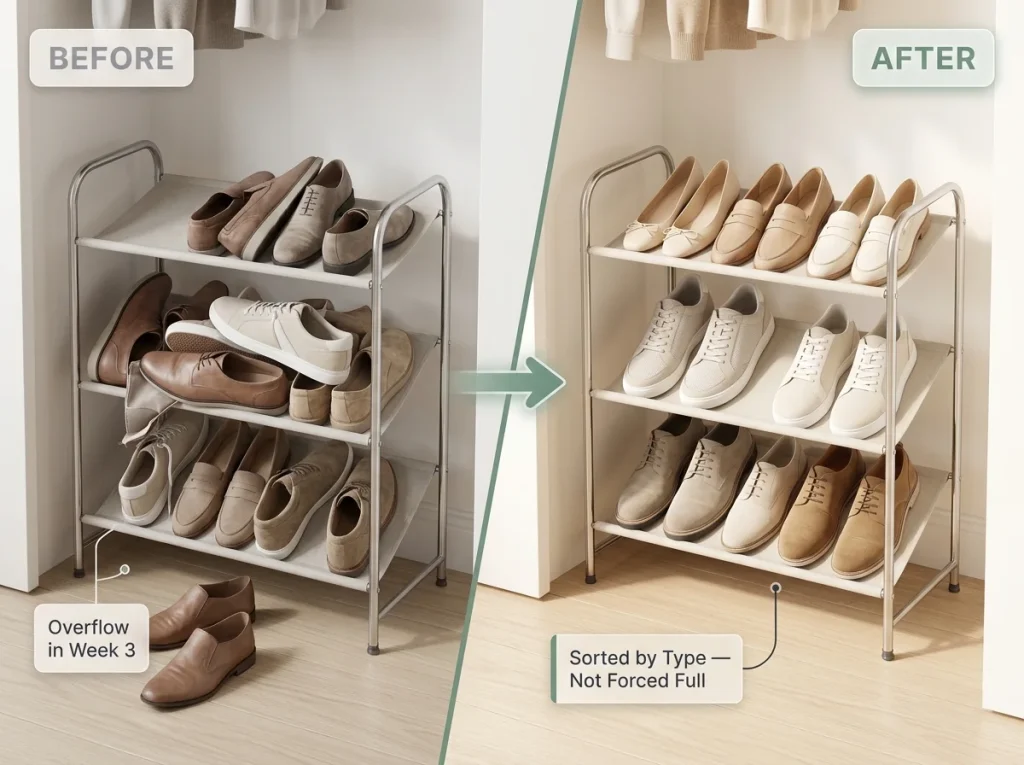
Measure closet floor depth at the door frame, not the back wall. The frame decides whether the door closes over your rack — and it’s almost always two to three inches shallower than you’d guess by eye.
Under-Rod Hanging Organizers
Look at the gap between your hanging clothes and the closet floor. In most reach-in closets that’s 8 to 12 inches of dead space, and a hanging fabric organizer turns it into storage for flats and other lightweight pairs. Keep boots and heavy sneakers off it — the weight pulls the whole thing crooked. This is also where a full reach-in closet organization plan pays off, since the shoe zone follows the same dead-space logic as the rest of the closet.
Clear Boxes on Closet Shelves
Clear boxes are great for the shelf above the rod — seasonal pairs, occasion shoes, anything you don’t grab daily. But the lid style matters more than the box. I used to recommend any clear box with a lid. After a set of separate-lid boxes sat unused in a friend’s closet for months — the lids were just enough friction that shoes landed on top instead of inside — I only point people to drop-front boxes now. The front drops open in about a second, which is the difference between a system people use and a stack of nice-looking boxes gathering dust. One warning: don’t stack them more than four or five high, or the column turns into a shoe avalanche the first time you pull from the bottom.
Entryway Shoe Organization
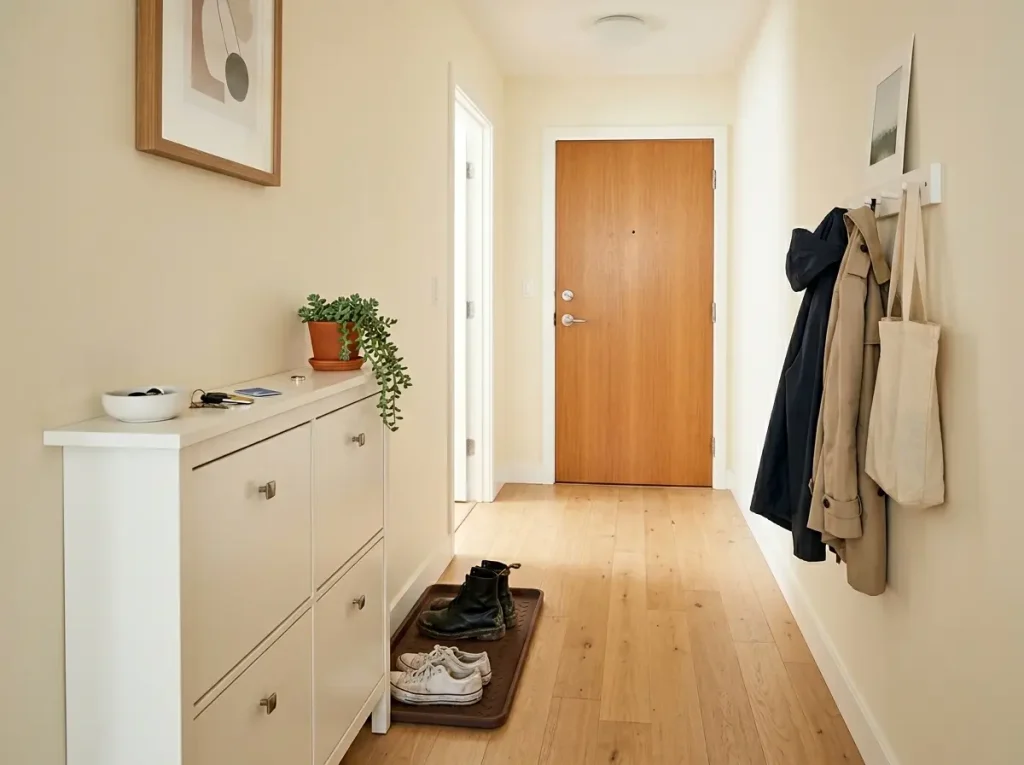
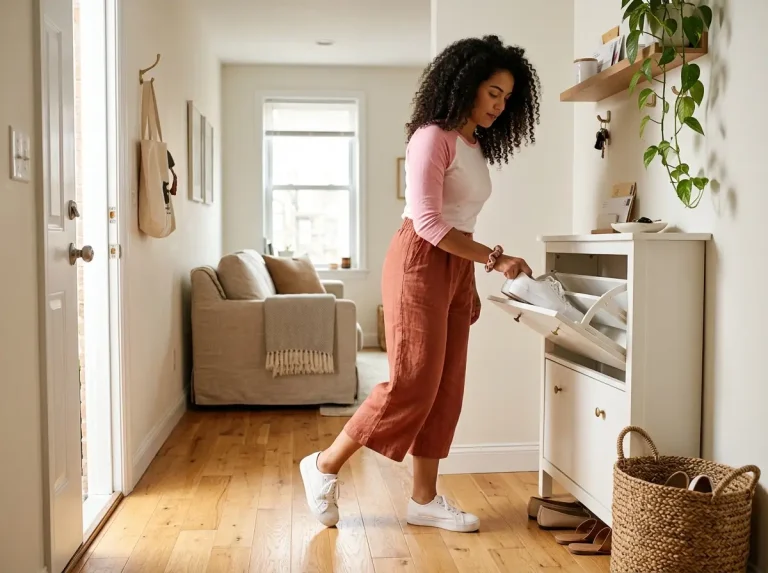
Most entryway storage fails because the product was chosen for the number of shoes instead of the size of the hallway. A 14-inch-deep cabinet that leaves 32 inches of passage doesn’t just look bad — it’s in the way, you bark a shin on it twice, and within two weeks the pile of shame migrates back to the floor beside it.
The 36-Inch Walkway Rule
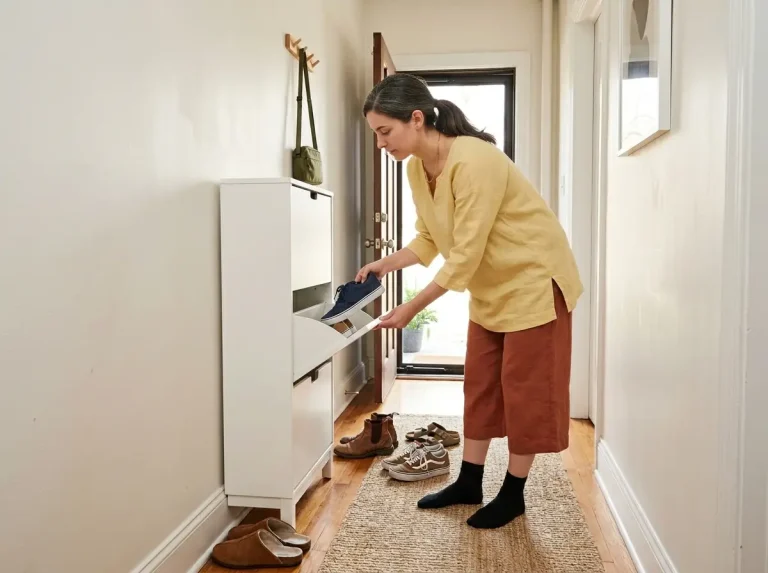
There’s a formula that prevents the most common entryway mistake. You want at least 36 inches of clear passage, so take your hallway width and subtract 36 — what’s left is your maximum cabinet or rack depth. A 48-inch hallway gives you 12 inches to work with; a 46-inch hallway drops you to 10; a 42-inch hallway leaves room for over-door or wall-mounted storage only. Measure the hallway before you fall in love with a cabinet, not after.
Tape the cabinet’s depth out on the floor with painter’s tape and live with it for a day before ordering. If you walk around the tape line even once, the real cabinet will end up in the donate pile.
Slim Cabinets vs. Open Racks
If you want enclosed storage that hides the daily shuffle, depth is the whole battle. Most “slim” cabinets still run 11 inches or more, which busts the 10-inch budget in a standard rental hallway. The exception is worth calling out on its own.
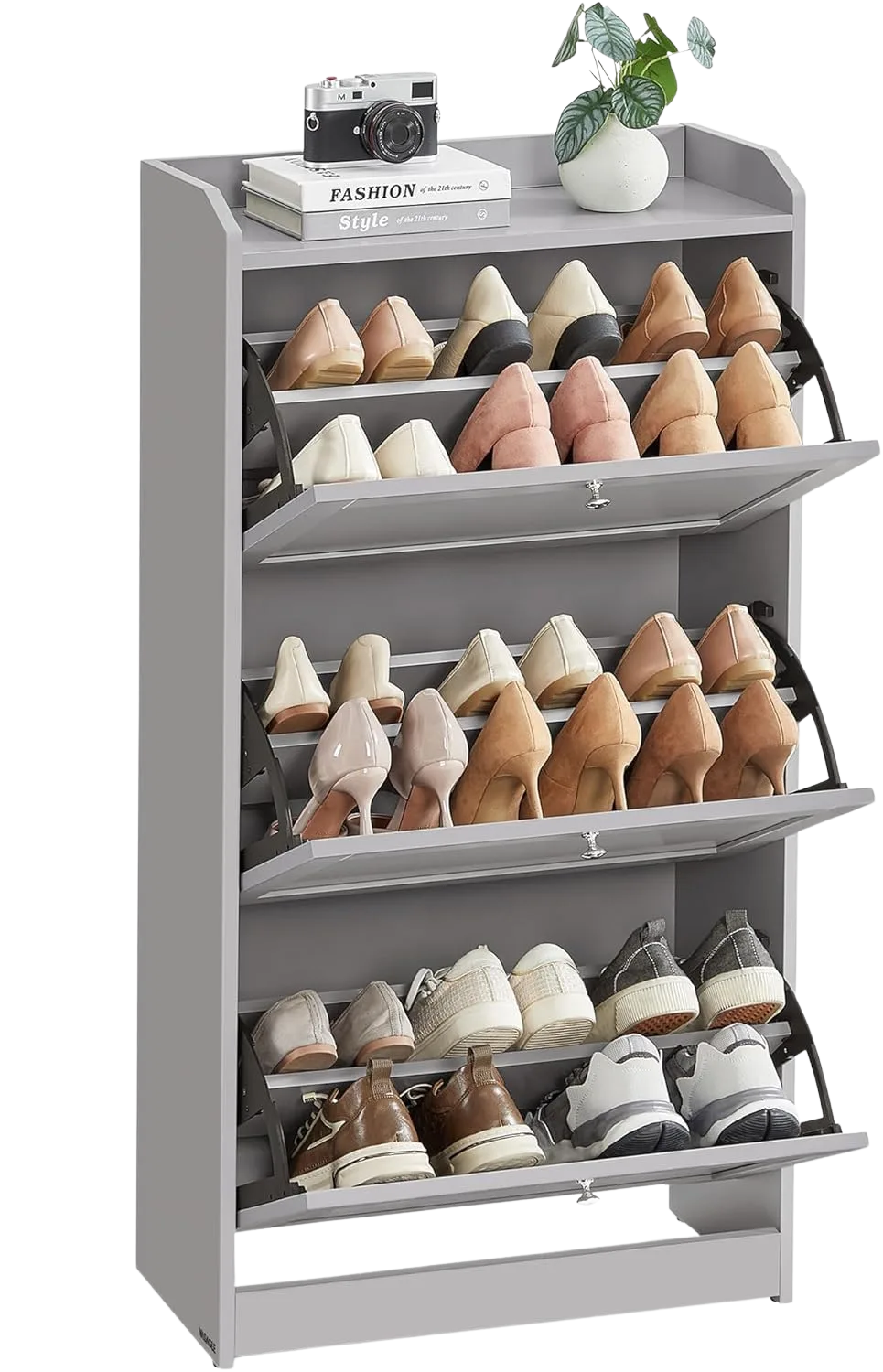
If you don’t need the enclosure, an open tiered rack gives faster access and more capacity for the same money, at the cost of visible clutter. Either way, only your active 6 to 8 pairs belong at the entry — the rest live in the closet. For a deeper walkthrough, the entryway shoe storage system guide covers the full range, and an entryway bench with storage is worth a look if you’ve got floor space for a sit-down spot.
The Boot Tray and Basket Combo
When in doubt, this is the system that never fails, and it costs almost nothing. A boot tray catches the wet and dirty by the door, and one basket per person holds that person’s active pair. No alignment, no lids, no rules about what goes inside. My partner’s system was the floor; mine was the cabinet. We compromised on one basket each, and that truce has outlasted every nicer setup we tried — because in a multi-person entry, people follow their own spot but won’t memorize your sorting logic.
Over-the-Door and Vertical Rack Solutions
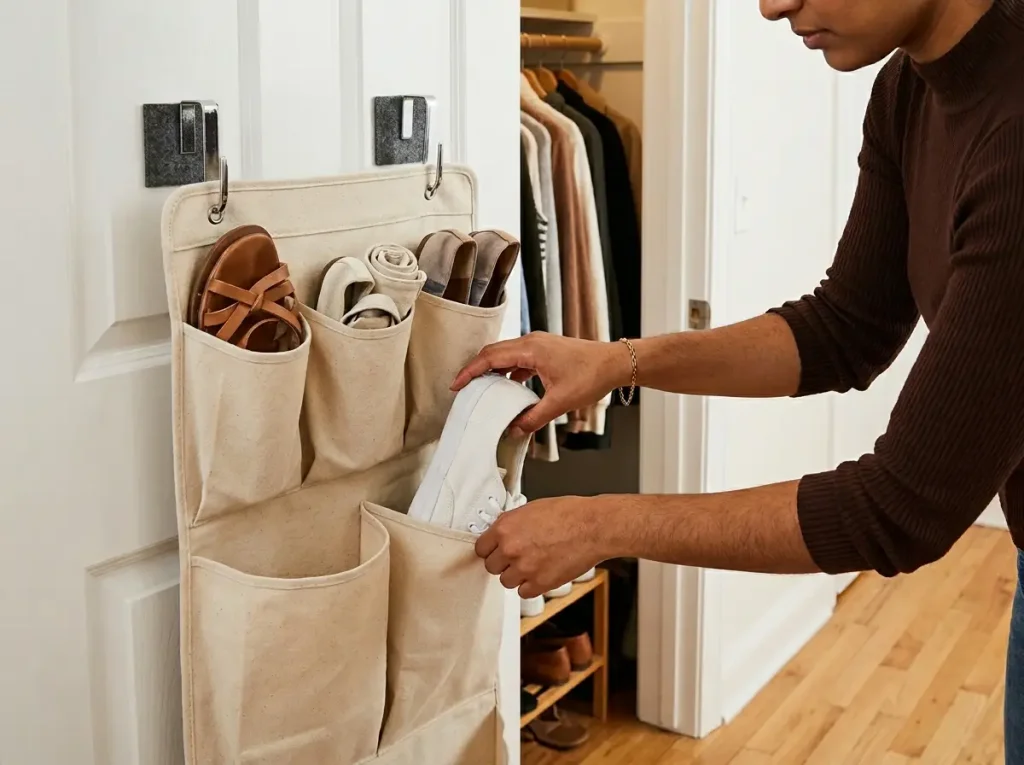
Over-the-door organizers are the most-recommended renter shoe solution and the most-returned shoe product, which tells you something. The failure is almost always the pockets being too narrow, or the hooks chewing up the door. Both are preventable with one check before you buy.
Over-Door Organizers and Pocket Width
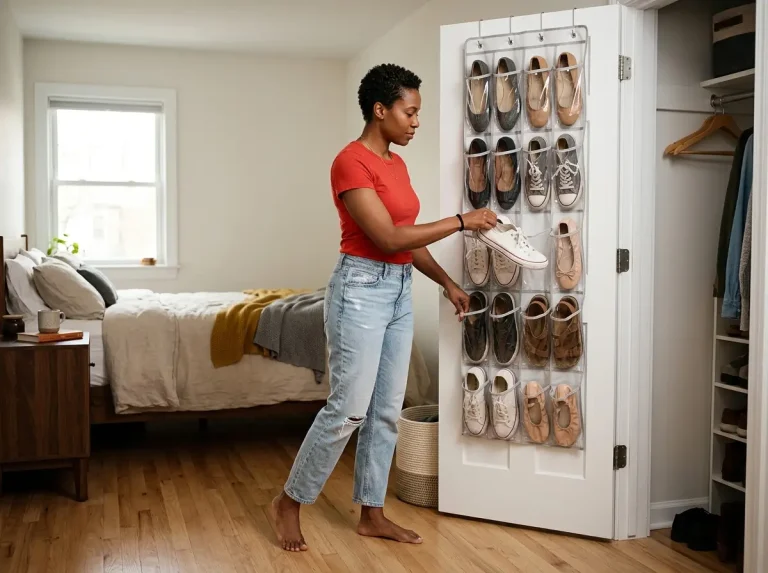
Standard canvas pockets run 5 to 6 inches wide, which fits flats, sandals, and narrow shoes. The SimpleHouseware 24-pocket organizer is the reliable baseline for those lightweight pairs. But push a men’s size 10 sneaker at one and it won’t go — which is where a wide-pocket design earns its keep. The MISSLO 10-tier organizer runs roughly 9-inch pockets that swallow an adult sneaker, so check the pocket-width spec against your biggest shoes before ordering.
Over-door organizers get recommended everywhere as the universal renter fix. And they are genuinely good — until someone loads boots into one and the door stops latching. Canvas racks top out around 10 pounds across all the pockets, so keep them to lightweight shoes, and on a hollow-core door stick felt pads on the hooks to stop them denting the panel. The over-door shoe organizer ideas guide goes pocket-by-pocket if you want more.
Freestanding Vertical Racks
When the door won’t cooperate — bi-fold doors can’t take an over-door organizer at all — a freestanding tower is the move. The same SONGMICS and LANTEFUL racks from the closet section work here, with no door-type restriction and higher weight capacity.
Using the Closet Door as Shoe Storage
The inside of a closet door is the surface everyone forgets. It’s often solid-core, so it takes over-door hooks better than a flimsy hollow entry door — good for seasonal overflow or second-string pairs. No floor space, no new furniture, no holes.
Under-Bed Shoe Storage
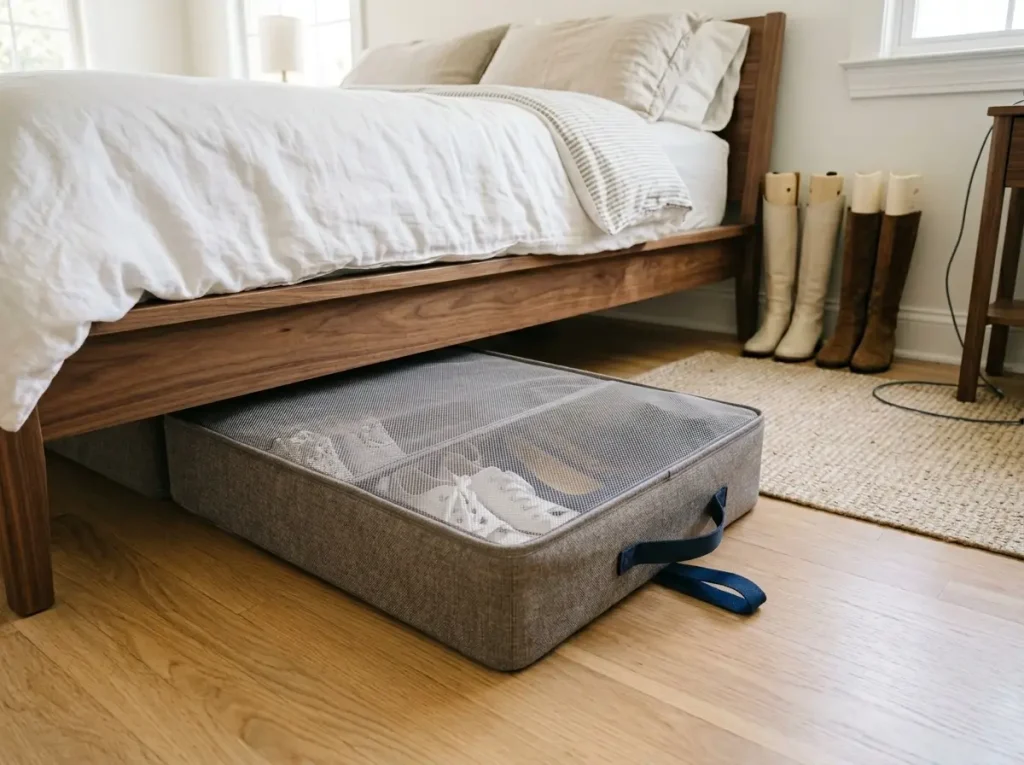
Under-bed storage sounds simple until the first time you buy a 7-inch container for a platform bed with 5 inches of clearance. The space exists on paper and not in practice. The fix is one measurement, taken correctly: floor to the bottom of the slat base, never floor to the top of the mattress.
Measure Before You Buy
Clearance comes in three rough tiers. Platform beds with minimal gap need ultra-thin containers around 4.5 inches; standard platform frames usually land at 5.5 to 6.5 inches; metal and raised frames give you 7 to 9 inches and room to roll bins in and out. That last part matters — a rolling container needs at least 7 inches to roll freely, and below that you’re relying on a pull handle instead.
Measure from the floor to the bottom of the slat base, not the top of the mattress. That gap is your true clearance, usually a couple of inches less than it looks. Renters who come up short can add bed risers to buy back two or three inches without touching the frame.
Flat Organizers vs. General Boxes
A shoe-specific organizer beats a generic tub because it’s sized for pairs and built with a pull handle, so retrieval at floor level doesn’t require a yoga pose. The Woffit under-bed organizer set runs about 5.5 inches tall and clears most platform beds, with two units to split a collection. If you’d rather store shoes alongside other things, a general IRIS USA under-bed box does double duty, though pairs slide around more without divided pockets. Keep under-bed space for seasonal and overflow pairs, never your daily shoes — the retrieval friction is too high for something you reach for every morning.
Boot Storage Under the Bed
Boots are the reason most people give up on under-bed storage, but they fit fine in a container built for them. The Woffit 16-pair-plus-4-boot organizer has dedicated boot slots at that same 5.5-inch clearance — the only flat product I’ve found that handles mixed boots and shoes in one unit. Slide a boot shaper into each shaft before storing it flat, and never vacuum-seal leather or suede. For the full bed-type breakdown, the under-bed shoe storage guide maps clearance to frame type in detail.
Small Space Shoe Organization
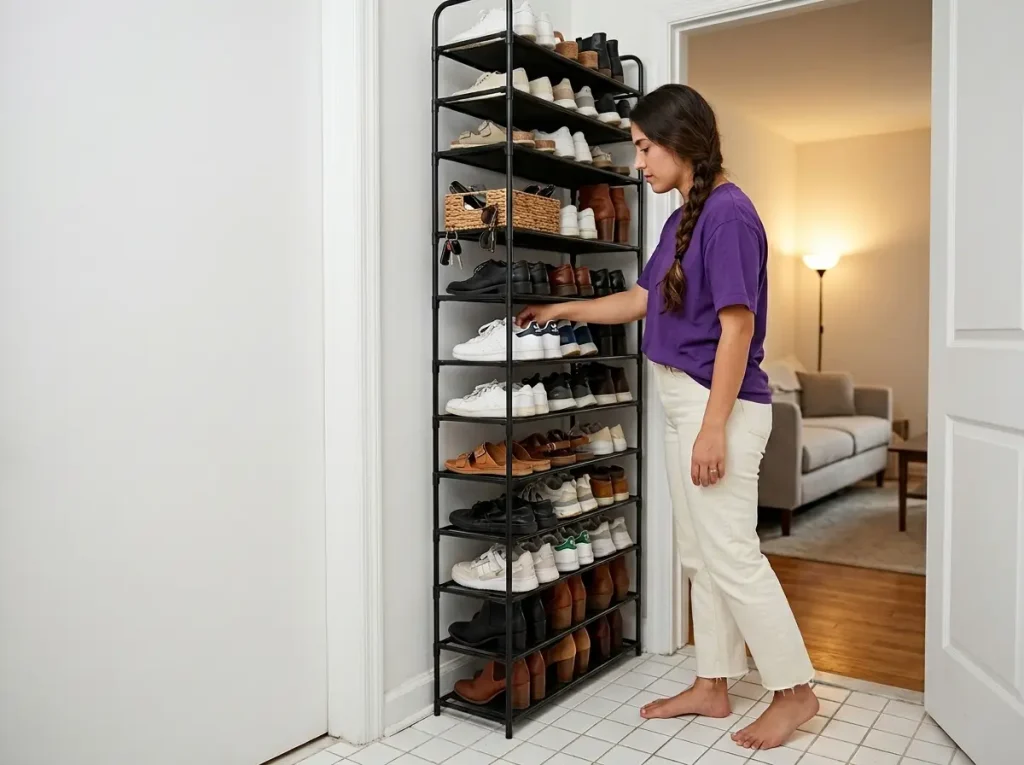
In a small space, the only shoe organization that survives is the kind that feels effortless. There’s no buffer — everything is right in front of you — so any system that asks you to open a lid or reach past something else collapses fast. Friction is the enemy, and small spaces have zero tolerance for it.
The Frequency-Zone System
Sort by how often you wear a pair, not by what kind of shoe it is. Daily pairs go at the door in a zero-friction landing spot; weekly pairs go in the closet on a rack; seasonal pairs go under the bed or on the top shelf. The frequency makes the call, which takes the daily decision off your plate.
Vertical Storage in Tight Corners
Think up before you think out. A tall narrow tower like the LANTEFUL 10-tier holds close to 20 pairs in a corner barely wider than a shoebox — the best vertical-to-floor ratio you’ll find. Any unused wall corner becomes storage the moment you measure it by height instead of floor footprint.
Renter Solutions Without Drilling
The no-drill toolkit for a small rental is short. Hang a canvas organizer on the inside of a bedroom or bathroom door, stack a pair of IKEA TRONES units two high (freestanding at about 7 inches deep, and a board across the top makes them look built-in), and add bed risers for under-bed clearance. For two people sharing a studio, one communal basket at the door usually beats two separate racks. The how to organize shoes in a small space guide runs the full system if your square footage is really tight.
Why Shoe Organization Systems Fail
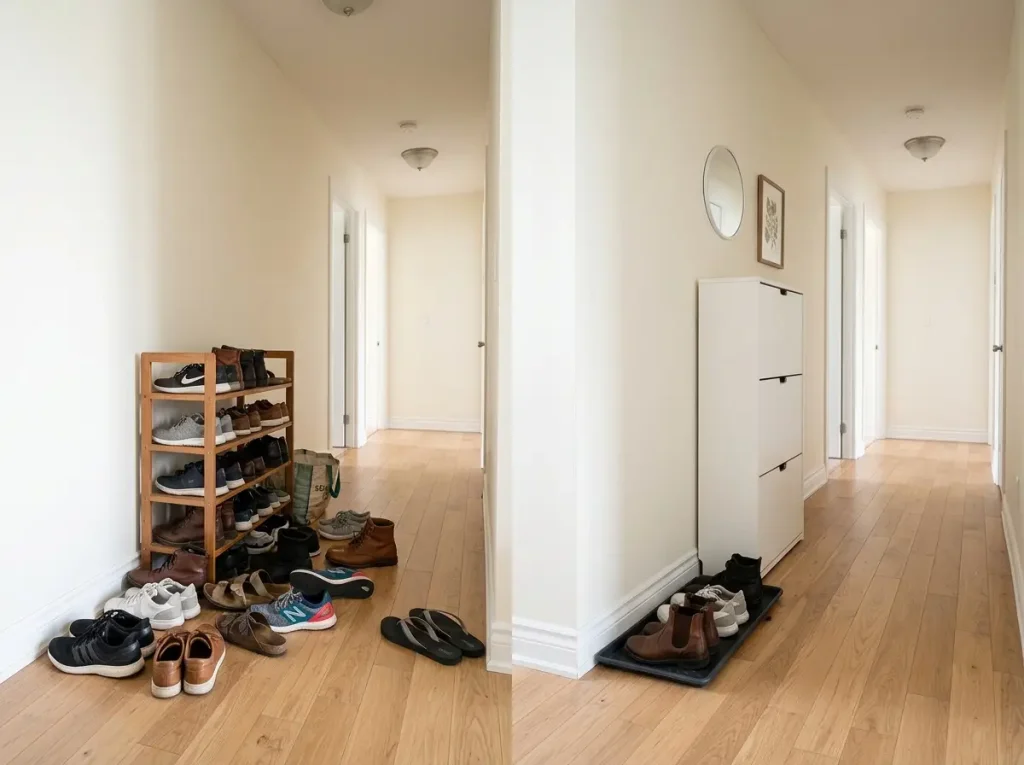
Every household with a shoe pile has also bought at least one shoe rack. The rack didn’t fix it. The problem was never the product — it was one of a short, predictable set of system failures that happened before the product ever had a chance. Name the failure and you stop repeating the purchase.
The Friction Problem
Here’s the rule that explains most of it: if putting a shoe away correctly takes more than about two seconds, the system erodes. It doesn’t fail all at once — it slides, one rushed evening at a time, from enclosed cabinet to drop-front to open rack to basket to floor. Each step trades tidiness for speed, because speed is what people actually choose at the end of a long day. So design for the friction your household will really tolerate, not the friction you wish it had. A basket everyone uses beats a beautiful cabinet nobody opens.
The Multi-Person Household Problem
A system built for one person and used by four falls apart at the seams, because the other three never learned where things go. The fix isn’t a lecture — it’s geometry. Assign each person a physical zone: their rack tier, their basket, their half of the bench. Person-zones outlast type-zones every time, because each person only has to remember their own spot instead of your entire sorting scheme. It’s the same principle behind shared closet organization — individual accountability beats shared rules.
The Volume and Dimension Problems
Three more failures, all diagnosable before you spend a dime. The volume problem: a 12-pair rack for a 24-pair collection overflows on day one. The depth problem: a 14-inch rack in a 44-inch hallway leaves 30 inches of passage and becomes an obstacle within two weeks. The type problem: canvas pockets for boots, or 5.5-inch tiers for ankle boots that need eight. Count the pairs, measure the space, match the format to the shoe — run those three checks and you’ve ruled out the failures that send the orphan pair drifting back to the floor. Most of shoe organization is this checklist, honestly. The rest is upkeep.
The Seasonal Shoe Rotation System
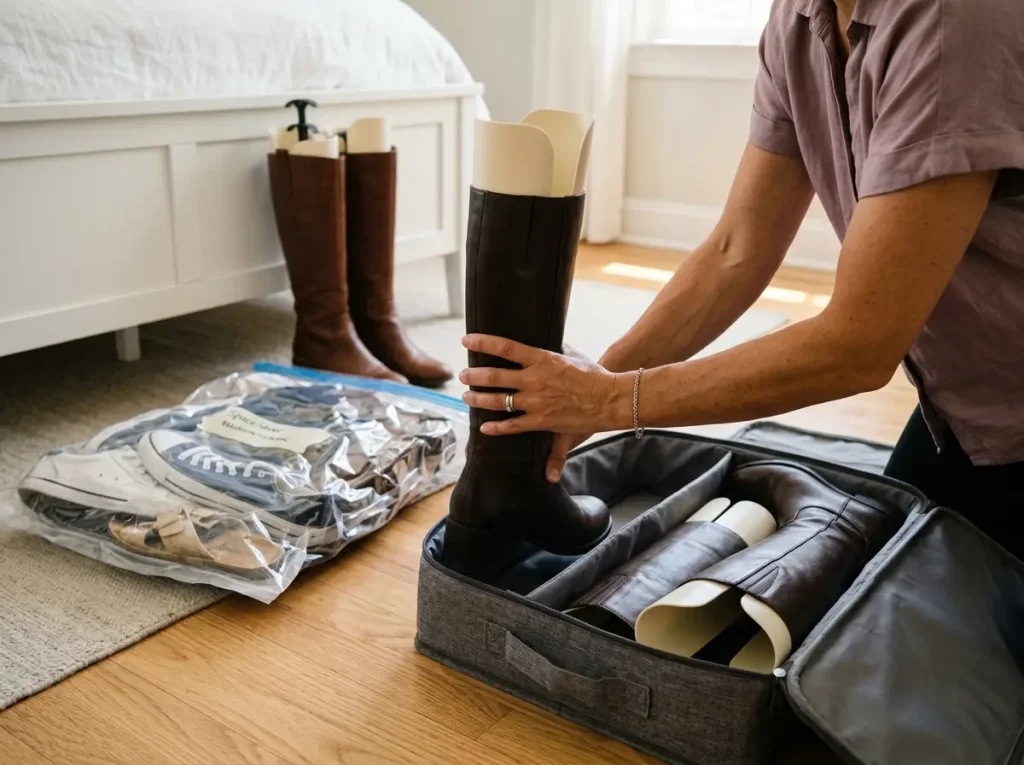
October is when most households discover eleven pairs of sandals they haven’t touched since June, all squatting in prime closet space the boots now need. A seasonal rotation isn’t about owning fewer shoes. It’s about keeping the right shoes within easy reach for the season you’re in, and storing the rest well enough that they come back undamaged.
When to Rotate
Two swaps a year is plenty for most North American homes. October moves sandals and lightweight shoes out and brings boots forward; April runs it in reverse. There’s no need to do it on the first — a two-week grace period is normal, and the real trigger is the weather, not the calendar.
How to Store Off-Season Shoes by Material
Material decides the method, and getting this wrong is the costly mistake. Canvas and synthetic shoes tolerate compression, so vacuum bags like the SpaceSaver jumbo set shrink a season of sneakers down to something that slides under a bed. Leather and suede are a different story — they need to breathe.
Never vacuum-seal leather or suede. The compression pulls the moisture balance out of the leather and collapses the shape, and it doesn’t fully recover. Use breathable fabric bags with a cedar block instead, and save the vacuum bags for canvas and synthetics.
Before any boot goes into storage, wipe the soles, slide a boot shaper into each shaft, and tuck it into a fabric bag or its original box. Knee-high pairs lay flat in an under-bed organizer with shapers, or stand in a box tall enough to clear them. The closet side of this swap is covered in the seasonal closet rotation guide if you’re rotating clothes at the same time.
The Monthly Reset
The pile doesn’t come back because the system is wrong. It comes back because shoes get taken out and not returned, a little at a time. Once a month, give it ten minutes: return any pairs that drifted from their zones, pull the ghost shoes that crept back into prime space, and check that the entry landing spot hasn’t quietly become a secondary pile. That’s it. Ten minutes beats reorganizing from scratch every season, by a wide margin.
The System in Three Moves
If you take three things from all of this, take these.
Count first, buy second. Storage sized for the wrong collection is the root of nearly every failure, and the count costs nothing but five minutes.
Match the dimensions to the shoes. Boots need 16-plus inches of vertical clearance or flat storage with shapers, standard racks need 12 to 15 inches of depth, and entryway cabinets need to stay under 10 inches for most rental hallways.
Design for the whole household, not the ideal user. Person-zones and low-friction drop points survive real homes with real people; tidy systems that demand discipline do not.
Three-Month Check: In three months, look for ghost shoes creeping back into prime storage — pairs kept “just in case” are the first sign the system is drifting. Run the two-pile edit again on anything that hasn’t moved.
Start with the count. Not the rack, not the cabinet, not the organizer. Count your pairs, sort them by type, and you’ll know exactly what you need before you spend a thing.
Frequently Asked Questions
01What is the best way to organize a lot of shoes?
Use a three-zone system sorted by how often you wear each pair. Daily shoes go at the door in a no-friction drop zone, weekly pairs go in the closet on a rack or in clear boxes, and seasonal pairs go in flat under-bed bins. Frequency decides placement, not preference.
02How do I organize my shoes in a small closet?
Stand a freestanding tiered rack on the floor — no wall anchoring needed — and add an over-rod hanging organizer to reclaim the 8 to 12 inches of dead space below your clothes. Keep seasonal and occasion pairs in clear drop-front boxes on the shelf above.
03What can I use instead of a shoe rack?
A repurposed bookshelf works well — each cubby holds two or three pairs at no extra cost. Over-door canvas organizers handle lightweight shoes with zero floor footprint, and flat under-bed containers store overflow without touching closet or entryway space.
04How do you store shoes in a small entryway?
Subtract 36 inches from your hallway width to find your maximum storage depth. For most rental hallways that means staying under 10 inches, where a slim flip-drawer cabinet fits. Below 42 inches of hallway width, switch to over-door or wall-mounted options.
05How do I keep my shoe organization working long term?
Run a ten-minute reset once a month — return drifted pairs, remove ghost shoes that crept back, and clear any pile forming at the entry. Swap footwear seasonally in October and April so off-season pairs never crowd the shoes you wear daily.
Disclaimer: ClutterlessNest is a participant in the Amazon Services LLC Associates Program. As an Amazon Associate we earn from qualifying purchases. This article may contain affiliate links — if you buy through them, we may earn a small commission at no extra cost to you. We only recommend products we have tested or genuinely believe in.