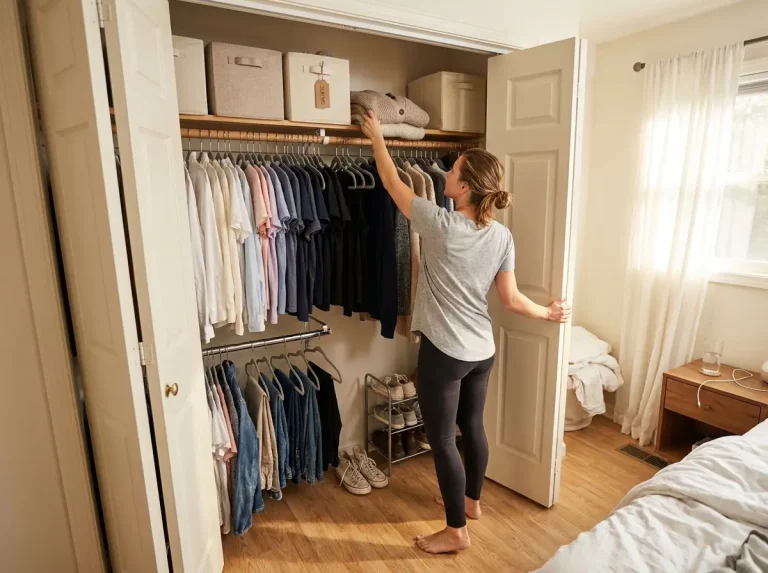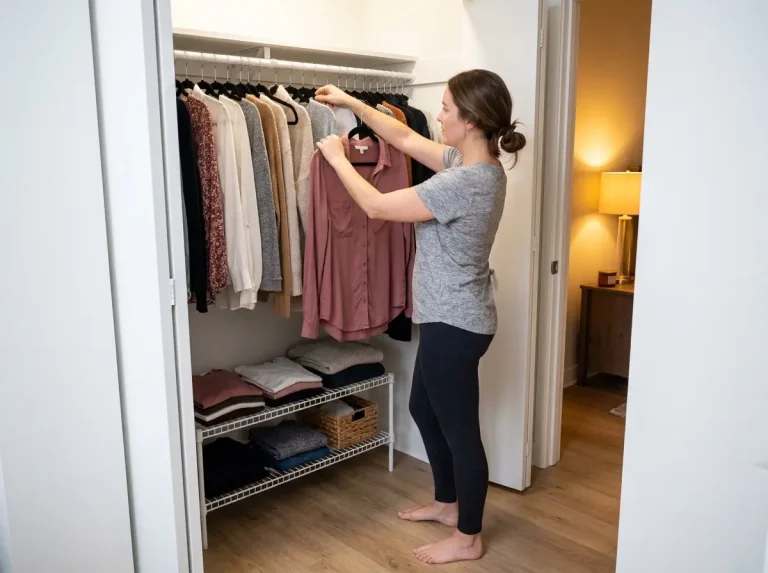
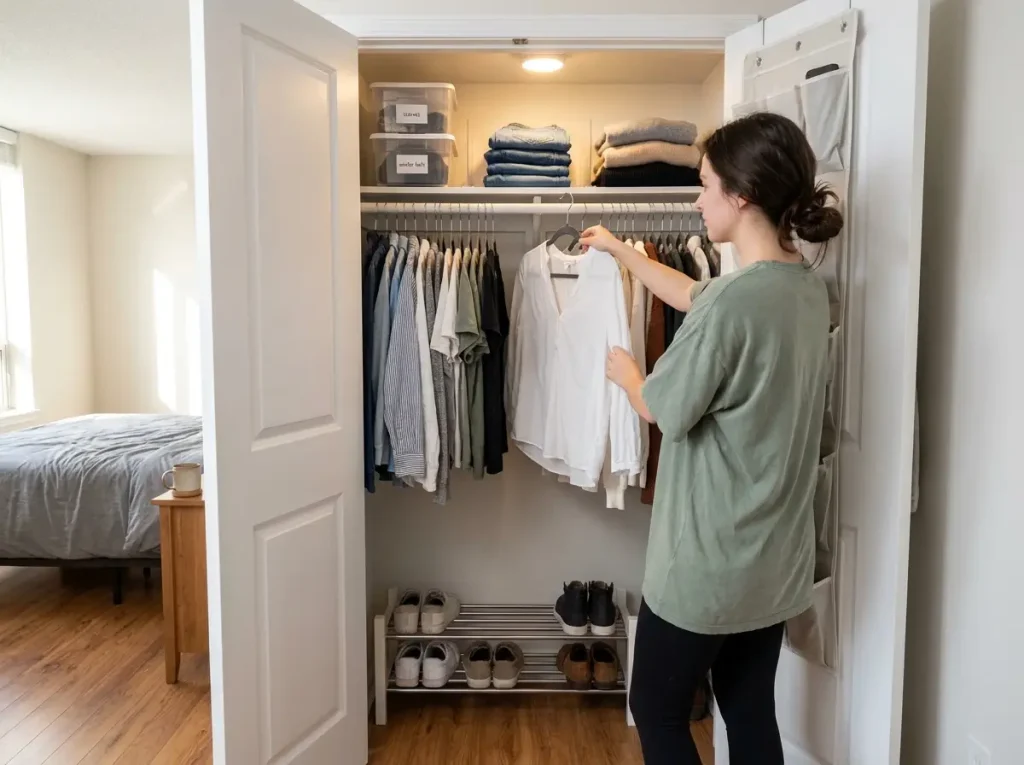
You spent Saturday afternoon reorganizing the closet. Everything fit. The hangers were even. By Wednesday, three shirts are on the floor and the shelf stack has toppled again. Sound familiar? I’ve reorganized enough small closets to know the problem isn’t you — it’s that most small closet organization ideas skip the step that actually matters: measuring your space before buying a single organizer. This guide covers why small closets revert, the dimensional math that makes them work, and specific products for closets under 48 inches wide — all filtered through the closet organization system that lasts I use in every space I organize.
Quick Answer: The best small closet organization ideas that actually last:
- Measure your closet (width, depth, rod-to-ceiling, rod-to-floor) before buying anything
- Switch to slim velvet hangers — reclaims 12-15 inches of rod space on a 48″ closet
- Add a second tension rod at 40-42″ below the main rod for short items
- Use shelf dividers to stop sweater stacks from toppling
- Maximize door back and floor space under hanging clothes
- Run a 10-minute monthly reset to prevent reversion
Why Your Small Closet Reverts in Two Weeks
The Rod-to-Shelf Gap Problem
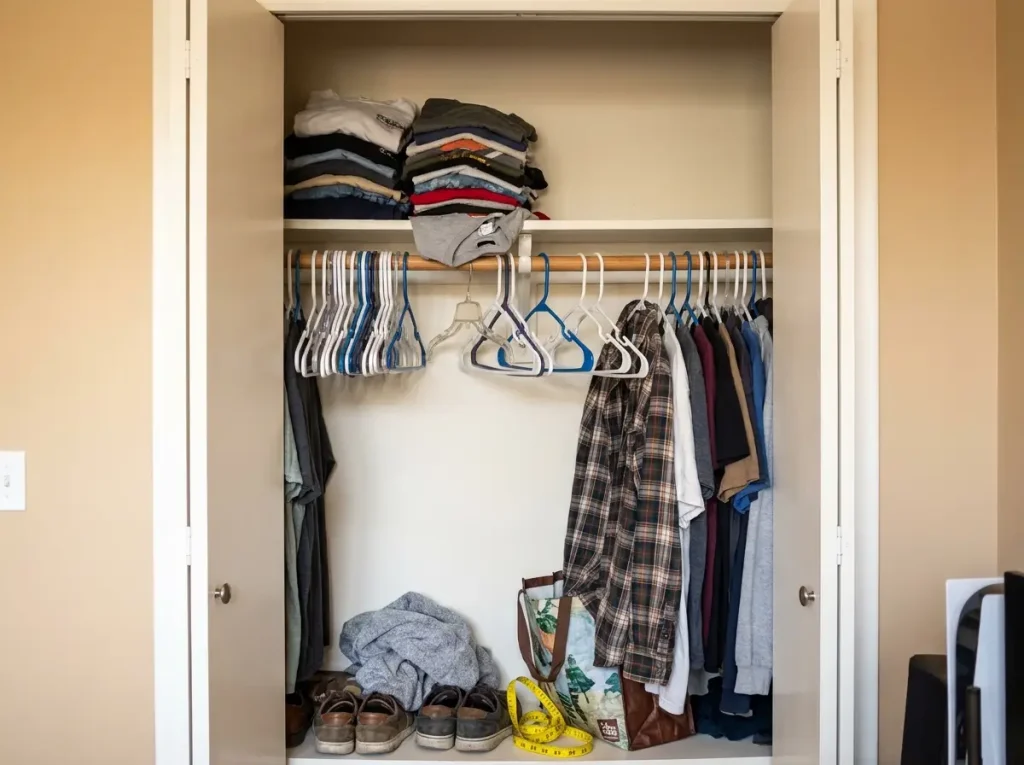
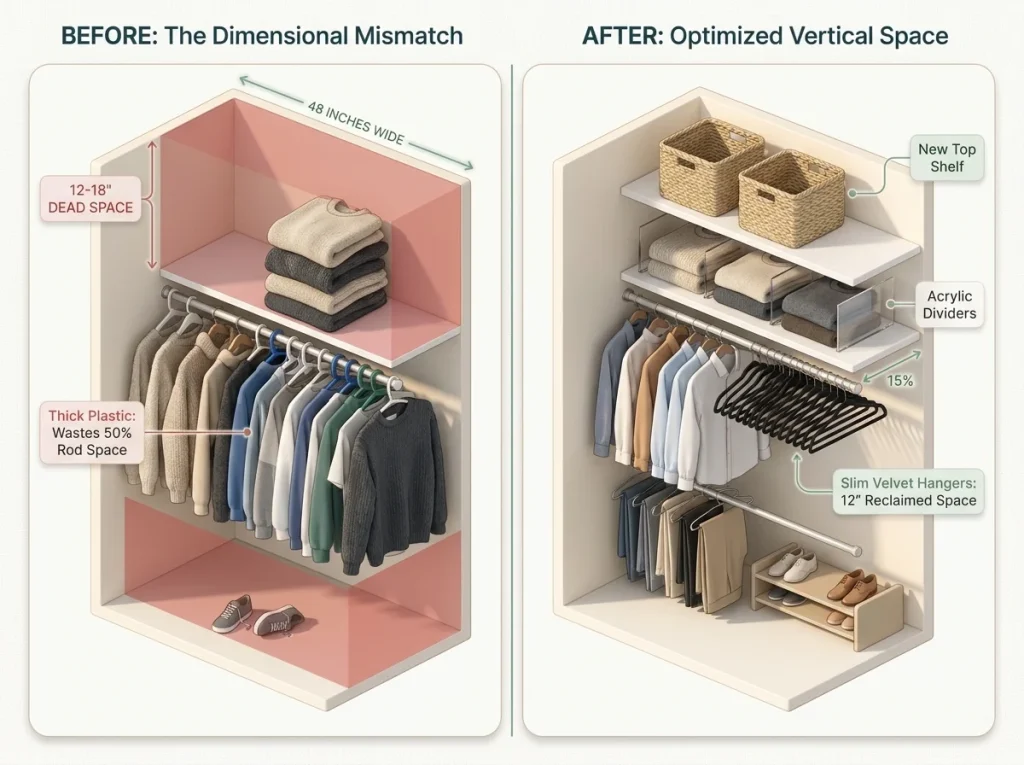
Here’s what happens in most small closets: you hang everything on thick plastic hangers that eat half your rod space, shove folded items on the shelf above without dividers, and ignore the 18 inches between the shelf and the ceiling. Within a week, hangers are jammed so tight you can’t pull anything out without dragging two neighbors with it. The shelf stack leans sideways. Shirts fall off smooth plastic hangers and pile up on the floor.
The root cause isn’t laziness — it’s dimensional mismatch. A standard reach-in closet is 24 inches deep and 48 to 96 inches wide, with one rod mounted at 66 to 72 inches. Most small closets sit at the narrow end: 48 inches or less. That means every inch of rod space matters, and thick hangers waste roughly 40 to 50 percent of it.
The “Everything Fits” Illusion After Decluttering
You declutter. Everything fits. It looks great. But you didn’t account for the clothes in the laundry, the jacket you left at work, or the three things you’ll buy next month. A small closet at 100 percent capacity after a declutter is a closet that’s already over capacity in real life. Leave 15 to 20 percent of your rod space empty after organizing — that buffer is what keeps the system from collapsing.
No Maintenance = No System
Every organizational setup needs upkeep. Without it, entropy wins. Most online guides show you the “after” photo and stop there. They never mention that you need to rehang things, re-fold stacks, and remove items you’ve stopped wearing. A system without a maintenance routine is a decoration — it looks good for the photo and breaks down the moment real life touches it.
Pro tip: When you declutter your closet, take everything out — including what’s in the hamper, on the drying rack, and at the dry cleaner. You can’t organize what you can’t see.
Measure Before You Buy Anything
The Four Measurements That Matter
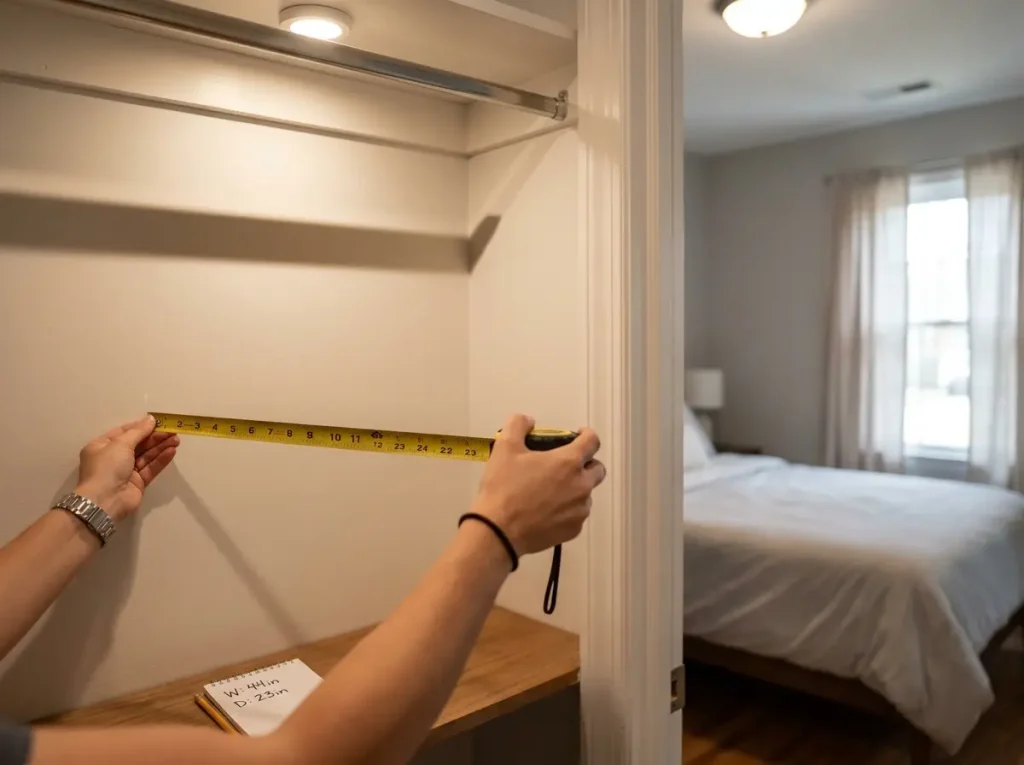
Grab a tape measure. Every product recommendation in this article includes the minimum closet dimensions it needs. If your closet is 36 inches wide, half the organizers on Amazon won’t fit — and none of them tell you that on the product page.
You need four numbers:
- Width — wall to wall, at rod height
- Depth — back wall to the door frame edge (not the door itself)
- Rod-to-ceiling gap — from the top of the rod to the ceiling or top shelf
- Rod-to-floor gap — from the bottom of the rod to the floor
Write them down. Tape them inside the closet door. You’ll reference them every time you shop.
Matching Products to Your Closet Width
A standard reach-in closet is 24 inches deep, but rental closets often come in at 22 inches. That two-inch difference sounds minor until an organizer sticks past the door frame and the closet won’t close. Depth matters more than width for product fit.
For rod space: a standard hanger is 17.5 inches wide. Slim velvet hangers are 17.3 inches — the savings come from thickness, not width. Each slim hanger is about 0.2 inches thick versus 0.5 inches for a standard plastic hanger. Multiply that across 40 hangers and you reclaim roughly 12 inches of rod space.
If your rod-to-ceiling gap is 24 inches or more, you can add a second shelf above the existing one with 12 to 14 inches of clearance between them. If it’s less than 18 inches, skip the shelf and use stackable bins directly on top.
If your rod-to-floor gap is 40 inches or more below the main rod, you have room for a second tension rod for short items like shirts, skirts, and folded pants on clip hangers.
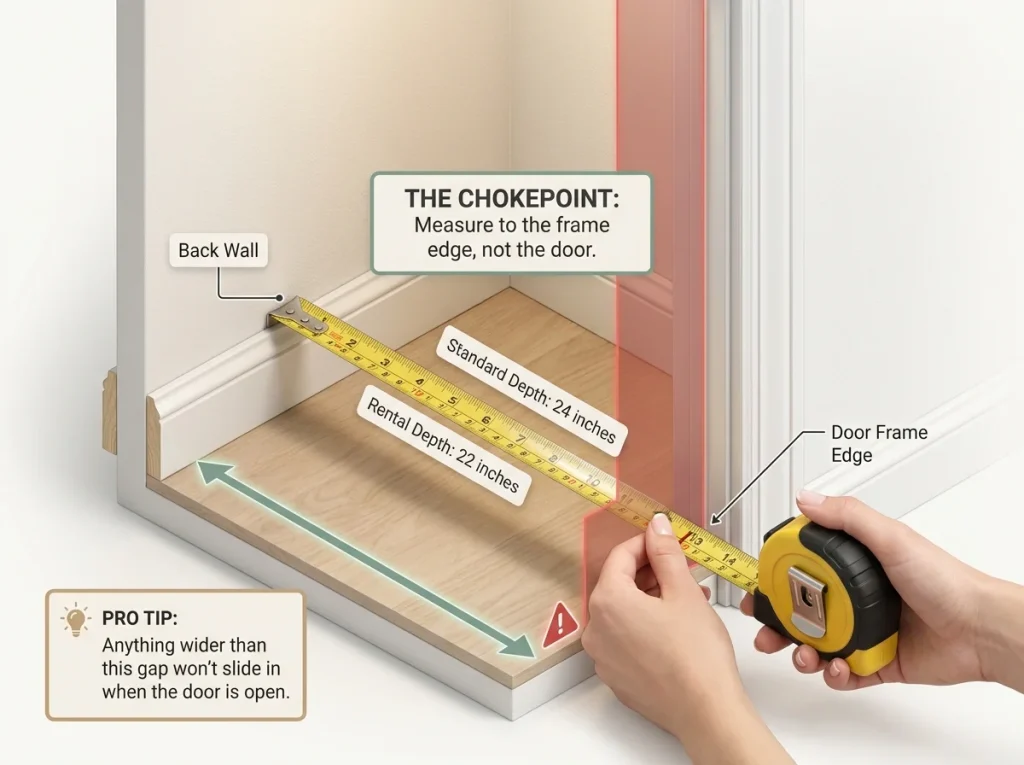
Pro tip: Measure the depth at the door frame, not at the back wall. The frame is the chokepoint — anything wider than the frame-to-wall gap won’t slide in when the door is open.
Reclaim Your Rod Space (The Hanger Math)

Slim Hangers — The Single Fastest Upgrade
Before you buy new hangers, try this: remove everything you haven’t worn in the last 12 months. If your rod still feels cramped after that purge, then it’s time for slim hangers.
The math is straightforward. Forty thick plastic hangers on a 48-inch rod take up about 20 inches of space just in hanger thickness. Forty Velvet Slim Non-Slip Hangers on the same rod take up about 8 inches. That’s 12 inches reclaimed — enough for 8 to 10 more garments. The velvet coating also solves the slippage problem: silk blouses, tank tops, and wide-neck shirts stay put instead of sliding off onto the floor.
One catch: velvet hangers don’t work well for heavy coats or structured blazers. Keep three to five wooden or padded hangers for those and use slim velvet for everything else.
Adding a Second Rod Without Drilling
If your rod-to-floor gap is 40 inches or more, a second hanging rod turns dead air into usable space. For renters, a SimpleHouseware Adjustable Closet Hanging Rod hooks onto the existing rod and hangs 13 inches below it — no drilling, no wall damage. It adjusts from 15.5 to 24 inches wide, which covers most small closets.
A cheaper option: a tension rod between the closet walls at 38 to 42 inches from the floor works if the walls are solid enough to hold the pressure. Test it with a few hangers before loading it up.
Cascading Hangers for Vertical Stacking
Cascading hooks let you hang three to five items vertically in the space of one hanger. They work well for similar items you rotate through — five work shirts, for example, or three pairs of dress pants. The trade-off is that pulling out the bottom item means lifting the ones above it. Use these for items you wear in predictable rotation, not for things you grab randomly.
Shelves, Dividers, and the Dead Space Above
The Space Above Your Rod Is Free Storage
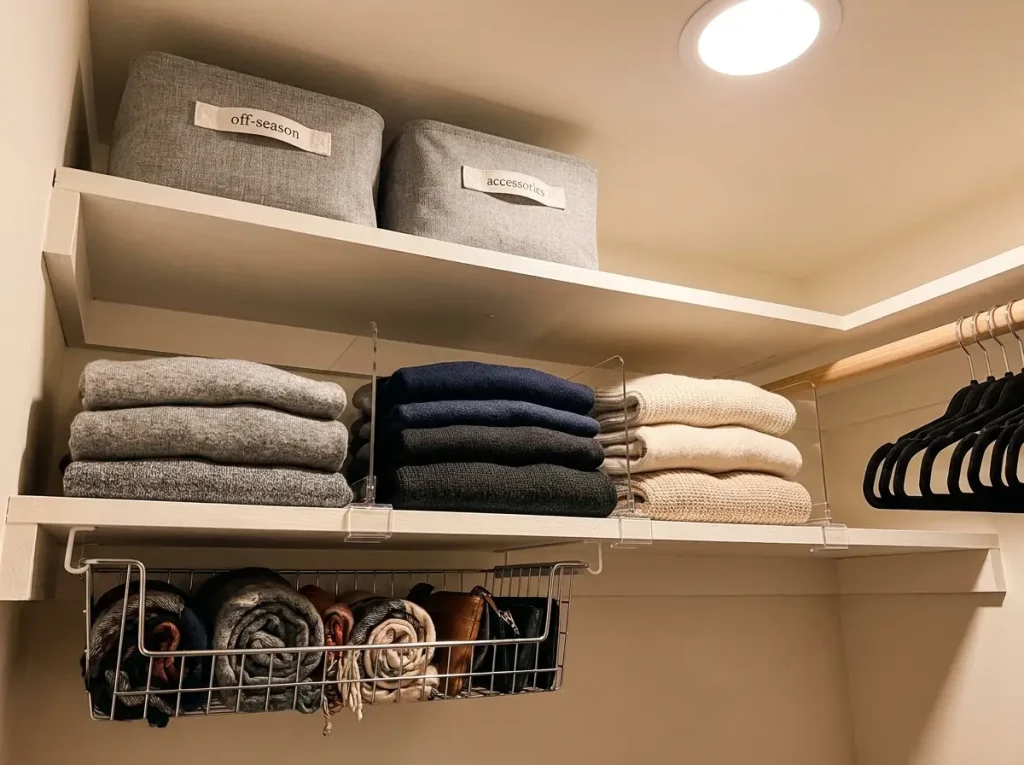
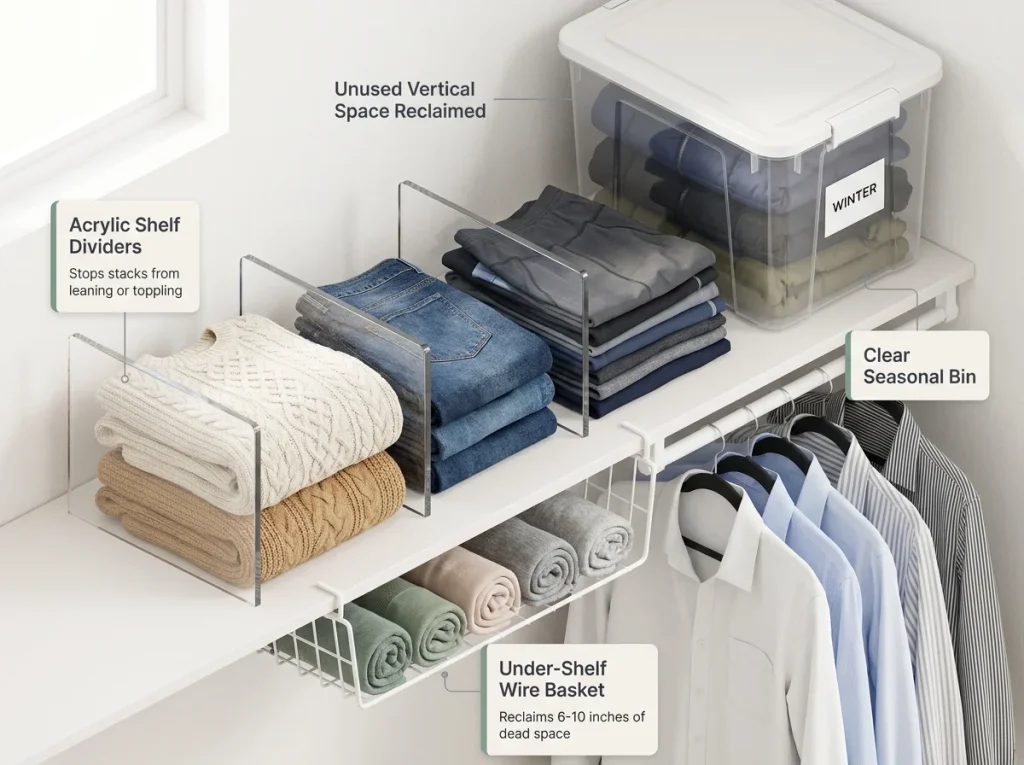
Look up. Between the top shelf and the ceiling in most small closets, there’s 12 to 18 inches of unused space. Below the hanging clothes, there’s another 18 to 24 inches of floor. That’s 30-plus inches of storage you’re paying rent on and not using.
If your ceiling gap is large enough, add a second shelf 12 to 14 inches above the existing one. Use it for items you access less often — off-season clothes in labeled bins, extra bedding, or rarely used bags. If adding a shelf isn’t an option (rental, no tools), stackable bins on top of the existing shelf accomplish the same thing without modification.
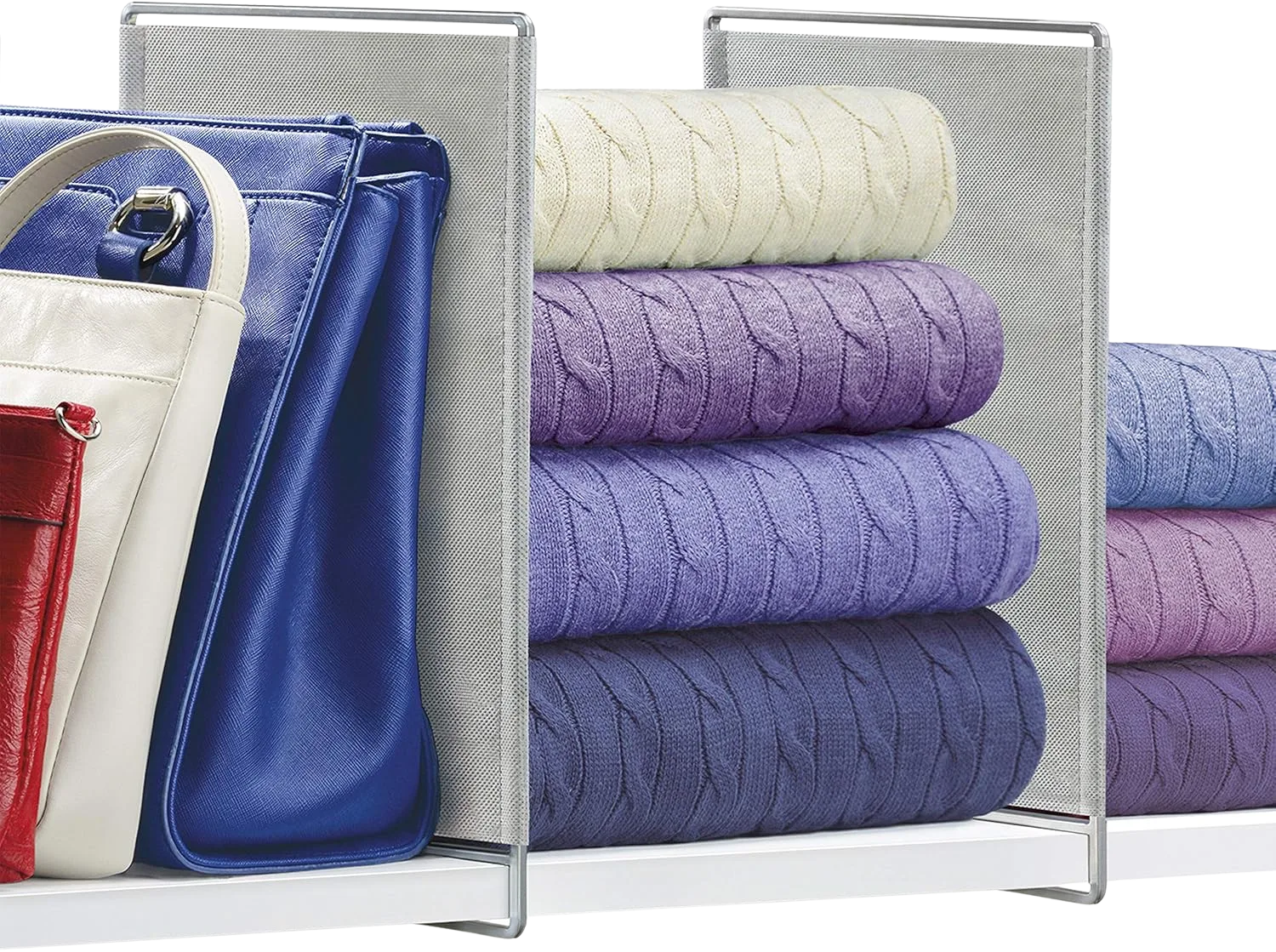
Shelf Dividers Keep Stacks from Falling
Stacking sweaters on a closet shelf without dividers is an exercise in optimism. The stack starts at five. By Thursday it’s leaning. By Saturday the bottom three have slid sideways and the whole thing looks like it did before you organized.
A tension rod placed vertically between the shelf and the one above it can work as a free improvised divider if you already own one. But for a permanent fix, acrylic shelf dividers clip onto standard three-quarter-inch shelves and create defined sections that keep stacks upright without any tools.
Under-Shelf Baskets for the Forgotten Gap
The gap between the bottom of your shelf and the top of your hanging clothes is usually 6 to 10 inches of wasted space. An Under-Shelf Wire Basket (16 × 10 × 4.5 inches) slides onto the shelf edge and creates a second tier for scarves, beanies, lightweight accessories, or folded gym clothes. No tools, no drilling, and it slides off when you move out.
If you’d rather not spend anything, a tension rod mounted under the shelf with S-hooks can hold lightweight items like scarves or belts. It won’t hold the same weight as a wire basket, but it costs almost nothing.
The Door and Floor — Storage Nobody Uses
Over-the-Door Organizers (Check Your Door First)
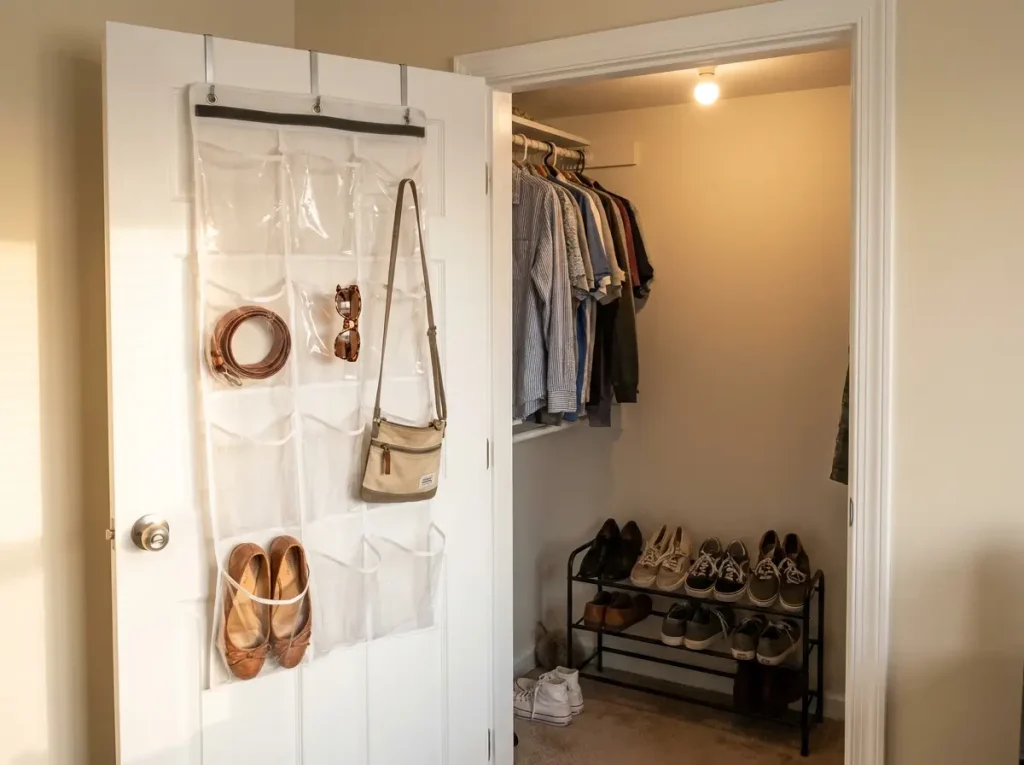
The back of your closet door can hold 20-plus accessories, shoes, or small items — but only if your door can handle the weight. Before you buy anything, check two things:
First, the door-to-shelf clearance gap. Open the door and look at how much space exists between the back of the door and the front edge of the shelf or the first row of hangers. You need at least 2 to 3 inches. If there’s less, a door organizer will push against your clothes every time the door closes.
Second, the door material. Knock on it. A hollow thud means hollow-core — common in rentals and apartments. Hollow-core doors handle about 5 to 10 pounds before the hooks start bending the door. Solid-core doors handle 25 pounds or more. If your door is hollow-core, stick with lightweight options like a SimpleHouseware Over-The-Door Hanging Shoe Organizer with clear pockets — it keeps the weight low and lets you see what’s in each pocket without rummaging.
Pro tip: If the metal hooks scratch or dent your door, add adhesive foam padding strips between the hooks and the door surface. Costs almost nothing and protects your deposit.
Floor Space Strategy Under Short Hanging Items
When your hanging clothes end at around 38 inches from the rod — shirts, blazers, skirts — that leaves 24 to 30 inches of open floor beneath them. Most people leave this empty or pile shoes in a heap.
A Stackable Shoe Rack (2-tier, expandable) fits this space at under 14 inches tall and adjusts from 24 to 44 inches wide. It holds 8 to 12 pairs on two tiers, keeping them visible and accessible. If you’d rather not buy a rack, shoeboxes stacked two high work fine — just label the short end so you can read them without pulling each one out.
For closets where the floor space is deeper than 22 inches, push the shoe rack to the back and use the front few inches for a small hamper or a tote bag for items headed to donation. Giving that bag a permanent spot means you’re always passively decluttering instead of waiting for a big purge that never comes.
The 10-Minute Monthly Reset That Keeps It Working
The Monthly Sweep (What to Check)
The “after” photo is not the finish line. A system works when it still looks good on a random Tuesday three months from now. That takes 10 minutes, once a month.
Here’s the sweep:
- Rehang anything that’s fallen to the floor
- Re-fold and restack shelf piles using the dividers as guides
- Check the door organizer — remove anything that’s been sitting there unused for a month
- Pull out one or two items you haven’t worn since the last reset
- Verify your one-in-one-out rule: if new things came in, something should go out
That’s it. Ten minutes. Set a phone reminder for the first Sunday of each month. If you skip it, the closet doesn’t collapse overnight — but skip three months and you’ll be back to the Saturday reorganization cycle.
Seasonal Rotation — One Bin, Twice a Year
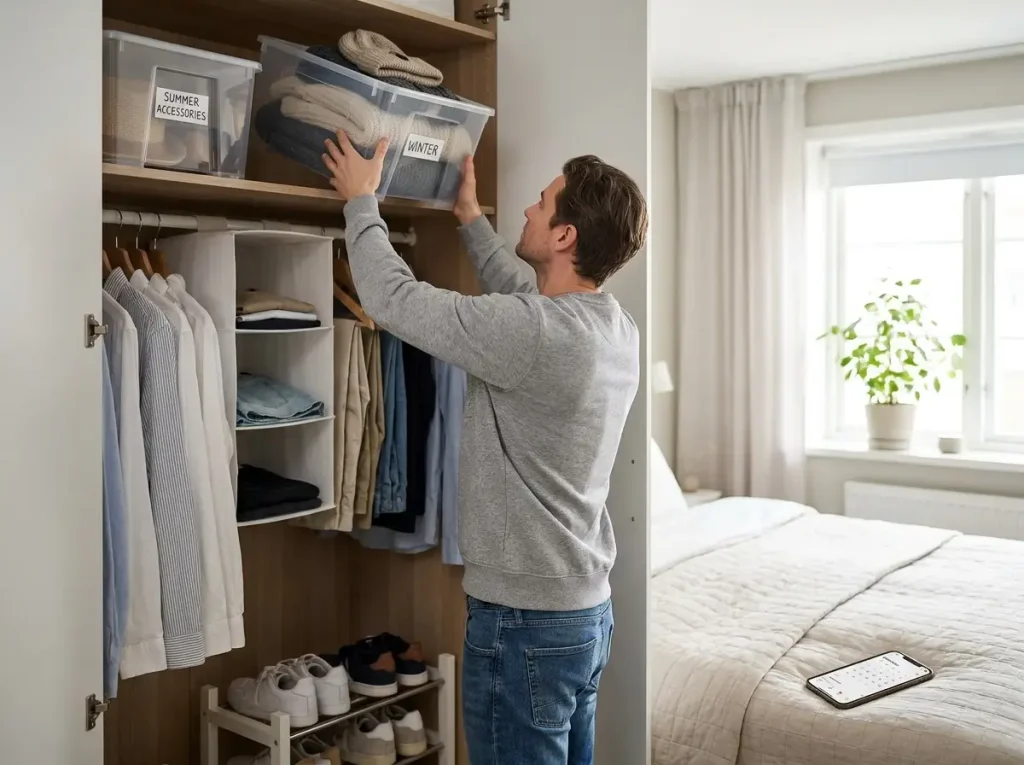
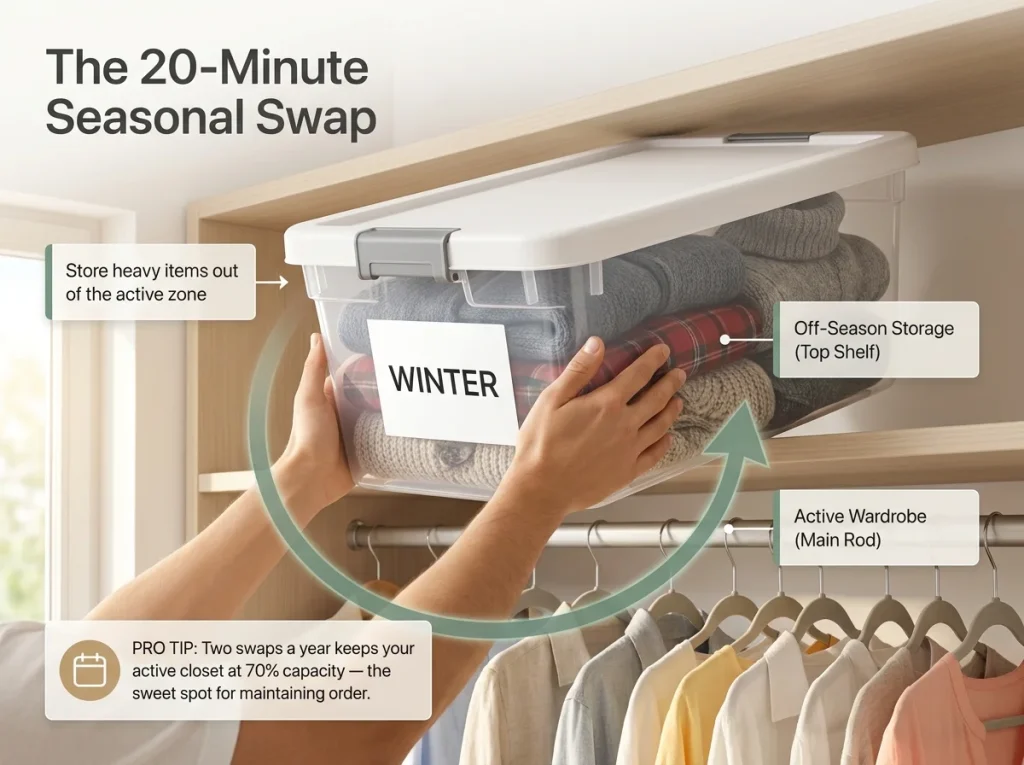
In a small closet, keeping all four seasons of clothing on one rod is a guaranteed space crunch. The fix is one labeled bin — “winter” or “summer” — that you swap twice a year.
When warm weather arrives, fold heavy sweaters, thick pants, and winter accessories into the bin and store it on the top shelf, under the bed, or in a hall closet. Replace them on the rod with lightweight items. Reverse in the fall. Two swaps a year, 20 minutes each, and your active closet stays at 70 to 80 percent capacity year-round — which is where it needs to be to function.
A shared closet makes this harder. The simplest rule: each person gets a defined section of the rod and shelf. No crossing into each other’s zone. If one person’s side is overflowing into the other’s, that’s a signal to declutter — not to negotiate for more space.
Keep Your Small Closet Working
Three things determine whether your closet stays organized or reverts within a month.
First, measure before you buy. Width, depth, rod-to-ceiling, rod-to-floor. Every product in this article includes the dimensions it needs to work. If your closet doesn’t match, the product fails — and it’s not the product’s fault.
Second, slim hangers plus a second rod reclaim more usable space than any bin, basket, or shelf insert. Start there.
Third, the 10-minute monthly reset is the difference between “organized closet” and “closet that stays organized.” Without maintenance, even a well-designed system drifts back to chaos.
Three-Month Check: Open the closet in three months and look at the floor. If there’s stuff on it, tighten your one-in-one-out rule and add a shelf divider where stacks are toppling. The floor is the first place a failing system shows symptoms.
Start tonight. Switch ten hangers. Just ten. See how much rod space comes back. Then do the rest.
Q1 How do you organize a small closet with a lot of stuff?
Remove everything you haven’t worn in 12 months first. Then measure your closet — width, depth, and the gap above the rod. Most small closets have 18-plus inches of unused vertical space that bins and a second shelf can reclaim. Slim hangers and a second tension rod free up 30 to 40 percent more hanging capacity.
Q2 What hangers save the most space in a small closet?
Slim velvet hangers at about 0.2 inches thick save the most compared to standard plastic hangers at roughly 0.5 inches. On a 48-inch rod with 40 hangers, that reclaims about 12 inches — enough for 8 to 10 more garments. The velvet coating also prevents slippage on silky fabrics.
Q3 How do I organize my closet on a budget?
Before buying anything, declutter and use what you already own — shoeboxes as dividers, tension rods as extra hanging. If you spend anything, start with slim hangers (the biggest space-saver per dollar) and shelf dividers. A full small closet overhaul can cost a fraction of a custom install.
Q4 How do you organize a closet without a dresser?
Use the floor space under short hanging items for stacking bins or a compact drawer unit. Add shelf dividers on existing shelves to create sections for folded items. Over-the-door pocket organizers handle socks, underwear, and accessories that would normally go in drawers.
Q5 How often should you reorganize a small closet?
A full reorganization shouldn’t be needed if you run a 10-minute monthly reset — rehang floor items, restack shelves, remove one or two untouched pieces. Swap seasonal items twice a year. The system maintains itself with minimal upkeep.
Disclaimer: ClutterlessNest is a participant in the Amazon Services LLC Associates Program. As an Amazon Associate we earn from qualifying purchases. This article may contain affiliate links — if you buy through them, we may earn a small commission at no extra cost to you. We only recommend products we have tested or genuinely believe in.