






















In this article
You followed a generic idea list, bought the 16-inch turntable the internet swore by, and now your counter has less usable space than before. That is the trap of small kitchen counter storage: on a tight counter, every “solution” is also a tax on the one thing you are short of, which is surface. The fix is almost never a bigger organizer. It builds on the same systems-first approach to kitchen counter organization, but adds the one thing a tight counter needs: a priority order that decides what earns counter space and what should never touch the counter at all. Here is what fits first, what waits, and what belongs on a wall or inside a cabinet instead.
Quick Answer
On a small counter, work in priority order instead of buying everything at once:
- Measure your usable run and clear it down to daily items.
- Keep the sink-side prep strip and cooktop landings empty.
- Move storage onto walls and the underside of cabinets first.
- Push remaining overflow into your cabinets.
- Add one small space-doubling product only if a gap remains.
What Actually Counts as a “Small” Kitchen Counter
Everyone thinks their counter is small. But there is a real line between a counter that is genuinely tight and one that is just cluttered, and the two problems have different fixes. Before you buy a single bin, it helps to know which one you actually have, because the priority order in this article is built for the first kind, not the second.
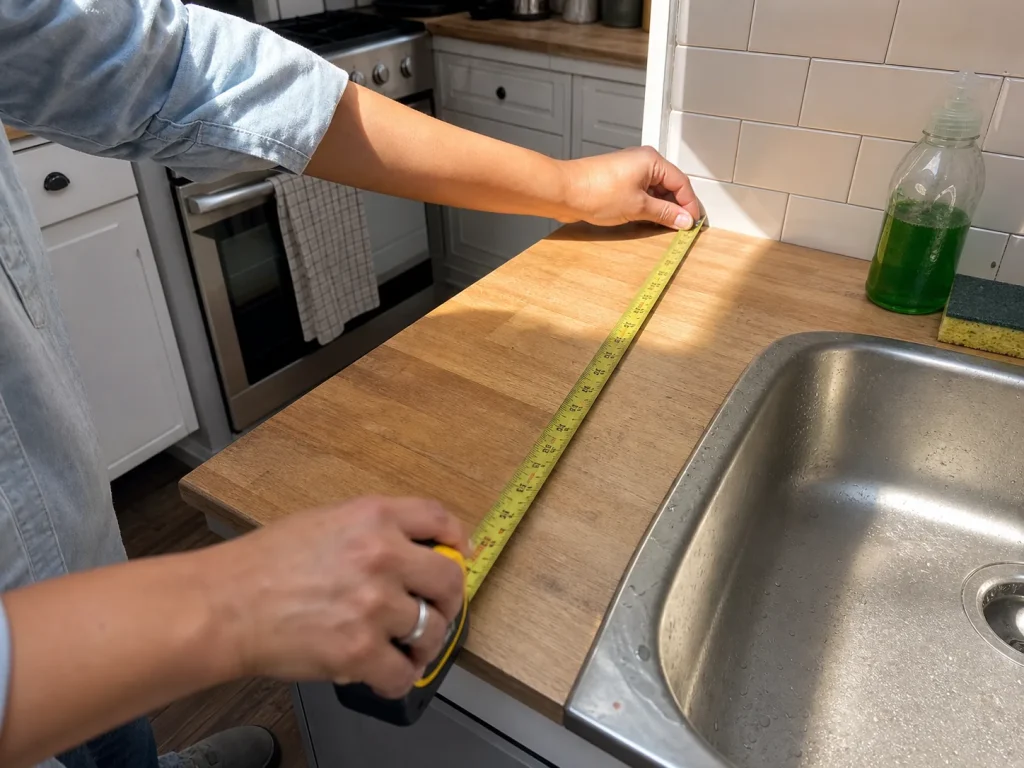
The 30-inch prep-zone test
Here is the fastest way to tell. Can you clear a continuous strip of counter beside the sink wide enough for a cutting board and a mixing bowl side by side (actually set them down and try it, because eyeballing this is how people end up with organizers that do not fit)? According to the NKBA’s kitchen planning guidelines, that continuous prep zone should be about 30 inches wide and 24 inches deep. A full kitchen is designed around roughly 158 inches of total counter frontage. If your whole run is a single stretch well under 6 feet, and you cannot free up that 30-inch prep strip without shoving things onto the stove, you are working with a genuinely small kitchen counter, whether that is a galley, a studio kitchenette, or just a tiny kitchen with one short run. That is not a discipline problem. It is a square-footage problem, and it needs a square-footage strategy.
Standard counter depth runs about 25 inches, which matters more than it sounds. Anything deeper than roughly 24 inches hangs over the front edge. So when you shop, “narrow” is a real spec you check, not a marketing word you skim past.
Why small counters overflow faster
This is the part nobody explains, and it is the reason a tidy small counter reverts so quickly. The same six or eight daily-use items that look fine spread across a 10-foot run will visibly bury a 3-foot run. It is not that you own more than other people. It is that a small counter has proportionally less buffer space per item, so the overflow shows up faster and looks worse. On a big counter, a stray mug is invisible. On a small counter, a stray mug is a third of your prep space.
Once you see it as a buffer problem instead of a willpower problem, the whole approach changes. You stop trying to organize the clutter and start clearing the counter down to what you actually use daily. Everything else needs a home somewhere other than that surface, which is exactly what the rest of this article sorts out.
The galley and shared-kitchen math
If you cook in a galley kitchen, the usable counter is smaller than the footage suggests, and the math is worth doing once. A typical galley runs 7 to 12 feet, but 42 to 48 inches of that has to stay clear just for the walkway, more if two people cook at the same time. Renters in galley-kitchen threads describe the same squeeze constantly: two people, one narrow run, and no room to set down a colander without moving something else first. So before you plan storage, subtract the walkway. The counter you can actually build on is the part that is not also a hallway.
Do the prep-zone test at your busiest cooking time, not on a clean Sunday morning. If you cannot clear 30 inches when you actually need it, that is your real counter size, and it is the number the whole plan should be built around.
The Priority Order That Earns Your First 12 to 18 Inches
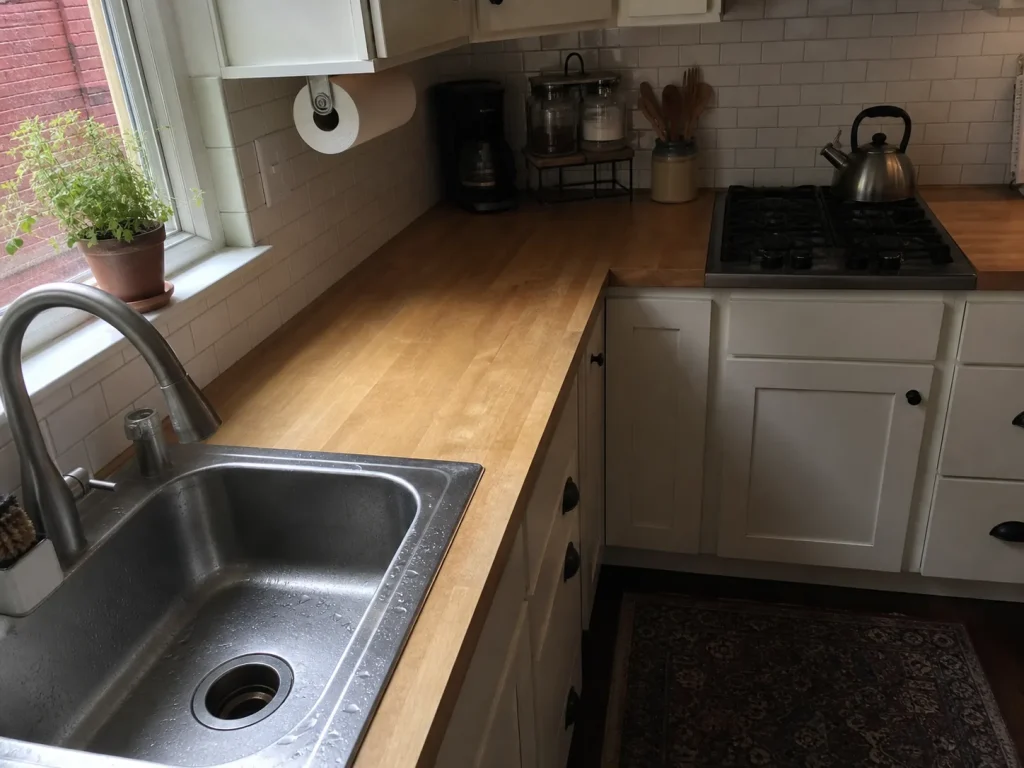
This is the section the idea lists skip. They hand you 15 things to try and let you drown, which is useless when you can only fit three of them. On a small counter you cannot do everything, so you need an order. The rule underneath all of it: the counter is prime real estate, and prime real estate goes only to what you touch every single day.
Protect the work zones first
Before anything gets a spot, two zones stay empty on purpose. The first is that sink-side prep strip. The second is the landing space beside the cooktop, where the NKBA calls for about 12 inches on one side and 15 on the other at burner height, so you have somewhere safe to set a hot pan. Those strips are not storage. They are the working surface the whole kitchen exists for, and they are always the first casualties when small-counter clutter creeps in.
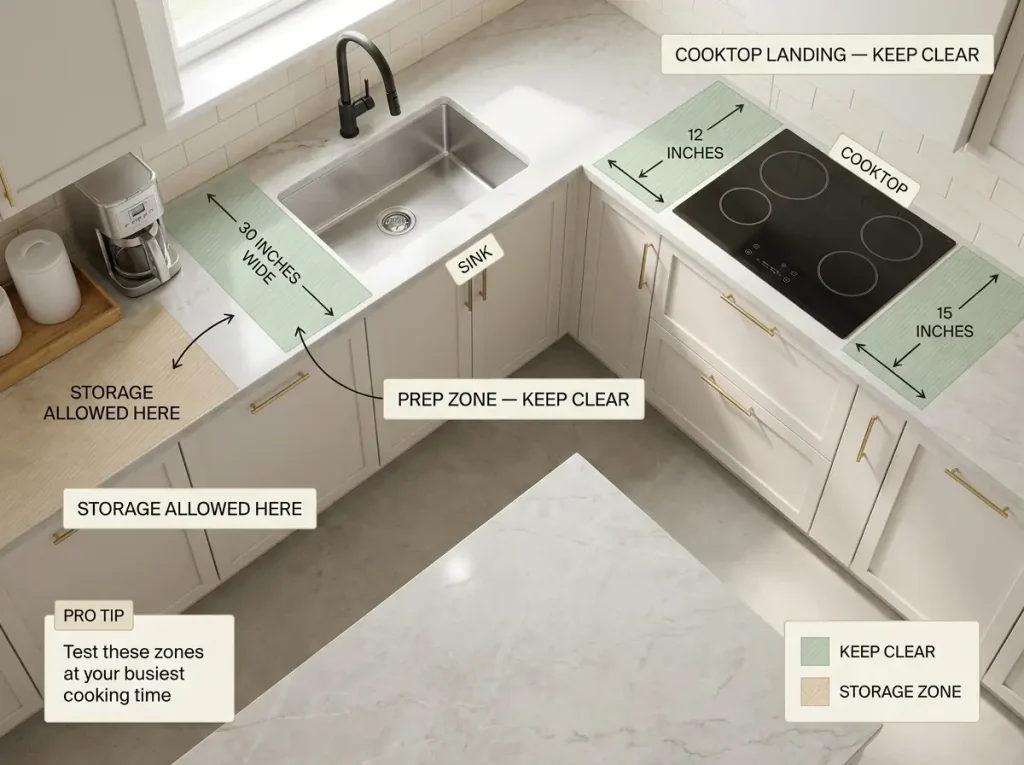
Treat these zones as fixed walls in your plan. Everything else has to fit around them, not through them. This one decision does more for a small counter than any product, and it costs nothing.
Daily-use earns the counter, nothing else
After the work zones, the only things that earn a permanent counter spot are the items you reach for every day. The coffee maker you run each morning, the knife you actually cook with, the salt you always grab. That is a short list for most people, usually shorter than what is currently out. Everything you use weekly or less goes vertical, onto a wall, or into a cabinet, which the next sections cover in order.
I used to tell people to just “corral” the rest into a nice tray and call it done. After enough small-counter reset stories in organizing threads, I switched, because a tray on a small counter is just clutter with a border. The better move is to get the non-daily items off the surface entirely and reserve the tray, if you use one, for the two or three daily things that would otherwise scatter.
Why cabinets beat products
Here is the part that saves you money. Before you buy a single new organizer, push overflow into the storage you already own. A certified cabinet shelf holds around 15 pounds per square foot, and a full overhead unit averages roughly 600 pounds of capacity. No no-drill wall mount will ever come close to that. So the load-bearing order is simple: cabinets first, walls second, adhesive last, and new counter products only for what genuinely has nowhere else to go.
This is also why the generic-list approach backfires. You bought the standard-sized organizer a listicle recommended, set it on the counter, and it ate more surface than it freed. The priority order exists to stop exactly that. New products are the last step, not the first, and by the time you reach them there is very little left to store. If you are reallocating overflow, push it into your cabinets first using the same measure-the-depth approach that keeps cabinets from becoming their own black hole.
Vertical and Wall-Mounted Storage That Costs Zero Counter Footprint
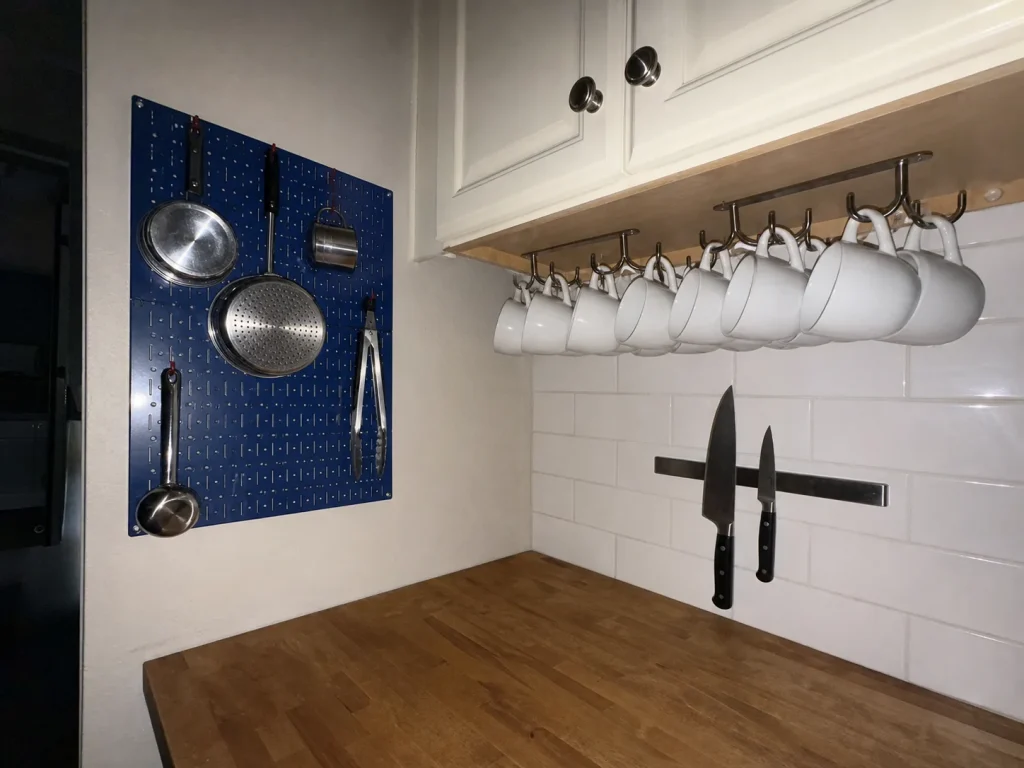
The wall above your counter is the most wasted space in a small kitchen, and it is where you win the most inches for the least money. Every knife block, utensil crock, and mug that moves to the wall hands you back counter you did not know you had. By definition, wall and under-cabinet storage costs zero counter depth, which is why it sits near the top of the priority order.
Walls cost zero counter footprint
Start with the single highest-leverage swap: the knife block. A block takes up several square inches of prime surface for no reason a wall could not serve better. A magnetic knife strip puts those same knives on the wall and costs zero counter depth. The Ninonly 12 Inch Magnetic Knife Strip mounts to the wall and holds a working set of knives within easy reach, though it is worth noting the strongest magnetic pull is meant for kitchen knives, not your heaviest cleaver, so keep the truly heavy blades in a drawer.
For pots, utensils, and tools, a pegboard turns a bare stretch of wall into hanging storage. It is the same move that rescues a kitchen with almost no counter at all, just scaled down. If your counter is just tight rather than nonexistent, the same wall-mounted approach that rescues a no-counter kitchen works even better, because you are only moving a handful of things, not staging your entire kitchen on the wall.
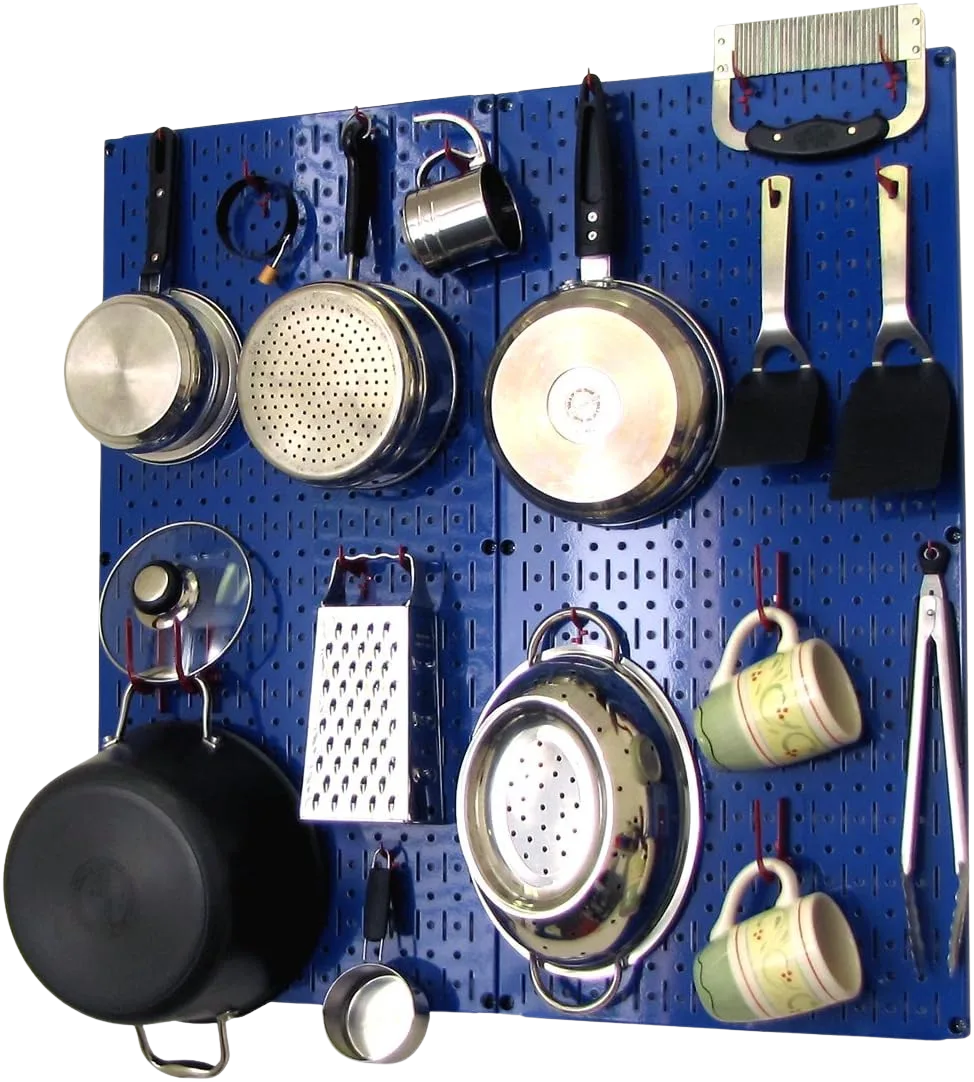
Under-cabinet dead space
Look up under your existing cabinets. The underside of a cabinet shelf is free real estate that most people never use, and it costs nothing on the counter. Mugs are the easiest win here, because they are the item that multiplies fastest and takes up the most surface for how little they matter day to day. The FOMANSH Mug Rack Under Cabinet hangs a row of mugs from the underside of a cabinet with no drilling, clearing a whole cluster off the counter in one move. The one caveat: measure the clearance between your cabinet bottom and the counter first, so a hanging mug does not block the outlets or the backsplash you actually use.
The weight ceiling nobody mentions
Here is where wall storage goes wrong. That sleek no-drill floating shelf you are eyeing for spice jars is fine for a few light jars and nothing more. Command’s own weight-limit guidance keeps most adhesive shelving under 5 pounds, and even the brand’s strongest picture-hanging strips top out around 20 pounds for one very specific mounting pattern. So wall storage is for your light daily items, not your cast iron. Match the load to the mount, and you will not walk into a shelf on the floor at 2 a.m. The same no-drill weight rules that apply here also govern vertical storage across a small apartment, so it is a habit worth building once and reusing everywhere.
Space-Doubling Picks Sized for a Tight Counter
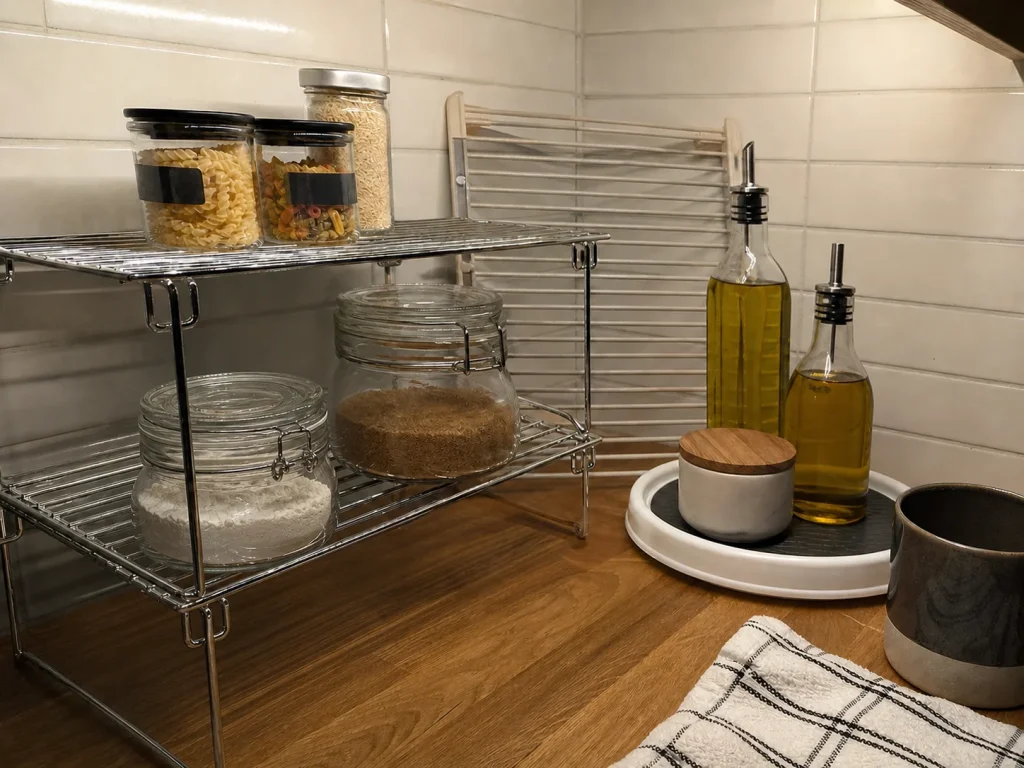
For the items that truly must stay on the counter, make that space work twice. There are only two honest ways to do it on a small counter: go up within the footprint you already have, or use something that disappears when you are not using it. And the trick with any of them is to buy small, because the standard-size version is what buried your counter in the first place.
Go up within the footprint
A shelf riser does not shrink its own footprint, but it doubles the usable space above it. A second tier over your canisters or mugs means the same square inches now hold twice as much, which is exactly the point when you have no room to spread out. The Deco Brothers Stackable Cabinet Shelf Organizer adds that second level in chrome and stacks in a pack of two, so you can go up over a corner without widening anything. It is one of the cheapest organizers you can buy, which makes it an easy first pick. Just leave a little finger clearance on the top tier, or you will scrape your knuckles reaching for the back row.
Buy the mini version, not the standard one
Remember the 16-inch turntable from the top of this article, the one that started the whole problem? This is where you avoid repeating it. A turntable is genuinely useful for splitting oils and spices in a corner, but the standard size claims a zone as big as a small cutting board. The Copco Non-Skid Turntable 9-inch is the mini version, sold as a set of two, sized for a tight corner instead of a full lazy-susan footprint. Two small ones let you separate cooking oils from everyday spices without surrendering a quarter of your counter. The principle is the same one that governs matching a turntable to the zone instead of buying the biggest one in a pantry: size first, then buy.
The disappear-when-idle pick
The other way to double a footprint is to make it temporary. A dish rack is the worst permanent offender on a small counter, because it claims a 14-inch zone all day for a job that happens for 20 minutes. A folding rack fixes that. The THANSTAR Collapsible Dish Drying Rack sits up during cleanup, then folds flat and tucks away, so it only exists when you need it. Because a self-draining rack dries out flat instead of holding a puddle, you also skip the standing moisture and the mold ring a permanent tray leaves behind on the counter. That is real space-doubling for a counter that cannot spare a permanent 14 inches.
One honest caveat on all of this. If a corner is already working and clear, do not add a product to it just because you can. Empty counter beats a well-organized gadget you did not need. The anti-sell rule holds even here: sometimes the best small-counter upgrade is buying nothing and keeping the surface bare. If you want to compare how much footprint each counter organizer really costs before you commit, that trade-off is worth reading through first.
Before buying any counter product, set an empty cereal box where it would go and live with it for two days. If the box gets in your way during normal cooking, the product will too, no matter how well it organizes. Cardboard is a free stand-in that saves a return.
A Small-Kitchen Appliance Strategy
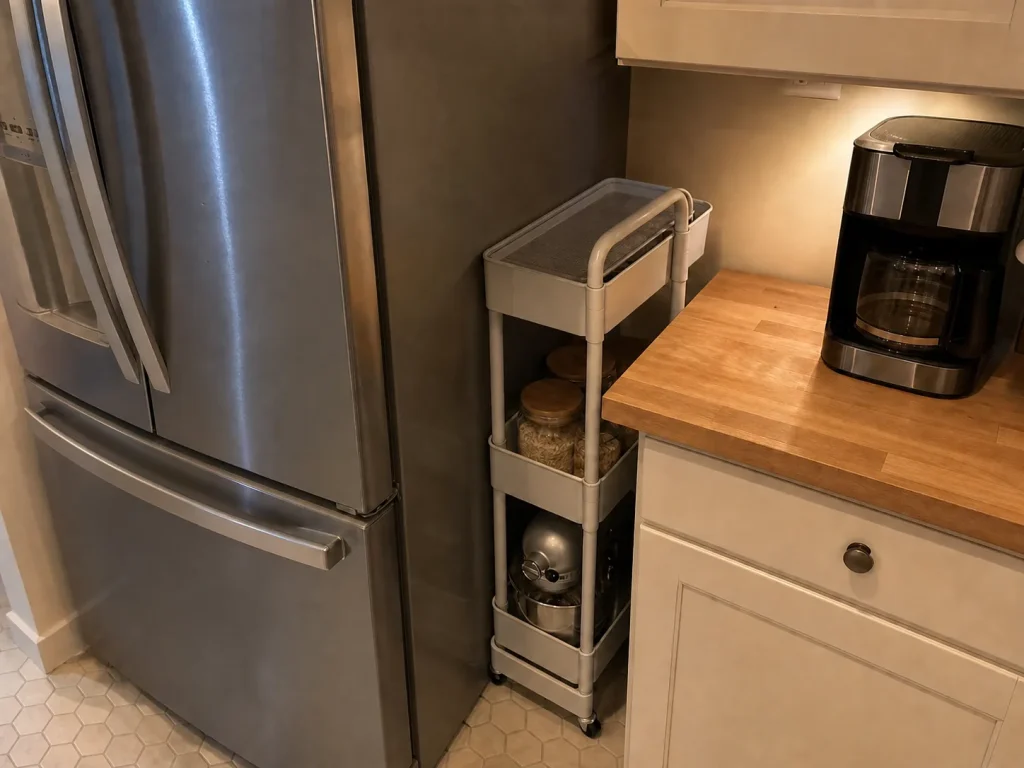
Appliances are where small counters really lose. The toaster, the coffee maker, the stand mixer, the air fryer: four items and your counter is gone. The move here is not a fancier organizer. It is deciding what earns permanent residence and giving everything else a home off the counter, plus a way to borrow surface only when you need it.
The daily-use test for appliances
Apply the same test the whole article runs on. Only the appliance you use every single day earns a permanent counter spot. The coffee maker you run each morning stays. The stand mixer that comes out twice a month does not, no matter how much it “belongs” in a kitchen (and the bread machine you used twice last year is not even a question). That mixer living on the counter is the single most common small-counter mistake, because it is paying daily rent for monthly use. Stow the occasional appliances in a cabinet or a pantry overflow zone, which ties straight back to the cabinets-first rule from the priority order. If a few truly have to stay out, group them into one appliance garage, a single corner or a lidded cubby that hides the toaster and blender behind one door, and where you can, swap a full-size unit for a compact appliance, since mini appliances hand back the depth a small counter cannot spare. If deciding what stays out feels hard, the same keep only what earns its spot logic that drives minimalist kitchens is a good gut check.
Borrowed counter with a rolling cart
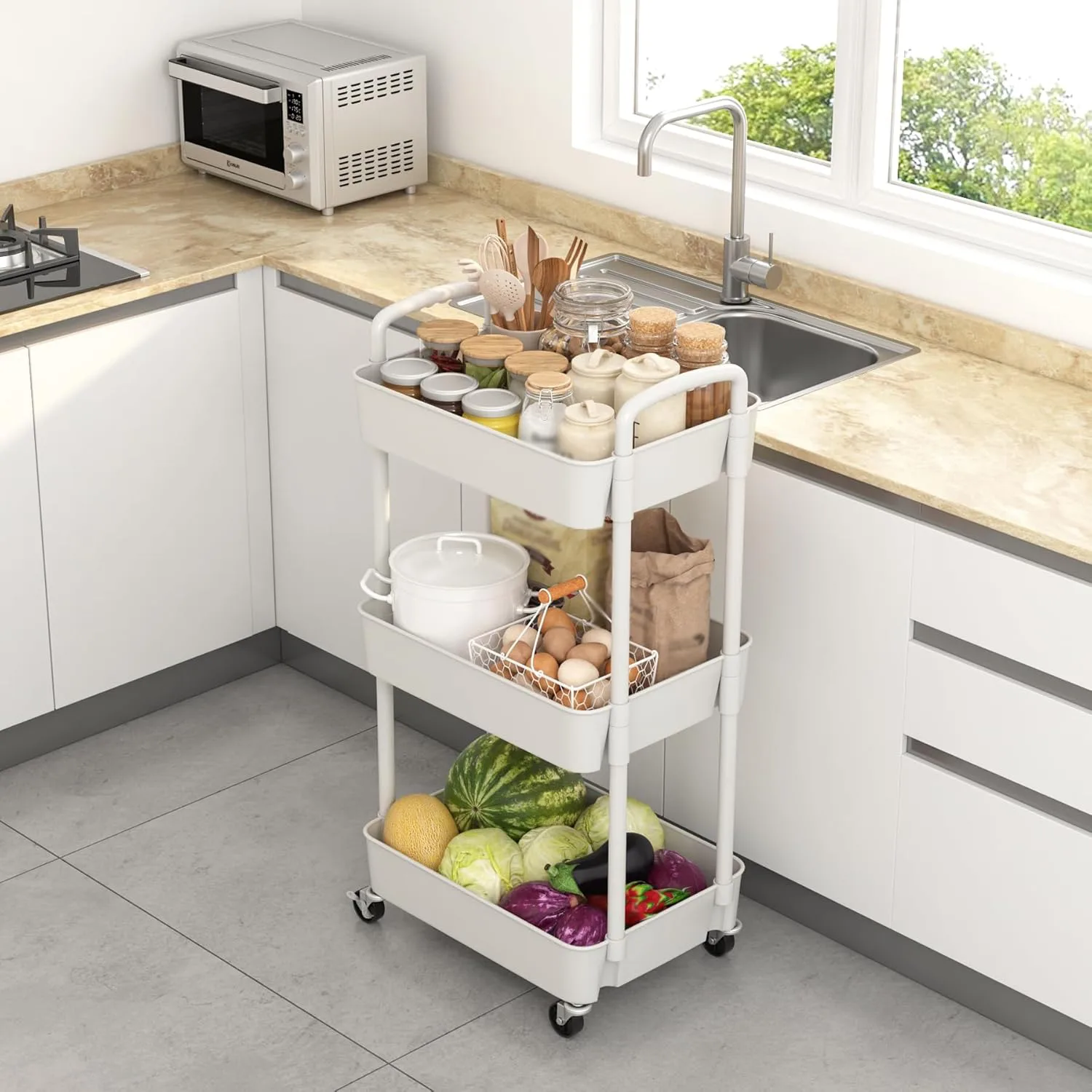
Here is the fix for the real problem behind appliance clutter, which is that you occasionally need more prep surface than you have. Instead of permanently sacrificing counter, borrow it. A narrow rolling cart slides into a gap a fixed cabinet never could fit, gives you temporary landing space during cooking, then rolls out of the way afterward. Renters bring these up constantly as the answer to “I need 10 more inches of counter for 20 minutes, twice a day.”
Give every appliance you stow a “home shelf” that is easy to reach, not the back of a deep cabinet. If pulling the mixer out is a two-minute excavation, it will migrate back to the counter within a week. The stow only sticks if retrieving the appliance is genuinely easy.
Renter-Safe No-Drill Solutions and the Daily Reset

Renters get told “just mount it” as if that is free. It is not, when you want your deposit back. The good news is that no-drill versions of nearly everything above exist. The catch nobody mentions is weight, because deposit-safe and load-bearing are not the same thing. And then there is the part that actually keeps a small counter clear: the reset.
No-drill versions of everything
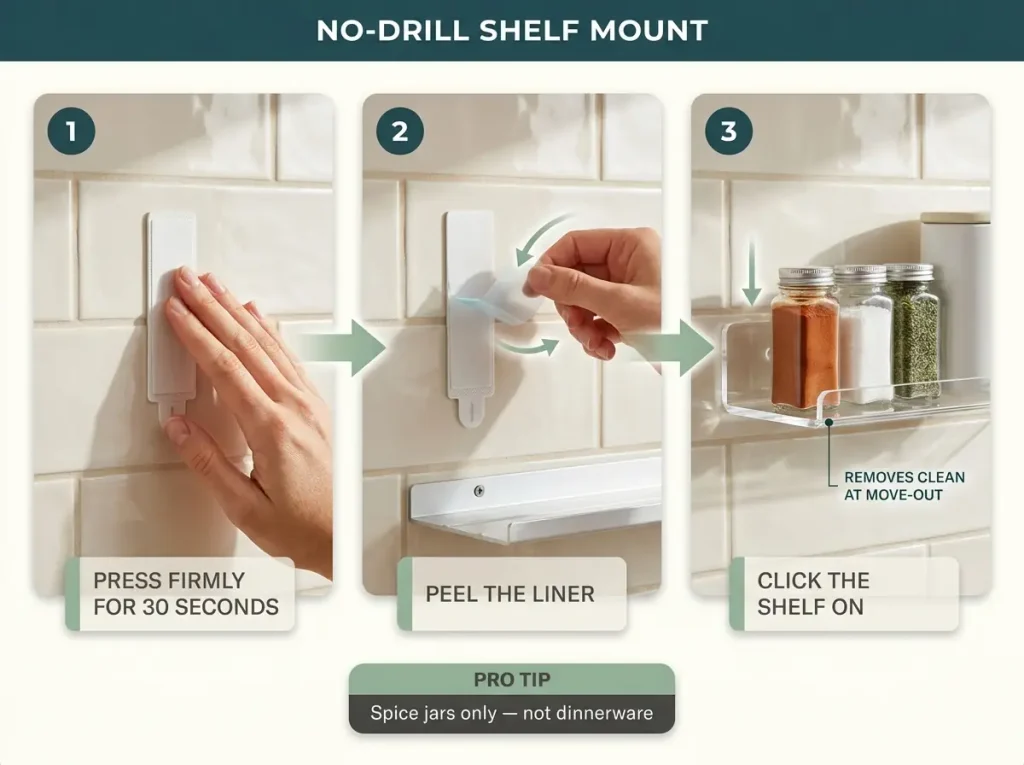
Almost every solution in this article has a deposit-safe twin. Command-strip shelves replace screwed-in ones, adhesive hooks replace anchors, tension rods work inside cabinets with no hardware at all, and a pegboard can lean against the wall or sit on a shelf instead of being mounted. It is the same deposit-safe, no-drill approach that works inside rental cabinets, just applied to the counter and the wall above it. The lowest-commitment vertical option is a set of removable acrylic shelves. The 2-Pack No-Drill Acrylic Wall Shelves mount with adhesive strips, come off clean at move-out, and are sized for spice jars and small canisters rather than dinnerware, which is exactly what you want them holding anyway.
Deposit-safe isn’t the same as load-bearing
This is the gap most renter advice leaves open, and it is worth stating plainly: renter-safe and load-bearing are two different questions, and you have to answer both. A shelf can be perfectly removable and still be the wrong place for a stack of plates. Independent testing from Consumer Reports found that adhesive strips are not rated to carry a loaded shelf, which matches Command’s own numbers. So when you plan renter storage, decide the counter-inches and the weight in the same breath. This shelf holds spice jars, not a cast-iron pan. That single habit prevents the most common no-drill failure, which is a mount that gives way a month later and takes your dishes with it.
The two-minute nightly reset
Here is the maintenance step that makes everything else survive past the first week. A small counter has no buffer, so it does not drift toward messy over a month the way a big one does. It buries itself in a day. The fix is a two-minute reset every night: everything back to its off-counter home before you go to bed. Not a deep clean, just a return-to-zero.
And the reset only works because you did the priority order first. Every item already has a home that is not the counter, so putting things away takes seconds instead of decisions. That is the whole system paying off. A counter where everything has a place resets in two minutes. A counter where nothing has a place never resets at all, which is why the “after” photo you saw on a listicle looked nothing like your kitchen two weeks later.
Conclusion
Three things carry the whole approach. Measure before you buy, because if you cannot clear a 30-inch prep strip by the sink, you are working small and the priority order applies. Treat the counter as prime real estate, so daily-use items only, and everything else goes vertical, onto walls, or into cabinets first. And buy small and buy fold-away, the 9-inch turntable and the collapsing rack, never the standard size that eats more than it frees.
In three months, look at what has crept back onto the counter. That item is telling you it needs a real off-counter home, not a bigger organizer to sit in.
Start with the sink-side prep strip. Clear those 30 inches, keep them clear for a week, and then move outward from there.
Frequently Asked Questions
01What counts as a small kitchen counter?
If you cannot clear a continuous 30-inch strip beside the sink for prep, the NKBA’s recommended prep zone, you have a genuinely small counter, not just a cluttered one. Most small counters are a single run well under 6 feet.
02How do I get more storage without losing counter space?
Move storage off the surface entirely. Walls, the underside of cabinets, and inside cabinets all cost zero counter footprint. Only add a product on the counter itself for daily-use items you cannot relocate, and size it small.
03What is the best no-drill kitchen counter storage for a rental?
Command-strip acrylic shelves, a magnetic knife strip, adhesive under-cabinet racks, and tension rods are all deposit-safe. Just respect the weight limits, since most adhesive shelving holds only a few pounds, so keep it to light daily items.
04Where do I start if everything won’t fit on my counter?
Start with the priority order. Protect the sink-side prep strip and cooktop landings first, keep only daily-use items on the counter, and push everything else vertical or into cabinets before buying anything new.
05Do shelf risers actually save counter space?
A riser does not shrink its own footprint, but it doubles the usable space above it, adding a second tier over canisters or mugs on the same square inches. On a small counter that is the point: go up, not out.