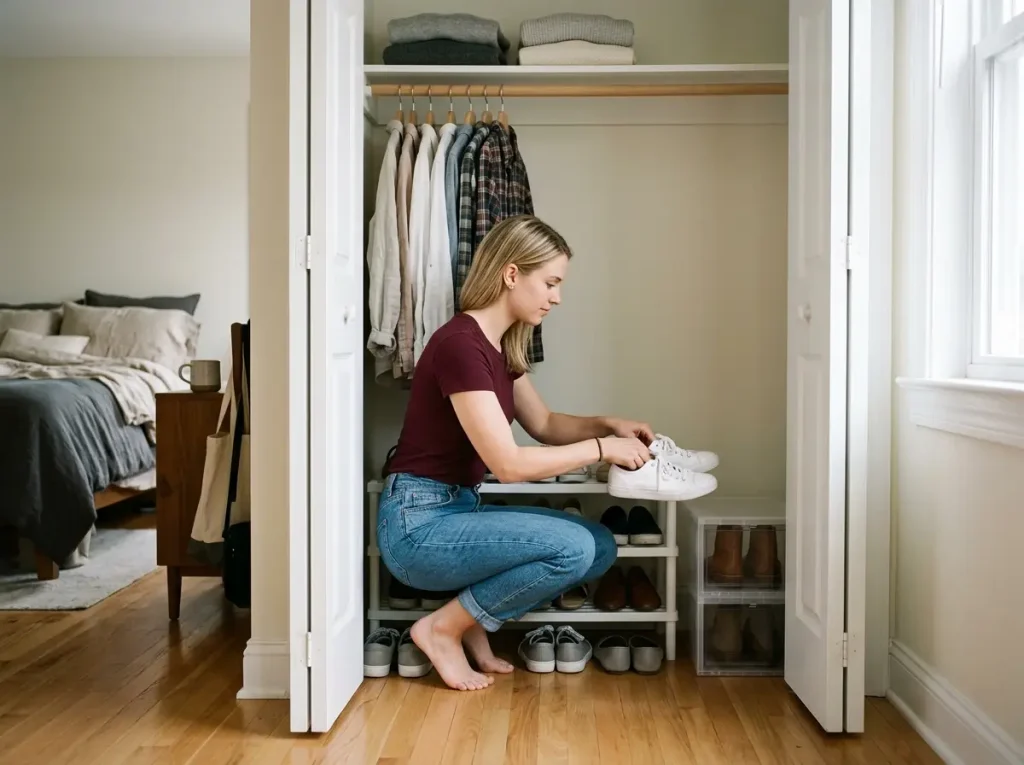
The over-the-door organizer everyone recommends? I hung one on a bedroom closet door, loaded it up, and that night the door wouldn’t latch, because the steel hooks added just enough height to catch the frame. A friend had the opposite problem: hers pulled loose from a hollow-core rental door by week three. After measuring dozens of rental closets and buying both the racks that overflow and the ones that last, I’ve learned the best shoe organizers aren’t a single product; they’re whatever matches your door, your closet depth, and the number of pairs you actually wear. Here’s how to pick the right type for your space, and which popular picks quietly fail.
Quick Answer
The best shoe organizer is the one that fits your space, your door, and how many pairs you actually wear. Match the type to your situation:
- Over-the-door pockets — spare flats and sneakers, solid doors only
- Slim tiered rack — daily pairs on a closet floor or by the door
- Clear drop-front boxes — the pairs you rarely reach for
- Shoe slots — double a shelf you already own
- Under-bed box — seasonal boots and off-season pairs
- Slim cabinet or bench — a tight entryway
How to Choose the Best Shoe Organizer for Your Space
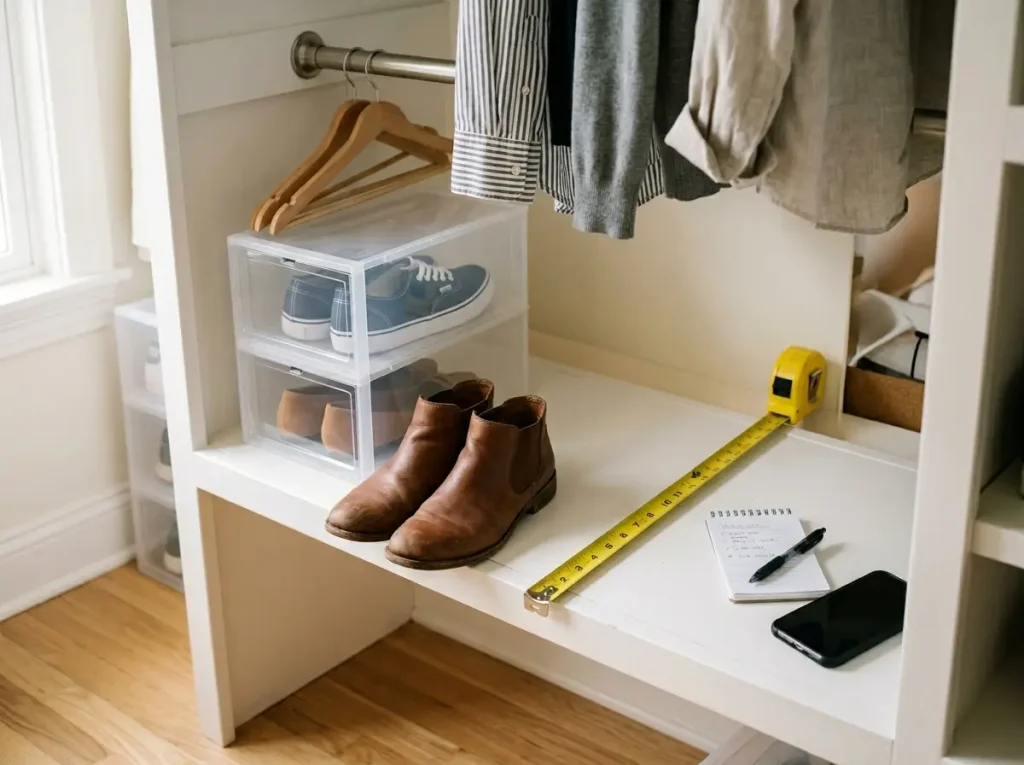
Almost everyone shops the product first and the space second. They see a 36-pair rack with great reviews, buy it, and then discover it hangs three inches into the closet doorway. Reverse the order. Four answers decide which organizer actually works for you, and none of them are about the product.
First, how many pairs — and split that into the three to five you wear every week versus everything else. Second, which zone are you organizing: a closet floor, an entryway, the space under your bed, or the back of a door. Third, what kind of door you have, because that one detail makes or breaks the most-recommended option on every list. Fourth, do you rent or own, which decides whether drilling is even on the table.
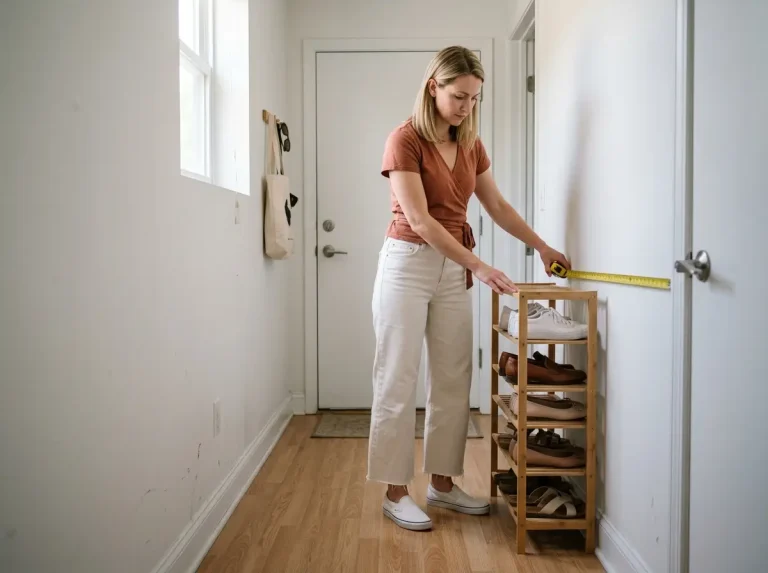
The measurement people skip is depth. A standard reach-in closet depth runs 24 to 26 inches, but rental reach-ins often drop to about 22 inches, and the practical floor is even less once you account for the door track. I measured one rental closet at 21.5 inches. A rack built for a 24-inch shelf left every toe poking past the frame, and the bi-fold door wouldn’t close over it. Shelves shallower than about 16 inches can’t hold most shoes heel-to-toe at all, so the toe ends up in the aisle. Measure the depth before you fall in love with anything.
There’s a reason organizers obsess over one feature: visibility. Professional organizers push the same rule (at least one transparent side on any container) because if you can’t see the pair, you forget you own it and stop putting it back. That single principle is what keeps a shoe system alive past month one. It’s also why “current season at eye level, everything else boxed and out of sight” beats any color-coded grid.
The last thing to internalize before you buy: most people need two solutions, not one. You need fast access for the pairs you wear constantly and deep storage for the rest. Treating all your shoes the same (cramming daily sneakers and once-a-year heels into the same rack) is the quiet reason the whole thing reverts. If you want the room-by-room version of this, our whole-home shoe organization system walks through it, and the sibling guide on matching each pair to a zone goes deeper on small-space layouts.
Here’s how the main types stack up before we get into specific picks.
| Organizer Type | Best For | Fits | Renter-Friendly |
|---|---|---|---|
| Over-the-door | Spare flats and sneakers, zero floor space | Solid doors with frame clearance | Solid doors only |
| Tiered / stackable rack | Daily pairs on a closet floor or by the door | Slim racks under 12 in deep | Yes |
| Clear drop-front boxes & slots | Pairs you rarely wear, stacked to save space | Closet shelves 16 in deep or more | Yes |
| Under-bed box | Seasonal and off-season pairs | Beds with 5 in or more of clearance | Yes |
| Bench or slim cabinet | An entryway and a few daily pairs | Tight walls, 9 in or more of depth | Freestanding |
Measure your closet depth and the gap between your door and its frame before you open a single product page. Write both numbers on your phone. Ninety percent of returned shoe organizers are returns because of fit, not quality, and fit is the one thing the reviews can’t tell you.
Over-the-Door Shoe Organizers and the Door Problem Nobody Checks
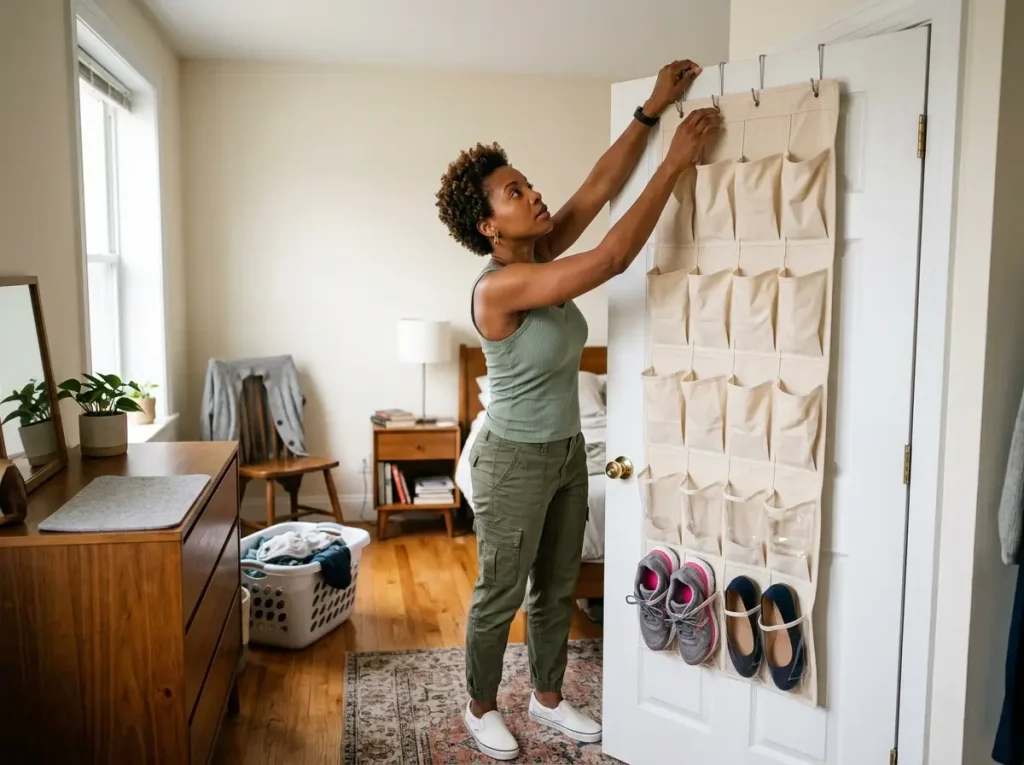
This is the type that lands at number one on every list, usually with no warning attached. It deserves a spot (it’s the only option that adds storage without touching your floor), but it fails more often than any other category, and always for the same two reasons.
How over-the-door organizers actually work
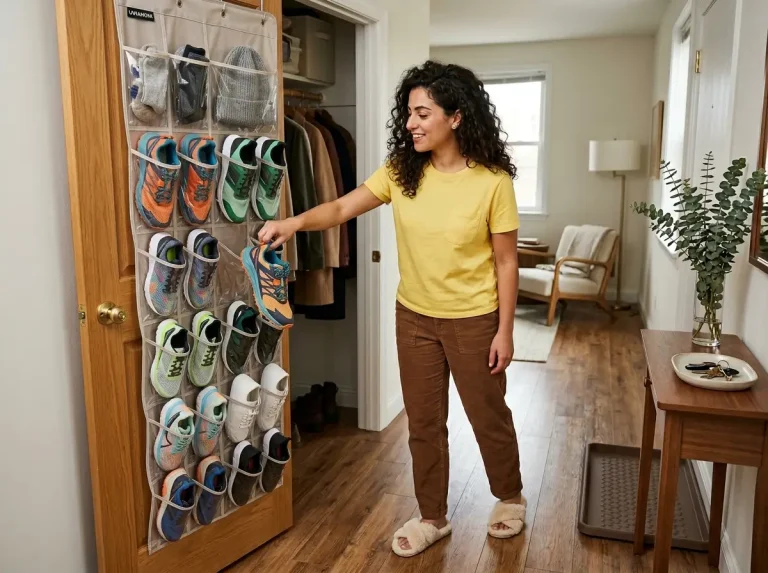
A panel of fabric pockets or wire tiers hangs from steel hooks that loop over the top edge of a door. A standard 24-pocket panel holds roughly a dozen pairs of flats and sneakers, and it costs you zero square feet of room. The catch is what fits: those pockets are sized for low-profile shoes, around five to six inches wide. Boots, chunky sneakers, and most men’s sizes won’t go in, or they go in and sag the whole panel forward.
The hollow-core problem (and the tap test)
Most interior doors in apartments and newer builds are hollow-core — a thin skin over a cardboard honeycomb with, as one forum put it, “no meat to the door.” A standard hook has nothing solid to bite into, so it pulls out under light weight. Load fifteen pounds of shoes onto it and you’ll hear the panel slide down the door at the worst possible moment.
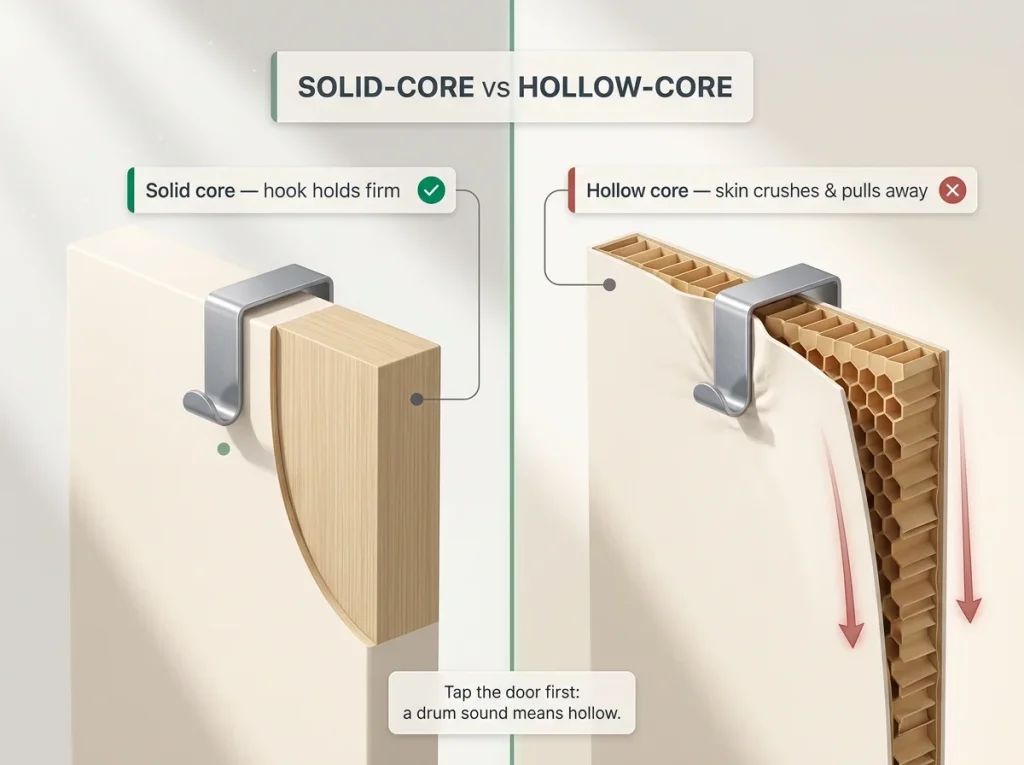
The fix takes ten seconds: tap the door. A solid, dull knock means solid-core, and you’re fine. A hollow, drum-like sound means hollow-core, so skip the steel hooks or switch to a fastener that clamps rather than hangs. Honestly, on a true hollow-core door, the cleaner move is to hang the organizer from a spare closet rod instead and avoid the door entirely.
The clearance problem and renter fixes
Even on a solid door, the hooks add about an inch over the top edge. If your door-to-frame gap is tight, the door won’t latch. That was my bedroom-door disaster, and now I check the gap before I commit. A felt furniture pad between each hook and the door also stops the hooks from scraping the paint, which protects your deposit. For the deeper version of all of this, including hook-clearance math and pocket sizing, we put together the full over-door playbook.
When the door cooperates, the clear-pocket SimpleHouseware Over-the-Door Organizer is the pick I keep coming back to, because the see-through pockets mean you actually use what’s in them.
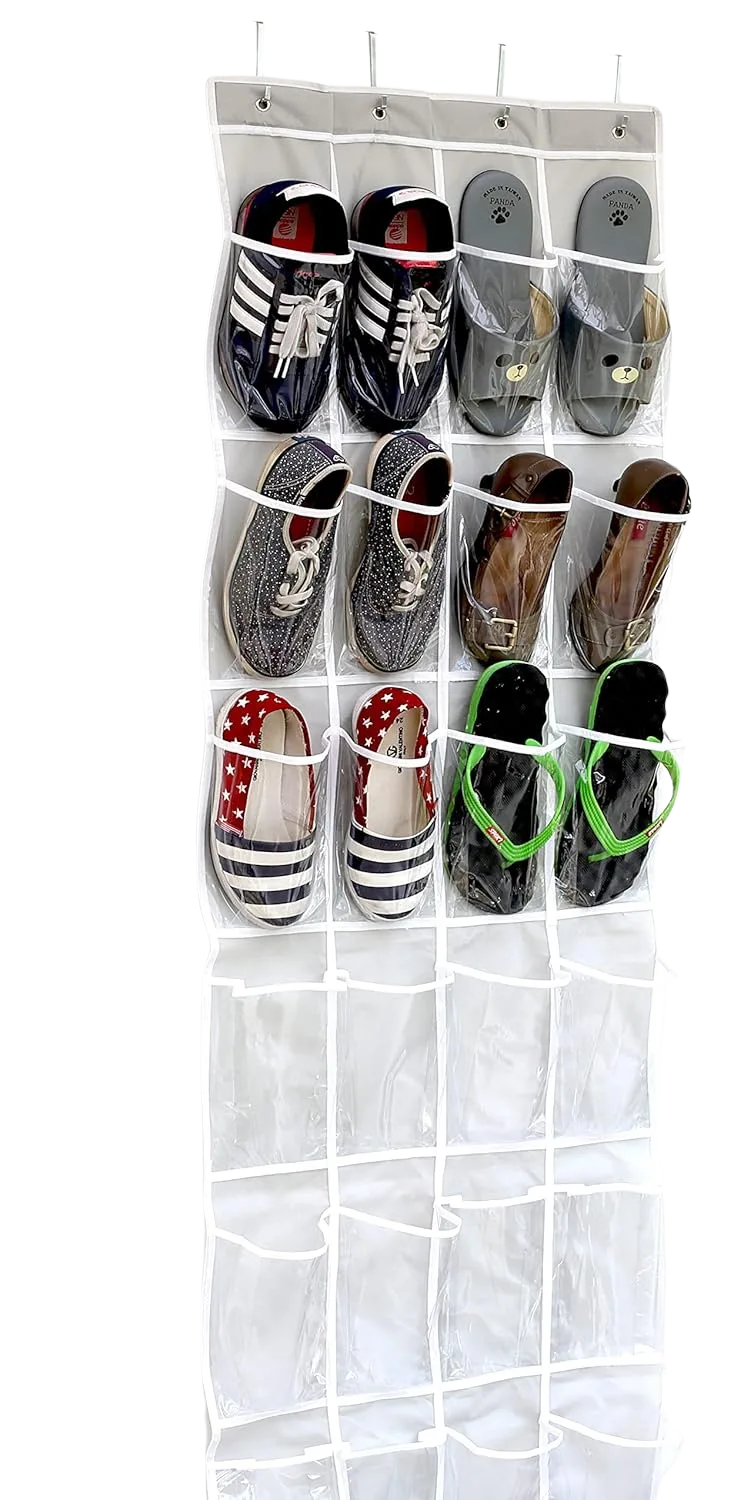
On a tighter budget, the Gorilla Grip 24-Pocket Organizer does the same job with breathable mesh pockets that air out gym shoes better than solid panels, though the mesh is less rigid, so heavier shoes tug it forward. And if you own more pairs than any standard panel can hold, the MISSLO 10-Tier Wide Pocket Organizer takes up to 30 pairs with wider openings that actually fit chunkier shoes, which makes it the overflow option for a large collection behind a solid door.
Stackable and Tiered Racks for Closet Floors and Entryways
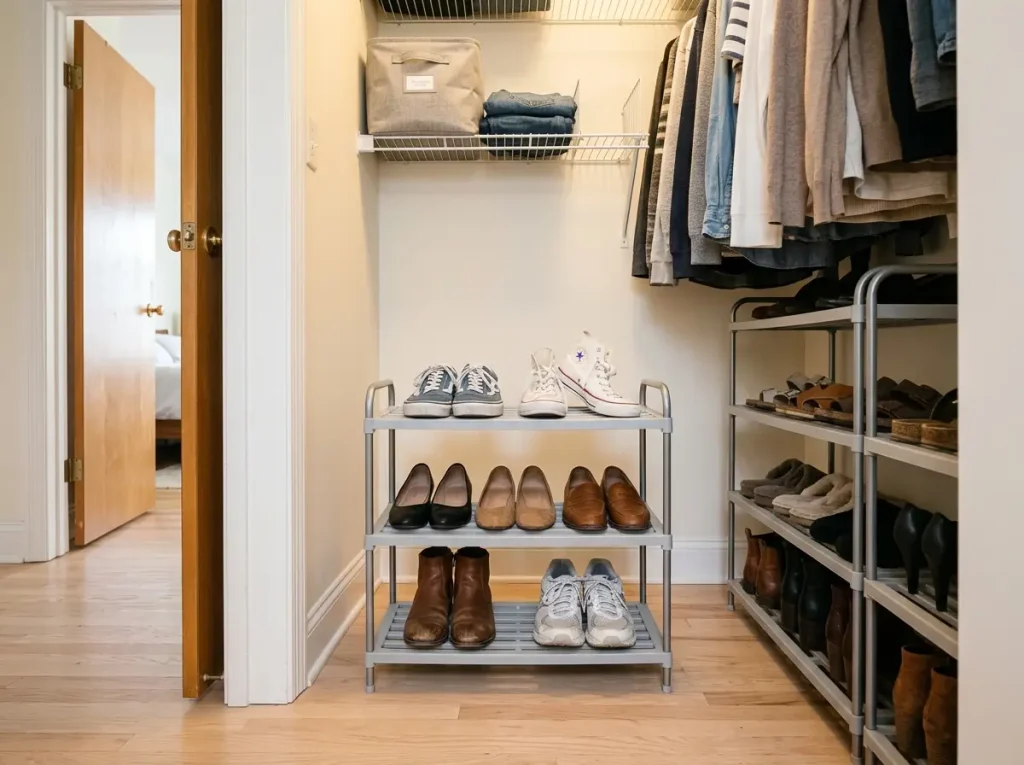
The freestanding floor rack is the default for a reason — it’s cheap, it’s everywhere, and it needs no door, no wall, and no tools. It’s also where people make the single most common shoe-storage mistake: buying one deeper than the closet it has to live in.
Tiered racks come in two to five tiers and hold anywhere from nine to twenty-four pairs, in resin, coated wire, or bamboo. Each material has a personality. Resin shrugs off humidity and wipes clean, wire is the cheapest but sags under heavy boots over a year or two, and bamboo looks the nicest until it lives in a damp entryway, where it warps. For what it’s worth, I’ve watched a bamboo rack cup at the corners after one humid summer by a back door.
Depth is the trap. A rack listed as 13 inches deep sounds modest until it’s in a 22-inch rental reach-in, where the toes shove past the door frame and the door won’t shut. A slim rack solves it. Well, a slim enough rack does; the toes still have to clear the door track. The Seville Classics 3-Tier Resin-Slat Rack measures 25.5 inches wide by 11.6 inches deep and holds about nine to twelve pairs at 30 pounds per shelf. That under-12-inch depth is what clears a shallow shelf, and the units interlock so you can stack a second one when you outgrow the first. The slatted resin also lets shoes breathe instead of trapping damp. The only caveat: at three tiers it’s compact, so a big collection needs the stack.
For a narrow gap (beside a dresser, in a closet corner), the ultra-slim SONGMICS 5-Tier Slim Rack is just 8.3 inches deep and 34 inches tall, trading footprint for height to hold around fifteen pairs. It tips easily if you load the top tier with heavy boots, so keep the weight low.
I used to default to the tallest five-tier rack I could find, figuring more tiers meant more shoes. After one tipped forward when someone pulled a pair off the top, I switched to two short stackable units instead. Same capacity, half the tip risk, and you can split them between two spots. We ranked the apartment racks by hallway clearance if you’re fitting one into a tight entry. The video below shows how different rack types actually load real shoes: the heel placement and tier spacing a spec sheet can’t convey.
Subtract two inches from your closet’s measured depth before you trust any rack’s listed dimensions. Bi-fold and sliding doors steal an inch or two of clearance you can’t see on the tape, and a rack that “fits” on paper is the one that stops the door from closing. Buy for the door, not the shelf.
Clear Boxes and Shoe Slots for the Pairs You Rarely Wear
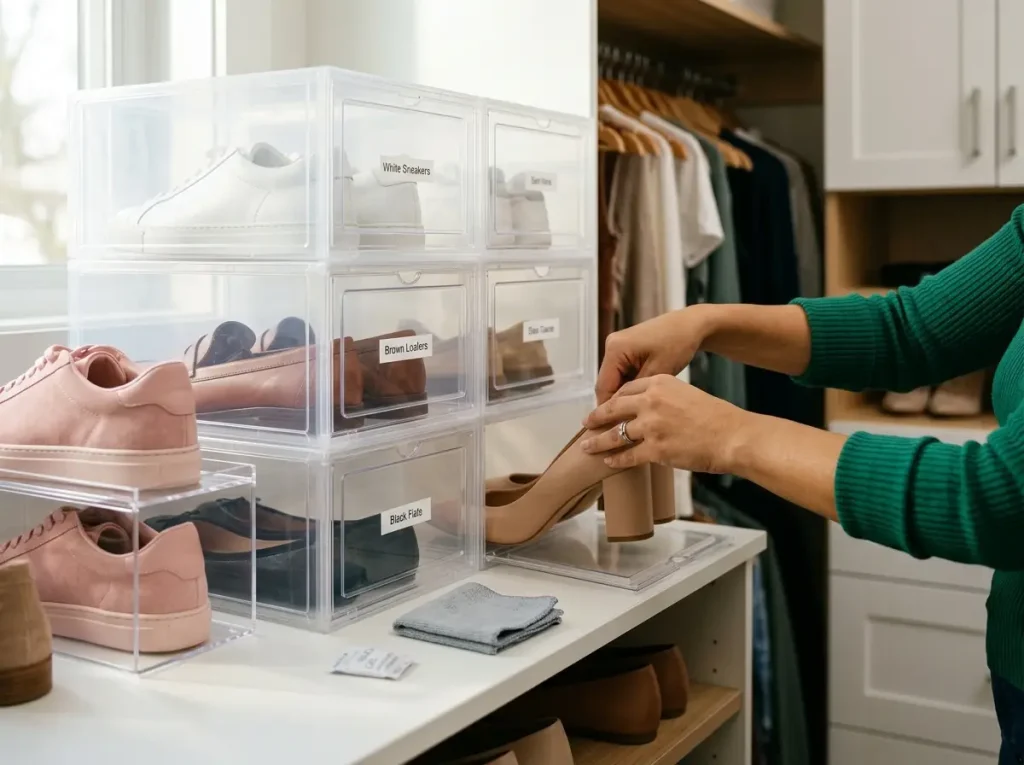
Clear stackable boxes photograph beautifully and get abandoned within a month, unless you respect what they’re actually for. They are deep storage, not daily access. Mixing those two jobs is exactly how a tidy wall of boxes becomes a pile on the floor in front of it.
The daily-versus-stored split
Think about how you actually grab shoes on a Tuesday morning. For the three to five pairs you wear every week, anything that makes you unstack a tower is too slow, and a too-slow system gets bypassed. As one person put it, “shoes pile up if the system isn’t convenient enough.” Clear boxes win for the other eighty percent: the dress shoes, the hiking boots, the heels you wear twice a year. Box those, stack them, and reclaim the shelf.
Drop-front boxes versus plain stackers
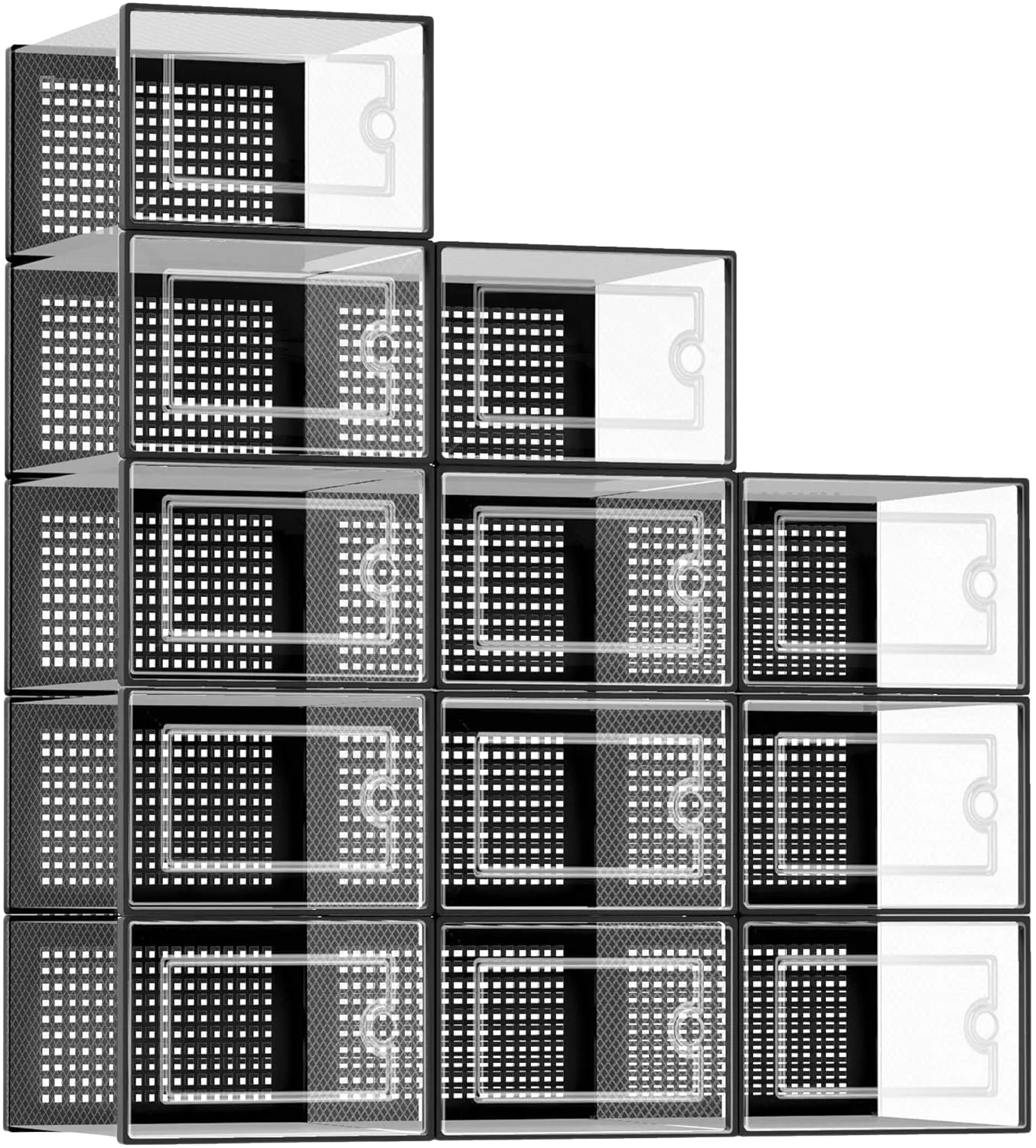
The fix for the unstacking problem is a hinged front panel. A drop-front box opens from the front, so you pull one pair without dismantling the stack above it. That single mechanical difference decides whether the boxes get used or quietly forgotten.
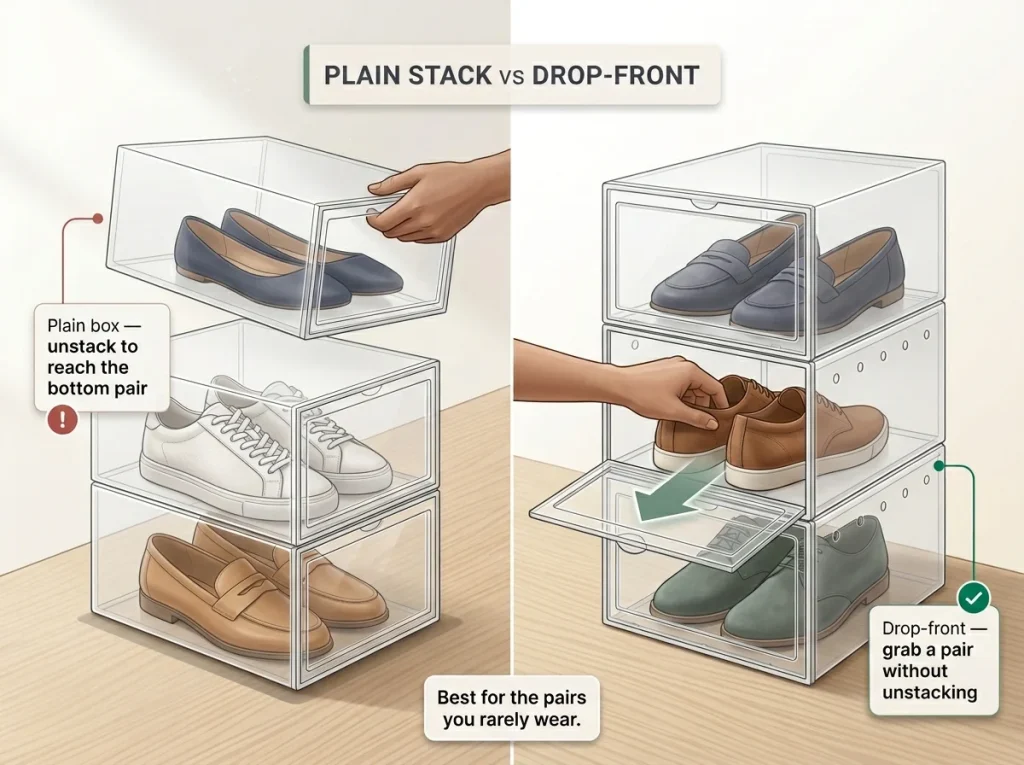
I used to recommend plain stackable boxes because they’re cheaper by the dozen. After watching three different people give up on them within two months (always for the same reason, always the unstacking), I switched to drop-front for anything stacked more than two high. The Kuject 12-Pack Clear Drop-Front Boxes are the ones I point people to now.
Shoe slots double a shelf
If your problem is shelf space rather than floor space, shoe slots are the cheapest fix going. The Neprock Shoe Slots Organizer layers one shoe above the other in the footprint of a single pair, adjustable from 2.7 to 7.2 inches to fit anything from flats to sneakers. They roughly double a shelf’s capacity. The honest tradeoff: you lift the top shoe to reach the bottom one, so these belong on stored pairs, not the shoes you sprint out the door in. Don’t want to commit to a full set? You can also buy single clear drop-front boxes a few at a time and test the system before you go all in.
Under-Bed and Behind-Door Storage for Seasonal Shoes
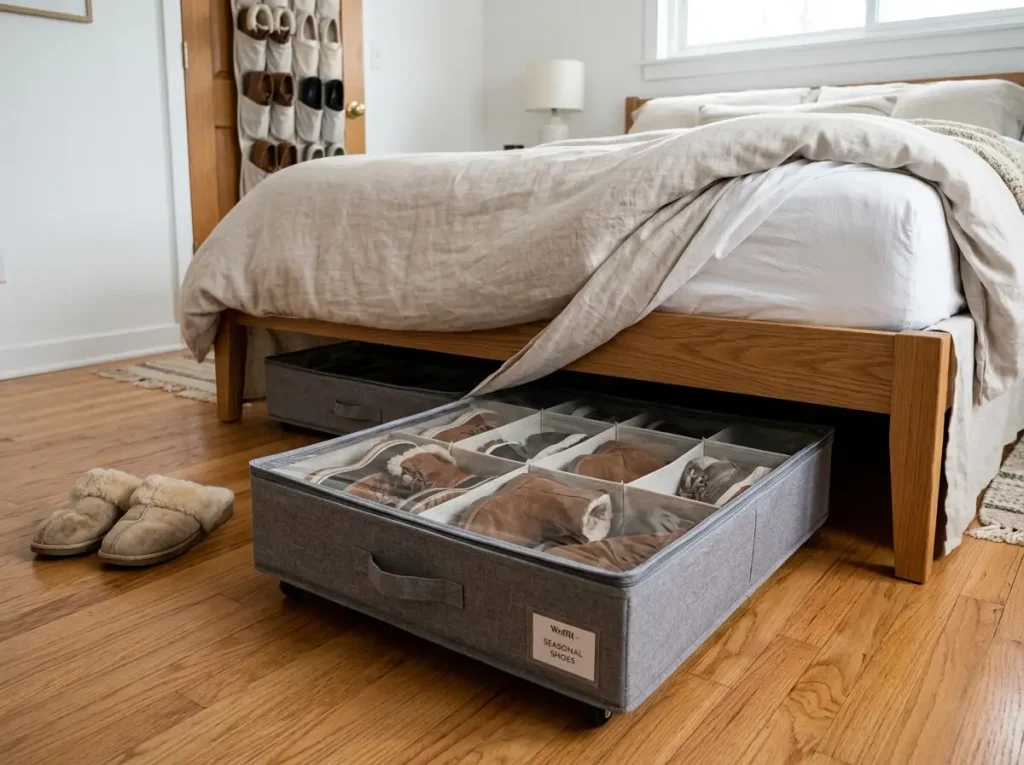
The shoes wrecking your closet usually aren’t the ones you wear. They’re the snow boots eating eye-level space in July and the sandals buried behind them in January. Move those out of the prime real estate and the rest of the system breathes.
Under-bed storage reclaims dead space you’re already paying rent on. A flat organizer with a clear top and individual compartments keeps seasonal pairs visible and protected, and the good ones roll out on wheels so you’re not crawling under the frame. The Woffit Under-Bed Shoe Organizer runs about 43 by 14 by 5.5 inches and holds sixteen pairs plus four boot slots, and the clear top means you can spot the pair you want before you pull it out. One thing to check first: bed clearance. Measure the gap under your frame, because platform beds sometimes give you almost nothing, and a 5.5-inch box won’t slide under a 4-inch gap.
Behind the door works for off-season overflow too: an over-rod pocket organizer in spare closet space costs you zero floor and pairs nicely with the over-door type from earlier. The principle underneath all of it is rotation, where only the current season earns visible, reachable space and the rest gets boxed and tucked away. For the full method, including which bed types fit which boxes, here’s under-bed shoe storage, step by step.
Choose breathable fabric over sealed plastic for long-term shoe storage. Leather and canvas trapped in an airtight box can grow musty over a season, especially under a bed near an exterior wall. A vented or fabric organizer lets them breathe, and a silica packet helps if your space runs humid.
Benches, Cabinets and Hall Trees for Entryway Shoes
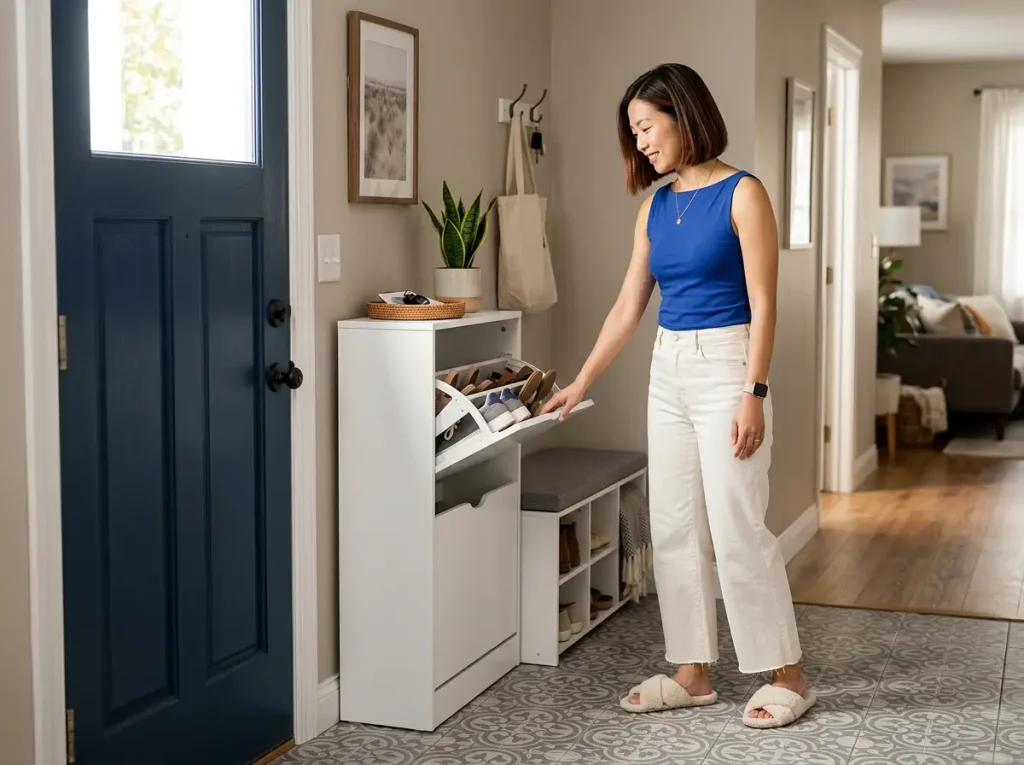
Entryway furniture is where shoe storage gets aspirational, and where it most often turns into a dumping ground. A bench looks like the answer. Then everyone in the house kicks their shoes off on top of it instead of inside it, and within a month it’s a heap with a cushion. Furniture only works with a rule attached, but the right piece in a tight entry is genuinely worth it.
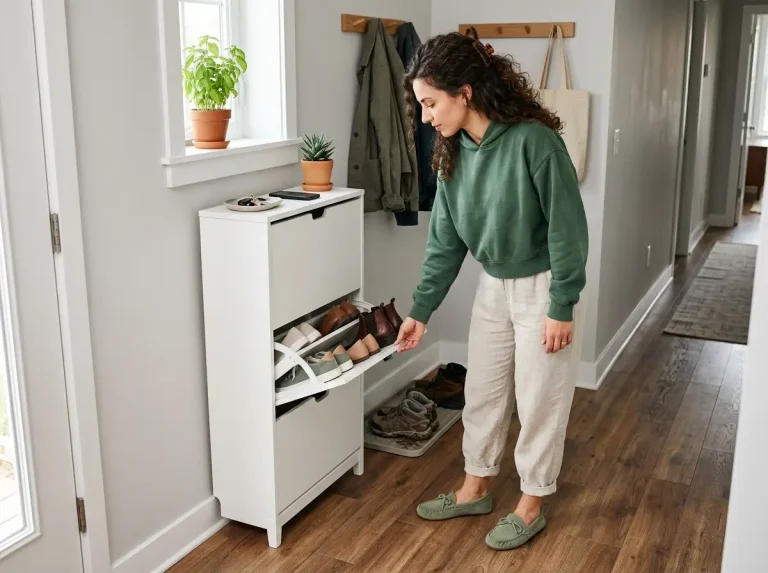
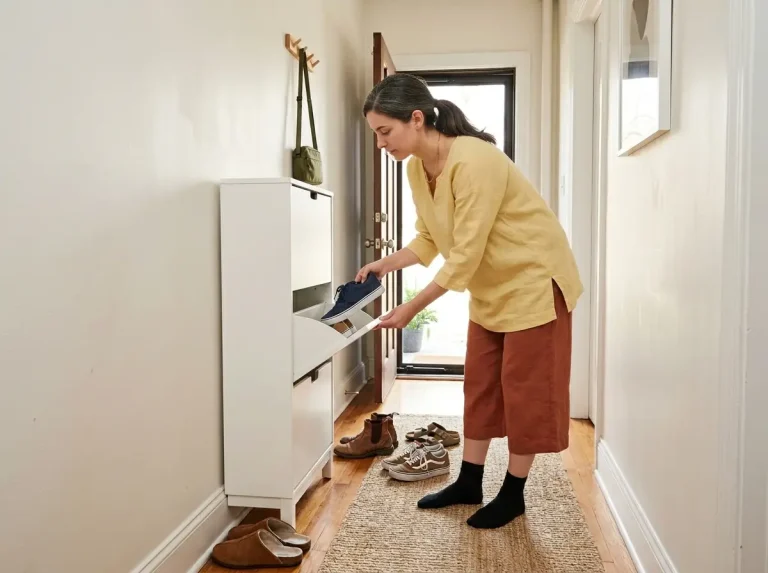
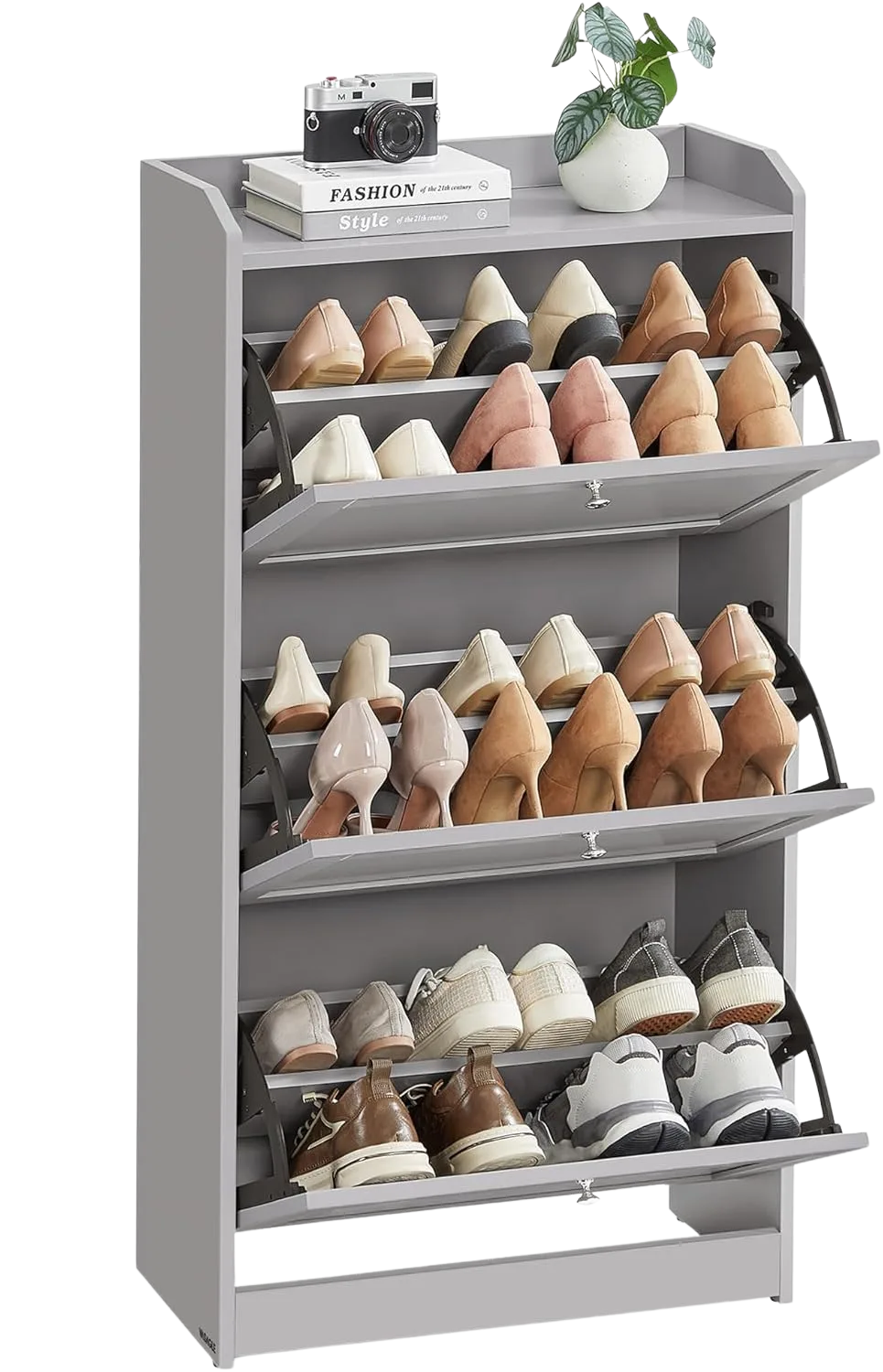
The slim flip-drawer cabinet is the small-entry hero. Instead of shelves, it has drawers that tilt out and hold shoes on their sides, so the whole thing is only about nine inches deep and hugs the wall without blocking the door swing. The VASAGLE Slim Flip-Drawer Cabinet is 9.4 inches deep and stores roughly a dozen pairs vertically behind a clean front, so it looks like a console, not a shoe rack.
If you want a seat too, the HOOBRO Storage Bench combines a cushioned top, twelve open cubbies, and a coat rack in one 39-inch unit, a genuine three-in-one for a narrow entry. But those open cubbies are the dump-pile risk, so set a hard limit of one pair per person per cubby or it fills with everything. For the narrowest entries, the VASAGLE Hall Tree stacks hooks, a bench, and shoe storage vertically, putting the whole landing zone on one small wall. Both are freestanding, but a tall hall tree should still anchor to the wall so it can’t tip. That tip-over guidance applies to any tall freestanding furniture, especially with kids around. We have more on entryway benches with built-in storage if that’s your zone.
Before you buy any of it, though, be honest about whether you need furniture at all. A bench is a want, not a need. A slim rack and a wall hook do the same job for a fraction of the cost, and the entry still functions.
Why Shoe Organizers Overflow in Three Months and How to Stop It
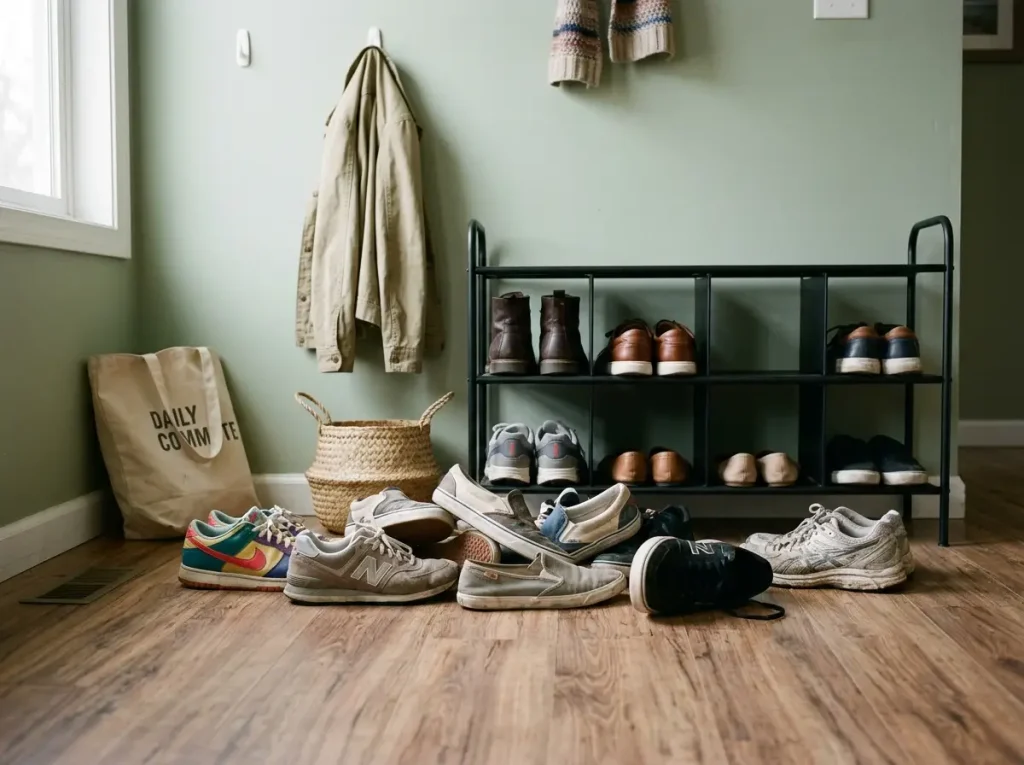
You organized it. It looked great. Three months later there’s a pile by the door again and you assume you lack discipline. You don’t. The system has a design flaw, and it’s the same one almost every time.
Here’s the mechanism. Daily pairs and stored pairs are competing for the same prime spot. The rack by the door (the easy, reachable one) slowly fills with shoes you don’t wear daily, because putting them “away” properly takes more steps. So the pairs you actually wear have nowhere convenient to land, and they end up in a heap on the floor. Call it the drop pile. It’s not a willpower problem; it’s a traffic problem.
The fix is to separate access by frequency, not by type. Give your three to five daily pairs the single easiest spot in the house: an open basket or a low tray right where you step in, with room for nothing else. Everything else goes into deeper storage: drop-front boxes, under-bed bins, the over-door pockets. When daily access is genuinely faster than dropping shoes on the floor, the pile stops forming. In a shared entry, the rule has to be per person (one designated spot each), or the bench becomes everyone’s dumping ground again.
Run a two-minute reset every week and a real swap every season. The weekly reset is just returning stray pairs to their spot before they become a pile. The seasonal swap (roughly October and April) moves the off-season shoes into deep storage and brings the current ones forward. Maintenance is two habits, not a weekend.
And the part nobody selling shoe racks wants to say out loud: you may not need to buy anything. If you’ve got an empty closet shelf, a few single drop-front boxes turn it into real storage for less than a takeout dinner. A handful of adhesive hooks on a wall holds flats and sandals vertically. A length of ribbon tacked along the top edge of a door can cradle shoes without a single screw or hook pulling out, a genuinely free fix that dodges both the hollow-core and the won’t-close problem. Start there. The same logic that keeps a shoe system alive is what’ll keep the whole closet from reverting, and the short video below shows just how far a few repurposed materials can go.
The Shoe System That Actually Lasts
Three things carry the whole article. Measure your closet depth and your door clearance before you buy anything, because fit, not quality, is what sends most organizers back. Buy two solutions, not one: fast access for the pairs you wear this week and deep storage for the rest, sorted by frequency instead of crammed together. And remember the best organizer is the one that fits your real door, your real space, and your real pair count, not the one with the most five-star reviews.
In three months, look for the drop pile by the door. If it’s back, the problem isn’t your discipline. Your daily-wear access is too slow, and the fix is making the easy spot easier, not trying harder.
Start with the pairs you wore this week. Give them the easiest spot in the house. Everything else can wait its turn.
Frequently Asked Questions
01What is the best way to store shoes in a small closet?
In a small closet, keep daily pairs on a slim tiered rack under 12 inches deep and box the rest in clear drop-front boxes on the shelf. Show only current-season shoes; store off-season pairs out of sight. That split keeps the floor clear and the system fast.
02How do professional organizers store shoes?
Professional organizers sort shoes by how often you wear them and keep only current-season pairs visible. Their core rule is at least one transparent side on any container, so you see the pair and put it back. Off-season shoes go in boxes on high shelves or under the bed.
03Are over-the-door shoe organizers worth it?
Over-the-door organizers are worth it on solid-core doors with enough frame clearance, holding about a dozen flats or sneakers with zero floor space. Skip them on hollow-core rental doors, where the hooks pull loose. Tap the door first — a drum sound means hollow, so hang the organizer from a rod instead.
04How do you store shoes without taking up floor space?
Hang an over-the-door or over-rod pocket organizer, slide a flat box under the bed, or add shoe slots to a shelf you already own. A hanging organizer uses about 7 inches of spare closet rod and no floor at all. Vertical and under-bed space is the dead space most people overlook.
05What can I use instead of a shoe rack?
Instead of a rack, use clear drop-front boxes on a closet shelf, an under-bed bin for seasonal pairs, or a hanging organizer on spare rod space. For daily pairs, a simple boot tray or basket by the door beats a rack you will overflow. You often already own the fix.
Disclaimer: ClutterlessNest is a participant in the Amazon Services LLC Associates Program. As an Amazon Associate we earn from qualifying purchases. This article may contain affiliate links — if you buy through them, we may earn a small commission at no extra cost to you. We only recommend products we have tested or genuinely believe in.