












In this article
You set up the one-in-one-out rule with good intentions. New shirt in, old shirt out — easy. For about five weeks you’re consistent, and then you buy a jacket in a hurry, forget to pull something out, and a month later the closet looks exactly like it did before you started. I’ve watched this same pattern play out across a dozen different homes, and the rule almost never gets blamed for the right reason. This article covers what the one-in-one-out rule actually does (and doesn’t do), why it quietly stops working by month three in most homes, and what a version that survives looks like in a real apartment, including the part nobody talks about: where the outgoing item actually goes.
Quick Answer
The one-in-one-out rule means that for every new item you bring home, one existing item leaves, ideally like-for-like: a shirt for a shirt. It’s a maintenance system, not a decluttering method. It holds a home steady once you’ve cleared it, but it won’t reduce a space that’s already overstuffed, and that distinction is why it fails.
What the One-In-One-Out Rule Actually Does (and Doesn’t Do)

The confusion starts with the name. “Decluttering rule” makes it sound like the rule reduces clutter. It doesn’t. It prevents new clutter from arriving, which is a completely different job. Mixing up those two jobs is the single most common reason people feel like the rule let them down.
The definition in one sentence
Every time a new item comes into the home, one existing item leaves. New mug in, old mug out. New pair of jeans in, an old pair gone.
The trigger is always the same: something arrived, so something has to go. That’s the entire mechanism, and its simplicity is exactly why it spreads so easily through organizing communities, usually shortened to OIOO.
Maintenance vs. decluttering — the distinction that changes everything
Here’s the part that matters. OIOO is a maintenance strategy. It keeps your home at whatever level it’s currently at. It does not lower that level.
If your closet is comfortable and you want it to stay that way, the rule is excellent. If your closet is already packed and you start the rule today, congratulations, you’ve just locked in “packed” as your permanent baseline.
This is the gap between what people expect and what actually happens. They reach for OIOO hoping to dig out, when the rule was only ever designed to stop the slow refilling that organizers call clutter creep: the quiet accumulation of small “just this once” additions that nobody tracks until the drawer won’t close. The rule guards the line. It can’t move the line for you.
The like-for-like principle that actually makes it work
The version that works is like-for-like: you match categories. A shirt buys out a shirt. A book buys out a book.
The reason this matters is mechanical, not philosophical. Like-for-like enforces a real limit on the space that’s actually crowded. If you buy a sweater and remove an old mug to “balance” it, you technically followed the rule, but the sweater shelf is still overflowing and the mug cabinet was never the problem.
I’ll be honest, the cross-category swap is the most seductive trap here, because it feels like progress. You did a thing. Something left the house. But the crowded category didn’t change, and that’s the only category the rule was supposed to protect. OIOO is one of eight decluttering methods worth knowing, and it’s the only one whose entire usefulness depends on you matching the swap to the category under pressure.
You Need to Declutter First — Here’s Why
Most people hear “one-in-one-out” and start that afternoon. I get it — it sounds like the kind of rule you can just switch on. But if you’re already overwhelmed, switching it on means you’ve decided to maintain the overwhelm, indefinitely, with discipline.
Why starting OIOO in a cluttered home keeps you stuck
I used to tell people to start the rule the day they got motivated. Strike while the iron’s hot, right? After watching it backfire in a friend’s already-packed studio (she kept the rule perfectly for a month, and her apartment looked identical at the end of it), I stopped giving that advice. Now I say the same thing every time: declutter to a baseline first, then turn the rule on to hold it.
A baseline isn’t minimalism. It’s just a comfortable state: every item has a home, nothing is stacking up on surfaces, and you can find what you need without excavating. That’s the target. The rule’s only job is to keep you there once you arrive.
What baseline actually means in practice
You’ll know you’re at baseline when putting something away doesn’t require moving three other things first. When the closet rod has daylight between hangers. When the “everything drawer” still has a little room. It’s a felt thing more than a counted thing, and you don’t need to hit some magazine standard. You just need the home to function on an ordinary Tuesday night.
This matters because a huge share of people who reach for OIOO are nowhere near baseline yet. A NAPO survey found that 54% of Americans feel overwhelmed by clutter and 78% don’t know what to do about it. That’s the exact group that needs a real clear-out first, not a maintenance rule layered on top of a pile.
The fastest path to baseline if you’re not there yet
Don’t try to declutter the whole house. Pick one category. Clothing is the easiest, because the keep-or-go decision is fast and you can see the result immediately. Clear that one category down to a level you’re happy with, and only then start applying OIOO to it. One category at a time, the rule activates as each one hits baseline.
If the whole place feels like too much to face, start here if the whole house feels like too much. It’s built for exactly that frozen, where-do-I-even-begin feeling. And if you’d rather work off a structured list than improvise, a room-by-room checklist for getting to baseline walks you through each space in order so nothing gets skipped.
How to Apply the One-In-One-Out Rule by Category
The rule sounds obvious until you’re standing in your kitchen holding a new set of spatulas, wondering what “equivalent” even means in a drawer full of mismatched utensils. The fix is to stop treating the home as one big pool and start applying the rule category by category, because each category has its own logic.
Start with clothing — the most forgiving category
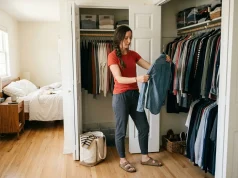
Clothing is where almost everyone should begin. Like-for-like is obvious here (a shirt for a shirt, jeans for jeans), so there’s no ambiguity to stall you. The decision is quick, and watching the closet hold its ground instead of creeping fuller is genuinely motivating in a way that keeps the habit alive. For what it’s worth, that early momentum is most of why I tell people to start with clothes.
The one place clothing trips people up is the “I’ll deal with it later” move. In my own first apartment, a new sweater would go straight onto the rod, and the old one it was supposed to replace ended up draped over the back of a chair, because the closet was the only place I’d ever put clothes, and it was full.
The new item integrated instantly. The old one just migrated to furniture and lived there for weeks. If the clothing category is already past capacity, that’s a sign you need the clear-out first. The rule can’t fix a closet that has no room to swap inside of.
Kitchen and food items — navigating the exception zone
The kitchen is where the rule needs an asterisk. Most of what comes into a kitchen is consumable: coffee, a new jar of cumin, dish soap. Those are exempt.
You don’t remove a fork because you bought oat milk. The rule only applies to the durable stuff: appliances, gadgets, mugs, dish towels, the things that pile up and never leave on their own.
For those durable items, strict like-for-like still wins. New travel mug in, a chipped one out. According to the National Association of Productivity and Organizing Professionals (NAPO), most of what people keep is rarely used. That’s exactly why a swap rule works in the kitchen: the worn-out or never-touched version is almost always sitting right there, ready to be the “one out,” if you actually look for it.
Books, décor, and the “miscellaneous” trap
Books and décor are harder because the categories blur, and “miscellaneous” is where the rule quietly collapses. The fix is to stop tracking counts in your head and assign each category a physical limit instead.
This shelf holds all the books. When it’s full and a new one comes in, an old one leaves to make room. No counting, no willpower, just a boundary you can see.
The boundary only works if everyone in the home can see it too. That’s where a label earns its keep, marking the shelf, the bin, or the drawer so the capacity limit isn’t a private rule living in your head. A free roll of masking tape and a marker does this job perfectly well for a week or two while you test the zones.
If you want something that survives daily handling and actually looks intentional, the Brother P-Touch PTD220 Label Maker is compact, needs no mounting or adhesive on your walls (so it’s renter-safe), and prints labels that don’t curl off a fabric bin after a month. It’s overkill for a single drawer. But for a whole category system the household has to follow, the readable labels are what keep it from sliding back into guesswork.
Make the container the limit, not a number. “Keep 15 mugs” is a rule you’ll forget by Thursday. “Mugs live on this one shelf, and when it’s full something leaves” is a rule the shelf enforces for you. The physical edge does the remembering so you don’t have to.
The OIOO Variations That Reduce Clutter Faster
Sometimes you’re not at baseline yet, but you don’t want to wait for a dedicated decluttering weekend either. The variations let you use the same trigger (a new item arriving) to do more than one item’s worth of work per swap. They turn the maintenance rule into a slow reduction engine.
One-in-two-out: for bringing an overstuffed home to baseline
For every new item in, two existing items leave. This is the version for a mild, specific overage. Say the closet is one shelf’s worth too full, but the rest of the home is fine.
Each purchase nudges that one category down toward baseline without you ever scheduling a separate session. It’s gentle, and it works precisely because it piggybacks on a habit you already have (buying things) instead of asking for a new one.
One-in-ten-out: the aggressive 30-day reset
One-in-ten-out is the blunt instrument. Every new thing that enters means ten go out. It’s built for people who still shop frequently and have real volume to clear, and the math gets aggressive fast. That’s the point. Organizing communities tend to recommend this one specifically for overstuffed wardrobes, where finding ten items you won’t miss is genuinely easy the first few rounds.
Figuring out which ten go is its own small skill, and a couple of quick filters help. The 20/20 and 90/90 rules pair well here: if it’s cheap and quick to replace, or you haven’t used it in ninety days and don’t expect to in the next ninety, it’s an easy “out.” Those questions make the ten-item ask far less paralyzing.
Which version you actually need right now
Match the version to your starting point. At baseline or close to it, run standard one-in-one-out, since you’re maintaining, not reducing.
Noticeably above baseline in a category, use one-in-two-out to drift it back down. Significantly cluttered, go one-in-ten-out, or pair it with a flat “buy nothing new” stretch for thirty days while you do a single one-out a day. That last combination is the one for people who’ve realized the shopping habit itself is the clutter source.
Honestly, though, the best variation is the one you’ll still be doing in six weeks. A perfect one-in-ten-out that you abandon by week two loses to a boring one-in-one-out you actually sustain. Start gentler than feels exciting. You can always tighten the ratio later, once the swap reflex is automatic.
The Three Real Reasons the Rule Stops Working
Here’s where most articles stop and most people get stuck. The rule gets blamed when the real problem was the setup, and almost nobody is told about these three failure modes before they start. Knowing them doesn’t just explain why your last attempt fizzled. It’s the difference between the next attempt working and failing the exact same way.
Reason 1 — The buying permission slip effect
This is the sneakiest one, because it disguises itself as success. The rule silently changes the question your brain asks at the store. Instead of “do I actually need this?” it becomes “what can I get rid of so I’m allowed to have this?” That’s a fundamentally different question, and a far riskier one — it turns removal into the price of admission for buying, which makes shopping feel virtuous rather than worth questioning. Organizers call this the buying permission slip.
A friend texted me once, genuinely thrilled, that she’d finally beaten her shopping guilt: every time she bought something she donated something, so she felt fine buying more. Three months later she owned more clothes than when she started. She’d followed the rule flawlessly. The rule had just quietly become a justification engine.
People who adopt OIOO sometimes shop more in the first months, not less, and they feel responsible the whole time. The fix is to catch the mental shift in the moment.
If you’re standing in a store already thinking “what can I remove at home to make this fit,” you’ve started using the rule backward. The swap is supposed to be a brake on the purchase, not a license for it. That pause, the shopping pause, is where the rule does its real work or fails completely.
Decide whether you’d buy the item if you had to remove two things, not one. If the answer is “no, not worth losing two,” you didn’t want it enough to begin with. The swap was covering for a purchase you’d have skipped on its own.
Reason 2 — The household non-compliance gap
The rule works per person. It does not work per household unless everyone’s in. This is pure math, and it’s brutal: if you remove one item a week following strict OIOO, and your partner brings in two a week without removing anything, your home is still gaining one item every week. Your discipline is real, and it’s being quietly cancelled out.
I set this rule up once with a couple where she removed something every week like clockwork and he added two without a second thought. Six weeks in, she told me she felt like she was bailing water out of a boat someone else kept filling. She wasn’t failing. The system was, because it was being applied by one person to a two-person problem.
The fix is to stop trying to run OIOO household-wide on day one. Apply it to individual ownership zones first: my closet, your closet; my desk, your desk. Each person maintains their own areas, and the shared spaces come later, once the habit is established and ideally once both people have agreed to it.
And never declutter someone else’s belongings without their consent. That’s not a maintenance system, that’s a fight. If a partner is genuinely on board with decluttering, running the rule together across shared rooms becomes possible. If they’re not, keep it to your own zones and protect your own peace.
Reason 3 — The 90-day enthusiasm drop and the environmental fix
The third reason is the one almost everyone hits: the rule just fades. You follow it perfectly for four to six weeks, then life gets busy, a purchase slips through without a swap, then another, and by month three you can’t remember the last time you did it. This isn’t a discipline failure. It’s a design flaw.
Here’s the mechanism. OIOO has no built-in trigger except the shopping event itself, and shopping is irregular and unpredictable, so there’s nothing in your home reminding you the rule exists between purchases. Compare that to a habit anchored to something you see every day: the rule is invisible by design, and invisible habits fade.
It’s the same mechanism that derails a 30-day challenge right around the two-week mark. Enthusiasm carries it at first, and when enthusiasm runs out there’s no structure underneath to catch it. The fix is to give the rule something visible to live on: a physical anchor in the home that doesn’t depend on you remembering. That anchor is the staging zone, and it’s important enough that it gets its own section.
The Staging Zone — Where the Outgoing Item Actually Goes
This is the part no other guide seems to mention, and it’s the part that makes or breaks the whole thing. The most consistent way I’ve seen OIOO fail in small apartments has nothing to do with willpower. It’s that the outgoing item gets set “somewhere” to deal with later, and later never comes. The incoming item is already integrated into the home, the outgoing item is still sitting in a corner, and now two items occupy the space that was supposed to hold one.
Why “I’ll deal with it later” breaks the rule
An item with no defined exit path doesn’t leave. It just relocates inside your home: to the floor, a chair, the back of the closet it came from. Organizers have a name for the result: the doom pile, the heap of things stuck in limbo between “I should donate this” and actually donating it. The doom pile is where good intentions go to sit for five weeks.
And it compounds. While that one outgoing sweater waits on the chair, you’ve made two more swaps, and now there are three things in transition and a chair you can’t use. The rule didn’t fail because you stopped believing in it. It failed because there was no physical place for the “out” half of one-in-one-out to actually go.
The renter staging zone setup (no garage required)
Homeowners get to use the garage or a basement landing for this. Renters in apartments usually have neither, which is exactly why the rule breaks down for us more often: there’s no obvious holding spot. The fix is to build one on purpose, a dedicated, labeled, fixed-location bin that lives near the front door.
Near the exit is the whole trick, because proximity to the door fights what organizers call rescue behavior: reaching back in to pull something out because “actually, I might need this.” Items staged in a back closet get rescued. Items staged by the door tend to actually leave.
Conventional advice says hide the donation box in a closet so it’s out of sight. In practice, out of sight is out the door never. That’s the doom bin by the door‘s quieter cousin, the box you genuinely forget exists. So make it visible and make it belong there.
The cheapest version that actually works is a single reusable shopping bag on a hook by the door. When it’s full, it goes out that week. For a one or two-person household with low volume, that bag is genuinely all you need. Don’t overthink it.
If your volume is higher, or you want something that doesn’t read as a permanent pile of shame in the entryway, a collapsible bin earns its place. It flattens completely when the zone is empty, which is the goal. A set like the Fabric Storage Bins with Labels (Set of 6, Collapsible) works because the labels tell everyone in the home what the bin is for without a conversation, and six bins means you can run a dedicated staging bin per category: one for clothes, one for books, one for the rest. The catch: a six-pack is more than a single-door entryway needs, so skip the set unless you’ll actually put the extras to work somewhere else.
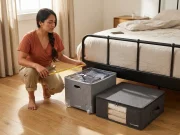
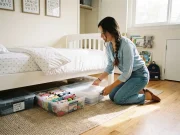
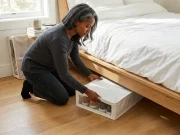
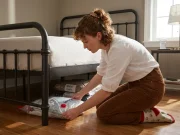
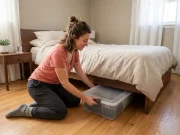
If there’s truly no room by the door, the next-best spots are a labeled bin inside the coat closet or a dedicated section of under-bed storage. The rule is that the location is fixed, the same place every time, not “wherever there’s room this week.”
The 7-day removal deadline — the non-negotiable that makes it work
A staging zone without a deadline is just a slower doom pile. Whatever lands in the bin has to physically leave the home within seven days of the swap. If it doesn’t leave in seven days, the swap failed — and you either send the incoming item back or you keep both pending a real decision, but you don’t get to pretend the rule worked. The deadline is what keeps the staging zone from quietly becoming a second storage zone.
For renters in walk-ups, the friction of actually hauling a box down the stairs is what breaks the deadline, so remove that friction in advance. Schedule a free donation pickup (Habitat for Humanity ReStore, Vietnam Veterans of America, and similar groups will collect from apartments) and book it for the same day the bin fills, not “sometime soon.” Soon is how the bin sits for a month.
Write the deadline on the bin, not in your head. A sticky note that says “empty by Sunday” turns a vague intention into a visible commitment you walk past every time you leave. When Sunday passes and it’s still full, the note nags you, which is exactly its job.
One category is the exception to the seven-day clock. Sentimental items need more time and a different process, because forcing a fast decision on them just leads to keeping everything by default. That’s why sentimental items get their own decision timeline and shouldn’t be jammed into the staging bin with last season’s jeans.
The Takeaway
The one-in-one-out rule is a maintenance system, not a decluttering method. Declutter down to a baseline you’re happy with first, then switch the rule on to hold that line. Running it on a cluttered home just locks the clutter in place.
When it fails, it fails for predictable, fixable reasons: the buying permission slip turns it into a shopping excuse, one person can’t out-swap a non-compliant household, and the rule fades by month three because nothing in your home keeps it visible. And the structural piece that solves the last two is the staging zone: a fixed, labeled bin near the door with a seven-day removal deadline, so the “out” half of the rule has somewhere to actually go.
At the three-month mark, check two things: is the staging bin getting emptied on schedule, and is the rule being applied across the household instead of by one person carrying it alone? If either one is slipping, that’s the gap to fix, not the rule itself.
Pick one category this week. Just one. Set a physical capacity limit for it and a spot by the door for whatever leaves. That’s the whole start. The rule builds from there.
Frequently Asked Questions
01What is the one-in-one-out rule for decluttering?
For every new item you bring into your home, one existing item leaves, ideally like-for-like: a shirt for a shirt. It’s a maintenance habit that prevents clutter from slowly building back up after you’ve organized a space.
02Does the one-in-one-out rule actually work?
It works well as a maintenance rule, not as a decluttering method. It holds a home at its current level once you’ve cleared it, but it won’t reduce a space that’s already overstuffed, so declutter to a comfortable baseline first.
03How do I start the rule if I already have too much stuff?
Declutter to a baseline first using another method, then switch on the rule to maintain it. Work one category at a time, starting with clothing, since the keep-or-go decision is fastest there.
04What are the exceptions to the one-in-one-out rule?
Consumables are exempt: soap, food, and cleaning supplies don’t trigger a swap. Sentimental items get their own slower timeline, and a worn-out item being replaced is a direct one-for-one, not an added decision.
05What is the difference between one-in-one-out and one-in-two-out?
One-in-one-out maintains your current level: one in, one out. One-in-two-out actively reduces it, removing two items for every one that enters. Use one-in-two-out when a category is mildly above the baseline you want.