







In this article
You walked in the door, dropped your coat on the couch, put your keys in your pocket, and now it’s 7 AM and you have no idea where your keys are. The couch has a coat on it. The shoes are wherever you stepped out of them. Your apartment has no entryway — and that five-second window when you come home is where the whole day’s organization falls apart.
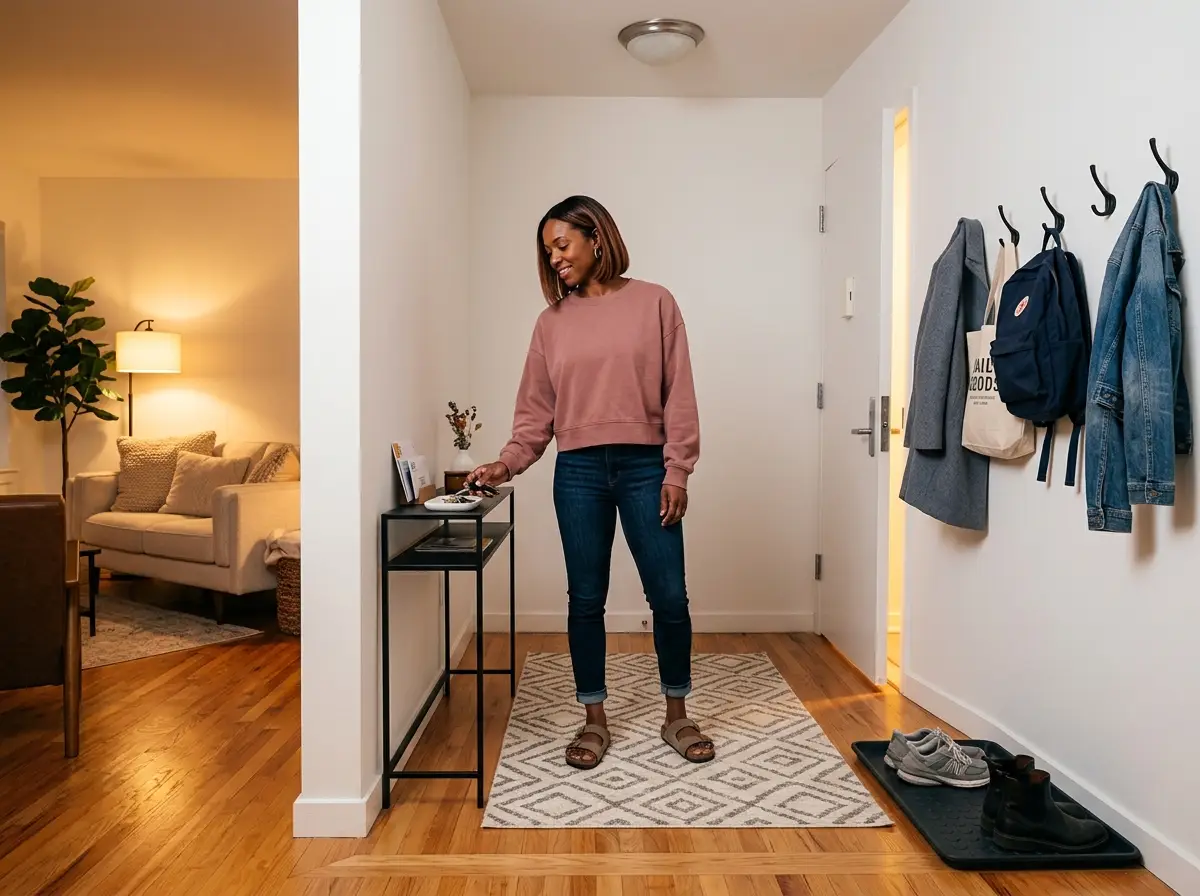
I’ve set up entryway zones in dozens of small apartments — studios, one-bedrooms, places where the front door opens directly into the living room. The problem is always the same: there’s no wall to hang anything on, no natural landing spot, and no obvious zone that says “stop here, drop things here.” But you can build one. It starts with geometry, not furniture, and the system has three layers that work together or not at all.
Quick Answer: Here’s how to create an entryway in an open floor plan:
- Measure your zone footprint first — 24–30 inches deep, at least 36 inches of walkway clearance
- Anchor the zone with a 3’x5′ or 4’x6′ rug, leaving 3–6 inches of bare floor on all sides
- Add a narrow console table (12 inches deep max) or a freestanding hall tree
- Mount hooks at 63 inches — one per person, no sharing
- Set a landing pad tray for keys and a boot tray for shoes
- Run a 3-minute weekly reset to keep the system working past month one
Start With the Zone Footprint, Not the Furniture

Everyone’s first instinct is to buy something — a bench, a rug, a hall tree — and then figure out where it goes. That’s backwards. In an open floor plan, the zone has to be defined in space before any furniture goes in, or you end up with a bench that blocks the door, a rug that’s too small to anchor anything, and a “zone” that nobody treats as a zone.
The problem with open floor plans is straightforward: there’s no natural stopping point. No wall, no hallway, no architectural cue that says “this is the entryway.” So the entryway becomes wherever things happen to land — the couch arm, the kitchen counter, the floor next to the door. You need to claim that space with measurements before you spend a dollar.
How Much Space Does an Entryway Zone Actually Need?
Your zone depth — the distance from the front door into the apartment — should be 24–30 inches. That’s enough room for a boot tray and a narrow piece of furniture without blocking the door swing. Less than 24 inches and the zone feels forced. More than 30 inches and you start eating into your living area.
For width, match the natural opening of your doorway, plus 6–12 inches on each flanking wall if you have the space. In practical terms, a 5-foot by 5-foot footprint is the realistic minimum for a functional zone — roughly 25 square feet. The National Association of Home Builders recommends dedicating 2–4% of total square footage to entryway function, which works out to 20–40 square feet in a 1,000-square-foot apartment. Most open-plan apartments allocate zero.
If you’re setting up a small entryway for the first time, the zone footprint is where every decision starts. Tape it out with painter’s tape before you buy anything. Live with it for a few days. Walk through it. If it feels right at the end of a long day — if you naturally stop there — the size is correct.
The Door Swing Test
Before you place a single thing, measure your door’s swing arc. If your front door swings inward (the default in most apartments), it sweeps a 30–34 inch arc depending on door width. Any furniture, rug corner, or boot tray that falls within that arc gets hit every single time the door opens.
This is the mistake I see most often. Someone puts a boot tray right inside the door, and the door clips it on every entry. Within a week the tray has migrated into the middle of the floor and nobody’s using it. Measure the arc first. Mark it with painter’s tape if you need to visualize it.
Pro tip: Use painter’s tape to mark both the door swing arc and your planned rug edges before buying anything. Live with the tape layout for 48 hours — you’ll catch clearance problems that measurements on paper miss.
The 36-Inch Rule That Determines Your Console Table Depth
Here’s the number that governs every furniture decision in an open-plan entryway: 36 inches of walkway clearance. That’s the industry minimum for interior passage — the space you need to walk past furniture without turning sideways.
The math is straightforward. If your door area is 48 inches wide (common in apartments) and you place a 12-inch-deep console table against the wall, you have 36 inches of walkway left. Acceptable. Use a 14-inch console and you’re at 34 inches — tight enough that you’ll feel it with grocery bags. Use a 16-inch console — which is what most furniture stores sell as “standard” — and you’re at 32 inches. That fails the standard.
This is why most “entryway console tables” don’t actually work in entryways. They’re designed for the back of a sofa, where walkway clearance doesn’t matter. The ones that work in doorway zones are specifically 12 inches deep or less, and there aren’t many of them. According to NAPO’s entryway organization guidelines, a dedicated drop zone should be planned around the clearance, not the other way around.
Anchor the Zone With a Rug
The rug is the only element that tells someone “this is a different zone” without needing a wall. It creates a visual floor frame — zone starts here, zone ends here. But most people undersize it, and a 2’x3′ mat doesn’t define a zone. It defines a doormat.
The Size That Works (and Why Most People Go Too Small)
For a standard apartment doorway zone, a 3’x5′ rug works. For wider areas or when you want your console table legs on the rug edge, step up to 4’x6′. An 8’x10′ works only in genuinely large open plans — anything smaller and it reads as a living room rug that happens to be near the door, not an entryway anchor.
The detail most people miss is the bare floor border. Leave 3–6 inches of visible floor around all four edges of the rug. That border is what makes the rug look intentional rather than undersized. Without it, the rug looks like it was placed randomly and never adjusted.
Rug Placement and Furniture Integration
Position the entryway rug so the front edge sits just inside where the door closes — not under the door swing. The back edge should align with or just reach the front legs of your console table or bench. Tuck the front two legs of the furniture onto the rug edge and it connects the furniture to the zone visually. The whole setup reads as one deliberate space instead of a rug and a table that happen to be near each other.
A machine-washable rug is non-negotiable for an entry zone — this surface sees daily shoes and outdoor grime. The Washable 3’x5′ Entryway Rug has non-slip backing that addresses the sliding problem on hardwood, and low-pile construction that cleans flat without curling at the edges under foot traffic. If you already have a rug you like, pair it with non-adhesive suction grippers underneath — a thrifted vintage wool rug works just as well if the backing holds.
Why the Rug Slides — and the Renter-Safe Fix
Every rug on hardwood slides. It’s not a question of if — it’s a question of how fast. Daily foot traffic pushes the rug toward the door, and within two to three weeks the entire zone boundary has shifted. The zone stops working because it’s not where you put it anymore.
Adhesive-backed gripper pads seem like the fix, but they leave residue on hardwood that can cost your deposit. Non-adhesive suction-style grippers (Gorilla Grip makes the most widely available version) use vacuum technology to hold the rug without glue — no residue, no staining, and they pull up cleanly when you move.
Pro tip: Natural rubber rug pad backing is safer for hardwood floors than synthetic rubber. Synthetic can react with polyurethane floor finishes and leave a ghost outline you’ll only discover when you pull up the rug after a year. This is a detail most rug pad articles skip — and it’s exactly the kind of problem that shows up at move-out inspection.
If you want more small entryway ideas beyond the rug, the rug-plus-table combination here is the starting point. Everything else layers on top.
Add Your Furniture Anchor
The rug defines the zone on the floor. The furniture gives it vertical presence — without it, a rug reads as a nice doormat and nothing more. This is also where people make the most expensive mistake: buying a console table that’s 18 inches deep and then realizing it blocks the walkway.
Console Table vs. Hall Tree — How to Choose
A console table works when you already have wall hooks (or plan to add Command hooks) and you want a lighter visual footprint. You get a surface for your key tray, shelves below for bags or baskets, and the wall above stays available for hooks.
A hall tree works when you want one piece that handles everything — coats on integrated hooks, a bench for shoe removal, cubbies for shoe storage. If you’re renting and want to be done in one purchase, the hall tree is the single-piece answer.
One limitation of hall trees: the coat hooks are fixed at the factory height, usually 66–72 inches from the floor. That works for most adults, but it’s higher than the 63-inch sweet spot for shorter family members or older kids. You can’t adjust what’s built in.
The 12-Inch Depth Rule (and Why Most Furniture Fails This Test)
Standard furniture store consoles are 15–18 inches deep — designed for the back of a sofa, not a doorway. In an entryway zone, every inch of depth steals from your walkway clearance. The functional range for an entry console is 12–14 inches deep, and 12 is better.
The WOHOMO Console Table is 31.5 inches wide, 11.8 inches deep, and 31.5 inches tall — one of the few options on Amazon specifically sized for this problem. The 11.8-inch depth preserves 36 inches of walkway in a standard 48-inch doorway zone. Three open shelves below the surface add vertical storage without increasing the footprint. The trade-off: it’s light. If you lean on it hard, it shifts — treat it as a landing surface, not a support beam.
If you’d rather skip the separate console-plus-hooks setup entirely, the VASAGLE Hall Tree with Bench and Shoe Storage 4-in-1 is the all-in-one alternative. At 13.4 inches deep and 28.3 inches wide, it stays within walkway clearance range while combining hooks, bench, and cubbies in a single freestanding unit. For more on how pieces like these work in tight spaces, see multi-functional furniture for small spaces.
The Freestanding Advantage for Renters
No wall mounting means no deposit risk, no holes, and the piece moves with you to your next apartment. Both the WOHOMO console and the VASAGLE hall tree are freestanding — they sit flush against the wall without brackets, screws, or anchors.
The hall tree is the strongest renter option. Coats on integrated hooks, bench for shoe removal, cubbies for storage — zero drilling, zero wall damage. And if you have roommates, it doubles as a shared boundary: everyone gets their own hook section and cubby. That kind of individual ownership matters more than people expect — it’s the difference between “our entryway” and “my hook, your hook,” and the second version actually lasts.
Build the Function Layer — Hooks, Landing Pad, and Shoe Zone
The rug and the furniture make the zone look like an entryway. The hooks, the landing pad, and the shoe tray make it function like one. Without these three elements, you have a zone that everyone walks past on their way to dropping things on the couch.
One Hook Per Person (Why Shared Hooks Always Fail)
This is the rule nobody follows until they’ve lived through the failure: one hook per person. Not one coat rack with eight hooks that everyone shares. One assigned hook per person in the household.
The physics of the coat avalanche are simple. More than one coat per hook shifts the center of gravity. The pile leans. By week two, the hooks are overloaded and coats are on the floor. By week three, it’s easier to throw the coat on the couch than fight the hook pile. The system is dead.
As NAPO recommends one hook per family member, individual ownership of the hook is what makes the habit stick. If you live alone, two hooks are enough — one for your everyday jacket, one for outerwear. If you have kids, mount their hooks 6–8 inches lower (52–55 inches from the floor) so they can reach without stacking on tiptoe, which defeats the entire habit.
The Command 7.5 lb Jumbo Utility Hook holds one coat plus a bag comfortably on smooth painted drywall, and removes cleanly with warm water and a slow-angle pull. Mount at 63 inches from the floor — that’s the standard height for adult reach without coat hems dragging. The limitation is visual: white plastic doesn’t look like permanent hardware, and it won’t fool anyone into thinking it’s a real wall hook.
If you want something that looks more like installed hardware without drilling, the ChDING No Drill Wall Hooks 6-Pack has a black metal and wood base aesthetic that reads as intentional decor. Six hooks in a pack lets you set up individual assignments for a full household. They work on the same no-drill principle as Command — just with a visual upgrade that pairs well with a black console table.
The Landing Pad — The 45-Second Drop Window
You have maybe 45 seconds when you walk through the door before a coat ends up on the couch and keys end up in a pocket. The entryway system has to win in those 45 seconds — or it doesn’t win at all.
The landing pad is a small tray or bowl on the console surface with one purpose: keys, phone, sunglasses, wallet. Nothing else. A 6-inch ceramic tray works. A salad bowl from the kitchen works. The specific product doesn’t matter — what matters is that it’s fixed, visible, and at reach height on the console surface.
The principle is friction against drift. Anything that lands on the console surface but not in the tray has no assigned spot — and anything without an assigned spot ends up on the couch, the counter, or lost in a jacket pocket until 7 AM tomorrow. If you want to see how this apartment entryway drop zone concept works in a full apartment setup, the landing pad logic is the same whether you have an open plan or a narrow hallway.
Shoe Storage That Doesn’t Take Over the Zone
The boot tray is the minimum viable shoe zone solution. It contains mud and water, creates a visual stopping point for shoes, and requires zero installation. The SUPENUIN Boot Tray at 27.95 by 15.74 inches holds 2–4 pairs and fits at the edge of the rug without invading the walkway.
The rule is daily rotation shoes only. The boot tray holds what you wore today and maybe yesterday. Not every pair you own, not seasonal boots, not flip flops from last summer. If the tray consistently holds more than four pairs, that’s not a willpower problem — you need a second tray or a bench with cubbies. The VASAGLE hall tree mentioned earlier handles 2–3 extra pairs in its built-in cubbies if you need the overflow capacity.
Pro tip: A vintage serving tray from a thrift store works as a boot tray at zero cost. As long as it has a raised lip to contain water drip, it does the same job. The containment function matters more than the product.
Here’s a look at how designers handle these exact layout challenges in open floor plans:
The Reset That Keeps This Working Past Month One
Every entryway system works for the first two weeks. The rug is straight. The hooks are tidy. The key tray has keys in it. And then life happens — you come home exhausted and toss the coat on the bench, leave your shoes in the middle of the zone, let the console surface fill up with mail and Amazon packages. By week six, the zone looks exactly like it did before you set anything up.
This is not a character flaw. It’s what happens to every organizational system that doesn’t have a maintenance trigger built into it.
Why Entryway Zones Always Revert (The Month-One Pattern)
The failure follows the same pattern every time. Week one: everything’s perfect. Week two: small drifts appear — a coat on the bench instead of the hook, shoes beside the tray instead of on it. Week three: the drifts compound because yesterday’s drift became today’s normal. Week four: the console surface has mail, two Amazon packages, a water bottle, and your sunglasses somewhere under it all. The key tray is buried. The boot tray has migrated.
Three failure modes do most of the damage:
Surface collapse. The console top becomes a catch-all. Once the tray is no longer the obvious landing spot, the habit dies. Everything lands on the surface. The surface fills. You stop putting things there because there’s no room. Now the couch is the landing pad again.
Hook overload. Someone hangs three coats on one hook. The weight shifts. The pile leans. Coats fall. Nobody picks them up because it’s too annoying to re-hang them on a crowded hook. The couch wins again.
Rug migration. The rug slides toward the door from daily foot traffic. The zone boundary moves. The furniture is no longer on the rug edge. The visual connection breaks and the zone stops reading as a zone. You stop treating it like one.
None of these are willpower problems. They’re systems design problems — and they all have the same fix.
The 3-Minute Weekly Reset
The reset is four steps, each about 45 seconds:
- Hang any displaced coats back on their assigned hooks
- Return shoes to the boot tray
- Clear the landing pad surface — anything that’s not keys, wallet, or sunglasses gets moved to its actual home
- Wipe the boot tray
Sunday evening works because Monday morning is when the system is most needed. But any consistent day and time works — the consistency matters more than the specific day.
If the reset takes longer than 3 minutes, the zone has grown too large or accumulated too much. That’s a capacity signal, not a reset problem. A well-sized entryway zone for one to two people should reset in under three minutes because there simply isn’t that much to put back. For more on keeping a small entryway organized long-term, the weekly reset is the bridge between “set it up once” and “it still works six months later.”
Pro tip: If you’re spending 10 minutes on the weekly reset, the system’s capacity doesn’t match your household’s volume. Add a second hook per person, upgrade the shoe solution, or add a mail sorter — but fix the capacity problem before the zone expands into the living room.
When to Adjust the System
If you find yourself fighting the system instead of using it, that’s not failure — that’s a signal to adjust.
Winter coat overflow. In cold months, two coats per person overloads the hooks. Add a temporary freestanding coat rack beside the zone for seasonal overflow. Remove it in spring. The zone stays clean because the overflow has its own designated spot instead of piling onto the primary hooks.
Boot tray overflow. If four-plus pairs are crammed in every day, you need a second tray or a shoe bench with cubbies. The zone isn’t wrong — the capacity is.
Landing pad surface collapse. If the tray fills up every week regardless of how often you clear it, the landing pad is trying to serve too many functions. Add a small vertical file holder for mail and give it its own section on the console. Split the functions so the key tray stays clear.
The system works because it’s small and specific. Protect that. The moment the entryway zone tries to be everything — shoe closet, mail center, charging station, package drop — it becomes nothing. A zone that handles coats, keys, and today’s shoes is a zone that lasts. One that tries to absorb the whole household’s overflow reverts to chaos by month two.
If you’re organizing your whole apartment and not just the entry, apartment organization that holds up follows the same maintenance principles — small zones, specific functions, regular resets.
Conclusion
Three things to take with you:
- Measure the zone footprint before buying anything. The 36-inch walkway rule governs every furniture decision — violate it and the zone becomes an obstacle instead of a system.
- Build in three layers: rug anchor (defines the zone on the floor), furniture anchor (gives it vertical presence), function layer (hooks, landing pad, shoe tray — the part that actually does the work).
- The 3-minute weekly reset is not optional. It’s the mechanism that separates a system that lasts one month from one that still works in month six.
Three-Month Check: In three months, check whether the landing pad tray is still clear and the boot tray is still being used. If either has collapsed into a catch-all, run the reset and reassess the capacity — not the concept.
Start with the rug. Get the size right — 3’x5′ minimum, with 3–6 inches of bare floor around it. Everything else builds from that anchor point.
Q1 How do you define an entryway in an open floor plan?
You define an entryway in an open floor plan by placing a 3’x5′ or 4’x6′ area rug just inside the front door as a visual zone boundary. Add a narrow console table or freestanding hall tree for vertical presence, then mount hooks at 63 inches for coats. The rug-furniture-hooks combination signals separate zone without needing walls.
Q2 What size rug should I use to create an entryway in an open floor plan?
A 3’x5′ rug is the right size for most apartment doorway zones, while a 4’x6′ works for wider entryway areas. Leave 3–6 inches of bare floor as a visible border on all sides — that border makes the rug look intentional. Anything smaller than 3’x5′ reads as a doormat, not a zone anchor.
Q3 How deep should a console table be for an entryway?
A console table for an open-plan entryway should be 12–14 inches deep to maintain at least 36 inches of walkway clearance. A 12-inch console in a 48-inch-wide doorway leaves exactly 36 inches — the industry minimum. Standard 15–18 inch consoles are designed for behind-sofa use and block the path in most apartments.
Q4 Can you create an entryway in an open floor plan without drilling?
Yes, you can build a complete open-floor-plan entryway without drilling a single hole. Command Jumbo Utility Hooks mount on painted drywall and remove cleanly. A freestanding hall tree handles coats, bench, and cubbies with zero wall contact. A boot tray and area rug require no installation. Every component is renter-safe and deposit-safe.
Q5 How do you organize shoes when you have no entryway?
A boot tray placed at the rug edge contains 2–4 pairs and creates a visual stopping point for shoes without any installation. For more storage, a hall tree with built-in cubbies handles 2–3 additional pairs. The rule: daily-rotation shoes only in the entryway zone — seasonal or overflow pairs belong in the closet.