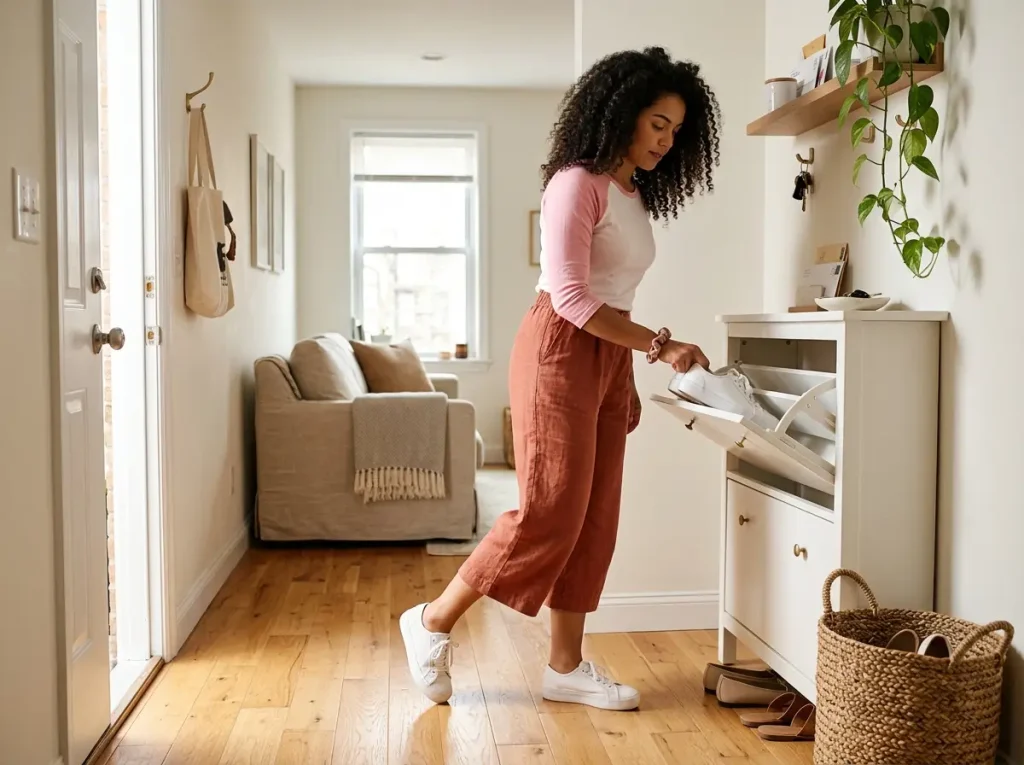
You walk in, drop your bag, toe off your shoes, and they land on the same patch of floor where three other pairs already live. By Thursday it’s a small mountain you step over on the way out. I’ve set up entryway shoe storage in three apartments where the front door opened straight into the living room, with no closet and no real landing, and the pile came back every single time until I figured out why.
It isn’t a discipline problem. It’s a design problem with a fixable cause, and the fix slots right into your wider shoe organization system for the pairs that don’t belong by the door. Here are the entryway shoe storage ideas that actually fit a tight front door, sorted by the constraint you’re fighting.
Quick Answer
Match the storage to the constraint you’re actually fighting:
- No closet, door opens into the room — a slim tilt-out cabinet that reads as furniture
- Tight floor, door swings across it — measure the swing first, then go under 8 inches deep
- Wet or winter shoes — an open ventilated rack over a boot tray, never a sealed cabinet
- Two or three daily pairs — one big basket by the door, toss-and-go
- A whole household — one labeled spot per person, kids’ shoes low and reachable
- Renting — freestanding, no-drill pieces (leaning rack, slim cabinet, adhesive hooks)
Why Your Entryway Shoe Pile Keeps Coming Back
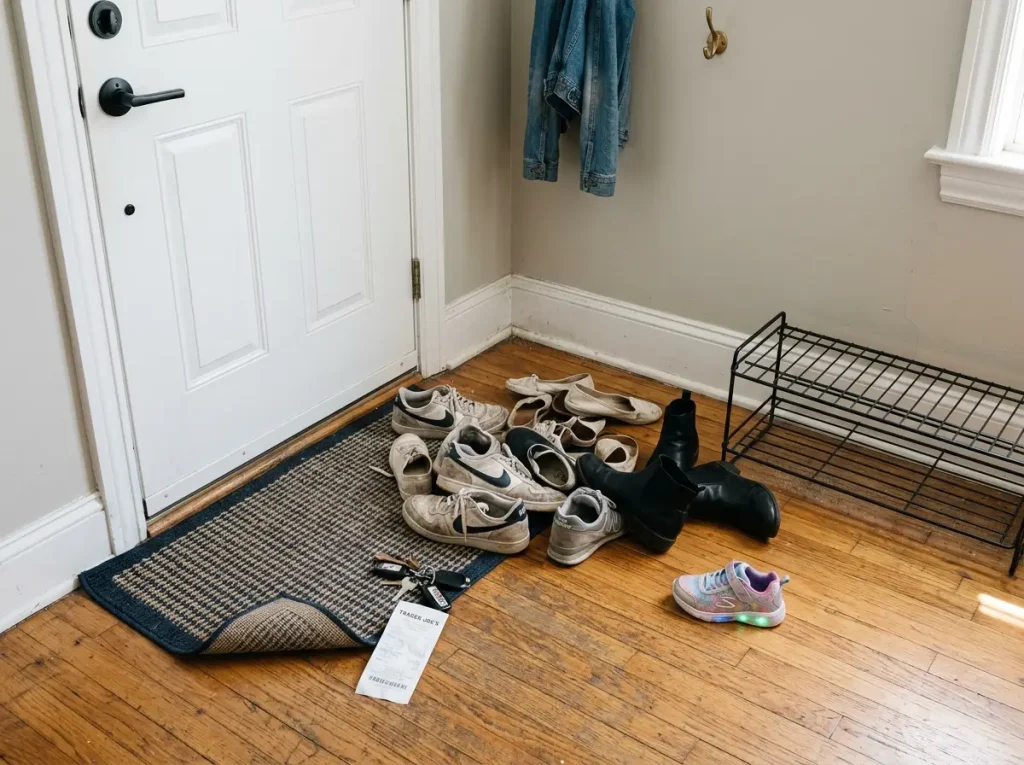
Everyone treats the entryway pile like a willpower failure. It isn’t. The pile comes back because dropping a shoe on the floor takes zero steps, and whatever storage you bought takes more than zero. Your brain does the math in half a second and picks the floor every time.
If the basket has a lid, if the rack means bending down, if the cabinet drawer needs two hands, the daily shoe never makes it in. It lands where your foot already is.
So the rule that fixes the pile is boring and physical: the spot for your grab-and-go shoes has to sit right at the drop point and ask for nothing. No lid to lift, no bending, no aiming. Professional organizers say the same thing in a nicer way, which is to keep daily shoes off the floor and at grab level so putting them away feels automatic. Family Handyman’s rundown of entryway shoe storage that actually holds up day to day lands in the same place: the setups that survive are the ones at the door, not the clever ones three steps away.
The second reason the pile returns is capacity. You’re trying to store your whole collection at the door, and the door zone was never meant to hold it. The entryway is for the rotation you’re wearing this week, two or three pairs per person, full stop. Everything else lives in a closet or under a bed.
I learned this the hard way with a wire rack I shoved against the baseboard in my first place. It held nine pairs, it looked cluttered and disastrous within a week, and the overflow piled on the floor in front of it anyway. The rack wasn’t too small. The job was too big.
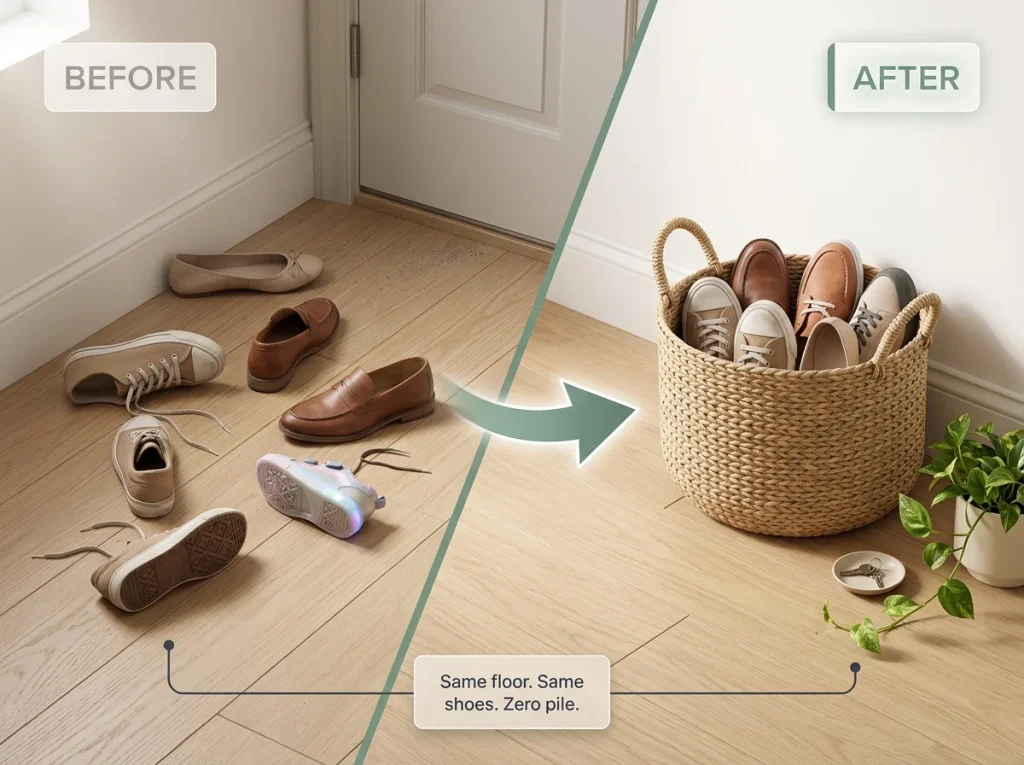
Before you buy anything, do a one-week test with a cardboard box at the drop point. If your shoes land in it without you thinking, that’s your storage zone. If they keep missing it, the box is in the wrong spot, and no expensive cabinet will fix a bad location.
Measure the Zone Before You Buy Anything
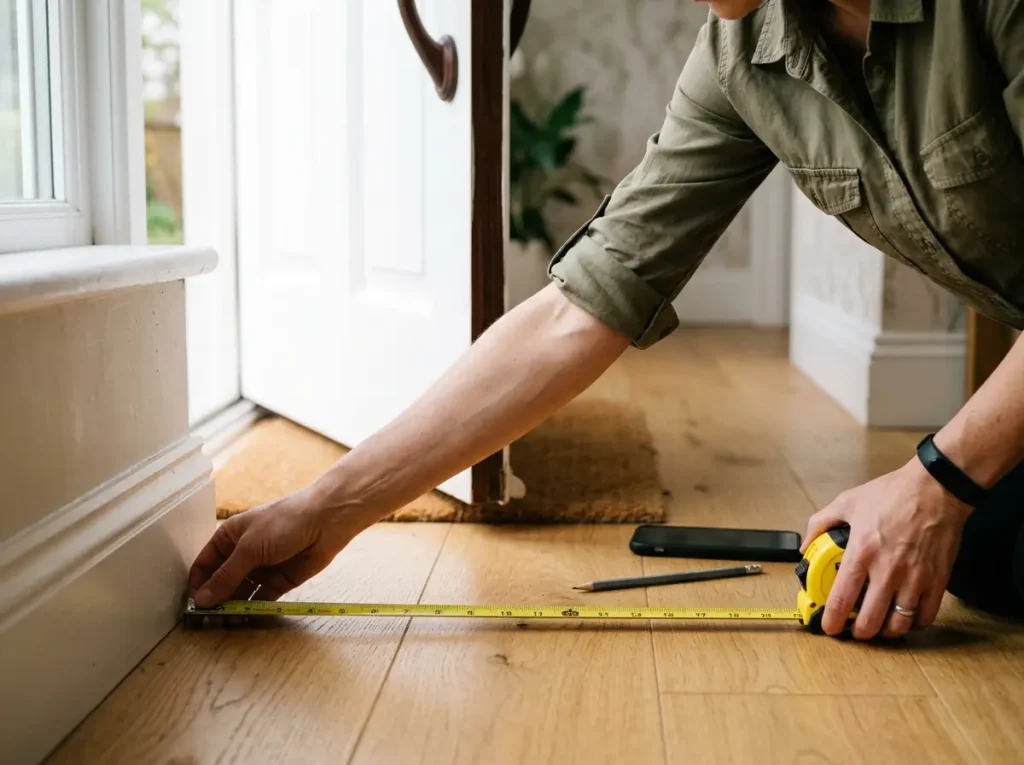
I used to tell people to measure the wall. That’s the wrong number. The number that actually decides what fits is the arc your door carves out of the floor when it swings open.
The door sweeps a quarter-circle, and that quarter-circle is almost always exactly where you wanted to put the cabinet. Buy for the wall width and ignore the swing, and you end up with a beautiful piece that won’t let the door close.
The first slim cabinet I bought was 13 inches deep and looked right against the wall. Then the door caught the corner of it on the way open, and I spent a week sidling past before I admitted defeat and returned it.
So measure two things. Open your front door to its full arc and mark where the leading edge lands, then keep all furniture outside that line. Then look at depth: anything past about 7 to 8 inches starts to feel like a wall in a tight entry.
Slim tilt-out cabinets run 7 to 11 inches deep, while flat-shelf racks need 13 to 14 because shoes lie flat on them. That depth difference is the whole game by a front door.
Leave 24 to 30 inches of clear floor in front of whatever you choose, too, so the door and a tilt-out drawer can both open without a standoff. And watch the small traps: a thick baseboard pushes a cabinet an inch off the wall, and a radiator or a coat-closet door that also swings into the zone can quietly eat the space you measured.
Cut a piece of cardboard to the depth of any cabinet you’re considering and tape it to the floor for two days. You’ll feel a 9-inch intrusion every time you squeeze past with grocery bags, long before you’ve spent a dime. That walk-past test has talked me out of more furniture than any review ever has.
When There’s No Closet and the Door Opens Into the Room
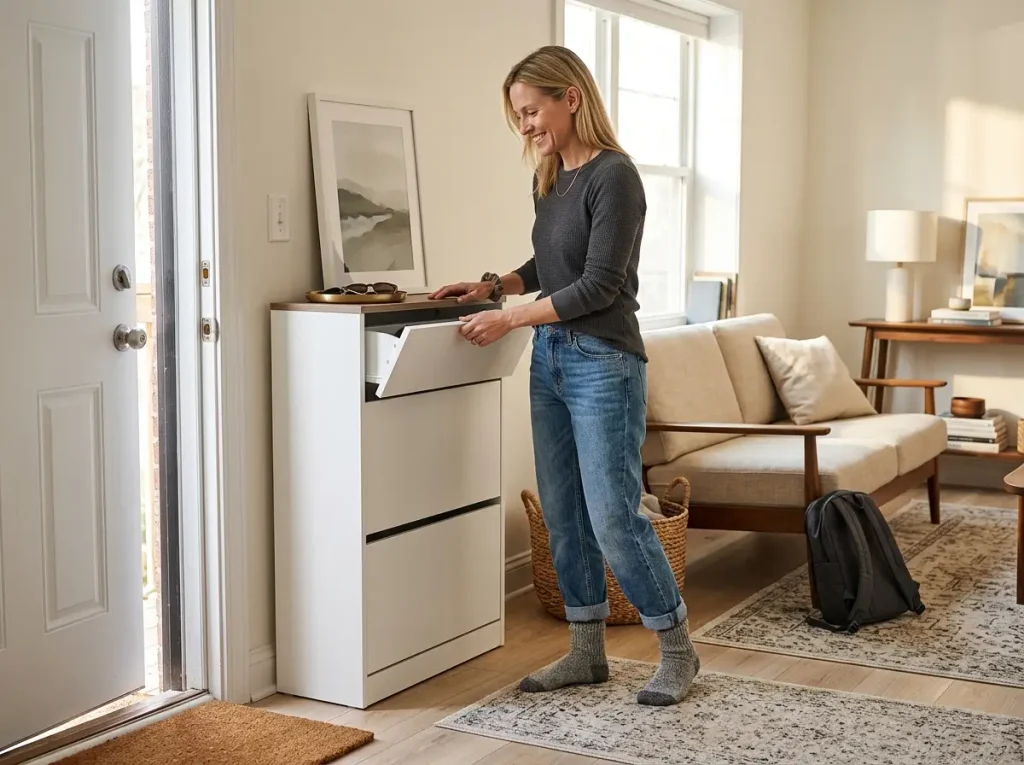
This is the layout nobody writes for, and it’s the one a lot of renters actually have. The door opens straight into the living room. There’s no foyer, no coat closet, no real landing, and the shoes are in your living space the second you walk in. One reader described it as tripping over a pile all day, which is exactly right, because the entry and the room you relax in are the same six feet of floor.
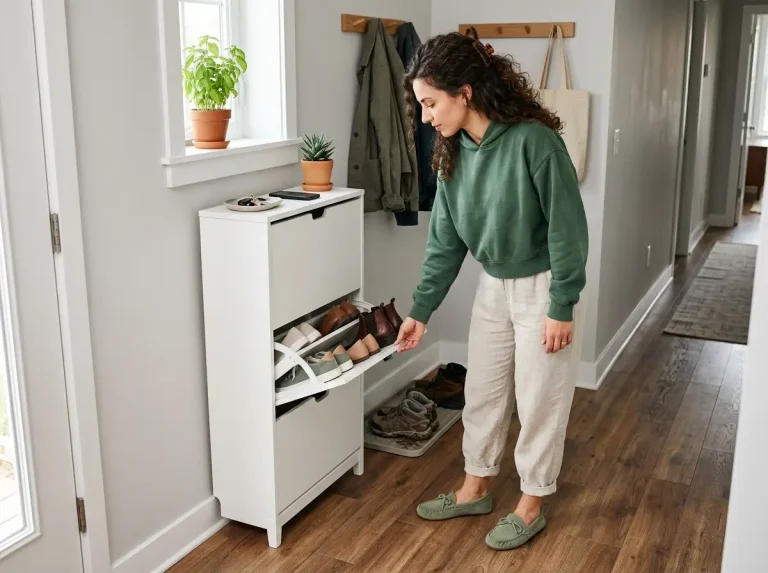
In a space like that, open storage works against you. An open rack in a room where you also eat and unwind is permanently on display, so it has to be tidy at all times or it reads as mess. Closed storage forgives the daily chaos instead. That’s why a slim tilt-out cabinet is the hero here: it hides the shoes behind a flat front and reads as a console, not a shoe rack.
The VASAGLE Slim Shoe Cabinet is only 9.4 inches deep and 23.6 inches wide, with three flip-down drawers that swallow the daily rotation while looking like a low sideboard against the wall. It’s freestanding, so there’s no anchoring and nothing for a landlord to object to. The drawers hold flats and sneakers easily but fight tall boots, so keep those somewhere else. If you want the same idea for less, the Haotian 4-Flip-Drawer Cabinet runs the same shallow depth with one more drawer.
Here’s the part the furniture guides skip, though. If you own two or three daily pairs, you may not need a cabinet at all. A basket you already have, or a bench sitting empty in another room, can do the whole job, and the anti-sell matters more in a studio where every piece you add crowds the space you live in.
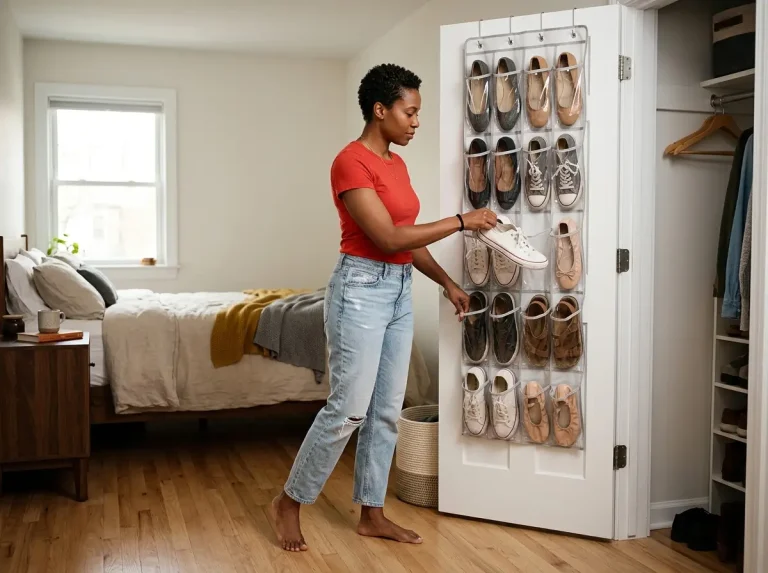
When there’s genuinely zero floor to give, go up instead: an over-the-door organizer earns the no-floor space on the front door itself, and the door-mechanics details live in that guide so I won’t repeat them here. A low rolling rack that you push out of sight when company comes is the other move for a no-wall entry. If the whole open-plan layout is the real problem, it helps to carve out an entry zone in an open floor plan first, then place the shoe storage inside it.
Benches, Hall Trees, and the Console-Plus-Baskets Combo
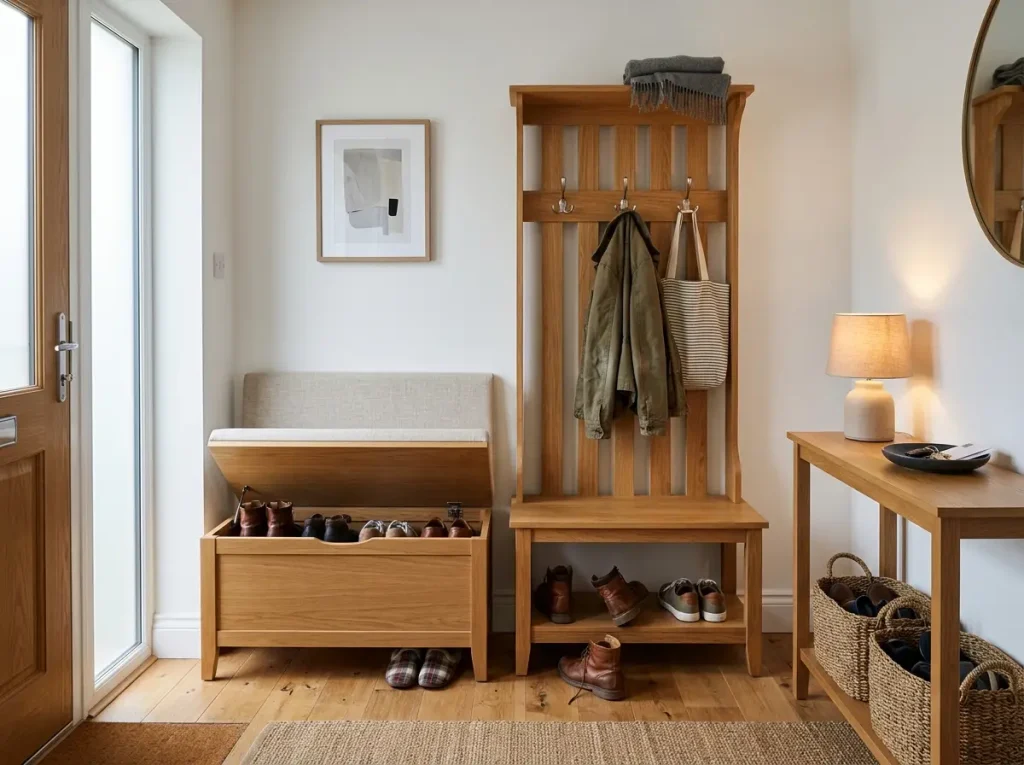
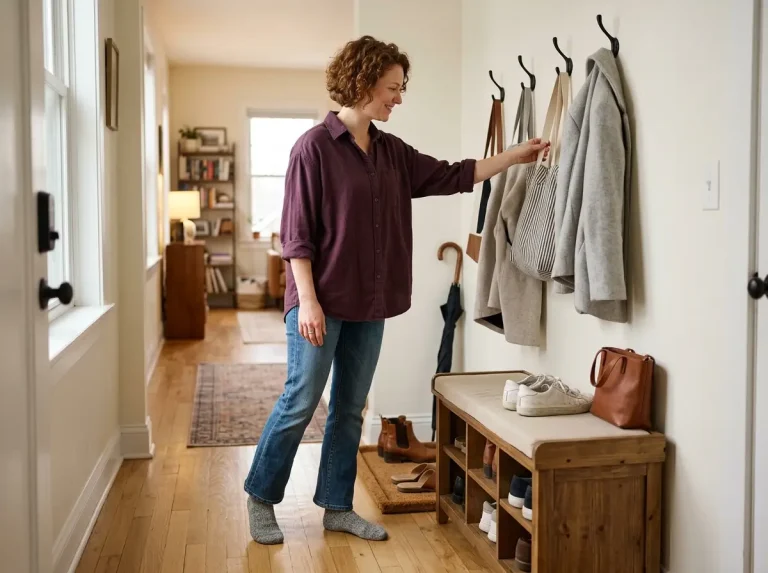
A bench earns its footprint only if you’d sit on it anyway. And honestly, you should, because putting shoes on standing up on one foot by the door is how people fall into walls. A storage bench gives you a place to sit and a hidden box underneath in the same footprint.
The HOMEFORT 30-inch Lift-Top Storage Bench is slim enough to clear most door swings at 30 inches wide, and the seat lifts to reveal a bin that holds the daily pairs out of sight. The one caveat with lift-tops is that you can’t get into them while you’re sitting there, so they suit the off-rotation pairs more than the shoes you grab on the way out. For a softer-on-the-budget version, the PETKABOO Bamboo Bench does the sit-and-store job with an open lower shelf instead of a lid.
When you have one vertical slice of wall and need it to do everything, a hall tree is the whole-entry kit in a single piece: hooks for coats up top, a seat in the middle, a shoe shelf at the bottom. The VASAGLE Hall Tree bundles all four jobs at one door, which is the entire point when there’s nowhere else to put a coat. One real safety note, though, and it matters if you have kids: a tall hall tree can tip if a child climbs the shelves or hangs off the hooks. The furniture tip-over guidance from the CPSC is worth two minutes here, and the fix is simple enough, either anchor it or choose a low, wide-based piece like the VASAGLE CUSTOS 10-Cubby that has no height to tip.
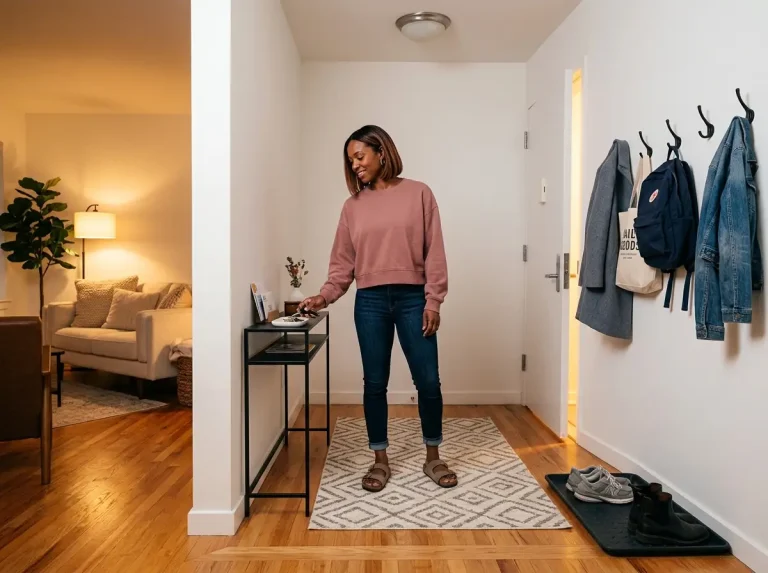
The quietest option in this family is a narrow console with two baskets tucked underneath. It turns a pass-through wall into storage without looking like storage at all, the baskets slide out for the kids, and the top holds keys and mail (where they were going to land anyway). If you’re weighing pieces, these are the bench styles that double as entryway storage without forcing you into a full mudroom build.
Baskets and the Toss-and-Go System
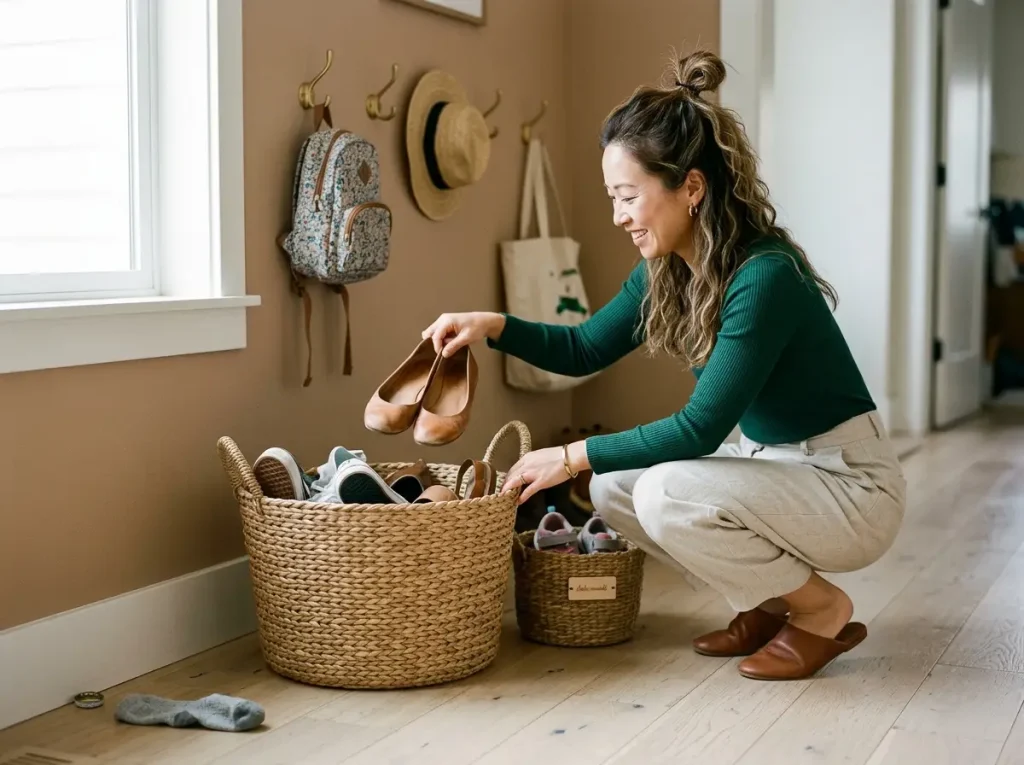
The simplest system that survives a real household is also the cheapest: one big basket you toss shoes into. No lid, no lining up, no rule a five-year-old can’t follow. It works because it asks for nothing, which loops straight back to the friction problem from the top of this article. A large woven basket holds two or three pairs of light shoes or a kid’s whole rotation, and the open top means the shoe goes in on the first try.
You do not need to spend much here, and you might not need to spend anything. A basket you already own works. So does a plain milk crate, which is honestly the move for a big family with muddy play shoes, because the open weave lets air through and a kid can throw a sneaker in from three feet away. The prettier woven version earns its keep in a studio where the basket sits in your living room. The Large Woven Seagrass Basket runs about 20 inches wide with handles, enough for the daily pairs without trying to swallow your whole collection.
Either way, skip baskets for wet boots. They have no drainage, so a soaked boot just sits in its own puddle, and that’s a job for the next section.
The basket also solves the shared-entry problem better than any cabinet. One basket per person, each at a height they can reach, and the scatter stops.
In my sister’s place, four people dropped shoes at one door and the hallway stayed a wreck until we gave each kid a single basket at knee height. The scatter through the house stopped within days, because the five-year-old could finally reach his own and put a shoe back without help. That was the whole trick.
Give each person’s basket a quiet label, a luggage tag on the handle or a strip of washi tape inside the rim, not a giant vinyl name across the front. People follow a system they can see at a glance, and they’re far less likely to dump a basket they think of as theirs.
Open Racks and the Wet-Shoe Problem
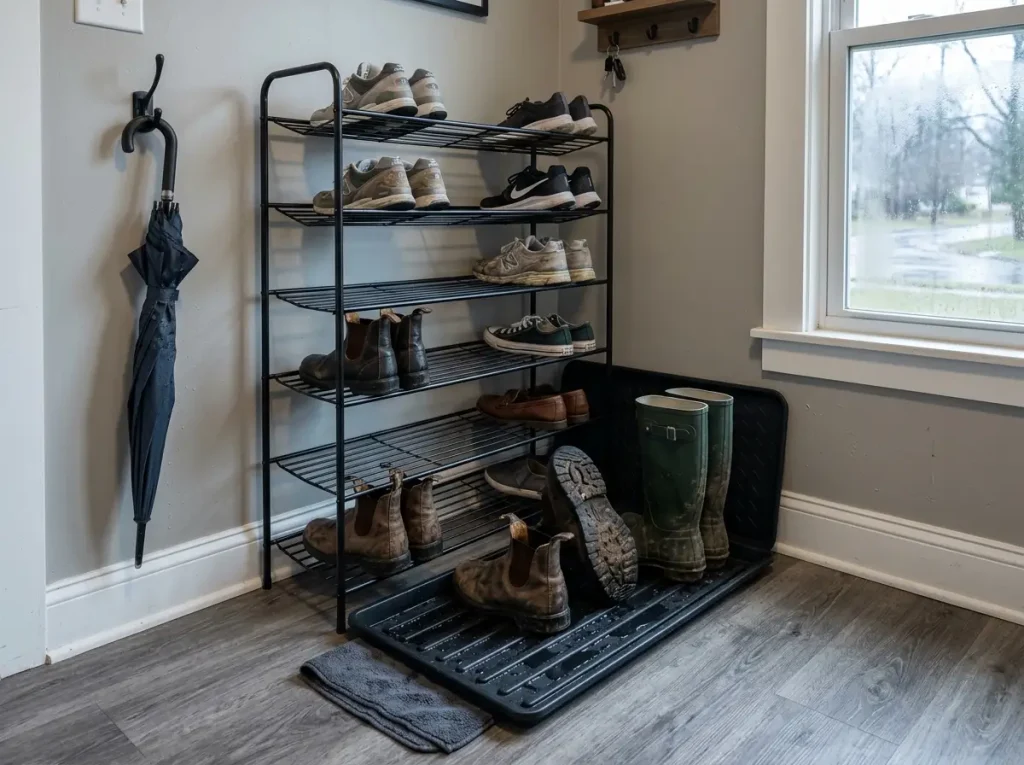
This is the section that keeps your entry from smelling like a locker room in February. Entryway shoes are the dirty ones. They come in caked with slush, rain, and road salt, and a wet shoe needs two things a sealed cabinet can’t give it: air and somewhere for the water to go.
I used to push closed cabinets for the clean look. Then I shoved a pair of salted winter boots into one to deal with later, and two weeks on, opening that cabinet hit you with a damp gym-bag smell that took baking soda and three days of an open door to clear. Sealed plus damp equals odor. Every time.
So for the wet months, go open. A slim ventilated rack lets air move around each pair, and the SONGMICS 5-Tier Slim Rack is only 8.3 inches deep, so it hugs the baseboard while its open metal tiers keep airflow on every shoe. Under it, or just inside the door, put a boot tray with raised channels. The SUPENUIN Boot Tray lifts the boot up out of the slush it sheds so the water drains away and the shoe dries instead of stewing in a puddle.
The tray is the part that protects your floor and your nose, so don’t skip it for winter boots. The working hybrid that real people land on is a boot tray on the bottom with a small ventilated shelf above it, drip catch below and airflow up top, and the LANTEFUL 10-Tier Rack or a small boot tray 2-pack cover the budget end of both halves.
If a closed cabinet is genuinely your only option in winter, you can make it survivable. Toss in a few silica packs, store damp shoes in breathable cotton or linen bags rather than sealed plastic, and crack the door for an hour after you come in so the moisture can leave. It’s a patch, not a fix, but it beats the gym-bag smell. For a wider look at how the racks stack up, here’s how the open-rack and boot-tray picks compare across spaces.
Line the bottom of your boot tray with a few smooth river stones from the garden center. The boots sit up on the stones above the meltwater instead of in it, which dries them faster and keeps the salt line off the soles. It costs almost nothing and works better than the fancy ribbed inserts.
Making It Work for a Whole Household (Without Drilling)
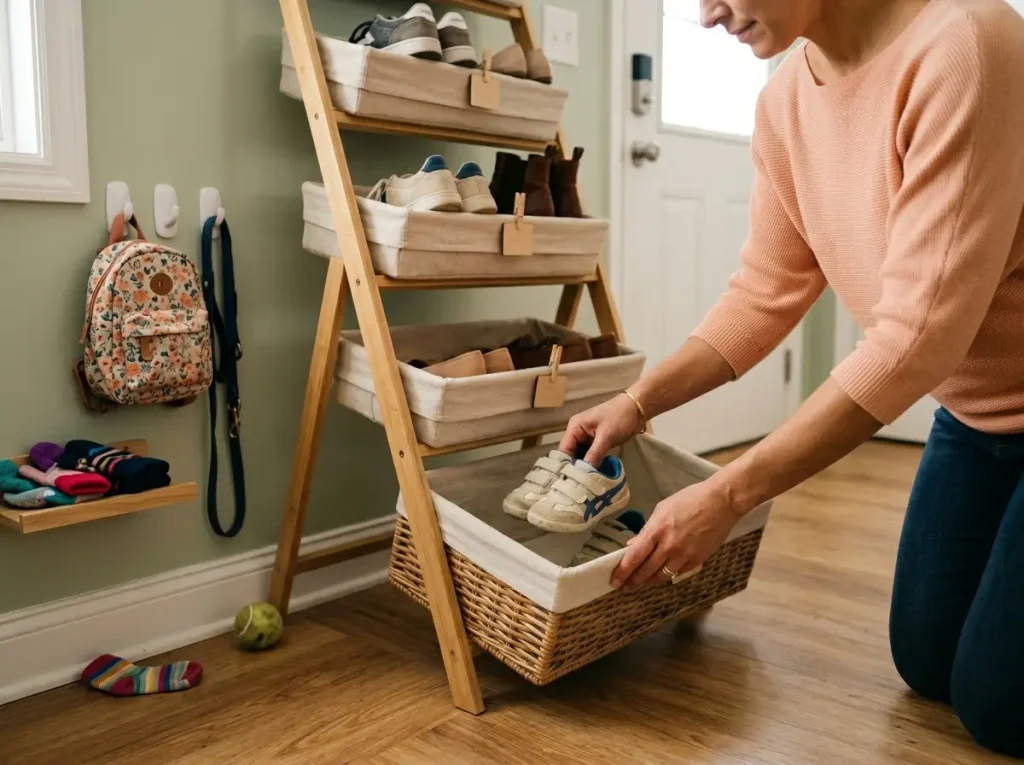
A system fails the moment one person won’t follow it. The fix is never more discipline. It’s one obvious spot per person and nothing that needs a drill.
Give every household member a single, named landing zone, a basket, a tier, a cubby, and make the kids’ spots the lowest and most open ones (a lidless basket beats a drawer for a four-year-old every time) so they can serve themselves and, more importantly, re-serve themselves. A shoe a child can’t reach to put away is a shoe on the floor.
For renters, the no-drill trio carries the whole load. A freestanding slim cabinet that doesn’t anchor to anything, a leaning or tiered rack that just rests against the wall, and a few adhesive hooks for the leashes and tote bags that otherwise end up on the floor with the shoes. None of it touches the wall structure, all of it leaves with you, and it covers a family’s daily rotation. If you want the method behind the mounting, these no-drill setups that don’t cost you the deposit translate straight to an entryway.
The last piece is the one people skip, and it’s the reason most entry systems quietly die. Keep only the daily rotation at the door. Two or three pairs per person, the shoes you’re actually wearing this week. The dress shoes, the off-season boots, the gym pair you use twice a month, all of that goes to a closet or you send the off-season pairs under the bed.
When a spot at the door starts collecting a second layer, that’s not a storage failure. That’s the door zone telling you it’s holding more pairs than it was sized for. A 30-second reset once a week, just walking the strays back to their spot, is what keeps the whole thing alive long past the after photo.
Putting It Together
Three things matter more than which piece you buy. Measure the door swing before anything else, because the prettiest cabinet is useless if it won’t let the door close. Store only the daily rotation at the door, and send the rest of the collection somewhere it can live without crowding the entry. And match the storage to the constraint you’re fighting: hide it behind a slim cabinet in an open plan, vent it over a boot tray for wet shoes, and give everyone one reachable basket if you share the space.
In three months, check one thing. If any spot has started growing a second layer of shoes, you’re storing too many pairs at the door, not failing at the system. Pull the extras back to the closet and the door zone settles down again.
Start with the door swing and one basket. Get the daily pairs off the floor first, then add the cabinet later if you still need it.
Frequently Asked Questions
01How do I store shoes in an entryway with no closet?
Use a slim freestanding tilt-out cabinet that reads as furniture, plus one basket for the daily pairs. If you have zero floor to spare, move to an over-the-door organizer on the front door. All three are renter-safe and need no drilling.
02What is the best shoe storage for a small entryway?
The shallowest piece that clears your door swing, usually a slim cabinet at 7 to 11 inches deep or a leaning rack. Skip flat-shelf racks, which need 13 to 14 inches and crowd a tight front door. Measure the swing before you buy.
03How do you keep entryway shoes from piling up?
Store only the daily rotation at the door, in a spot that needs zero steps, no lid, no bending. The pile is a friction problem, not a willpower one. Send every off-season and occasional pair to a closet so the door zone never gets overstuffed.
04How do you store wet or dirty shoes by the front door?
Use an open ventilated rack over a boot tray with raised channels so water drains away and air dries the shoe. Never seal wet shoes in a closed cabinet, which traps moisture and starts the odor. The tray protects your floor at the same time.
05How many pairs of shoes should you keep in the entryway?
Two or three daily pairs per person. The entryway is for the rotation you’re wearing now, not the whole collection. If a spot starts collecting a second layer, that’s the signal you’re storing too many pairs at the door.
Disclaimer: ClutterlessNest is a participant in the Amazon Services LLC Associates Program. As an Amazon Associate we earn from qualifying purchases. This article may contain affiliate links — if you buy through them, we may earn a small commission at no extra cost to you. We only recommend products we have tested or genuinely believe in.