










In this article
You bought a shoe rack. It holds twelve pairs. You have fourteen pairs you actually wear, and you still haven’t measured the hallway. I’ve done this exact thing, and so has almost everyone who organizes a small entryway for the first time. The problem was never the rack — it was that I picked it off a product page based on how many pairs it claimed to hold, when the spec that actually decides whether a rack works in an apartment is its depth against your walkway. This guide ranks apartment shoe racks the way they should be ranked: by how they fit a real entryway, not by a number printed on the box.
Quick Answer
Match the rack to your hallway width first, then to your shoe count. The best apartment picks by situation:
- Hallway under 42 inches wide — over-door organizer, zero floor footprint
- Narrow hallway, want it hidden — slim flip-drawer cabinet under 10 inches deep
- Tight budget, open access — slim 5-tier rack that fits a door-frame gap
- Most pairs, least floor space — tall 10-tier rack in a corner
- Room to spare, want seating — narrow flip-drawer bench
This article goes deep on the products. For the full framework of how to measure and set up your entry zone from scratch, start with our guide to entryway shoe storage.
Before You Buy Any Shoe Rack, Measure This First

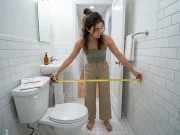
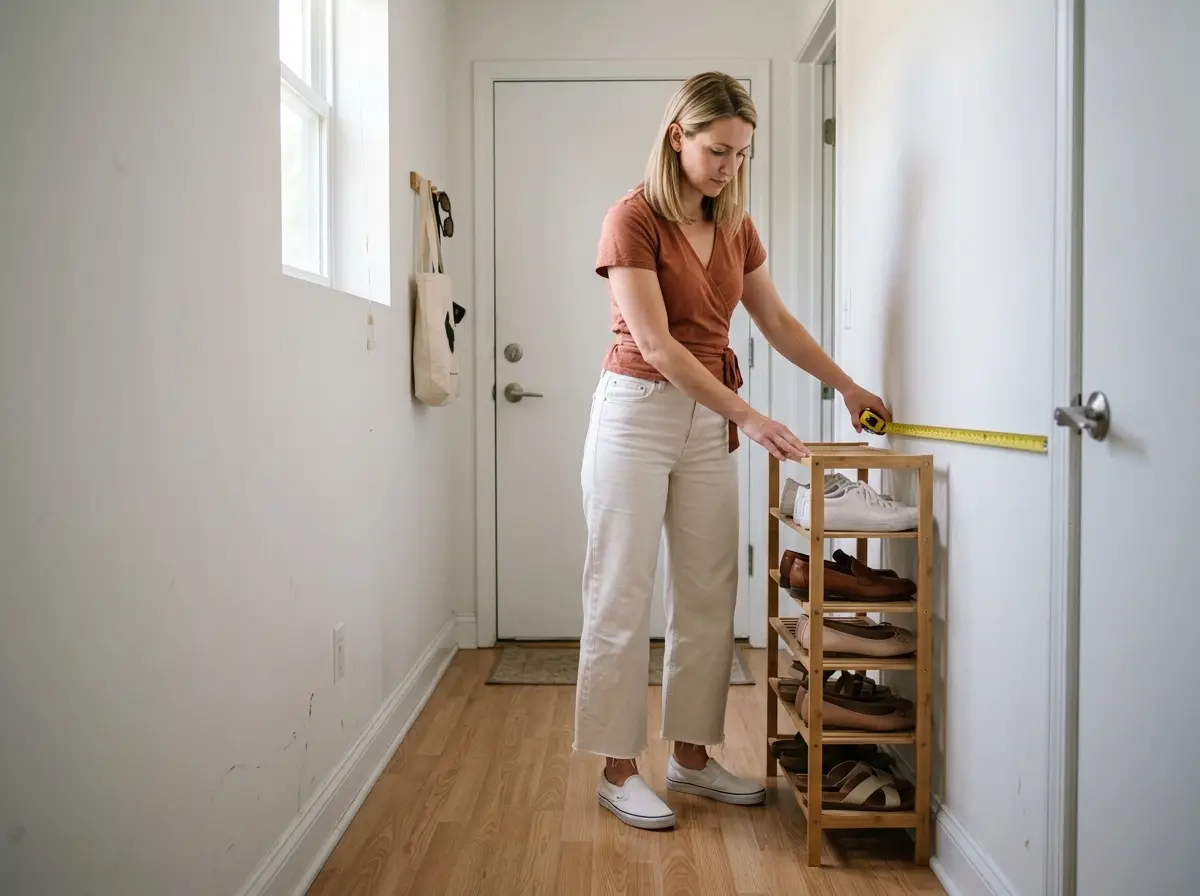
Here’s the step everyone skips. You fall for a rack online because it looks clean and holds a lot, it arrives, and then it either blocks the door or turns your hallway into a tunnel you have to turn sideways to walk through. The measuring takes thirty seconds and saves you a return shipping label.
The one number that matters most is walkway clearance. Take your hallway width, subtract the depth of the rack you’re eyeing, and what’s left has to clear 36 inches. That’s the standard minimum for a path people can actually walk through without shuffling. Most apartment hallways run 36 to 48 inches wide. Do the math before you fall for anything, and it’s the same 36-inch walkway clearance rule we use for every entryway organizer.
The Formula — Hallway Width Minus Rack Depth
Run your actual width through it. In a 36-inch hallway, the math says your maximum rack depth is zero — which sounds absurd, but it’s telling you something true: a freestanding rack will block that hallway no matter how slim it is. Your only real option is an over-door organizer. In a 42-inch hallway, you’ve got 6 inches to play with, which rules out almost every standard rack (most are 12 to 15 inches deep). In a 48-inch hallway, you finally have up to 12 inches of depth to work with, and most slim racks fit.
That’s why depth, not capacity, is the first filter. A rack that holds twenty pairs is useless if it eats your only path to the door.
How Many Pairs Belong at the Door
Count the shoes you’ve worn in the last two weeks. For most people that’s five to seven pairs — the sneakers, the work shoes, the one pair of boots you’re living in this season. That’s what the entryway rack is for. Not your whole collection.
I used to tell people to buy the biggest rack that fit and fill it. After watching that backfire in my own place and a dozen others, I changed my advice completely. The entryway rack is a daily-rotation zone, not a storage unit. Everything else — off-season pairs, the dress shoes you wear twice a year — lives somewhere else. (Yes, this means the rack near your door will look half-empty sometimes. That’s the system working, not failing.)
The Two Measurements Nobody Takes
First, your door swing. Open your front door all the way and notice where the edge travels. If your planned rack sits inside that arc, you’ll be nudging it aside every single time you come home. I learned this in an apartment where the door cleared the rack by about an inch — for the first week. Then a winter coat on the rack’s side hook tipped the math, and the door started catching on it daily.
Second, your floor. Hard floors — tile, vinyl, wood — let a loaded rack slide when someone yanks a shoe out of it, and the feet can scratch the finish you’ll be paying for when you move out. Rubber-footed racks or a set of felt pads underneath solve both problems for almost nothing.
Measure the door swing with the door’s worst-case load in place — a heavy coat or a tote bag on the rack’s side, not the empty rack. The arc that clears today fails the first time something bulky hangs off the near side.
Open Tiered Racks — The Budget Option That Earns Its Keep
Open tiered racks are everywhere because they’re cheap and you can build one in ten minutes. That’s also why most of them are disappointing — the cheapest ones survive exactly one apartment move before the plastic connectors crack on reassembly (I’ve lost two this way, both at the worst possible moment, both surrounded by half-packed boxes). But the good ones do a real job: fastest access for daily shoes, easy to reconfigure, no hidden cost. The trick is knowing which spec to check before you click buy.
What to Look For Before Buying — Depth and Tier Spacing
Two specs decide whether an open rack actually holds shoes or just looks like it should. Depth needs to land around 11 to 13 inches — enough that a men’s size 10 (about 11.5 inches long) sits flat instead of hanging its heel off the back edge. And tier spacing needs at least 6 inches of vertical gap, more like 7 for anything with a chunky sole. Tiers spaced tighter than that force shoes in at a diagonal, and a diagonal shoe is a shoe that slides off in the night.
Most people buy on capacity — the “holds 15 pairs!” number — and ignore depth and spacing entirely. Those two specs are the ones that determine whether the thing works on a Tuesday morning.
The SONGMICS ULSH55H — Best for the Door-Frame Gap
Almost every apartment has one weird narrow slot that no normal furniture fits: the gap between a door frame and the adjacent wall, usually 8 or 9 inches wide. I spent two apartments treating that space as useless before realizing a slim rack was built for exactly it.

If you’re a renter who moves often, look for the version with metal connectors rather than the cheapest plastic-jointed model — the same logic runs through our no-drill closet organization guide for renters, where portability across moves matters more than a few dollars saved up front.
When to Skip Open Racks Entirely
Open racks show everything. Whatever lands on them — a muddy sneaker, a flattened slipper, the bag someone dropped on top — is on display. If your entryway is the first thing guests see, or you share it with kids or a partner who treats the rack as a launchpad, the open style fights you. That’s where the closed cabinet options below earn their higher price.
Slim Shoe Cabinets — The Apartment-Specific Design
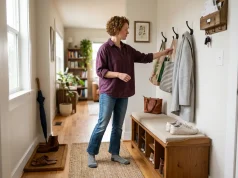
A shoe cabinet looks like furniture. Guests see a console, not a pile of footwear, and that single fact is why cabinets win for entryways people actually entertain in. The flip-drawer kind goes one better in a tight apartment, because it needs no swing clearance at all.
Why Flip Drawers Beat Hinged Doors in Tight Entryways
A hinged cabinet door needs clearance equal to its own width to open — call it 12 to 16 inches of empty air in front of it. In a 36-inch hallway, that door swings right into the opposite wall. A flip drawer tilts open within the cabinet’s own footprint, so it works flush against a wall in a space where a hinged door is dead on arrival.
The Haotian FSR196-W at 9.4 Inches Deep
Run a standard 12-to-14-inch-deep cabinet through the clearance formula in a 48-inch hallway and you’re left with 34 to 36 inches — right at the edge of too tight. The Haotian’s 9.4-inch depth leaves you 38-plus inches in the same hallway. That’s the difference between a walkway that feels normal and one that feels like an obstacle course.
Sizing for One-Person vs. Two-Person Apartments
For one person, the FSR196-W plus a seasonal rotation to under-bed storage covers everything. For two people, sixteen pairs fills up fast — add a second solution rather than buying a wider cabinet that breaks your clearance math. Two slim cabinets side by side work if their combined depth still clears the walkway, or pair the cabinet with an over-door organizer for the second person’s daily pairs. And honestly, two people sharing one entryway is the moment the daily-use-only rule stops being optional and becomes the thing holding the whole system together.
Tall Narrow Racks — Maximum Pairs in Minimum Footprint
The tall narrow rack is the solution that usually just works — until you try to store boots on it. It trades floor space for ceiling space, which is exactly the trade an apartment entryway wants to make.
The Footprint Math — Why Vertical Beats Wide
A wide 3-tier rack takes roughly three times the floor footprint of a tall vertical one for similar capacity. In a small entryway, floor is the scarce resource and the air above 4 feet is doing nothing. Going vertical claims that wasted column. For the broader version of this idea across every room, our vertical storage principles for apartments cover weight limits and anti-tip methods in detail.
The LANTEFUL B0BZ42GY8V — What the Numbers Don’t Tell You
The spec sheet gives you 10 tiers and an 11.5-inch square base. What it doesn’t tell you is that the five side hooks quietly replace a separate key-and-bag station, and that corner placement solves the tip-over problem without a single hole in the wall.
Load a tall rack from the bottom up and put your heaviest pairs on the lowest tiers. A top-heavy tower tips; a bottom-heavy one stays put even before you tuck it into a corner.
Tall Racks and the Boot Problem
Tall boots are where flat-tier racks fall apart. A 12-inch shaft has nothing to lean against on a flat tier, so it flops sideways and takes over the tier below it. Ankle boots with a 6-to-8-inch shaft balance only if the tier is deep enough that the toe doesn’t overhang. The community calls this the “boot problem,” and there’s no fix that makes a standard tiered rack good at it.
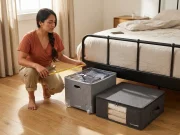
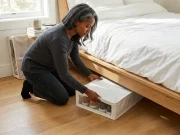
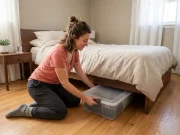
The real answer is to stop forcing it. Tall boots that won’t stand on any entryway rack belong in under-bed shoe storage for boots, where they lie flat and keep their shaft shape instead of creasing at the ankle. The entryway rack holds what you wear weekly; the boots you wear in one season live elsewhere the rest of the year.
Zero Floor Space — Over-Door and Behind-Door Options
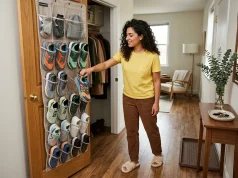
Over-door organizers are the fallback everyone recommends and almost nobody pressure-tests. The advice is fine right up until the part nobody mentions: it depends entirely on what kind of door you have. Most apartments have hollow-core interior doors, and that changes what an over-door rack can hold before it starts failing.
The Hollow-Core Door Test (Do This Before Buying)
Knock on your door. A solid-core door answers with a firm, dense thud — like rapping a workbench. A hollow-core door sounds tinny and resonant, almost like a drum. Nearly every interior door in an apartment is hollow-core. We covered this same hollow-core door tap test in the entry shoe guide, and it matters here for one reason: weight.
A hollow-core door handles around 25 to 35 pounds when the load is spread evenly across the hook. Concentrate that weight low — heavy shoes crammed in the bottom pockets — and you create a lever that pries the bottom of the organizer away from the door. Over weeks, the hooks start walking toward the center of the door’s top edge, and one day the whole thing dumps your shoes on the floor. The same physics behind furniture tip-over risk with heavy loads is at work on a smaller scale here.
How Many Pairs It Actually Holds
The listing says 24 pockets. That reads as 24 shoes, which is 12 pairs — but only if every pocket holds exactly one shoe, and only flats and sandals cooperate. Sneakers bulge out of the pocket, boots don’t fit at all. Plan for eight to ten functional pairs, not twelve.
The Behind-the-Door Alternative for Solid Doors
If your tap test came back solid — heavier door, often a painted steel exterior entry door — you’ve got more options. Rail-style over-door racks (the rigid kind that hold shoes on horizontal bars) can take real weight on a solid door without the lever problem. Most apartment renters won’t have this on an interior door, so check before you assume. The pocket organizer above is the safer default for the hollow-core doors that dominate apartments.
The Bench Option — Seating and Shoe Storage Together
The bench is the solution everyone wants and maybe one in five apartments can actually fit. The photo you saved looks great because it was shot in a house with a proper foyer. Before you buy one, be honest about whether your entryway has the floor to give.
Which Entryways Have Room for a Bench
A bench needs at least 36 inches of width and around 30 inches of depth beyond your walkway clearance. That’s a real chunk of floor. An apartment with an actual entry hall or an open foyer can swing it; a door that opens straight into the living room, or a galley-style entry, cannot. Run the numbers first — the bench clearance math for narrow entryways walks through the exact calculation. Conventional wisdom treats a bench as the upgrade you graduate to. In a small apartment it’s often the downgrade that eats the floor a slim rack would’ve kept clear.
The Haotian FSR82-K-W — What It Actually Holds
For the apartments that do have the room, this is the bench that earns it.
Why Bench Tops Become Clutter Magnets (and the Fix)
Here’s the failure mode that catches everyone. You use the bench to sit and put on shoes — good. You also set the mail there, then the package, then whatever’s in your hands when you walk in. Within six weeks the bench top is a drop zone for everything, the storage drawer hasn’t been opened in a month, and the shoes are back on the floor. The bench became the shoe graveyard it was supposed to prevent.
The fix is a rule, not a product. One item lives on the bench top — a small key tray, nothing else. And the flip drawer gets the same daily-use treatment as every other option here: only the two or three pairs you reach for most.
Put the one allowed object on the bench top the day it arrives — a key tray you actually like. An empty surface invites a pile; a surface that already has a clear purpose resists one. The tray is the bouncer.
Conclusion
Three things carry the whole system. Measure your hallway width and subtract from 36 inches of clearance — that one number eliminates most of the racks being sold before you spend a dollar. Treat the entryway rack as a daily-rotation zone, not total shoe storage, so off-season and occasion pairs live in the closet or under the bed instead of crowding what you reach for every day. And remember that the best rack is the one that disappears into your routine; if you’re moving shoes aside to use it, it’s wrong for your space.
In three months, do a quick audit: is the rack still holding only daily-use shoes, or has it quietly collected off-season pairs again? That drift is the only thing that breaks these systems, and a two-minute check catches it.
Start by measuring your hallway width today. That single number tells you exactly which type of rack works before you look at a single listing. Once the shoes are handled, set up a key and mail organizer for the same zone and the whole drop zone finally works as one.
Frequently Asked Questions
01What is the best shoe rack for a small apartment entryway?
It depends on your hallway width, so run the clearance math first. For hallways under 42 inches wide, only over-door organizers or ultra-slim cabinets under 10 inches deep fit without blocking the walkway. For 42 to 48 inch hallways, a slim flip-drawer cabinet or a narrow tiered rack works.
02How many pairs of shoes should I store in an apartment entryway?
Only the pairs you have worn in the last two weeks, which is typically five to seven for most people. Off-season shoes and rarely worn pairs belong in the closet or under the bed, not competing for entryway space with your daily rotation.
03What shoe storage works for renters who cannot drill into walls?
Freestanding racks and cabinets need no drilling at all. For tall racks that could tip, positioning them in a corner uses two walls as natural stabilizers with zero anchors. Over-door organizers also require no drilling, just check your door type first.
04How deep should an entryway shoe rack be to keep the hallway clear?
Maximum rack depth equals your hallway width minus 36 inches. In a 48-inch hallway that means 12 inches of depth; in a 42-inch hallway, just 6 inches. Most standard racks run 12 to 15 inches deep, so they only fit comfortably in hallways 48 inches or wider.
05What is the difference between a shoe rack and a shoe cabinet for apartments?
Open racks are cheaper and faster to access but show everything on them. Cabinets with flip drawers look like furniture, hide the clutter, and if the depth is under 10 inches they fit narrower entryways than any open rack. For entryways guests see, the cabinet is worth the extra cost.